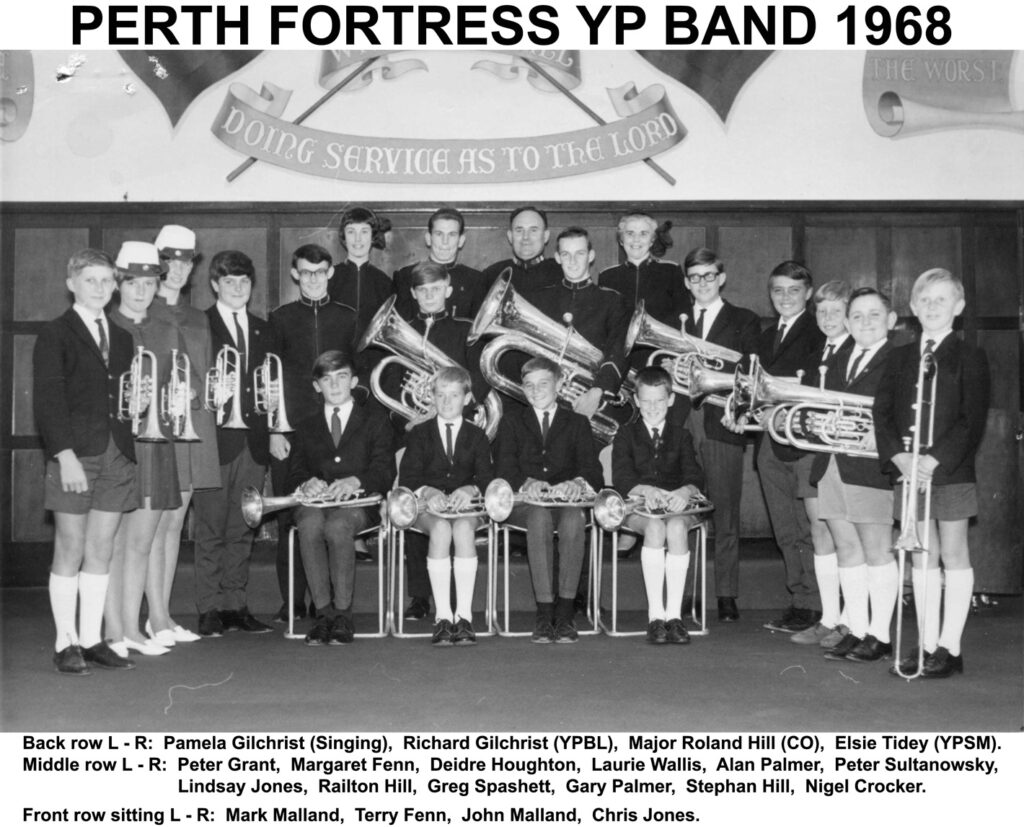
Perth Fortress Band
Person
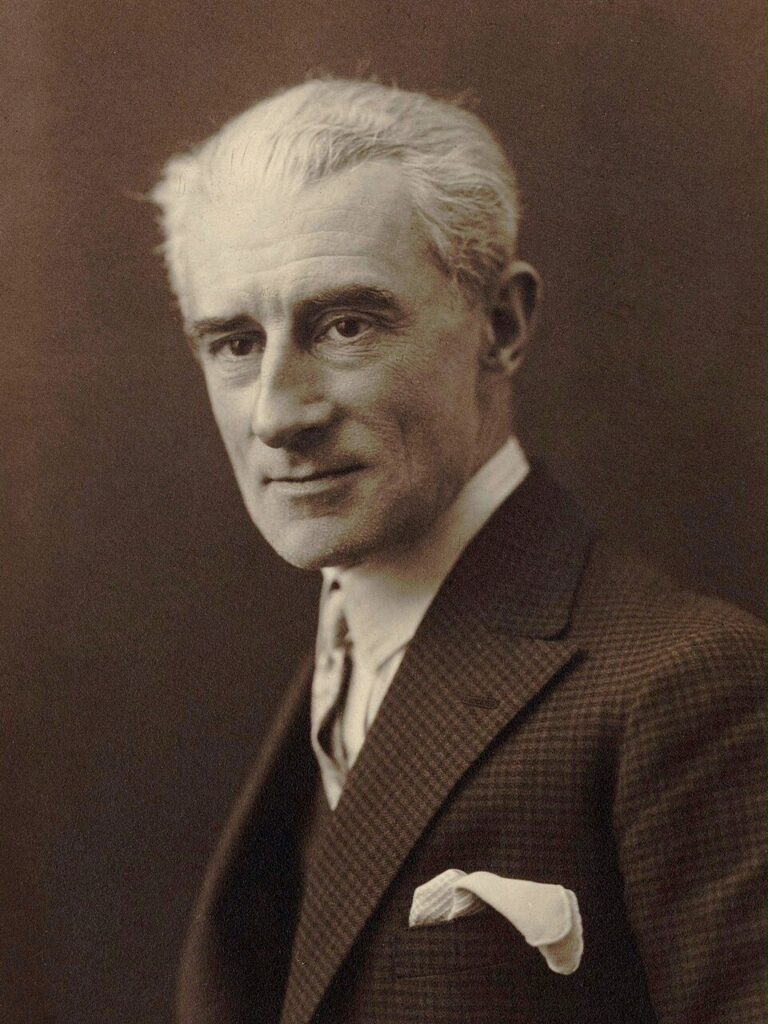
Born in Ciboure, France, in 1875, Maurice Ravel was an outstanding figure in modern French music.
His family moved to Paris when he was three months old. He began his musical studies at the age of seven. He entered the Paris Conservatory where he studied composition under Gabriel Faure¢ in 1899, when he also won recognition for his Pavane for a Dead Princess.
Around 1902, he joined an avant-garde group of artists, writers, and musicians who discussed ideas and collaborated on projects. Impressionistic compositions from this period include the piano suite Gaspard of the Night (1908), Spanish Rhapsody for orchestra (1908), and the ballet Daphnis et Chloé (1912).
After serving in World War I, his works included the choreographic poem, La Valse (1920); the opera The Child and the Enchantments (1925); and Boléro (1928), originally intended as a ballet.
In 1921, he was awarded the Légion d’Honneur. Despite the award’s public announcement Ravel declined accepting it. In 1928, Ravel took a four-month tour of the United States where his concerts and piano recitals received an enthusiastic reception. During this trip he met George Gershwin, whose work he much admired.
One of Ravel’s last major works was the Piano Concerto in D, for the left hand (1931), written for the Viennese pianist Paul Wittgenstein (1887-1961), who had lost his right arm in the World War. Stricken with a neurological disorder in 1932, Ravel died in Paris in 1937.
INTRODUCTION AND ALLEGRO
In the first years of the 20th Century, Debussy and Ravel were championed as the latest important voices in French Art Music, each playing important roles within an intoxicating style generally labeled Impressionism. In a reflection more of fans and critics than the actual relationship between the two composers or their musical styles, Parisians would even take sides in a feisty rivalry of Debussy vs. Ravel. This passionate dichotomy lent itself to another contest of the period: a competition between two rival manufacturers of the concert harp, each with a different solution for equipping with instrument with the complete array of chromatic tones. In 1903, the Pleyel company commissioned Debussy to write an ensemble work featuring their new fangled chromatic harp resulting in Danse sacrée et Danse profane of 1904 for harp and string quartet. In 1905, the Érard company followed suite by offering Ravel the commission to feature their pedal harp and, quickly thereafter, in a rush that he described as “a week of continuous work and three sleepless nights”, Ravel completed his Introduction and Allegro for harp, flute, clarinet and string quartet.
As it requires an unconventional ensemble compared with the string quartet, piano trio or even a full orchestra, Ravel’s truly fantastic Introduction and Allegro is a relatively rare bird on the concert stage. Comprising a single movement with two sections—a short introduction presenting a few crucial motifs forming the thematic substance of the ensuing allegro—it can be regarded in some ways as little harp concerto. The harp takes the lead in stating the main theme of the Allegro, pursues a concertante rivalry with the ensemble and eventually indulges in solo cadenza celebrating Érard’s harp in its full glory. But with its independence of parts, brilliant color and its myriad of ingenious textures often juxtaposing strings against winds, Ravel’s piece makes for well-balanced chamber music.
A familiar and beloved Impressionistic style features both poetic languor and sparkling animation so richly wrought from an economy of musical motifs. At the heart is the solo cadenza for harp: a nearly still reflecting pool of the entire work very gently grazed with the ripples of a soft breeze and sparse, mesmerizing harmonics like a meditative Asian zither of a rarefied, exotic aesthetic.
Many have noted that Ravel ultimately omitted this work from his catalog and made no mention of it in his autobiography. Yet it was the first of a small number of works he recorded in 1923.
© Kai Christiansen Used by permission. All rights reserved.
https://www.earsense.org/article/Ravel-Introduction-and-Allegro
The Perth Premiere of Ravel’s “Introduction and Allegro for harp, flute, clarinet and string quartet” was performed by the Oriel String Quartet, Owen Fisenden (flute), Jack Harrison (clarinet) and harpist, Alan Ratcliffe on Sunday 6th October 1968 in a free concert put on by the A.B.C. in the Basic Kirke Studio.
Free A.B.C. Concert – Sunday October 5th 1968
In tomorrow afternoon’s free concert in the A.B.C.s Basil Kirke Studio beginning at 3 o’clock, the performers will be the Oriel String Quartet, clarinettist Jack Harrison, flautist Owen Fisenden and harpist Alan Ratcliffe. The program will be quartets by Dalayrac and Debussy and “Introduction and Allegro” for harp, flute, string quartet and clarinet by Ravel. The West Australian Saturday October 5 1968
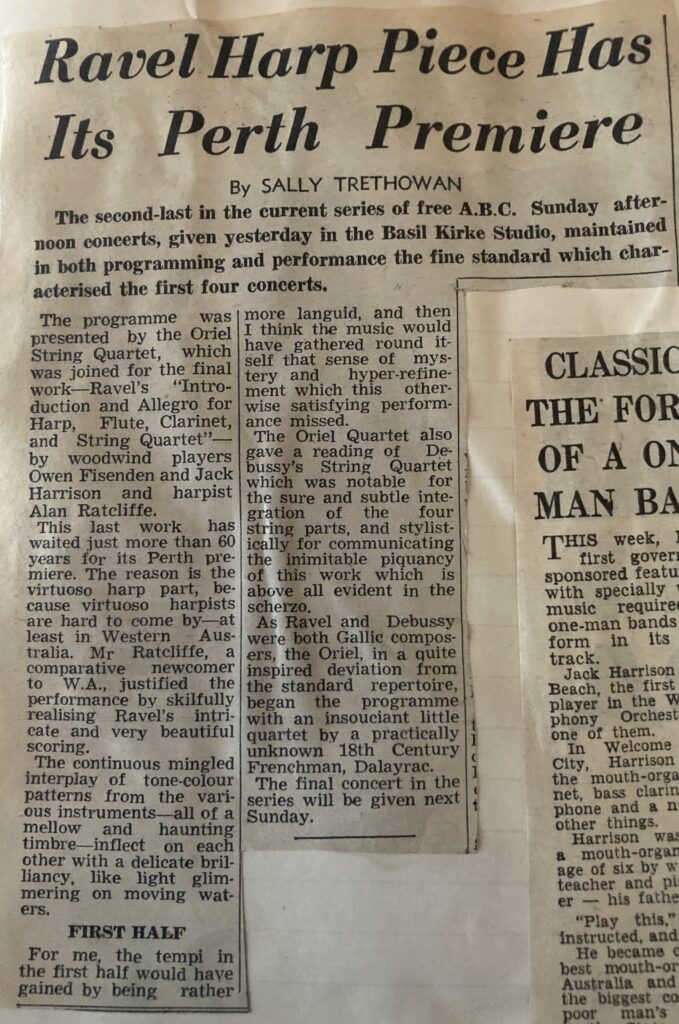
Ravel Harp Piece Has Its Perth Premiere – By Sally Trethowan
Sunday 6th October 1968
The second last in the current series of free ABC Sunday afternoon concerts given yesterday in the Basil Kirke Studio maintained in both programming and performance the fine standard which characterised the first four concerts. The program was presented by the Oriel String Quartet which was joined for the final work – Ravel’s “Introduction and Allegro for harp, flute, clarinet and string quartet” by woodwind players Owen Fisenden and Jack Harrison and harpist, Alan Ratcliffe. This last work has waited just more than 60 years for its Perth Premiere. The reason is the virtuoso harp part, because virtuoso harpists are hard to come by, at least in Western Australia. Mr Ratcliffe a comparative newcomer to W.A., justified the performance by skilfully realising Ravel’s intricate and very beautiful scoring. The continuous mingled interplay of tone coloured patterns from the various instruments – all of a mellow and haunting timbre – inflect on each other with a delicate brilliancy like light glimmering on moving waters. For me, the tempi in the first half would have gained by being rather more languid, and then I think the music would have gathered around itself that sense of mystery and hyper refinement which this otherwise satisfying performance missed. The Oriel Quartet also gave a reading of Debussy’s String Quartet which was notable for the sure and subtle integration of the four string parts, and stylistically for communicating the inimitable piquancy of the work which is above all evident in the Scherzo. As Ravel and Debussy were both Gallic composers, the Oriel, in a quite inspired deviation from the standard repertoire, began the program with insouciant little quartet by practically unknown 18th century Frenchman Dalayrac.
The final concert in the series will be given next Sunday. The West Australian Monday October 7 1968
| 6.10.1968 | Ravel Introduction and Allegro (1905) PERTH PREMIERE | Jack Harrison (clarinet), Oriel String Quartet Owen Fisenden (flute) Alan Ratcliffe (harp) | Free Concert, Basil Kirke Studio A.B.C. Adelaide Terrace, Perth, Western Australia |
September 15 1975 – The Alberni String Quartet
Ravel Introduction and Allegro for Harp, string quartet, flute and clarinet
With Michael Jefferies – harp; David Leviston – flute; Jack Harrison – clarinet
Chamber Group off to a Good Start – By Derek Moore Morgan – 23rd April 1979
The recently formed Wigmore Ensemble made its first public appearance last night with a delightfully varied program at the Octagon Theatre. A flexible group with no fixed numbers, it has the practical advantage of being able to present music of widely different genres some of which inevitably gets left on the shelf because it doesn’t quite fit a specific mould such as the string quartet or Trio. This was a University of W.A. music Society recital. The performers were Graham Wood and Ashley Arbuckle (violins), John Dean (viola), Jill Cole (cello), Neil Fisenden (flute), Jack Harrison (clarinet) and Anthony Maydwell (harp). The final item, Ravel’s atmospheric and beautifully crafted “Introduction and Allegro” brought all the players together to produce a nice degree of sonority and delicacy capturing much of the subtlety of the masterpiece. Starting with the Mozart Quartet for Flute and Strings in D major a mellifluous example of the composer’s earliest style, the players gave us a bright indication of the bubbling and effervescent Gatty of the Rondo finale. The British composer Frank Bridge, himself a viola player, wrote a whole body of telling string music. His little known Trio (Rhapsody) from 1928 proved to be a forward looking piece for the difficult unless usual combination of two violins and viola, with mysterious opening and closing sections surrounding an energetic central portion. The Italian composer Malpiero’s “Sonata a cinque” (1936) is an appealing piece of writing which hangs on the air like a haunting elergy. Anthony Maydwell’s expressive harp playing came to the fore here. The Quartet for clarinet and strings by Rawsthorne is another piece of chamber music which is deftly written and manipulates varying moods. Jack Harrison’s neatly inflected clarinet tone was well handled.
Person
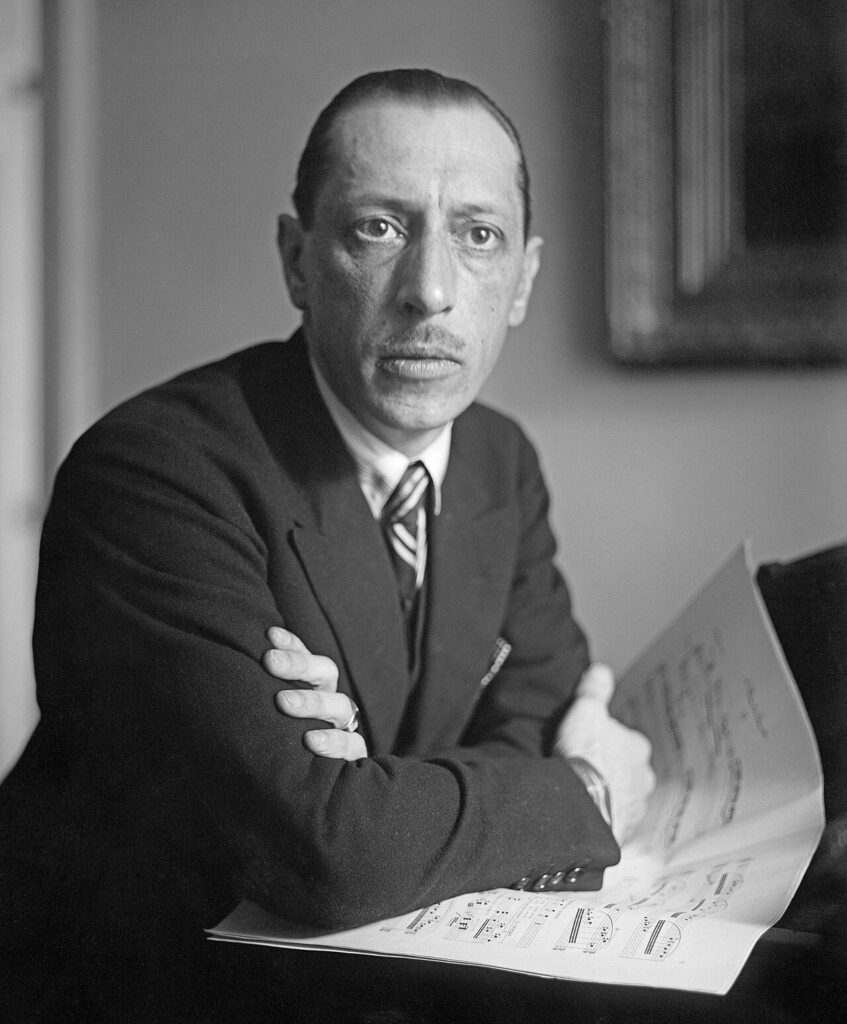
| 28.9.1968 | Igor Stravinsky Soldier’s Tale Concert Suite (1920) PERTH PREMIERE | Jack Harrison (clarinet) Jill Mowson (bassoon) John Mowson (bass) Graham Wood (violin) Don Johnson (trumpet) Alan Mewett (trombone) Bryan Sadique (percussion) | Free Concert Basil Kirke Studio A.B.C. Adelaide Terrace, Perth, Western Australia |
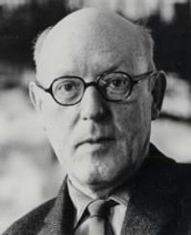
On 27th July 1968 Graham Wood and Stanislaw Kowarski (violins), John Dean (Viola), Brian Meddemmen (cello), John Mowson (bass), Patrick Brislan (Horn), Jack Harrison (clarinet) and Jill Harrison (bassoon) played the Australian premiere of Octet for Wind and Strings by Howard Ferguson. It was an A.B.C. Studio broadcast from the Basil Kirke Studio in Perth.
| 27.7.1968 | Howard Ferguson Octet Op. 4
for clarinet, bassoon, horn, string quartet and double-bass (1933) AUSTRALIAN PREMIERE |
Jack Harrison (clarinet)
Jill Mowson (bassoon) John Mowson (bass) Patrick Brislan (horn) |
ABC Broadcast
Basil Kirke Studio A.B.C. Adelaide Terrace, Perth, Western Australia |
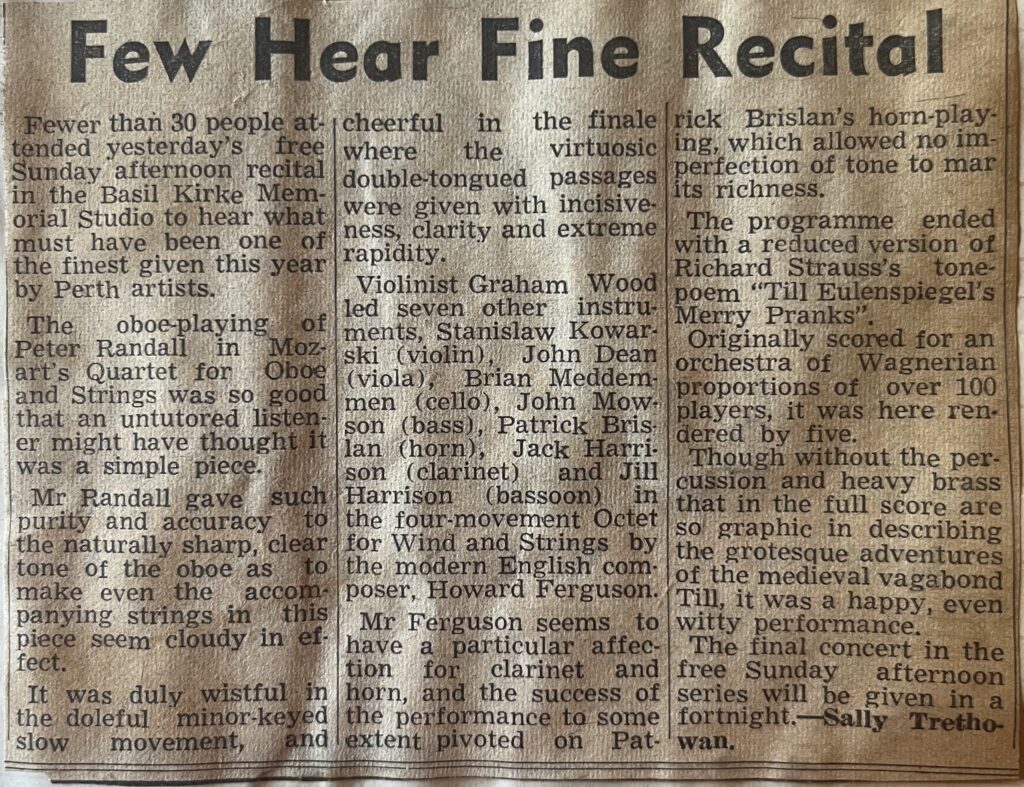
FEW HEAR FINE RECITAL
By Sally Trethowan
Sunday February 29 1968
Fewer than 30 people attended yesterday’s free Sunday afternoon recital in the Basil Kirke Memorial Studio to hear what must have been one of the finest given this year by Perth artists. The oboe playing of Peter Randall in Mozart’s Quartet for oboe and strings was so good that an unchartered listener might’ve thought it was a simple piece. Mr. Randall gave such purity and accuracy to the naturally sharp clear tone of the oboe as to make even the accompanying strings in this piece seem cloudy in effect. It was duly wistful in the doleful minor keyed slow movement and cheerful in the finale where the virtuosic double-tongued passages were given within incisiveness, clarity and extreme rapidity.
Violinist Graham Wood led seven other instrumentalists Stanislaw Kowarski (violin) John Dean (Viola) Brian Meddemmen (cello) John Mowson (bass) Patrick Brislan (Horn) Jack Harrison (clarinet) and Jill Harrison (bassoon) in the four movement Octet for Wind and Strings by the modern English composer Howard Ferguson. Mr. Ferguson seems to have a particular affection for clarinet and horn, and the success of the performance to some extent pivoted on Patrick Brislan’s horn playing which allowed no imperfection of tone to mar its richness. The program ended with a reduced version of Richard Strauss’s tone poem “Till Eulenspiegel’s Merry Pranks”. Originally scored for an orchestra of Wagnerian proportions of over 100 players, it was here rendered by five. Though without the percussion and heavy brass that in the full score are so graphic in describing the grotesque adventures of the mediaeval vagabond Till, it was a happy even witty performance. The final concert in the free Sunday afternoon series will be given in a fortnight.