Search names, events, places, organisations, and sources across the archive.
Person
CROCKER, Nigel
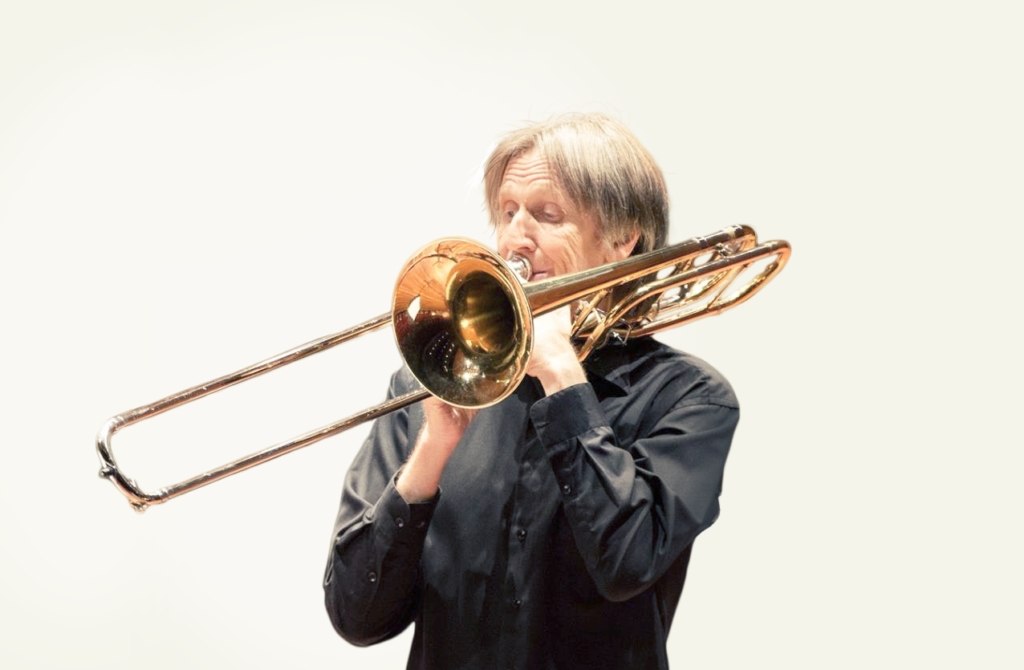
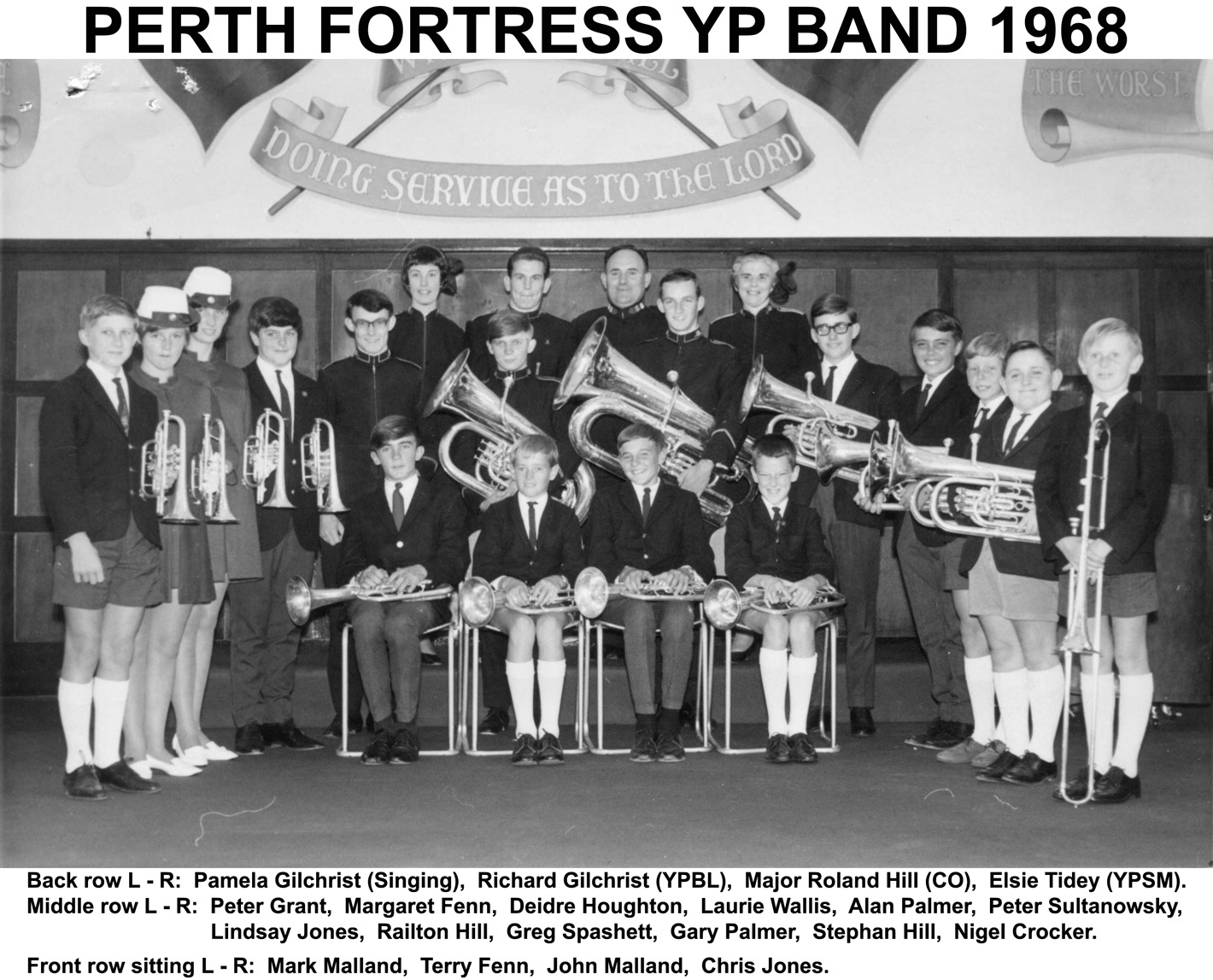
Nigel Crocker began is brass playing life performing in Salvation Army bands.
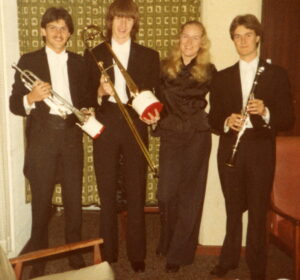
Nigel attended Perth Modern School and was a member of the Western Australian Schools’ Concert Band overseas tour from June 23 to July 1976 performing in London, Vienna, Innsbruck, Lucerne, Montreux and Zurich as part of the Fifth International Festival of youth and Music and the Tweflth International Conference of the International Society for Music Education.
The band was conducted by Ted Lewis and John Embleton and consisted of an amalgamation of largely Perth Modern School and Churchlands music scholarship students and a handful of representatives from other schools.
Margaret Bellos winners: Kim Harrison, Nigel Crocker, Marie Chantal Bertinazzo and Allan Meyer
After high school, he hung around the U.W.A. Music Department for a year, long enough to win the Margaret Bellos prize.
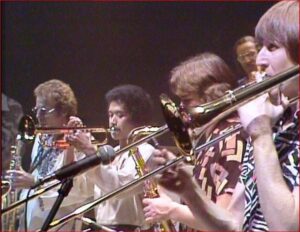
Nigel’s career started in funk and R&B bands in Perth in the late ’70’s.
In 1978 Nigel played with WASO on a weekly contract which rolled on for 10 months due to vacancies in the trombone section following recent departures by Simone De Haan and a few months later Bill Farnham.
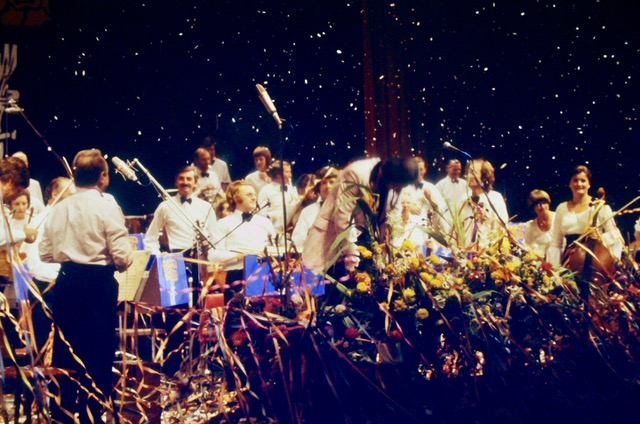
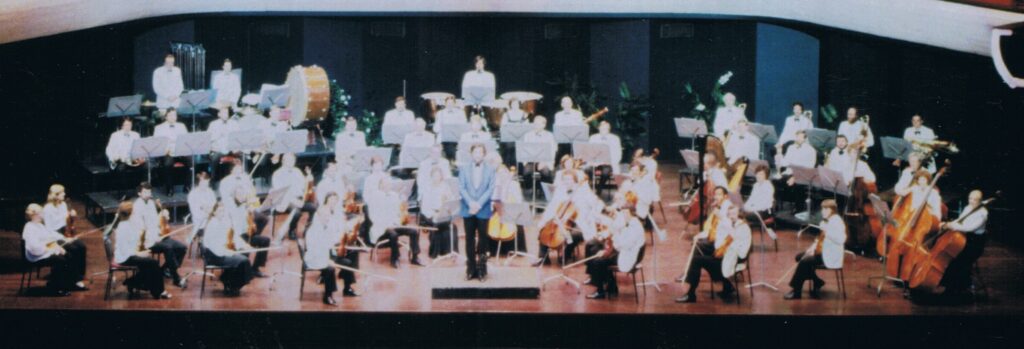
WASO Proms concert at the Entertainment Centre – Nigel centre stage
ON JACK HARRISON:
“As a smart arse 19 year old I called all my new colleagues by their first names except for Mr Farnham (who’d been my teacher in high school) and Mr Harrison. He told me to call him Jack but it was strange ‘cos I’d known him as Mr Harrison since I was a whippersnapper. Jack’s easy, free playing and velvety sound was a revelation, especially as I’d only just come out out of some pretty squawky high school concert bands. I still love hearing it to this day. Indeed I loaned my copy of Jack’s Moon River CD to a young Som Howie who had just started freelancing here in Sydney. Little did I know a decade or so later he’d be sitting alongside Jack’s son-in-law Allan Meyer (another close buddy) in the WASO clarinet section. I also loved Jack’s quick quips about the occasional posturing, pompous conductors chock full of their own self importance. He had the amazing skill to project his voice to the front desk but somehow not quite reaching the ears of the maestro. A skill I have endeavoured to master throughout my own career.”
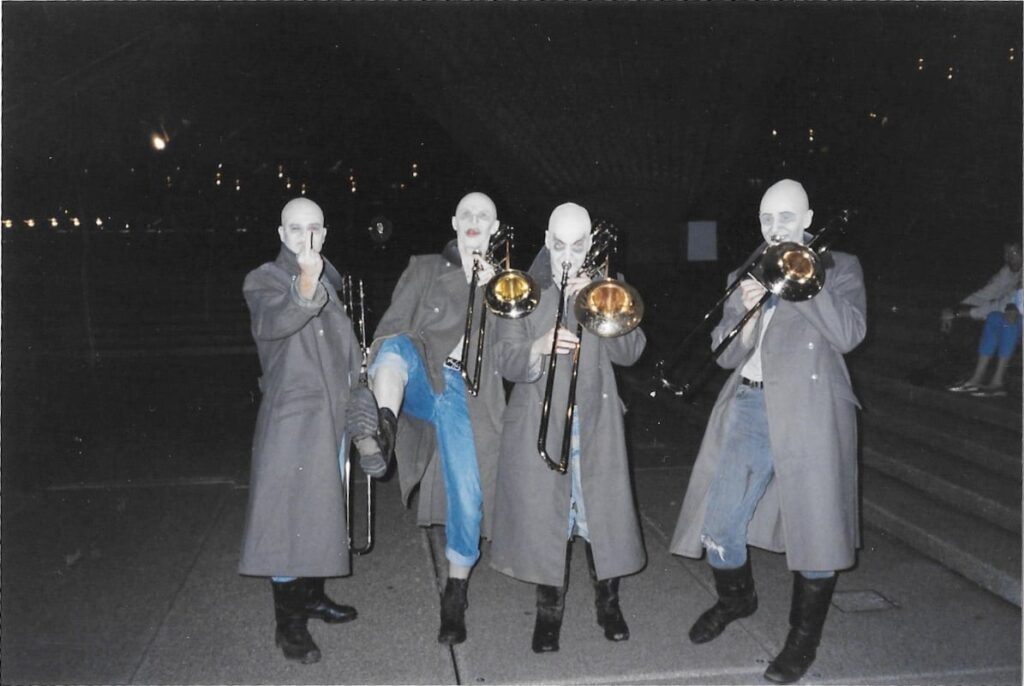
Jack Howard and Nigel Crocker NOT playing in Hunters and Collectors
Upon moving to Melbourne in ’81, Nigel found himself playing briefly with Hunters and Collectors before securing a position in the trombone section on the Channel 9 band on The Don Lane Show.
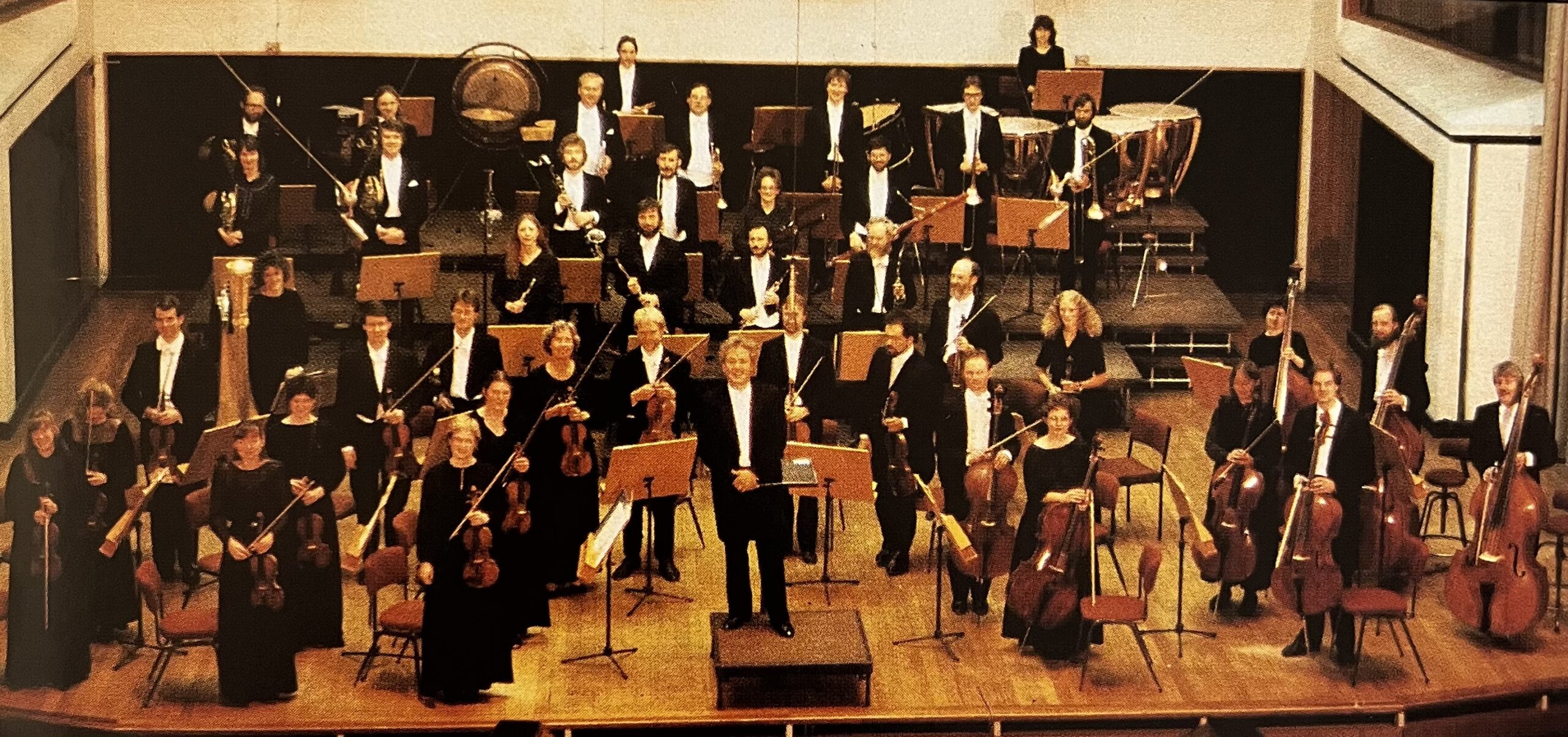
In 1983 Nigel was appointed Principal Trombone of Tasmanian Symphony Orchestra.
Tasmanian Symphony Orchestra. Source: Symphony Australia 1987, p.127.
After 7 years with them he moved to Sydney where he has been busy freelancing ever since, across a broad spectrum of genres.
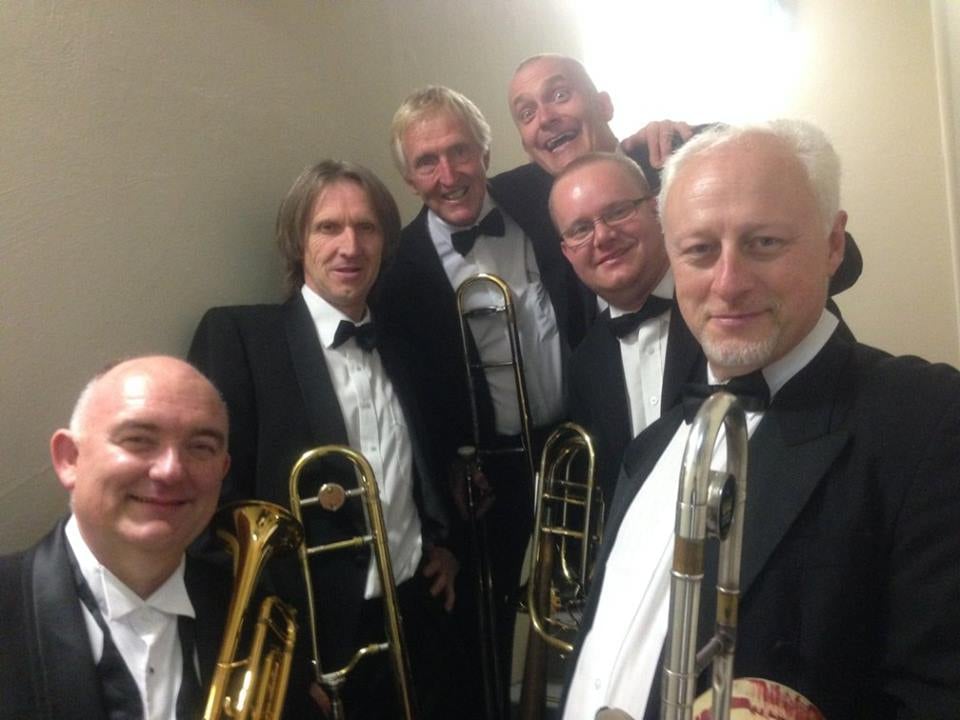
Sydney Trombone Quartet: Scott Kinmont (SSO), Nigel Crocker, Will Farmer (OAO) Matthew Walker. Australian Opera Gala concert 19932013: James Morrison, Nigel Crocker, Ed Wilson (Daly Wilson), Dave Panichi, Dan Barnett and Colin Burrows
For the past couple of decades he has also been a trombone lecturer at the Sydney Conservatorium of Music and Principal Trombone with Canberra Symphony Orchestra.
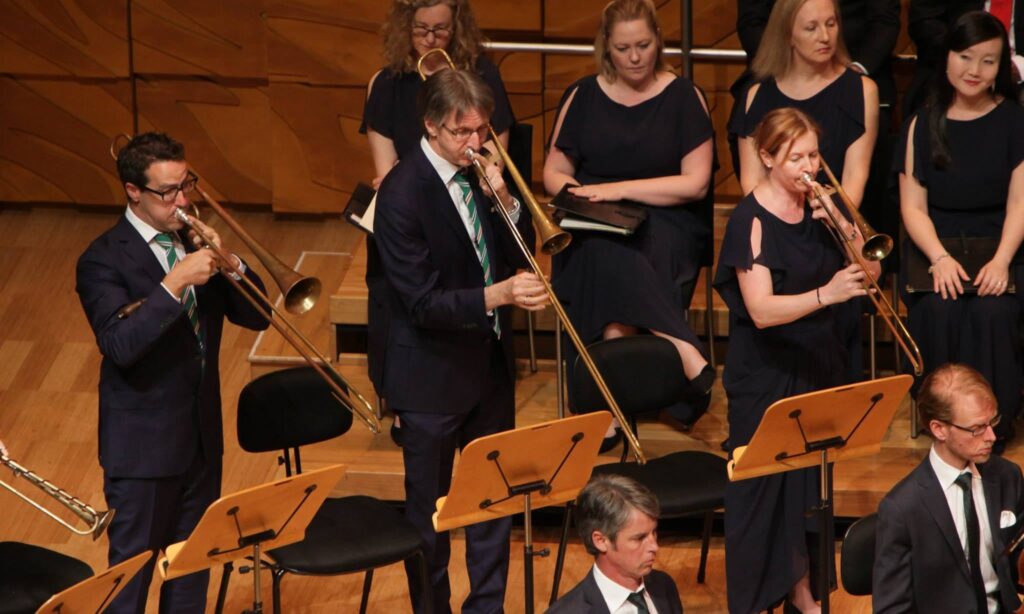
Brandenberg Orchestra on sackbut
Nigel took up the sackbut in the early 2000’s and has since then has appeared regularly with the Australian Brandenburg Orchestra and Pinchgut Opera. More recently he has also been collaborating with Van Diemen’s Band on their acclaimed new CD ‘Transformations’ featuring the incredible voice of West Australian Andrew O’Connor.
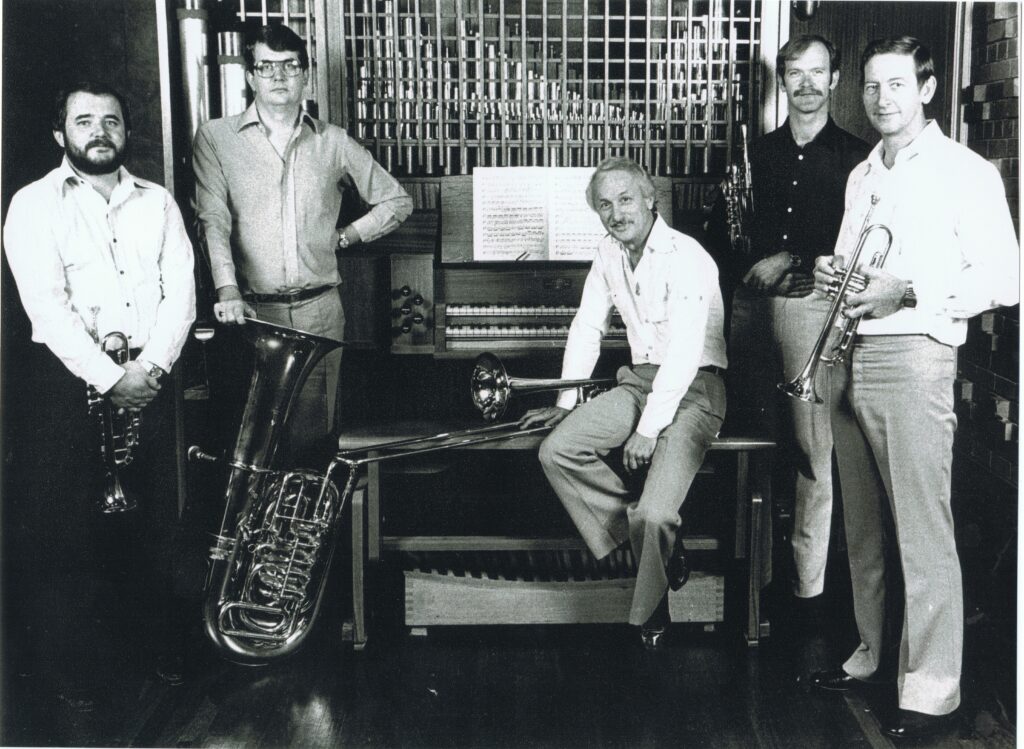
He was born in 1933 in Bound Brook New Jersey U.S.A, obtaining a Bachelor of Science at Ithaca College New York and a Masters of Music from New England Conservatory Boston Massachusetts.
He toured Europe with the 7th Army Symphony Orchestra for 2 years.
He was Principal Trombone with the Milwaukee Symphony Orchestra, conducting Brass Clinics and performing Brass Quintet recitals.
He came to Australia in 1972 joining the Elizabethan Melbourne Orchestra as Principal Trombone.
1979
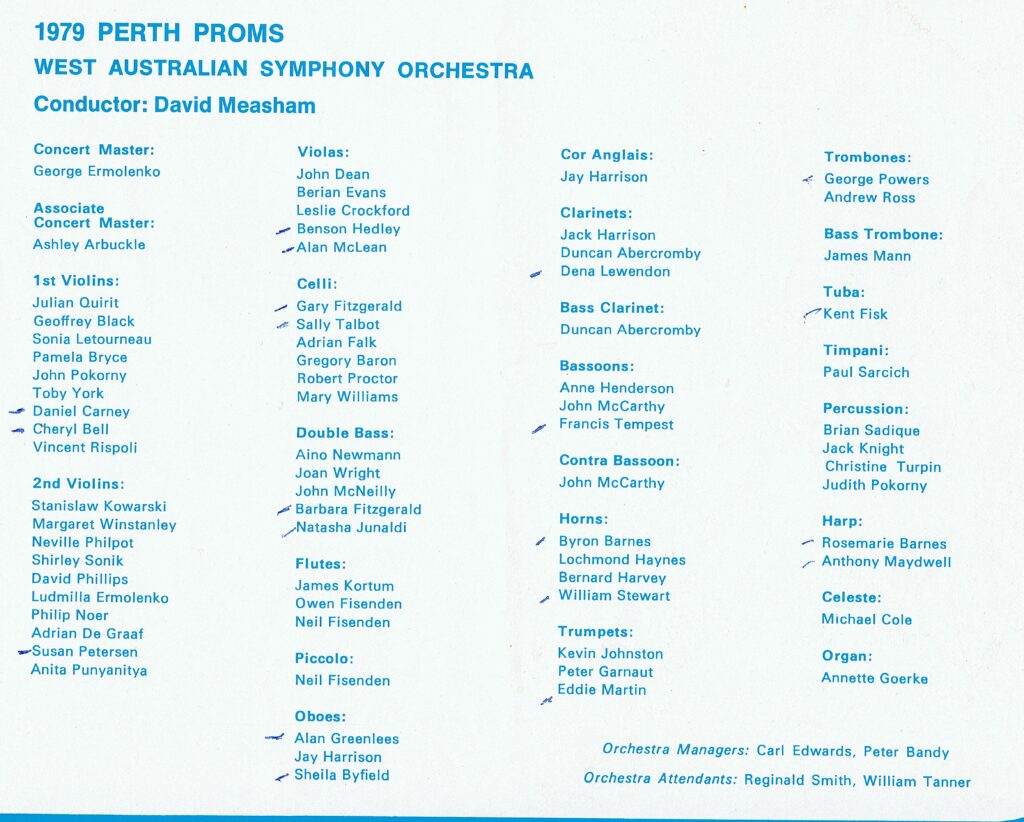
1979 Proms program orchestra list
George died unexpectedly on 25th January 1982 aged 49 and Jim Mann moved to the Principal Trombone position in the West Australian Symphony Orchestra.
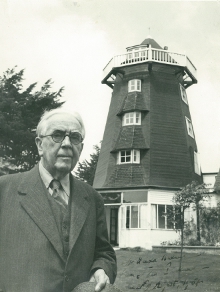
Born near Manchester, studied and taught at the Royal College of Music, lived in Chelsea, London for over 50 years and died in a converted windmill in Sussex. Ireland’s foremost inspirations were the ancient landscapes of the Channel Islands, Dorset and Sussex and the writings of pagan mystic Arthur Machen; the composer recounting that he himself had experienced a ‘vision’ on the South Downs.
John Ireland was born in Bowdon, near Manchester, England on 13th August 1879. His parents were literary people and knew many writers of the day, including Emerson. Ireland entered the newly-established Royal College of Music in London at the age of fourteen, lost both his parents shortly after, and had to make his own way as an orphaned teenager, studying piano, organ and composition. The last was under Sir Charles Stanford, who taught many of the English composers who emerged at the end of the 19th century: Ralph Vaughan Williams, Gustav Holst, Frank Bridge (born in the same year as Ireland), Eugene Goossens, Arthur Bliss, Herbert Howells, George Butterworth, and many others.
Ireland destroyed almost all his student works and juvenilia (the beautiful Sextet for clarinet, horn and string quartet being one of the few works which he permitted to be published, and then only towards the end of his life) and emerged as a celebrated composer towards the end of World War I when his Violin Sonata No.2 in A minor brought him overnight fame. From then until his death in 1962 he led an outwardly uneventful life combining composition, composition teaching at the Royal College (where his pupils included Benjamin Britten and E. J. Moeran), and his position as organist and choirmaster at St. Luke’s Church, Chelsea, in London.
Ireland’s music belongs to the school of ‘English Impressionism’. Having been brought up on the German classics, notably Beethoven and Brahms, he was strongly influenced in his twenties and thirties by the music of Debussy, Ravel, and the early works of Stravinsky and Bartók. While many of his contemporaries, such as Vaughan Williams and Holst, developed a language strongly characterised by English folk song, Ireland evolved a more complex harmonic style closer to the French and Russian models. Like Fauré, he preferred the intimate forms of chamber music, song, and piano music to the larger orchestral and choral canvases, He wrote neither symphony (unlike his friend Arnold Bax who wrote seven) nor opera and only one cantata, These Things Shall Be, but his Piano Concerto is arguably the best to have been written by an Englishman, and is a work of intense emotion and nostalgic feeling.
Ireland was strongly influenced by English poetry. His settings of A. E. Housman, Thomas Hardy, Christina Rossetti, John Masefield and Rupert Brooke are among the best known of his works. He was also highly susceptible to the spirit of place. He lived for many years in London’s Chelsea (Chelsea Reach is a depiction in the form of a barcarole of that great sweep of the Thames as it passes along the Embankment to the west of the Houses of Parliament). He was also devoted to the Channel Islands of Guernsey and Jersey. Their location between England and France must have seemed appropriate to his musical orientation, but more importantly he found there traces of prehistoric pagan ritual to which he had originally been drawn through the writings of the Welsh writer Arthur Machen.
But perhaps his greatest love was for the English county of Sussex, a landscape of rolling downs and (in Ireland’s day) isolated villages, including Amberley whose ‘Wild Brooks’ – streams coursing through fields – gave him the inspiration for one of the most brilliant of his piano pieces. Ireland eventually retired to Sussex in 1953 when he bought a converted windmill, Rock Mill, underneath the Downs. He died there on 12th June 1962.
Ireland’s music is intensely personal in style and has always attracted a devoted following among discerning music lovers. As well as his Piano Concerto, previously mentioned, works that continue to be frequently performed and recorded are: A Downland Suite and Concertino Pastorale for strings, The Overlanders, A London Overture, Mai-Dun, and TheForgotten Rite for orchestra, sonatas for cello and piano, violin and piano, and clarinet and piano, The Holy Boy, Sea Fever and his beautiful motet Greater Love (to name but a few). His hymn tune My Song is Love Unknown is sung in churches throughout the English speaking world.
Fantasy-Sonata is a piece in E-flat major for clarinet and piano composed by John Ireland in 1943. The work is Ireland’s only extant piece for solo clarinet and one of his last major compositions before his retirement. It is dedicated to Frederick Thurston and was premiered by Thurston and Ireland in January 1944. The two also broadcast the piece live on the BBC in 1948. The piece is about 15 minutes long.
Fantasy-Sonata was written between January and June 1943, while Ireland was temporarily living in Essex. It was inspired by the Roman comic poem “Satyricon” and by Ireland’s experience in being evacuated from Jersey during the Second World War. Fiona Richards has suggested that the work also contains “allusions to Ireland’s attraction to younger men”.
The through-composed piece is written in a very loose sonata form with frequent shifts in tempo, mood, and tonal centre, but has no clear resolution, as would be expected in a typical sonata. It has a lush and highly virtuosic piano part; Scott Goddard argued that “in all English music of the last half-century there has been no purer pianoforte writing than this”. The clarinet part covers the instrument’s entire range, incorporating both legato and rhythmic passages.
A reviewer from the News Chronicle, cited by Colin Lawson, noted that he “had never imagined that clarinet and piano could be combined so satisfactorily; nor that (by a mixture of tact and daring) they could form such an exciting ensemble”.
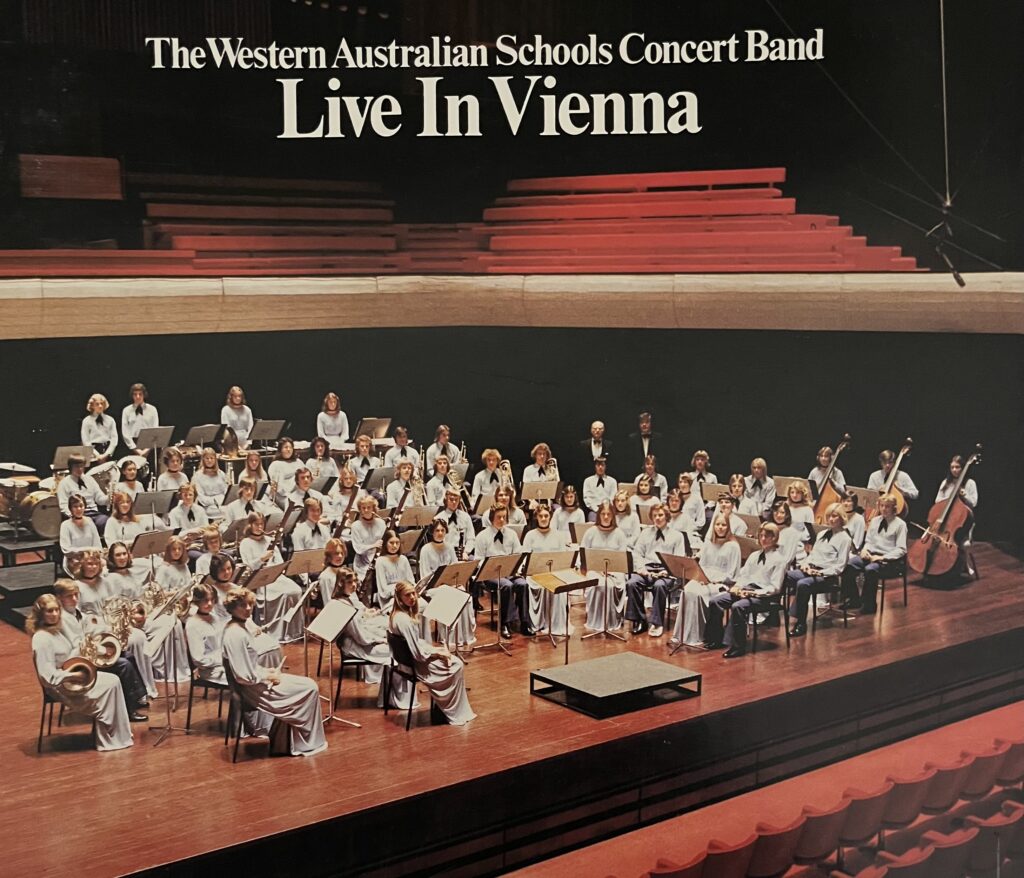 The band was conducted by Ted Lewis and John Embleton and consisted of an amalgamation of largely Perth Modern School and Churchlands music scholarship students and a handful of representatives from other schools.