Howard Ferguson’s Octet for Wind and Strings – Australian Premiere
On 27th July 1968 Graham Wood and Stanislaw Kowarski (violins), John Dean (Viola), Brian Meddemmen (cello), John Mowson (bass), Patrick Brislan (Horn), Jack Harrison (clarinet) and Jill Harrison (bassoon) played the Australian premiere of Octet for Wind and Strings by Howard Ferguson. It was an A.B.C. Studio broadcast from the Basil Kirke Studio in Perth.
27.7.1968
Howard Ferguson Octet Op. 4
for clarinet, bassoon, horn, string quartet and double-bass (1933)
Fewer than 30 people attended yesterday’s free Sunday afternoon recital in the Basil Kirke Memorial Studio to hear what must have been one of the finest given this year by Perth artists. The oboe playing of Peter Randall in Mozart’s Quartet for oboe and strings was so good that an unchartered listener might’ve thought it was a simple piece. Mr. Randall gave such purity and accuracy to the naturally sharp clear tone of the oboe as to make even the accompanying strings in this piece seem cloudy in effect. It was duly wistful in the doleful minor keyed slow movement and cheerful in the finale where the virtuosic double-tongued passages were given within incisiveness, clarity and extreme rapidity.
Violinist Graham Wood led seven other instrumentalists Stanislaw Kowarski (violin) John Dean (Viola) Brian Meddemmen (cello) John Mowson (bass) Patrick Brislan (Horn) Jack Harrison (clarinet) and Jill Harrison (bassoon) in the four movement Octet for Wind and Strings by the modern English composer Howard Ferguson. Mr. Ferguson seems to have a particular affection for clarinet and horn, and the success of the performance to some extent pivoted on Patrick Brislan’s horn playing which allowed no imperfection of tone to mar its richness. The program ended with a reduced version of Richard Strauss’s tone poem “Till Eulenspiegel’s Merry Pranks”. Originally scored for an orchestra of Wagnerian proportions of over 100 players, it was here rendered by five. Though without the percussion and heavy brass that in the full score are so graphic in describing the grotesque adventures of the mediaeval vagabond Till, it was a happy even witty performance. The final concert in the free Sunday afternoon series will be given in a fortnight.
When John Alan William Mowson was born on 23 February 1931 in Fiji, his father, Alan, was 34 and his mother, Mary, was 25.
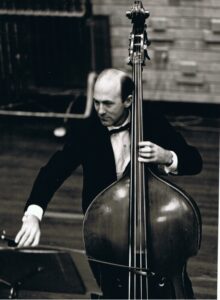
John Mowson was an esteemed Australian classical and jazz musician, best known for his long and distinguished tenure as the Principal Double Bass player for the Melbourne Symphony Orchestra (MSO).
Hailing originally from Melbourne, Mowson’s early musical footprint spanned both the classical and jazz idioms. Before establishing his career as a leading orchestral musician, he spent time in Sydney.
In 1949, bass player John was in The Jack Brokensha Quartet became so well-known that in 1948 they were booked to appear at the Sydney Town Hall for two concerts. In mid-1949, following Jack Brokensha’s recovery from a nervous breakdown, the quartet was re-formed in Sydney with Brokensha, Errol Buddle, Ron Loughhead and a new bassist John Mowson. They landed a job at Gold’s Nightclub in the AWA Building in York Street (now the Shalimar Restaurant) and became probably the most popular small jazz group in Sydney.). The Broadcaster, Saturday August 18 1951 Vol. 18 No. 907.
John performed in the first broadcast of “Jack Harrison and His Music” was on September 1951 on 6WN:
JACK HARRISON’S SEXTET OPENS ON 6WN
On September 2 Jack Harrison’s Sextet opens on 6WN. The programme will probably consist of light classics, arranged modern ballads, and bright numbers of the samba, tarantella and bolero type. Last year Jack studied under the Sydney musician Clive Amadio and it is quite likely that Jack’s sessions will resemble the well-known Amadio Quintet. Jack reports that the members are James Drummond (violinist), Stephanie James (pianist) who recently returned from Europe, Kenneth Murdoch (saxophonist) John Mowson (bass) and his father, William Harrison (organ and vibes). Jack will play first clarinet and second saxophone. He will have a guest singer for each session. Kath Bass, Phyllis Blott and Elise Longwill would probably be the first three he says. Each number will be arranged for the sextet. Jack and his father are doing some of this work. Some work by an Eastern States arranger is available provided it is copied. Sister Jill is doing this in her spare time in Adelaide. [1]
August 23rd 1951 BROADCAST – JIVE ENSEMBLE IN ALL-STATE FEATURE
Harry Bluck’s Jive Ensemble, a West Australian Group, will be featured in the Thursday Night Swing Club broadcast of August 23 at 10 o’clock over 6WF and regionals. It will be re-broadcast in other states. Members are well-known identities. Harry Bluck, leader, arranger, pianist and accordion player is West Australian born and has been a full-time teacher and professional for many years. As well as running his own dance band and orchestra, he is leader of five other W.A. ensembles. Other members are: Kath Bass, vocalist, who has been heard with the State’s leading dance band and radio combinations; Jack Harrison, one of Western Australia’s leading instrumentalists, who specialises on the clarinet, is a member of the West Australian Symphony Orchestra, and also conducts his own dance band; Johnny Mowson, bass player, also a member of the West Australian Symphony Orchestra, and Cliff Admas, guitarist, well known both in the Eastern and Western States, whose Hawaiian Ensemble is heard in A.B.C. programmes. [1]
After two years of study in Adelaide, Jill Harrison returned to Perth in January 1952 to fill the second bassoon vacancy in the WASO. John Cran was Principal Bassoon of WASO at this time and later became Principal Bassoon with the Sydney Symphony Orchestra. Jill was 20 when she joined the West Australian Symphony Orchestra. WASO hours were about 24 hours together each week working from 10am until 5pm. If it was a performance week they would often rehearse Wednesday, Thursday, Friday morning and perform Friday and Saturday. John and Jill started dating.
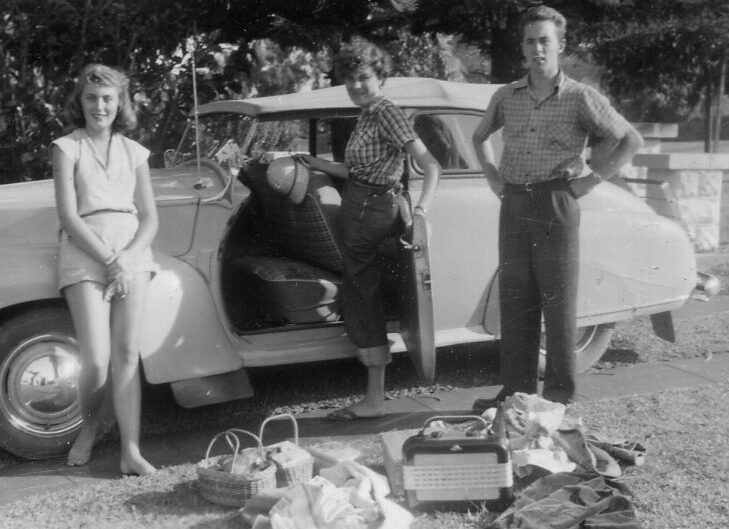
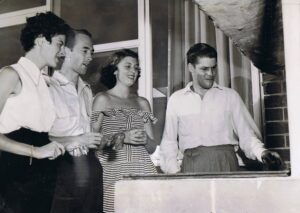
1952 Marcia Chayter, Jill Harrison and John Mowson with Jack’s Vauxhall in driveway of 24 Highway Nedlands
In 1952, Jack’s jazz ensemble (now consisting of Jack, Jill, Ray, John Mowson (bass) and Cliff Adams (guitar) was broadcast nationally on the ABC’s Swing Club. Jazz gigs and concerts were juggled between classical concerts and broadcasts with W.A.S.O.
W.A. BAND ON NATIONAL HOOK-UP EARLY IN APRIL 1952
Thursday night Swing Club listeners in all States of the Commonwealth are to hear a broadcast by Jack Harrison’s Swing Quintette, one of Perth’s most outstanding modern style outfits. The group recently recorded a session for the Australian Broadcasting Commission, which is now due for an early airing. This band is to some extent a family concern, with Jack himself, alto, tenor and clarinet; twin sister, Jill Harrison, piano; and Ray Harrison, drums. The remaining members of the group are one-time Brokensha bass man John Mowson and Cliff Adams guitar. Cliff is a well known Sydney musician and has played for many years at the Trocadero – the harbour city’s number one dance hall. In 1949 the family group won the “Battle of the Bands” in Perth and has been doing regular broadcast work since, in addition to its usual dance engagements. An interesting fact regarding Jack and Jill Harrison, and also John Mowson, is that they are still under twenty one years of age. In addition to this all three are members of the West Australian Symphony Orchestra. The group’s manager is yet another member of “the family” – William E. Harrison. (TOM STERNE). [1]
The A.B.C.’s Thursday Night Swing Club is almost a family affair for there are three
Members of the Harrison family in the Jack Harrison Swing Quintette. Twenty year old Jack is on the saxophone and clarinet, twin sister Jill is pianist and Ray is drummer. Other members are John Mowson (bass) and Cliff Adams (guitar). Jack has been associated with radio shows for 12 years having appeared as a mouth organist in an amateur hour in 1940. Jack and Jill have graduated through swing music to the W.A. Symphony Orchestra. John Mowson is also a permanent member of the orchestra and Cliff Adams is well-known in Sydney as a member of the Trocadero Band. [1]PHOTO
Jill with John Mowson (bass), Jack (vibes) and Ray (drums)
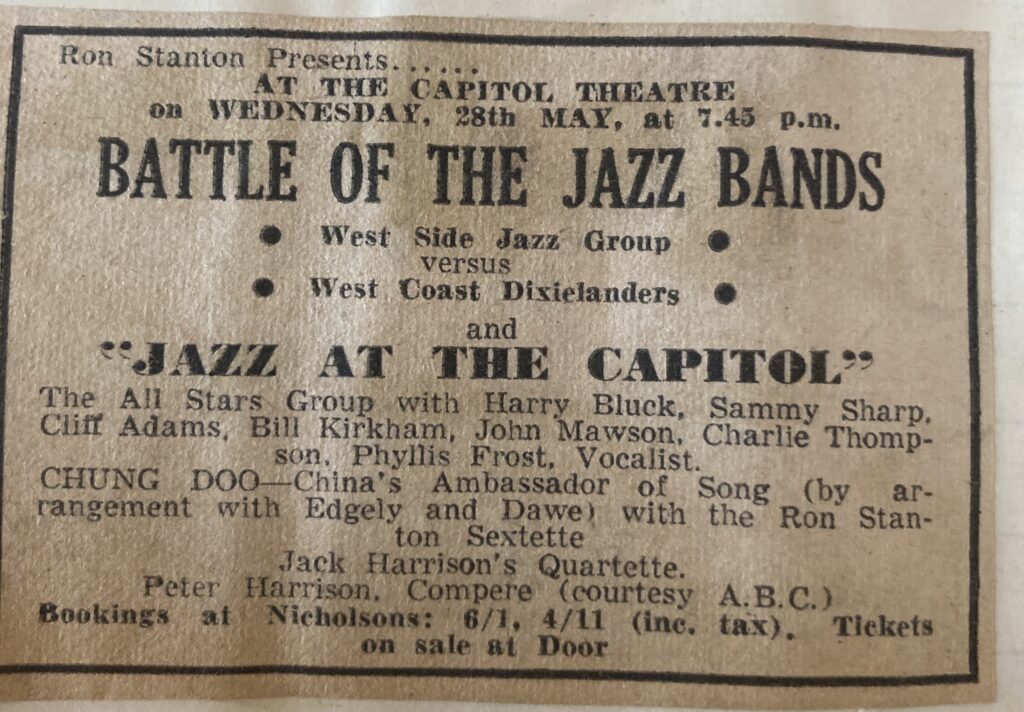
Wednesday 28th May 1952 – Jazz At The Capitol
Lena Horne. Spike Jones. Mills Brothers. Harry Eddison. Lester Young. Ella Fitzgerald. Ray Brown . . .They’re just a few big names of modern music in the long list of acquaintances claimed by Ron Stanton, now in Perth. Ron, a Sydneysider, is a genuine young man of music. American tours have given him an intimate knowledge of techniques over there — and he’s bringing them to Perth. Particularly impressed with the annual festival Jazz at the Philharmonic, he has formed a “leaders group” in Perth for Jazz at the Capitol. Group includes Harry Bluck, Sammy Sharp, Cliff Adams, Bill Kirkham, John Mowson, Charlie Thompson and Ron Stanton himself. Program— at the Capitol on Wednesday night— will also include the “name bands” of Perth, Chung Doo, Stanton’s sextet and Jack Harrison’s quartette. [2]
[1] The Broadcaster Saturday May 17 1952 Vol. 19 No. 946
In late November 1952, Jill Harrison became engaged to John Mowson. Jack and Marcia announced their wedding would be in December 1953. As the ABC orchestras only offered holidays at Easter and over Christmas, Edna Harrison suggested a double wedding, as she didn’t think two weddings in December 1953 was feasible. Marcia didn’t want a double wedding & Jill and John didn’t want to wait, so planned their wedding for the Easter of 1953.
1952 Mary and John Mowson, Jill Harrison engagement
HARRISON-MOWSON: Mr. and Mrs. W. E, Harrison have much pleasure in announcing the engagement of their only daughter. Jill, to John, eldest son of Mr. and Mrs. A. T. Mowson, of Melbourne. [2]
Congratulating her son John (centre) on his engagement to Jill Harrison (right), Mrs. Mary Mowson (left) has a savory before the dinner party given by Mr. and Mrs. W. E. Harrison at their Nedlands home last night to announce their daughter’s engagement. Both John and Jill are members of the WA Symphony Orchestra. [3]
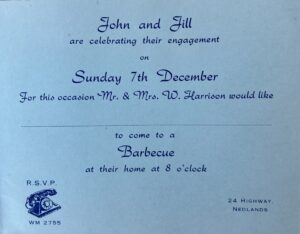
1952 Jill and John’s engagement party invitation
Engagement Party To celebrate
To celebrate the engagement of their daughter, Miss Jill Harrison, to Mr John Mowson, Mr. and Mrs. Bill Harrison gave an outdoor party at their home in Nedlands last night. Miss Harrison wore a pretty, flared frock of pale-blue waffle pique. Among the guests were Mrs. A. Mowson, who arrived from Melbourne recently Mr. and Mrs. John Mathews, Mr. and Mrs. T. Bennett, Mr. and Mrs. A. Ackland, Mr. and Mrs. Alan Cole, Misses Stephanie James, and Shirley Flesflader. Miss Harrison and her fiancé plan to be married early next year. [4]
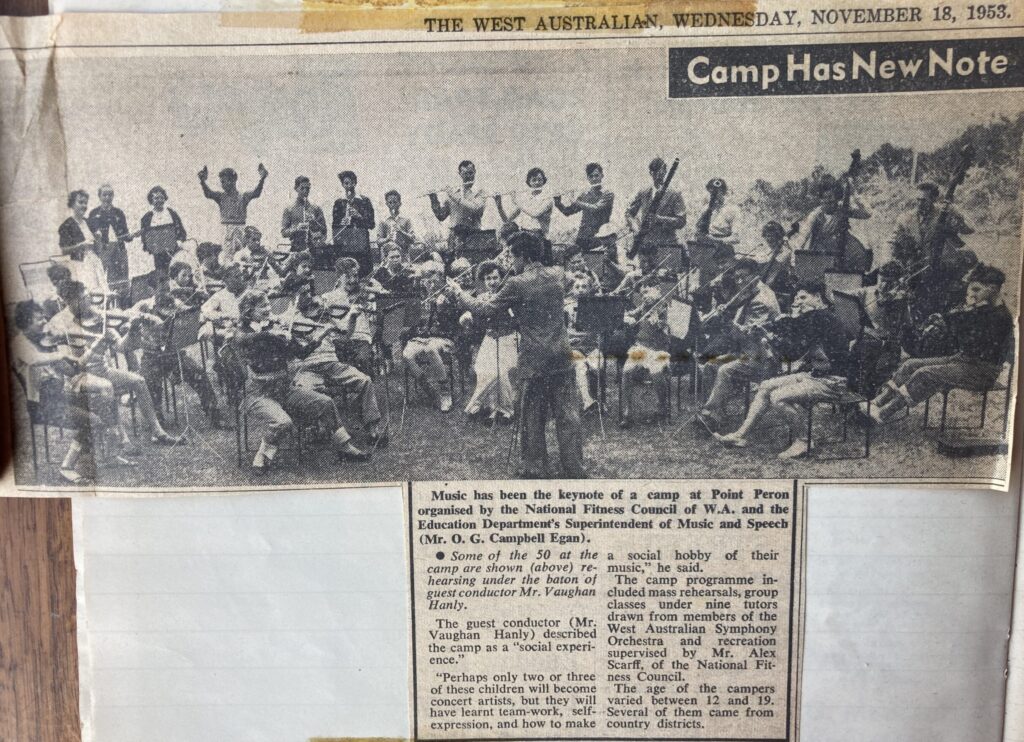
1952 Music Camp Perth
Jack, Jill and John were all tutors at the first Music Camp ever to be held in Western Australia from November 14 – 17 1952 at Point Peron.
The following tutors have agreed to give their services at the Point Peron Music Camp to be held from November 14 – 17: Mr Vaughan Hanly, Miss Barbara Smith, Mr John Mowson (strings); Miss Jill Harrison, Mr Jack Harrison, Mr John Cran (woodwind); Mr Charles Court (brass). The Director of Music will be Mr. O. G. Campbell Egan assisted by Mr Edgar Nottage. Mrs Honor Nottage will be the camp chaperone. A full timetable of sectional of sectional rehearsals, films, talks and recitals (by the tutors) has been arranged. Recreation will be organised by Mr Ross Bromilow of the National Fitness Council. [1]
1951 WASO Kalgoorlie tour: Charles Thompson, Jack Harrison, John Mowson, Don Cartright, Bernie Conlon, Jock Williams
TUESDAY, DECEMBER 30 1952 – MUSIC for MODERNS – Albany Town Hall
STARRING: JACK HARRISON Leader—Clarionet, Radio Stage Star. JOHN MOWSONRhythm String Bass Player.
WEST AUSTRALIA’S TOP FLIGHT MUSICIANS. A Night You Will Remember. Dancing 8 p.m. to Midnight. Under Direction Harry Ward. [1]
[1] The Albany Advertiser Monday 8 December 1952 page 3
[4] The West Australian Monday 8 December 1952 page 12
SHOWER TEA: Miss Ann Poynton (centre, above) gave a shower tea at her home in Nedlands last night for Miss Jill Harrison, whose marriage to Mr. John Mowson will take place at St. Andrew’s Church, Perth, next week. With the hostess are Miss Betty Dawkins (left), of Nedlands, and Miss Marcia Chayter, of Mt. Lawley.[1]PHOTO
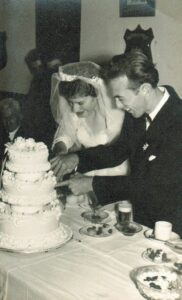
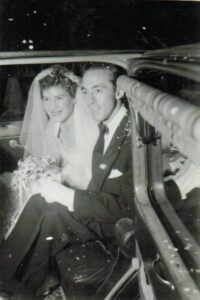
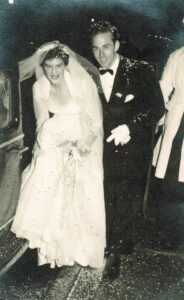
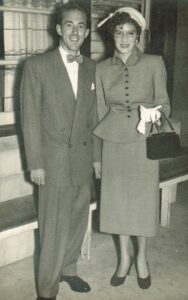
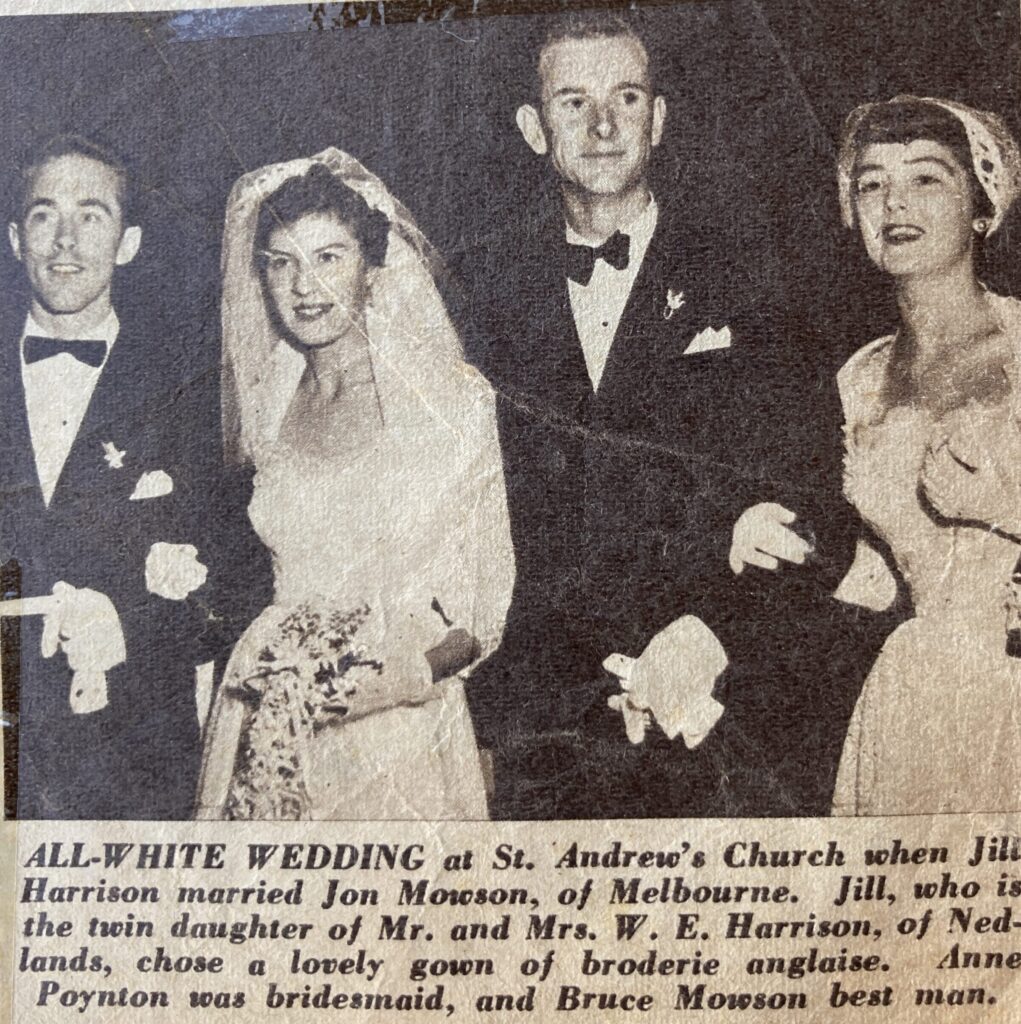
2nd April 1953 Jill and John Mowson1953 Wedding of Jill Harrison and John Mowson1953 wedding of Jill Harrison and John Mowson1953 John and Jill Mowson leaving their wedding
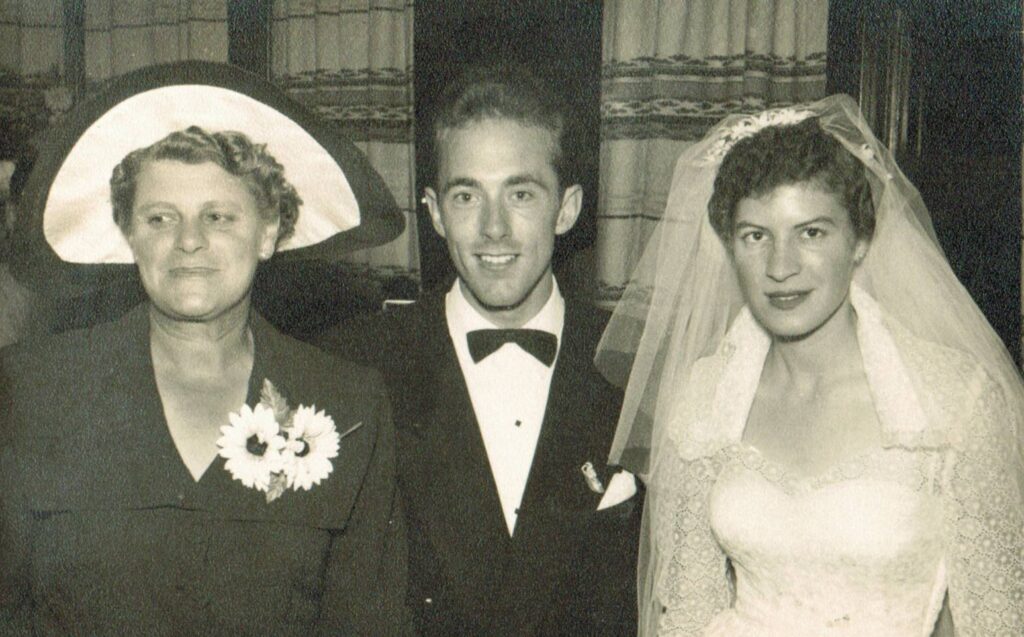
On April 2nd 1953 Jack’s twin Jill Lois married John Alan William Mowson. John’s brother, Bruce Mowson, flew over from Melbourne to be best man, and it was the first time he met Jill.
1953 Mowson – Harrison wedding article
THE AUSTRALIAN ACCORDIONIST MAGAZINE
PERTH: Any ideas that may be held by unenlightened persons that harmonica players are not musicians could be rapidly dispelled by hearing of the activities of Jack Harrison of Perth. Jack is a clarinettist with the Symphony Orchestra in that city and is State Finalist in the A.B.C. Concerto Competitions on clarinet. In addition to these activities he has his own dance band and has formed his own quintet known as the Jack Harrison Quintet”. The quintet comprises Stephanie James (1st piano), Brenda Cullity (violin), John Mowson (bass), Jill Harrison (Vibes, Celeste, Bassoon, 2nd piano and Vineta) and Jack himself (Clarinet, Bass Clarinet, Saxophones and harmonica). Jack is a grand example to everyone of a young musician who started on the harmonica and who, at the same time, worked seriously on another instrument. All readers will join with us in wishing you every success and in looking forward to the time when we may be able to hear your group on records. [1]
[1] The Australian Accordionist July 1953 Vol. 1 No. 3
CONDUCTOR IN THE GROOVE
Conductor-pianist Walter Susskind, currently in Perth to give a series of concerts and recitals, last Sunday evening deserted the concert platform to “getin the groove” with a group of Perth’s most ardent swing fans.
The maestro has always been tolerant of modern music – he has expressed admiration for works by Gershwin and Woody Herman. With this in mind a group of Perth’s young swing fans sent him an invitation to join them on Sunday evening at Geoff Forsaith’s home in Crawley, where they would beat out a few bars. Prominent in the group were the West Coast dixielanders – who only a few nights before had been placed first in the 1953 Dance Band Contest – John Mowson and Jill and Jack Harrison, and ABC announcer and record wrangler Peter Harrison. The bars were being duly “beat” when the doorbell rang to announce a new arrival at the festivities, and to their delight the swingsters were being introduced a few moments later to Walter Susskind.
The evening which followed was a complete success. The guest of honour regaled the musicians with anecdotes on his experiences while travelling in America and on the Continent and the musicians in turn treated him to a selection of modern music which would have sent their fans green with envy.
And although he declined an invitation to take over the pianist’s seat for a few numbers, Walter Susskind left the impression that he would have been only too happy to have done so had it not been for the fact that there were serious things ahead for him on the morrow. [1] PHOTO
[1] The Broadcaster Saturday August 1 1953 Vol. 20 No. 1009
NOTES ON THE DANCE BANDS – Thursday 27 August 1953
The Inkspots, not the famed colored outfit, but a group of well-known business, sporting and musical folk who usually gather at popular Clive McMillan’s home, held a ladies’ night at the Continental, Claremont, on Thursday last. Guests included the following: Clive McMillan, Steve McHenry, Murray Church, Merv Rowston, Morry Maurice, Cliff Adam, Jim Beeson, Wally Hadley, Roy Delamere, Reg Benjamin, Jack and Jill Harrison, Johnny Mowson, Dr. Willington, Cyril Bird and Reg North. Mine host Harry Ward entertained on the banjo and joined the boys on trombone in several jam sessions. [1]
Jill and John Mowson travelled to Melbourne during their December 1953 ABC Christmas holidays in order for Jill to meet the Mowson family and therefore had to miss Jack and Marcia’s wedding on 14th December 1953.
JAZZ
1955 – No. 5 Band – JACK HARRISON QUARTETTE
Numbers –
“Rachel’s Dream”
“The Man I Love”
“K.P. Jumps”
PERSONNEL: Jack Harrison (Clarinet, Sax, Trombone), Jill Harrison (Piano), Ray Harrison (Drums), John Mowson (Bass).
BAND No. 3 – JACK HARRISON’S QUARTETTE
Numbers –
“Geneva’s Move”
“Can’t Get Started”
“Jumping with Symphony Sid”
PERSONNEL: Jack Harrison (Clarinet, Sax), Billy Clowes (Piano), Ted Campbell (Drums), John Mowson (Bass).
John and Jill Mowson were offered positions in the Victorian Symphony Orchestra, now the Melbourne Symphony Orchestra, performing with many great conductors including Sir Charles McKerras, Richard Bonynge, Sir Eugene Goosens and Otto Klemperer. For the Opening Ceremony of the 1956 Olympic Games in Melbourne, M.S.O. combined with the Sydney Symphony Orchestra playing in the presence of Prince Phillip.
Jill and John returned to Perth and rejoined WASO in 1960.
BBQ Jill, John, Jack & Marcia
WEEKEND MAIL JANUARY 1956
It was at a barbecue part given by Mr and Mrs Jack Harrison at their City Beach home. Two of the guests (left) were Eastern states visitors Mr and Mrs John Mowson. PHOTO
MUSIC FOR LEISURE – FAMILY TIES
These three players of Jack Harrison’s group are all relations and will be heard in “Music for Leisure” on Sunday night November 13 from 3AR-7ZL at 9.15. They are from right: Jack Harrison of Perth, clarinet, his sister Jill, bassoon; and husband John Mowson, bass. [1]
[1] The A.B.C. Weekly Vol. 20 No. 46 12 November 1958
Jack Harrison’s Quartet has a regular booking on ABC TV with Don Vickers Jnr. on accordion, piano, John Mowson, Bass and Guy Bart, drums. [1]
1954 John Mowson, Jack Harrison, Norman Bourke (Sound Engineer) & Don Sanders (ABC Announcer) . Jill Harrison back left.
RADIO BROADCAST – Light Music by Family
When Perth’s versatile instrumentalist Jack Harrison and his quintet play, it’s a family affair. In a series of six programmes of light music starting this Tuesday at 8pm from 6WN, Harrison will play the harmonica, saxophone and clarinet. He and his father have made special arrangements of Latin-American tunes slow ballads and novelty numbers for the programmes. Members of the quintet will be Harrison’s twin sister Jill (bassoonist and second pianist) her husband John Mowson (principal bass with the W.A. Symphony Orchestra), Laszlo Vidak (violin), Verdon Williams (percussion) and Stephanie James (principal piano). photo
Jack and Marcia Harrison, Bruce Mowson, Jill & John Mowson at Reno restaurant June 19591961 John and baby Penny, Charles Porter, Kim and Marcia Harrison at 11 Dodonia Gardens
Penelope Jane Mowson was born on 16 December 1960, first child of Jill and John.
8pm Sat 5th August 1961 – FESTIVAL CONCERT TONIGHT – WINTHROP HALL – UNIVERSITY ORCHESTRA conducted by Trevor Jones.
Soloists: Michael Cole, Jack Harrison, Brian Pope. Assisting Artists: John Mowson, John Dean, Verdon Williams. World Premiere of David Farquhar’s prize winning Concertino for Piano and Orchestra, First Performance in Australia – Chamber Concerto No. 3 for Bassoon, Strings and Percussion by Elisabeth Lutyens. David Tunley’s Introduction and Scherzo for Clarinet and Strings Plus works by Dvorak, Grieg, Delius, Elgar, Walton and others.
Unreserved seats at door 10/ Students 7/6
1959 Jill and John Mowson, Jack & Marcia Harrison outside 11 Dodonia Gardens
BROADCASTS
The Eastern states have had the rare pleasure of hearing a good deal of Jack Harrison’s quintet from the A.B.C. stations. Jack produced six programmes of light music for 6WN with arrangements by himself and his father of Latin-American tunes, slow ballads and novelty numbers. Members of the quintet are: Jack, clarinet, saxophone and harmonica; his sister Jill on bassoonist and also as second pianist; her husband John Mowson, principal bass with the W.A. Symphony Orchestra; Laszlo Vidak, violin; Verdon Williams, percussion and Stephanie James, principal piano. The session is a pleasure to listen to. [1]
[1] The Australian Accordionist Vol. 8 No. 1 November 1961
1965 William, Marcia, Edna and Kim Harrison, Peter, John, Penny and Jill Mowson, Jay Harrison 1965
In 1965 Jill and John were invited to go to London with the Sydney Symphony Orchestra for the Commonwealth Festival of Arts. During our stay, the Orchestra was invited to lunch with Prince Phillip. (Jill was tapped on the shoulder and told not to smoke until the Prince arrived.) In 1967 they played with the Melbourne Symphony Orchestra in Montreal for Expo, whilst Jill’s parents minded their 3 children -Penny 7, Peter 5 and Paul aged 1.
1966 CHILDREN’S ANTICS DELIGHT AUDIENCE
Actors coming in late on cues, making extra movement, forgetting to leave the stage when their item was finished and interjections of “mummy” did nothing to spoil a special concert at the Wembley Kindergarten. The children’s unconventional stage activiy only made the concert more enjoyable. A small charge was made to the audience of parents and friends. The money will help pay for the Dolly’s Corner which was recently fitted at the kindergarten. Added entertainment was given by a trio from the W.A. Symphony Orchestra – Jack Harrison, his twin sister, Jill and his brother-in-law John Mowson. The trio played suitable music for children, elephant music on the bass, Three bears music and the children banged their hands in time against their knees.
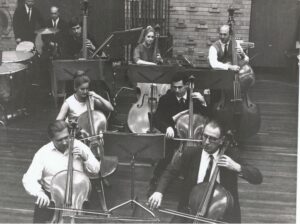
1967 WASO cellos and basses Basil Kirke Studio
NEW PROGRAM OF “EVERGREENS” FROM W.A. – JACK HARRISON AND HIS MUSIC
A new series of popular all-time favourite music will start on Monday on May 16 1966 at 8.30pm on the First Network. It will be presented by six members of the West Australian Symphony Orchestra led by Jack Harrison. Special arrangements have been written for their combination of bassoon, bass, violin, piano and percussion with the leader doubling on clarinet and saxophone. There are five programs in the series to be titled “Jack Harrison and his Music”. Jack Harrison will occasionally introduce his first love the mouth organ. He is a versatile musician and once made a multi recording in which he played 14 instruments including percussion and piano. He has been a member of the W.A. Symphony Orchestra for 15 years during which he has appeared frequently as soloist in clarinet and saxophone Concertos. Highlights of these performances were the Australian Premiere of the Aaron Copland Clarinet Concerto and the Richard Strauss Double Concerto for Bassoon and Clarinet. On this occasion the bassoon soloist was his twin sister Jill who also joins him in his new series doubling on piano and percussion. Items in the first program are “mice on the move”, “Gigi”, “Sidewalk”, “petite waltz” “holiday in Honduras” “comedian Gallop” “the pygmy patrol” “Will O‘ wisp” and “forever Samba”. The other artists in the series Laszlo Vidak violin, John Mowson bass, Stephanie James piano and Verdon Williams percussion.
MUSIC – By Peter Hellstrom – September 24? 1967
There will be an all Beethoven programme at tomorrow afternoon’s recital at the A.B.C. Basil Kirke Studio beginning at 3 o’clock. It will consist of the Septet in E flat and the Serenade in D. Op.8. The performers will be Graham Wood (violin), John Dean (viola), Brian Meddemmen (cello), John Mowson (bass), Jack Harrison (clarinet), Neil Pierson (French horn) and Jill Harrison (bassoon).
1967 John Mowson and Jack Harrison. Ednah Street, Como.
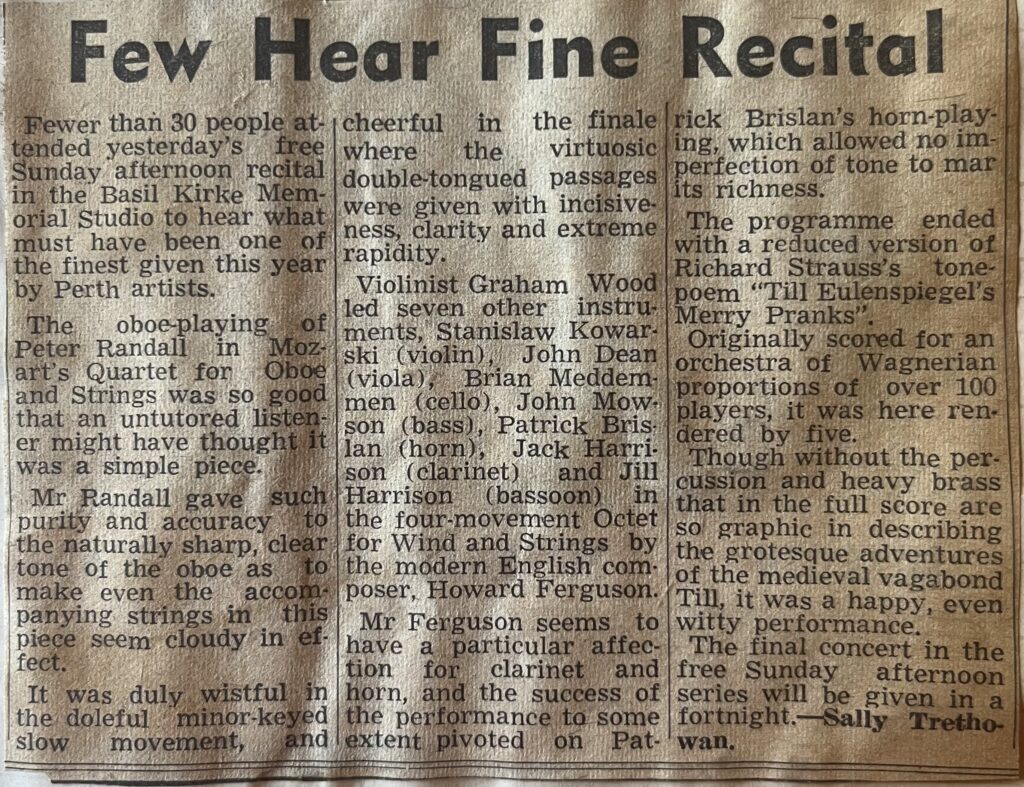
FEW HEAR FINE RECITAL – By Sally Trethowan – Sunday February 29 1968
Fewer than 30 people attended yesterday’s free Sunday afternoon recital in the Basil Kirke Memorial Studio to hear what must have been one of the finest given this year by Perth artists. The oboe playing of Peter Randall in Mozart’s Quartet for oboe and strings was so good that an unchartered listener might’ve thought it was a simple piece. Mr. Randall gave such purity and accuracy to the naturally sharp clear tone of the oboe as to make even the accompanying strings in this piece seem cloudy in effect. It was duly wistful in the doleful minor keyed slow movement and cheerful in the finale where the virtuosic double-tongued passages were given within incisiveness, clarity and extreme rapidity. Violinist Graham Wood led seven other instrumentalists Stanislaw Kowarski (violin) John Dean (Viola) Brian Meddemmen (cello) John Mowson (bass) Patrick Brislan (Horn) Jack Harrison (clarinet) and Jill Harrison(bassoon) in the four movement Octet for Wind and Strings by the modern English composer Howard Ferguson. Mr. Ferguson seems to have a particular affection for clarinet and horn, and the success of the performance to some extent pivoted on Patrick Brislan’s horn playing which allowed no imperfection of tone to mar its richness. The program ended with a reduced version of Richard Strauss’s tone poem “Till Eulenspiegel’s Merry Pranks”. Originally scored for an orchestra of Wagnerian proportions of over 100 players, it was here rendered by five. Though without the percussion and heavy brass that in the full score are so graphic in describing the grotesque adventures of the mediaeval vagabond Till, it was a happy even witty performance. The final concert in the free Sunday afternoon series will be given in a fortnight.
The Australian premiere performance of Till Eulenspiegels lustige Streiche, Op. 28 by Richard Strauss arranged for five instruments by Austrian composer Franz Hasenöhrl in 1954 was performed by (Graham Wood (Violin) Jack Harrison (Clarinet) Jill Harrison (Bassoon) Patrick Brislan (Horn) John Mowson (Double Bass) on Sunday February 29 1968 in the A.B.C. Basil Kirke Studio as part of the Festival of Perth.
John Mowson WASO Principal Bass 1967 Basil Kirke Studio
MEET THE FAMILY – By Mary Ferber
The Harrison’s of City Beach are a family who are what they are because their parents are what they are and their grandfather still is. They are music lovers and musicians. They practise partly because it is one of the things they do because they should, but also because they like to. There is no” do what I do, not do what I say” psychology in parental attitude from the parents. No lines of demarcation between popular music (what the young like) and classical (parents’ choice) any more than there is between a music lover and a musician. When four year-old Jody knocks out little tunes on the piano she is enjoying herself, but she is also being a serious creative musician and is treated seriously. And why not? These people do not learn music beginning with five finger exercises. They live it.
When Jody’s father Jack found a little mouth organ in his Christmas stocking when he was five he began his musical career. When in a few years he had one 10 silver cup,s $1000 in fees, topped the voting list in an amateur hour session and being on Eastern state tours playing his mouth organ, he backtracked according to conventional musical training ideas. He learned the piano from his father, worked hard at the clarinet and started consolidating a theoretical background. Now the States leading clarinet player in the ABC Symphony Orchestra, he has a solid knowledge of harmony, counterpoint and all that un-jazz. He still plays popular music as well as orchestral work and teaches.
His son Jay, 13, has inherited the clarinet his grandfather bought for his son Jack from a member of Johnny Turck’s US Army band during the war. He plays it in a modern group of youngsters who play Dixieland and call themselves “The Five Saints.” He also likes Mozart and playing hockey at Hale school and will sing in the school production of “Oliver”. Before the clarinet, Jay learnt the piano from his grandfather, Mr. William Harrison, as his seven-year-old brother Kimberley is doing now on Sunday night. The Harrison’s go to tea with the grandparents in Nedlands and the music lesson is sandwiched in. Bill Harrison. Senior was a part-time picture theatre pianist in the silent days with that wonderful repertoire of mood music which gave the old flicks another emotional dimension. He had to wait to resign from a government job to be a full-time musician, took a band up to the Murgoo races every year for 10 years, had a dance band and took his teaching diploma after the war. When his son had a group playing for radio, Bill Harrison did their arrangements for them. Now Jack Harrison does his own arrangements. Bill Harrison, now more than 70 and still playing and teaching on a restricted scale, belonged to that generation of parents who wanted their families to make music together. He drew his children into his own band- son Bill on saxophone. Ray on drums( he still does some playing) and twins Jack and Jill on clarinet and bassoon. At 16 the twins and Ray formed their own dance band. Playing for a Perth College dance, Jack met pretty Marcia Chayter and later married her. She is not a professional musician. She plays the piano usefully and enjoys singing in the chorus of the Gilbert and Sullivan Society as contentedly as Kimberley plays one hymn, arranged by his father, for his Sunday school.
John Mowson now Principal double bass player in the W.A. Symphony Orchestra came from Melbourne and married Jill Harrison the bassoon player nearly 3 years ago. John and Jill were invited to join the Sydney Symphony Orchestra on a tour which included the Commonwealth Arts Festival in England and in Asian countries. They left their two children with Jill’s parents. Two years later they were asked to join the Melbourne Symphony Orchestra for Expo 67 in Canada. There was then another little Mowson, so Penny, now eight, Peter showing musical promise at six and baby Paul were farmed out among the family. The family is scattered around Perth. Jack and Marcia Harrison have a delightful, modern, open-planned home at the end of the Dodonia Gardens City Beach with the coast down to Fremantle as picture in a picture window. The young have learnt to be quiet when music is going on in such a house, to listen with appreciation. But the whole family looks forward to having a music room so that making a noise when one wants to isn’t so important. [1] PHOTO
The free concert in the A.B.C.s Basil Kirke Studio tomorrow beginning at 3 o’clock is one of a series of six in which distinguished artists are performing a wide variety of works. The program will be Bartok’s outstanding and complicated “Sonata for two pianos and percussion” played by Wendy Nash and Stephen Dornan and percussionists John Reece and Brian Sadique directed by Verdon Williams and Stravinsky’s “Soldiers Tale” concert suite conducted by Verdon Williams. The performers will be Graham Wood (violin), John Mowson (bass), Jack Harrison (clarinet), Jill Harrison (bassoon), Donald Johnson (trumpet), Alan Mewitt (trombone) and Brian Sadique (percussion). [1]
Igor Stravinsky’s The Soldier’s Tale Concert Suite (July 1920) is scored for septet: Clarinet (in A and B♭), Bassoon, Cornet, Trombone, Violin, Double Bass and percussion. The West Australian premiere was performed on Sunday September 29th 1968 in a free concert put on by the A.B.C. in the Basic Kirke Studio. Directed by Verdon Williams, the performers were Graham Wood (violin), John Mowson (bass), Jack Harrison (clarinet), Jill Harrison (bassoon), Donald Johnson (trumpet), Alan Mewitt (trombone) and Brian Sadique (percussion).
[1] The West Australian Saturday September 28 1968
CLASSICS THE FORTE OF A ONE-MAN BAND – By James Penberthy
This week, Perth’s first government sponsored feature film with specially written music required to one man bands to perform in it soundtrack. Jack Harrison of City Beach, the first clarinet player in the West Australian Symphony Orchestra, was one of them. In “Welcome to City” Harrison played the mouth organ, clarinet, bass clarinet, saxophone and a number of other things. Harrison was handed a mouth organ at the age of six by well-known teacher and piano player – his father. “Play this” he was instructed and he did. He became one of the best mouth organists in Australia and now has the biggest collection of poor man’s wurlitzers in the State. Then Harrison Senior directed his son to the piano, the clarinet and the saxophone, to jazz, pop, commercial, light and classical music of all sorts. While Jack excelled, so did sister Jill who became a pianist and one of Australia’s top bassoonists. Jack has now turned his attention away from all but classics. When his teacher, the ace clarinettist Alan Rule, decided to step down from first to second clarinet in the West Australian Symphony Orchestra, his mantle fell on the shoulders of his brilliant student. Harrison now plays first and Rule on the less demanding second, basks in a reflected and perhaps more satisfying glory for the student is a great credit to himself and his master. Jack has formed a new generation of musical Harrisons. His two sons Kim and Jay are learning and their sister has a gleam in her eye. Jill Harrison married Australian bass virtuoso John Mowson and put her bassoon aside for a while in favour of the needle and saucepan. [1]
A few years later, in 1967, John Mowson performed with the Melbourne Symphony Orchestra at the prestigious Montreal Expo 67.
In 1969 John and Jill returned to Melbourne where John was appointed Principal Double Bass player for the MSO. Jill worked on a casual basis while Paul started school. The Government decided to expand the State Orchestra and new jobs became available in 1973. For 18 years Jill was Principal Bassoon of the Victorian State Orchestra (Elizabethan Trust Orchestra) which played for the Australian Opera, the Australian Ballet and the Victorian Opera Company.
John remained a prominent fixture of the orchestra for decades, regularly featured as a soloist in major subscription concert series, working under world-renowned guest conductors such as Franz-Paul Decker.
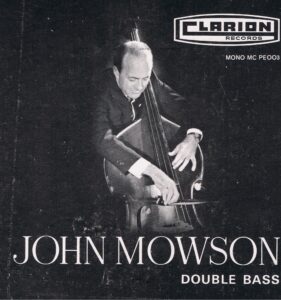
John Mowson single record recording
Recognized as one of the finest double bassists in the country, Mowson recorded a rare, self-titled solo EP, “John Mowson – Double Bass,” released in Australia in 1966. The vinyl release highlighted the instrument in a classical solo capacity, a testament to his individual virtuosity at a time when solo double bass recordings were uncommon.
Beyond his performances on stage, Mowson was a passionate and influential educator. As a teacher, he offered enthusiastic guidance and mentored the next generation of Australian string players, helping many transition into successful orchestral careers.
Together had three children (Penny, Peter, and Paul) while simultaneously balancing demanding international touring schedules and local performance careers.
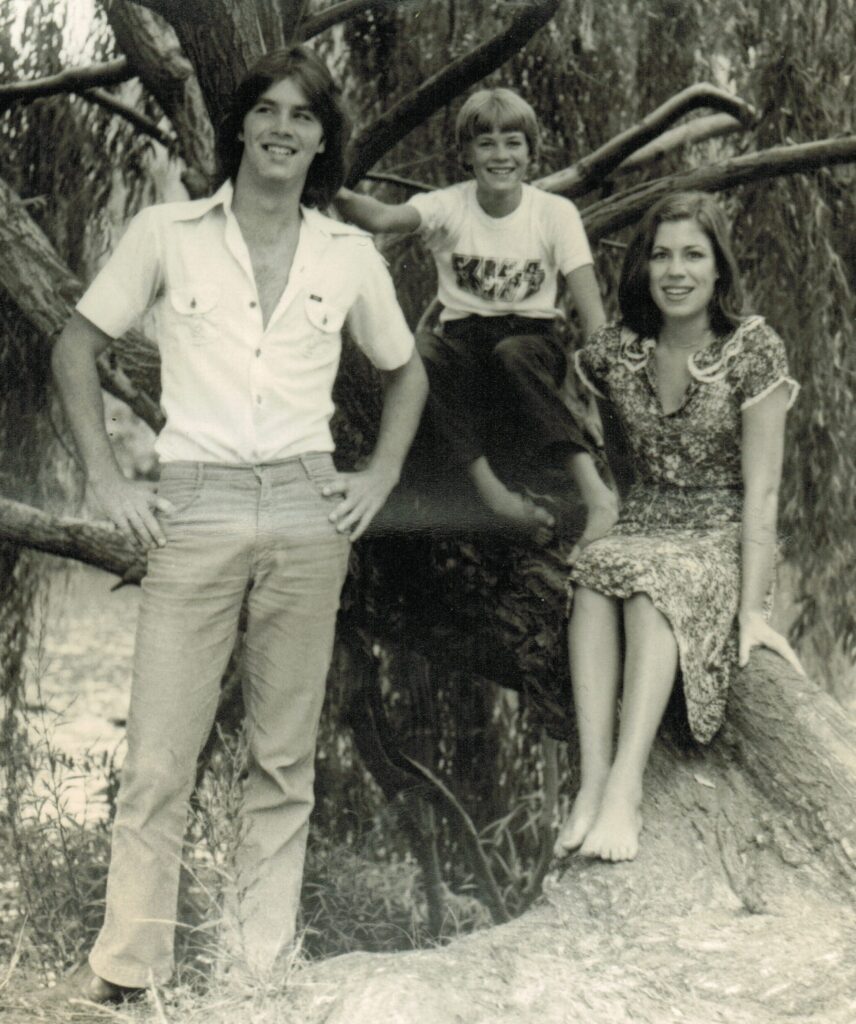
1981 Peter, Paul and Penny Mowson
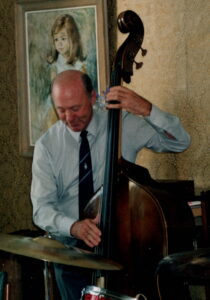
John Mowson jamming in 1991 at Jack and Jill’s 60th and Edna Harrison’s 85th. 11 Dodonia Gardens City Beach.
John and Jill retired as music professionals in 1991 and returned across the Nullarbor to settle back into Perth after an absence of 23 years. They were members of the Royal Perth Yacht Club.
1993 John, Michelle Windle and baby Chloe Mowson
1993 John, Jill and grand daughter Paris
John had two grandchildren Paris and Chloe.
2000 Jill and John Mowson, Jeff Harrison, Paul Mowson. Front: Mitchell and Kim Harrison.Jack Harrison, Jill and John Mowson, Ray Harrison
Peter Harrison was a popular and mischievous jazz presenter and announcer for ABC Radio Perth (historically 6WF) broadcasting from the old Adelaide Terrace studios and worked across Perth and Melbourne commercial and public radio from the 1950s through the 1980s. He compered hundreds of live shows in the 1950s, working with all the big jazz names in Perth and celebrities such as Rolf Harrison. Peter was the compere of popular radio broadcast “Jack Harrison and his Music.”
Around November 1970, Peter started appearing on stations including 6KY and continued presenting programs for the ABC (such as jazz and swing segments and Sportsview on Saturday afternoons).
Peter relocated to Melbourne in February 1972 where he joined 3XY, initially hosting the late-night shift before moving into a highly rated breakfast and morning slot that cemented his reputation for quick wit and a distinctive on-air voice. He also spent time on 3DB
He also played the double bass.
Peter Harrison (bass) and Billie Clowes (accordion)
1946
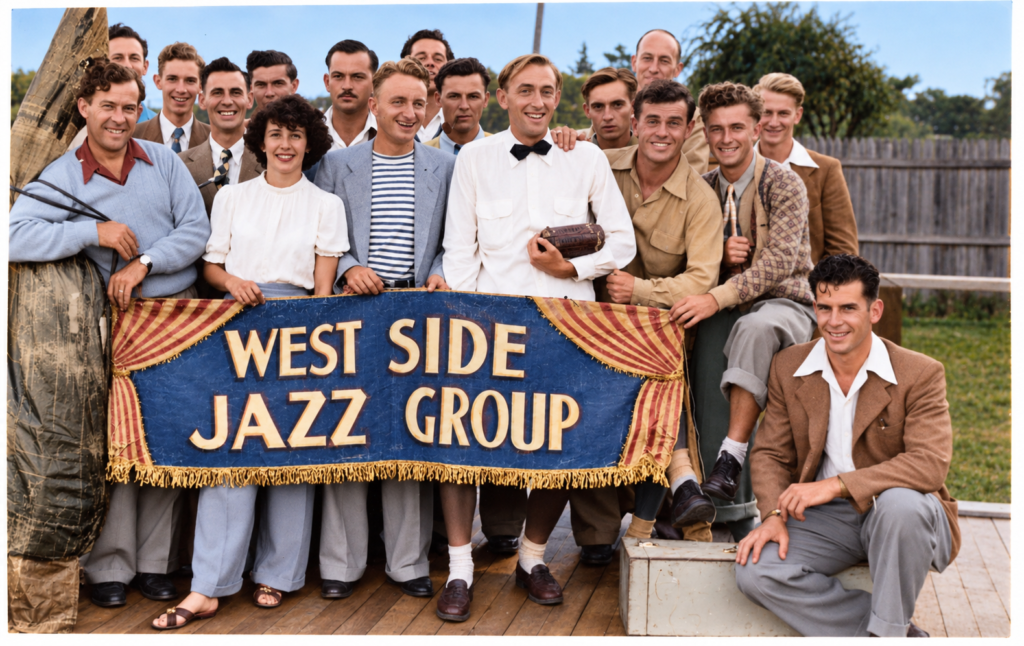
Peter Harrison: West Side Jazz group. Credit kimharrison.au/
On October 6 1949, Jack Harrison played the first performance in W.A. of the Artie Shaw Clarinet Concerto with the Jazz Symphony Orchestra conducted by John Nugent Haywood at the Capitol Theatre:
JAZZ SYMPHONY OF 1949 – CAPITOL THEATRE – THURSDAY, OCT. 6 1949 – (One Night Only).
1949’s BIGGEST MUSICAL SHOW
Surprise Exclusive Engagement of Australia’s Topline Film, Radio Actor and Producer Star of “Overlanders” Film, Founder and First Conductor of Perth Symphony Orchestra JOHN NUGENT HAYWARDConducting
THE JAZZ SYMPHONY ORCHESTRA IN GERSHWIN’S “RHAPSODY IN BLUE”
Featuring LOUISE D’ARCY – A.B.C. Concerto SOLOIST.
HUGE LINE-UP OF THE STATE’S BEST PROFESSIONALS ! ! !
SAMMY SHARP‘S JAZZ SYMPHONY ORCHESTRA of 28 Leading Musicians.
ALBERT CHAPPELLE Dramatic Baritone in W.A.’s first presentation of the famous “SOLILOQUY” with Orchestra.
JACKIE HARRISON First Performance in W.A. of the thrilling ARTIE SHAW “CONCERTO FOR CLARINET” with Orchestra.
PHYLLIS FROST Sensational Blind B.B.C. Singer.
CLIFF ADAM and “NIDDY” ROBERTS hilarious Comedy Duo.
“SOPHISTICATED LADIES” STRING ENSEMBLE All-femme String ensemble heard with success over A.B.C.
PETER HARRISON Well-known Radio Personality and Announcer, also prominent “Old'” Jazz Authority.
HARRY BLUCK Producer who successfully directed the “Jazz Symphony of 1948”, “Jazz Jamboree,” “Battle of Bands” and other successes.
ADMISSION – 3/-, 4/-, 5/- (plus tax) – BOX PLAN AT NICHOLSONS. – BOOK EARLY TO AVOID DISAPPOINTMENT.
The West Australian Friday 30 September 1949 page 37
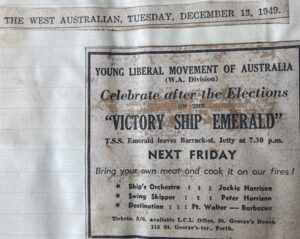
Victory Ship Emerald
Young Liberal Movement of Australia (W.A. Division) – Celebrate after the Elections
“Victory Ship “Emerald”
T.S.S. Emerald leaves Barrack St Jetty at 7.30pm. Friday December 16th 1949
Bring your own meat and cook it on our fires! Ship’s Orchestra: Jackie Harrison. Swing Skipper: Peter Harrison
Destination: Point Walter – Tickets: 3/6 available L.C.L. Office St George’s House – 115 St George’s Terrace, Perth
The West Australian, Tuesday December 13th 1949
1950
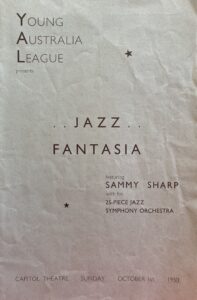
1950 Jazz Fantasia
“JAZZ FANTASIA”
October 1 1950
The Young Australia League – will present Sammy Sharp and his orchestra of 25 in the third annual Jazz Fantasia at the Capitol Theatre on October 1. Supporting artists will include Louise D’Arcy, Jack Harrison, Betty Whittaker, Bryn Gifford, Phyllis Frost and Keith Hounslow. The compere will be Peter Harrison.
The West Australian Tuesday 19 September 1950 page 12
A BLITZ IN MUSIC WILL FOLLOW THE BAND
The Young Australia League band will march through the city as a prelude to Perth’s third Jazz Fantasia at the Capitol Theatre on Sunday, October 1. Sammy Sharp and his Jazz Symphony Orchestra, with many supporting artists will provide the programme at the theatre. One of the featured works will be a performance of London Fantasia, with pianist Louise Darcy as soloist. It is a musical story of the spirit of London during the blitz. Other artists will include clarinettist Jackie Harrison; a State finalist in the concerto and vocal competition this year, Phyllis Frost; a blind singer who has been featured with Claude Brampton’s All Blind Orchestra in- London; and Betty Whittaker, star of the Repertory Club’s Maritza. The show will be’produced by Sammy Sharp and compered by Peter Harrison and Terry Scanlon.
With SAMMY SHARP and his 25-piece Jazz Symphony Orchestra.
Comperes; TERRY SCANLAN, compere Ice Follies (by courtesy David N. Martin, Mgr. Dr. Tiv. Circuit Aust. Pty. Ltd.); PETER HARRISON (by courtesy A.B.C.).
Guest Artists Include- LOUISE D’ARCY. Soloist of “London Fantasia”: Jackle Harrison in “Clarinet Concerto” and Betty Whittaker, Bryn Gifford, Phyllis Prost, Jimmy Beeson.
SAMMY SHARP will be featured in Harry James’s arrangement of “Concerto for Trumpet.” Prices 5/ 4/ 3/ plus tax. Box plan at Nicholsons.
The West Australian Wednesday 27 September 1950 page 37
1950 Jazz Jamboree
BANDLEADERS. Applications are invited from all Bandleaders who wish their bands to participate in the JAZZ JAMBOREE OF 1950 on OCTOBER 29. Application Forms and particulars are available from MUSICIANS’ BENEVOLENT FUND Secretary, Union Office, 33 Barrack-st. Applications close 1 p.m., August 31, 1950. HARRY BLUCK. Hon. Organiser.
West Australian (Perth, WA : 1879 – 1954), Monday 21 August 1950, page 28
JAZZ JAMBOREE TOMORROW The annual Jazz Jamboree will be held at the Capitol Theatre at 8.45 p.m. tomorrow. Almost 100 professional musicians will take part and play all types of modern music. The entire proceeds of the concert will go to the musicians’ benevolent fund. Sixteen dance-band leaders, all wellknown musicians, will take part, and the show comperes will be Geoff Manion and Peter Harrison.
West Australian (Perth, WA : 1879 – 1954), Saturday 28 October 1950, page 7
THE BIGGEST DANCE BAND SHOW of the YEAR — ALL YOUR FAVORITES
JAZZ JAMBOREE of 1950 – CAPITOL THEATRE – SUNDAY, OCTOBER 29th
NINE OF THE STATE’S LEADING DANCE BANDS
Bill Kirkham’s Embassy Band
Ken Murdoch’s Ensemble
Ron Jenkins Band
Peter Clinch Boptette
Merv Rowston’s Band
Colin Hicks and His Musk
Wayne Hendrick’s Modernaires
Norm Wrightson’s Band
Harry Bluck’s Music in the Modern Manner
ALL YOUR SWING, JAZZ AND BEBOP PAVORITES
500 Unreserved Seats on Sale at Doer
GFOFF MANION and PETER HARRISON Comperes
JAZZ MUSIC: Nine dance bands combined to present the “Jazz Jamboree of 1950” in the Capitol Theatre on Sunday night to raise money for the W.A. Musician’s Benevolent Fund. Every seat was filled and the audience had an op portunity of comparing different styles. Warm applause greeted special efforts by the bands or their vocalists. The programme was produced by Harry Bluck and the comperes were Geoff Manion and Peter Harrison.
West Australian (Perth, WA : 1879 – 1954), Tuesday 31 October 1950, page 9
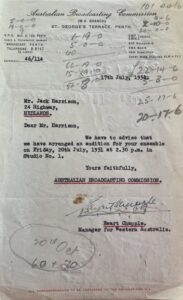
1951 ABC invitation to audition
1951
On 20th July 1951 Jack’s ensemble auditioned at 2.30pm in A.B.C. Studio 1 by Ewart Chapple, Manager for Western Australia. “Jack Harrison and His Music” broadcast regularly for nine years on A.B.C. Radio 6WN up until 1960. The A.B.C. provided a 1 ¼ hour rehearsal followed immediately by a 1 ¼ hour pre-recording during the week (often Wednesday afternoons) and live broadcasts occurred Sunday evenings, usually 6 – 6.30pm. Jack was required to provide 27 minutes of music which were introduced by an A.B.C. presenter (often Peter Harrison – no relative) making a total of half an hour. Twenty seven minutes of new music was about 10 musical numbers that had to be new, arranged for the specific ensemble, parts copied by hand, practised and rehearsed before they got to the ABC. In 1959 Jack received a total of £42 for the above. Jack’s father William did many of the arrangements.
The first broadcast of “Jack Harrison and His Music” was on September 1951 on 6WN.
1951 – JACK HARRISON’S SEXTET OPENS ON 6WN
On September 2 Jack Harrison’s Sextet opens on 6WN. The programme will probably consist of light classics, arranged modern ballads, and bright numbers of the samba, tarantella and bolero type. Last year Jack studied under the Sydney musician Clive Amadio and it is quite likely that Jack’s sessions will resemble the well-known Amadio Quintet. Jack reports that the members are James Drummond (violinist), Stephanie James (pianist) who recently returned from Europe, Kenneth Murdoch (saxophonist) John Mowson (bass) and his father, William Harrison (organ and vibes). Jack will play first clarinet and second saxophone. He will have a guest singer for each session. Kath Bass, Phyllis Blott and Elise Longwill would probably be the first three he says. Each number will be arranged for the sextet. Jack and his father are doing some of this work. Some work by an Eastern States arranger is available provided it is copied. Sister Jill is doing this in her spare time in Adelaide.
The Broadcaster Saturday August 18 1951 Vol. 18 No. 907.
1952
1952 Jazz at the Capitol
1953
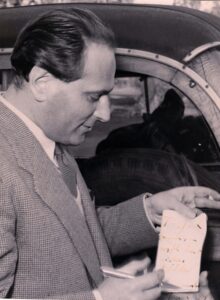
1953 Walter Susskind – signed photo
CONDUCTOR IN THE GROOVE
Conductor-pianist Walter Susskind, currently in Perth to give a series of concerts and recitals, last Sunday evening deserted the concert platform to “getin the groove” with a group of Perth’s most ardent swing fans.
The maestro has always been tolerant of modern music – he has expressed admiration for works by Gershwin and Woody Herman. With this in mind a group of Perth’s young swing fans sent him an invitation to join them on Sunday evening at Geoff Forsaith’s home in Crawley, where they would beat out a few bars. Prominent in the group were the West Coast Dixielanders – who only a few nights before had been placed first in the 1953 Dance Band Contest – John Mowson and Jill and Jack Harrison, and ABC announcer and record wrangler Peter Harrison. The bars were being duly “beat” when the doorbell rang to announce a new arrival at the festivities, and to their delight the swingsters were being introduced a few moments later to Walter Susskind.
The evening which followed was a complete success. The guest of honour regaled the musicians with anecdotes on his experiences while travelling in America and on the Continent and the musicians in turn treated him to a selection of modern music which would have sent their fans green with envy.
And although he declined an invitation to take over the pianist’s seat for a few numbers, Walter Susskind left the impression that he would have been only too happy to have done so had it not been for the fact that there were serious things ahead for him on the morrow.
The Broadcaster Saturday August 1 1953 Vol. 20 No. 1009
On 5th September 1953 Marcia Chayter was bridesmaid for the wedding of her ABC typist friend Deirdre Schorer to ABC announcer Donald Sanders. ABC announcers Peter Harrison and John Treffrey attended, along with the ABC typist girls including Jeanette Earl and Mary Treffry.
1952: John and Mary Trefry, Marcia Chayter and Jack Harrison, ? and Peter Harrison
A.B.C. announcer Don Sanders and his wife leave Christ Church, Claremont, after their wedding. The bride was formerly Deirdre Schorer, daughter of Mr. and Mrs. H. C. Schorer, of Dalkeith. Don is the only son of Mr. and Mrs. W. Sanders of Adelaide.
On 14th December 1953, Peter attended the wedding of Jack Harrison and Marcia Chayter.
1953 Jack & Marcia’s wedding – Peter Harrison1953 Berwyn Allen, Peter Harrison and Bill Harrison Jnr
Nutty Cook, Jack Harrison, Peter Harrison and Ted Preston
1954
RON JENKINS – OLD HATS INSPIRED ‘MAD HATTER ‘ MUSIC VOGUE
A stack of old hats in his father’s men’s wear store started Ron Jenkins on the road to success in dance band-cum-comedy work. Discarded headgear gave Ron the idea of adding a novelty angle to his band. Later, he dug deeper into the pile of old clothes which had collected in the shop since its inception in 1910, and the idea for what so many dancegoers now know as typical Jenkins’ style was born. Ron always believed patrons want something more than straight music. Just how right he was is illustrated by the way dancers will stop and gather round the stand while Bon and the boys go through their crazy capers.
The Jenkins’ humor is essentially a team effort. A title is first chosen, then all band members offer their suggestions for slapstick. Best ideas are pooled and a number is ready to split the dancers’ sides. A lot of comedy is impromptu, but for big shows the band gets together at Ron’s place — as some Melville residents know only too well— to rehearse. To back this fooling Ron has a huge store of varied clothes. Included in his ‘wardrobe’ are 50 hats, ranging from elegant bowlers’ to Yankee gob caps, 8 striped blazers of unknown vintage. parson’s coats, swallow-tailed coats, oilskins, and Indian blankets. He also has masks, spectacles, false noses, cheeks and such like by the hundreds, not to mention innumerable wigs both male and female. Compere of ‘Jazz at the Capitol’ Peter Harrison will probably say smoke bombs and crackers should be included in the list of the Jenkins’ equipment. While Harrison was talking before Jenkins’ act last Sunday a smoke bomb exploded behind him. Amid crackers and jumping jacks he was removed from the stage in a none-too-gentle manner. Before the smoke of the battle had cleared away the boys were on their stands beating out ‘Crazy Man ‘Crazy.’ ! It was!! Some think Ron’s car must have elastic sides, judging from the huge bundle of clothes of one sort or another which he; brings to engagements. When he opens the door out comes Ron, crazy clothes and all. The next half hour is usually spent sorting it out.
Comedy is only part of the Jenkins’ group. His musicians are ton class and can turn out: solid music. Group comprises Vince Cook (drums), Allan Cole (bass) and Austin Ray (piano), not to mention Ron Jenkins on sax and clarinet. When the outfit is increased to a quintet for bigger bookings Ray Reason (you should listen to Reason) adds his trumpet Nutty Cook, apart from his brilliant drumming, can certainly put over a vocal — particularly a semi-comedy type. Ron vouches for the fact that many of the ideas for his shows come from the Cook cranium. Pianist Austin Ray has built up a great local reputation with his keyboard work, and really enters into the spirit of things when the band goes mad. Allan Cole (bass), needs no Introduction. He used also to be with Colin Hicks. Ron Jenkins has based his band to some extent on the Fats Waller style. ‘Fats got terrific lift out of popular numbers for a small combination and we try to get something of the same effect,’ says Ron, summing up. He sticks mainly to popular numbers which please the majority. The drive the quartet gets is amazing. Ron Jenkins’ interest in dance music dates back to when he was 6. His parents used to take him to dance festivals and the like. Soon after, he started to practise on his father’s drum kit and then he switched to the sax. He started playing with his father at small dances and shows. His first big job was with Merv Rowston‘s Old Time Band at Government House. Later, he formed his own group. He has had more or less the same personnel in his outfit since the end of the war. The Jenkins’ Group will always be small and compact. Ron says he would never be able to put across his comedy with a big band. Things would get out of hand and it would be a shambles. He has a great admiration for the way Spike Jones can present the music be does with so many in the band, and thinks this would take a lot of practice. He doesn’t take ideas from Spike, however. During the ball season the Ron Jenkins’ Quartet or Quintet has a busy time. Apart from regular Saturday engagement at the Valray, Rockingham, he has also a number of week-night engagements. He has travelled as far north as Big Bell and as far south as Busselton to play at dances. One Australian he has a lot of time for is Bobby Limb. Both Bobby Limb and Ron Jenkins serve up a similar type of fooling. Now Ron intends to revive some of his favorites from a few years back. Among best numbers are ‘Down on the Farm,’ ‘I’m Nuts on Screwy Music’ (which naturally enough his one of his favorites) and ‘Don’t Bring Lulu.’ Current, numbers which have received a going over from the Jenkins’ group Include ‘Ugly Child,’ ‘Dear Ron (John), and ‘I See the Moon.’ Ron was in 2 minds whether to play ‘Dear Ron’ or ‘I See the Moon’ at the Capitol last Sunday. He settled for the latter as it was more topical. Applause almost brought the roof down. Looking to the future. Ron and the boys are very interested in the advent of TV in the West. A group, like theirs should do very in this medium. Band gets Just as much kick out of playing as you get from seeing and having fun.
The Mirror Saturday 3 July 1954 page 14
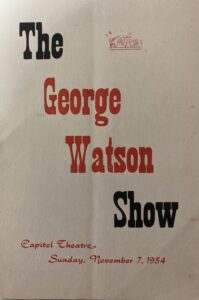
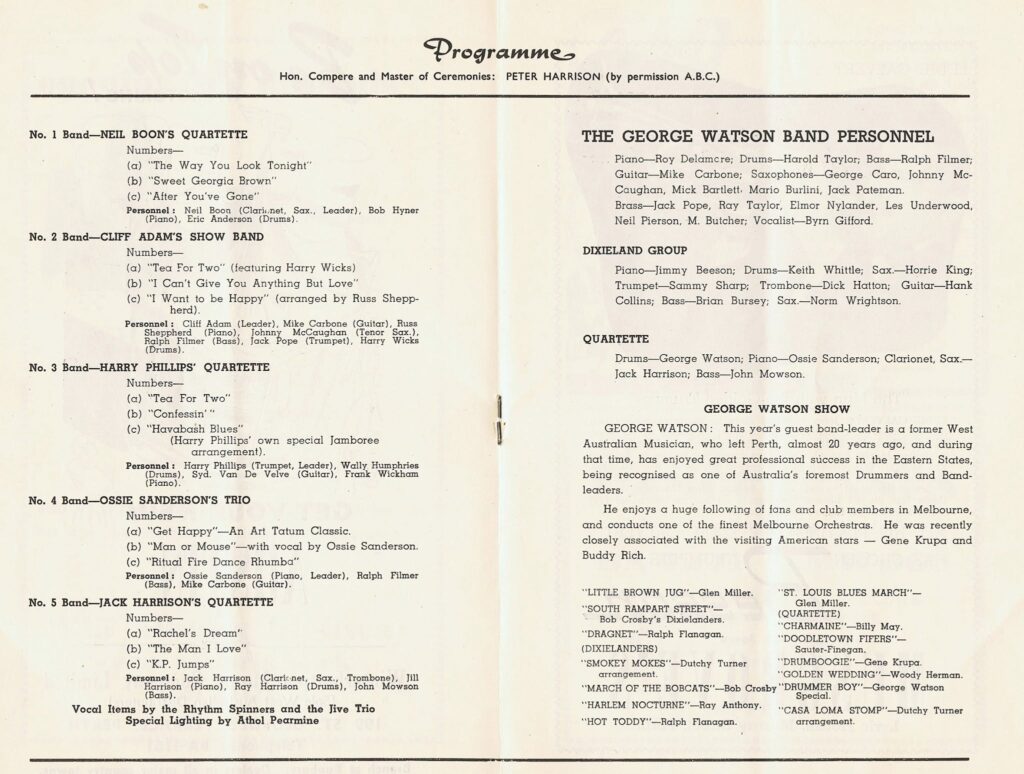
The George Watson Show:
1954 George Watson Show1954 Watson George program
1955
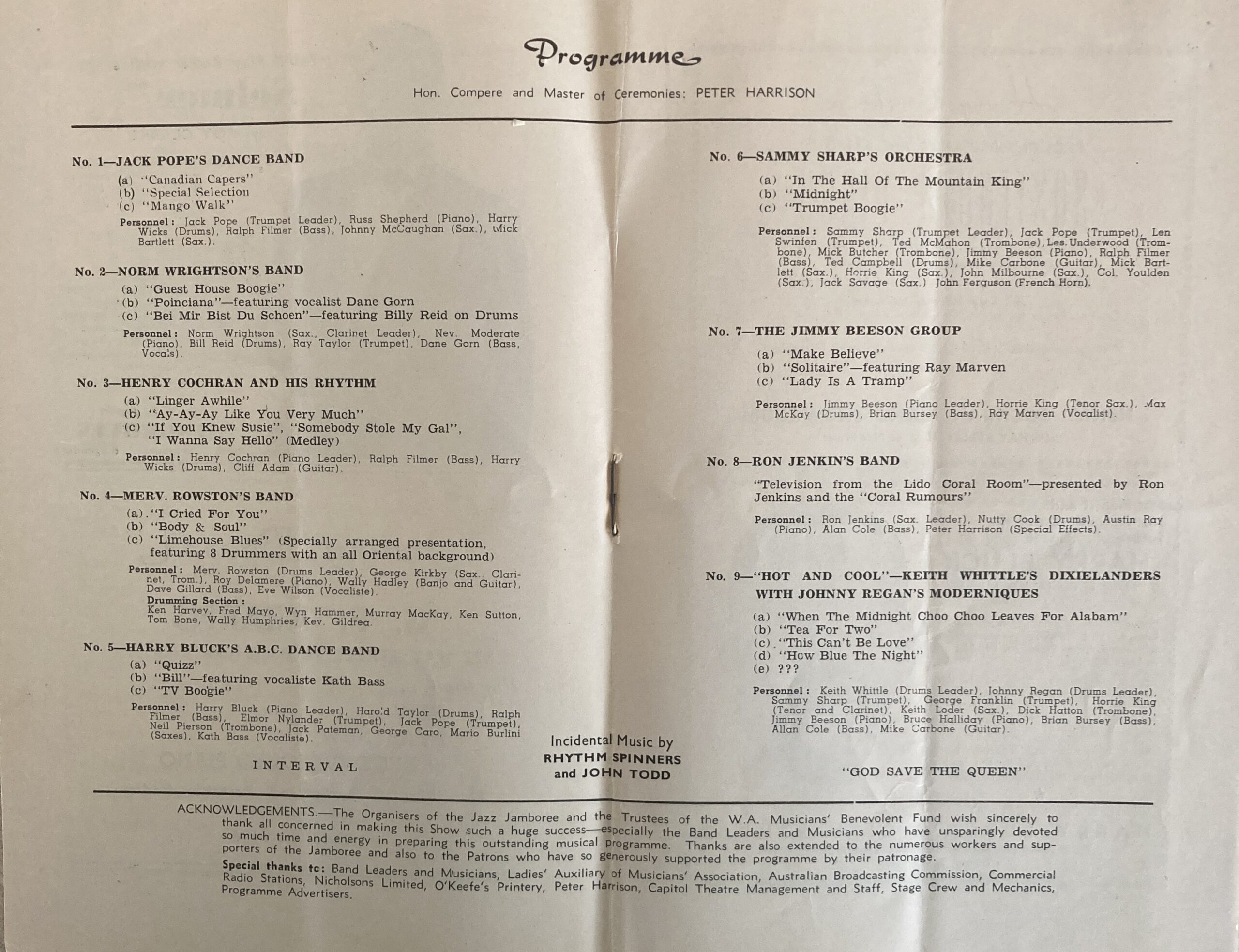
Compere of Jazz Jamboree:
1955 Jazz Jamboree Program
1960
Dizzy Fingers on 10 clarinets
Versatile musician Jack Harrison recently made a recording playing ten parts on clarinet. Harrison, a member of the WA Symphony Orchestra, took 3 ½ hours to record a 2 ½ minute version of the appropriately named Dizzy Fingers.
Dizzy Fingers, Harrison’s third multiple recording, will be broadcast on Peter Harrison’s 6WN programme Saturday Roundabout this Saturday 19th March at about 8.15.
ABC technician Garry Matthews played recordings at different speeds and superimposed them on a master tape to get the effect. The finished work was outstanding. One odd side-effect: when one recording of a clarinet was played back faster than is had been recorded it sounded like a piano accordion. Harrison’s first multi-recording involved ten instruments. They included saxophones, clarinets, a vibraphone, harmonica, piano and drums. An ABC spokesman said he believed that this was the first time in Australia and possibly the world that a multi recording had been made with clarinets only. The Sunday Times Mar 13 1960
1961
1961: Marcia and Jack Harrison at the wedding of Maureen and Peter Harrison
Jack and Marcia Harrison attended the wedding of Peter Harrison to Maureen Lorraine Rooke from Bridgetown.
1964
TELEVISION
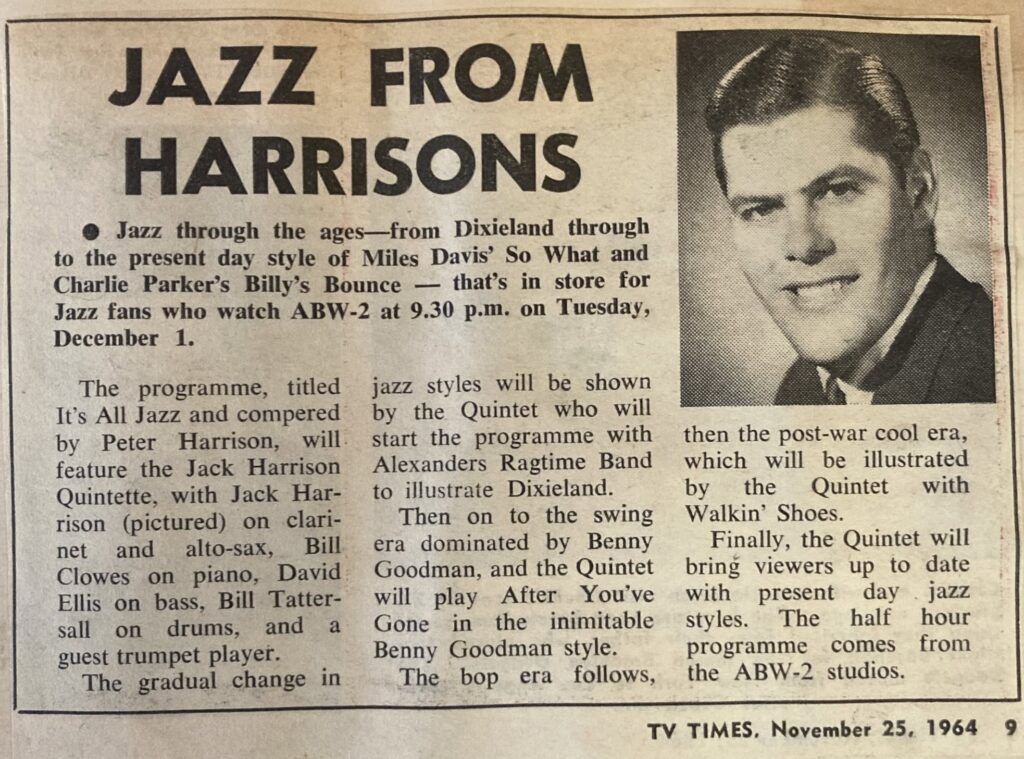
JAZZ FROM HARRISONS
Jazz through the ages – from Dixieland through to the present day style of Miles Davis’ “So What” and Charlie Parker’s “Billy’s Bounce” – that’s in store for jazz fans who watch ABW-2 at 9.30pm on Tuesday December 1.
The programme entitles “It’s All Jazz” and compered by Peter Harrison, will feature the Jack Harrison Quintette with Harrison (pictured) on the clarinet and alto-saxophone, Bill Clowes on piano, David Ellis on bass and Bill Tattersall on drums and a guest trumpet player. The gradual change in jazz styles will be shown by the Quintet who will start the program with play “Alexander’s Rag Time Band to demonstrate Dixieland. Then on to the swing era dominated by Benny Goodman, and the Quintet will play “After You’re Gone” in the inimitable Goodman style. The bop era follows, then the post- 1947 cool era, with “Walkin’ Shoes”. Finally, the Quintet will bring viewers up to date with present day jazz styles. The half hour programme comes from the ABW-2 studios. TV Times November 25 1964
1964 Jazz from the Harrisons article
TELEVISION
JAZZ PLAYING 50 OVER 50 YEARS
Tuesday 1st Dec 1964
Dixieland, swing and be-bop is in store for viewers with an ear for jazz on ABW2 at 9.35pm on Tuesday. The programme, called “And All That Jazz” will show how the style of jazz playing has altered in the past 50 years, beginning with Dixieland Jazz. It then moves to the swing era dominated by Benny Goodman, then on to bop, cool and mainstream jazz. The concert will be compered by Peter Harrison with Perth’s top jazz band, the Jack Harrison Quintet. It consists of Jack Harrison (alto sax and clarinet) Billy Clowes (piano) David Ellis (bass) and Bill Tattersall (drums) and a guest trumpet player.
PETER HARRISON – Career & On-Air Style
Themed Music Nights: He hosted specialized evening music segments, famously presenting the jazz programs where he would meticulously detail every track, artist, recording year, and studio. [1, 2]
Station Antics: Known for his great sense of humour and camaraderie, he was infamous for playful pranks on nervous young announcers just starting their live shifts.
Broadcasting Legacy: He was a cherished personality during the golden era of local Perth radio before automation and networking changed the medium.
To the average person, the commercial announcers appeared more friendly, not as stern or stuffy as the ABC variety, though in reality, the ABC announcers were often the opposite in person. They needed to be well educated, knowledgeable and articulate to hold the position, yet these qualities were often combined with a quick wit and a mischievous sense of humour. This in an atmosphere of camaraderie which often led to pranks and no end of high jinks when off-air. For example: Roger Cook described the mischievous nature of Peter Harrison in his book, “More Dangerous Ground: The inside story of Britain’s Best Known Investigative Journalist”.
“Peter’s favourite targets were young announcers fresh out of training. Waiting until they had gone on air, he would ignore the red ‘On Air’ light outside the soundproofed studio and wander in, putting a reassuring finger to his lips to imply he was there purely in a monitoring capacity. The nervous reader would plough on, glancing up at Peter from time to time.
The next thing the victim would see was the stations most senior newscaster dropping his twills and underpants and lowering his buttocks down onto the grey metal wastepaper basket. He would stare fixedly at the now panic-stricken newsreader who would stutter, lose his place and generally wish for his mother to come and take him away.
Peter would then up the ante, and start to strain and grimace, producing barely-audible grunts. Nothing that the listener would ever hear, but loud enough for those in the studio to pick up.
The end result was usually near-hysteria and a newsreading performance that left the listener confused and often concerned for the health of the young broadcaster. The broadcaster, having gratefully handed over to the continuity announcer, would watch, slack-jawed, as Harrison pulled up his pants, did himself up and strode out of the room as if nothing had happened. Sometimes his victims would try to persuade themselves that nothing had happened, particularly when Peter greeted them later and nonchalantly gave them some small piece of advice about their performance.”
Imprint: Book Guild Ltd Country of Publication: United Kingdom ISBN: 9781846241093 Publication Date: April 2007
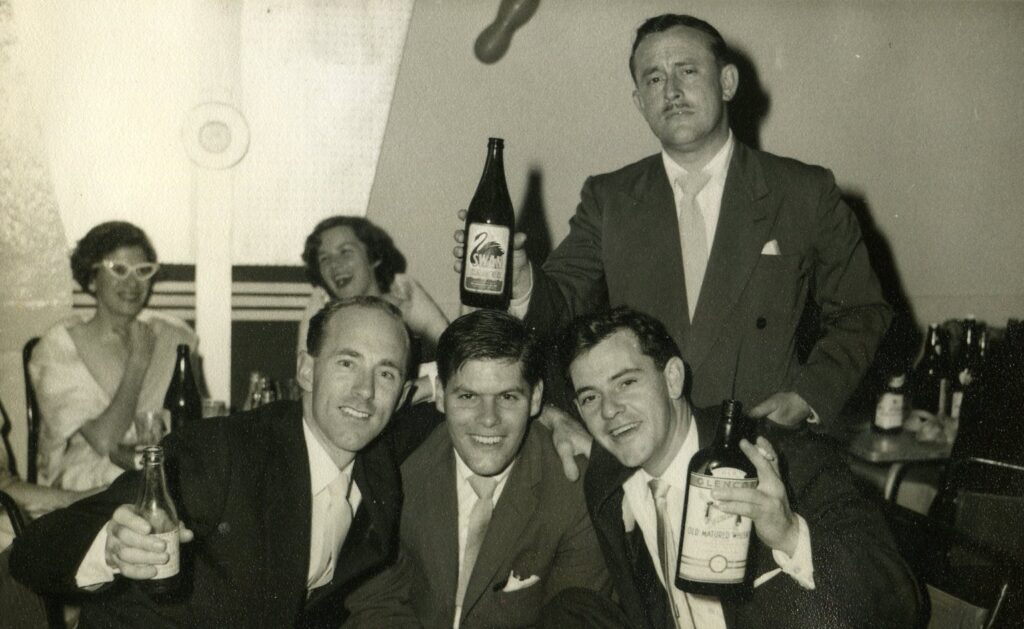
Peter Harrison (bass) with Billy Clowes (accordion)
Further to Peter Harrison, Ian Stimson has kindly pointed to that ‘Harro’ played the double bass fiddle at a nite club directly in line with the Cottesloe surf lifesaving club. The Picture gardens were on the eastern side of that cabaret building.
“He was one of the Jazz Musos for the Jack Davey show held at the Cottesloe Civic centre. I can remember his group arriving in an open vintage car to play there followed by Jack Davey. This was recorded at 6IX, the whole programme.
“Then there was the famous incident coming back to 2pm Saturday afternoon when he marched into ABC studio one as the big White Hunter complete with Pith Helmet and shotgun. This gag cost him a 6 week suspension.
“I knew his brother at 25 squadron RAAF Base Pearce in my Nasho Days.”
Here are some Heritage Notes to put this into perspective….
The Lido Cabaret and The Lido Picture Gardens opened in 1936 and were important social centres for Cottesloe and other nearby western suburbs until c 1960.
According to Dr Peter Harries… In the 1960’s the Lido was the first cabaret club to feature a stripper and was run by Ron Jenkins, drummer Nutty Cooke, piano Jimmy Beeson and bass player Peter Harrison of ABC fame.
Earlier, the Ron Jenkins Band performed at the Palais de Danse on the Cottesloe beach front. This dance venue was in the Centenary Pavilion, that opened in 1929. The pavilion became the focus for beach activity at Cottesloe Beach until its demolition in 1982. Several restaurants were located within the pavilion. The top floor was a dance floor and in the 1940s and 1950s the ‘Palais de Dance’ was a popular venue for dancing and live music.
The Lido land was owned by F.D. North. It stretched down to the parade from his home. In 1913 a weatherboard building was erected and rented to Mrs McDonald who had a shop there. The Lido Cabaret and Picture Gardens were designed and built by Howard Bonner for the Hatfield family in 1936. Reference: “Cottesloe is Calling” Daily News Friday Dec 20 1935.
At the seaside suburb of Cottesloe, local residents and holidaymakers would spend the balmy summer nights at the new Lido Picture Garden constructed beneath tall pines near the Indian Ocean at the foot of Forrest Street. One of the most prestigous in the group, the Lido was built solely as an open air venue. It was designed by Howard Bonner in 1935 and adjoined the popular Lido Cabaret which operated until the 1960s as Perth’s favoured night club. The cinema catered for an audience of 550 and consisted of a 94ft x 92ft. walled garden space, and a proscenium with a vaguely Oriental motif.
The picture gardens held 550 patrons. It was the third venue in the Cottesloe area operated by Lewis M. Hatfield. It was constructed in 1935 at the corner of Forrest St and Marine Parade, overlooking the ocean and behind the Lido Tea-rooms, which were later removed in pieces and relocated to Rockingham as a weekend cottage. The Lido Cabaret was then built on the corner in front of the gardens. The gardens was called a Chinese Gardens, because the construction had a chinese flavour. The gardens closed in 1960 and the Cabaret in 1966, after which the site was again used for a restaurant – the Mandarin, which was sold in 1996.
Sources: Max Bell, Perth – a cinema history, The Book Guild, Lewes, Sussex, p.59
Max Bell, ´Looking back’, Kino, no.41, September 1992, pp.16-17
The Lido Cabaret closed in 1966, after which the site was used for a restaurant, the Mandarin, which was sold in 1996, and became the La Tropicana Restaurant. When the La Tropicana Restaurant closed, it was converted into a restaurant/cafe/bakery called Il Lido (88 Marine Terrace) which opened in (2007 or 2008).
Il Lido Italian Canteen is an art-deco espresso bar and licensed restaurant that takes its name from the site’s heritage — it used to be the popular “Lido Cabaret”.
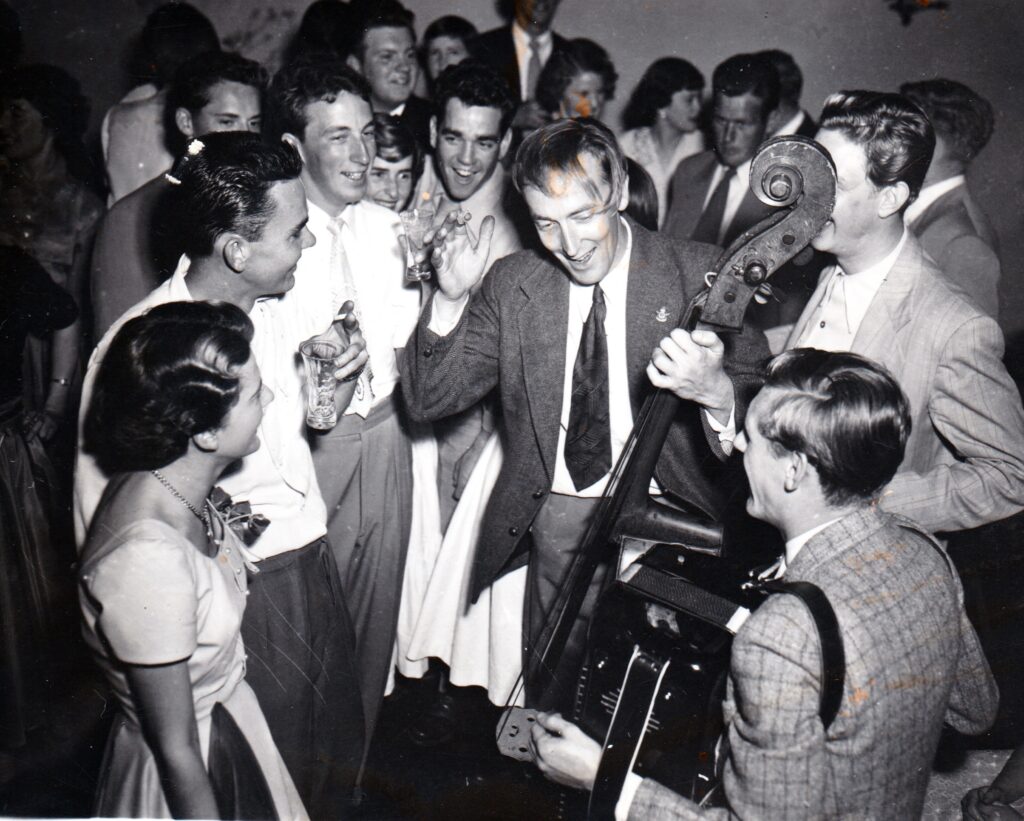

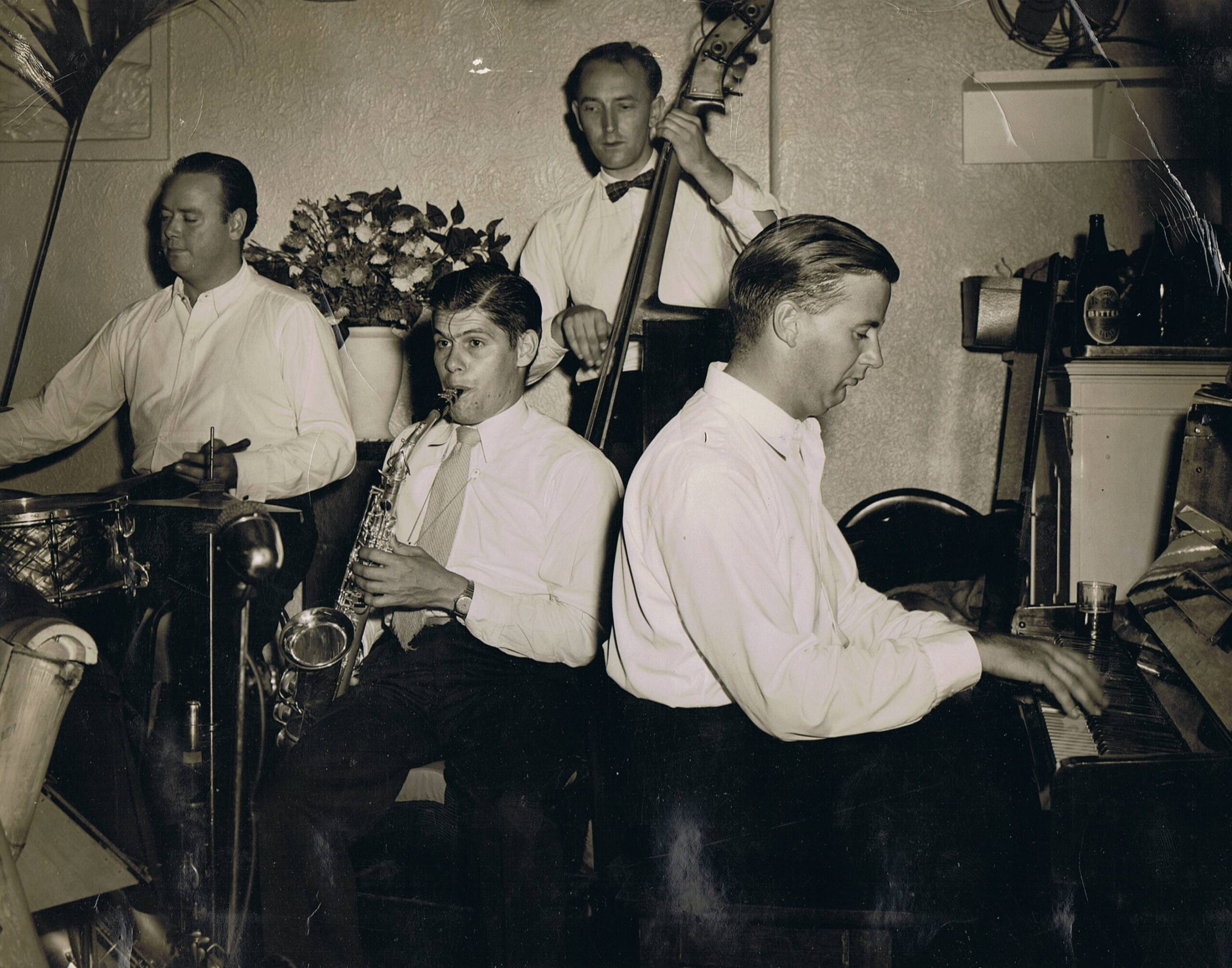
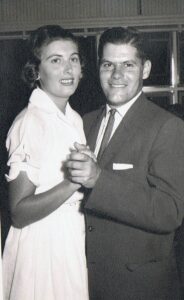
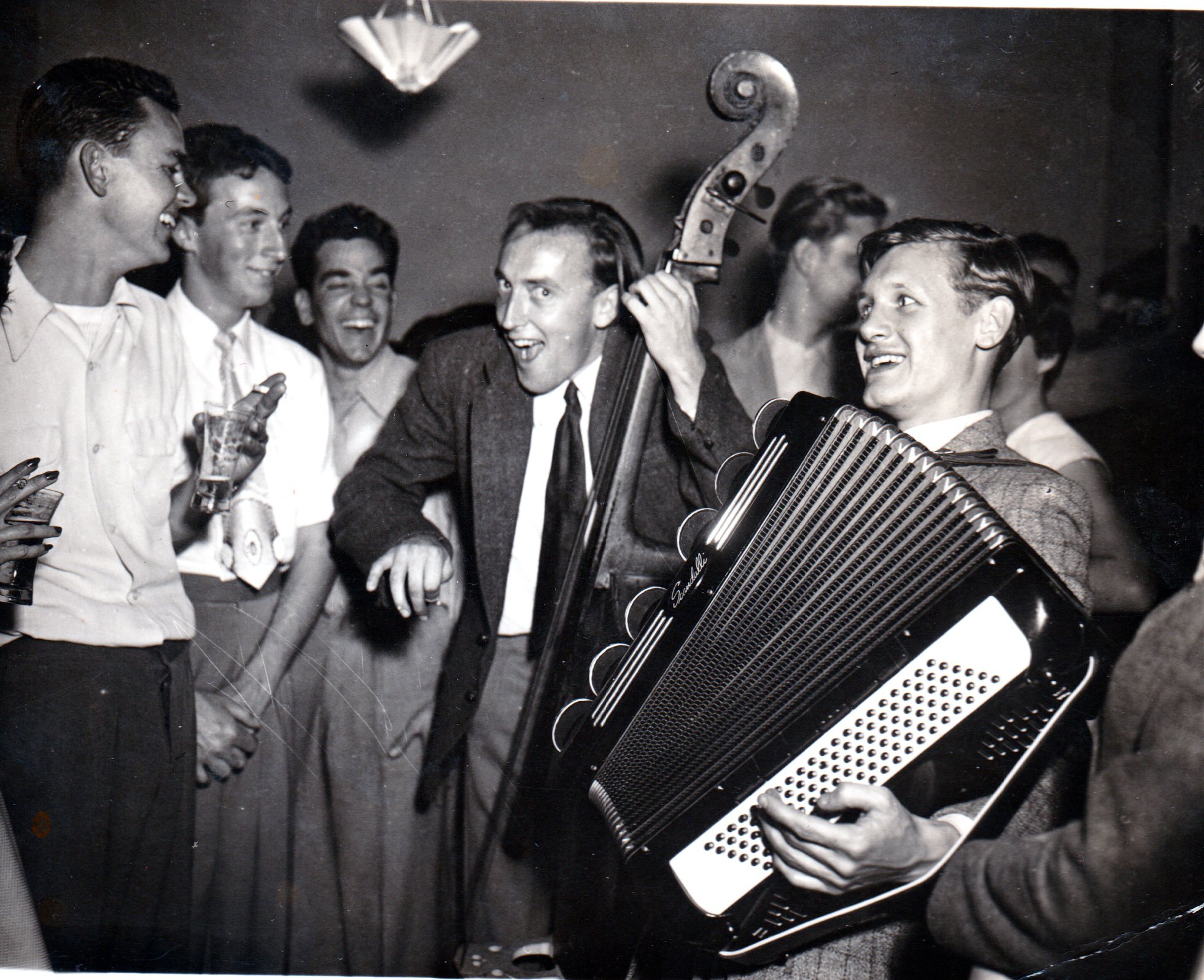 Peter Harrison (bass) with Billy Clowes (accordion)