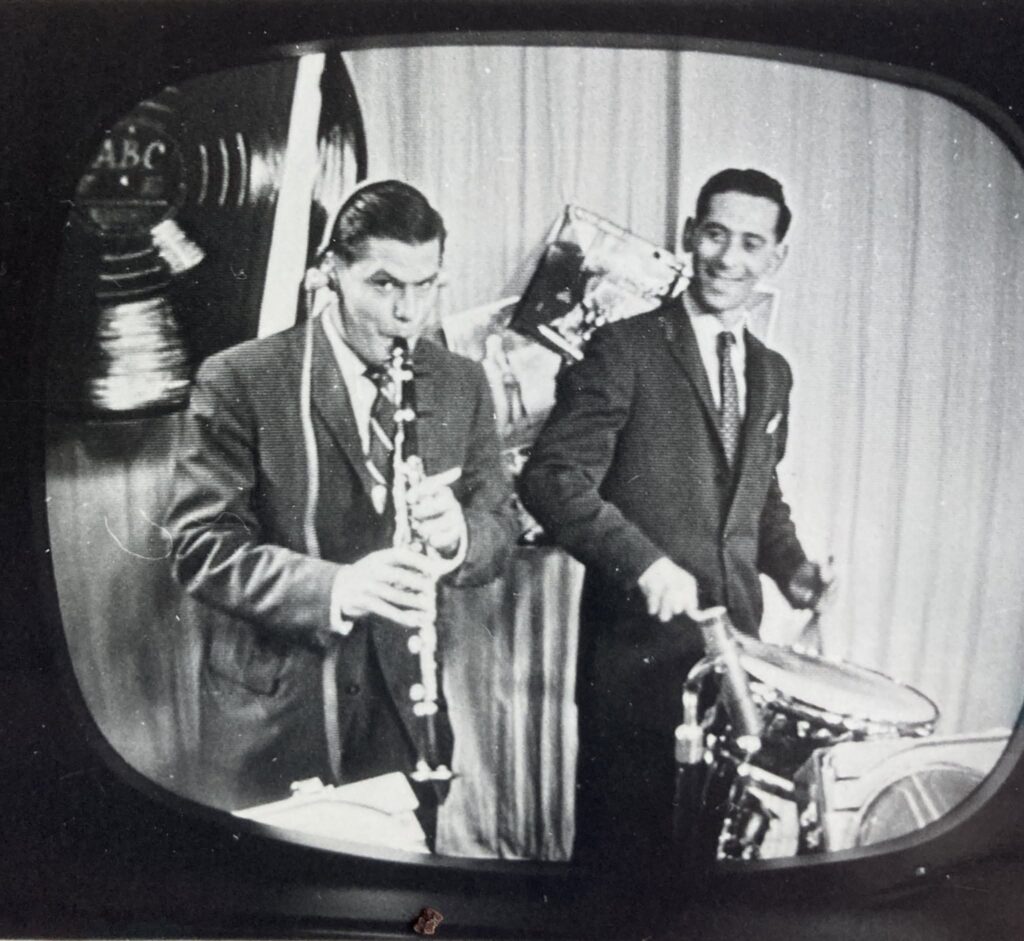
Kit Denton was a writer and broadcaster with a lifelong interest in music. He performed in dance bands in Western Australia before his later career in radio and television. He was the father of Andrew Denton.
Kit Denton, originally Arnold Ditkofsky, was a writer, screenwriter, producer and broadcaster who was prominent in his adopted home of Australia. He also tried his hand at prospecting. He was born in England of Polish Jewish descent.
Born Arnold Christopher Ditkofsky on 5th May 1928 in Stepney, Middlesex, England, Kit Denton was raised in London’s East End. His parents, Harry Ditkofsky and Fanny Baskin, were devout Jews who kept Shabbat, ate kosher and spoke Yiddish.
He joined the British Army following the Second World War, with which he served with the British Forces Broadcasting Service in Germany.
Served in the Australian Military Force 1953-1953
Kit married Lee Pearson, who was of Irish Catholic heritage, and became an atheist.
From 1951 until 1965, Kit worked for the Australian Broadcasting Commission as an announcer, and eventually moved on to screenwriting, producing and directing television. With an abiding interest in military history, he is best known for his 1973 novel, The Breaker, based on the story of Breaker Morant (the film, Breaker Morant, was not based on Kit’s book, but on a play by Kenneth G Ross). [1] Kit also wrote:
- The Thinkable Man, 1976. [2]
- Gallipoli: One Long Grave, a 1986 book about the Gallipoli Campaign of The Great War. [3]
- For Queen and Commonwealth, 1987, about British military forces in the late 19th century. [4]
- Burning Spear, a 1990 collection of prizewinning and internationally acclaimed stories. [5]
Aged almost 69 years, Kit passed away on 14th April 1997 at his home in the Blue Mountains, New South Wales.
He was the father of comedian, television producer, Gold Logie-nominated television presenter and former radio host, Andrew Denton (4 May 1960-), who married fellow tv presenter Jennifer Byrne and are the parents of Connor Denton (1994-). In August 2006, Andrew announced a $25,000 writing scholarship in his father’s name: The Kit Denton Fellowship, which has been presented to members of the Australian Writers’ Guild from 2007 onwards.
https://www.wikitree.com/wiki/Ditkofsky-1
https://en.wikipedia.org/wiki/Kit_Denton
1952
Mr. and Mrs. Kit Denton, who were married last Friday, met in the course of their radio station duties. Mr. Denton is an announcer. The bride, who was Lee Pearson, is the daughter of Mrs. E. J. Pearson, of Tenterfield, N.S.W., who came to Perth for the pretty all-pink wedding which took place at St. Mary’s Cathedral. The honeymooners will set up house in a nice little flat over-looking the river at Mosman Bay.
Western Mail (Perth, WA : 1885 – 1954), Thursday 7 August 1952, page 33
1960
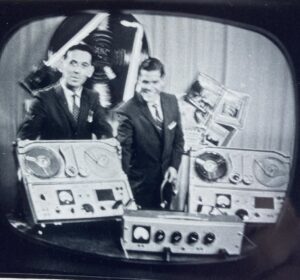
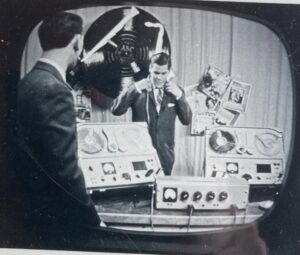
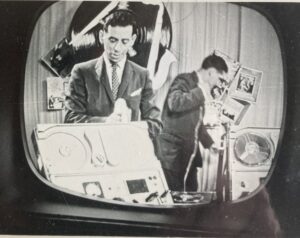
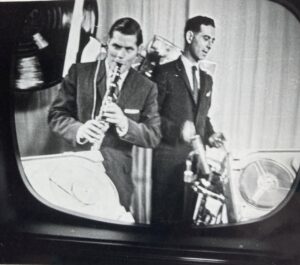
ABC TV Perth (station callsign: ABW) officially launched on May 7, 1960. Broadcasts began from the original studios on Adelaide Terrace in downtown Perth and its transmitter in Bickley, expanding public-owned television to Western Australia. The station relied entirely on live-to-air broadcasting for its music performances. True multitracking did not exist in the station’s infancy; early local audio engineers captured performances using mono or basic two-channel twin-track tape recorders (like early Ampex machines) connected to a centralized mixing console.
Kit Denton assisted Jack Harrison with his multi tracking broadcast.
1961
GOLD MINER IS NOW A TV STAR
Witty, urbane Kit Denton considers himself a “failure” in Australia. The reason: he migrated to be a goldminer, instead has found himself stranded (prosperously) on the surface. Denton came to Western Australia 11 years ago from London. For six months he WAS a goldminer on Western Australia’s colourful goldfields, but then decided he didn’t have the aptitude and settled in Perth. Here he found consolation in a field he had already had some knowledge of in Britain — radio and entertainment. Almost reluctantly he found himself being pushed up the ladder. He worked, successively, on three Perth commercial radio stations, as announcer, programme manager. scriptwriter, then joined the Perth stations of the Australian Broadcasting Commission. He soon won himself a reputation as a polished interviewer and prepared many radio documentaries. Denton has travelled over much of the 1,000,000 square miles of Western Australia with a tape recorder, a lively imagination, a quick eye and ear. Many of his programmes have been broadcast throughout Australia, and some over Radio Australia, the ABC’s shortwave programme to the world. “I was a rotten miner, but Australia has been good to me just the same.” Denton said. “This must be the most exciting continent on earth to live at the moment.”
Good Neighbour (ACT : 1950 – 1969), Saturday 1 April 1961, page 3
1964
A LOOK AT THE BEATLES
The Beatle Cult comes under a close and humorous scrutiny in B-Day on Channel 3 tonight at 8.30.
The programme, narrated and compiled by Kit Denton, looks at the Beatles’ “trade marks”—their shocks of hair, and the distinctive Mersey beat.
Their hair style has become part and parcel of their act.
“Yet,” says Kit Denton, “hair-styles have been part of the ‘personality’ of many of the world’s greatest figures.
“In the 1930’s Adolf Hitler had the most talked about hair-do in the world. The flambouyant wrestler Gorgeous George would have been nothing without his wonder-ul growth of hair. Further back in history, the biblical character Samson won fame through his hair, and maybe the Beatles should note that without it he was a nothing.”
Kit Denton takes a close look at the Beatles’ “Liverpool Sound”, with the Mersey beat.
“Is it any different from the beat that took the King of Swing, Benny Goodman, to dizzy heights in the 1940’s?” Denton asks.
To illustrate his point, he shows a group of madly stomping teenagers of the 1960’s dancing to music by the Beatles. The music changes and you see the same group dancing just as well to Benny Goodman and his swing of the 1940’s; then further back to Kid Ory, even further back to Meade Lux Lewis and way, way back to Johann Sebastian Bach.
Canberra Times (ACT : 1926 – 1995), Thursday 11 June 1964, page 39
1983
Author’s new book not meant to destroy Breaker legend – By PETER FULLER, Literary Editor
I’m devoted to cryptic crosswords,” says Kit Denton, “and I never give them up. I have some at home which I’ve had sitting around for years with one clue still vacant.”
The remark is made by way of analogy. For more than a decade Denton has been wrestling with the mysteries of the lives and death of Harry “Breaker” Morant, bushman, poet, soldier and, some might say, martyr. He has dealt with him fictionally, in his novel ‘The Breaker’, and historically in his latest book, ‘Closed File’, written in part “to get the itch out of my skull”. But is the file really closed on the man who was executed with fellowofficer Peter Handcock at Pretoria in 1902?
“I’d like to think it was; I’d like to think so,” Denton says.
“I don’t really believe it is, not while those imponderables are still there. The analogy is the detective who successfully wraps up the case, the guy’s in prison, and he knows when he goes back over the file that there are two witnesses that he can’t find.
“There are two outstanding things, aren’t there?” he says.
“For me the itch is never going to truly disappear until and unless I can scratch at those two things. One: Who was Morant? Was he Harry Harbord Morant, of Hampshire, or not? That’s one. And the other, what happened to James Francis Thomas’s record of the court-martial, which he brought back to Australia with him? Where the hell is it?”
“There’s an ancilliary one, too: why were the documents destroyed by the Brits? And perhaps another ancilliary question: is my romantic suspicion about a correspondence between the Kaiser and the King anything more than a romantic suspicion? Until the revolution, and I can sit there and rifle through, and say – “There it is: ‘Dear Ted’.
For those who came late, “Breaker” Morant was, by his own word, the son of Admiral Sir George Morant, a member of an old and honourable south-west-of-England house. Whatever truth there might be in that, he was a notable personality in Australia in the latter part of the last century, making a reputation for himself as a superlative horseman and versifier of some talent. When the Boer War broke out he joined the South Australian Mounted Rifles and reached South Africa in February 1900. A little more than a year later he was commissioned as a lieutenant in the Bush Veldt Carbineers, one of the irregular units formed by the British to suppress the Boer commandos; less than a year after that he and Handcock died before a firing squad for war crimes. They were defended by Captain J. F. Thomas, a Tenterfield lawyer and newspaper proprietor. The circumstances surrounding their executions were not quite regular, and it has been suggested that the British used them as scapegoats to placate German outrage at the killing of a German missionary.
Denton says ‘Closed File’ is not an attempt to the “demythologise” the figure of Morant, who has become something of a folk hero in the light of ‘The Breaker’ and the film ‘Breaker Morant’.
“I wasn’t intent in the first place on establishing a myth,” Denton says, “and certainly there’s been no intention in this case of breaking down a legend. “It’s simply that from word one, from the first time I heard him talked about, I’ve wanted to know what the truth of the matter was. And this [‘Closed File’] is something like the book I wanted to write in the first place – not the novel.”
In retrospect, Denton isn’t surprised that Australia was captivated by Morant. It’s a standard pattern, he says. “Robin Hood, Jesse James, William Tell, Siegfried, George Patton – you know. The winner against all odds, like Phar Lap, is one thing; the nearly winner against all odds is the stuff of legend. The good bad man is the one people like because he’s bucking the system.”
At the time that Denton wrote ‘The Breaker’, shortage of time and money prevented him doing the sort of research he wanted to do to unravel the whole Morant story. ‘Closed File’ is the product of that morecomplete research, which has thrown up some surprising facts and opinions, among them the charge by Trooper Theunis Botha, Morant’s interpreter, that on at least one occasion “The Breaker” had shown cowardice in refusing to close with a Boer party.
“That came as a shock to me when I first saw it,” says Denton.
“It’s the only hint, anywhere that I’ve searched, anywhere at all, of that sort of reticence in the face of physical danger. And it’s easily acceptable that Botha was biased about it, or looking at it from the wrong point of view, or not capable of appreciating the military situation, as it was. But then 1 don’t know that Morant was capable of appreciating it. He had no practical experience in making command decisions, other than what he’d learnt on the ground. But he was a quick study, wasn’t he’?”
The Morant of history was, Denton says, “an enigma from beginning to end”: “That business of where he came from is a puzzle.” His character is more easily discerned, however, and Denton would sum it up with the word “bastard”.
“That phrase that the old man who first told me the story used is the one 1 still cling to – ‘The bravest bad bastard I’ve ever met’.
“He was a weird mix of things, and I think if you have to put one word down to describe him neatly, the nearest word 1 think might be “bastard”, in the Australian sense, so that it has that equivocal meaning. He’s a good bastard, he’s a bad bastard: you can take it whichever way you want, and quite plainly through his life people took it at one side or the other. I doubt very much if he knew what side he was on anyway.
“I truly think he was a properly, scientifically, clinically amoral man, incapable of distinguishing between conventional right and wrong. Therefore I can’t see him as a sinful man, as an evil man.”
It’s not unfair, though rather simplistic, to see the Carbineers as tough men who were unjustly punished for doing their job, an admittedly dirty job. If their job was containing the Boers so that peace talks could continue, then they were doing it, Denton says -“but they were doing it in a very roughshod if not slipshod way, which was true not only of them but of most of the other troops under command at that time in forward areas.
“Unjust? Yes, I think that’s probably true because there were so many examples of the same sorts of things being done, on both sides. But there was a degree of unfairness about the whole thing. It was a show-piecc trial – a German missionary had been killed, a civilian. It was a perfect chance for Kitchener to do things that needed to be done, in his eyes.”
For Denton, a question mark still hangs over the behaviour of Lord Kitchener, the British Commander-in-Chief, though “it’s more a suspicion, more a feeling, an emotion than anything else”, he says.
The thing that “really gets under my skin” is that after sentence was passed. Kitchener was out of touch for several days. “At no other level at all than the purely military one, for the GOC in a war area simply to sever himself from communication at that time was dead wrong. It smells,”
Canberra Times (ACT : 1926 – 1995), Sunday 23 October 1983, page 9
Slow and painful: Andrew Denton recalls father’s final agonising moments