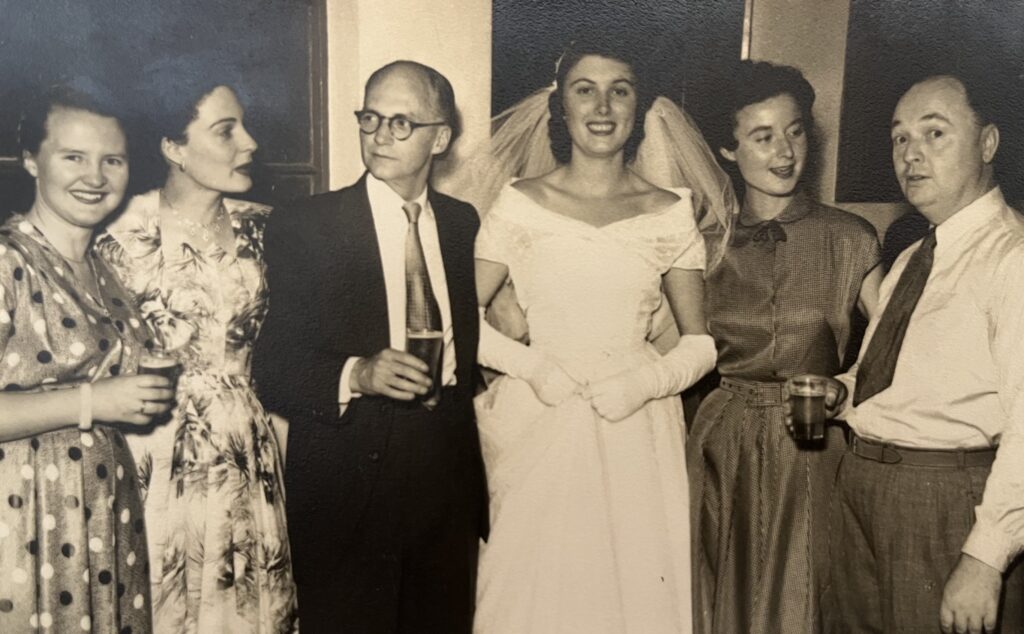
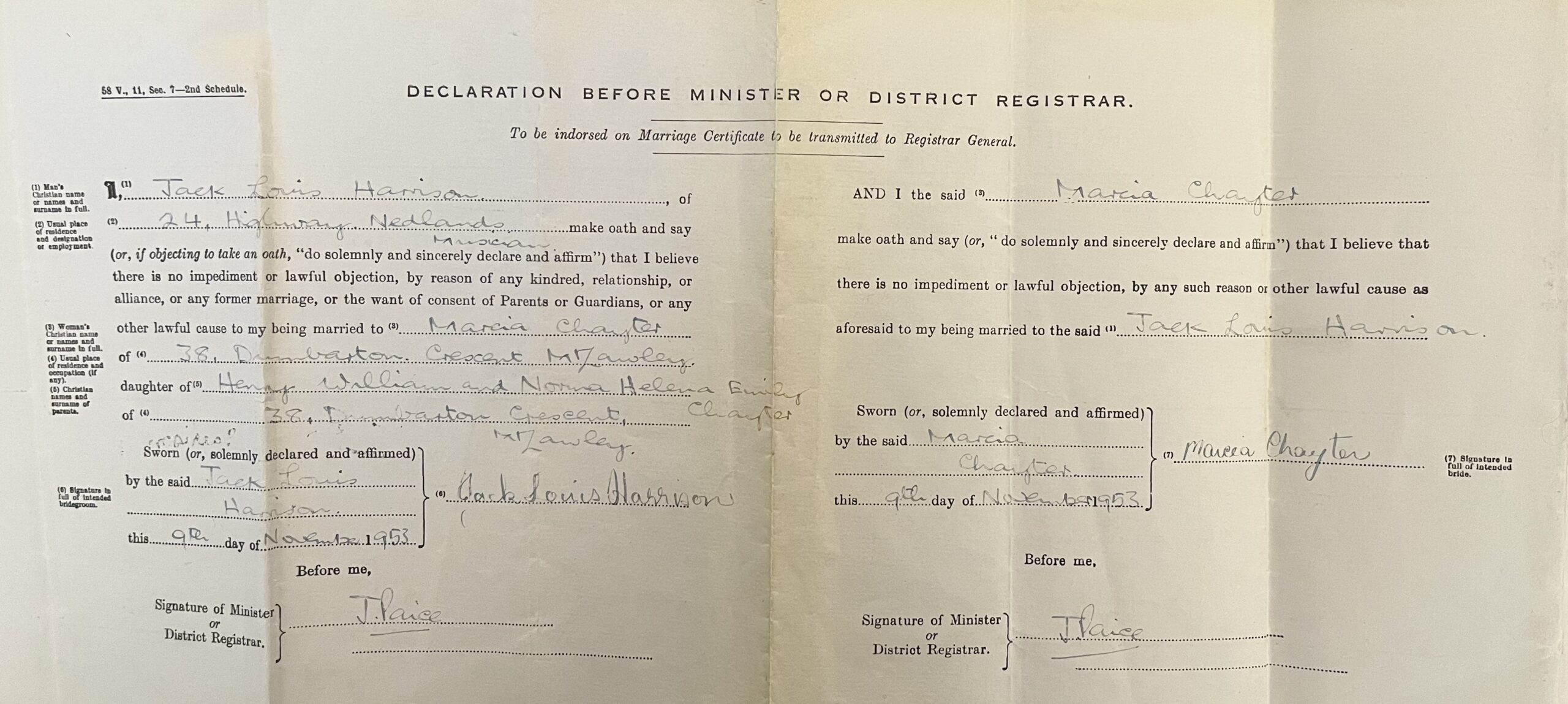
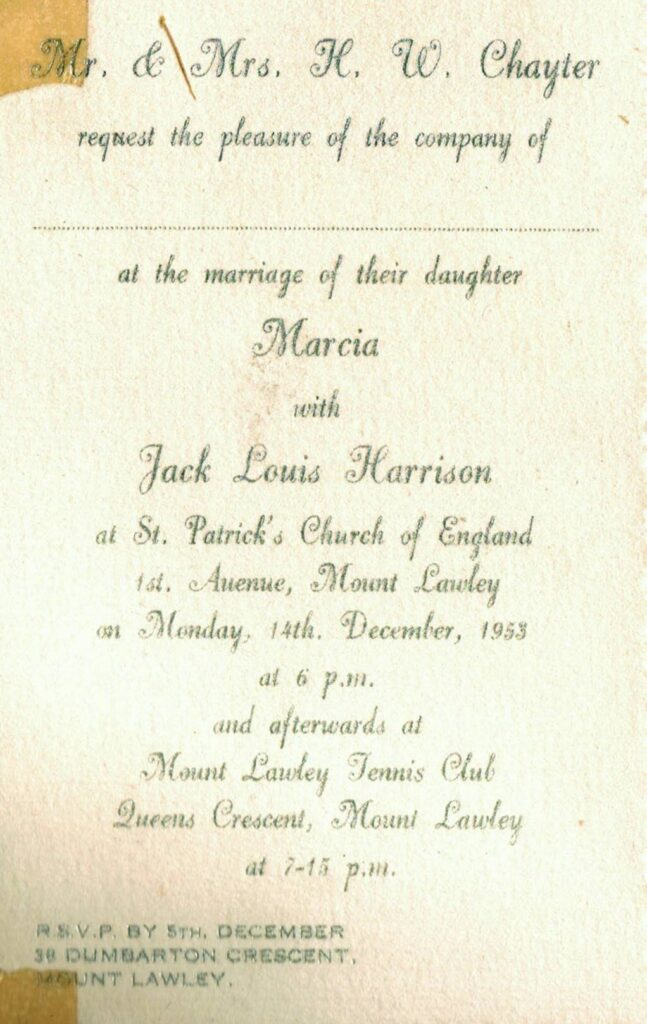
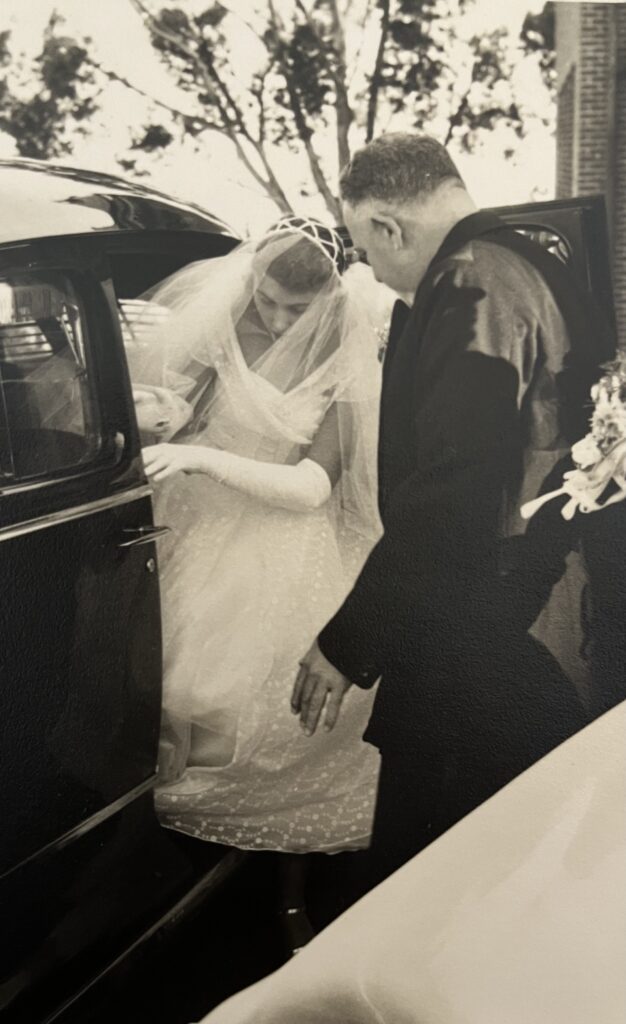
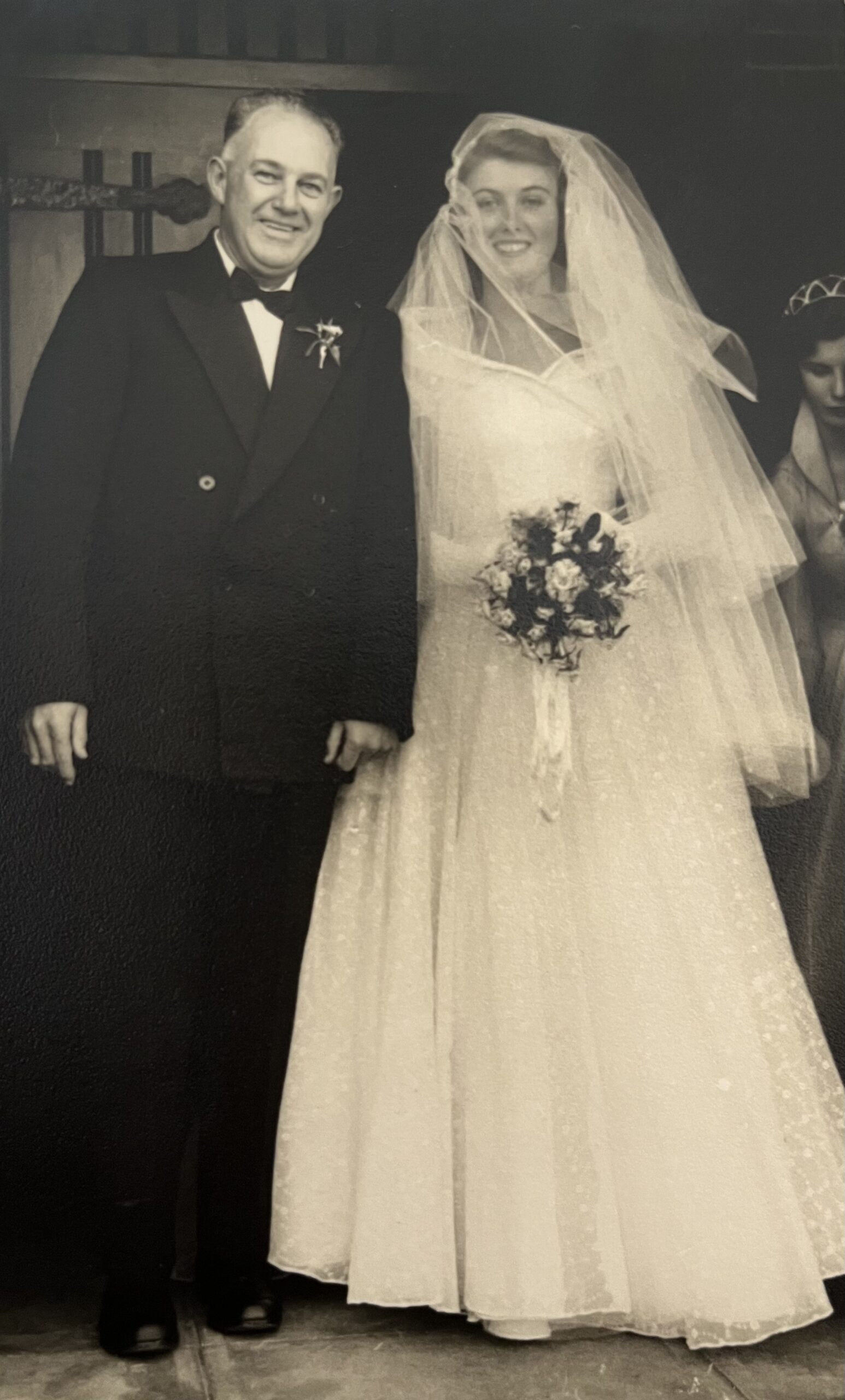
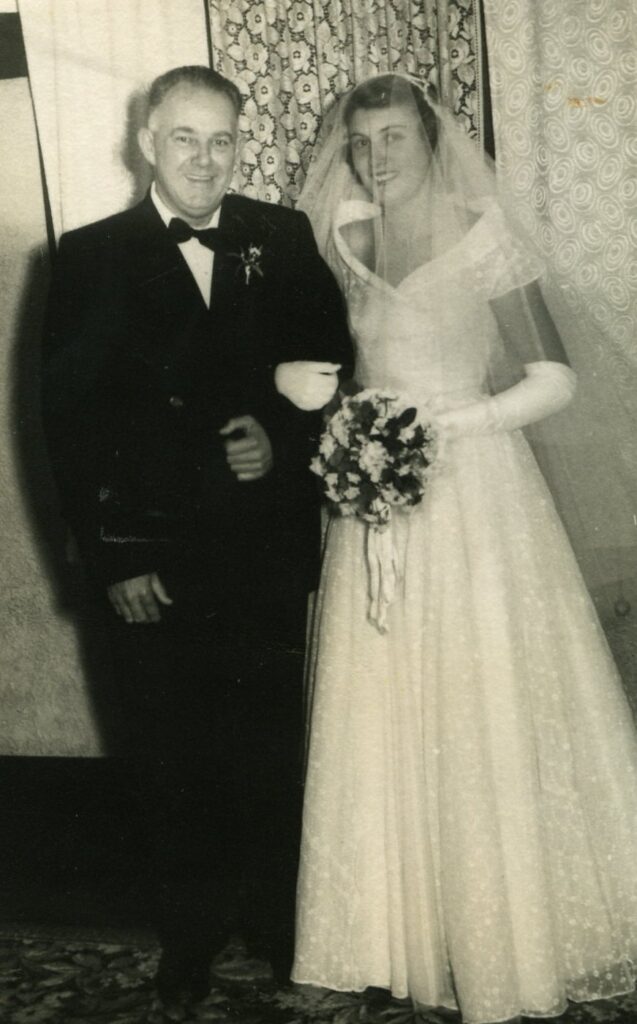
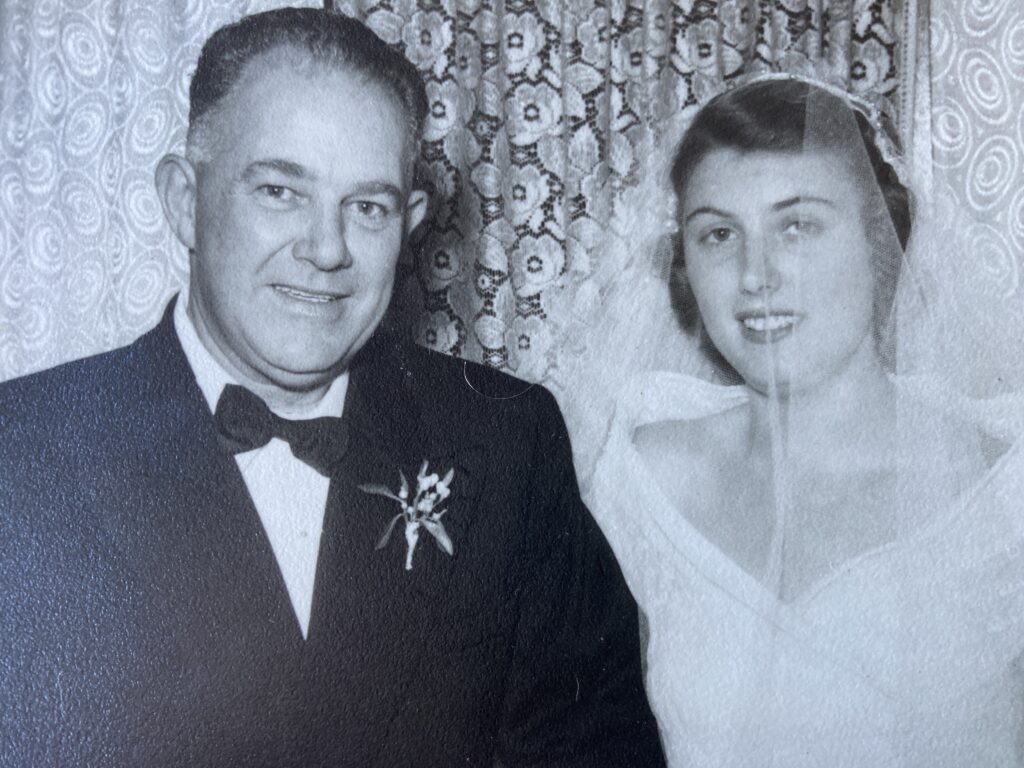
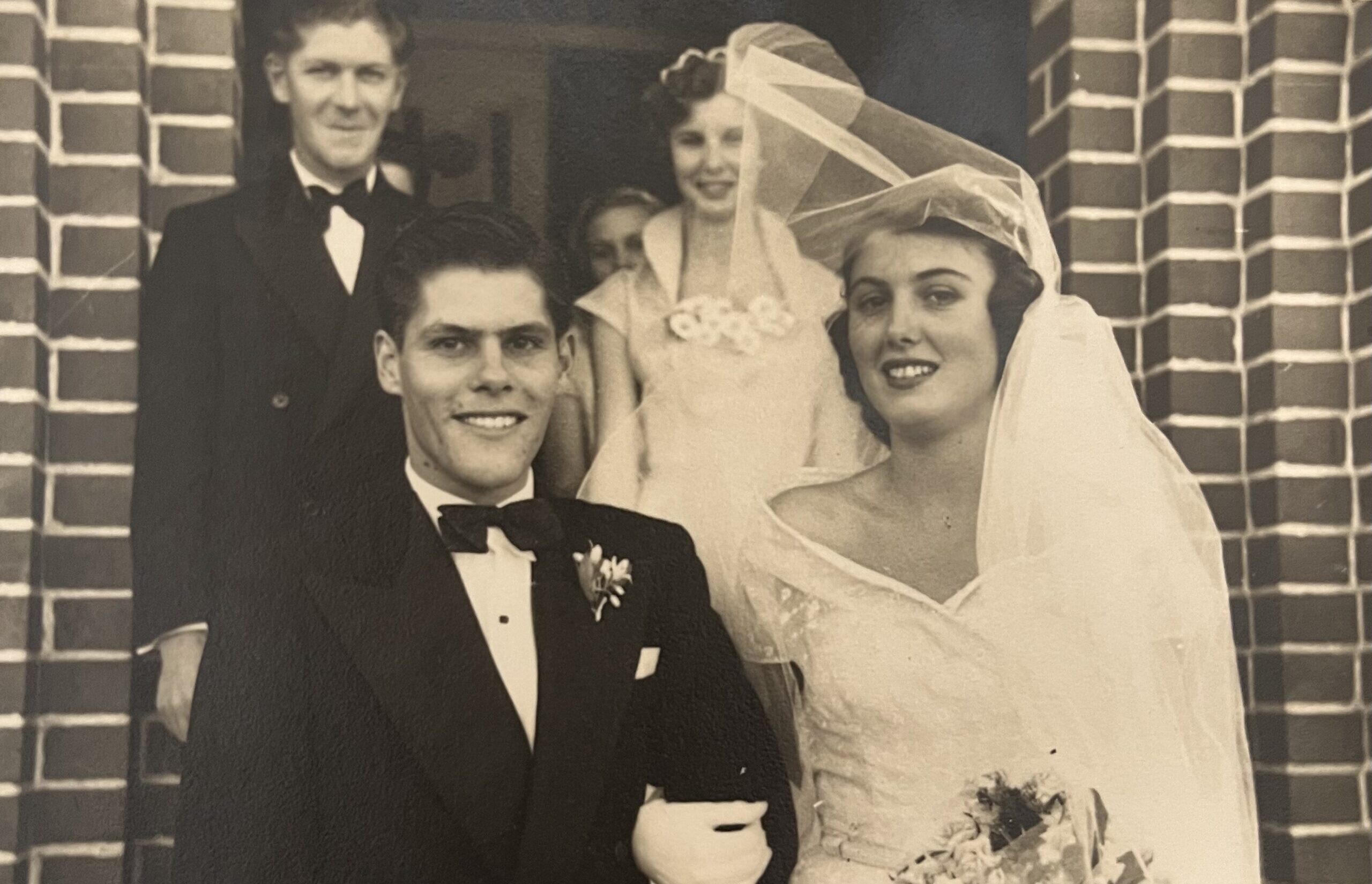
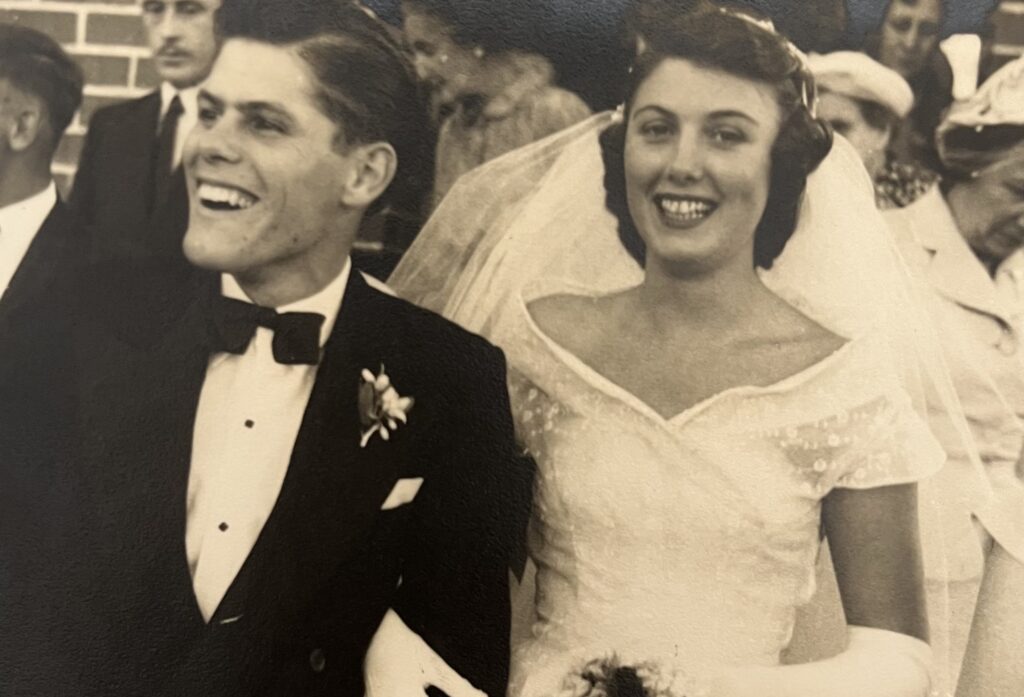
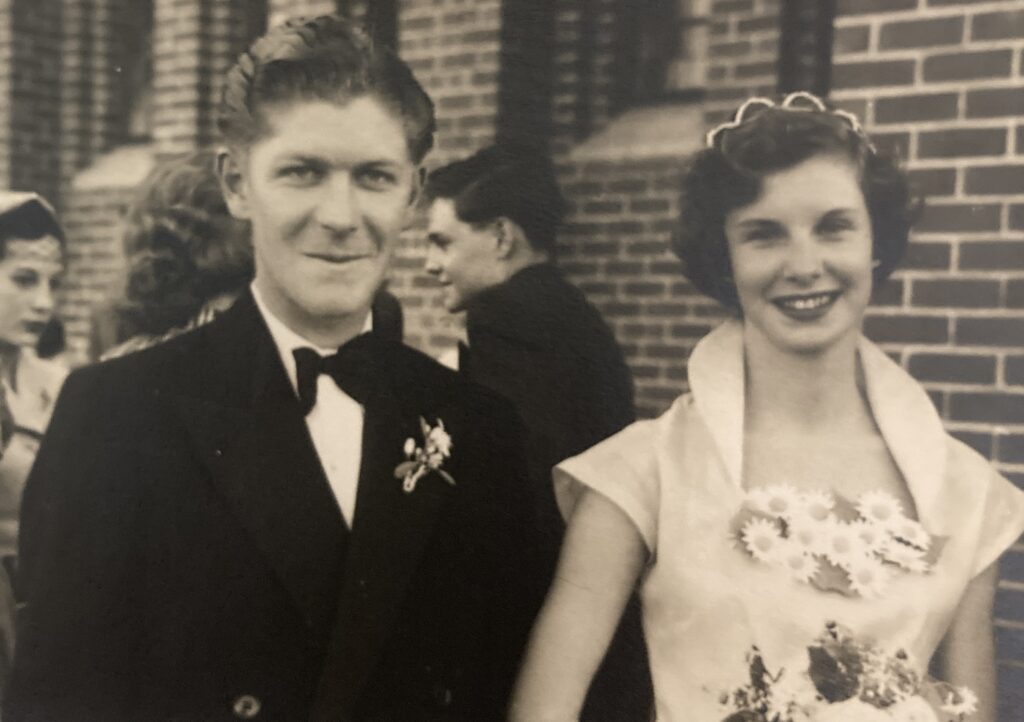
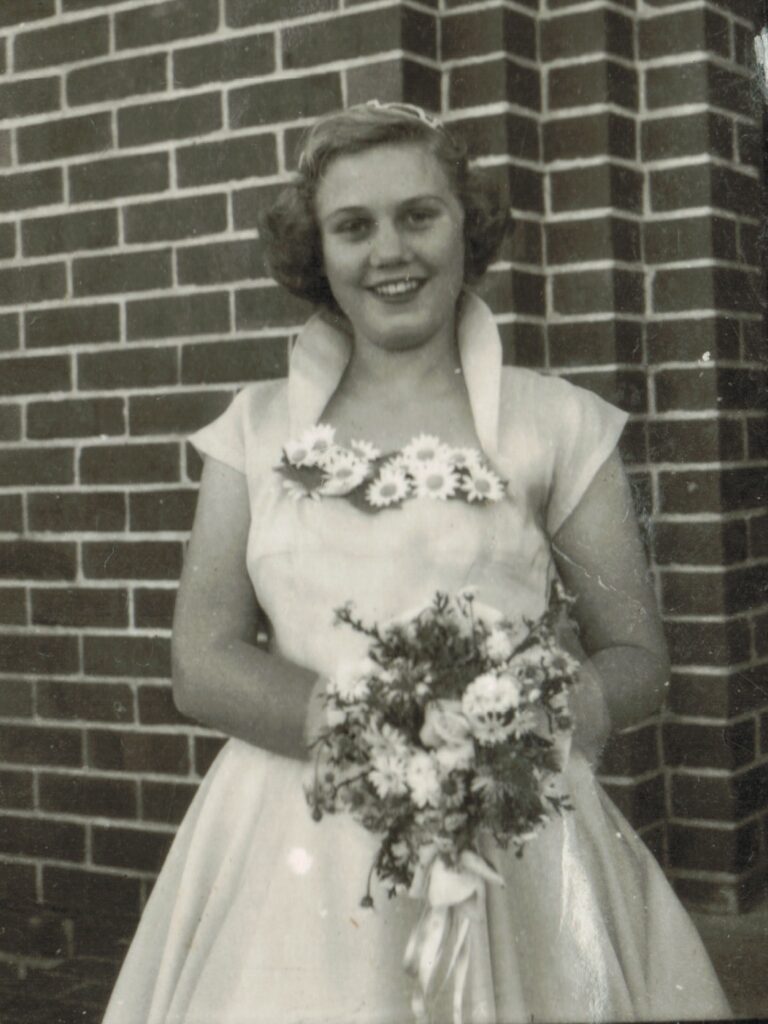
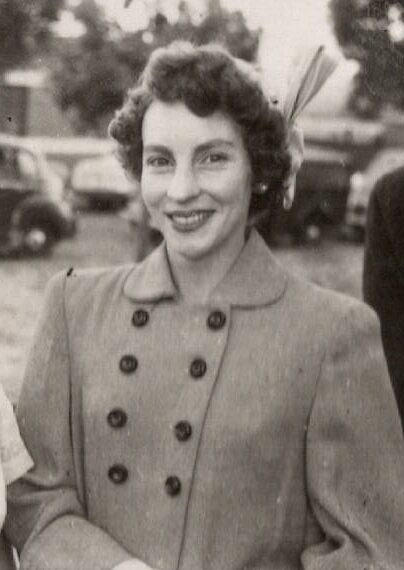
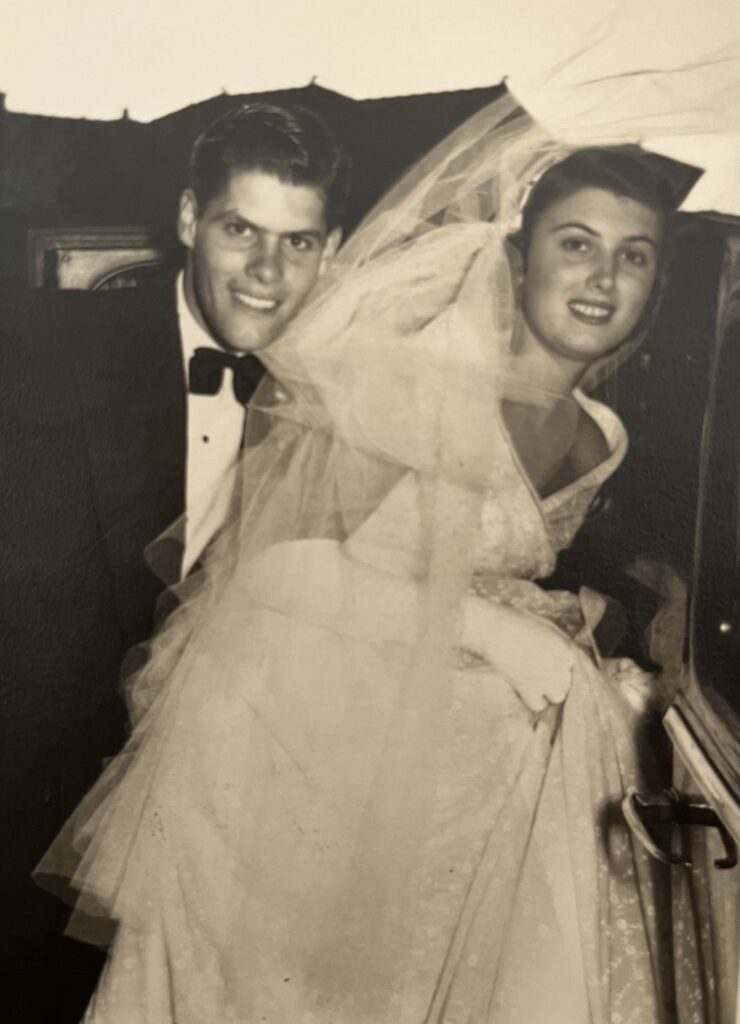
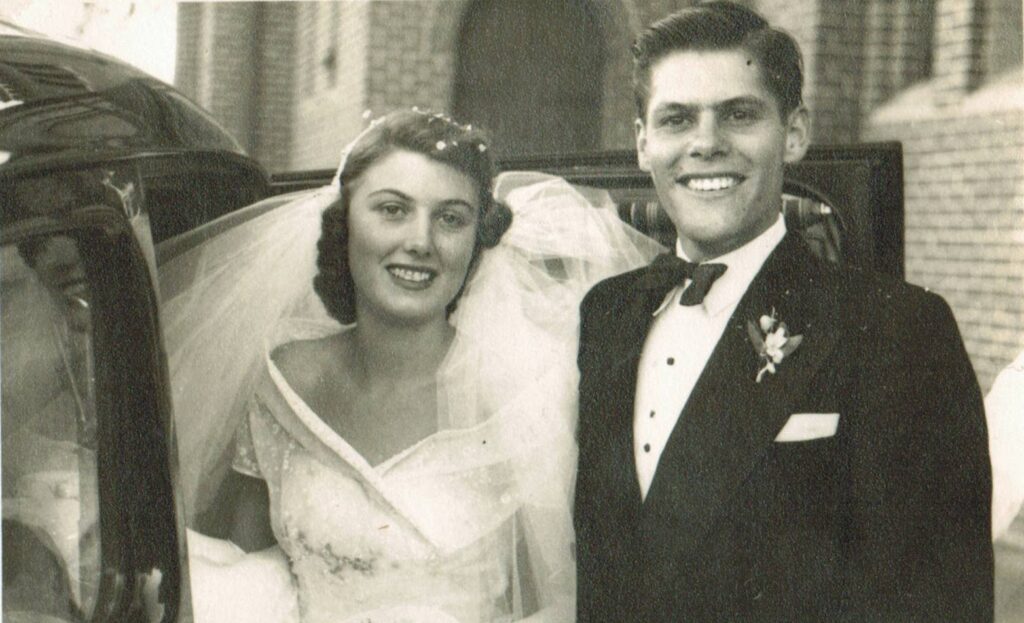
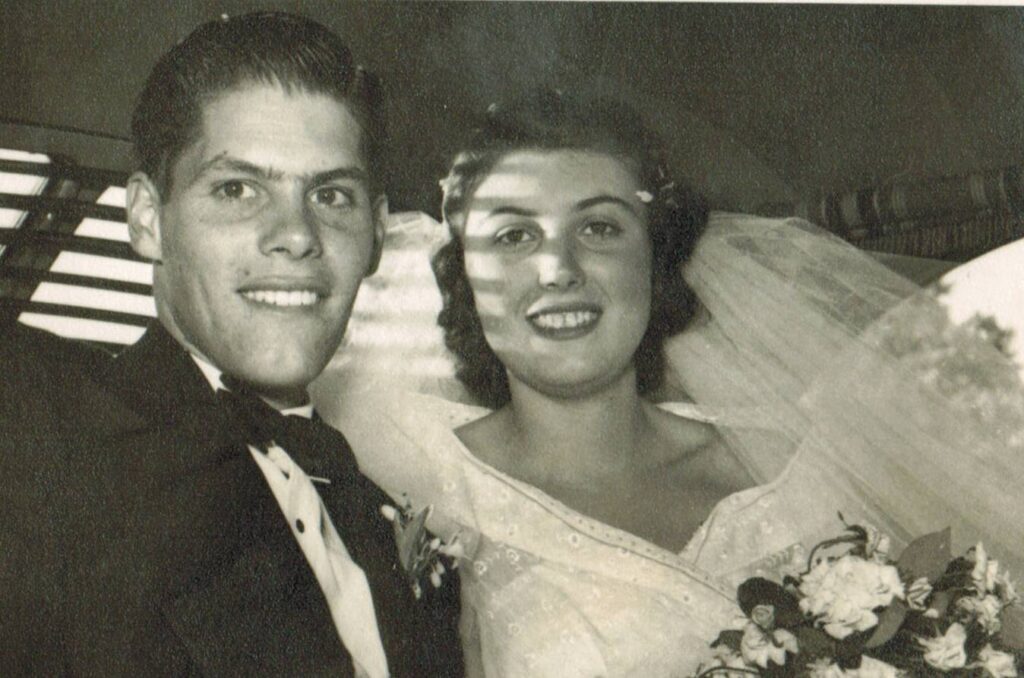
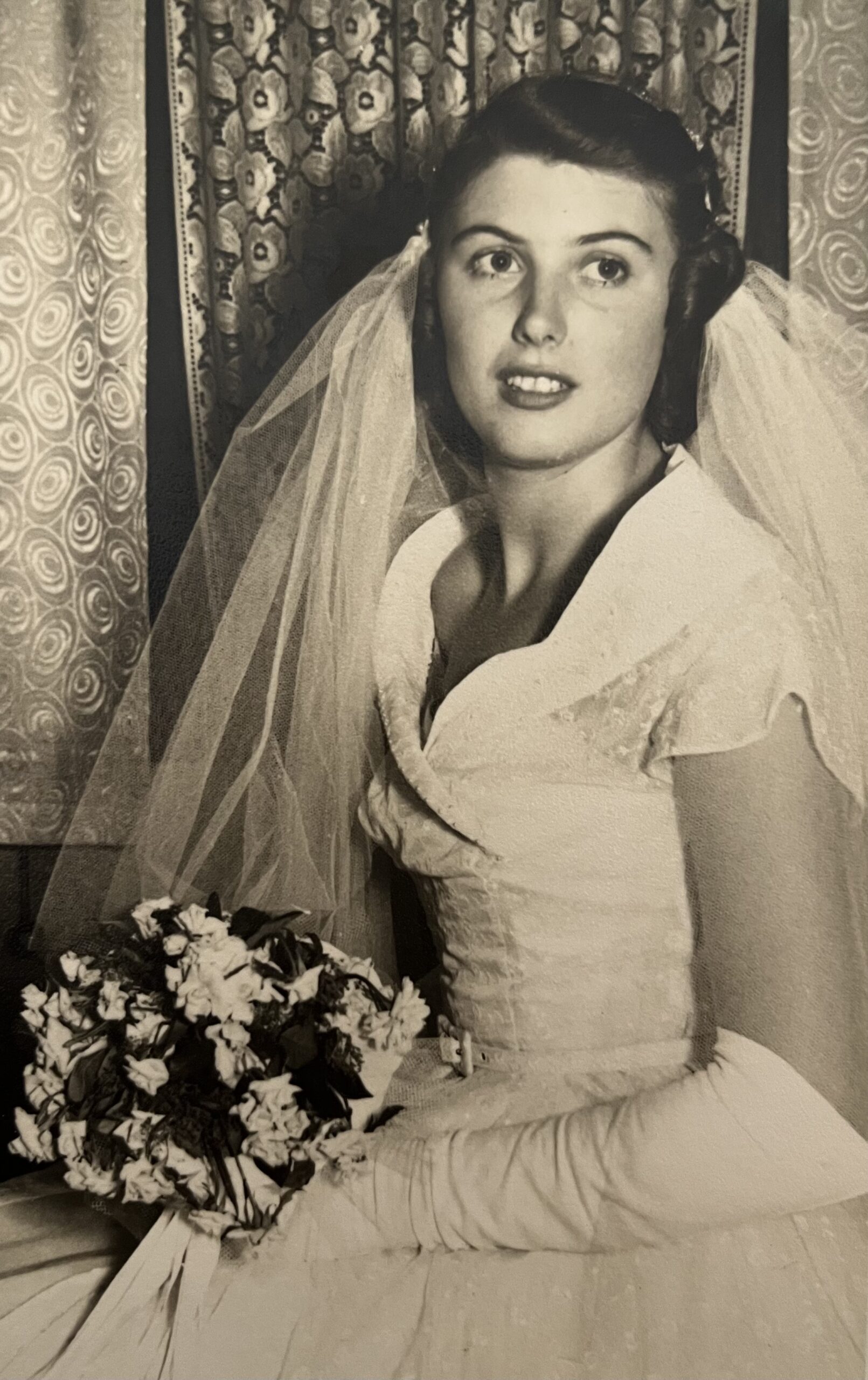
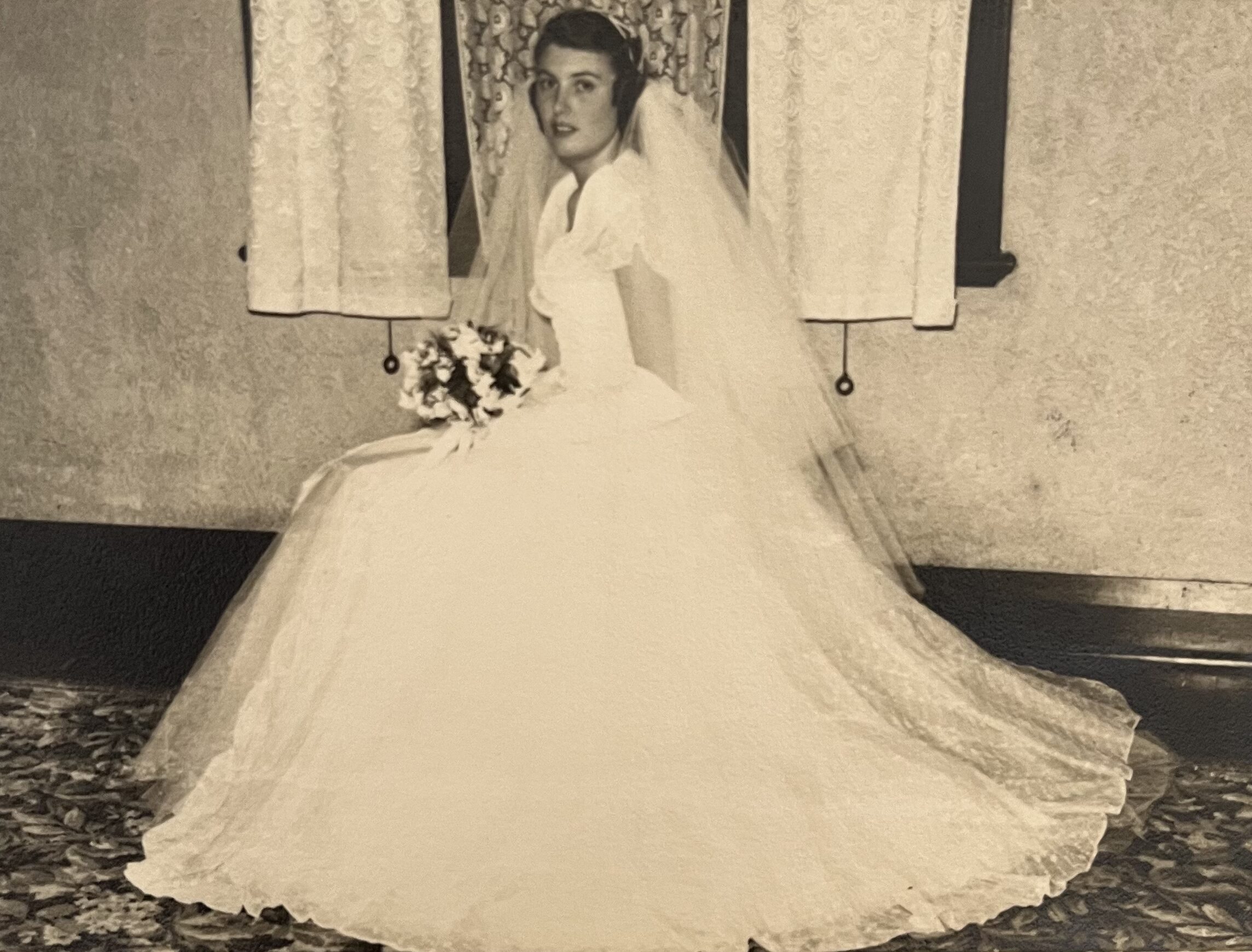
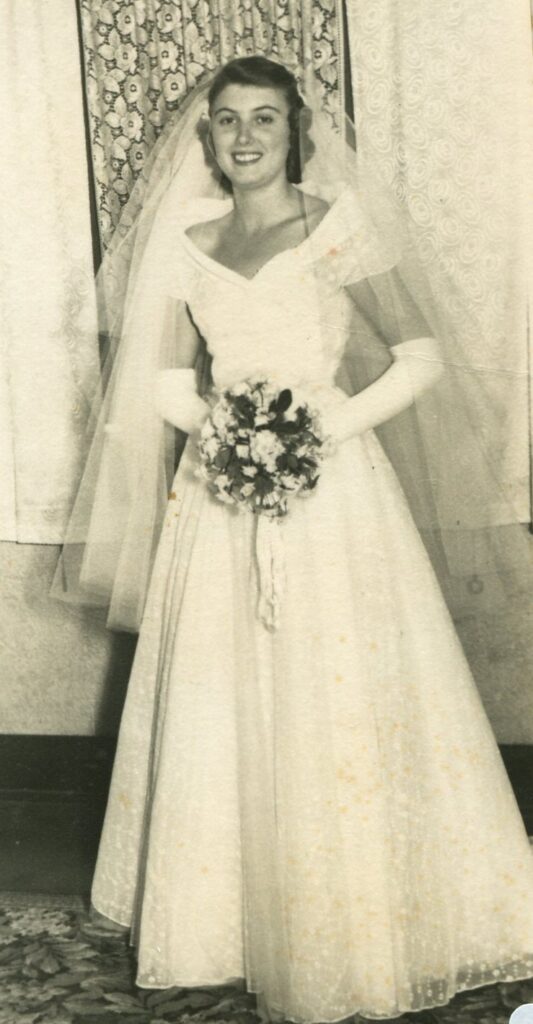
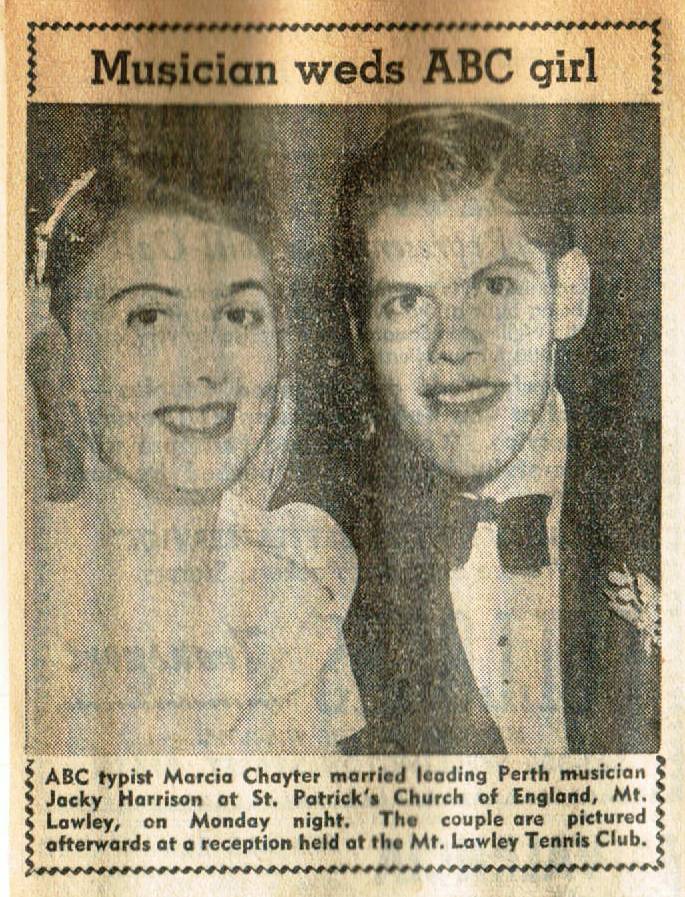
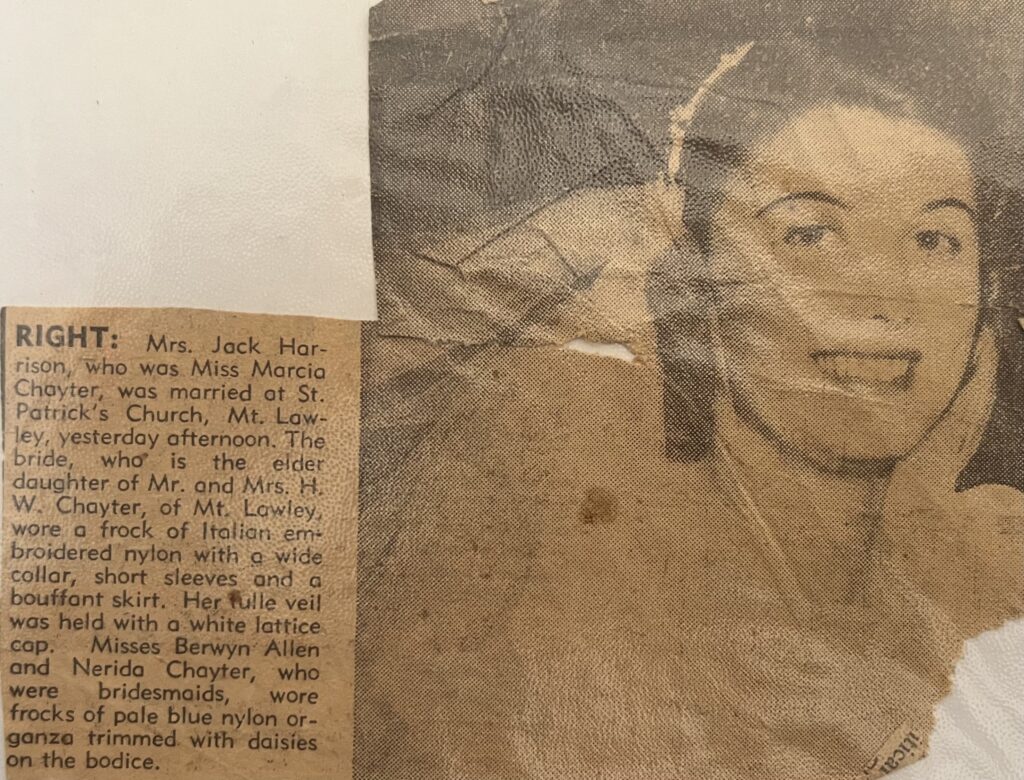
Marcia’s dress was made by Diana Waldron’s mother. It was made with %100 Italian embroidered nylon with short sleeves, a stiff petticoat under the bouffant skirt and a gaspingly tight corset underneath. The neckline was modelled on Snow White from the Disney movie as were the bridesmaid’s dresses. Daisies were one of Marcia’s favourite flowers, which were pouring out of the necklines of her bridesmaids, Berwyn Allen and sister Nerida. Their dresses were pale blue nylon organza.
The cap was a lattice of netted pearls that kept her tulle veil in place.
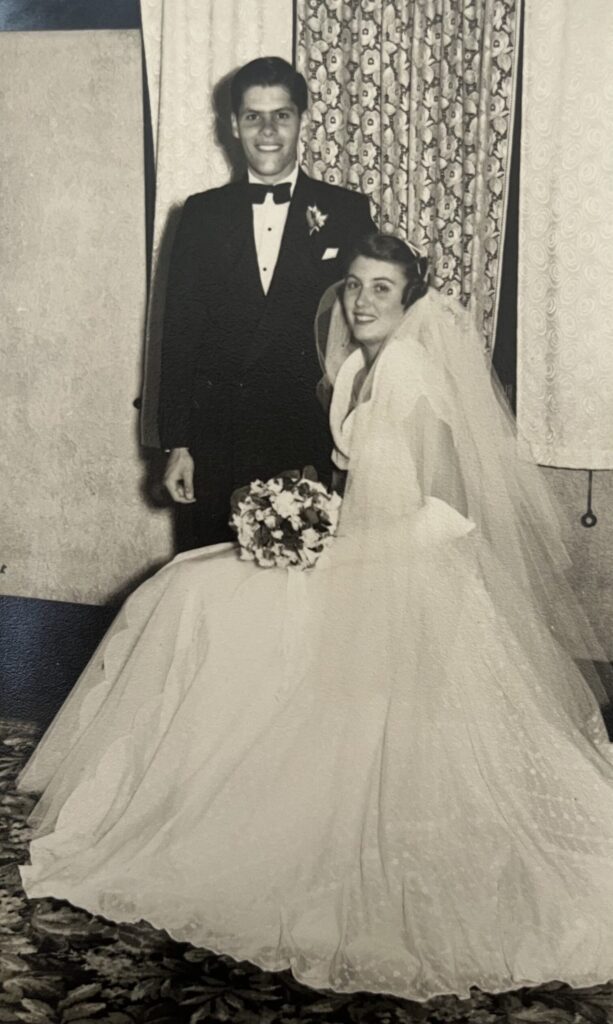
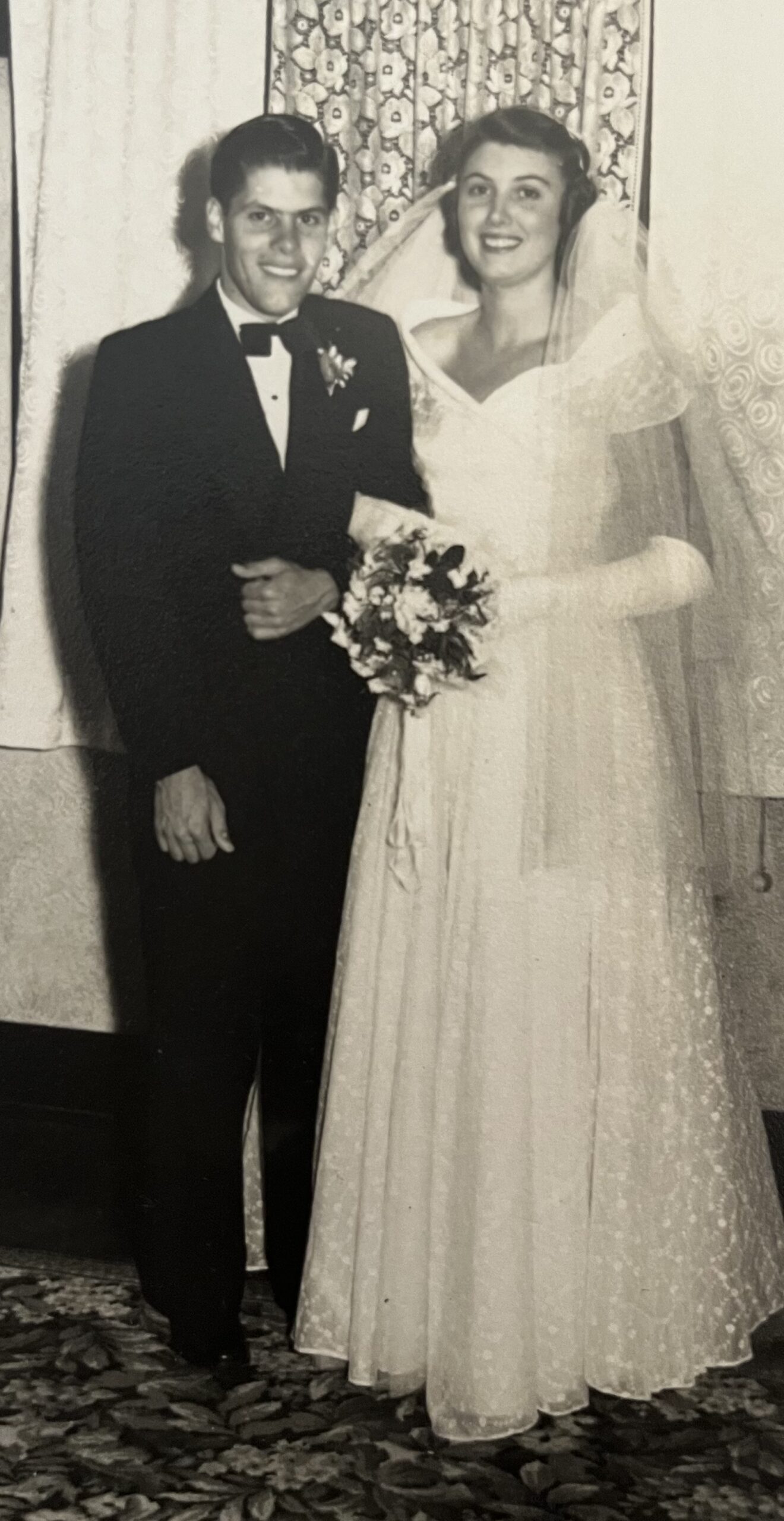
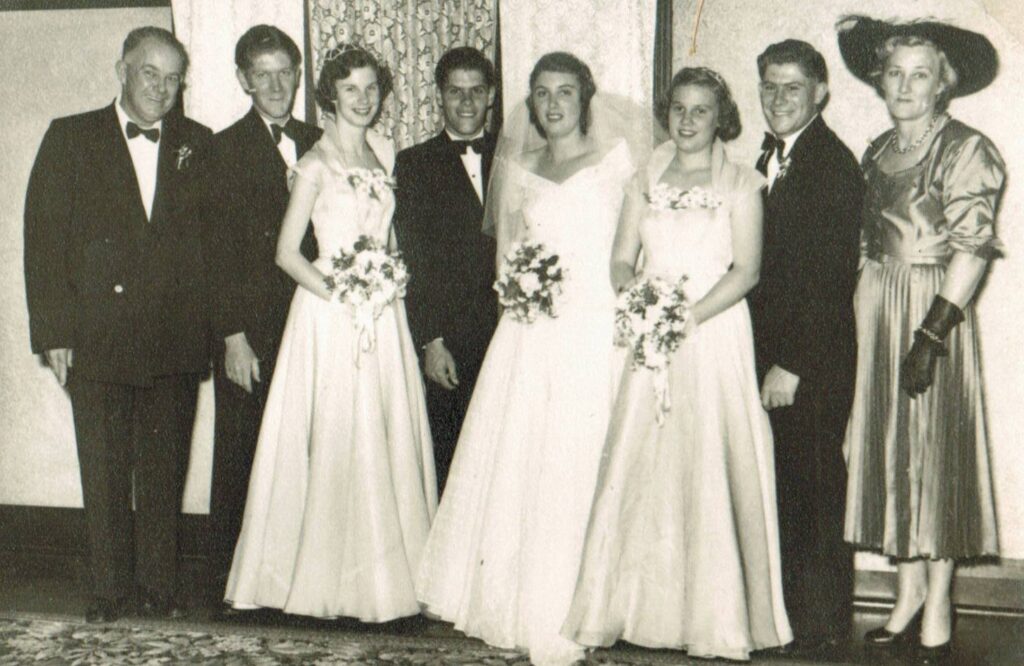
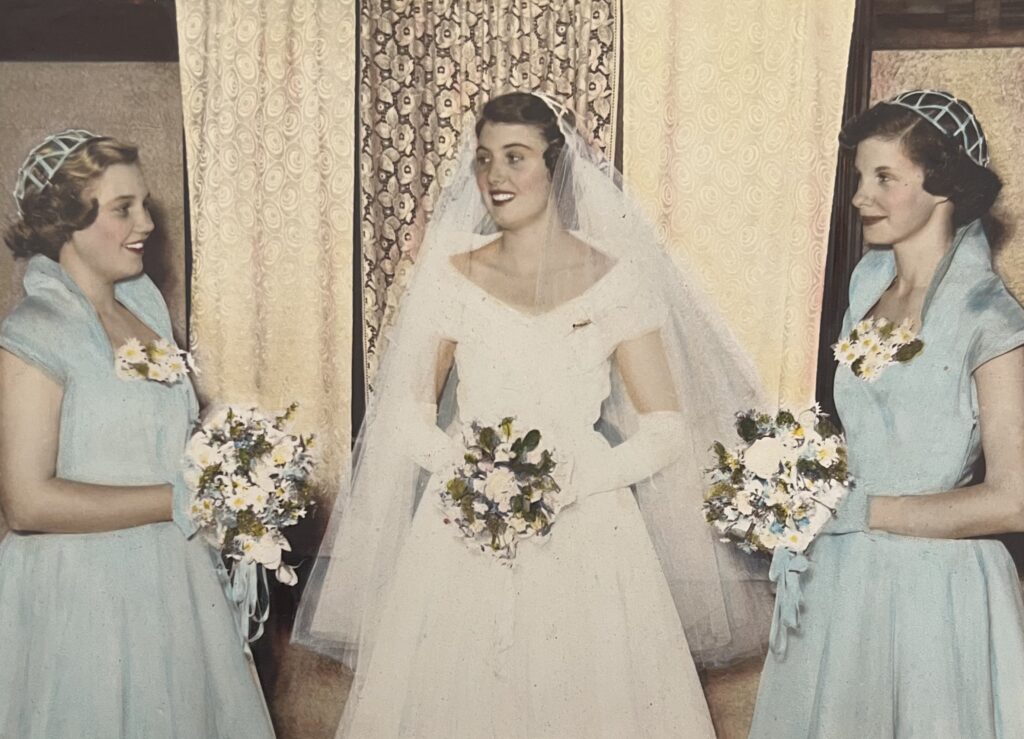
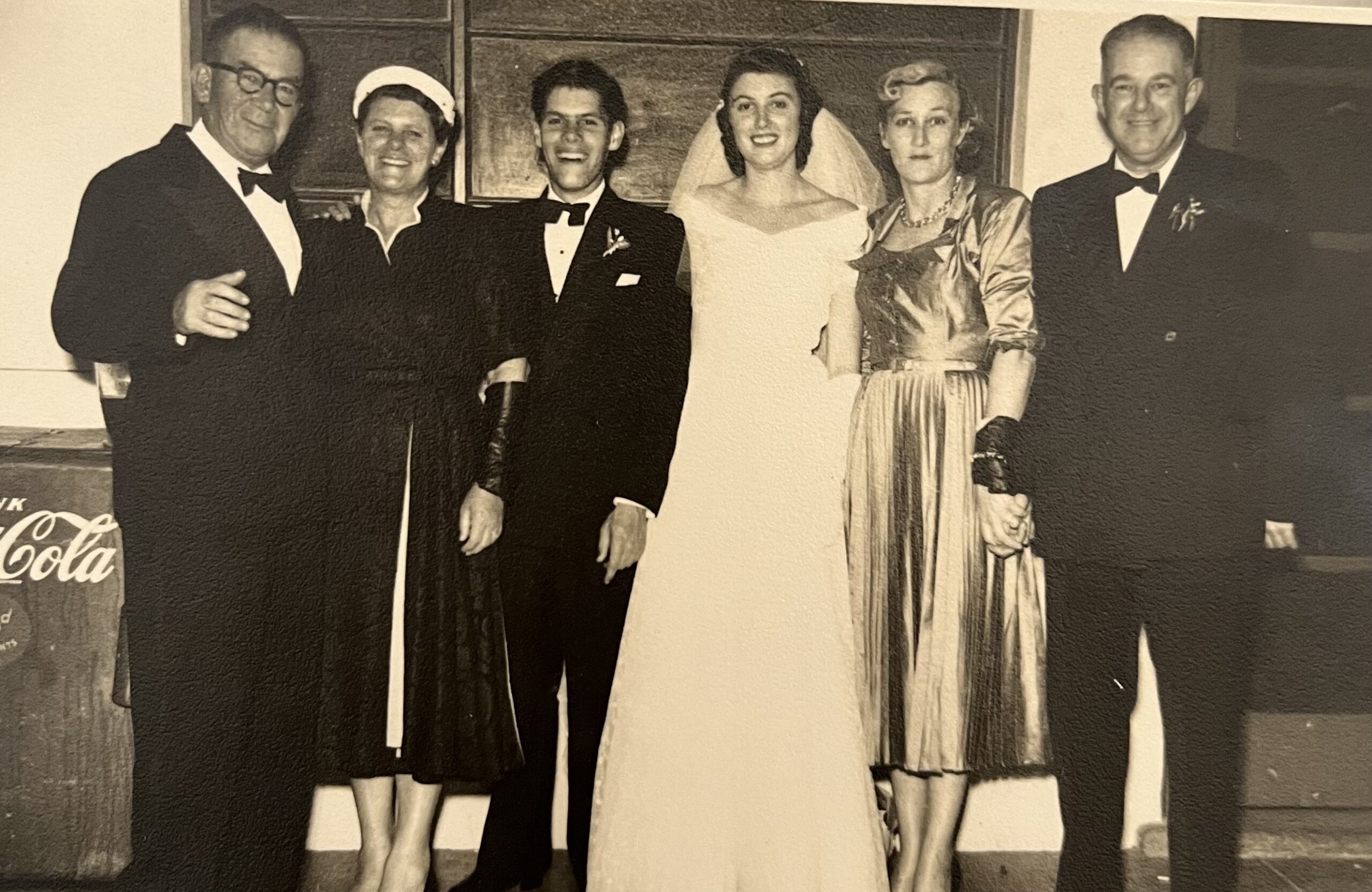
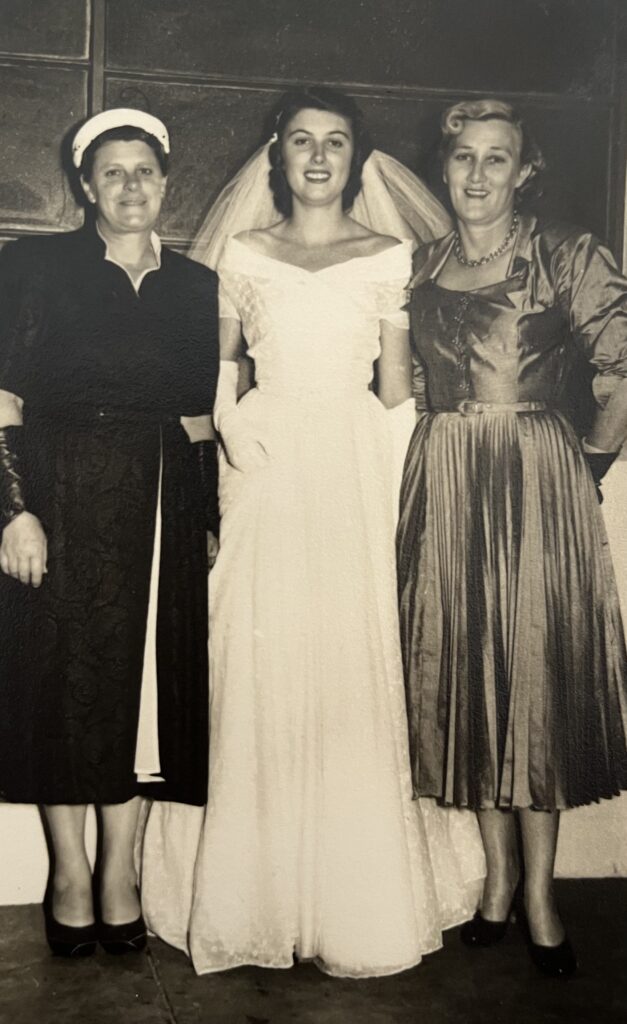
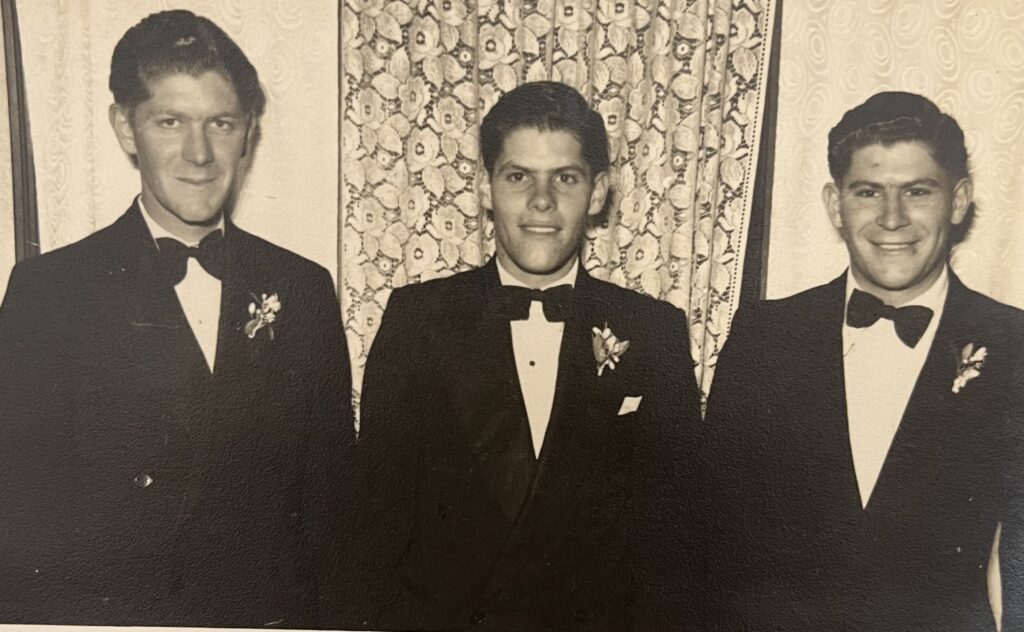
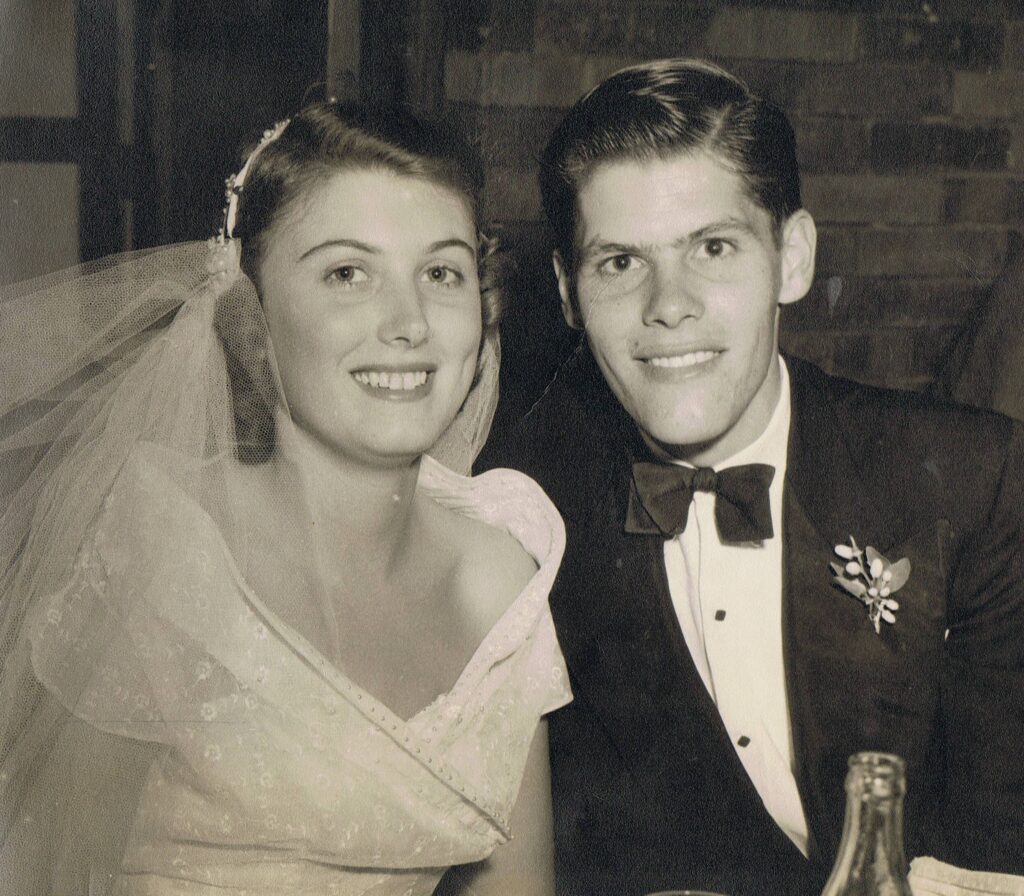
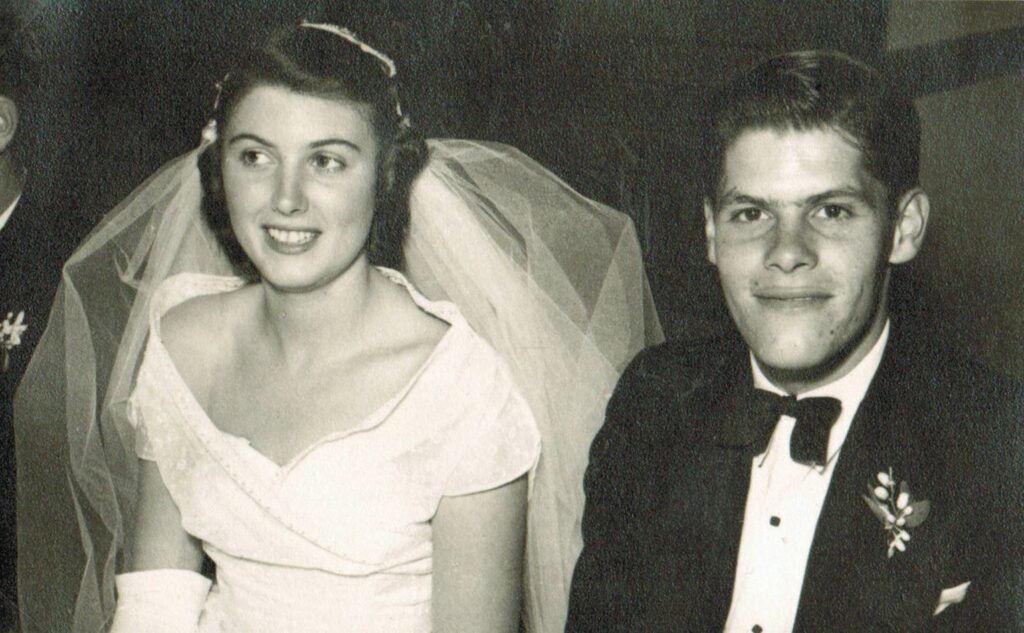
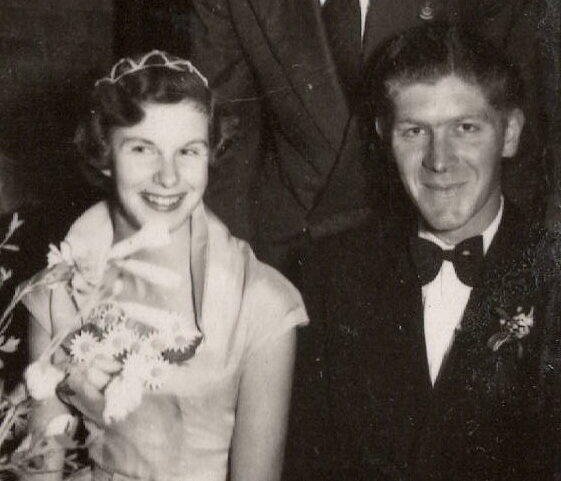
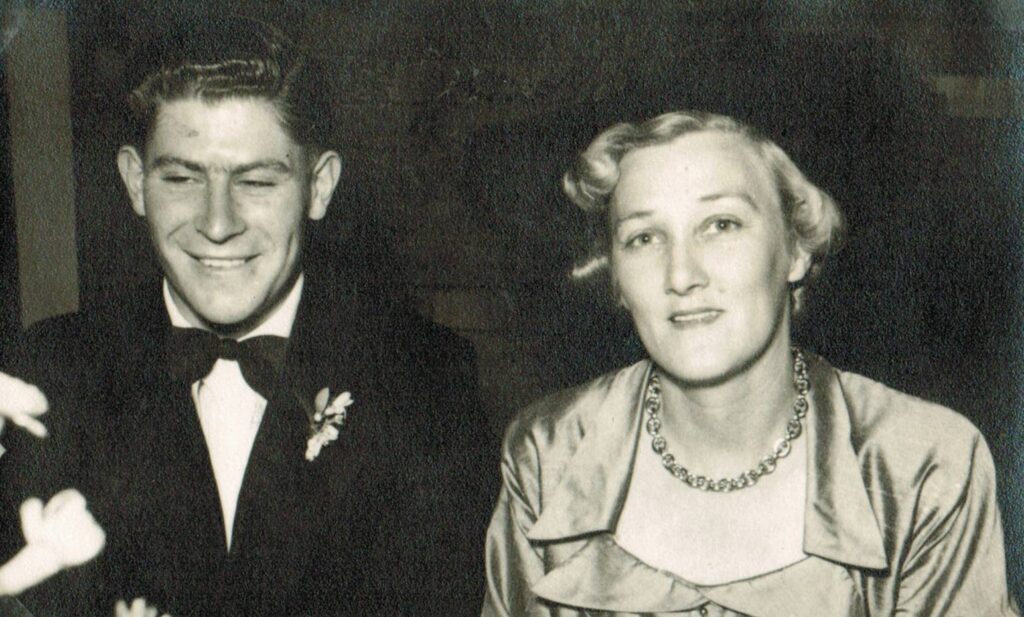
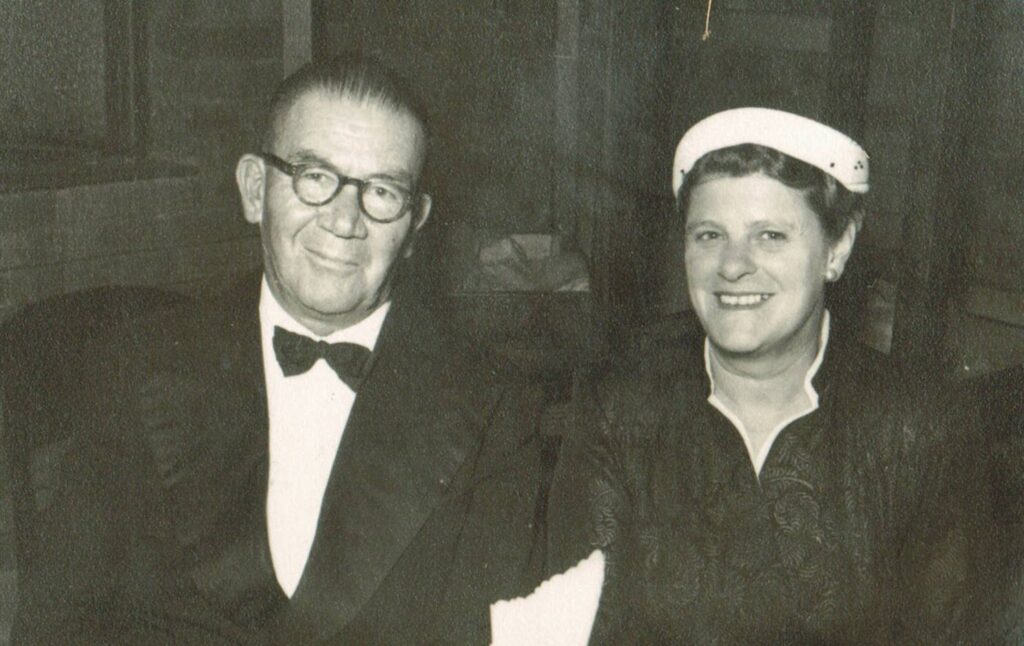
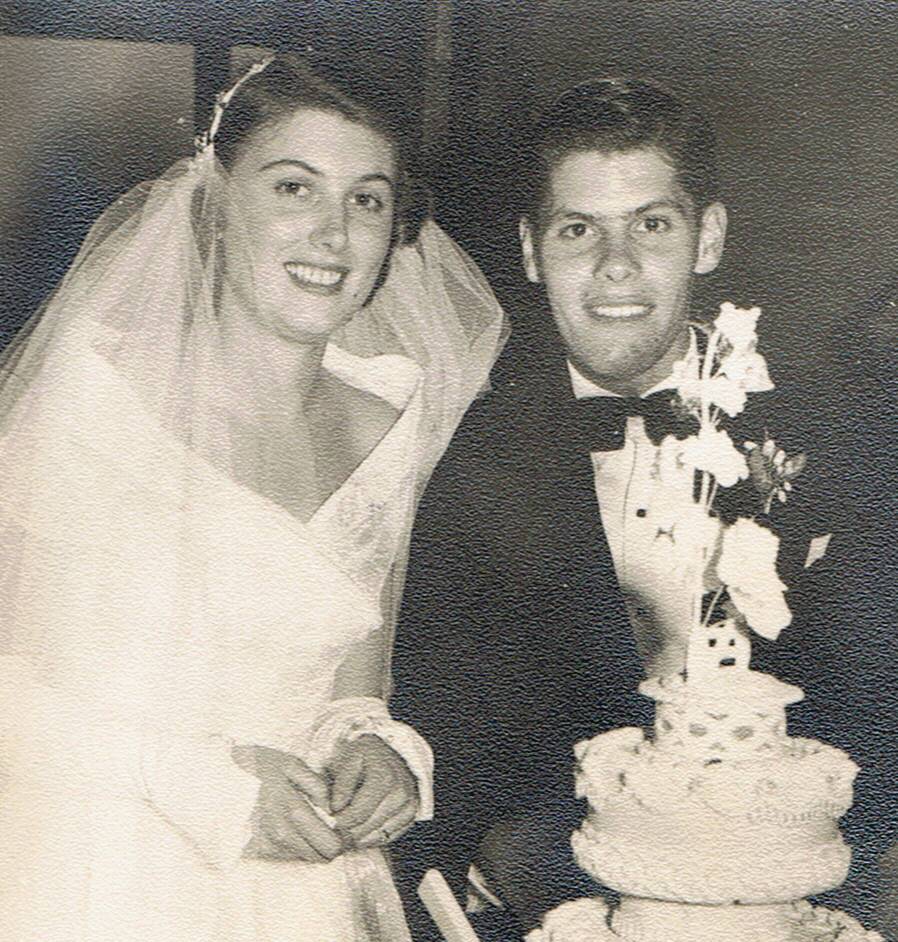
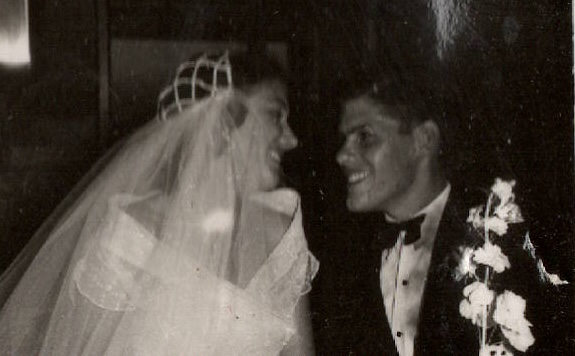
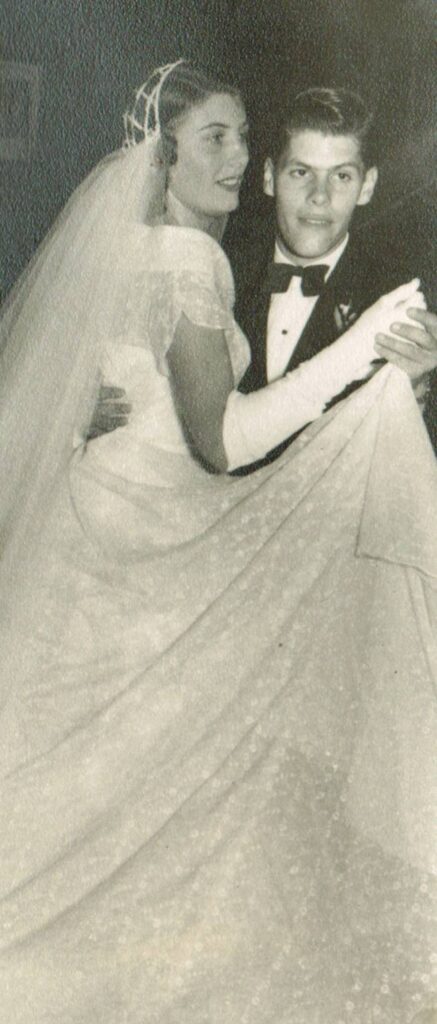
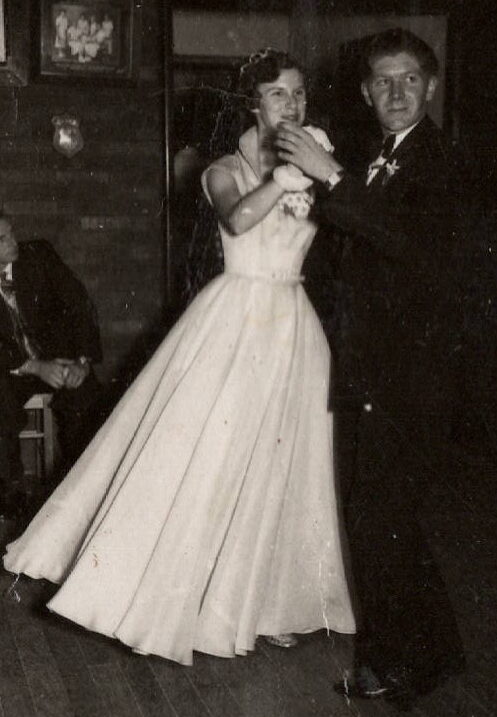
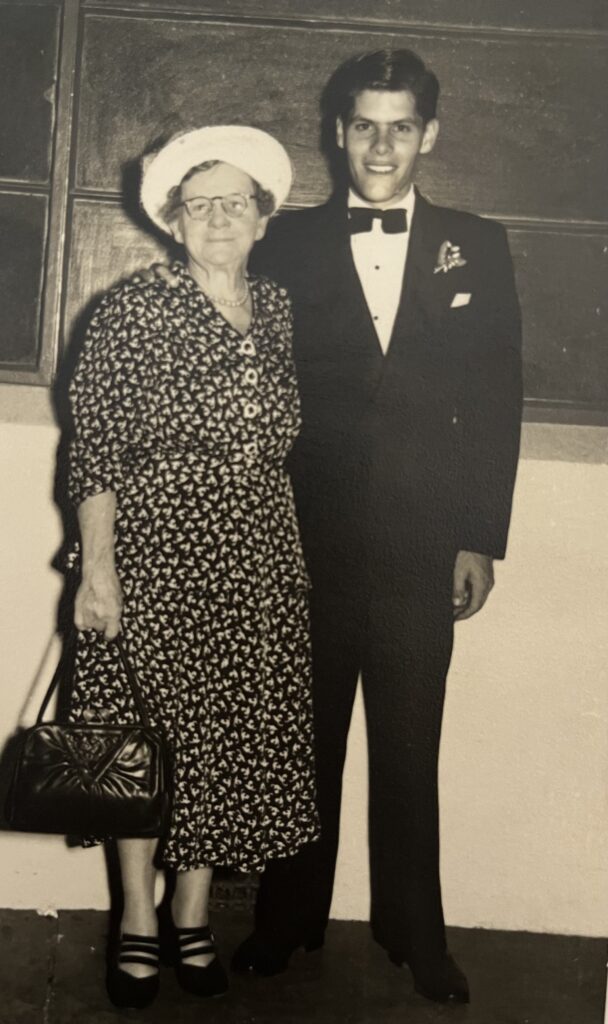
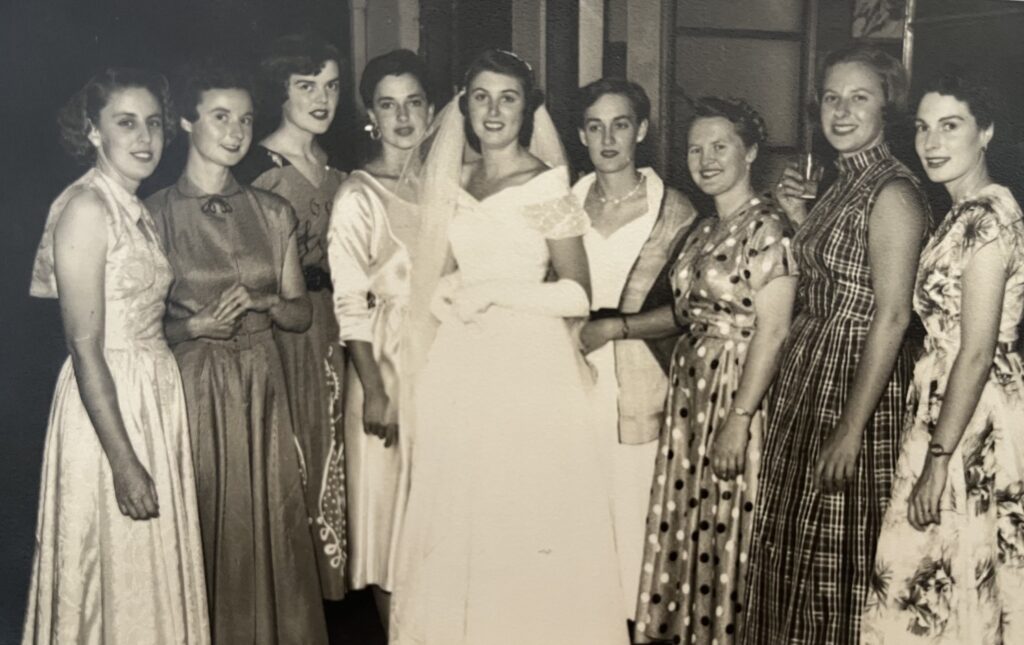
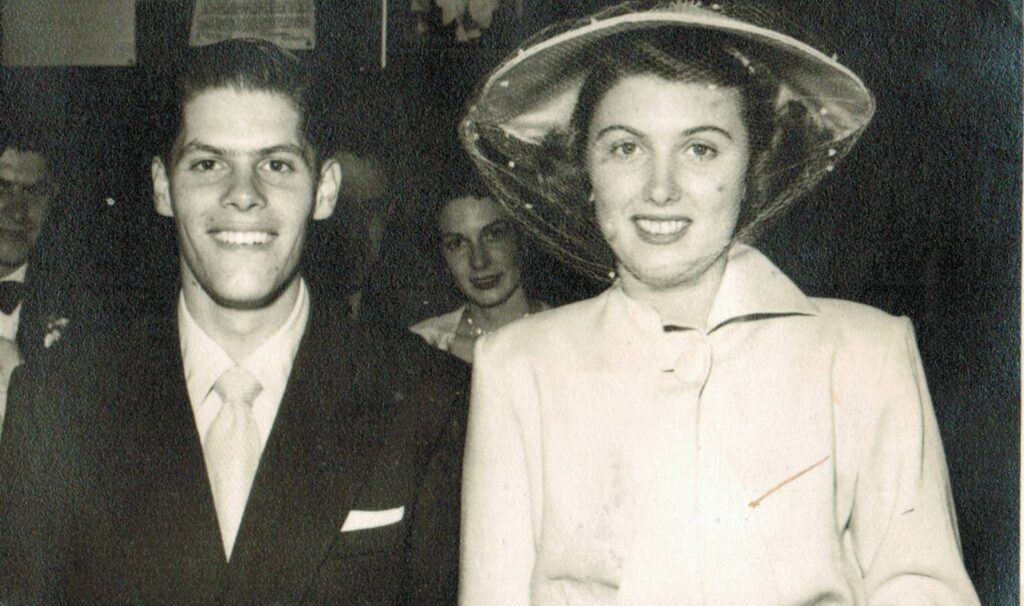
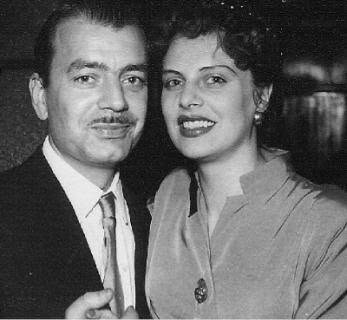
The honeymoon night was spent at the Ocean Beach Hotel, Cottesloe.
Person
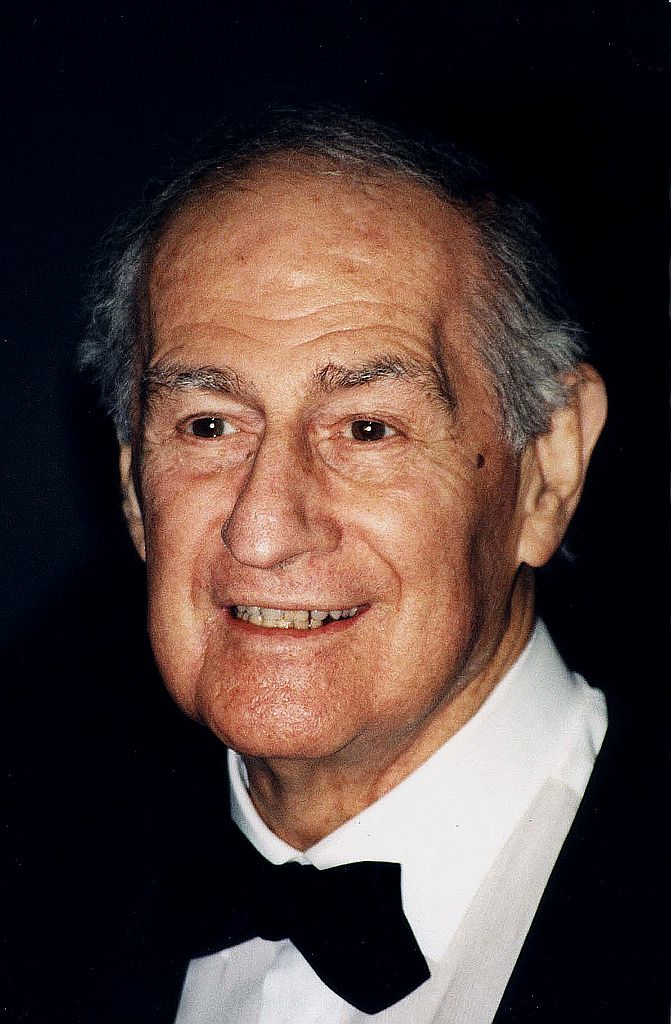
Gian Carlo Menotti, composer (b. July 7, 1911–d. February 1, 2007)
Gian Carlo Menotti became the most-performed contemporary opera composer of his era. He stood alone on the American scene as the first to create American opera with so much appeal to audiences that it became established in permanent repertory. He adapted his natural Italian gift for operatic drama and performance to the requirements of the American stage and changing times. According to fellow composer Ned Rorem: “It is not opinion but fact that Menotti singlehandedly revitalized the concept of living opera for Americans…and violently altered the nature of lyric theater here and, by extension, throughout the world.”
Menotti was born in the country town of Cadegliano on Lake Lugano in Italy. His father was a prosperous businessman and his mother, although she had nine other children, was a talented musician, and taught her young son the rudiments of music. At age 10, Menotti wrote his first opera titled The Death of Pierrot, though it was never performed professionally. At age 13, when Menotti entered the Milan Conservatory, he had already written a second opera. In 1927, he came to the United States and studied at the Curtis Institute of Music in Philadelphia with Rosario Scalero. Having received his diploma with honors from the Institute in 1933, Menotti began the libretto for his opera Amelia Goes to the Ball, an ebullient opera buffa, first staged in 1937 at Philadelphia’s Academy of music by students of the Curtis Institute and then in New York with such success that the Metropolitan Opera accepted it for the following season. Amelia was responsible for Menotti’s receiving a commission from NBC for a radio opera. The comic opera, first broadcast in 1939, was The Old Man and the Thief, which was later performed on stage by the Philadelphia Opera Company.
It was, however, with The Medium that Menotti was established as one of the foremost composer-librettist of modern opera. The tragedy, about a fraudulent spiritualist caught between the worlds of reality, which she cannot understand, and of the supernatural, in which she doesn’t believe, had a run of 211 performances at the Ethel Barrymore Theater on Broadway (1947-48) and was accompanied by a “curtain-raiser,” a totally different one-act comedy The Telephone.
Menotti’s first full length opera, The Consul, considered by many to be his greatest work, opened at the Ethel Barrymore Theater March 15, 1950. This searing contemporary work describing the plight of political fugitives vainly trying to escape an unnamed police state but failing to obtain the necessary visa had an eight month run and received the Pulitzer Prize and the Drama Critics Award. It has since been translated into 12 languages and performed in more than 20 countries.
On Christmas Eve, 1951, the first opera written expressly for television, Menotti’s Amahl and the Night Visitors was broadcast on NBC. The opera, influenced by Bosch’s Adoration of the Magi, has become one of the most frequently performed of the 20th century. The composer’s next effort, The Saint of Bleecker Street, a serious drama set in contemporary New York, which opened in New York December 27, 1954, won the Drama Critics Circle Award for the best musical play of 1954 and the Pulitzer Prize for 1955. It also received a Music Critics Circle Award for the best opera. Three years later, Menotti organized the Festival of Two Worlds in Spoleto, Italy, staging old and new musical works.
In 1977, he inaugurated the American counterpart of the festival in Charleston, South Carolina. Menotti was later replaced as director of the Spoletto Festival, due to differences in his approach to music. Additional works evolved including The Death of the Bishop of Brindisi, a cantata about the Children’s Crusade of 1212, commissioned by the Cincinnati Music Festival Association, and Le dernier sauvage, an opera which premiered in France and was later given a lavish production at the Metropolitan Opera in New York.
Operas for children are also included among his works. A Bride from Pluto, a humorous space opera was commissioned by the Kennedy Center. His Help, Help, the Globolinks!, which he considers “an opera in one act for children and those who like children,” was commissioned in Hamburg.
In addition to his numerous operatic works, Menotti has enriched the artistic world with his ballets, including Sebastian ; Errand into the Maze; and The Unicorn, the Gorgon and the Manticore orchestral works (Apocalypse), and Landscapes and Remembrances, a cantata to his own autobiographical words. Menotti continued to compose–his most recent operas include Goya (1986) and The Singing Child (1993). In addition to being awarded the Kennedy Center Honors for lifetime achievement in the arts, Menotti was also chosen as the 1991 “Musician of the Year” by Musical America. According to critical appraisal by H. Wiley Hitchcock, “Menotti combined the theatrical sense of a poplar playwright and a Pucciniesque musical vocabulary with an Italian love of liquid language and a humane interest in characters as real human beings. The result is opera more accessible than anyone else’s at the time.
https://www.kennedy-center.org/artists/m/ma-mn/gian-menotti/
https://en.wikipedia.org/wiki/Gian_Carlo_Menotti
Gian Carlo Menotti’s opera The Consul had its historically notable Perth premiere on July 3, 1953. It was staged by the National Theatre Movement Opera Company at His Majesty’s Theatre, featuring a highly praised performance by Australian soprano Marie Collier in the lead role of Magda Sorel. Jack performed in a Menotti opera “The Consul” and quoted from it his whole life – “sign at the bottom of the page” and “what is your name? Magda Sorel, age 33”.
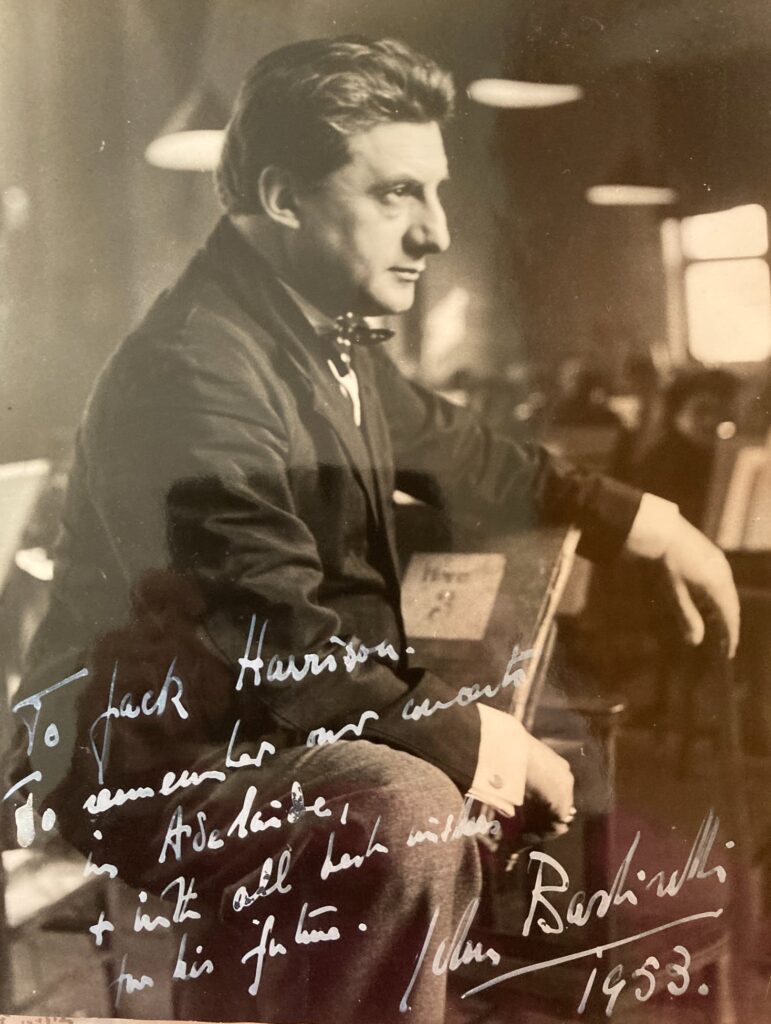
Person
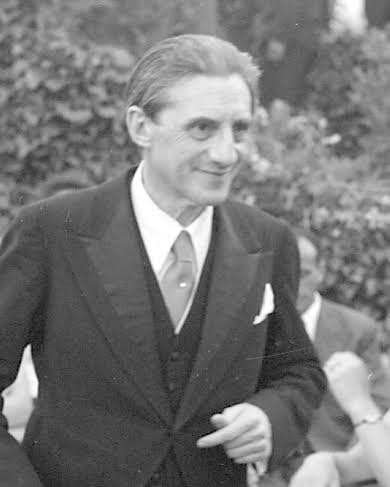
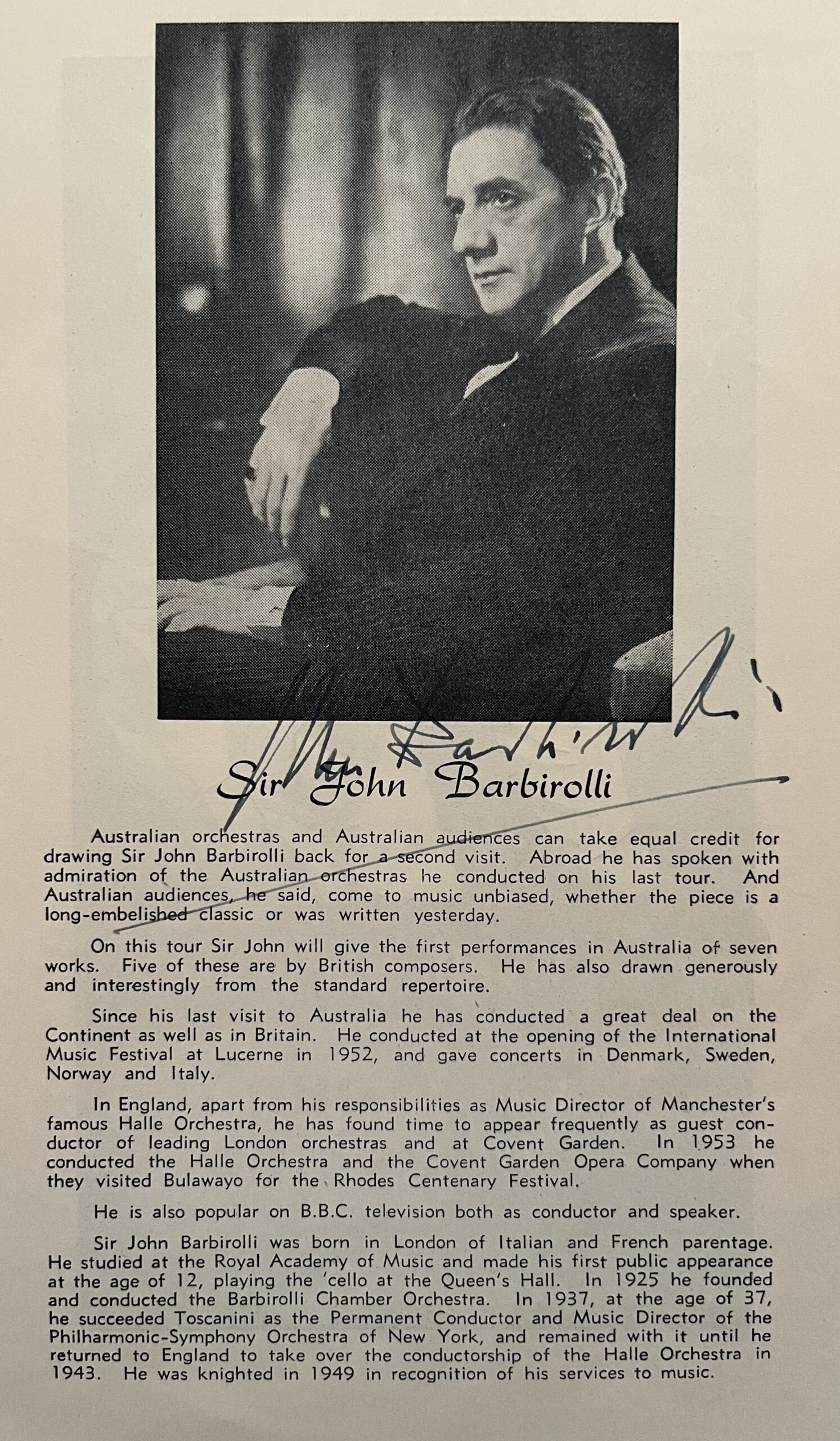
Sir John Barbirolli (born Dec. 2, 1899, London, Eng.—died July 29, 1970, London) was an English conductor and cellist.
Barbirolli was the son of an émigré Italian violinist and his French wife. He began playing the violin when he was 4 (later switching to the cello) and, at the age of 10, became a scholar at the Trinity College of Music. He attended the Royal Academy of Music from 1912 to 1916 and established himself as an orchestral and solo cellist. During his mid-20s he devoted himself to chamber work. He then turned to opera as a full-time conductor, taking seasons at Covent Garden and Sadler’s Wells and making appearances at the British National Opera. He also conducted with the London Symphony Orchestra and the Scottish Orchestra. Invited for the 1936–37 season of the New York Philharmonic, he won the permanent post of music director in succession to Arturo Toscanini and held it through that organization’s memorable centenary season, 1941–42.
His subsequent appointments included conductorships (1943–70) with the Hallé Orchestra in Manchester, Eng., where he gained international recognition as a conductor. A decade of deteriorating health did not prevent him from continuing guest conducting, recording, and worldwide touring with major orchestras. He was principal conductor for the Houston Symphony Orchestra (1961–67) and was a favourite guest conductor with the Berlin Philharmonic Orchestra (1961–70). He was knighted in 1949.
Person
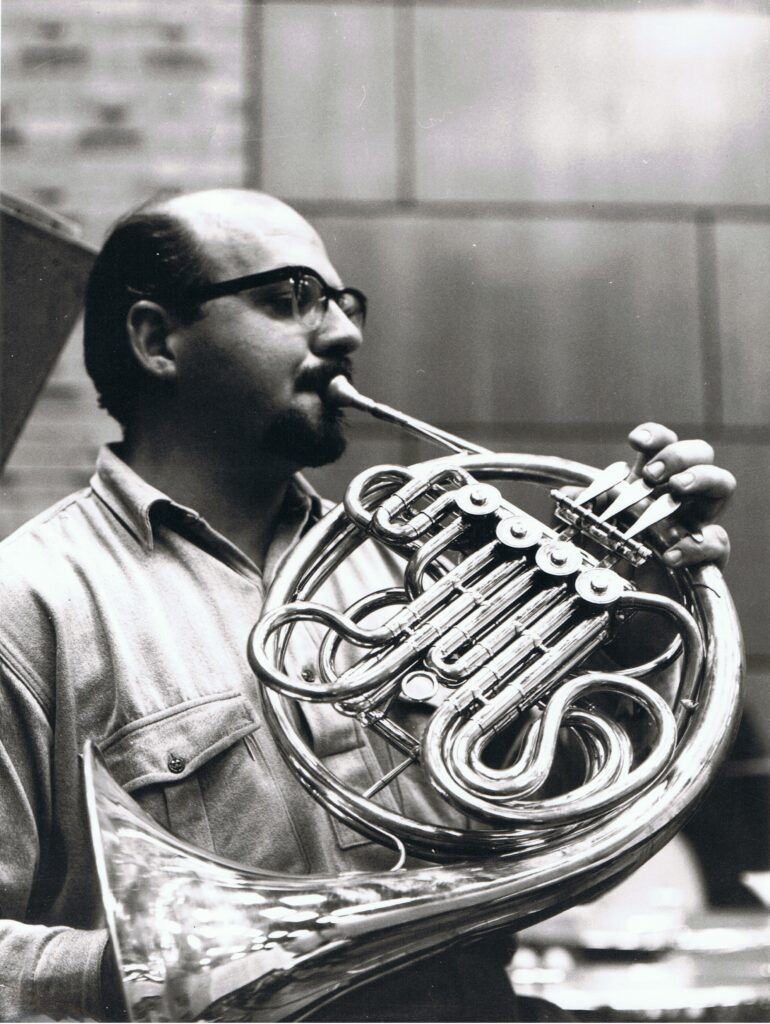
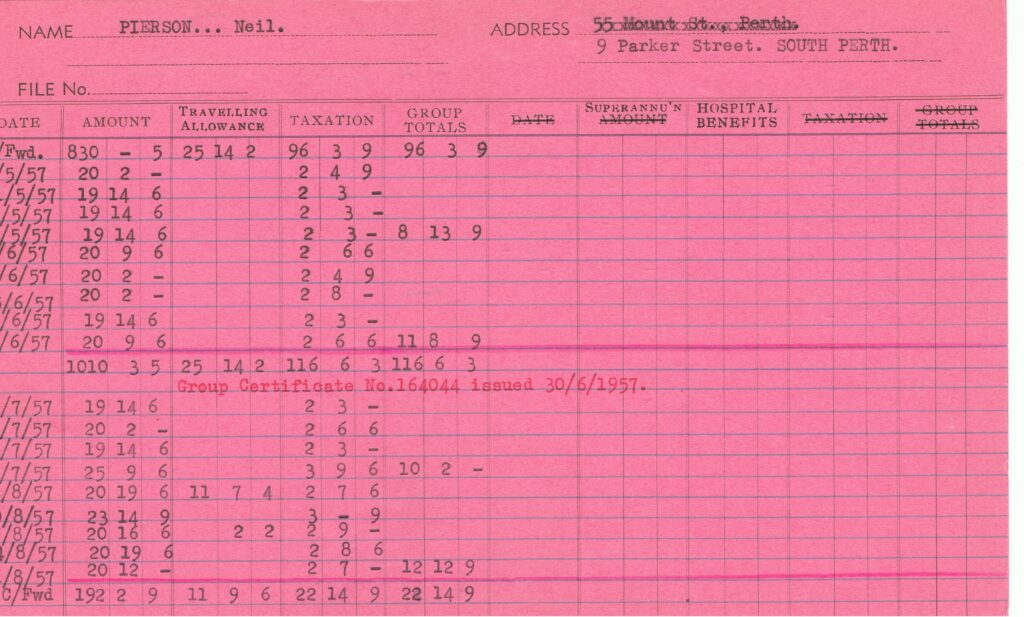
Husband and wife team Aino Neumann and Neil Pierson both studied at the Sydney Conservatorium. They married in 1952 and moved to Perth the following year, Aino to play bass with the West Australian Symphony Orchestra while Neil played trombone with a band at His Majesty’s Theatre. Later, on advice from Rudolf Pekarek, he studied french horn as a second instrument and joined the orchestra in 1956 playing that instrument.
Harrison, Marcia, West Australian Symphony Orchestra Celebrating 75 Years, (WASO Holdings Pty Ltd, 2003). p.57
1954
1956
COMPOSER IS PROVOCATIVE
February 21, 1956
By “Fidelio”
A West Australian composer, James Penberthy, offered us last night what in some ways the most adventurous Australian composition so far heard in the Art Gallery programmes. This includes, notably, his medium of expression; a wind quintet consisting of flute, oboe, clarinet, horn and two bassoons. For this unusual combination Mr Penberthy had produce a work in short, linked movements, based on the music and life of Australian aborigines. He obtained interesting effects in the way of atmosphere and drastic colourings, but his score sounded very fragmentary. It seemed often to be hovering uncertainly between outright imitative realism and the freer imaginative flight which, we felt, should not convincingly emerge. Another unusual inclusion was a set of three nicely fanciful songs for soprano and flute (no piano) by John Gordon, the words being taken from Chinese. The rest was chiefly light music, generally pretty in a conventional style. There were two pieces for flute and piano by A.C. Black (a West Australian), clarinet and piano pieces by Dulcie Holland and Moneta Eagles, songs by Horace Keats and Elizabeth Mills. The performers were Sylvia Biddle (soprano), Owen Fisenden (flute), Jack Harrison (clarinet), Neil Pierson (horn), Ron Richmond (oboe), George Dreyfus and Claude Welling (bassoons) and Phyllis Allen (accompanist).
1957
1967
MUSIC – By Peter Hellstrom
September 24 1967
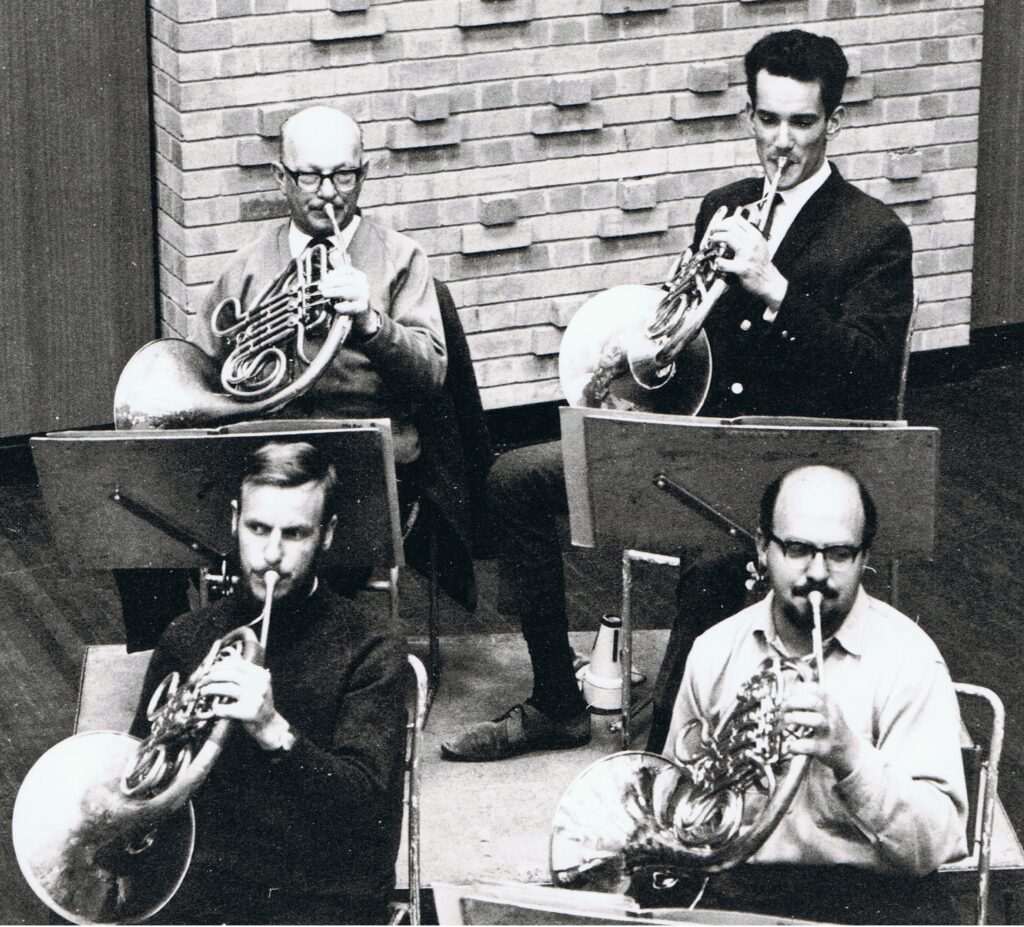
There will be an all Beethoven programme at tomorrow afternoon’s recital at the A.B.C. Basil Kirke Studio beginning at 3 o’clock. It will consist of the Septet in E flat and the Serenade in D. Op.8. The performers will be Graham Wood (violin), John Dean (viola), Brian Meddemmen (cello), John Mowson (bass), Jack Harrison (clarinet), Neil Pierson (French horn) and Jill Harrison (bassoon).
1970
SWING TIME AT THE PLAYHOUSE – By Peter Hellstrom
The playhouse will really swing on February 10, 17, 24 and March 3 when four Perth’s best jazz groups go through their paces in a series that will be part of the Festival Of Perth. These late afternoon jazz concerts starting at 5:45 pm, will each consist of two widely different types of performance. There will be first class fare for those like the trad jazz and for those more attuned to mainlining. One of the groups, Don Johnson’s Octet, includes five members of the West Australian Symphony Orchestra who will thus reveal the versatility. Members of the Octet are Robert Johnson (trumpet), Neil Pierson (French horn, trumpet and trombone), Peter Clinch (alto saxophone), Jack Harrison (tenor saxophone), Harry Retting (piano) Brian Bursey (bass), Bill Tattersall (drums) and Bill Farnham (trombone). The West Australian Saturday January 31 1970
Sunday May 26 1970
The second concert in Series I of this year’s A.B.C. recitals in the Basil Kirke Studio will be given tomorrow afternoon at 3 o’clock. A Rossini Quartet For Wind will be played by flautist Owen Fisenden, clarinettist Jack Harrison, horn player Neil Pierson and bassoonist Brian Pope. A Beethoven septet will be performed by clarinettist Jack Harrison, bassoonist Brian7, violinist Vaughan Hanly, violist John Gould, cellist Ray Fraser and double bass player Aino Neumann. One of the objects of the concert is to bring the best local artists playing chamber music before the public. Symphony concerts naturally attract more people because of the grandeur and perhaps a little because of the mere occasion. But we must not let the chamber music and solo recitals die. They are part of the backbone of music in Europe, the primary source of most music.
1972
Congratulations – we’re lucky to have you, Mr Paul
By Robert Gude
If conductor Tibor Paul thought the rousing ovation he received at this week’s Youth Concert was simply urging him on for an encore, he misjudged his young audience. It is customary for audiences who want more for their money to stomp and holler hoping for a kind of bargain basement addition to the printed program. Such was not the case following the WASO’s fine performance of the titanic Fifth. Every section without exception excelled in alternating dynamics and delicacy, Mr Paul conducting without a score, was in complete command with his subtle sweeping cues and characteristically spare, precise beat. Jack Harrison was heard in a fine reading of Stanford’s Clarinet Concerto. Mr Harrison alone saved this plain, uninteresting work bearing shades of Elgar and a momentary sally in Wagner. For one brief moment, an elegant melody carried by the entire string section could have lent unusual character to this concerto – had Stanford continued variations on this theme for solo clarinet, developing and alternating this material into meaningful music. Mr Stanford chose however to leave this melody suspended in mid-air, a la Bruckner, never to be heard again. Mr. Harrison came upon this work during his recent Churchill Foundation study tour and brought it to us as an example of fine writing for clarinet. This it was beyond doubt propelled by Mr Harrison’s undoubted skill and this was reflected in the fine reception he received from a young audience which appreciates his enormous talents. The program opened with Stravinsky’s orchestral suite from the ballet “The Fairy’s Kiss” one of this great Russian, French, American’s gentler works. What could go unnoticed was the excellence of harpist, Michael Jefferies, the first chair solo quartet provided by leader Vaughan Hanly, Stanislav Kowarski (second violin) George Coleman (viola) and Raymond Fraser (cello) and, again risking reputation, the WASO’s splendid horn section led by Neil Pierson. Concert audiences in Liverpool, England still recall with awe and admiration Mr. Paul’s appearance on the podium of the Royal Liverpool Philharmonic last October. Here, beyond question, is a conductor of world standing. The A.B.C. the WASO and Perth concert audiences should appreciate the nature and global reputation of Mr. Paul while he is with us, they should count themselves fortunate.
Sunday Independent May 14 1972
Night of Russian Musical heritage – By John Meyer
Friday June 23 1972
In an evening of Russian music at the ABC orchestral subscription concert in Winthrop Hall last night three works illustrating different facets of that nations musical heritage were featured. The highlight was a controlled and well-defined performance of Tchaikovsky’s Fifth Symphony in E minor played by the West Australian Symphony Orchestra and conducted by Tibor Paul Mr. Paul’s total view of this symphony seem to be an admirable one. He did not emphasise only it’s obvious emotional qualities but gradually built up the drama from the sombre opening for clarinets to the triumphant climax of the final. In this last movement he was well supported by the Orchestra. The performance throughout was distinguished by some fine solo playing especially by Neil Pierson Horn and Jack Harrison and Peter Clinch clarinets.
The West Australian Saturday June 24 1972
1973
Albert Herring Proves to be a Bad Catch
With Robert Gude
Ten minutes late getting underway to a two-fifths empty house at the Octagon, the opening night of the W.A. Opera Company’s production of Benjamin Britten’s “Albert Herring” was already too moribund to resuscitate. The plotting in Act One induced the muse of Morpheus simply because it was virtually impossible to decipher what anyone on stage was singing about. The company threw away the key to the plot which remained undiscovered right to the last bar of Act Three. Patricia Whitbread remained prominent both vocally and socially in her role as the imperious Lady Billows. Her larger than life characterisation lent itself to projecting both voice and diction into the lifeless acoustics of the Octagon. The rest of the cast had equal opportunity but for some inexplicable reason underplayed and undersang Britten’s brilliant operatic farce. An occasional word or two was intelligible. isolated by bar after bar of baffle. The less said about Martin Clare portraying the mumbling Mayor the better. Mr Clare’s pitch was pathetic, his onstage efforts inept. Between Miss Whitbread and Mr Clare this small cast was totally inadequate for the operatic task required.
What redeems Albert Herring is the splendid production by John Milson. Act Two Scene One had the magic Milson touch: Jeffrey Weaver as Harry enduring functional discomfort during choir practice; Cliff Arndt’s bedrock boredom of wearisome waffle from windbags; John Nicholson’s stunned mullet manner and accepting homage as though facing the gallows with a recommendation for preferential treatment. Kristan Fredrickson’s articulate set and consummate costumes were colourful. Allowance should have been made, however, for a costume change amongst characters who could afford more than one ensemble thus enhancing the illusion of a passage of stage time. Conductor Geore Tintner seemed determined that Britten’s 12 member orchestra should overwhelm his singers at every opportunity. Strings were insecure throughout, with the exception of Aino Neumann, contrabass; Neil Pierson’s horn; Jack Harrison’s clarinet; Peter Randall’s oboe; James Hopkinson’s flute and most commendable, Michael Jefferies impeccable harp held Mr Tintner’s orchestra together. This festival fare is indigestible, not worth a candle and most certainly not worth the price of admission. If Britten’s Herring performed at it was on opening night is the W.A. Opera Company’s first production for the Festival Of Perth it could well be the last.
Sunday Independent February 4 1973
1975
September 15 1975 – The Alberni String Quartet
Schubert Octet in F Major Op. 166
With John McNeilly – bass; Jack Harrison – clarinet; Neil Pierson – horn; Brian Pope – bassoon.
1978
Neil Pierson retired from WASO after 22 years service.
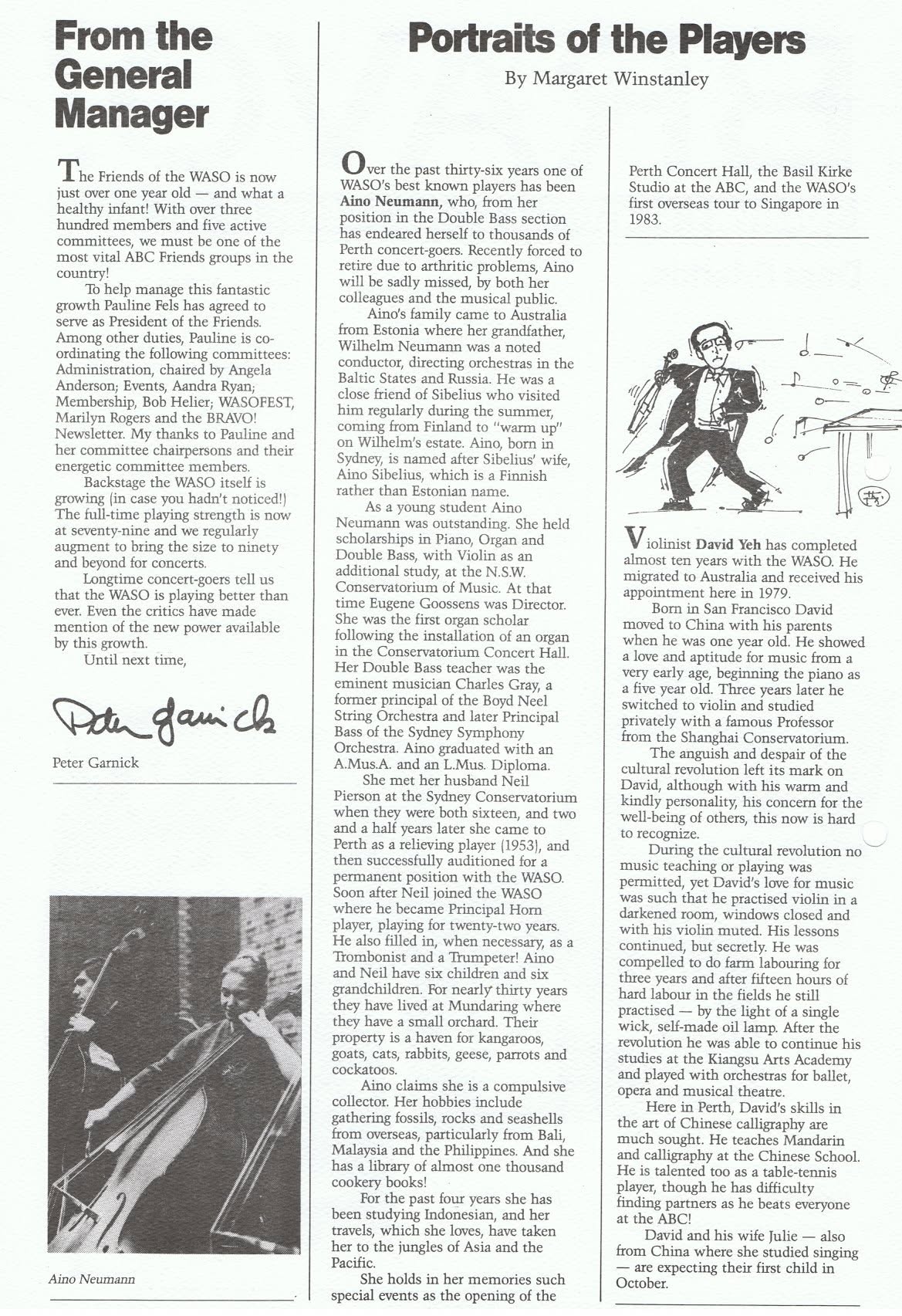
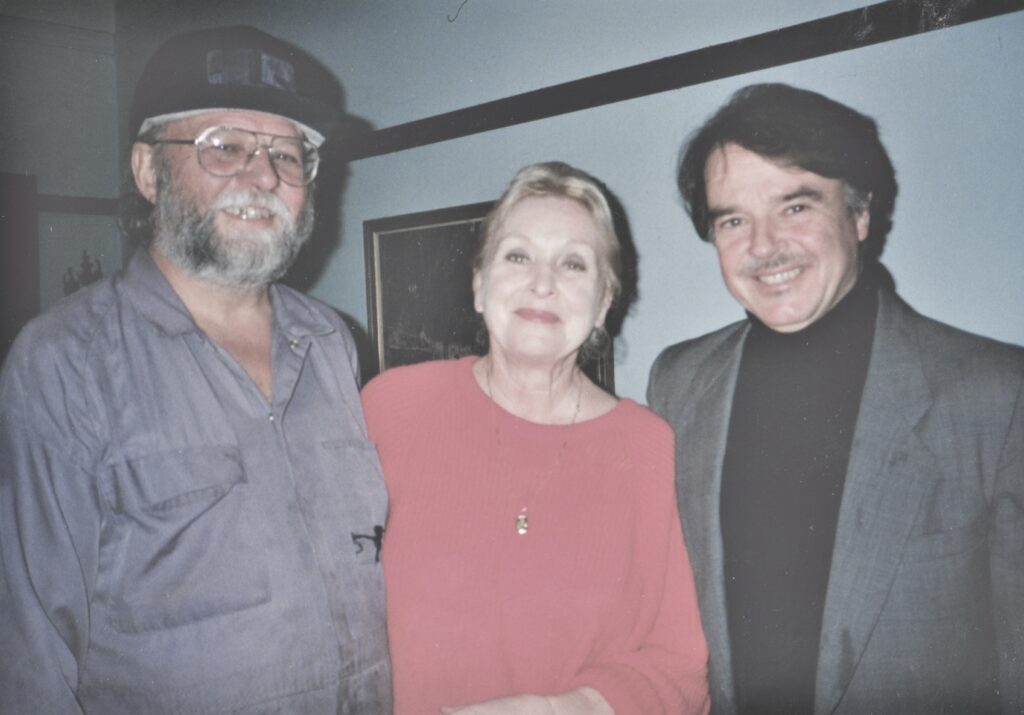
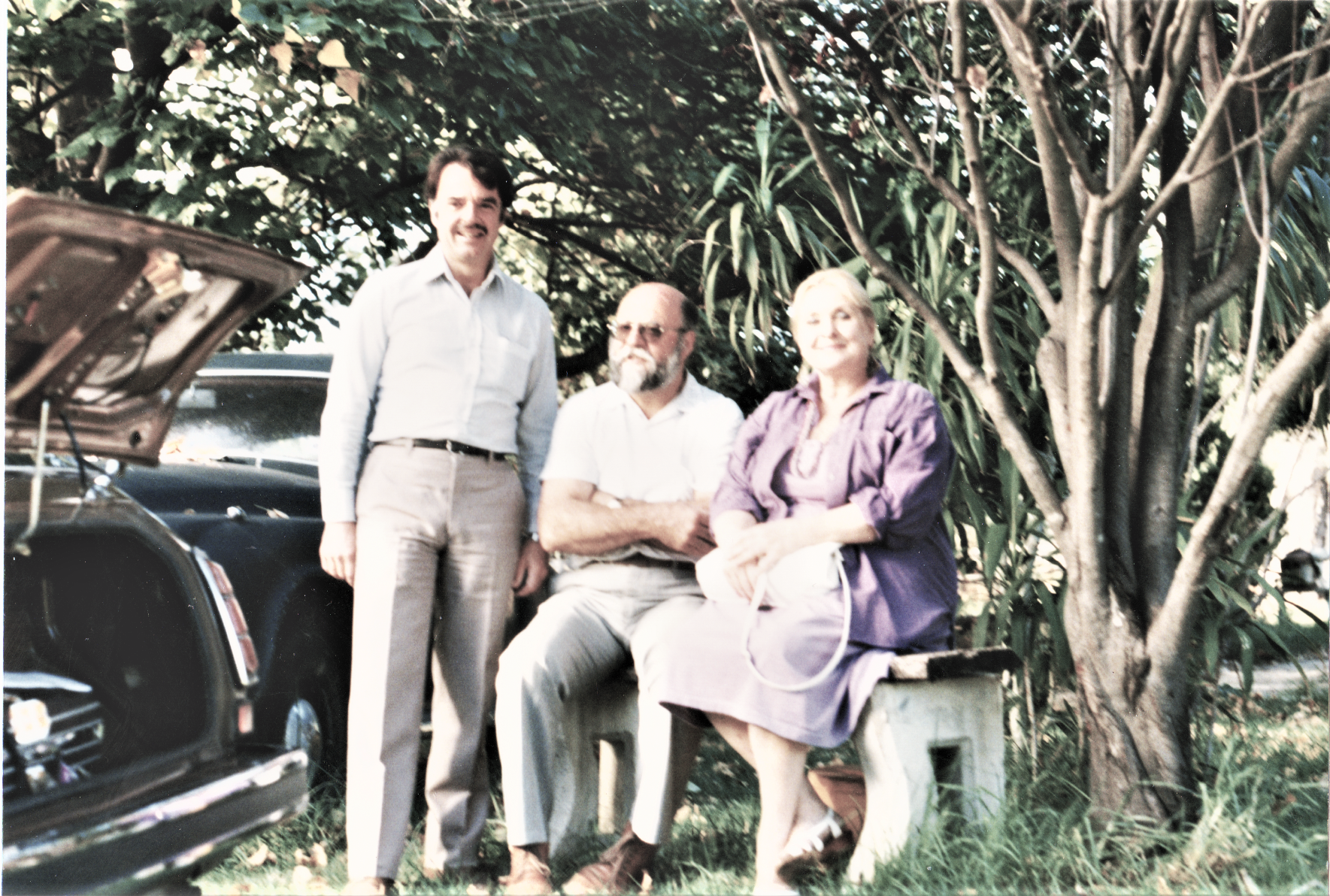
Neil John Pierson died on 5th November 2011 aged 76.
The ABC Young Performers Awards (historically known as the ABC Instrument and Vocal competitions) is Australia’s oldest and most prestigious classical music competition for young musicians, running continuously or through periodic revivals since 1944.
The competition evolved through several administrative eras and titles:
| Year / Period | Competition Name | Managing Body / Notes |
| 1944 | State-based competitions | Founded by the Australian Broadcasting Commission (ABC) with state symphony orchestras. |
| 1949 | Commonwealth Final introduced | State winners competed nationally for the first time. |
| 1950–1967 | ABC Concerto and Vocal Competition | Expanded format launching early career soloists like Max Olding (1952) and Roger Woodward (1964). |
| 1968–1986 | ABC Instrumental and Vocal Competition | Standardized into four distinct categories by 1978: String, Vocal, Keyboard, and Other Instrumental. |
| 1987–1996 | ABC Young Performers Awards | State finals converted into category finals (1986); rebranded to emphasize holistic young artist development. |
| 1997–2004 | Symphony Australia Young Performers Awards | Management moved to Symphony Australia following the devolution of the ABC’s Concerts Division. |
| 2001–2015 | Vocal category transition | The vocal section shifted to the Music & Opera Singers Trust (MOST®), while instrumental categories remained under Symphony Australia / ABC. |
| 2016–2022 | ABC Young Performers Awards (administered by MOST®) | MOST® assumed full administration with the ABC remaining as media and broadcast partner. |
| 2026–Present | ABC Young Performers Awards (returned to ABC) | Returned to full stewardship under ABC Classic to mark its 50th-anniversary celebrations, featuring finalists performing live with the Sydney Symphony Orchestra. |
Format and Structure
Notable Past Winners and Finalists
Over more than 80 years, the competition has helped launch the international and national careers of many prominent Australian musicians:
1947
Finalists (By “Tenori”).
Australian Broadcasting Commission’s Concerto and Vocal Competition.
Finalists: Miss Betty North. Miss Nancy Barnden, Miss Betty Wright, Miss Norecn Edwards, and Miss Stephanie James.
Tuesday, April 23, in the Capitol Theatre, the Australian Broadcasting Commission conducted a Concerto and Vocal Concert at which were heard the above dualists in the recent competitions.
The Perth Symphony Orchestra, under the baton of Mr. Ernest J. Roberts, opened with an overture, “The Marriage of Figaro,” by Mozart. Miss Betty North played “Konzertstuck in F Minor for Piano and Orchestra,” by Weber. This item was followed by Recit. and Aria, ” Dove Sono,” from ” The Marriage of Figaro,” by Mozart, rendered by soprano Miss Nancy Barnden.
Miss Betty Wright then played the first movement of ” Concerto in A Minor, Op., 16, for Piano and Orchestra.” by Grieg, which completed the first half of the
programme. After the Interval, Miss Noreen Edwards played a Concerto No. 1 in G Minor for Violin and Orchestra, first and second movements by Max Bruch. This artist, although quite young and immature, so far as orchestral associations are concerned, displayed a solidity and sympathy which makes her future musical career assured.
Miss Ray Williams, soprano, then sang “Il Est Deux, Il Est Bon” (from “Herodiade”), and the programme was brought to a close with an item from Miss Stephanie James, Symphonic Variations for Piano and Orchestra” by Franck. Of all the contestants this young lady was outstanding. She has the brilliance and poise of the accomplished artist and a promising musical future is. undoubtedly in store for her.
Music lovers throughout the Stale are appreciative of the Concerto and Vocal programmes provided by the A.B.C., which are a boon to country listeners and which provide aspiring young artists with the opportunity of displaying their talent before a public audience.
Westralian Worker (Perth, WA : 1900 – 1951), Friday 2 May 1947, page 2
1948
Music And Theatre By “FIDELIO”
The A.B.C. has completed plans for its 1948 Concerto and Vocal Competitions and the Overseas Scholarship Contest (scholarship tenable at the Juilliard School of Music in New York). As in previous years, artists selected as finalists in the Concerto and Vocal Competitions will appear at a special orchestral concert in their own State, but a new feature will be the selection of a winner from the finalists in each State who will be chosen at the concert by an adjudication committee. The winner in each State will receive a special prize of three broadcasts, provided that his or her work is of the requisite standard. The winner will be debarred from the competitions in subsequent years. Entries close on Saturday February 14, and forms with full details will be available shortly at all A.B.C. offices and conservatoriums.
West Australian (Perth, WA : 1879 – 1954), Saturday 6 December 1947, page 5
1950
VOICE AND CONCERTO – Semi-Finalists In A.B.C. Contest
The West Australian semi-finalists in the concerto and vocal competitions conducted by the Australian Broadcasting Commission were announced yesterday. They are Molly McGurk, Bernise Demorest. Pamela Kott and Ina Micale (pianists), Elise Longwill and Pamela Flower (sopranos) and Jack Harrison (clarinet). They will appear at the orchestral concert to be conducted by Sir Bernard Heinze on May 25 at the Capitol Theatre, at which the two State finalists will be selected. The final will be adjudicated by Dr. A. E. Floyd, Mr. L. Kennedy and the Assistant-Director of Music of the A.B.C. (Mr. H. Cannon). Mr. Cannon said yesterday that the number of entries in Western Australia in proportion to population had been the largest in the Commonwealth. This year there had been 69 entries for the competition, the majority having come from the metropolitan area. Prizes, he said, were being given to both the instrumentalist and vocalist finalist in the State and Commonwealth finals. The aim of the competition was to give young artists an opportunity to appear with an orchestra under an experienced conductor. Mr. Cannon added that the competition had impressed many overseas conductors, mainly because of the experience gained by young artists. and several conductors had said that it was a unique competition in this respect.
The West Australian Thursday 4 May 1950 page 7
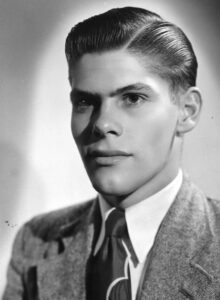
VOICE AND CONCERTO
Semi-Finalists In A.B.C. Contest
The West Australian semi-finalists in the concerto and vocal competitions conducted by the Australian Broadcasting Commission were announced on Wednesday. They are Molly McGurk, Bernise Demorest, Pamela Kott and Ina Micale (pianists), Elise Longwill and Pamela Flower (sopranos) and Jack Harrison (clarinet). They will appear at the orchestral concert to be conducted by Sir Bernard Heinze on May 25 at the Capitol Theatre, at which the two State finalists will be selected. The final will be adjudicated by Dr. A. E. Floyd, Mr. L. Kennedy and the Assist ant-Director of Music of the A.B.C. (Mr. H. Cannon).
Mr. Cannon said on Wednesday that the number of entries in Western Australia in proportion to population had been the largest in the Commonwealth. This year there had been 69 entries for the competition, the majority having come from the metropolitan area. Prizes, he said, were being given to both the instrumentalist and vocalist finalist in the State and Commonwealth finals. The aim of the competition was to give young artists an opportunity to appear with an orchestra under an experienced conductor. Mr. Cannon added that the competition had impressed many overseas conductors, mainly because of the experience gained by young artists, and several conductors had said that it was a unique competition in this respect.
The West Australian Friday 5 May 1950 page 5
Local Finalists Meet Conductor
State finalists in the ABC vocal and concerto competition, who will play at next Thursday’s youth concert, met their conductor, Sir Bernard Heinze, yesterday morning.
Left to right: Molly McGurk (piano), Ina Micale (piano), Pamela Kott (piano), Pamela Flower (soprano), Jack Harrison (clarinet), Elise Longwill (soprano). Bernice Demorest (piano), and Sir Bernard.
Sunday Times Sunday 21 May 1950 page 21
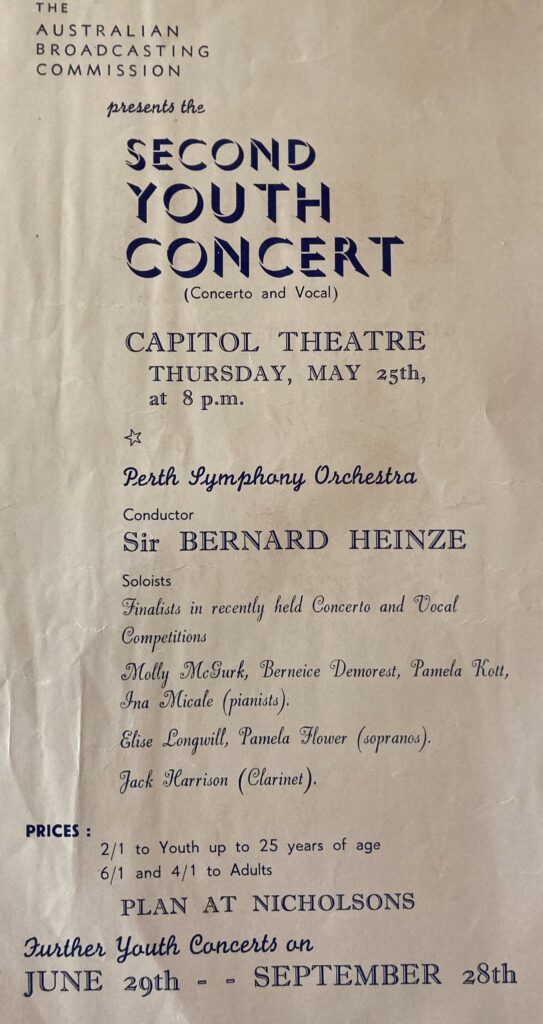
Tomorrow at 8pm Capitol Theatre – 2nd YOUTH CONCERT
State Finalists in the Concerto and Vocal Competition.
PERTH SYMPHONY ORCHESTRA Conductor: Sir Bernard Heinze
Soloists: Molly McGurk, Bernice Demorest. Pamela Kott. Ina Micale (pianists); Elise Longwlll. Pamela Flower (sopranos); Jack Harrison (clarinet).
Prices: 2/1 to Youth up to 25 years 6/1 and 4/1 to adults. Plan at Nicholsons. Direction: Australian Broadcasting Commission.
The West Australian Wednesday 24 May 1950 page 35
PERTH SYMPHONY ORCHESTRA
Conductor: Sir Bernard Heinze
Soloists: Molly McGurk. Bernice Demorest, Pamela Kott. Ina Micale (pianists). Elise Longwill. Pamela Flower. (sopranos). Jack Harrison (clarinet).
Prices: 2/1 to Youth up to 25 years, 6/1 and 4/1 to adults. Plan at Nicholsons until 4.30. Patrons are requested to be seated by 7.50 as the concert will commence at 8 sharp and there will be no admittance during an item.
Direction: AUSTRALIAN BROADCASTING COMMISSION
The West Australian Perth, Friday May 26 1950 page 14
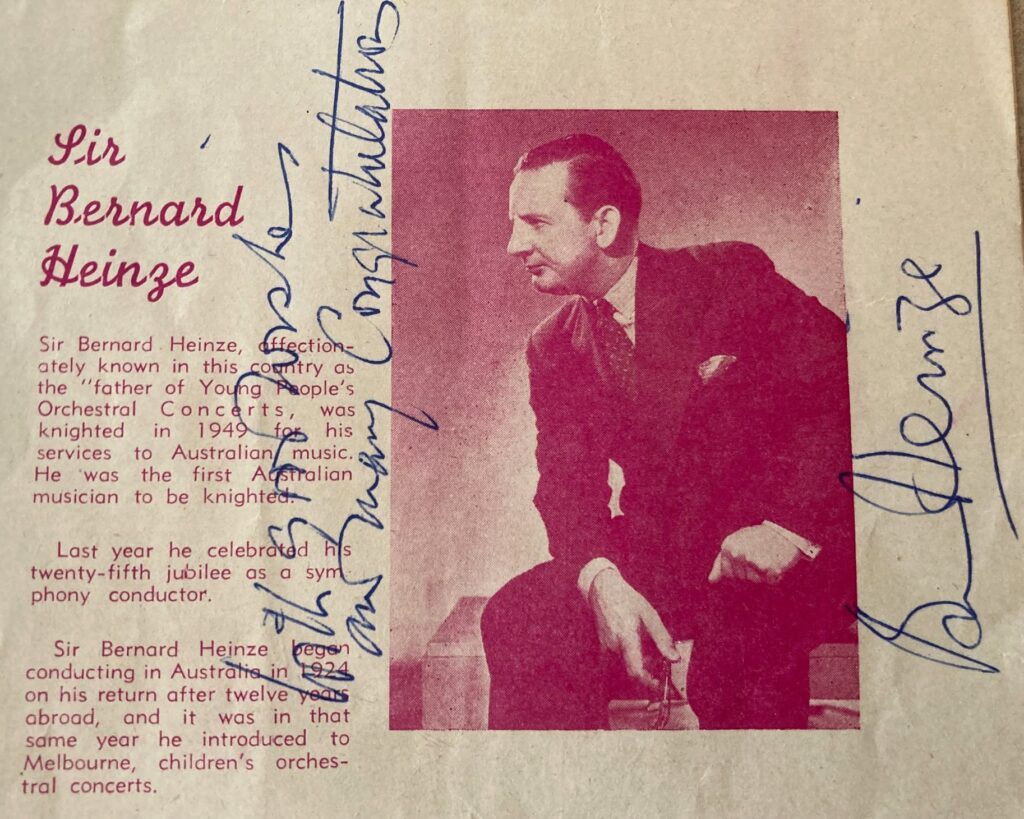 Sir Bernard Heinze – signed program
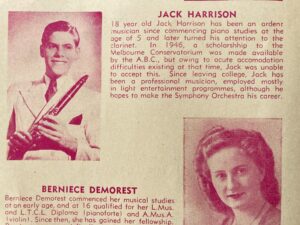
FINALISTS CHOSEN – A.B.C. Concerto And Vocal Contest – (By ‘”Tactus.”)
Last night at the Capitol Theatre an audience which completely filled the auditorium attended the second of the Australian Broadcasting Commission’s series of youth concerts. Actually, the occasion, more than any other previous concert of the kind, fulfilled the purpose, for the young solo performers were those chosen in the West Australian concerto and vocal competition. There were seven of them, four pianists, one clarinettist (the only male to qualify) and two vocalists. Considerable interest was added by the fact that the concert was the final test to decide the choice of one instrumentalist and one singer to compete against two representatives of each State in Sydney at a later date.
HIGH PRAISE
The adjudicators were the Director of Music for the A.B.C. (Mr. W. G. James) and Dr. Edgar Bainton (former Director of the New South Wales Conservatorium of Music), Their decision, which was announced at the end of the concert, bestowed the honours on Miss Elise Longwell, soprano, whose singing of the aria, “Salce, Salce,” the Willow Song from Verdi’s opera,”Otello,” was a fine performance, and on Miss Molly McGurk, who received high praise for her playing of Liszt’s TodtcnTanz (Dance of Death). The adjudicators were so impressed also with Jack Harrison, who played the clarinet Concertino (Weber) that they announced their intention of strongly recommending his inclusion as a finalist.
The others who appeared were Miss Pamela Kott (first movement of Beethoven’s Piano Concerto No. 4, in G Major); Miss Bernice Demorest (first movement of Moszkowski’s Piano Concerto in E Major); Miss Ina Micale (first movement of Schumann’s Piano Concerto in A Minor); and Miss Pamela Flower (Jewel Song from Gounod’s opera “Faust”). A high standard was maintained by all the young musicians, and Dr. Bainton described the adjudicators’ task in arriving at their verdict as “exciting.” The orchestra, under the direction of Sir Bernard Heinze. Gave excellent cooperation to the soloists.
Saturday May 27 1950 page 11
1951
ABC CONTEST FINALISTS IN WA CHOSEN
THE eight WA finalists in the ABC Annual Concerto and Vocal competition were selected today. They are Sheila Hines (piano) ; Ian Conochie (baritone) ; Barbara Smith (viola) ; Molly McGurk (piano) ; Ina Micale (piano) ; Jack Harrison (clarinet) ; Valerie Wynne (soprano); Bernice Demorest (piano). They will all appear with the WA Symphony Orchestra in the Capitol Theatre on Thursday. A State finalist from each of the vocal and the instrumental sections will be selected.
These two winners will be eligible for the Australia-wide competition, which will be held in Sydney on July 7. The winner of this competition will be booked for a tour of Australia under the ABC.
THE WORLD OF MUSIC – State Finalists In. A.B.C. Competition
Seven young West Australians were chosen yesterday to appear at the Capitol Theatre on Thursday night as the State finalists in the Australian Broadcasting Commission’s concerto and vocal competitions. They are Miss Sheila Hines (pianist), Miss Barbara Smith (violist), Miss Molly McGurk (pianist), Miss Ina Micale (pianist), Miss Valerie Wynne (soprano), Miss Berniece Demorest (pianist), Mr. Jack Harrison (clarinettist), and Mr. Ian Conochie (baritone). They will all appear with the W.A. Symphony Orchestra under the baton of Mr. Rudolf Pekarek. The judges at the concert will be Dr. A. E. Floyd and Messrs. Lauri Kennedy, H. Cannon and Pekarek. From these finalists they will select one artist from the vocal section and one instrumentalist These will have the chance of appearing with other State finalists in Sydney on July 7 when the Australian winner of each section will be announced. The winners will then tour Australia under the direction of the commission.
The West Australian Saturday 28 April 1951 page 4
Bookings also open for CONCERTO & VOCAL FINALS. Featuring: SHEILA IINES, IAN CONOCHIE, BARBARA SMITH, MOLLY McGURK, INA MICALE, JACK HARRISON, VALERIE WYNNE, BERNIECE DEMOREST, With W.A. Symphony Orchestra conducted by RUDOLF PEKAREK. Capitol Theatre Next Thursday. PRICES: 4/-, 6/-, plus booking fee. Direction A.B.C.
The West Australian Monday 30 April 1951 page 21
ABC CONTEST 3rd MAY 1951 – WINNERS IN MUSIC A.B.C.’s Vocal And Concerto Finals – (By “Fidelio.”)
Finalists in the A.B.C.’s concerto and vocal contest for this State played and sang before the judges and a big audience at the Capitol Theatre last night. Sheila Hines, pianist, and Valerie Wynne, soprano, were placed first in the respective sections. Jack Harrison, clarinettist, was specially commended. Of the eight contestants heard with the W.A. Symphony Orchestra four were pianists. There were only two singers, and the remaining instrumentalists were a violist and a clarinettist. Miss Hines played a Mendelssohn con certo, Miss Wynne sang “Elsa’s Dream” (Wagner), Mr. Harrison played two movements of Mozart’s Clarinet Concerto. The judges were Dr. A. E. Floyd, Mr. Lauri Kennedy, Mr. Herbert Cannon (the A.B.C.’s Assistant Director of Music) and Mr. Rudolf Pekarek, conductor of the Perth orchestra. Four of the contestants had been among the finalists in previous years, one (Ina Micale, pianist) three times, two (Molly McGurk and Berniece Demorest, pianists) twice, and Mr. Harrison once; but last night’s winners were appearing for the first time in that role. The ages of the contestants ranged from 19 to 26. Whether one or both of the winners will go to the Eastern States, there to compete with winners in other State contests in the Commonwealth, finals, has still to be decided.
The West Australian Friday 4 May 1951 page 4
ABC CONTEST FINALISTS IN WA CHOSEN
The eight WA finalists in the ABC Annual Concerto and Vocal competition were selected today. They are Sheila Hines (piano); Ian Conochie (baritone) ; Barbara Smith (viola) ; Molly McGurk (piano) ; Ina Micale (piano) ; Jack Harrison (clarinet) ; Valerie Wynne (soprano); Bernice Demorest (piano). They will all appear with the WA Symphony Orchestra in the Capitol Theatre on Thursday. A State finalist from each of the vocal and the instrumental sections will be selected. These two winners will be eligible for the Australia-wide competition, which will be held in Sydney on July 7. The winner of this competition will be booked for a tour of Australia under the ABC.
The Daily News Friday 27 April 1951 page 6
WINNERS IN MUSIC – A.B.C.’s Vocal And Concerto Finals (By “Fidelio.”)
Finalists in the A.B.C.’s concerto and vocal contest for this State played and sang before the judges and a big audience at the Capitol Theatre last night. Sheila Hines, pianist, and Valerie Wynne, soprano, were placed first in the respective sections. Jack Harrison, clarinettist, was specially commended. Of the eight contestants heard with the W.A. Symphony Orchestra four were pianists. There were only two singers, and the remaining instrumentalists were a violist and a clarinettist. Miss Hines played a Mendelssohn concerto, Miss Wynne sang “Elsa’s Dream” (Wagner), Mr. Harrison played two movements of Mozart’s Clarinet Concerto. The judges were Dr. A. E. Floyd, Mr. Lauri Kennedy, Mr. Herbert Cannon (the A.B.C.’s Assistant Director of Music) and Mr. Rudolf Pekarek, conductor of the Perth orchestra. Four of the contestants had been among the finalists in previous years, one (Ina Micale, pianist) three times, two (Molly McGurk and Berniece Demorest, pianists) twice, and Mr. Harrison once; but last night’s winners were appearing for the first time in that role. The ages of the contestants ranged from 19 to 26. Whether one or both of the winners will go to the Eastern States, there to compete with winners in other State contests in the Commonwealth, finals, has still to be decided.
The West Australian Friday 4 May 1951 page 4
1953
1953 A.B.C.’s Concerto and Vocal Competition
Next Thursday evening the finals of the A.B.C.’s Concerto and Vocal Competition will take place at the Capitol. The contestants, with their chosen items, are as follows: Donald Thornton, pianist (first movement of Tschaikowsky concerto); Molly McGurk, soprano (air from “Louise”); Brenda Cullity, violinist (first movement of Beethoven concerto); Laurie Devine, pianist (Franck’s “Symphonic Variations”); Patricia Wyatt, soprano (Meyerbeer aria); Jack Harrison, clarinettist (movements from Weber concerto). The adjudicators will be the A.B.C.’s Director of Music (Mr. W. G. James) and Mr. H. Portnoj.
The West Australian Saturday 2 May 1953 page 20
Finalists Will Be Selected The State finalists in the Concerto-Vocal Competition will be selected tomorrow when the State semi-finalists are called for re-audition. The finalists will appear with the West Australian Symphony Orchestra in the Concerto Vocal Concert to be held on May 7. The semi-finalists are: Pianists. Laurie May Devine, Donald William Thornton. Sheila Hines and Angela Travia: violinists, Brenda Cullity and Barbara Tyler; clarinet, Jack Harrison: sopranos, Patricia Wyatt, Lynette Howieson, Beth Banks and Molly McGurk, mezzo-soprano. Vella Timewell; baritone, John Little and bass-baritone, Douglas Glendinning. The West Australian Friday 10 April 1953 page 6
ABC FINALISTS ANNOUNCED For MAY 7 1953 THE Australian Broadcasting Commission today announced the State finalists in its 1953 concerto and vocal competition. The six finalists are: Sopranos; Patricia Wyatt and Mollie McGurk. Pianists: Laurie Devine and Donald Thornton. Violinist: Brenda Cullity, Clarinet: Jack Harrison. An ABC spokesman said that the finalists would be heard at a youth concert in the Capitol on May 7, with the State Symphony orchestra. They will compete in the Australian final in Melbourne in July. The Daily News Saturday 11 April 1953 page 3
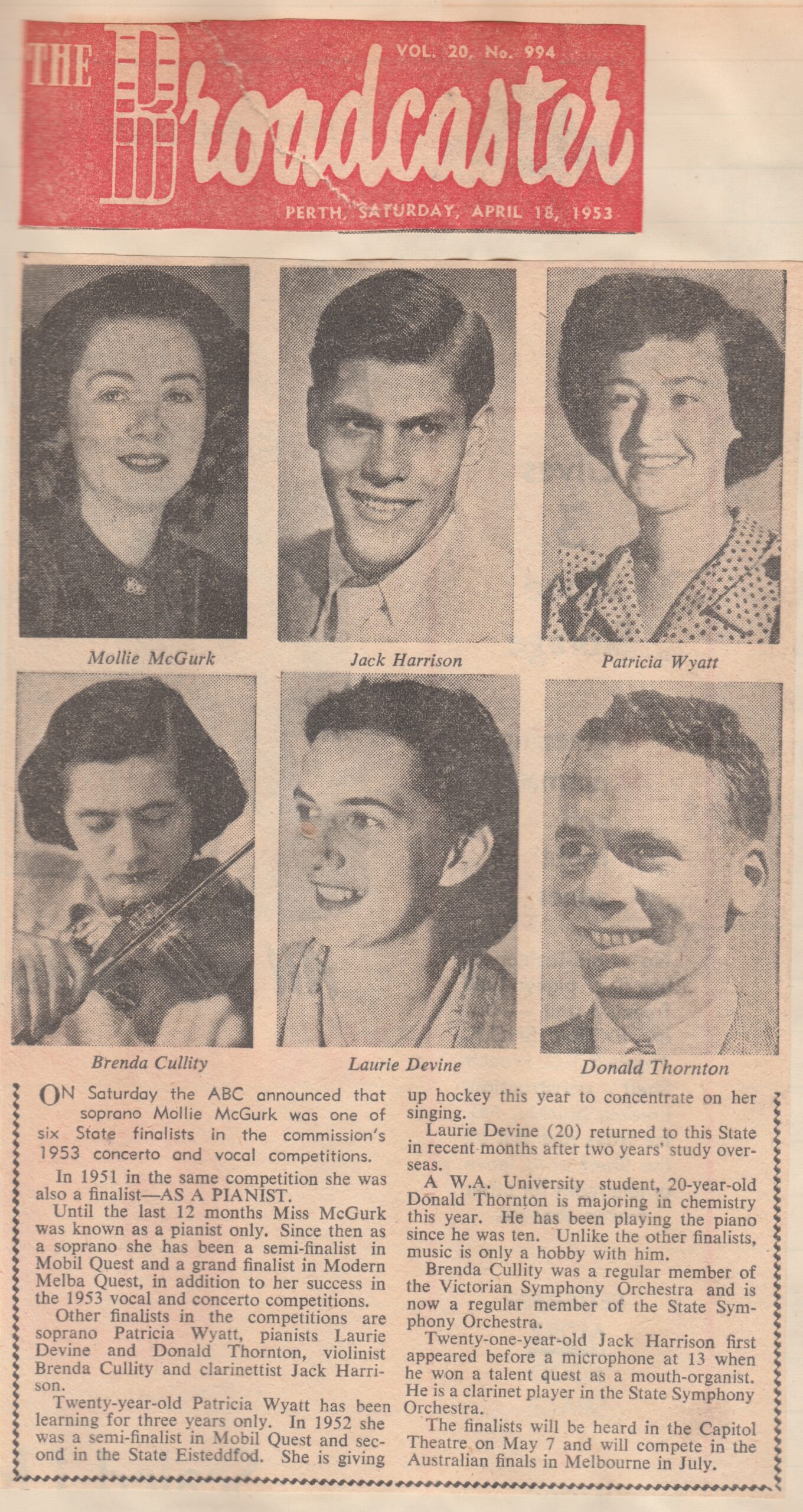
ABC STATE FINALISTS State finalists in the ABC Concerto and Vocal competition for 1953 are: Sopranos: Molly McGurk, Patricia Wyatt. Pianists: Laurie Devine, Donald Thornton. Violinist: Brenda Cullity. Clarinet: Jack Harrison. They will take part in the finals on May 7 when they appear with the State Symphony orchestra in the Capitol. Sunday Times Sunday 12 April 1953 page 8
Music Under Fire – Youth Concert Reviewed
Pianist Donald Thornton, who was judged winner of the instrumental section, opened the concert with the first movement of Tchaikovsky’s Piano concerto No. 1. Soprano Molly McGurk, winner of the vocal section, with a lovely poetic rendering of Charpenter’s “Depuis de Jour”. Jack Harrison opened the second half of the programme with the second and third movements of Weber’s Concerto in E Flat for clarinet and orchestra. He played with imperturbable technique and in places genuine artistry. I should like to hear him play a Mozart work, which might give scope for a more sensitive and musical approach than Weber. PEGASUS. The Pelican (UWA Guild Journal) – Jack Harrison’s scrapbook
Winners In Music Test Are Chosen (By “Fidelio.”)
Donald Thornton, a 20-year old science student at the University of Western Australia, won first place in the instrumental section of the A.B.C.’s concerto and vocal finals at the Capitol last night. It was his first appearance in these competitions. He played the opening movement of the Tschaikovsky No. 1 Piano Concerto and pleased the judges (and others) with his “musical approach” to a work which, as the A.B.C’s Director of Music (Mr. W. G. James) said, is so often “banged out from end to end.” In the vocal section, Molly McGurk, who sang the well-known soprano air from “Louise,” was named the winner, thereby achieving a feat probably without precedent here. For hitherto Miss McGurk has figured in the list of finalists – three times – as pianist. Her win last night, which was her first, comes at her first attempt as vocalist. The remaining contestants were Brenda Cullity, violinist (second time in these concerts); Laurel Devine, pianist, and Patricia Wyatt, soprano, both newcomers; and Jack Harrison, clarinettist, who for the third time had gained a place in the finals. High Standard The adjudication was in the hands of Mr. James, Mr. Henry Portnoj, and the W.A. Symphony Orchestra’s conductor, Mr. Pekarek. Mr. James introduced Mr. Portnoj as a musician from Vienna, now settled in Melbourne, and formerly closely associated with the Vienna State Opera. Mr. James said that the all-round standard was high, and he gave well deserved praise to Mr. Pekarek for his sympathetic help to the competitors by way of the orchestral ac-companying. Hitherto the “grand finalists” from the several States, chosen to appear in Sydney, have been selected from the State winners. Mr. James said this had been changed. From now on, the eight to appear in Sydney will be selected from the finalists in the States, that is, they will not necessarily be the winners in the States. So far this year, finalists have been heard only in W.A. After the Hobart adjudication, on June 6, when all State finals will have been completed, the choice of winners to go to Sydney will be made. As usual at these events, there was a very large audience last night.
West Australian (Perth, WA : 1879 – 1954), Friday 8 May 1953, page 8
Jack Harrison was, again, highly commended, but didn’t win. He was always tremendously impressed that Molly McGurk had won on two occasions – once on piano then as a vocalist and enjoyed working with Molly in both roles during their careers. To make matters worse, clarinettist Don Westlake came into prominence in the 1953 to be the first wind player to win the ABC’s Instrumental and Vocal Competition.
1954
Scooped the Pool – W.A. MUSICIANS’ SUCCESS
Sydney, Aug. 17.—Two West Australian musicians who scooped the pool in the final round of the A.B.C. vocal and concerto competitions last night said that they did not want to win “We only wanted honourable mentions,” they said. The two—Donald Thornton, pianist, and Patricia Wyatt, soprano—are both 21 and for the next four years could have entered the A.B.C competition. “Now we have won it seems that we cannot enter any more,” Miss Wyatt said. “We can only go back-stage and wish competitors the best of luck.” Mr Thornton won the instrumental section. He played Rachmaninov’s “Paganini Rhapsody” with the Sydney Symphony Orchestra. Miss Wyatt, who sang the “Bell Song” from Delibes’ “Lakme,” won the vocal section. Nine young musicians took part in the final concert. The adjudicator was the noted European conductor, Walter Susskind, and the orchestra was conducted by Eugene Goosens.
Kalgoorlie Miner (WA : 1895 – 1954), Wednesday 18 August 1954, page 8
1958
Once again, the State finals of the Concerto and Vocal Competition on June 12 showed the strength of talent in young Western Australian musicians. The finalists were WA Symphony Orchestra violinist Robert Ingram, tenor Lloyd Masel, pianists Michael Bertram and Josephine McKimmie, sopranos Elayne Sibritt, Margot Robertson and Lynette Howieson and violinist Geoffrey Michaels.
1959
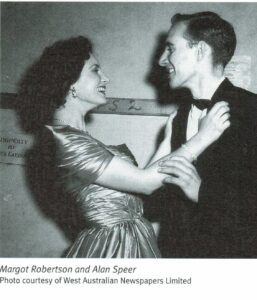 Margot Robertson was the soloist when the West Australian Symphony Orchestra travelled south in March, returning in time to take part in the Shell Aria Contest held in Canberra. In the eisteddfod held in conjunction with the main contest, Margot won champion lady’s solo. In June 1959, Margot and pianist Alan Speer won their sections in the state finals of the Concerto and Vocal Competition.
TALENTED ARTISTS TO VISIT YORK
An all star cast of leading Commonwealth and State artists will give a Concert in the York Town Hall on Saturday, 30th August. The occasion is the one hundred and sixth Anniversary of the York Methodist Church. Geoffrey Michaels, the fourteen year old violin prodigy, who last month, playing with the Sydney Symphony Orchestra, won the A.B.C’s Commonwealth Concerto Competition will be featured. Miss Patricia Connop who was last year’s winner and is at the present the star of the “Mikado” now playing at the Capitol Theatre, together with George Idle who plays opposite her in the same show, will be among vocalists. Miss Dianne Hosking, one of Perth’s leading actresses, will present speech items and John Dean and Bob Ingram, of the Perth Symphony Orchestra, will contribute instrumental items. Miss Margo Robertson, a West Australian finalist of Mobil Quest and Mr Ian Conochie, a leading base soloist in the “Messiah”, will also be vocalists. Duo-pianists of State fame who will perform are Josephine McKimmie and Michael Bartram; Wendy Prosser and Alan Speer. This is the finest line up of talent this State and York has enjoyed for such moderate charges. To make the evening a social success fitting for the occasion supper will be served the admission fee of six shillings will cover this. To obtain a good seat it is advisable to book at Efford’s Pharmacy, Beverley.
Beverley Times (WA : 1905 – 1977), Friday 22 August 1958, page 4
1960
A thirteen-year-old pianist who was later to make a name for himself was highly commended for his rendition of Ravel’s Concerto in G. His name was David Helfgott. Other competitors were pianists Noelle Johns and Michael Cole, violinist Brian Hanly and soprano Lesley Perrin. The winners were pianist Pauline Rowe and soprano Margot Robertson, who was successful for a third time. The conductor was John Farnsworth Hall.
Harrison, Marcia, West Australian Symphony Orchestra Celebrating 75 Years, (WASO Holdings Pty Ltd, 2003), p.52.
1961
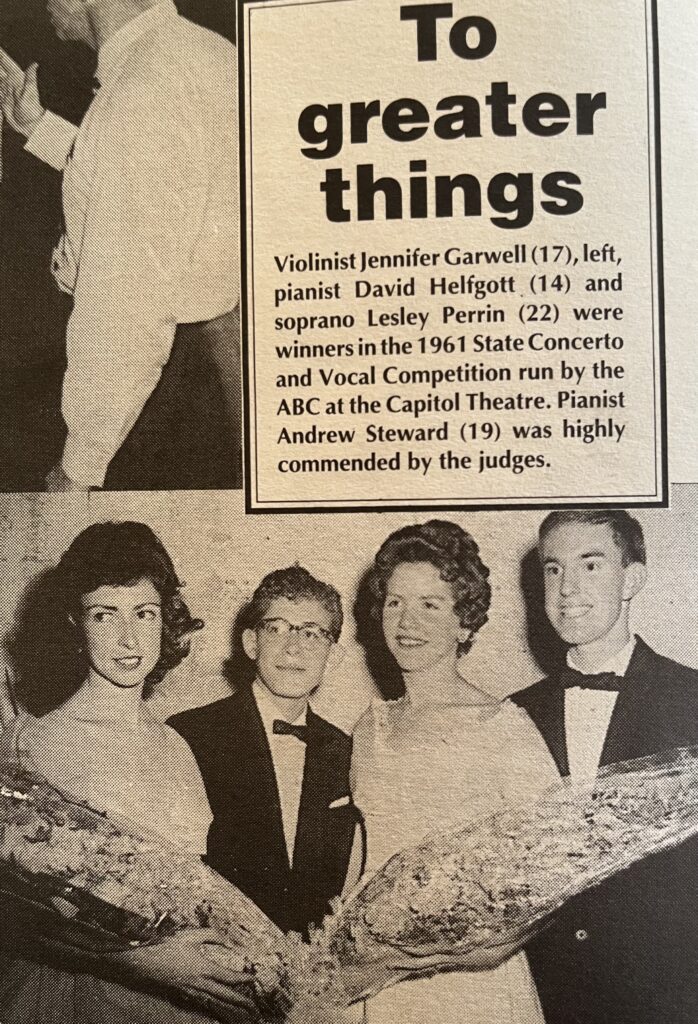
1962
In 1962, Lyn Tilsed won the instrumental section of the New South Wales Final of the ABC Concerto and Vocal Competition playing the flute, and in the following year, won both the Keyboard (flute)and Wind/Brass (flute) sections of the West Australian Finals.
1964
W.A. Finalists were David Helfgott (piano), Brian Hanly (violin), Patrick Brislan (French horn), Jennifer Garwell (violin) and Allyn Tilsed (flute).
In this historic 1964 Perth final, a young David Helfgott won the piano section with a performance of Rachmaninoff’s Piano Concerto No. 3
1968
In 1968, Lyn Tilsed entered the ABC Concerto and Vocal Competition once more, winning the keyboard section of the WA Finals and was runner – up in the Commonwealth Finals playing the harpsichord, an instrument for which she developed a great love and interest.
1984
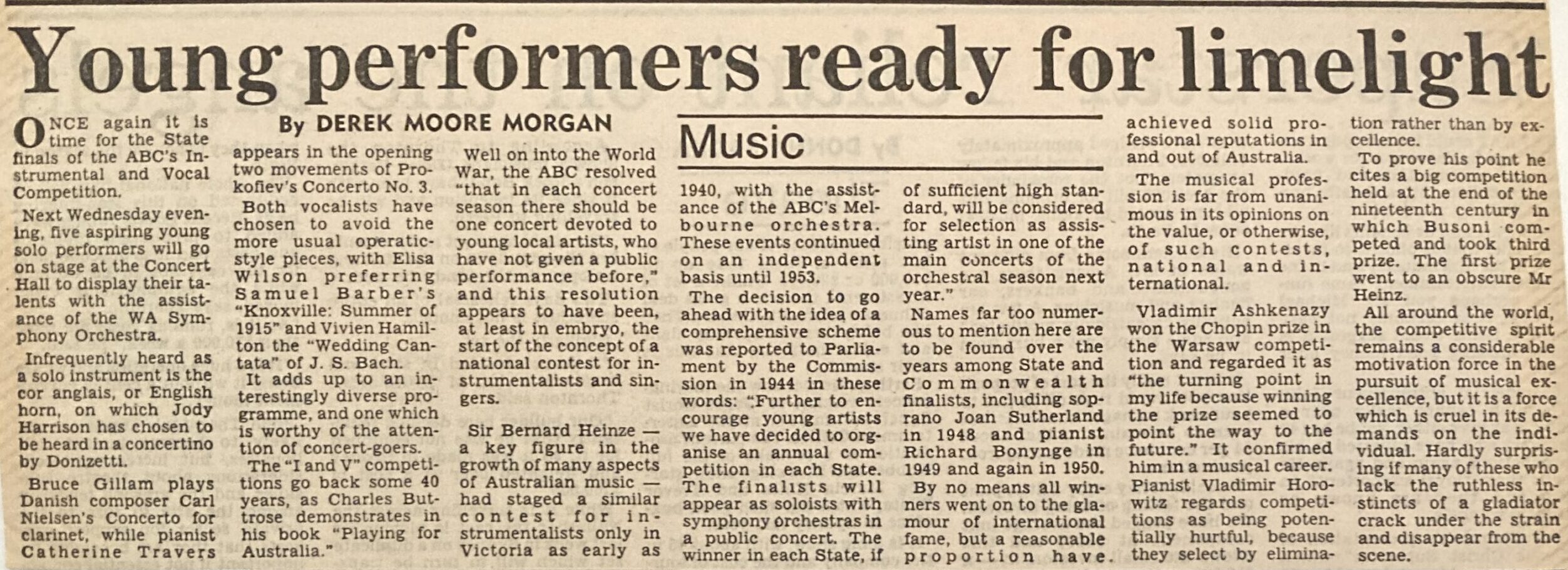
The West Australian Thursday May 17 1984
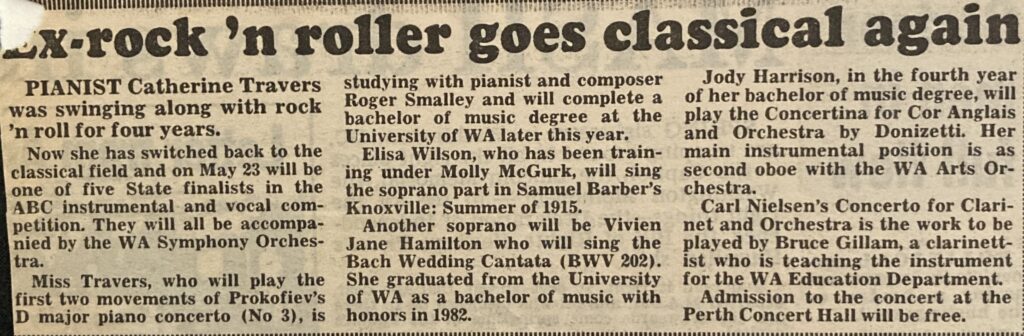
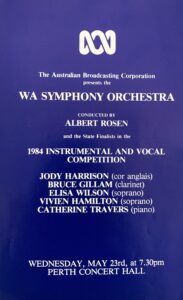
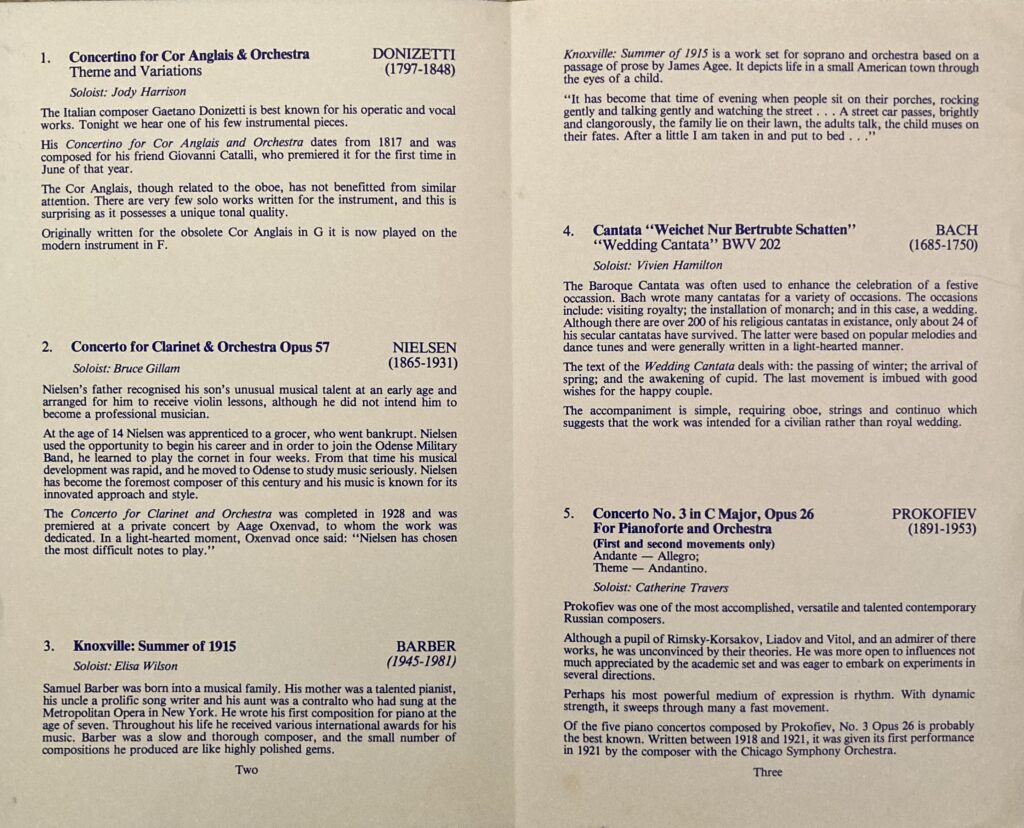
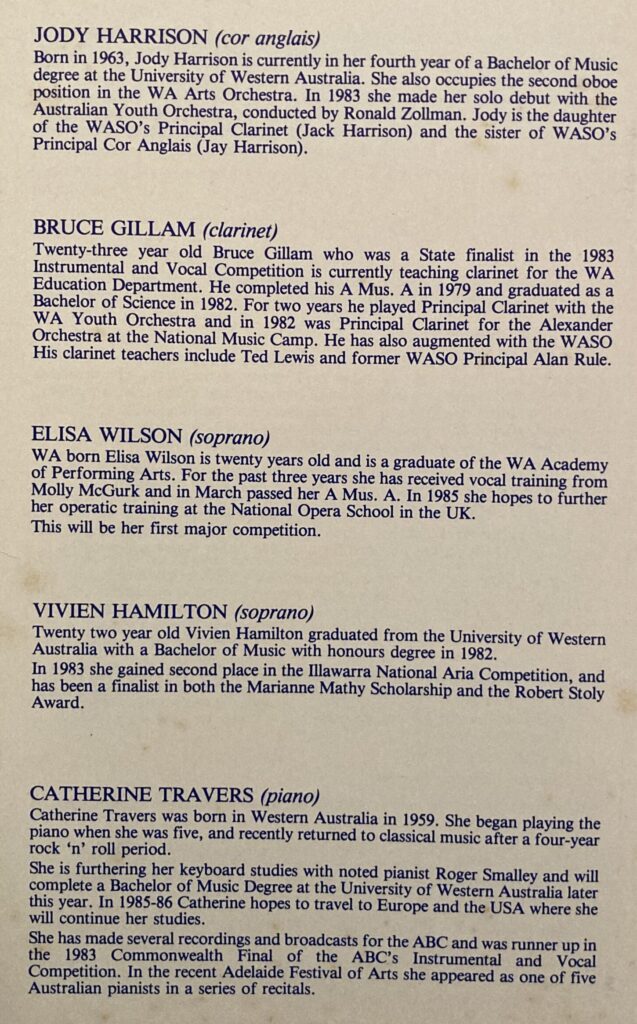
In 1984, Bruce Gillam was named a State Winner of the ABC Instrumental and Vocal Competition, performing Nielsen’s Clarinet Concerto with the West Australian Symphony Orchestra. Elisa Wilson won the Vocal section and Cathie Travers the Piano.
Person
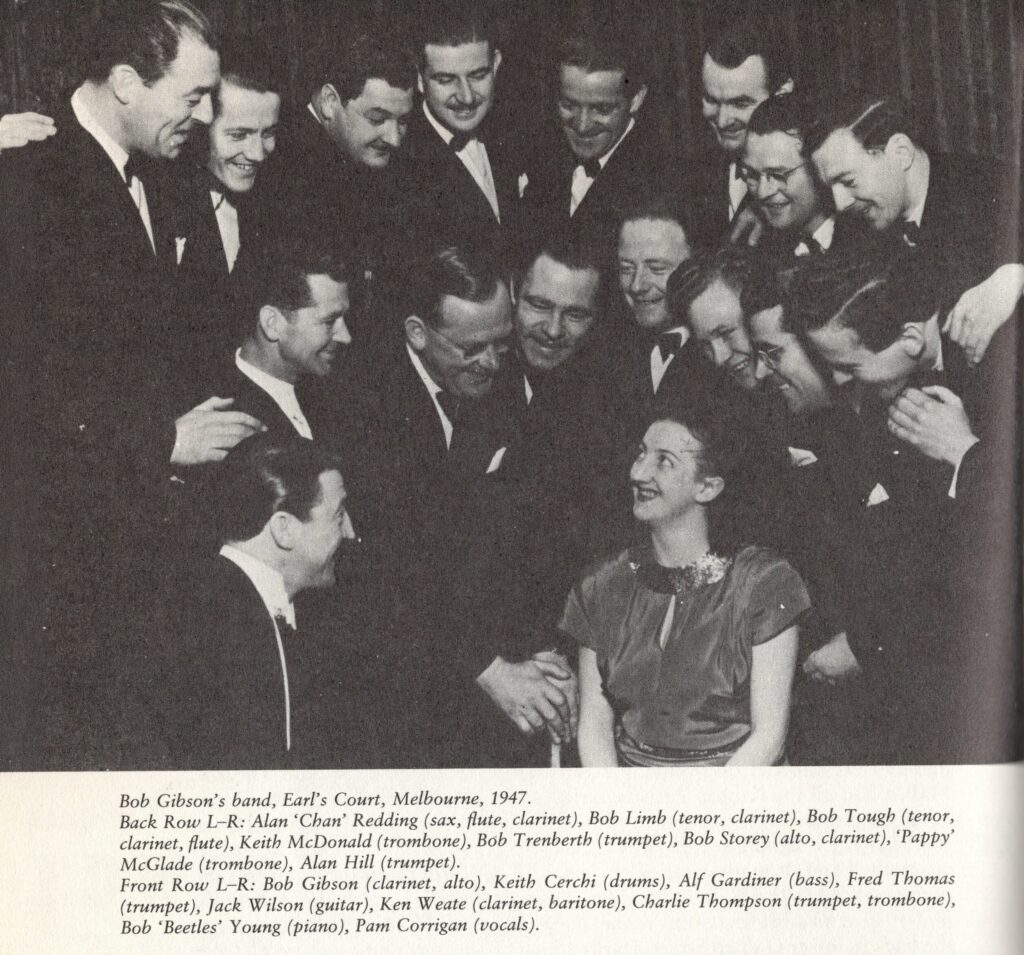
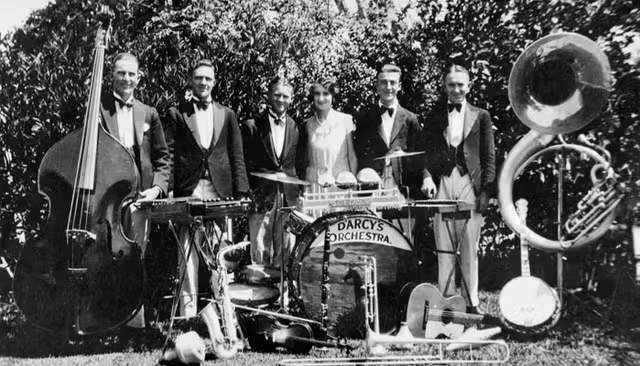
Bob Gibson was a Perth musician who began his career on violin, then learning clarinet and saxophone with Harold Moschetti. In Perth he initially played with the Doreen D’Arcy’s Orchestra, a six piece dance band, and then in Ron Moyle’s seven piece band at the Embassy Ballroom. Moyle toured to Melbourne and Gibson auditioned successfully in 1935 for the “Good Companions”.
1931
This image taken in 1931 is of Doreen D’Arcy’s Orchestra, a six piece dance band from Perth. There were a number of bands led by women in Perth at that time, including the all girl band led by May Salter called The Melody Girls.
https://www.nfsa.gov.au/stories/articles/australian-jazz-archive
1933
LOCAL BAND HONOURED – Engagements in Eastern States.
For the first time in broadcasting history a West Australian band has been engaged through the Australian Broadcasting Commission to give performances- over the air in the Eastern States. Ron Moyle and his ‘Westralians,’ a combination of local performers, will leave ‘ for Adelaide by the Great Western express on Saturday, night, and will be absent for about six weeks. The ‘Westralians’ will be heard over the air from 5CL, Adelaide, on December 21 and 22, and from South Australia they will go to Melbourne, where they will broadcast from 3LO- between January 6 and 27. It is possible that the band will; also visit Sydney. Ron Moyle himself is well-known to listeners in Western Australia, having been connected with broadcasting in this State for many years. His band, which is composed of the following players, was heard from 6WF during last dancing season: — Ron Moyle, A.T.C.L. (pianist); Bob. Gibson, L.A.B. (alto saxophone, clarinet and violin) ; George Caro, A.T.C.L. (tenor saxophone, clarinet and violin); Allan Gough, A.T.CJj. (alto saxophone, clarinet and violin); Viv. Nylander (trumpet and trombone); Kem. Fimmel (trumpet); Charles Thompson (trombone and trumpet);. Wally Hadley (banjo, flute and guitar); Cliff Adams (guitar, tap dancer and vocalist); Eddy Roberts (drums and vocalist); and Tom Bennett (bass). The band will give a final concert at the Ambassadors Theatre on Friday night. West Australian (Perth, WA : 1879 – 1954), Wednesday 13 December 1933, page 5
In 1935 the band the “Good Companions” was formed by Ern Pettifer at the Palais de Danse, St Kilda. “The formation of the “Good Companions” set music at the Palais on a forward-looking path, because Pettifer gave some talented young players a break. Auditions were held on a hot summer day and in the line of hopeful stretching around the corner was a gifted alto saxophonist from Perth, Bob Gibson. The audition piece was a tough arrangement of “Bugle Call Rag” by Frank Coughlan who was then with Pettifer. Gibson sailed through it because he had had a thorough classical training and had won many scholarships for his ability, and he knew dance work too. Gifted young players never appear out of nothing and Gibson was no exception. Perth had its own thriving dance bands.” Andrew Bisset, Black Roots White Flowers, 1987 Globe Press. page 55
1941
Talking Shop By “Finn” Westralian Wonder. From farther and farther afield come the stars of 3Aws “Youth Show” and the latest on the list is an amazing young man from Nedlands, Western Australia. He is nine year old Jack Harrison who surprised everyone by winning the first prize in the big 150 pound “Search for Talent”. He competed against allcomers and won by popular vote, although listeners had no knowledge of his age or identity. Jack started playing the mouth organ …he will feature in the broadcast from 3AW. The Listener In Complete Radio Newspaper February 22-28 1941 And 4BH. Teleradio Saturday March 1, 1941
Jack’s father tells me (per the P.M.G.) that he has met at least 14 W.A. people n Melbourne and Sydney who are tops in the eastern entertainment world. He cut out newspaper references to some of the W.A. people which have appeared during the few weeks he has been in the East and forwarded them to me. One about “Duffy” Newton (who used to act in 6WF plays) made about ten inches of type, had a double column heading and carried a photo. Other cuttings contained photographs of David Samuel (deputy-leader of Bert Howell’s Band and leader of last year’s “Youth Sow” band), Chester Bond (who is at present featured in a big radio serial), Bob Gibson and George Watson (a principal of the Drum Club). The Broadcaster February 1 – 8 1941
1949
19 February 1949 – PERTH JAZZ MEN ARE TOPS IN EAST
Recent news about WA dance musicians who have sought to establish national reputations is good news. At least 4 who have been questing after the big-time in the Eastern States have made it, some of them ranking amongst the top-salaried musicians of the day. Currently occupying press space in musical magazines and feeling the for and, against quips of critics in Sydney is Ray Hartley, onetime popular pianist at radio lunch-hour concerts in Perth. General gossip has it that Ray is sow in the high salary range although it is rumoured that the road has been long and very rough. At present Ray is featured with Paul Lombard’s outfit at the Celebrity Club which used to be Rose’s and spare time, as little as he may have, L being turned towards arranging and holding down a couple of radio spots. In addition to this Ray contributes to the Music Maker, the Australian Dance Band Editorial and his articles on prominent keyboard men are a worth while contribution to that magazine. Although his name is usually associated with lunch hour concerts, Ray’s success was first assured in renditions of the Ray Hartley Trio; a combination which he has reformed in Sydney.
One Of The Best Recognised as being one of the best musicians in Australia was Bob Gibson. Since leaving Australia some months ago to further his knowledge in England, little news has been heard of him. He is another W. A. man and at the age of 9 was a winner of eisteddfods and a gold medalist, but his future career was not restricted to his ability as a violinist alone, for at the age of 14-15, Bob commenced taking sax and clarinet lessons from Harry Moschetti, and very soon established himself on these instruments. In the early 1930’s, Bob took over the leading alto sax seat in the Ron Moyle outfit, a combination through which passed some of the finest musicians of the State, and when this outfit went on tour through the Eastern States, Bob Gibson still occupied alto seat but he never returned to W. A. With hard work and perseverance he finally cracked the ice in Melbourne and had occasion to look back. Just prior to the last war, he organised his own band and hit St. Kilda night spots which proved to be his first top liners. His subsequent success such as the Shell Show are now history and it is hoped that his success overseas will continue. Mirror (Perth, WA : 1921 – 1956), Saturday 19 February 1949, page 11
1950
April 1949 – Outstanding alto and clarinet man with the Sharp combination, George Caro, has had a colourful career in the game. At 15 he commenced the sax, and as George maintains, was completely self-taught. He first came to the public notice in 1930 when he was one of 18 who competed in the saxophone competition conducted by the Brass Band Association of WA. Winner was Cas Mitchell, now of the ABC Melbourne, second George Caro, Bob Gibson (now in England) was third, and fourth position was filled by Bob Trew (Perth ABC). In 1934, when the exodus was on, George made the Eastern States tour with the Ron Movie outfit, and when this orch. returned to WA, George decided to hit out for the overseas spots. His first working port o’ call was Colombo, where he played at the Mount Lavinia Hotel. From here he went to the Grand Hotel at Calcutta, before making the Malayan Peninsula in 1936, where he played in Singapore cabarets and the Eastern and Oriental Hotel in Penang. On his return to Australia, George linked up with pit work, played for the American Marcus ‘Show, North China Troupe, Dante, and various other visiting shows. During the war he played second cornet with the 28th Battalion Band, and at a later stage, while serving in Darwin conducted a Sunday night Swing Show featuring a 5piece outfit. Returning to civvy street, he joined Chris Gosper’s eight playing at St. Mary’s, Mt. Hawthorn. When Sammy Sharp returned from England, George moved in with Sammy and remained with him ever since. —’QUAIL.’Mirror (Perth, WA : 1921 – 1956), Saturday 23 April 1949, page 14
1950
On The Home Range – BOB GIBSON
Ask the boys in the strings and the winds about Bob Gibson. Gibson! they say with awe. He lives, eats, and drinks music. He has no other interests, only music, in which he strives for perfection. And in hushed tones they say, ” What an ‘ear’ that man’s got!” ASK “Melbourne’s thousands of dance fans. “Bob Gibson,” they say. “He’s more than a band leader. He is the perfect dance tempo!” To us Bob appears to be just an ordinary bloke, unassuming, dark, rather short, with a pleasant fluency. Local dance fans were desolate when Bob sailed for England in 1948. Now he’s back, after London successes, wondering whether to re-form his band in Sydney or in Melbourne. Few, if any, Australian band leaders have had a bigger personal following than Gibson. Before his London trip his band, then the only big-time, freelance combination in the country, was nationally famous for its work in hit radio – programmes such as The Shell Show, All Australian Hit Parade, Popularity Parade, and A.B.C. Shows. In addition, the Bob Gibson band, which incidentally was then costing about £500 a week to run, was in demand for Vice-Regal evenings and the top society balls of the season. Bob was something of a child prodigy. At 12 years of age, he was playing the violin in the newly-formed Perth Symphony Orchestra. In his early teens he was awarded his violin degree in Perth by the travelling examiner of the Royal Academy of Music. As a youth of 17 he stepped off the Overland in Melbourne into the St. Kilda Palais orchestra, the Palais being one of the biggest dance halls in the Commonwealth. He was lugging four cases — three for his violin, saxophone, and clarinet, and one for clothes. He fiddled and “doubled” on the sax and clarinet to such purpose that within a few years he was promoted to be Palais Orchestra arranger, probably the youngest in the Commonwealth. Then in 1939, only 25 years old, he formed his own orchestra. Bob went overseas to study entertainment trends in radio, television. and on the stage. He warns Australian musicians and theatricals that the competition over there is terrific. For every musician here there are at least 100 in London, competing for a limited amount of work. When a band vacancy occurs a dozen first-class players apply. for the position before it can be advertised. Only the fittest survive. Working conditions are much tougher than here, and the pay is not as good. There are many English musician anxious to migrate here. English artists and players are beginning to take a “dim view” of the increasing number of Australians reaching the top. But, Bob says, for every Dick Bentley, Kittys Bluett, and. Joy Nicholls at the top there are a score of Australians hovering on the breadline, many of them good artists. “Great talent is not enough in London,” he says, “You must have” luck too.” Gibson had his share. After doing a “study” tour with Tommy Trinder’s show, Bob was asked to form an orchestra of 25 players for the B.B.C. He also spent seven weeks in Paris and conducted a light orchestra which did the background”, music in a French film. Bob advises young theatricals and musicians to go to England for study, but to buy a return ticket before leaving! Gibson plans to return to London in 1951. In the meantime, he aims to. satisfy those dancing feet in Melbourne, or Sydney, perhaps! Smith’s Weekly (Sydney, NSW : 1919 – 1950), Saturday 18 February 1950, page 15
1953
Local Acts Compete for Record Prizes in Talent Final – Sixteen local acts will contest the grand final of Talent Hour, Australia’s most richly endowed talent quest, to be relayed from Melbourne Town Hall through UZ at 8 p.m., Tuesday, November 10. Each of the four section winners will receive £500, with minor placegetters receiving £250, £40 and £15. The best act of the night will be awarded an additional £1000. Awards will be made at the conclusion of the programme. Regular adjudicators, Dr. Herman Schildberger and Mr. Harry Sutcliffe; have been joined by Mr.-Garnet H. Carroll. Recorded semi-final performances of all artists will be featured in Talent Hour Preview, at 3 p.m. Sunday, November 8. Recorded grand final performances will be repeated, in Talent Hour Review, at 3 p.m. Sunday, November 15. Sydney orchestra leader, Bob Gibson will direct a 20-piece orchestra. The stage setting will include the appearance of leading Melbourne mannequins. Competitors are as follows;— Vocal: Joan Reed, soprano; Kenneth Sullivan, tenor; Theodor Sartory, bass-baritone; Leonard Delany, baritone. Instrumental: Roger Holmes, piano; Ian King, tuba; Eugene Danilov, clarinet; Mary Nevmet, violin. Pop Vocal: Reg Gray; Jack Bowkett; Margot Carroll, John Oldham. Novelty: Alfred Smith, monologuist; Don Harper Quartet; John Shingler and Kelvin McMillian, flute and saxophone duo; D.D.H. instrumental trio. Age (Melbourne, Vic. : 1854 – 1954), Thursday 5 November 1953, page 19
RED CARPET FOR MUSIC VIPs GET WELL WORN
Perth musicians are finding their red carpet (for rolling to welcome local members who have become VIP’s in the musical world) is wearing pretty thin. Latest to tramp across it will be Bob Gibson, on Monday night. He arrives from the Eastern States by ‘plane, will be an honoured guest at the Musicians’ Ball at the Embassy on Tuesday night. He has made his name not only as a musician and band leader, but also as an ‘ arranger. His work has been praised by ‘big name’ clarinettist Artie Shaw. Bob studied violin in Perth at an early age. While still in short pants he played at the old Prince of Wales Theatre. He turned to the saxophone later, left here in that capacity with Ron Moyle’s orchestra in 1933 for. what is believed to be! the first tour of a dance band under the ABC banner. He stayed in Melbourne, where he ‘saxed’ with Ern Pettifer’s orchestra at St. Kilda’s Palais de Dance, which was later taken over by Hal Moschetti, another West Australian. Later engagements included seasons with Bert Howell, of Capitol Theatre, and Shell Radio Show fame, Jay Whidden, Roy Fox and Dick Freeman. Bob formed his own combination at Melbourne’s Palm Grove, with a wealth of experience behind him. During the war he organised a band and toured forward areas as director of a US entertainment unit. After the war he returned to England as musical director of the Tommy Trinder Show (a job now held by Hal Moschetti). But the climate and ill-health (he developed pneumonia) sent him back to Australia, where he has carved himself a new niche. Mirror (Perth, WA : 1921 – 1956), Saturday 24 October 1953, page 12
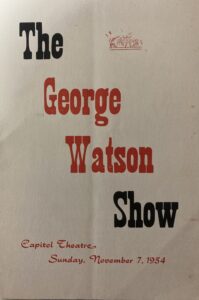
SUNDAY, NOVEMBER 1st, 1953 – Jazz Festival Week Part Two: CAPITOL THEATRE – THE BOB GIBSON SHOW
Featuring Australia’s Outstanding Band Leader
WEST COAST DIXIELANDERS
NORM WRIGHTSON
MARTIN GISCHUS
HARRY PHILLIPS
COLIN HICKS
KATH BASS
Box Plans for both these attractions now open at Nicholsons. TICKETS 5/ The West Australian Saturday 17 October 1952 page 35
LISTENERS WILL HEAR GIBSON An agreement reached between the W.A. Musicians’ Association and the ABC resulted in last Sunday’s Jazz Jamboree (featuring The Bob Gibson Show) being recorded for broadcasting from 6WF. When the ABC heard that ace band leader Gibson would be the guest artist for the second part of Jazz Jamboree, it came to an agreement with organisers Sam Sharp and Harry Bluck for Gibson’s show to be recorded, and also agreed to pay the W.A. Musicians’ Association a fee for the right to record the show. The date of the broadcast will be published shortly. Gibson is now musical director for 2UW. Recently Gibson signed an agreement with the Columbia Recording Company. The first of his releases to be heard in Perth will probably be “Wild Horses” and “My One and Only Heart”. Gibson, who went to England in 1948 and returned in 1950, now favours big band. He records with a 28-piece band, and for concert and radio work he uses anything from 16 to 20 musicians. Two of his most popular programmes, heard from 2UW and Sportsman’s Parade and Musically Yours. Gibson said that any young musicians who hoped to go abroad needed plenty of capital and lucky breaks. He said that there were too many instances of a bandleader casually approaching a popular tune without having any idea of presentation.
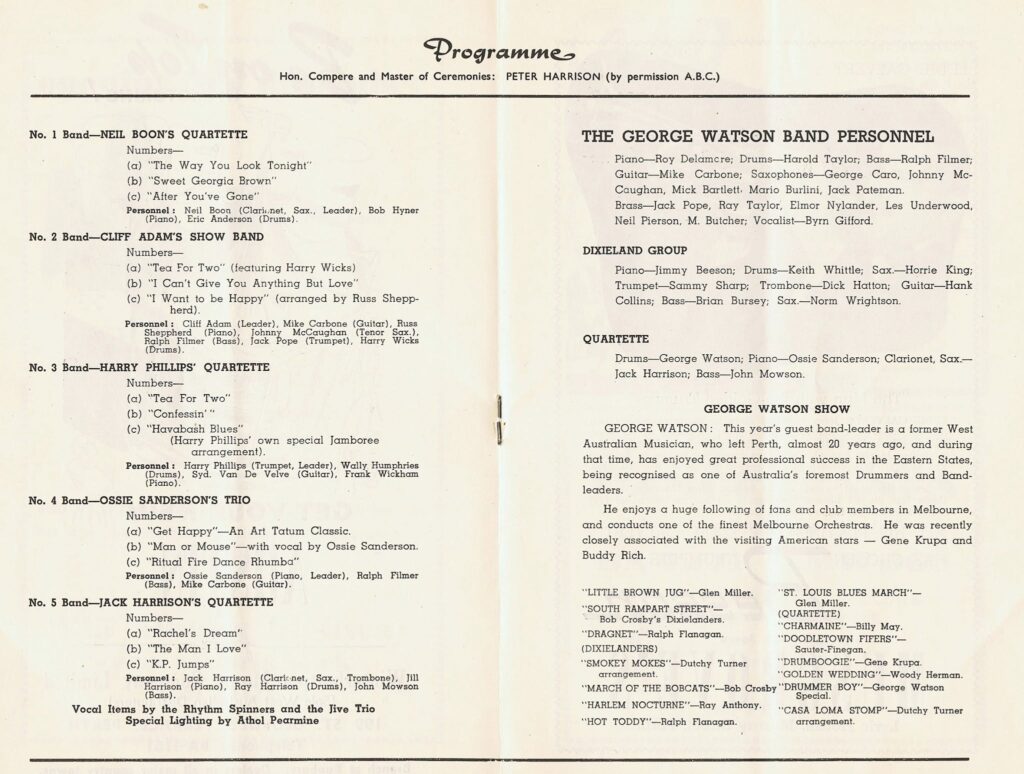
Of the orchestra he conducted at the Jazz Jamboree on Sunday night, Gibson commented “They are a first class bunch of musicians. Considering they had such short notice to get together they gave a truly remarkable performance.” The band leader also praised individual performances. He believes that 17 year old Neil Boon could develop into a top line artist. Jack Harrison displayed plenty of versatility and gave a smooth performance, he said. Gibson also praised the responsiveness of the audience. “In modern music there is no greater encouragement” he said. The Broadcaster Saturday November 7 1953 Vol .20 No. 1023
BAND HAS BIG NAMES IN EVERY SECTION – When Harry (‘Powerhouse’) Phillips takes up his trumpet on the stage it is usually a signal for wild enthusiasm from rhythm fans who see in him a combination of Louis Armstrong, Harry James and a dozen other trumpet idols. Harry, who has been to WA for nearly 5 years, is from an English musical family which has been associated with big-name bands in England and on the Continent for many years. His brother Syd will always be remembered for his compositions and arrangements with the famous Ambrose. Another brother, Woolf, is equally well known. Before coming here Harry played in most of the capital cities of Europe and speaks several languages fluently. He has played lead trumpet with brother Syd’s band, with Ambrose, Mantovani and Harry Roy, as well as with his own groups. He can play a sweet trumpet, but is usually associated with the forceful style which gives him his name of ‘Powerhouse.’ Although this looks to be a difficult style, he achieves his effects from the modern non-pressure method, with which there is no great physical effort, despite the seemingly strained attitude of the player. Harry claims to be able to te ich this style easily. Associated with Harry in his band are a number of promising young musicians, notably saxophonist Neil Boon, a 17-y-o Dutch boy who literally stopped the show at last Sunday night’s Jazz Jamboree, when Bob Gibson was guest conductor. A great future is predicted for this boy, who has been playing saxophone for less than a year, but has played the clarinet for 4 years. His alto sax solo ‘I’m In the Mood for Love’ received such an ovation that compere Wally Hadley had to ask Harry to bring him forward and introduce him to the audience. Band’s guitarist Sid Vandervelde, also from London, was with the late Felix Mendilsohn’s Hawaiian Ensemble and the late Freddie Gardner, the great sax stylist. Sid works a6 a motor-mechanic in Perth and has been here for 2 years. Fans like the drive he gives the band with his solid rhythm on an amplified Spanish guitar. Brothers Don and Gordon Bates, who play piano and drums with the outfit, are local boys who have been well-known in the music game here since they had ‘their own band some years ago. Don is a saddler with his father and Gordon is with a City leather firm. Harry works as a planning engineer for a Perth firm.
The popular Harry Phillips combination which has delighted Perth rhythm fans: (PHOTO) From left: Syd Vanderveldt, guitar; Don Bates, drums; trumpeter Harry, Gordon Bates, piano; Neil Boon, sax and clarinet. Mirror (Perth, WA : 1921 – 1956), Saturday 7 November 1953, page 12
Person
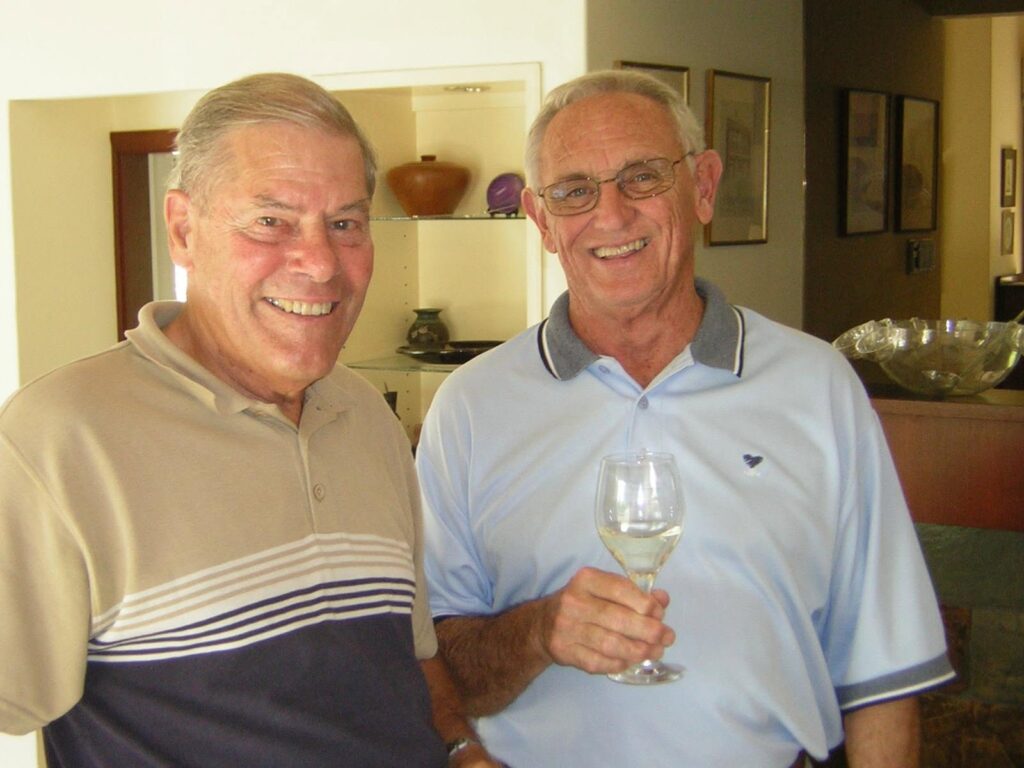
By 1942, aged 14, Burrows had begun playing clarinet and quit school. He began appearing at Sydney jazz clubs, and appeared on The Youth Show, a Macquarie Radio show. In 1944 he was invited to play and record with George Trevare’s Australians. He became well known in Sydney jazz circles and was performing in dance halls, nightclubs and radio bands. He was a member of Jim Gussey‘s ABC Dance Band for five years.
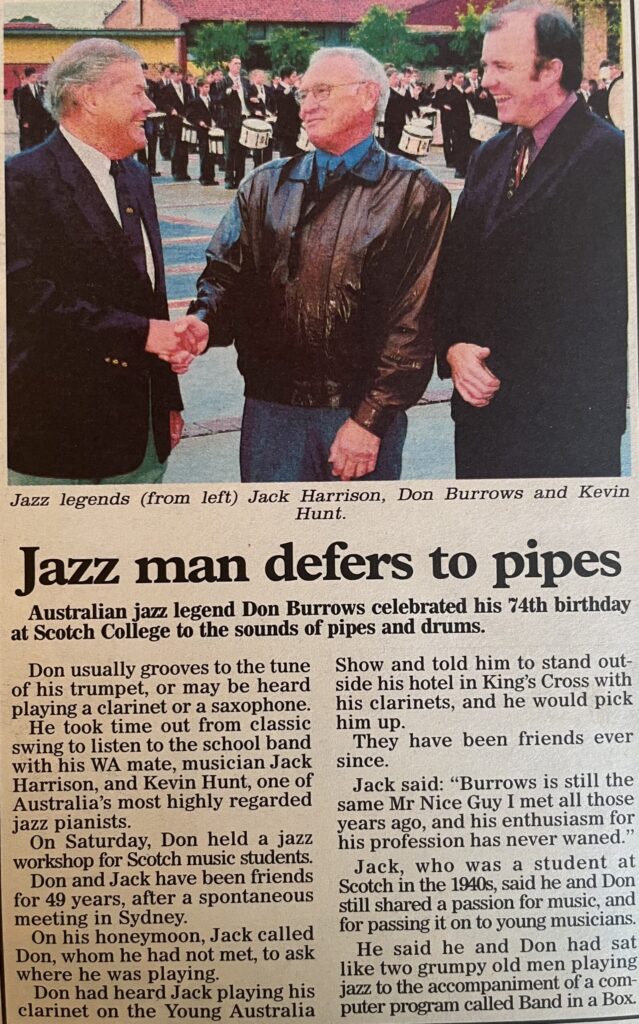
Jazz man defer to pipes
Australian jazz legend Don Burrows celebrated his 74th birthday at Scotch College to the sounds of pipes and drums. He took time out from classic swing to listen to the school band with his WA mat, musician Jack Harrison and Kevin Hunt, one of Australia’s most highly regarded jazz pianists. On Saturday, Don held a jazz workshop for Scotch music students. Don and Jack have been friends for 49 years after a spontaneous meeting in Sydney.
On his honeymoon, Jack called Don, whom he had not met, to ask where he was playing. Don had heard Jack playing his clarinet on the Young Australia Show and told him to stand outside his hotel in King’s Cross with his clarinets and he would pick him up. They have been friends ever since. Jack said “Burrows is still the same Mr Nice Guy I met all those years ago, his enthusiasm for his profession has never waned.” Jack, who was a student at Scotch in the 1940s said he and Don still shared a passion for music, and for passing it on to young musicians. He said he and Don had sat like two grumpy old men playing jazz to the accompaniment of a computer program called Band in a Box. Claremont Nedlands Post August 31 2002 Vol. 28 No. 35
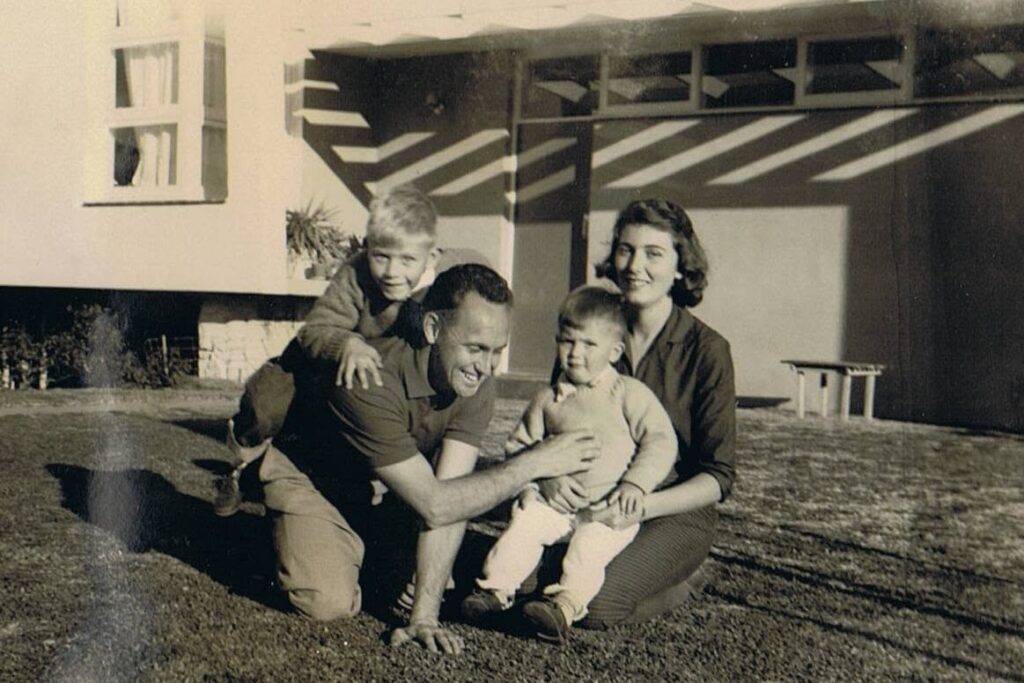
During the 1960s and 1970s Burrows had many engagements in Australia and the United States, including six years performing at the Wentworth Hotel in Sydney in quartets with Ed Gaston, George Golla, and various drummers. It was this association which made his name the “most familiar in Australian jazz”. In 1972, he was invited to perform at the Montreux Jazz Festival and later the Newport Jazz Festival.
The year 1973 was a watershed for Burrows as he received the first gold record for an Australian jazz musician for his record Just the Beginning,[8] instigated the first jazz studies program in the southern hemisphere, at the New South Wales Conservatorium of Music (under the direction of Rex Hobcroft) and was appointed a Member of the Order of the British Empire (MBE). In 1979 he was appointed Chair of Jazz Studies at the conservatorium.
Burrows performed to mostly classical music audiences through tours with Musica Viva and the Australian Broadcasting Corporation concert series. He led the nationally televised show The Don Burrows Collection for six years. He had an extensive recording career with his groups and performed on albums by others.
In the 1980s Burrows mentored and was closely associated with James Morrison. He formed the Don Burrows Quartet with George Golla (guitar), Ed Gaston (double bass) and Alan Turnbull (drums). He also worked with Frank Sinatra, Dizzy Gillespie, Nat King Cole, Oscar Peterson, Tony Bennett, Stéphane Grappelli, Cleo Laine, and the Sydney Symphony Orchestra.
In 1981 Burrows played woodwind on a Play School album, Hey Diddle Diddle: it was his only involvement with the show.
In 2005 Burrows toured with a small band that included the Australian jazz pianist Kevin Hunt. He used his photographic images with his music in a show called Stop, Look and Listen.
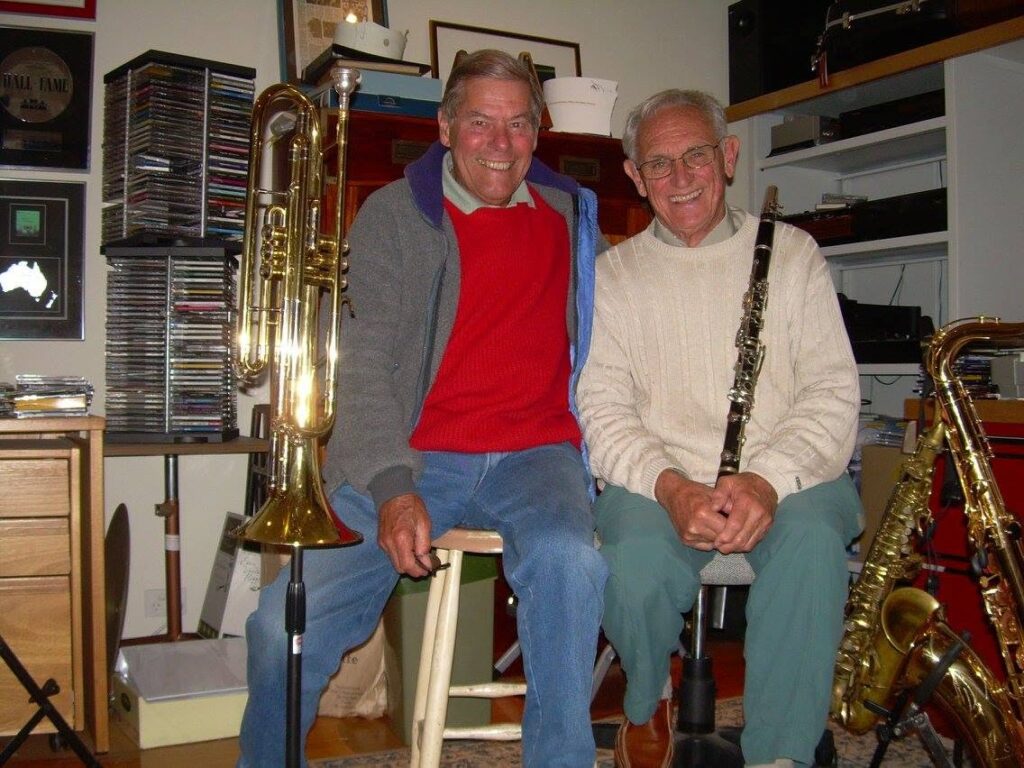
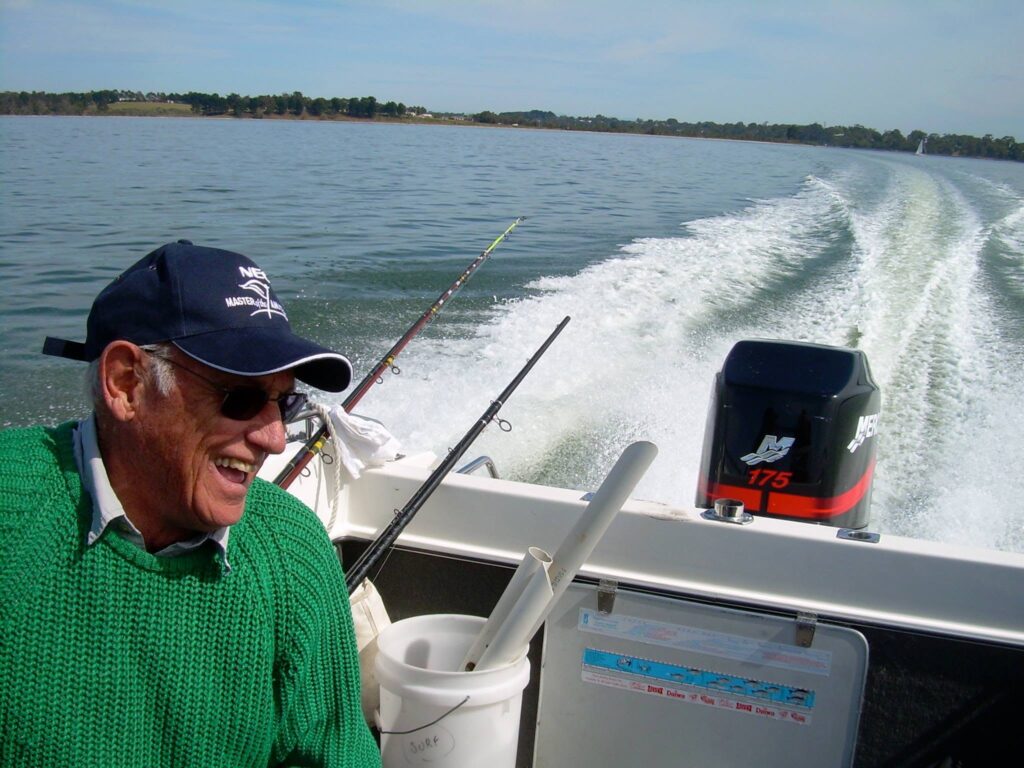
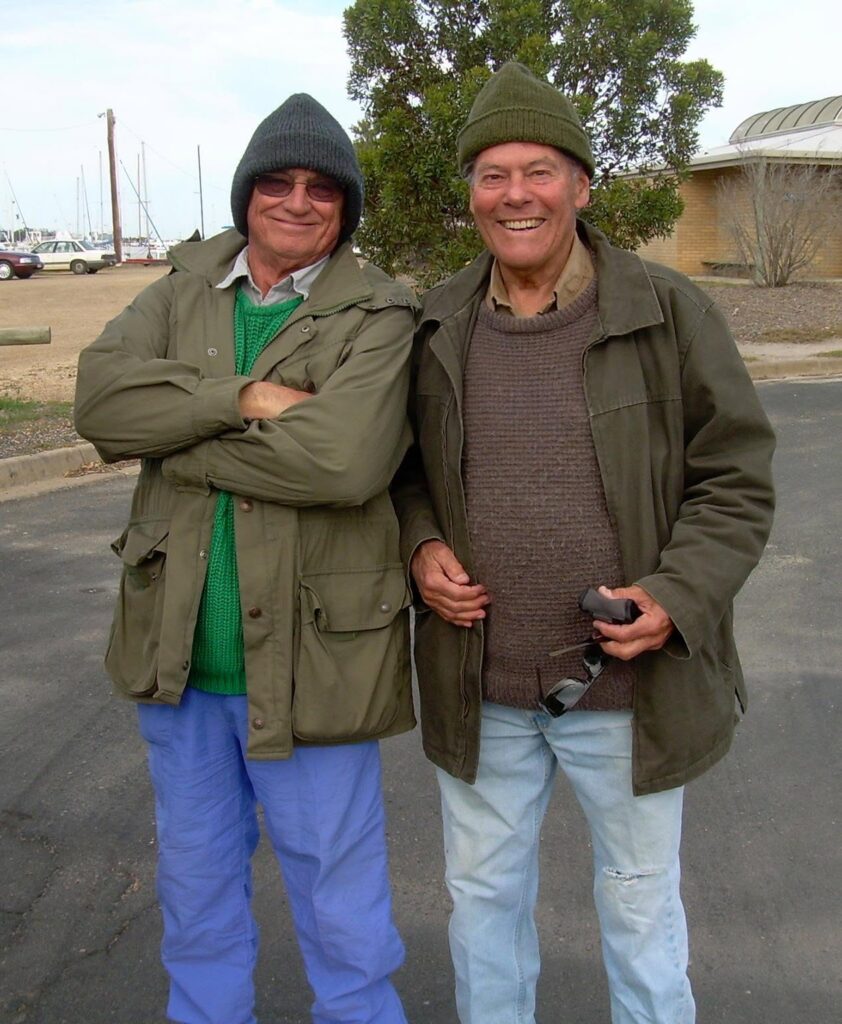
Don loved fishing, a passion he shared with Jack Harrison.
Burrows had arthritis from age 38. In a 2008 interview with the Australian Broadcasting Corporation’s Andrew Ford, celebrating his 80th birthday, he said that “arthritis is not the greatest for playing a musical instrument. But playing a musical instrument is very, very good for arthritis”. In later years he had Alzheimer’s disease and lived in a nursing home in northern Sydney. He died on 12 March 2020, aged 91.
https://en.wikipedia.org/wiki/Don_Burrows
IS THERE AN AUSTRALIAN who hasn’t heard of Don Burrows? Legendary musician Don Burrows (AO, MBE) has been at the forefront of the jazz world for most of his 60 years in the business. He’s a household name in Australia, renowned for his musicianship and his enthusiastic support for the jazz arts. He’s also highly respected internationally, where he’s toured numerous times to great acclaim annually since 1960.
This superb multi-instrumentalist plays flute, clarinet and all the saxophones, from alto to baritone. He’s a composer and arrange of great note, and one of the world’s finest interpreters of the jazz tradition. A Don Burrows concert is a journey from classic swing and the gentle sway of Brazilian bossa nova to exciting modern jazz.
Did you know that this Living National Treasure (named in 1988 and 1998) was the first Australian jazz artist to win a gold record, the first to play Europe’s famed Montreaux and the USA’s Newport festivals, the first to play in China, the first awarded a Creative Arts Fellowship, the first inducted into the ARIA Hall of Fame, the first Director of a Jazz Studies course. He has also found time to host his own television show, The Burrows Collection, for six years on ABC TV, has released close to forty albums, and regularly tours here and abroad, including South and North America, Europe, the Middle East and Asia. And just look at this who’s who of great recording and concert partners – Oscar Peterson, Dizzy Gillespie, Nat King Cole, Mel Torme, Stephane Grappelli, Tony Bennett, James Morrison, George Golla, Cleo Laine, Frank Sinatra, Kate Ceberano, the Sydney Symphony Orchestra and hundreds more.
Now in his 74th year, Don Burrows has not even begun to think about slowing down. He continues to tour Australia and the world regularly. In the last few years Don Burrows appearances have included China, Brazil, Argentina, Mexico, Venezuela, Cuba, New Zealand and all the major jazz festivals of Australia. His passion for jazz has seen him embark on several countrywide educational tours in recent years, taking his music and experience to schools in isolated corners of Australia, from Broome to Tasmania.
His 1995 Creative Arts Fellowship, under the auspices of which he tours schools, follows two earlier honours – an Order of Australia and an MBE – in recognition of his generous and unstinting work in promoting jazz. Each year the University of Sydney awards Honorary Degrees to people who have achieved great distinction in their field. On the 25th of May 2000, Don Burrows was awarded the degree of “Doctor of Music” [Honoris causa].
On the second of April 2001, Don Burrows was awarded for the second time the degree of “Doctor of Music” [Honoris causa] from the Edith Cowan University in Perth, Western Australia.
In October 2001, Don Burrows returned to Mexico and South America to perform with musicians from Brazil, Venezuela and Argentina. Recently he headlined the first International Jazz Festival in Nepal.
Don is now in his 60th year as a professional musician.
Throughout a long, varied and successful career Don Burrows has played just about every kind of venue, in front of just about every kind of audience, from nightclubs and festival stages to television studios and outback classrooms. His musicianship and his ability to communicate his passion for the music have become legendary. He remains one of Australia’s pre-eminent artists, veritably a Living National Treasure.
https://australianjazzrealbook.com/artists/don-burrows/
https://www.portrait.gov.au/people/don-burrows-1928
https://celebrating.waverley.nsw.gov.au/nodes/view/73135
https://johnshand.com.au/don-burrows-1928-2020/
https://www.abc.net.au/listen/jazz/features/specials/don-burrows-obituary/12053490