Search names, events, places, organisations, and sources across the archive.
Person
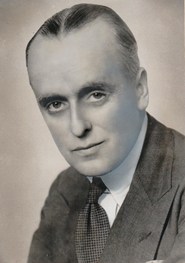
COATES, Eric
Eric Coates was born on August 27th, 1886, at Hucknall. His father was a well-loved and respected doctor in this small mining town in the centre of the Nottinghamshire coalfields between Nottingham and Mansfield. Coates showed an interest in music at an early age, studying first the violin and then the viola with George Ellenberger, a pupil of Joachim, and harmony with Dr Ralph Horner in Nottingham.
At the age of twenty he arrived in London determined to make a career in music despite some family misgivings. He won a scholarship to the Royal Academy of Music where he studied viola with Lionel Tertis and composition with Frederick Corder. This was in the days of Sir Alexander Mackenzie when the Academy was in Tenterden Street. At the outset Mackenzie recognised Coates’ talents. ‘Mark my words, young man,’ he said to Coates, ‘ye’ll start as a viola player but ye’ll end up as a composer!’
From 1912-1919 Eric Coates was principal viola of the Queen’s Hall Orchestra under Sir Henry Wood. He also played under the batons of Elgar, German, Delius, Holst, Walford Davies, Bantock, Richard Strauss, Debussy, Ethel Smyth (who addressed him delightfully as ‘the man who writes tunes’), Mengelberg Nikisch and Beecham. He also played in theatre orchestras including the one at the Savoy Theatre for the Gilbert & Sullivan Operas. Although a very modest man, he enjoyed telling the story about members of the orchestra having a competition to see who would be the first to play an entire score from memory —and how he won. Coates played in string quartets too. He took Lionel Tertis’ place in the Hambourg String Quartet for a tour of South Africa.
Eventually, in 1919, when neuritis in his left hand made playing the viola more and more difficult, Eric Coates turned exclusively to composition. By this time, his music was acquiring a steady following with such established successes as Stonecracker John (1909) and Miniature Suite with its entrancing Scene du bal, first performed at a Prom Concert in 1911.
Eric Coates’ work is in the tradition of polished melodic light music started by Sir Arthur Sullivan and continued by Edward German. Indeed, in his early years, Coates was much influenced by German. During the 1920s, however, Eric Coates developed a distinctive style which embraced his own use of the newly-introduced American syncopated idiom. He was the first European composer to treat this new style seriously and successfully integrate it into symphonic writing. When he adopted syncopation, the music critics of the heavier press ignored him but it never concerned him. ‘After writing the London Suite,’ he once said, ‘I moved from the music page to the news page and it was one of the moves I have never regretted.’
For over twenty seven years Eric Coates’ march Knightsbridge, from his London Suite introduced BBC Radio’s In Town Tonight. For forty years By the Sleepy Lagoon announced Desert Island Discs. And these were not the only long running programmes that used Coates’ music. His march Calling All Workers was the clarion call for the thousands of Music While You Work programmes broadcast during the hard days of the war. Halcyon Days (Elizabeth Tudor) from The Three Elizabeths Suite opened and closed BBC Television’s immensely popular serialisation of Galsworthy’s The Forsyte Saga. These were just a few of the programmes that were enhanced by Eric’s music which seems to give them a special cachet and perhaps a touch of magic because they all seemed to be successful. After Knightsbridge was first broadcast in 1933, twenty thousand letters arrived at Broadcasting House within the following two weeks asking for the name of the composer and the signature tune of In Town Tonight.
Whereas many British composers sought inspiration in the countryside it was usually the reverse for Coates. He was most happy working amongst the sounds and excitement of London. Inspiration sometimes came to him in the most unusual places. A certain pillar box in Harley Street, for instance, is said to have inspired one of his marches. Eric Coates received many letters suggesting ideas for suites. Most of these were unsuitable but one from a Rev Arthur L Hall of Barnes did inspire The Three Elizabeths dedicated to the then Queen Consort (to become the Queen Mother) and first performed in 1944.
The years from 1926 to 1939 were the most prolific in Coates’ career and marked his rise to international fame. From this period comes: The Three Bears, Cinderella, The Enchanted Garden, London Suite, London Again Suite, From Meadow to Mayfair, the Saxo-Rhapsody, The ThreeMen, Four Ways and The Jester at the Wedding.
What is not quite so well known today is that Coates composed a large number of songs. Speaking of these, Mrs Stanford Robinson, who sang many of them under her professional name, Lorely Dyer, said: ‘I always enjoyed singing Eric’s songs. They had a lovely vocal line and gave one every chance to colour one’s voice. My favourites were Fairy Tales of Ireland, Bird Songs at Eventide, I Heard You Singing and, most of all, Green Hills of Somerset.
Eric Coates enjoyed conducting his own music and had very decided views on the subject. He liked his music to be taken at brisk and lively tempi — he frowned on those conductors who made it sound slow and stodgy — there was nothing like that about him. Stanford Robinson, who must have conducted more performances and made more recordings of Eric’s music than any other conductor, said, ‘He was a very good conductor. He was always neat and immaculate and, of course, having been an orchestral player himself, he did not bully the orchestra but he was always in control.’
One’s overall impression, reading his autobiography, Suite in Four Movements, published in 1953, is that Eric Coates was an essentially happy person, full of joie de vivre. His son, Austin Coates, confirmed that this was so and said: ‘Yes, that’s absolutely true although at home we noticed how calm and extremely well ordered he was. For instance, he couldn’t settle down to write music until he was properly dressed in the morning complete with tie and Harris Tweed coat — and, perhaps, a Turkish cigarette. He was very formal at home and incredibly tidy. If I left a book lying around anywhere there would be quite a lot of remonstrances to follow. But he was very easy to live with.’
Recently, Sir Charles Groves wrote of him, ‘Eric Coates was a gentle and quietly-spoken man but his music crackled with vitality. He could write tunes and could clothe them in the most attractive instrumental colours; not for nothing had he been Henry Wood’s Principal Viola in the Queen’s Hall Orchestra. ‘He did not, as far as I know, aspire to writing symphonies or oratorios. He knew what he could do and he did it superbly well. ‘Someone once said that the marches of Souza would make a man with a wooden leg step out; a man would have to have a wooden heart not to respond to the music of Eric Coates.’
When Eric Coates died on December 21st 1957, it was rightly commented that perhaps no other composer had ever provided music to suit the public taste so unerringly for so many years. Indeed from his early song successes in Edwardian days to those of his last orchestral works (including The Dam Busters’ March), Eric Coates was recognised as the ‘uncrowned king of light music’.
Reproduction Rights
This biography can be reproduced free of charge in concert programmes with the following credit: Reprinted by kind permission of Warner/ChappellSAXO-RHAPSODYTheSaxo-RhapsodyEric Coates is a classical concert piece written in 1936 for solo E-flat alto saxophone and orchestra. The Saxo-Rhapsody stands as one of the notable early concert works written to showcase the expressive and technical capabilities of the saxophone within a light orchestral framework. It features lyrical melodies paired with lively, rhythmic sections. Early landmark recordings featured pioneering saxophonist Sigurd Raschèr alongside Coates conducting.
Key Details
Composer: Eric Coates (1886–1957)
Year of Composition: 1936
Instrumentation: Solo E-flat alto saxophone with symphony orchestra (also arranged for saxophone and piano)
Duration: Approximately 11 minutes
Publisher: Faber Music
1956
Eric Coates Saxophone Rhapsody (1936)
PERTH PREMIERE?
Free concert
Orchestral Shell Supreme Court Gardens Perth, Western Australia Broadcast on 6WN from 8.30pm to 10pm
A free concert in the Supreme Court Gardens (using the new orchestral shell) will be given tomorrow evening by the A.B.C. starting at 8.30. John Farnsworth Hall will conduct the W.A. Symphony Orchestra and the soloists will be Jack Harrison (in Eric Coate’s Saxophone Rhapsody) and Ivan Nylander (in Koenig’s Post-Horn Galop). Orchestral numbers will be from Offenbach, Delibes, Sibelius, Bizet, Arthur Benjamin, Johann Strauss, etc.Tonight’s free concert comes over 6WN from 8.30pm to 10pm. The W.A. Symphony Orchestra provides the music from the Orchestral Shell. John Farnsworth Hall is the conductor. Saxophonist Jack Harrison and post-horn player Ivan Nylander will give solo items. Harrison will play Saxophone Rhapsody and Nylander The Post-Horn Galop.WASO COUNTRY TOURMoora Town Hall Monday 5th August 1957Northampton King’s Hall Tuesday 6th AugustMullewa Town Hall Thursday 8th AugustConductor – John Farnsworth HallSoloists: Vaughan Hanly (violin) Jack Harrison (saxophone)ERIC COATES: Saxo-Rhapsody
https://en.wikipedia.org/wiki/Eric_Coates
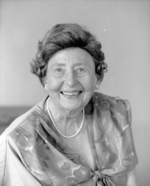
Born in Sydney in 1913, Dulcie Holland trained at the NSW State Conservatorium of Music, where she studied piano with Frank Hutchens, cello with Gladstone Bell, and composition with Alfred Hill. She graduated with her Teacher’s Diploma in 1933. After leaving the Conservatorium she studied for a time with Roy Agnew.
Travelling to London, Holland studied at the Royal College of Music with John Ireland, and at the end of her first year was awarded the Blumenthal Scholarship (which provided for three years of study at the RCM) and the Cobbett Prize for Chamber Composition. With the outbreak of World War II the next year, however, she returned to Australia to work as a freelance composer. On a return visit in 1950 she studied with the serialist composer Matyas Seiber.
During the 1940s in Sydney, she combined family life with producing a considerable output of original music. It was in 1944 that she composed one of the greatest treasures of Australian music, the Trio for violin, cello and piano.
In the 1950s her musical output turned in a new direction, when she was associated with the Department of the Interior as composer of music for some forty films documenting life in Australia, produced at the time of the large post-war intake of migrants.
In 1973 the first of Holland’s many books on the technique of writing music appeared. To her, it was a matter of logic that a teacher should help others in explaining the art of two-part writing, melody writing and so on, and Dulcie’s books on musicianship and related matters remain a unique educational contribution and their fame has spread far and wide.
Included among the many prizes Dulcie won for her compositions are ABC/APRA Awards in 1933, 1944, 1951, and 1955; ANZAC Festival Awards in 1954, 1955, and 1956, the General Motors Theatre Award in 1963 and the Henry Lawson Award in 1965. In 1977 she received the AO, and in 1993 was honoured with an Honorary D.Litt. from Macquarie University in recognition of her achievements.
Dulcie Holland died in Sydney on 21 May 2000 at the age of 87.
https://www.australianmusiccentre.com.au/artist/holland-dulcieCOMPOSER IS PROVOCATIVE – February 21, 1956 – By “Fidelio”A West Australian composer, James Penberthy, offered us last night what in some ways the most adventurous Australian composition so far heard in the Art Gallery programmes. This includes, notably, his medium of expression; a wind quintet consisting of flute, oboe, clarinet, horn and two bassoons. For this unusual combination Mr Penberthy had produce a work in short, linked movements, based on the music and life of Australian aborigines. He obtained interesting effects in the way of atmosphere and drastic colourings, but his score sounded very fragmentary. It seemed often to be hovering uncertainly between outright imitative realism and the freer imaginative flight which, we felt, should not convincingly emerge. Another unusual inclusion was a set of three nicely fanciful songs for soprano and flute (no piano) by John Gordon, the words being taken from Chinese. The rest was chiefly light music, generally pretty in a conventional style. There were two pieces for flute and piano by A.C. Black (a West Australian), clarinet and piano pieces by Dulcie Holland and Moneta Eagles, songs by Horace Keats and Elizabeth Mills. The performers were Sylvia Biddle (soprano), Owen Fisenden (flute), Jack Harrison (clarinet), Neil Pierson (horn), Ron Richmond (oboe), George Dreyfus and Claude Welling (bassoons) and Phyllis Allen (accompanist).
Work Details
Year: 1950
Instrumentation: Clarinet, piano.
Duration: 5 min.
Difficulty: Medium — AMEB Grade 6-7.
Written for: Clive AmadioFirst performance: by Clive Amadio, Olga Krasnik — 1950. for ABC radio
https://www.australianmusiccentre.com.au/workversion/holland-dulcie-ballad/4433
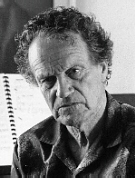
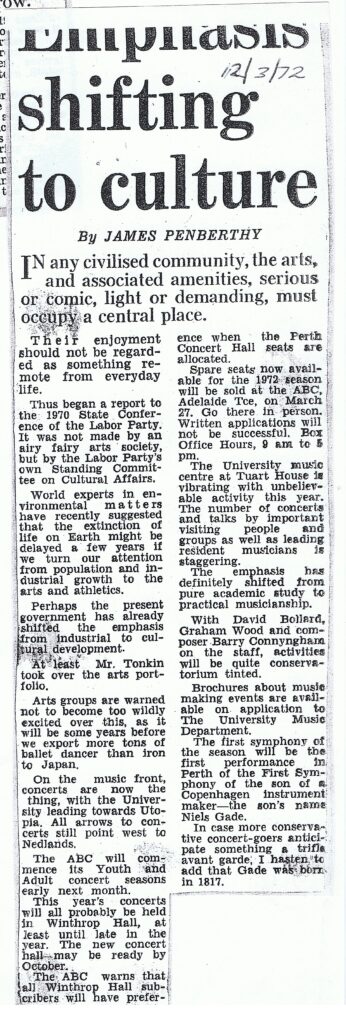
Albert James Penberthy was born in Melbourne in 1917 and received his early music training from his father. After attending the universities of Western Australia and Melbourne he became a schoolmaster where he taught music and formed orchestras. Following active war time service with the RAN, he obtained first class honours in composition at the University of Melbourne. He later studied composition with Nadia Boulanger in France and conducting with Sir John Barbirolli in England.
For many years he worked in Western Australia where he founded the West Australian Opera Company and was co-founder of the West Australian Ballet Company. He was a prolific composer and his major works number over 100. Although he wrote in many different genres, his intense interest in the theatre resulted in 22 ballets and 11 operas, and it is in this body of work, which displays his strong dramatic and lyrical gifts, that his importance in Australian music lies.
In 1975 Penberthy moved to live on the North Coast of NSW, where he founded the School of Arts at Southern Cross University.
He was awarded the degree of Doctor of Music from Melbourne University in 1975 and the Order of Australia in 1986.
James Penberthy married Kira in 1950 and they had children Alex and Tamara. Kiri was a ballet teacher and a founder of the W.A. Ballet Company.
Art Gallery Program Art Gallery of Western Australia (inside the Jubilee Building on Beaufort Street,)
The review written by “Fidelio” describes the premiere of a groundbreaking wind quintet by West Australian composer James Penberthy.
Venue: The Art Gallery of Western Australia (then commonly called the National Art Gallery of Western Australia). The text directly mentions this was the most adventurous Australian piece “so far heard in the Art Gallery programmes.”
Date: February 21, 1956
This performance was part of a chamber music series integrated into the 4th Annual Festival of Perth. The concert specifically showcased modern Australian wind and vocal music, breaking away from conventional light classical styles. The ensemble listed at the bottom features notable musicians of the era, including a young George Dreyfus on bassoon before he became one of Australia’s premier composers.
In 1956, the Art Gallery of Western Australia (AGWA) was located inside the Jubilee Building on Beaufort Street, within the same complex where WA Museum Boola Bardip stands today.
COMPOSER IS PROVOCATIVE – February 21, 1956 – By “Fidelio”
A West Australian composer, James Penberthy, offered us last night what in some ways the most adventurous Australian composition so far heard in the Art Gallery programmes. This includes, notably, his medium of expression; a wind quintet consisting of flute, oboe, clarinet, horn and two bassoons. For this unusual combination Mr Penbethy had produce a work in short, linked movements, based on the music and life of Australian aborigines. He obtained interesting effects in the way of atmosphere and drastic colourings, but his score sounded very fragmentary. It seemed often to be hovering uncertainly between outright imitative realism and the freer imaginative flight which, we felt, should not convincingly emerge. Another unusual inclusion was a set of three nicely fanciful songs for soprano and flute (no piano) by John Gordon, the words being taken from Chinese. The rest was chiefly light music, generally pretty in a conventional style. There were two pieces for flute and piano by A.C. Black (a West Australian), clarinet and piano pieces by Dulcie Holland and Moneta Eagles, songs by Horace Keats and Elizabeth Mills. The performers were Sylvia Biddle (soprano), Owen Fisenden (flute), Jack Harrison (clarinet), Neil Pierson (horn), Ron Richmond (oboe), George Dreyfus and Claude Welling (bassoons) and Phyllis Allen (accompanist).
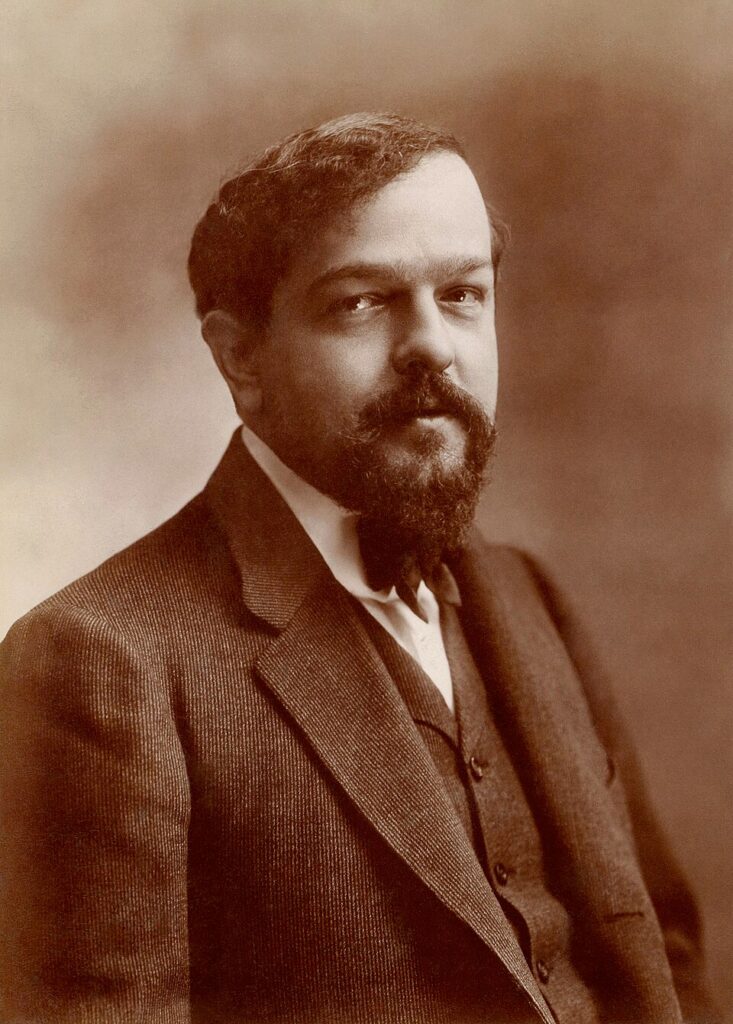
Born in Saint-Germain-en-Laye, France in 1862, Claude Debussy was the creator and leading exponent of French musical impressionism. At age ten, he entered the Paris Conservatory, where he studied piano with Antoine Francois Marmontel and composition with Ernest Guiraod. Over the next ten years, he continued his studies at the Conservatory and became acquainted with a wide range of music as he traveled to Italy, Austria, and Russia.
In 1894, his cantata, The Prodigal Son, won the coveted Grand Prix de Rome. From 1887 on, Debussy confined his activity to composition, rarely appearing in public as a performer. He enjoyed the company of the leading impressionist poets and painters who gathered at the home of the poet Stephane Mallarme. Their influence is felt in Debussy’s first important orchestral work, Prelude to the Afternoon of a Faun (1894). This work established the style of impressionist music and initiated Debussy’s most productive period, which lasted nearly 20 years.
During that time, he composed his one completed opera, Pelleas and Melisande (1892-1902); the orchestral suites Nocturnes (1893-99), The Sea (1903), and Images (1906-09); most of his piano music, including the books of Preludes (1910-13); the ballet, Games (1912); and one of his best known piano compositions, Claire de Lune, from Suite Bergamasque (1890-1905).
Around 1910, Debussy developed cancer, which sapped his strength during his last years. Many projects were started, such as an opera based on Edgar Allan Poe’s The Fall of the House of Usher, but few were completed. He died in Paris in 1918.
Composed between December 1909 and January 1910, it was dedicated to the French clarinet professor Prosper Mimart.
In 1909, Gabriel Fauré, Director of the Conservatoire de Paris, named Debussy to its board of directors (le Conseil Supérieur). One of Debussy’s first duties was to supply two works for the next year’s clarinet examinations. The Rhapsodie was first performed as part of the examinations on July 14, 1910. The original composition was for clarinet and piano; Debussy published his own orchestration of the accompaniment in 1911, after the official premiere with Mimart.
PERTH – YOUTH AND MUSIC – Issued by the A.B.C. Youth Concerts’ Committee
A well-attended committee meeting, at which further details of recorded programmes for youth Clubs were arranged, was held on July 12. The A.B.C. agreed to make studio space available at Broadcast House, for Youth Concerts’ Committee members to present programmes of recorded music (and supper) to other members and friends. The first gathering of this kind was on July 23. It was extremely successful and the Committee is keen to make these a regular feature of Youth concerts activity.
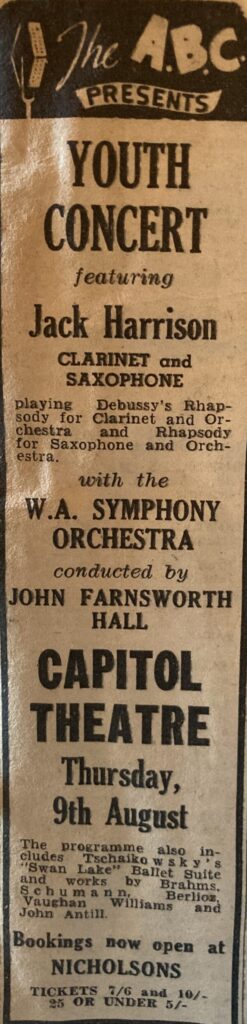
The third Youth Subscription concert on August 9 1956 will be conducted by John Farnsworth Hall with Jack Harrison, soloist, playing a Rhapsody for Clarinet and Orchestra by in the first half of the concert, and a Rhapsody for Saxophone and orchestra by the same composer in the second half. Youth and Music issued by the A.B.C. Concerts’ Committee No. 3 August 1956
MUSIC AND THEATRE BY “FIDELIO” – DEBUSSY RHAPSODIES
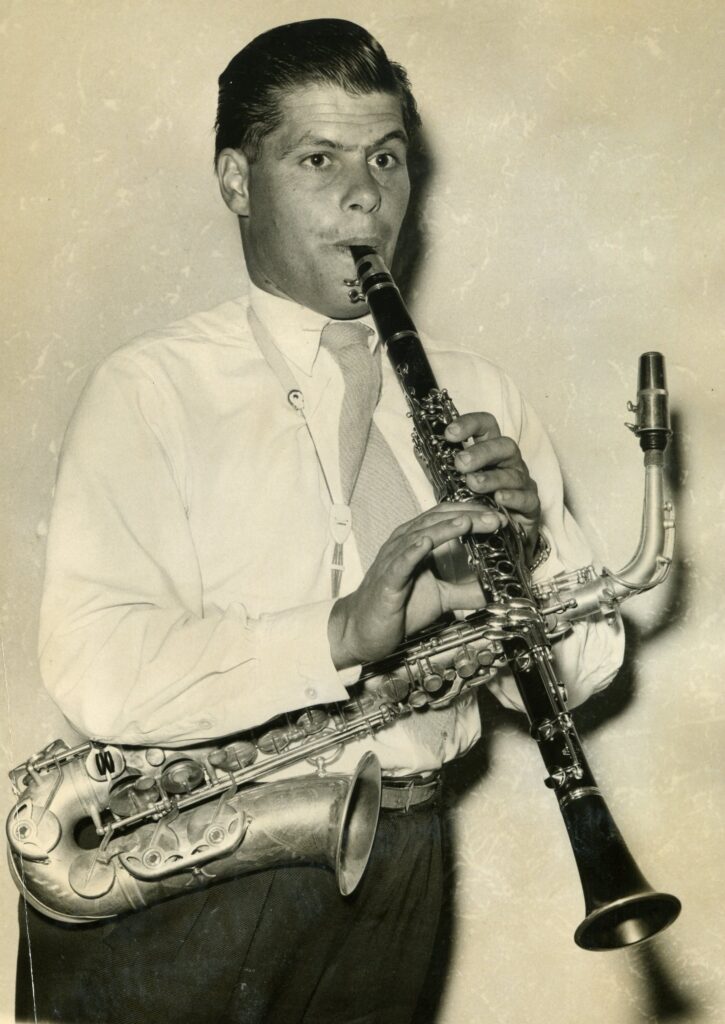
For the A.B.C.’s next Youth Concert on Thursday August 9, Mr John Farnsworth Hall will be in charge, and Jack Harrison will set up what is maybe a record for these concerts (or indeed any in the annals of the W.A. Symphony Orchestra) by appearing as soloist not merely on two occasions in the programme but playing each time a different instrument. With the clarinet he will be heard in a Rhapsody by Debussy, and with the saxophone in – again – a Rhapsody by Debussy. There is no “funny business” about this: Debussy really did write a rhapsody for the clarinet and also a rhapsody for the saxophone. The latter was commissioned by an American lady, left unfinished by Debussy and completed by Roger-Ducasse.
WN is broadcasting the ABC Youth Concert from the Capitol Theatre on Thursday and Friday evenings. Jack Harrison, a brilliant young Perth musician in both classical and modern spheres, will be the soloist with the W.A. Symphony Orchestra. J. Farnsworth Hall is the conductor. The opening half of the concert is broadcast on Thursday starting at 8pm. Jack Harrison joins the orchestra in Debussy’s Rhapsody for Clarinet and Orchestra. On Friday at 9.15pm, when the second half of the concert is broadcast, Harrison is featured on saxophone.
THE WEST AUSTRALIAN (newspaper) August 1956
SAXOPHONE SHINES IN A HOTCH-POTCH
By “Fidelio”
“The saxophone is classified as a woodwind instrument” the Professor of Music at Harvard University tells us in a treatise published this year “despite the fact that it is entire made of brass.” There, of course, is one proof more that musicians are an irrational folk. (For an alternative explanation read the next few sentences of Professor Piston’s book.). Professor Piston also tells us that while in serious music the saxophone gives voice with “a pure, steady tone,” in popular dance music nowadays it is “Tremulous, oversweet, sentimental and it is almost invariably played out of tune.”
We are certain that Mr Jack Harrison did not play it “almost invariably played out of tune” last night; but then, Mr Harrison was not in a dance hall but at the Capitol and devoting his skill not to jive but to Debussy’s Rhapsody for Saxophone and Orchestra. He also played for us, and very effectively, another Debussy “Rhapsody” for clarinet, which gave him greater opportunities than the saxophone piece. Neither is particularly good Debussy.
For this A.B.C. Youth Concert Mr Farnsworth Hall compiled a programme which achieved great variety at the cost of being rather a hotch-potch. Among the purely orchestral works three commanded special attention – “An Outback Overture” by the Australian composer John Anthill; the wonderful pages from Berlioz’s “The Trojans” unusually labelled “Royal Hunt and Storm”; and Schumann’s rarely heard overture to “Manfred”, a welcome tribute in this centenary year, for all its sombreness. We had some beautiful playing in the Berlioz, though the horns were not quite up to the mark. The West Australian August 1956
1956
Debussy Premiere Clarinet Rhapsody Debussy Saxophone Rhapsody AUSTRALIAN PREMIERE being performed in same programme (maybe even in the world?)
Jack Harrison (clarinet) Jack Harrison (saxophone) John Farnsworth Hall (conductor) West Australian Symphony Orchestra
Capitol Theatre Perth, Western Australia
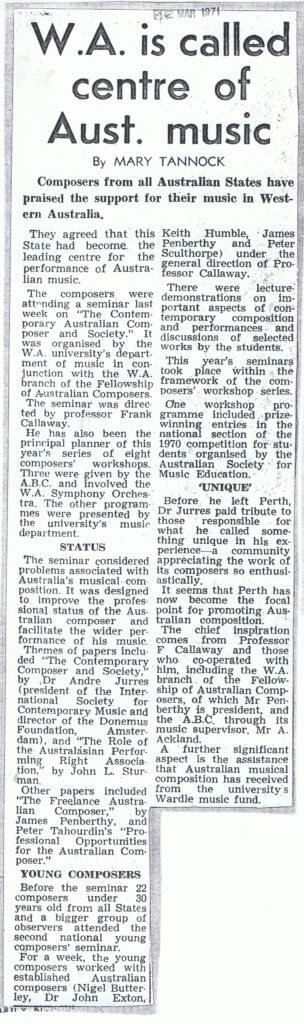
16.2.1971
DebussyRhapsodie No. 1
Jack Harrison (clarinet) Arthur Fiedler (conductor)
Festival of Perth Winthrop Hall University of Western Australia
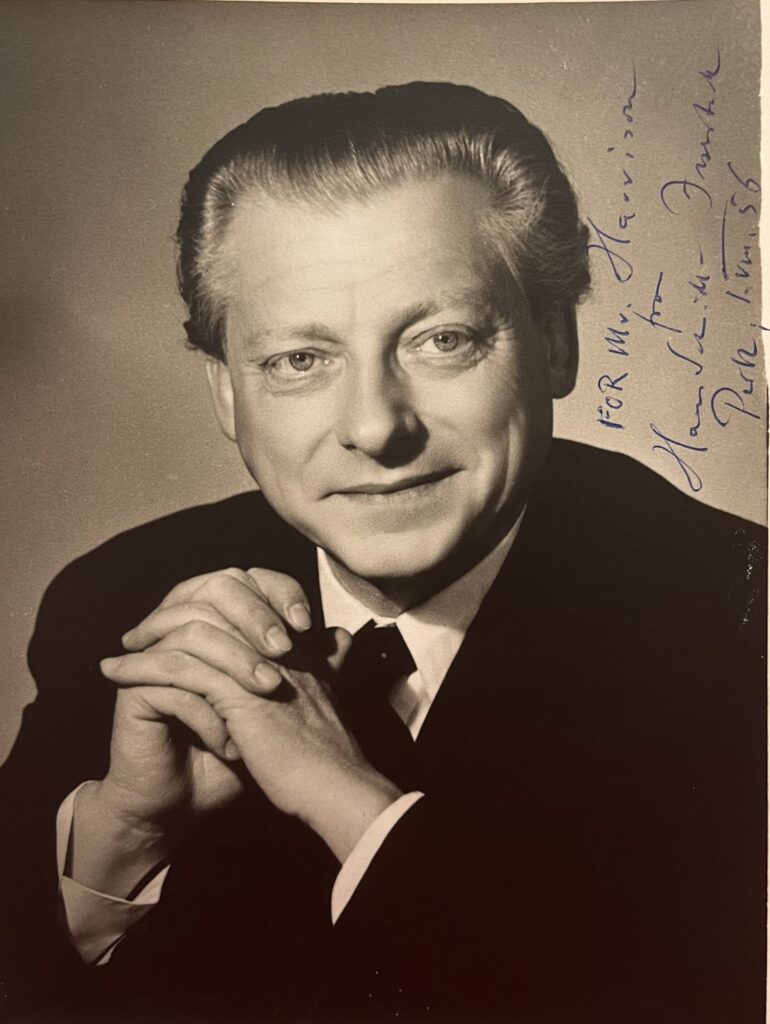
Hans Schmidt-Isserstedt (5 May 1900 – 28 May 1973) was a German conductor and composer. After studying at several music academies, he worked in German opera houses between 1923 and 1945, first as a répétiteur and then in increasingly senior conducting posts, ending as Generalmusikdirektor of the Deutsche Oper Berlin.
After the Second World War, Schmidt-Isserstedt was invited by the occupying British forces to form the Northwest German Radio Symphony Orchestra, of which he was musical director and chief conductor from 1945 to 1971. He was a frequent guest conductor for leading symphony orchestras around the world, and returned to opera from time to time, including appearances at Glyndebourne and Covent Garden as well as the Hamburg State Opera.
Schmidt-Isserstedt was known for his transparent orchestral textures, strict rhythmic precision, and rejection of superfluous gestures and mannerisms on the rostrum. His extensive recorded legacy features the Austro-German classics with which he was widely associated, but also includes works by Czech, English, French, Italian and Russian composers.
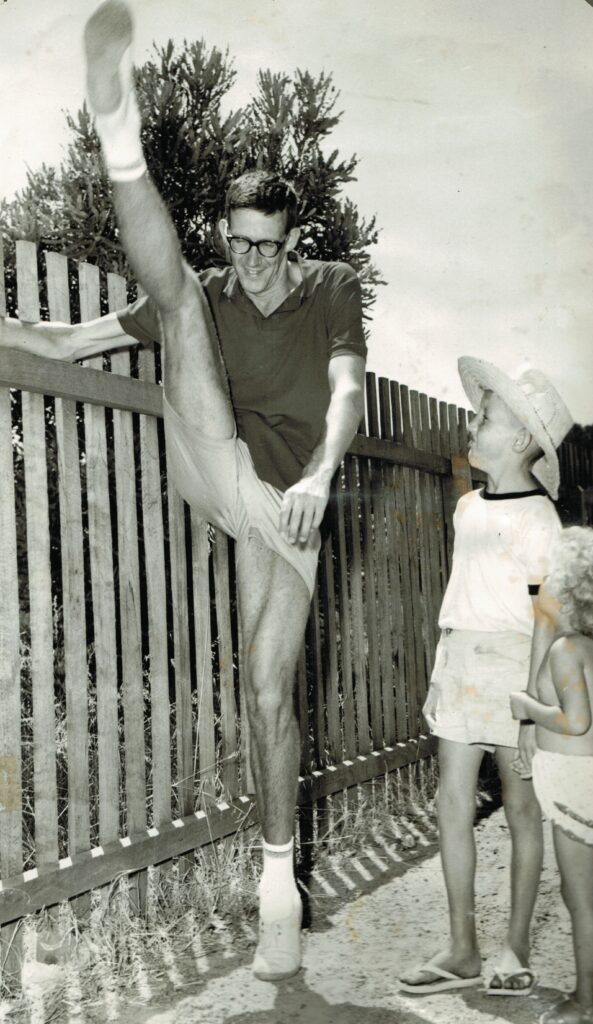
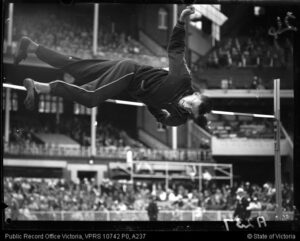
Charles ‘Chilla’ Porter (athletics) was a high jumper who won silver medals at the 1958 British Empire and Commonwealth Games in Cardiff and again in Perth in 1962. Most famous for his epic duel with American Charles Dumas in fading light at the 1956 Olympic Games in Melbourne where Porter also won the silver medal. Chilla also competed in the 1964 Tokyo Olympics however he didn’t qualify for the final. Winner of seven straight Australian titles in the high jump from 1955 to 1961, Porter was inducted into the Athletics Australia Hall of Fame in 2011. He continued his long involvement in athletics on the board of Athletics WA and became chair of the Western Australian Institute of Sport (WAIS).
1956 Debussy Rhapsody for Clarinet and Saxophone – same performance
The Third Youth Subscription concert of the West Australian Symphony Orchestra on August 9 1956 at the Capitol Theatre will be conducted by John Farnsworth Hall with Jack Harrison, soloist, playing a Rhapsody for Clarinet and Orchestra by in the first half of the concert, and a Rhapsody for Saxophone and orchestra by the same composer in the second half.
Youth and Music issued by the A.B.C. Concerts’ Committee No. 3 August 1956
MUSIC AND THEATRE BY “FIDELIO”
DEBUSSY RHAPSODIES
For the A.B.C.’s next Youth Concert on Thursday August 9, Mr John Farnsworth Hall will be in charge, and Jack Harrison will set up what is maybe a record for these concerts (or indeed any in the annals of the W.A. Symphony Orchestra) by appearing as soloist not merely on two occasions in the programme but playing each time a different instrument. With the clarinet he will be heard in a Rhapsody by Debussy, and with the saxophone in – again – a Rhapsody by Debussy.
There is no “funny business” about this: Debussy really did write a rhapsody for the clarinet and also a rhapsody for the saxophone. The latter was commissioned by an American lady, left unfinished by Debussy and completed by Roger-Ducasse.
WN is broadcasting the ABC Youth Concert from the Capitol Theatre on Thursday and Friday evenings.
Jack Harrison, a brilliant young Perth musician in both classical and modern spheres, will be the soloist with the W.A. Symphony Orchestra. J. Farnsworth Hall is the conductor. The opening half of the concert is broadcast on Thursday starting at 8pm. Jack Harrison joins the orchestra in Debussy’s Rhapsody for Clarinet and Orchestra. On Friday at 9.15pm, when the second half of the concert is broadcast, Harrison is featured on saxophone.
SAXOPHONE SHINES IN A HOTCH-POTCH
By “Fidelio”
“The saxophone is classified as a woodwind instrument” the Professor of Music at Harvard University tells us in a treatise published this year “despite the fact that it is entire made of brass.” There, of course, is one proof more that musicians are an irrational folk. (For an alternative explanation read the next few sentences of Professor Piston’s book.). Professor Piston also tells us that while in serious music the saxophone gives voice with “a pure, steady tone,” in popular dance music nowadays it is “Tremulous, oversweet, sentimental and it is almost invariably played out of tune.”
We are certain that Mr Jack Harrison did not play it “almost invariably played out of tune” last night; but then, Mr Harrison was not in a dance hall but at the Capitol and devoting his skill not to jive but to Debussy’s Rhapsody for Saxophone and Orchestra. He also played for us, and very effectively, another Debussy “Rhapsody” for clarinet, which gave him greater opportunities than the saxophone piece. Neither is particularly good Debussy.
For this A.B.C. Youth Concert Mr Farnsworth Hall compiled a programme which achieved great variety at the cost of being rather a hotch-potch. Among the purely orchestral works three commanded special attention – “An Outback Overture” by the Australian composer John Anthill; the wonderful pages from Berlioz’s “The Trojans” unusually labelled “Royal Hunt and Storm”; and Schumann’s rarely heard overture to “Manfred”, a welcome tribute in this centenary year, for all its sombreness. We had some beautiful playing in the Berlioz, though the horns were not quite up to the mark.
 MUSIC AND THEATRE BY “FIDELIO”