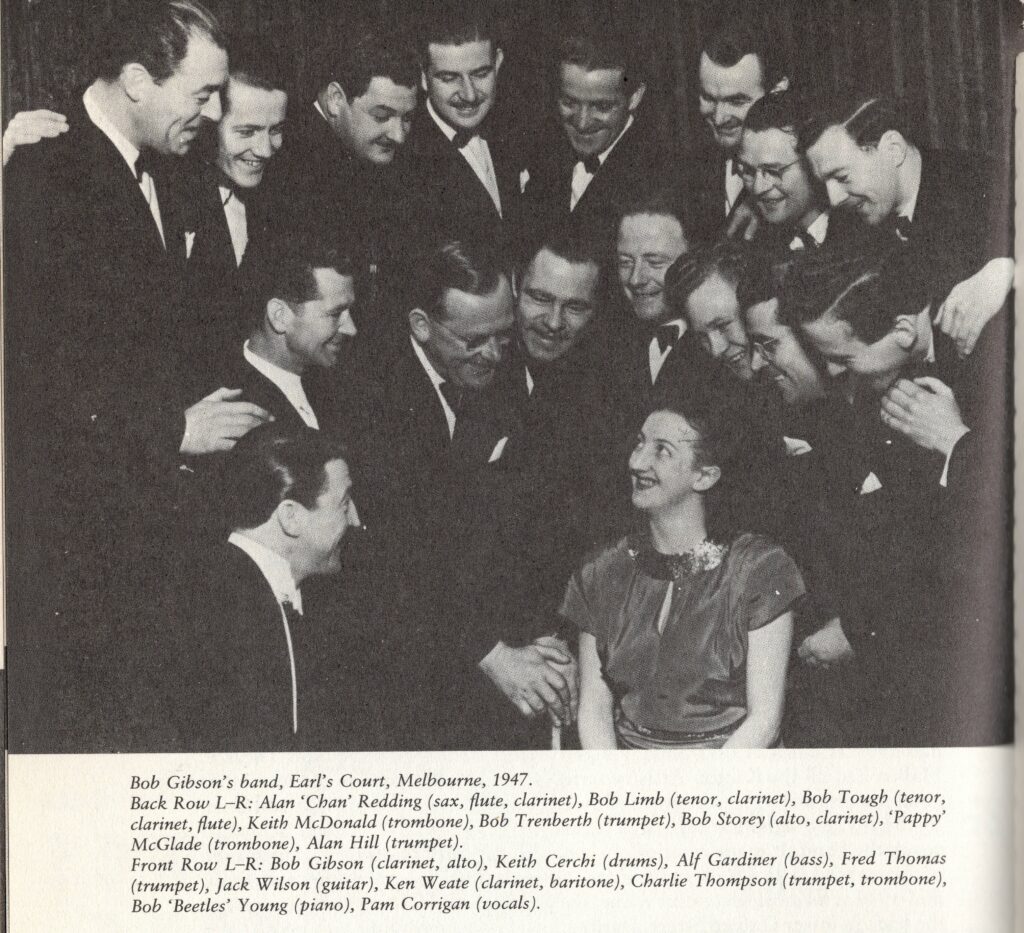
Bob Gibson was a Perth musician who began his career on violin, then learning clarinet and saxophone with Harold Moschetti. In Perth he initially played with the Doreen D’Arcy’s Orchestra, a six piece dance band, and then in Ron Moyle’s seven piece band at the Embassy Ballroom. Moyle toured to Melbourne and Gibson auditioned successfully in 1935 for the “Good Companions”.
1933
LOCAL BAND HONOURED – Engagements in Eastern States.
For the first time in broadcasting history a West Australian band has been engaged through the Australian Broadcasting Commission to give performances- over the air in the Eastern States. Ron Moyle and his ‘Westralians,’ a combination of local performers, will leave ‘ for Adelaide by the Great Western express on Saturday, night, and will be absent for about six weeks. The ‘Westralians’ will be heard over the air from 5CL, Adelaide, on December 21 and 22, and from South Australia they will go to Melbourne, where they will broadcast from 3LO- between January 6 and 27. It is possible that the band will; also visit Sydney. Ron Moyle himself is well-known to listeners in Western Australia, having been connected with broadcasting in this State for many years. His band, which is composed of the following players, was heard from 6WF during last dancing season: — Ron Moyle, A.T.C.L. (pianist); Bob. Gibson, L.A.B. (alto saxophone, clarinet and violin) ; George Caro, A.T.C.L. (tenor saxophone, clarinet and violin); Allan Gough, A.T.CJj. (alto saxophone, clarinet and violin); Viv. Nylander (trumpet and trombone); Kem. Fimmel (trumpet); Charles Thompson (trombone and trumpet);. Wally Hadley (banjo, flute and guitar); Cliff Adams (guitar, tap dancer and vocalist); Eddy Roberts (drums and vocalist); and Tom Bennett (bass). The band will give a final concert at the Ambassadors Theatre on Friday night. West Australian (Perth, WA : 1879 – 1954), Wednesday 13 December 1933, page 5
In 1935 the band the “Good Companions” was formed by Ern Pettifer at the Palais de Danse, St Kilda. “The formation of the “Good Companions” set music at the Palais on a forward-looking path, because Pettifer gave some talented young players a break. Auditions were held on a hot summer day and in the line of hopeful stretching around the corner was a gifted alto saxophonist from Perth, Bob Gibson. The audition piece was a tough arrangement of “Bugle Call Rag” by Frank Coughlan who was then with Pettifer. Gibson sailed through it because he had had a thorough classical training and had won many scholarships for his ability, and he knew dance work too. Gifted young players never appear out of nothing and Gibson was no exception. Perth had its own thriving dance bands.” Andrew Bisset, Black Roots White Flowers, 1987 Globe Press. page 55
1941
Talking Shop By “Finn” Westralian Wonder. From farther and farther afield come the stars of 3Aws “Youth Show” and the latest on the list is an amazing young man from Nedlands, Western Australia. He is nine year old Jack Harrison who surprised everyone by winning the first prize in the big 150 pound “Search for Talent”. He competed against allcomers and won by popular vote, although listeners had no knowledge of his age or identity. Jack started playing the mouth organ …he will feature in the broadcast from 3AW. The Listener In Complete Radio Newspaper February 22-28 1941 And 4BH. Teleradio Saturday March 1, 1941
Jack’s father tells me (per the P.M.G.) that he has met at least 14 W.A. people n Melbourne and Sydney who are tops in the eastern entertainment world. He cut out newspaper references to some of the W.A. people which have appeared during the few weeks he has been in the East and forwarded them to me. One about “Duffy” Newton (who used to act in 6WF plays) made about ten inches of type, had a double column heading and carried a photo. Other cuttings contained photographs of David Samuel (deputy-leader of Bert Howell’s Band and leader of last year’s “Youth Sow” band), Chester Bond (who is at present featured in a big radio serial), Bob Gibson and George Watson (a principal of the Drum Club). The Broadcaster February 1 – 8 1941
1949
19 February 1949 – PERTH JAZZ MEN ARE TOPS IN EAST
Recent news about WA dance musicians who have sought to establish national reputations is good news. At least 4 who have been questing after the big-time in the Eastern States have made it, some of them ranking amongst the top-salaried musicians of the day. Currently occupying press space in musical magazines and feeling the for and, against quips of critics in Sydney is Ray Hartley, onetime popular pianist at radio lunch-hour concerts in Perth. General gossip has it that Ray is sow in the high salary range although it is rumoured that the road has been long and very rough. At present Ray is featured with Paul Lombard’s outfit at the Celebrity Club which used to be Rose’s and spare time, as little as he may have, L being turned towards arranging and holding down a couple of radio spots. In addition to this Ray contributes to the Music Maker, the Australian Dance Band Editorial and his articles on prominent keyboard men are a worth while contribution to that magazine. Although his name is usually associated with lunch hour concerts, Ray’s success was first assured in renditions of the Ray Hartley Trio; a combination which he has reformed in Sydney.
One Of The Best Recognised as being one of the best musicians in Australia was Bob Gibson. Since leaving Australia some months ago to further his knowledge in England, little news has been heard of him. He is another W. A. man and at the age of 9 was a winner of eisteddfods and a gold medalist, but his future career was not restricted to his ability as a violinist alone, for at the age of 14-15, Bob commenced taking sax and clarinet lessons from Harry Moschetti, and very soon established himself on these instruments. In the early 1930’s, Bob took over the leading alto sax seat in the Ron Moyle outfit, a combination through which passed some of the finest musicians of the State, and when this outfit went on tour through the Eastern States, Bob Gibson still occupied alto seat but he never returned to W. A. With hard work and perseverance he finally cracked the ice in Melbourne and had occasion to look back. Just prior to the last war, he organised his own band and hit St. Kilda night spots which proved to be his first top liners. His subsequent success such as the Shell Show are now history and it is hoped that his success overseas will continue. Mirror (Perth, WA : 1921 – 1956), Saturday 19 February 1949, page 11
1950
April 1949 – Outstanding alto and clarinet man with the Sharp combination, George Caro, has had a colourful career in the game. At 15 he commenced the sax, and as George maintains, was completely self-taught. He first came to the public notice in 1930 when he was one of 18 who competed in the saxophone competition conducted by the Brass Band Association of WA. Winner was Cas Mitchell, now of the ABC Melbourne, second George Caro, Bob Gibson (now in England) was third, and fourth position was filled by Bob Trew (Perth ABC). In 1934, when the exodus was on, George made the Eastern States tour with the Ron Movie outfit, and when this orch. returned to WA, George decided to hit out for the overseas spots. His first working port o’ call was Colombo, where he played at the Mount Lavinia Hotel. From here he went to the Grand Hotel at Calcutta, before making the Malayan Peninsula in 1936, where he played in Singapore cabarets and the Eastern and Oriental Hotel in Penang. On his return to Australia, George linked up with pit work, played for the American Marcus ‘Show, North China Troupe, Dante, and various other visiting shows. During the war he played second cornet with the 28th Battalion Band, and at a later stage, while serving in Darwin conducted a Sunday night Swing Show featuring a 5piece outfit. Returning to civvy street, he joined Chris Gosper’s eight playing at St. Mary’s, Mt. Hawthorn. When Sammy Sharp returned from England, George moved in with Sammy and remained with him ever since. —’QUAIL.’Mirror (Perth, WA : 1921 – 1956), Saturday 23 April 1949, page 14
1950
On The Home Range – BOB GIBSON
Ask the boys in the strings and the winds about Bob Gibson. Gibson! they say with awe. He lives, eats, and drinks music. He has no other interests, only music, in which he strives for perfection. And in hushed tones they say, ” What an ‘ear’ that man’s got!” ASK “Melbourne’s thousands of dance fans. “Bob Gibson,” they say. “He’s more than a band leader. He is the perfect dance tempo!” To us Bob appears to be just an ordinary bloke, unassuming, dark, rather short, with a pleasant fluency. Local dance fans were desolate when Bob sailed for England in 1948. Now he’s back, after London successes, wondering whether to re-form his band in Sydney or in Melbourne. Few, if any, Australian band leaders have had a bigger personal following than Gibson. Before his London trip his band, then the only big-time, freelance combination in the country, was nationally famous for its work in hit radio – programmes such as The Shell Show, All Australian Hit Parade, Popularity Parade, and A.B.C. Shows. In addition, the Bob Gibson band, which incidentally was then costing about £500 a week to run, was in demand for Vice-Regal evenings and the top society balls of the season. Bob was something of a child prodigy. At 12 years of age, he was playing the violin in the newly-formed Perth Symphony Orchestra. In his early teens he was awarded his violin degree in Perth by the travelling examiner of the Royal Academy of Music. As a youth of 17 he stepped off the Overland in Melbourne into the St. Kilda Palais orchestra, the Palais being one of the biggest dance halls in the Commonwealth. He was lugging four cases — three for his violin, saxophone, and clarinet, and one for clothes. He fiddled and “doubled” on the sax and clarinet to such purpose that within a few years he was promoted to be Palais Orchestra arranger, probably the youngest in the Commonwealth. Then in 1939, only 25 years old, he formed his own orchestra. Bob went overseas to study entertainment trends in radio, television. and on the stage. He warns Australian musicians and theatricals that the competition over there is terrific. For every musician here there are at least 100 in London, competing for a limited amount of work. When a band vacancy occurs a dozen first-class players apply. for the position before it can be advertised. Only the fittest survive. Working conditions are much tougher than here, and the pay is not as good. There are many English musician anxious to migrate here. English artists and players are beginning to take a “dim view” of the increasing number of Australians reaching the top. But, Bob says, for every Dick Bentley, Kittys Bluett, and. Joy Nicholls at the top there are a score of Australians hovering on the breadline, many of them good artists. “Great talent is not enough in London,” he says, “You must have” luck too.” Gibson had his share. After doing a “study” tour with Tommy Trinder’s show, Bob was asked to form an orchestra of 25 players for the B.B.C. He also spent seven weeks in Paris and conducted a light orchestra which did the background”, music in a French film. Bob advises young theatricals and musicians to go to England for study, but to buy a return ticket before leaving! Gibson plans to return to London in 1951. In the meantime, he aims to. satisfy those dancing feet in Melbourne, or Sydney, perhaps! Smith’s Weekly (Sydney, NSW : 1919 – 1950), Saturday 18 February 1950, page 15
1953
Local Acts Compete for Record Prizes in Talent Final – Sixteen local acts will contest the grand final of Talent Hour, Australia’s most richly endowed talent quest, to be relayed from Melbourne Town Hall through UZ at 8 p.m., Tuesday, November 10. Each of the four section winners will receive £500, with minor placegetters receiving £250, £40 and £15. The best act of the night will be awarded an additional £1000. Awards will be made at the conclusion of the programme. Regular adjudicators, Dr. Herman Schildberger and Mr. Harry Sutcliffe; have been joined by Mr.-Garnet H. Carroll. Recorded semi-final performances of all artists will be featured in Talent Hour Preview, at 3 p.m. Sunday, November 8. Recorded grand final performances will be repeated, in Talent Hour Review, at 3 p.m. Sunday, November 15. Sydney orchestra leader, Bob Gibson will direct a 20-piece orchestra. The stage setting will include the appearance of leading Melbourne mannequins. Competitors are as follows;— Vocal: Joan Reed, soprano; Kenneth Sullivan, tenor; Theodor Sartory, bass-baritone; Leonard Delany, baritone. Instrumental: Roger Holmes, piano; Ian King, tuba; Eugene Danilov, clarinet; Mary Nevmet, violin. Pop Vocal: Reg Gray; Jack Bowkett; Margot Carroll, John Oldham. Novelty: Alfred Smith, monologuist; Don Harper Quartet; John Shingler and Kelvin McMillian, flute and saxophone duo; D.D.H. instrumental trio. Age (Melbourne, Vic. : 1854 – 1954), Thursday 5 November 1953, page 19
RED CARPET FOR MUSIC VIPs GET WELL WORN
Perth musicians are finding their red carpet (for rolling to welcome local members who have become VIP’s in the musical world) is wearing pretty thin. Latest to tramp across it will be Bob Gibson, on Monday night. He arrives from the Eastern States by ‘plane, will be an honoured guest at the Musicians’ Ball at the Embassy on Tuesday night. He has made his name not only as a musician and band leader, but also as an ‘ arranger. His work has been praised by ‘big name’ clarinettist Artie Shaw. Bob studied violin in Perth at an early age. While still in short pants he played at the old Prince of Wales Theatre. He turned to the saxophone later, left here in that capacity with Ron Moyle’s orchestra in 1933 for. what is believed to be! the first tour of a dance band under the ABC banner. He stayed in Melbourne, where he ‘saxed’ with Ern Pettifer’s orchestra at St. Kilda’s Palais de Dance, which was later taken over by Hal Moschetti, another West Australian. Later engagements included seasons with Bert Howell, of Capitol Theatre, and Shell Radio Show fame, Jay Whidden, Roy Fox and Dick Freeman. Bob formed his own combination at Melbourne’s Palm Grove, with a wealth of experience behind him. During the war he organised a band and toured forward areas as director of a US entertainment unit. After the war he returned to England as musical director of the Tommy Trinder Show (a job now held by Hal Moschetti). But the climate and ill-health (he developed pneumonia) sent him back to Australia, where he has carved himself a new niche. Mirror (Perth, WA : 1921 – 1956), Saturday 24 October 1953, page 12
SUNDAY, NOVEMBER 1st, 1953 – Jazz Festival Week Part Two: CAPITOL THEATRE – THE BOB GIBSON SHOW
Featuring Australia’s Outstanding Band Leader
WEST COAST DIXIELANDERS
NORM WRIGHTSON
MARTIN GISCHUS
HARRY PHILLIPS
COLIN HICKS
KATH BASS
Box Plans for both these attractions now open at Nicholsons. TICKETS 5/ The West Australian Saturday 17 October 1952 page 35
LISTENERS WILL HEAR GIBSON An agreement reached between the W.A. Musicians’ Association and the ABC resulted in last Sunday’s Jazz Jamboree (featuring The Bob Gibson Show) being recorded for broadcasting from 6WF. When the ABC heard that ace band leader Gibson would be the guest artist for the second part of Jazz Jamboree, it came to an agreement with organisers Sam Sharp and Harry Bluck for Gibson’s show to be recorded, and also agreed to pay the W.A. Musicians’ Association a fee for the right to record the show. The date of the broadcast will be published shortly. Gibson is now musical director for 2UW. Recently Gibson signed an agreement with the Columbia Recording Company. The first of his releases to be heard in Perth will probably be “Wild Horses” and “My One and Only Heart”. Gibson, who went to England in 1948 and returned in 1950, now favours big band. He records with a 28-piece band, and for concert and radio work he uses anything from 16 to 20 musicians. Two of his most popular programmes, heard from 2UW and Sportsman’s Parade and Musically Yours. Gibson said that any young musicians who hoped to go abroad needed plenty of capital and lucky breaks. He said that there were too many instances of a bandleader casually approaching a popular tune without having any idea of presentation.
Of the orchestra he conducted at the Jazz Jamboree on Sunday night, Gibson commented “They are a first class bunch of musicians. Considering they had such short notice to get together they gave a truly remarkable performance.” The band leader also praised individual performances. He believes that 17 year old Neil Boon could develop into a top line artist. Jack Harrison displayed plenty of versatility and gave a smooth performance, he said. Gibson also praised the responsiveness of the audience. “In modern music there is no greater encouragement” he said. The Broadcaster Saturday November 7 1953 Vol .20 No. 1023
BAND HAS BIG NAMES IN EVERY SECTION – When Harry (‘Powerhouse’) Phillips takes up his trumpet on the stage it is usually a signal for wild enthusiasm from rhythm fans who see in him a combination of Louis Armstrong, Harry James and a dozen other trumpet idols. Harry, who has been to WA for nearly 5 years, is from an English musical family which has been associated with big-name bands in England and on the Continent for many years. His brother Syd will always be remembered for his compositions and arrangements with the famous Ambrose. Another brother, Woolf, is equally well known. Before coming here Harry played in most of the capital cities of Europe and speaks several languages fluently. He has played lead trumpet with brother Syd’s band, with Ambrose, Mantovani and Harry Roy, as well as with his own groups. He can play a sweet trumpet, but is usually associated with the forceful style which gives him his name of ‘Powerhouse.’ Although this looks to be a difficult style, he achieves his effects from the modern non-pressure method, with which there is no great physical effort, despite the seemingly strained attitude of the player. Harry claims to be able to te ich this style easily. Associated with Harry in his band are a number of promising young musicians, notably saxophonist Neil Boon, a 17-y-o Dutch boy who literally stopped the show at last Sunday night’s Jazz Jamboree, when Bob Gibson was guest conductor. A great future is predicted for this boy, who has been playing saxophone for less than a year, but has played the clarinet for 4 years. His alto sax solo ‘I’m In the Mood for Love’ received such an ovation that compere Wally Hadley had to ask Harry to bring him forward and introduce him to the audience. Band’s guitarist Sid Vandervelde, also from London, was with the late Felix Mendilsohn’s Hawaiian Ensemble and the late Freddie Gardner, the great sax stylist. Sid works a6 a motor-mechanic in Perth and has been here for 2 years. Fans like the drive he gives the band with his solid rhythm on an amplified Spanish guitar. Brothers Don and Gordon Bates, who play piano and drums with the outfit, are local boys who have been well-known in the music game here since they had ‘their own band some years ago. Don is a saddler with his father and Gordon is with a City leather firm. Harry works as a planning engineer for a Perth firm.
The popular Harry Phillips combination which has delighted Perth rhythm fans: (PHOTO) From left: Syd Vanderveldt, guitar; Don Bates, drums; trumpeter Harry, Gordon Bates, piano; Neil Boon, sax and clarinet. Mirror (Perth, WA : 1921 – 1956), Saturday 7 November 1953, page 12