Person

BLISS, Arthur

Sir Arthur Bliss is generally remembered as an English composer, a pillar of the British musical establishment, but he was in fact half-American (on his father’s side), and America was to play an important part in his life and career.

Bliss was born in London on 2 August 1891 and was educated at Rugby School and Pembroke College, Cambridge. In the spring of 1914 he attended the Royal College of Music – only for a term, but long enough to receive valuable instruction and advice from Vaughan Willliams and Holst. His studies were interrupted by the outbreak of the First World War. Bliss obtained a commission, to servein France, first with the Royal Fusiliers, and then with the Grenadier Guards. He was wounded on the Somme in 1916 and, two years later, gassed at Cambrai, and his bravery was commended in despatches, but he survived – unlike his brother Kennard, whose loss he felt keenly.

Bliss began to make an impact as a composer shortly after the War, with works like Madam Noy (1918) and Rout (1920), and he also began to be noticed as a conductor. The modernity of these early works had gained him a reputation as an enfant terrible but a more mature tone entered his voice with the Mêlée Fantasque of 1921 and, in particular, the Colour Symphony, first performed at the Three Choirs Festival in 1922; it was commissioned at the behest of Elgar, whom Bliss had first met in 1912.

In 1923 Bliss went with his father to the United States, composing little during this period but becoming highly active as a conductor, pianist, lecturer and writer; he also heard his music played by the Boston Symphony Orchestra under Pierre Monteux and the Philadelphia Orchestra under Leopold Stokowski. During this period he met Trudy Hoffmann, whom he married in 1925; early the following year they returned to England and the stream of compositions began to flow again: Introduction and Allegro for orchestra (1926), a quintet for oboe and strings (1927), Pastoral (“Lie strewn the white rocks”) for soprano, chorus, flute, timpani and strings (1928) and a Serenade for baritone and orchestra (1929). In the late 1920s Bliss began work on the score that may well be his masterpiece, Morning Heroes, a symphony for orator, chorus and orchestra dedicated to the memory of his brother Kennard and “all other comrades killed in battle”. With it, Bliss said, he exorcised his own horrific memories of action in the First World War.

One of Bliss’ most influential scores was his film music for Alexander Korda’s version of H. G. Wells’ Things to Come (1934–35), which set a benchmark for future composers. This was followed by three equally influential ballets: Checkmate (1937), Miracle in the Gorbals (1944) and Adam Zero (1946). Bliss always responded to the stimulus of writing for individual musicians, and his Piano Concerto (1939) was composed for Solomon, the Violin Concerto (1955) for Alfredo Campoli and the Cello Concerto (1970) for Mstislav Rostropovich. He also continued to produce a number of impressive orchestral scores, not least the Meditations on a Theme of John Blow (1955) and the late Metamorphic Variations (1972).

Bliss’s only attempt at a stage opera, The Olympians (1949), to a libretto by J. B. Priestley, was only moderately successful, and he attempted the genre only once again, in the TV opera Tobias and the Angel (1960), to a text by Christopher Hassall. He continued to enjoy writing for voice: The Enchantress (1952), a scena for contralto and orchestra, was composed for Kathleen Ferrier, and The Beatitudes (1962) is an extensive cantata for soprano, tenor, chorus and orchestra. His last major work was another cantata, Shield of Faith (1975).

Bliss was always at the centre of British musical life: he worked in the Overseas Music Service of the BBC in 1941, and was the BBC’s Director of Music from 1942 to 1944. He was knighted in 1950, and was appointed Master of the Queen’s Musick in 1953, in succession to Sir Arnold Bax. He died on 27 March 1975.

Arthur Bliss is published by Boosey & Hawkes.

This biography can be reproduced free of charge in concert programmes with the following credit: Reprinted by kind permission of Boosey & Hawkes.

https://www.boosey.com/composer/Arthur+Bliss?ttype=BIOGRAPHY


CLARINET QUINTET (1932)

Moderato Allegro molto Adagietto expressivo Allegro energico I wrote my clarinet quintet in 1932, and it had its first play-through at a musical evening in our Hampstead house late that year with Frederick Thurston and the Kutcher String Quartet. The composition is in four movements, of which the two middle ones carry the most weight. The opening movement is a flow of ‘conversation’ between the five instruments. The clarinet starts the discussion, shortly afterwards the viola joins in, then the cello, and last of all the two violins add their comments. The music throughout is euphonious and lyrical. The second movement is an extended scherzo, strenuous and dramatic. It follows a fairly traditional sonata form and calls for vital rhythmic playing from all the five instrumentalists. The third movement is a rhapsodical romance well suited to the expressive melodic power of the clarinet, while the final is all sprightly brilliance with cross rhythms to add to the zest. Towards the end there is a moment of tranquil lyricism, but the peroration soon follows with laughing gaiety. © Sir Arthur Bliss

https://www.wisemusicclassical.com/work/13022/Quintet-for-Clarinet-and-String-Quartet–Arthur-Bliss

Bliss wrote his Clarinet Quintet (1932) for the prominent British clarinettist Frederick Thurston, who gave the first performance at the composer’s home alongside the Kutcher Quartet. While Thurston was the intended performer, Bliss dedicated the published score to his friend, the composer Bernard van Dieren.

The quintet is also widely regarded as a private, musical tribute to Bliss’s younger brother, Kennard (a talented amateur clarinettist who was killed in World War I)

English composer and conductor Sir Arthur Bliss visited Perth in September 1964.

As the serving Master of the Queen’s Musick, his tour of Australia generated significant national media coverage. Newspaper archives from 28 September 1964 capture his time in Western Australia, including interviews where he publicly praised Australia’s growing classical music potential.

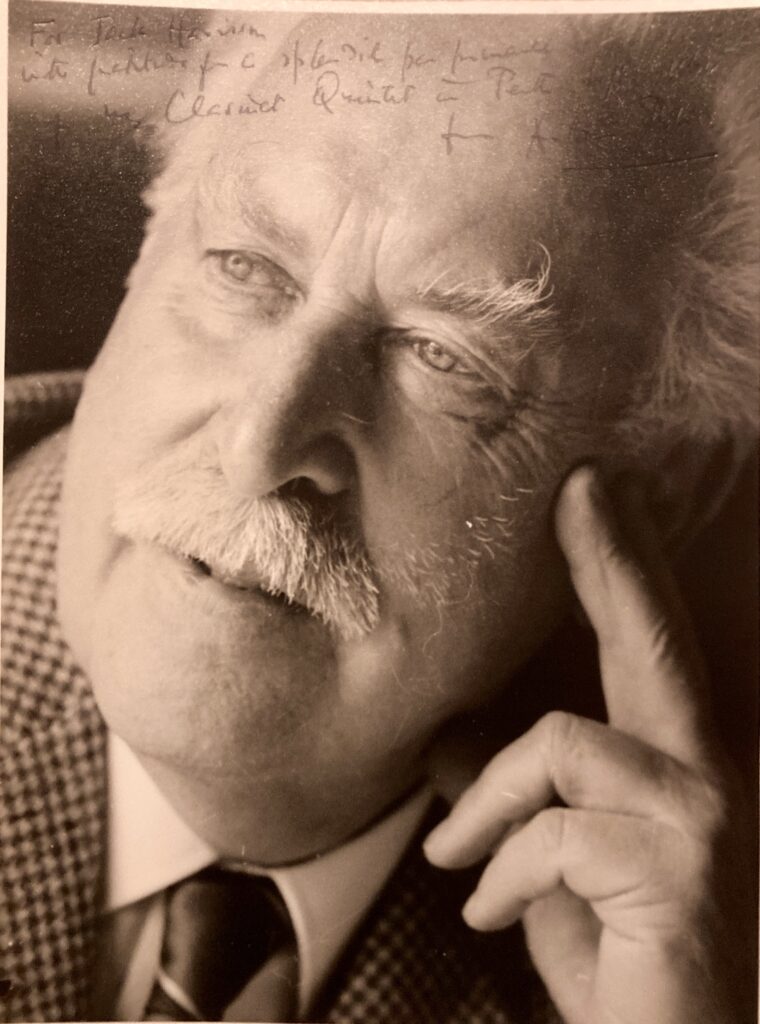
Clarinettist Jack Harrison performed the Australian premiere of the Arthur Bliss Clarinet Quintet with the Oriel Quartet in September 1964 in the presence of the composer.  Jack got Arthur Bliss to sign a photograph that is inscribed

“For Jack Harrison with gratitude for a splendid performance of my clarinet Quintet in Perth 1964 from Arthur Bliss”.


U.W.A. Thursday Lunchtime Recital

September 1964

Clarinettist Jack Harrison with the Oriel String Quartet will interpret the Bliss Quintet at next Thursday’s free lunch-hour recital at 1.15pm in the Winthrop Hall undercroft, and oboist Peter Randall, with members of the quartet, will play the Mozart Oboe Quartet.

MUSIC

By Sally Trethowan

September 1964

Also a fine performance was the reading of the Bliss Clarinet Quintet by Jack Harrison and the Oriel Quartet who emphasized the romantic, lyrical nature of this music which is expressed through a dissonant idiom.  The clarinet beginning as only one bright strand in a contrapuntal musical skein, emerges as soloist in the adagio where it wanders, looping itself in long braids and arabesques of melody in clarinet writing that recalls the Brahms Quintet.  The studio was about two thirds full for the performance.

17.4.1964 18.9.1964 Arthur Bliss Clarinet Quintet (1932) AUSTRALIAN PREMIERE (performed in front of Bliss) Jack Harrison (clarinet) Oriel String Quartet, Sir Arthur Bliss Studio performance ABC Free lunchtime concert Winthrop Hall Undercroft University of Western Australia

MUSIC – By Peter Hellstrom – Festival Of Perth 1966

The Master of Queens Musick, Sir Arthur Bliss, has told the Festival Of Perth committee that the planning of the musical programs in the coming festival is a magnificent gesture to British music and should be more widely known.   That it has become well known already in Britain is showing by letters from many leading authorities there they include congratulations from the executive of the Composers Guild of Great Britain.   Though some prominent English music festivals like Cheltenham Aldeburgh and the longest established Three Choirs Festival feature their country music, no British festival has in recent times included such an extensive and exciting range of British music in one series.  Works of nearly 70 composers are included. The Perth programs have been wisely spaced over the six week festival period and though many of the concerts will start at the customary 8 pm some will be at 6 pm to enable patrons to attend another festival attraction the same evening.

Works by Vaughan Williams Gordon Jacob, Howard Ferguson, Lennox Berkeley and Michael Tippett will be new to W.A. The London Symphony Orchestra conducted by Colin Davis will introduce Bliss’s “Discourse for Orchestra” to Australia in one of its Perth concerts.  In the other, Tippitt’s Symphony No. 2 and Stravinsksy’s Symphony in Three movements will be played here for the first time. Leading W.A. musicians appearing as soloists in the festival will include soprano Molly McGurk who will sing Benjamin Britain’s song cycle Les Illuminations with the W.A. Symphony Orchestra. She will also sing the solo soprano part in the University Choral Society’s performance of Vaughan Williams A Sea Symphony. Stephen Dorman will be the accompanist for tenor David Galliver’s three British song recitals. He will also partner violinist Vaughan Hanley in a Sonata recital and will play the solo part in constant Lambert’s Concerto for Orchestra and Nine Instruments.  Jack Harrison will be the soloist in David Tunley’s Clarinet Concerto and will be joined by the Oriole Quartet in Bliss Clarinet Quintet.  Graham Wood will introduce James Penberthy’s Romance for Violin and Orchestra and Alice Carrard will be the pianist with the A.B.C. Wind Players in Rawsthorne’s recent quintet. Madame Carrard will be joined by Mr Dornan, Stephanie James and Michael Cole to perform Malcolm Williamson’s new Concerto for Wind Quintet and two pianos. The new university organist, Mr John Hind, will be soloist in a program which will feature the W.A. Bach Society. The Oriel Quartet will also be the soloists with the W.A. Symphony Orchestra in Elgar’s Introduction and Allegro for strings and will give a separate recital of works by Howells, Frank Bridge,  John Exton (the newly appointed senior lecturer in music at the university) Gerald Finzi, Elizabeth Lutyens and Edmund Rubbra.

The West Australian September 1965 Heat Affects Performance – By Sally Trethowan

The auditorium may have been stifling but the choice of program was coolly classical at the Chamber Music Society’s first meeting for 1970 held last night in the Secondary Teachers College Hall Nedlands.  The Oriel String Quartet with Jack Harrison (clarinet) presented works by Beethoven, Mozart and Sir Arthur Bliss.   The Oriel Members have a new stage image.  Two are now bearded and all four are stylishly sporting sideburns. Last night’s heat though must have been too enervating, for they seem to have neither the heart nor the energy to give us anything more than technically acceptable professional playing.  However, Jack Harrison’s two performances in the great Mozart Clarinet Quintet and in Bliss’s astringent Quintet were jewels.  While the Oriel provided the harmonic and contrapuntal décor, Harrison’s cool, pure intonation and intrinsic musicality made  glorious sound and sense of his every phrase.  His playing of the finely wrought clarinet line in the Mozart was especially lovely and here, too, there was some beautiful responsive phrases from Graham Wood’s violin.  In the performance of Beethoven’s String Quartet Op. 18. No. 6. the heat seemed ponderable enough to weigh the Oriel’s bows judging from the absence of enthusiasm in the player’s movements.  The resulting reading of what is in fact one of Beethoven’s gayest inspirations paced wearily where it should’ve nimbly stepped the light fantastic. Indeed, the phrases of the slow movement drooped so desperately that my sympathies went out to players and composer alike.  Had the room being 20° cooler, the performance would predictively have been very different. 

Perth Chamber Soloists – Sunday July 21 1985 – UWA Music Auditorium

Robert Cooper, Neil Barclay, John Dean and Jill Cole

Guest artist Jack Harrison

Quintet for Clarinet and String Quartet (Bliss)
Instruments

Years

Sir Arthur Bliss

English composer and conductor Sir Arthur Bliss visited Perth in September 1964.

As the serving Master of the Queen’s Musick, his tour of Australia generated significant national media coverage. Newspaper archives from 28 September 1964 capture his time in Western Australia, including interviews where he publicly praised Australia’s growing classical music potential.

Bliss wrote his Clarinet Quintet (1932) for the prominent British clarinettist Frederick Thurston, who gave the first performance at the composer’s home alongside the Kutcher Quartet. While Thurston was the intended performer, Bliss dedicated the published score to his friend, the composer Bernard van Dieren. The quintet is also widely regarded as a private, musical tribute to Bliss’s younger brother, Kennard (a talented amateur clarinettist who was killed in World War I)


Clarinettist Jack Harrison performed the Australian premiere of the Arthur Bliss Clarinet Quintet with the Oriel Quartet in September 1964 in the presence of the composer.  Jack got Arthur Bliss to sign a photograph that is inscribed

“For Jack Harrison with gratitude for a splendid performance of my clarinet Quintet in Perth 1964 from Arthur Bliss”.

September 1964 – U.W.A. Thursday Lunchtime Recital

Clarinettist Jack Harrison with the Oriel String Quartet will interpret the Bliss Quintet at next Thursday’s free lunch-hour recital at 1.15pm in the Winthrop Hall undercroft, and oboist Peter Randell, with members of the quartet, will play the Mozart Oboe Quartet.

September 1964 – MUSIC – By Sally Trethowan

Also a fine performance was the reading of the Bliss Clarinet Quintet by Jack Harrison and the Oriel Quartet who emphasized the romantic, lyrical nature of this music which is expressed through a dissonant idiom.  The clarinet beginning as only one bright strand in a contrapuntal musical skein, emerges as soloist in the adagio where it wanders, looping itself in long braids and arabesques of melody in clarinet writing that recalls the Brahms Quintet.  The studio was about two thirds full for the performance.


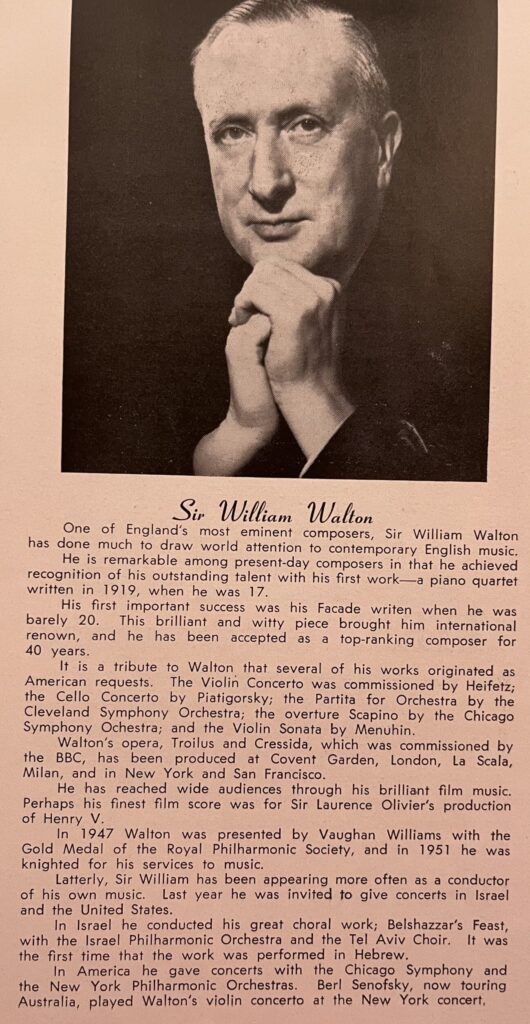
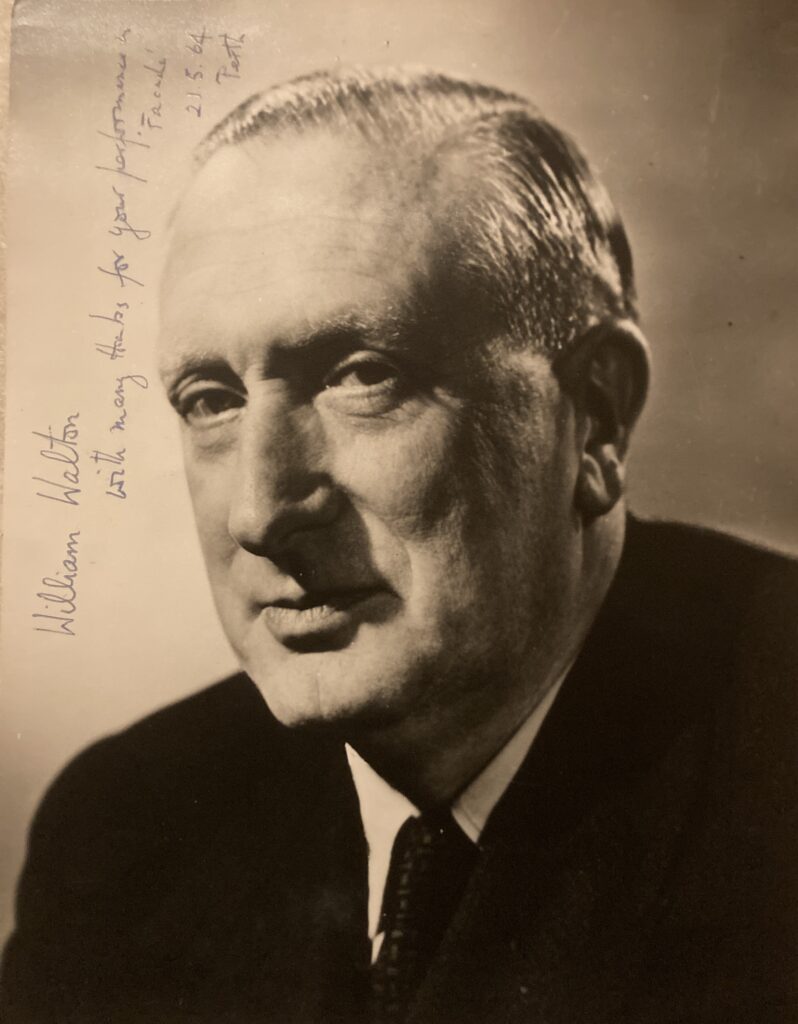
Sir William Walton

Jack Harrison performed in the Perth premiere performance of “Façade” in May 1964 with the composer present. Actor James Beattie was the speaker and Verdon Williams the conductor.  William Walton signed a photo for Jack that reads

“with many thanks for your performance in “Façade” 21.5.64 Perth”.

Person

WALTON, William

29.3.1902 – 8.3.1983 Sir William Turner Walton OM was an English composer. During a sixty-year career, he wrote music in several classical genres and styles, from film scores to opera. His best-known works include Faccedil An Entertainment, the cantata Belshazzar’s Feast and his First Symphony. Born in Lancashire, the son of a musician, Walton was a chorister and then an undergraduate at Christ Church, Oxford. On leaving the university, he was taken up by the literary Sitwell siblings, who provided him with a home and a cultural education. His earliest work of note was a collaboration with Edith Sitwell, Façade, which at first brought him notoriety as a modernist, but later became a popular ballet score. Other early works that made his name were a Viola Concerto and Belshazzar’s Feast. In middle age, Walton left Britain and set up home with his young wife on the Italian island of Ischia. By this time, he had ceased to be regarded as a modernist, and some of his compositions of the 1950s were criticised as old-fashioned. His only full-length opera, Troilus and Cressida, was among the works to be so labelled and has made little impact in opera houses. In his last years, his works came back into critical fashion; his later compositions, dismissed by critics at the time of their premieres, were revalued and regarded alongside his earlier works. Walton, who was largely self-taught as a composer, was a slow worker, painstakingly perfectionist, and his complete body of work across his long career is not large. https://www.kennedy-center.org/artists/w/wa-wn/sir-william-walton From February until May 1964 composer Sir William Walton visited Australia and New Zealand conducting his own works.  He visited his sister Nora Donnelly in New Zealand.  The entire 1964 tour of Australia—including his travel, accommodations, and performances in Perth—was primarily financed and organized by the Australian Broadcasting Commission (ABC), in cooperation with the Adelaide Festival of Arts.  The initial financial “anchor” that justified bringing Walton halfway across the world was the 1964 Adelaide Festival. The festival committee pooled its budget with the ABC to co-sponsor Walton as their headline international composer. He was brought out specifically to oversee the Australian premiere of his opera Troilus and Cressida and conduct his symphonic works. Walton’s 1964 Australian itinerary mostly highlights his scheduled performances of the Hindemith Variations with various state orchestras. However, behind the scenes, the tour suffered from a notorious logistical headache: the physical sheet music and orchestral parts for the Hindemith Variations were either missing, incomplete, or faulty.  Because they couldn’t play the planned program, Walton and his promoters had to frantically substitute pieces. He frequently turned to his famous suite Façade because it was a crowd-pleaser and something he could pull together quickly with local players. The original, definitive version—featuring the instrumental ensemble accompanied by a live narrator reciting the poetry through a megaphone—did not receive a major, documented Australian premiere until Sir William Walton’s first-ever tour of the country in 1964.   The tour’s primary, officially scheduled staging of the full Façade entertainment took place at the Adelaide Festival of Arts in March 1964, where Walton personally conducted the Festival Chamber Group. It was because of the wild success of this specific presentation that Walton was able to quickly pull the piece out of his back pocket and recreate it on the fly.
FAÇADE
May 1964  William Walton Façade PERTH PREMIERE Performed in front of Walton Jack Harrison James Beattie (speaker) Verdon Williams (conductor) Festival of Perth Basil Kirke Studio A.B.C. Adelaide Terrace, Perth, Western Australia
Walton’s “Façade” for speaker and chamber ensemble with which Walton first made an impact on the English musical scene. It consists of a recitation of Edith Sitwell poems against the background of chamber ensemble music.  The speaker will be James Beatty and the ABC chamber ensemble will be conducted by Verdon Williams. The other work in the programme, Bliss Clarinet Quintet, will be performed by the Oriole String Quartet with Jack Harrison.  The West Australian Saturday February 26 1966
WORDS, MUSIC BLEND SUBTLY IN “FAÇADE” By Sally Trethowan Nearly 2 years ago, actor James Beatty conductor Verdon Williams and a small chamber ensemble gave a scintillating performance of the original version of “Façade”. The same actor and conductor were responsible for a no less diverting and accomplished reading of the work in the Basil Kirk Memorial studio on Saturday night as part of the Festival Of Perth “Music of Britain” series. William Walton deft and witty accompaniment to the spoken verses by Edith Sitwell no longer shock audiences as they did in the 20s.  What seemed iconoclastic musical language then, derived as it was mainly from jazz and the music-hall, seems passe now. But though time has weathered the original satiric bite, the work still magnificently fulfils the sub- title “An Entertainment”.  A successful performance of “Façade” depends predominantly on fractional timing and coordination between the individual musicians, and between the speaker and instrumentalists. On this count Saturday’s reading could scarcely have been better. Beattie’s performance of the verbal prestidigitations in the “Tarantella” and part of the “’Tango Paso Doble” was admirable as was his rhythmic delivery of the apparently nonsensical compilation of associative images into a rich mosaic of orchestrated word sounds. The other work on the program, Arthur Bliss’s Clarinet Quintet, is extremely demanding on all players, though in no sense is it a showpiece. The Oriel String Quartet and clarinettist Jack Harrison, who also performed this work in the composers presence when he visited W.A. about 18 months ago, gave a craftsman like an intelligent reading, inclusive in the brusque helter-skelter scherzo and finale, and reflective, even faintly nostalgic, in the intensely lyrical first and third movements. Bliss’s harmonic acidulation in these movements, however, precludes any thought of the molasses type sentimentality often associated particularly in 19th century music with lyricism. The West Australian Monday February 28 1966
Walton’s “Façade” for speaker and chamber ensemble with which Walton first made an impact on the English musical scene. It consists of a recitation of Edith Sitwell poems against the background of chamber ensemble music.  The speaker will be James Beatty and the ABC chamber ensemble will be conducted by Verdon Williams. The other work in the programme, Bliss Clarinet Quintet, will be performed by the Oriole String Quartet with Jack Harrison.  The West Australian Saturday February 26 1966
FESTIVAL FAILS IN ITS HUNT FOR A MUSICAL DRAW CARD BY KENNETH HINCE IN PERTH Put on at cocktail time “Façade” was prefaced by the Clarinet Quintet of Arthur Bliss, music of thick Brahmsian texture. This has no necessary reason for existence being simply a work that someone felt like writing down. All the instruments are used with a sense of duty, all the movements are filled with scrupulously professional writing, but it’s total meaning might be boiled down into a bar or two of Elgar or Britten. Only a historian could have really enjoyed its performance; only an archivist could have been satisfied to hear it played instead of reading it over in a library.  It was performed on Saturday by Jack Harrison and the Oriol String Quartet – Harrison with unfailingly accurate but monotonous uninflected attack, the Quartet balanced, well matched and reasonably polished.   “Façade” came off rather worse.  Music of superb elan which has worn much better than most people realise, it had a fairly good reading from James Beatty. The décor in the Basil Kirk studio was quite adequate with a gauze curtain allowing just enough of the reciter and the chamber Orchestra to come through to the audience. But the instrumental work was just not accurate enough for the music.   For a mid 60s audience, the point of this music lies half in the way it bites its thumb at Victorian morality, half in the bitterly precise realisation of the score.  On Saturday under Verdon Williams, things were too this and that too hither and thither.  For people who had not heard “Façade” before this was a tolerable enough experience but to a man who wanted to feel the true historical grip of this music, the performance was too slack and inefficient for a casual reading let alone for a performance of festival tone.  The Australian Monday February 28 1966
Walton’s “Façade Suite” will be given by the Music Society at the Octagon theatre tomorrow night.  The brilliantly witty work with Neville Teede reading the nonsense verse of Edith Sitwell, will be accompanied by the Wigmore Ensemble conducted by Graham wood.  Those taking part in the ensemble will be Jill Wright (flute), Jack Harrison (clarinet), Neil Boon (saxophone), Kevin Jonston (trumpet), Jill Cole and Sally Talbit (cellos) and Paul Sarcich (percussion).  Members of the group will also play the Pastorales de Noel by Andre Jolivet the French composer and musical director of the Caomedie Francaise, the flute, violin and harp trio of Eugene Goosens and Igor Stravinsky’s “Epitaphium” for flute, clarinet and harp. The Sunday Times April 20 1980
Walton signed a photo for Jack Harrison that reads “with many thanks for your performance in “Façade” 21.5.64 Perth”.

Instruments

Years

Person

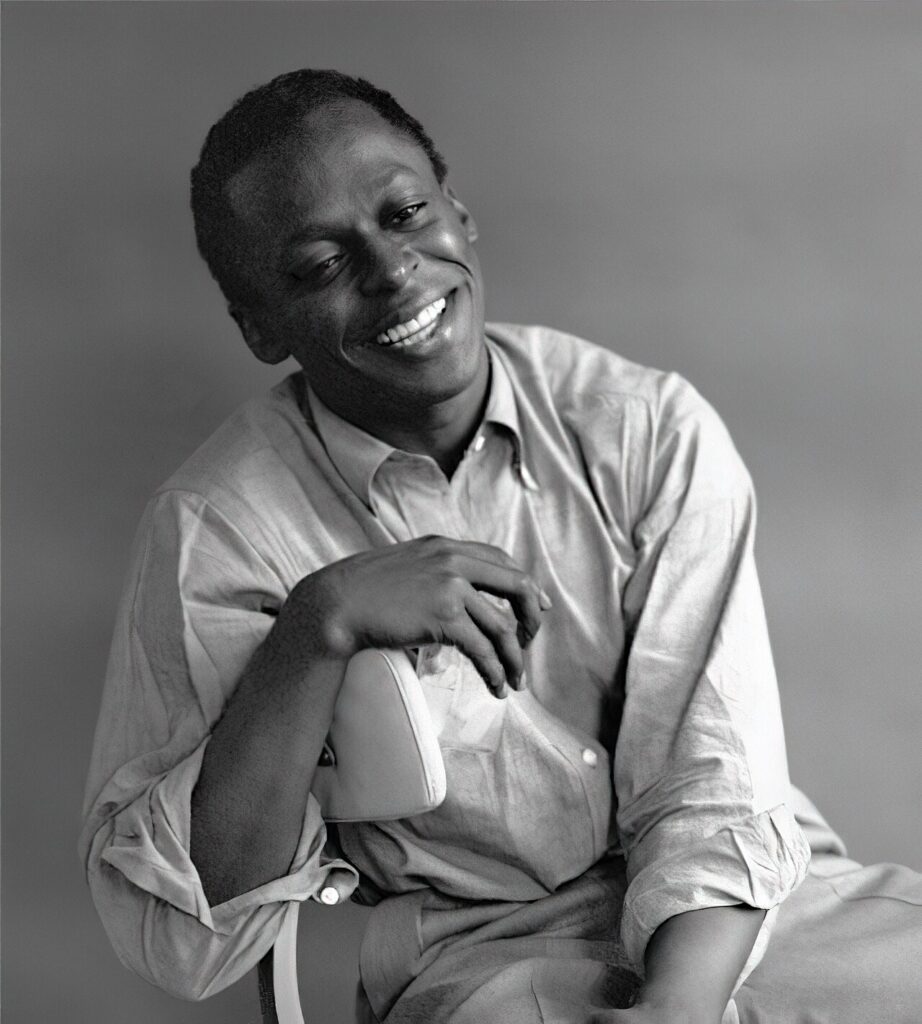
DAVIS, Miles

Miles Davis was arguably the most influential jazz musician in the post-World War II period, being at the forefront of changes in the genre for more than 40 years. Born into a middle-class family, Davis started on the trumpet at age 13. His first professional music job came when he joined the Eddie Randall band in St. Louis in 1941. In the fall of 1944 Davis took a scholarship to attend the Juilliard School, a convenient passport to New York. It didn’t take him long to immerse himself in the New York scene and he began working 52nd Street gigs alongside Charlie Parker in 1945. Soon, Davis found work with Coleman Hawkins and the big bands of Billy Eckstine and Benny Carter. During the late 1940s, a number of musical contemporaries began to meet and jam regularly at the small apartment of arranger-pianist Gil Evans. Among them were saxophonists Gerry Mulligan and Lee Konitz, and pianist John Lewis. Out of this group of musicians, Davis formed the nonet to record his first major musical statement, Birth of the Cool. In addition to the standard piano, bass, and drums rhythm section, Davis’ nonet horn section used French horn and tuba along with trombone and alto and baritone saxophones, lending the band a unique harmonic sound. In 1955, Davis assembled his first important band with John Coltrane, Red Garland, Paul Chambers, and Philly Joe Jones, adding Cannonball Adderley in 1958. By this time Davis, influenced by George Russell‘s theories, had begun playing in modes rather than standard chord changes, which led to his most famous album (and the all-time biggest-selling jazz album), Kind of Blue, in 1959. Davis also continued an important musical partnership with Gil Evans, recording four releases in five years: Miles Ahead, Porgy and Bess, Sketches of Spain, and Quiet Nights. In 1964, Davis assembled a new band of younger musicians, which became known as his second great quintet. This included Herbie Hancock, Tony Williams, Ron Carter, and Wayne Shorter. By this time, the Miles Davis Quintet was recording mostly originals, with all the band members contributing memorable tunes. Davis’ horn playing also changed, increasing the spacing of notes to create more suspense in the music. In 1968, Davis again changed direction, leading the way for electric jazz with the release of In a Silent Way. By the 1969 release of Bitches Brew, as he deepened the electronic elements and rock rhythms of his music, the transformation was complete. By the mid- 1970s, following the debilitating effects of a 1972 auto accident, Davis went into semi-retirement. He returned to the scene in 1980 and resumed touring in 1981, attracting newer fans. From then to 1991, Davis remained vital and popular, receiving the Grammy Lifetime Achievement Award in 1990. Selected Discography Birth of the Cool, Capitol, 1949-50 Kind of Blue, Columbia, 1959 The Complete Live at the Plugged Nickel, Columbia, 1965 Bitches Brew, Columbia, 1969 Amandla, Warner Brothers, 1989 https://www.arts.gov/honors/jazz/miles-davis
https://www.milesdavis.com/
“So What” is the first track on the 1959 album Kind of Blue by American trumpeter Miles Davis. It is one of the best-known examples of modal jazz, set in the Dorian mode and consisting of 16 bars of D Dorian, followed by eight bars of E♭ Dorian and another eight of D Dorian. This AABA structure puts it in the thirty-two-bar format of American popular song. The piano-and-bass introduction for the piece was written by Gil Evans for Bill Evans (no relation) and Paul Chambers on Kind of Blue. An orchestrated version by Gil Evans of this introduction is later to be found on a television broadcast given by Miles’s first quintet (minus Cannonball Adderley, who was ill that day) and the Gil Evans Orchestra; the orchestra gave the introduction, after which the quintet played the rest of “So What”. The use of the double bass to play the central theme makes the piece unusual. This arrangement was later performed and recorded as part of the album Miles Davis at Carnegie Hall. PELICAN Thursday April 23rd 1964 Jazz by Nessia Solomons Jazz versatility in jazz No classical music this week!  Instead the fresh sound of modern jazz filled Winthrop Hall as the sounds of Jack Harrison (alto sax and clarinet) Billy Clowes (piano) David Ellis (bass) and Bill Tattersall (drums) presented a program on the changing styles of jazz.   The Jack Harrison Quartet features the well-known Billy Clowes Trio while Jack Harrison is also a member of the W.A. Symphony Orchestra in which he plays clarinet. Although they play other styles of music, they enjoy playing jazz with a vibrant sound that is synonymous with modern jazz today. The opening number “9.20 special” a tune written for Count Basie, was of fast tempo and made the expectant audience sit up and listen. Unfortunately, the acoustics in Winthrop Hall caused the drumming to sound a little dominant at all times, however the smooth playing of both piano and saxophone tied this over to no disadvantage.  Pianist Billy Clowes composed the next number played – a 12 bar blues – a style which has been popular at all times through the evolution of jazz to the present day. As always, when a composer plays his own tune, the result is an extra special sound with an atmosphere perfectly suited to its style. Perhaps it was just the Paul Desmondish sound of the alto sax or maybe some ultramodern chord forms, yet this and a few other numbers were reminiscent of Dave Brubeck’s style. The changing styles and jazz were illustrated through five numbers, the two most popular being a swinging version of “Alexander’s Ragtime Band” and an excellent takeoff Miles Davis in “So What”. Although the group was versatile as it had to be for that program, they seem to play with much greater ease the more modern numbers, especially “Work Song”.  This number was played in great style –  it possessed an interesting, varied beat as the drummer and the bass player really gave forth the jazz message in their solos.  The musicians pleased an obviously critical audience with their versatility, as with showing by the applause for several numbers and on the whole, the jazz concert did lift, however slightly, the cultural curtain to edge a little way through the sound barrier that divides the two cults of music in the Western world today.  PELICAN Undergraduate Newspaper UWA, Vol 35 No. 5 Thursday April 23rd 1964
1.12.1964 Miles Davis’s “So What” PERTH PREMIERE Jack Harrison (clarinet and alto-saxophone), Billy Clowes (piano) David Ellis (bass) and Bill Tattersall (drums) ABC TV live to air broadcast Adelaide Terrace, Perth, Western Australia

Home
 

Instruments

Years

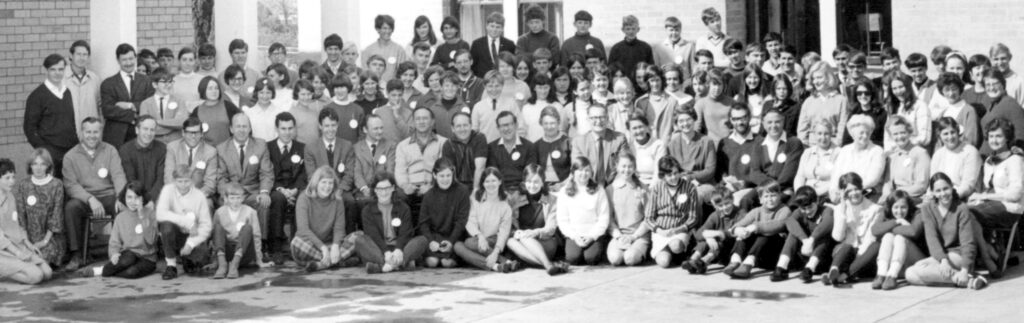
W.A. Music Camp

WA Music Camp 1964. WASO tutors include: Patrick Brislan, Don Johnson, John Gould and Ashley Arbuckle (all standing on the left and rear). Seated in the second row: Owen Fisenden, Graham Wood, Jack Harrison, John Mowson, Brian Meddemmen, John Dean, Stan Kowarski, Vaughan Hanly, Peter Randall, Brian Pope and also Prof. Frank Callaway.