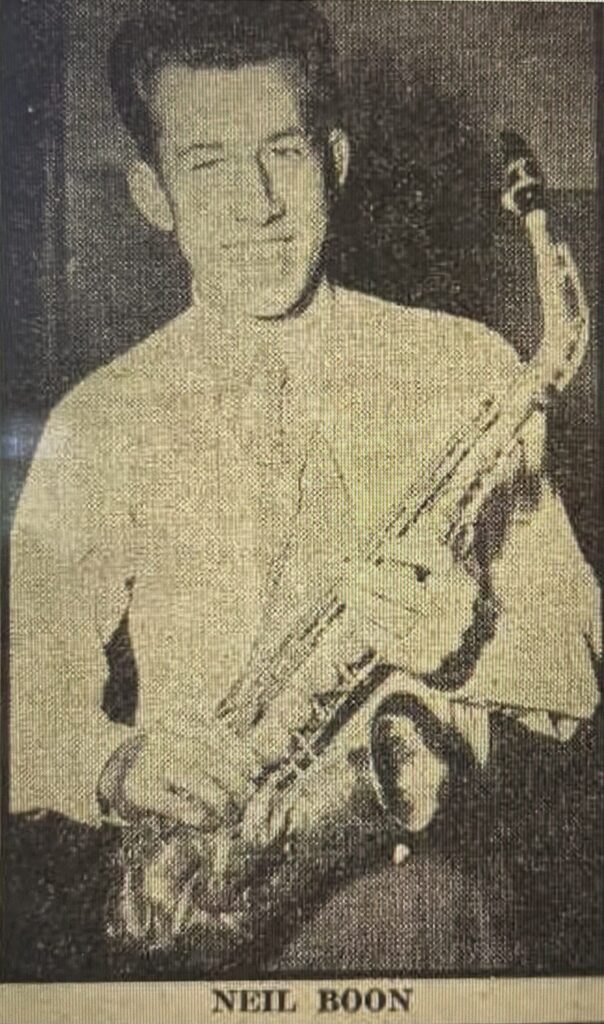
Neil Boon was born in the Netherlands in 1936, decided to become a musician in 1941 and migrated to Australia with his family in October 1950.
1951
From Neil Boon’s memoires detail his audition for the West Australian Symphony Orchestra:
The ABC office consisted of a group of weatherboard cottages with one fairly large room which was called “The Studio”. This rather weird collection of wooden buildings was situated in the beautiful gardens on the south eastern corner of Barrack Street and St George’s Terrace.
We were welcomed warmly by the office staff and introduced to the ABC accompanist, Stephanie James. Stephanie was an extremely tall and friendly woman. She took Bob and me into the main studio. When I handed her the piano music for my pieces she produced her own copies which she preferred to use. She gave me a few minutes to warm up before I went to tune my clarinet to the large Bechstein grand piano. There was only limited time to rehearse together, so we went through stop-starts, tempi and tempo changes in the two pieces. If I had been knocked out by the playing standard of Miss Bray, when I heard Miss James, I felt I’d heard the impossible. I felt humbled to be given the chance to play with her. To have this opportunity so early in my music experiences in my new country was just magic.
The audition was well received by Rudolph Pekarek, the then resident conductor of the Perth Symphony Orchestra (later called WASO). I was given the chance to play the complete Concertino for Clarinet by Weber and the first movement of the Saint- Saens Sonata. Henry Kripps, a visiting Austrian conductor, came into the studio for the Sonata movement. After the performance the two conductors conversed for some time before coming over to talk to us. They congratulated me on my playing. Mr. Pekarek advised me to get in touch with the principal clarinettist of the orchestra, Mr Allan Rule, and ask him to take me on as his student. He said that both he and Mr Kripps were very impressed by my performance. They both shook my hand and wished me well. “Leave your address in the main office, and, if you change address, make sure you let the office know”, were their parting words. Stephanie congratulated me and said that she hoped to see me in Perth soon. Thirty years later we worked together as examiners for the AMEB, the Australian Music Examinations Board.
On leaving the ABC studios with Bob, I felt relieved that it was over whilst at the same time feeling rather sad that my performance with Stephanie James was a once only occurrence. The experience stuck in my mind for a very long time.
I left my address with the main office.
1953 – May
From Neil Boon’s memoires – May 1953:
I had ninety minutes to try and contact Mr. Bluck the dance band/jazz band promoter. I had a lot of trouble locating the Nicholson Music Store. After walking around the commercial business block several times, I eventually found it somewhere in Barrack Street, if I remember correctly.
I took the very narrow creaky stairs to the second floor, which brought me to the office of: Harry Bluck, promoter of live music in WA.
On entering the office I stood face to face with the man who, I’d been told, was the one person in Perth who more than anyone could introduce me to the music making fraternity of Perth. What a helpful person Harry turned out to be!
He took the time to listen to my story and my plans and ambitions.
He made me aware that, contrary to my belief, Perth was a small town with limited opportunities for professional work. He gave me the telephone numbers of several musicians who could be looking for a saxophonist-clarinettist.
It so happened that two of these, Gordon and Don Bates, had approached Harry only a couple of days earlier to see if he knew of a good saxophonist who was looking for work. When I said to him that I wondered if I would be good enough for what these brothers had in mind, Harry answered: “Bloody oath you are”. How did he know that? He said that the grapevine moves fast in little WA. He was well aware of the standard of playing Peter S. and I had produced in the lower South West.
Harry then made a phone call to Gordon B. who was interested in my experience in the Pemberton district. Because I was rather unfamiliar with the lay-out of the Perth suburbs, Gordon was prepared to pick me up from my boarding address on Saturday morning, to go to his studio to see if we could work together.
Harry promised that he would give my phone number to several Perth musicians who could be interested in employing me sometimes.
At 9.45am I told Harry that I had a job interview at ten o’clock. He wished me all the best and said: “believe in your-self young fella”! I took that advice seriously and went on my way.
Before going back to Maylands I went into the city centre with the intention of searching out the music stores. I found a shop called Musgroves, where I met two people who were to become good friends sometime later. One was a young man of exactly my age. His name was Theo Henderson. Theo was a shop-hand at that time. A few years later he started his own music store, which eventually became the largest music store in Perth, known as Theo’s Music.
The other person was an elderly gentleman called Harry Visser. Harry had the reputation of being the best piano technician in Perth. I’d catch up with him a year later when I joined a church group for which he was the organist.
Theo sold me some Vandoren sax and clarinet reeds. He gave me a huge discount which was much appreciated. We became very good friends over the years.
I intended to practise the Mozart Concerto to get it to a level worthy of presenting it to Mr Allan Rule, the principal clarinettist of the West Australian Symphony Orchestra. Hopefully I would be able to contact him to commence lessons on my return to Perth.
At the start of the first week of my stay in the Pemberton I had written to Mr. Rule the principal clarinettist of the Perth Symphony Orchestra, asking him if he would take me on as his pupil. I received his reply just two days before my return to Perth. In it he emphasised that he couldn’t promise anything until he had heard me play. As he didn’t have a telephone, the only way I could contact him was by written correspondence. He did write that Mr. Pekarek, the resident conductor of the WASO, had spoken to him favourably about a young Dutch clarinet player in Merredin. Would that by any chance be me, he wanted to know?
My lessons with Allan Rule the master teacher.
In the music scene the next three months (July 1953) were very exciting!!
I started lessons with Allan Rule, the principal clarinettist with WASO.
Alan was a big bloke with hands twice the size of mine. When he put his instrument in his mouth, it was as if by magic everything else in the world didn’t seem to matter anymore. His was the most beautiful clarinet sound I had ever heard. This was how a clarinet should sound! Whether he played loud or soft, fast or slow, high or low, there always was that pure and clear centre to his tone. His breath support was consistent and his tonguing was super clean, light and rapid, as well as being energetic or aggressive when it needed to be. This big man was a sensitive being with a superb sense of timing, tuning, phrasing and articulation. I was so lucky to have him as my teacher. This was what I’d been waiting for since I first heard about him during my ABC audition in 1951. When Mr. Rule (is what I called him at first) heard me play, his first comment was: “if you are prepared to work hard, maybe, just maybe, one day you will play the clarinet the way it should be played”.
I obviously hadn’t impressed him with my playing or my attitude. It took me some time to realise that, until I met Allan, I’d always been a big fish in a very small pond. Now I was being thrown in the big pond where I’d have to share the “limelight” with much bigger fish. If I wanted to become a professional clarinettist I first had to come down off my “high horse” and learn what it was to be humble and self-critical. No more applause for mediocre young Neil Boon. It was time to get serious, which meant going back to some of the basics, without feeling as though someone was deliberately “stepping on my willy”.
I told Mr. Rule I that was prepared to go back to basics where he thought it necessary. I made a sincere promise that I’d “work my guts out” to get to my best standard possible. “Fair enough, but don’t become a gutless wonder” was his reply. I wasn’t sure how to interpret this comment but I decided to let it rest.
Funny how I remember just about every word we exchanged on that particular day. Although I was rather taken aback by his criticism of my playing that day, I came away from his house elated and zestful, because I now had a Master-Teacher.
In the jazz and dance-band area things went along famously as well.
Gordon and Don gave me plenty of work and Harry Bluck introduced me to the top echelon of the jazz scene in WA. So it happened that I worked with the Sammy Sharp and the Merv Rowston Big Bands on several occasions, whilst in the small group area I picked up a lot of experience working with musicians like Jimmy Beeson, Terry Ingram, Neil Manolini, Keith Whittle and Harry Bluck.
My most wonderful experience was as the reed player in the sextet for the regular Friday night dance organised by the Student’s Social Club of the University of Western Australia (UWA). The Harry Philips Sextet consisted of trumpet, sax & clarinet, guitar, piano, drums and string bass, these days often referred to as the “stand-up bass”. The young regular crowd was huge and extremely responsive. These evenings were highly successful and lasted for nearly two years.
Harry Phillips, the band leader and superb trumpet player, was the elder brother of the highly regarded English jazz clarinet/sax player Syd Phillips. Every member of Harry’s sextet was a first class musician, at least by local standards, and was able to improvise in Dixieland and Swing styles.
My time with Harry’s sextet was one of the real highlights of my career.
When I wasn’t at work or playing in bands, the back shed at number 10 Eighth Ave in Maylands was alive with scales, arpeggios and clarinet excerpts from operas and symphonies. It was a wonder that no one complained about noise after eleven pm as, night after night, I was practising till at least 1 o’clock in the morning in order to be able to front up to Allan Rule and prove to him I was keeping my end of the bargain.
The second lesson with Mr. Rule!
Because of the search for land and the excitement of starting to build a house, my practice had been less than sufficient. I was rather worried that in the first week I hadn’t kept my promise to “work my guts out”.
When I told Allan how the circumstances of the last week had been rather unusual, his reaction was surprisingly mild. In fact, he said that I’d made good progress, but I shouldn’t for one moment think that I could get away with such little practice from now on. During the lesson I began to realise that there was a soft and caring side to this man’s character.
He spoke about the importance of self-confidence and determination.
It became obvious to me that he had done some research into the jazz work I had done over the last two years or so. I’m sure he’d had some contact with Harry Bluck, who of course was well informed regarding my experience in the jazz and dance band scene, both in Perth and the South West mill towns.
For the first time in my life I was made aware of the meaning of the educational terminology of “input and outcome”. Allan said that in regard to playing an instrument, most people think that when reading the music, the job is done when they respond correctly to the instructions on the page.
His words: “Real musicianship comes to the fore by listening to the outcomes of your inputs and deciding how to turn your actions into worthwhile and sensitive musical happenings. It’s all in your interpretation of the notes”.
Herewith Allan tried to make me aware of the need to develop musical awareness. He warned me that the jazz scene in Perth was heavily focused on “being famous” or at least on being well known, rather than being capable and musically proficient (I had noticed that the best known players weren’t necessarily the most capable). According to Allan this didn’t work in what he called “serious” music. I believed by serious music he meant artistic music compared to pop music. In Perth in the early fifties, jazz music was seldom recognised as being artistic, but unfortunately more often categorised with pop music, the music for the masses.
During the next couple of months Allan focussed heavily on sight-reading as well as absolute clarity of tonguing in the clarion register of the instrument.
I was told that I was an intensely stressed player, evident in the way in which I held my instrument. His words were: “you have only one holding finger and nine playing fingers. The task of your right-hand thumb in combination with your embouchure is to hold the instrument firmly. The other nine fingers are totally free to do whatever is needed to perform the required movements for an efficient playing technique. Any one of those nine fingers must never be used to hold or stabilise the instrument, in whatever way possible.
Allan set me to work on a couple of volumes of clarinet excerpts from the symphonic repertoire. After my second lesson with Allan the weekly one hours visit turned into two hour sessions. Each time when I came away from one of those sessions, I felt inspired and raring to go!
1953 – June
Royal Freshwater Bay Yacht Club: Coronation effort was supplied with music from a new young outfit headed by young accordeonist Neil Mannolini and the reed work was very capably dispensed by a teenage Dutch lad— Neil Boon. Up-and-coming outfits like this deserve encouragement— and work!
Mirror (Perth, WA : 1921 – 1956), Saturday 6 June 1953, page 12
IMPROMPTU JAM STOLE THE SHOW
An impromptu jam session nearly stole the show at Thursday night’s WA Amateur Dance Band Concert at the Capitol Theatre. Composite band of members who had competed earlier, really went to town and had patrons rocking in their seats. Jam band was led by internationally known Harry Phillips on the trumpet and Sid Vandervelde on guitar. Boys really turned it on and the crowd went wild. Even when Sammy Sharp came forward to announce the night’s awards the audience clamored for another spread of jam. So a grinning Sammy waved the boys to continue. Night was a feast of bounce, jive and bop with the amateur instrumentalists showing enough promise to indicate that many will soon be making pro names for themselves. Hundreds were present to hear 13 outfits, ranging in size from 4 to 11 pieces, vie with one another in a variety of Jazz renditions. Judges Ken Murdock, Ron Moyle, Merv Rowston, Harry Bluck and Bill Kirkham were not set an easy task. Finally they awarded the shield to the West Coast Dixielanders, a 7 -piece outfit led by Phil Battey on trumpet, George Battey, clarinet, Dick Hatton, trombone, Conn Goldsmith, bass, Bob Anderson, piano. Alan Blight, drums, and Vince Goldsmith, guitar. These boys have been playing together less than a year and decided at the last minute to enter the contest. They will hold the shield until next year’s contests.
The Dixielanders all prefer the type of music their name suggests is their special dish and are keen on the Jelly Roll Morton school. Second place went to Neil Manno’s Quintette with the Jive Five led by Wynne Hammer third. Other awards were: Best Instrumentalist ; Ray Taylor, trumpet. Best Guitar: Jimmy Taylor. Best Drummer: Wynne Hammer. Best Pianist: Thelma McGrath. Best Vocalist: Bill Groessler. Most promising reed player was 17-y-o Neil Boon, a Dutch youth. Organisers, the W A Musicians’ Union, Sammy Sharpe and compere Wally Hadley are to be congratulated on a good show which all agreed was a great improvement on previous contests and augurs well fox the future of dance music in this State. Saw quite a sprinkling of musicians who have given up regular playing in the audience at the Capitol, including Harry Ward and Laurie McGrath.
Mirror (Perth, WA : 1921 – 1956), Saturday 25 July 1953, page 11
Young Musician Receives Loud Applause
A saxophone solo by 17-year old Neil Boon was loudly applauded in the Capitol Theatre last night at the final session of the Jazz Jubilee. The young musician, who arrived in Australia from England four years ago with no knowledge of music appeared in an orchestra with the veteran trumpeter Harry Phillips. He played an arrangement by the late Freddy Gardiner of “I’m In the Mood for Love.” Another artist on the same programme was Jack Harrison, who played six instruments in a ten-minute “jam session.” He played the alto and bass saxophone, clarinet, vibraphone, trombone and the piano accompaniment to his sister Jill when she moved from the piano to play the oboe (bassoon!) in “bebop” tempo.
The West Australian Monday 2 November 1953 page 4
Boy Is Versatile Instrumentalist
WHEN Neil Boon was 11, he played first clarinet in a 150-piece symphony orchestra in Holland.
So it was nothing new to him — now 17— when he bowed to the applause of a Capitol Theatre crowd after his saxophone solos at the Jazz Jamboree last week. But the crowd’s applause did signify one thing — his success as a convert from classical to jazz music. “There’s a bigger future here in jazz than in classical music — especially in the instruments I play,” Neil said , today. Neil is a new Australian. His father is a forestry worker, who migrated from Holland with his family four years ago. The boy had just turned 11 when he wanted to learn to play the piccolo, but could not find one. So he bought a clarinet. Six months later, he joined the Enschede Symphony Orchestra, and three months after that was leading its 35 clarinetists. His clarinet and alto saxophone still occupy him in his spare time. He hopes soon to run his own dance band in Perth.
Daily News (Perth, WA : 1882 – 1955), Thursday 5 November 1953, page 8
LISTENERS WILL HEAR GIBSON
An agreement reached between the W.A. Musicians’ Association and the ABC resulted in last Sunday’s Jazz Jamboree (featuring The Bob Gibson Show) being recorded for broadcasting from 6WF. When the ABC heard that ace band leader Gibson would be the guest artist for the second part of Jazz Jamboree, it came to an agreement with organisers Sam Sharp and Harry Bluck for Gibson’s show to be recorded, and also agreed to pay the W.A. Musicians’ Association a fee for the right to record the show. The date of the broadcast will be published shortly. Gibson is now musical director for 2UW. Recently Gibson signed an agreement with the Columbia Recording Company. The first of his releases to be heard in Perth will probably be “Wild Horses” and “My One and Only Heart”. Gibson, who went to England in 1948 and returned in 1950, now favours big band. He records with a 28-piece band, and for concert and radio work he uses anything from 16 to 20 musicians. Two of his most popular programmes, heard from 2UW and Sportsman’s Parade and Musically Yours. Gibson said that any young musicians who hoped to go abroad needed plenty of capital and lucky breaks. He said that there were too many instances of a bandleader casually approaching a popular tune without having any idea of presentation.
Of the orchestra he conducted at the Jazz Jamboree on Sunday night, Gibson commented “They are a first class bunch of musicians. Considering they had such short notice to get together they gave a truly remarkable performance.” The band leader also praised individual performances. He believes that 17 year old Neil Boon could develop into a top line artist. Jack Harrison displayed plenty of versatility and gave a smooth performance, he said. Gibson also praised the responsiveness of the audience. “In modern music there is no greater encouragement” he said.
The Broadcaster Saturday November 7 1953 Vol .20 No. 1023
BAND HAS BIG NAMES IN EVERY SECTION
When Harry (‘Powerhouse’) Phillips takes up his trumpet on the stage it is usually a signal for wild enthusiasm from rhythm fans who see in him a combination of Louis Armstrong, Harry James and a dozen other trumpet idols. Harry, who has been to WA for nearly 5 years, is from an English musical family which has been associated with big-name bands in England and on the Continent for many years. His brother Syd will always be remembered for his compositions and arrangements with the famous Ambrose. Another brother, Woolf, is equally well known. Before coming here Harry played in most of the capital cities cf Europe and speaks several langues fluently. He has played lead trumpet with brother Syd’s band, with Ambrose, Mantovani and Harry Roy, as will as with his own groups. He can play a sweet trumpet, but is usually associated with the forceful style which gives him his name of ‘Powerhouse.’ Although this looks to be a difficult style, he achieves his effects from the modern non-pressure method, with which there is no great physical effort, despite the seemingly strained attitude of the player. Harry claims to be able to teach this style easily. Associated with Harry in his band are a number of promising young musicians, notably saxophonist Neil Boon, a 17-y-o Dutch boy who literally stopped the show at last Sunday night’s Jazz Jamboree when Bob Gibson was guest conductor. A great future is predicted for this boy, who has been playing saxophone for less than a year, but has played the clarinet for 4 years. His alto sax solo ‘I’m In the Mood for Love’ received such an ovation that compere Wally Hadley had to ask Harry to bring him forward and introduce him to the audience. ..Band’s guitarist Sid Vandervelde, also from London, was with the late Felix Mendelsohn’s Hawaiin Ensemble and the late Freddie Gardner, the great sax stylist. Sid works as a motor-mechanic in Perth and has been here for 2 years. Fans like the drive he gives the band with his solid rhythm on an amplified Spanish guitar. Brothers Don and Gordon Bates, who play piano and drums with the outfit, are local boys who have been well-known in the music game here since they had their own band some years ago. Don is a saddler with his father and Gordon is with a City leather firm. Harry works as a planning engineer for a Perth firm.
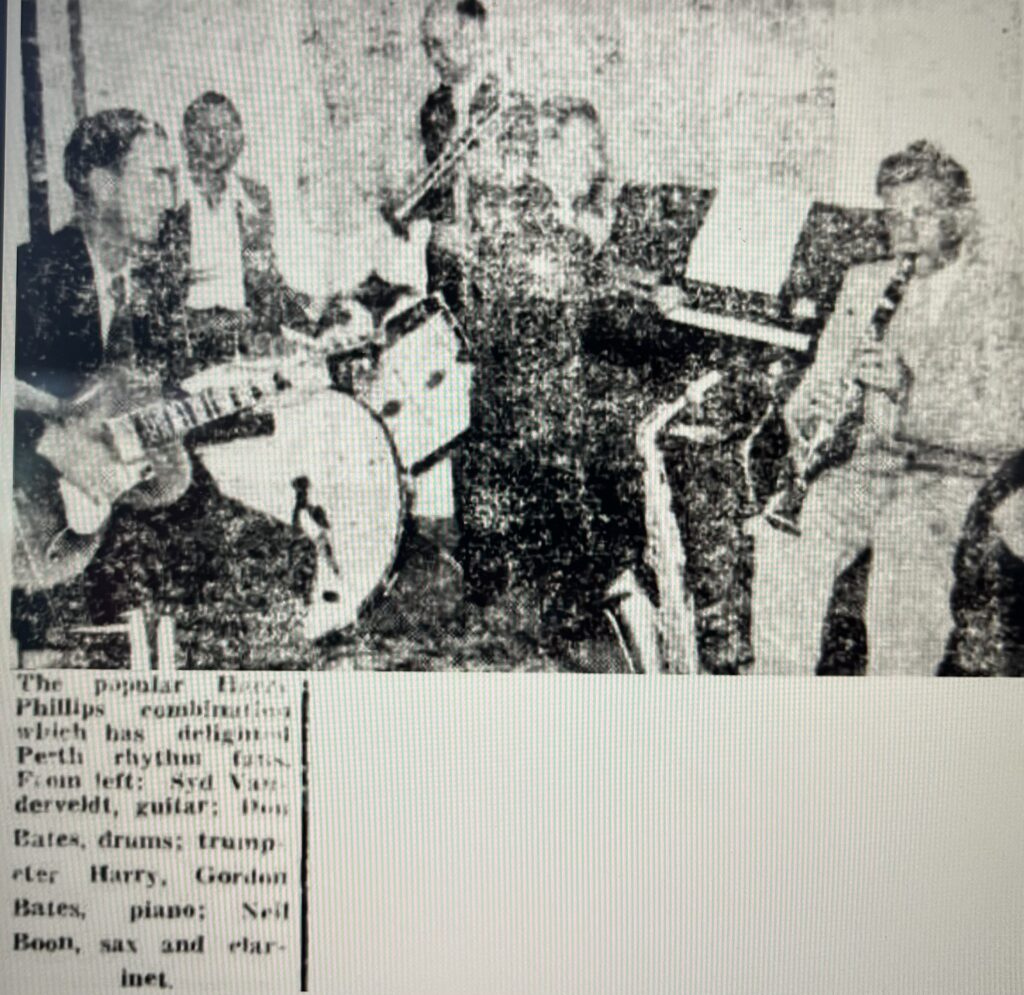 The popular Harry Phillips combination which has delighted Perth rhythm fans: From left: Syd Vanderveldt, guitar; Don Bates, drums; trumpeter Harry, Gordon Bates, piano; Neil Boon, sax and clarinet.
Mirror (Perth, WA : 1921 – 1956), Saturday 7 November 1953, page 12
1954
AMATEUR NIGHT IN THE DANCE – BAND WORLD
Next Thursday a dozen dance bands will battle it out for the title of WA’s top amateur group at die annual dance-band contest. As well as the prizes, there is the added incentive for the winner of playing as the house band at the Musicians’ Ball later this year. This will be the winner’s first professional engagement. Bands range from trios to 8-piece outfits. Every phase of dance-band work from Latin-American to Dixieland is covered. Idea of the contest is to boost the music business I generally, as well as giving these youngsters a good start in the music world. From these contests will come the new blood so essential to keep up the standard of local modern music. Many musicians who play on Thursday will be recruited by established bands; some groups will enter the professional field as a unit. Not only does this concert help the newcomer, but it also spurs the old hand on to greater efforts. If, for instance, a clarinet man shows out at the contest, all licorice stick exponents here will endeavour to give their best all the time for fear they are given the axe in preference to these newcomers. Age of the players range from 16-20. A few are older. Bands are not restricted in any way in their choice, and this freedom adds much to the show. Each band can select any 3 numbers, only stipulation being that it has to have a set for dancing. Speaking about the advantages of the contest during the week, trumpeter Sammy Sharp said: ‘We feel that there is no back-door to the music business. It’s no good a musician spending his time in a dead-end job hoping that a big break will come some day. Often it doesn’t arrive and WA loses many prospective stars.’ Many Perth maestros donate prizes for the show for instruments as well as for combinations. Among them is one donated by Harry Bluck for the night’s top pianist. Sammy Sharp donates the trumpet prize. Way the popularity of the band contest has grown is illustrated by the number competing. When initiated 3 years ago, there were only 5 entrants, made up to 7 just before the show. This year, apart from the 13 competing bands, many had to be turned away because of lack of time to fit them in! High hopes are held for a further increase over the next year or so. Last year’s winners, the West Coast Dixielanders, lost little tune in getting established in the professional dance world. In a matter of a few months they worked their way into the Jazz Jamboree, which is now looked upon as the showcase of our I dance bands. Unfortunately, this group has now broken up because a couple of its personnel had to leave Perth. Contest has been referred to by some musicians as a minor edition of the Melody Makers’ Poll. This famous dance band contest covers the whole of Britain and assures the winners permanent employment in the music world.
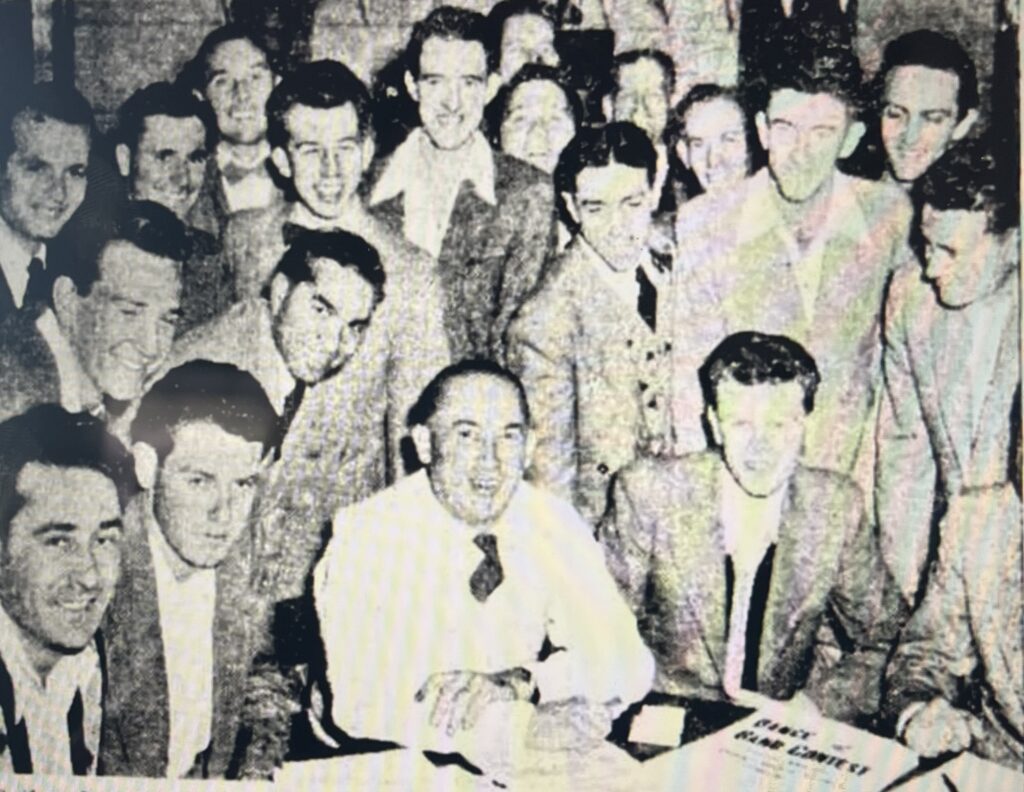 PHOTO: Gathered round Sammy Sharp are the new bloods of the WA Dance Band world. Picture was taken while they were being briefed for the dance band contest (see story left). Happy smiles belie the fact that on Thursday they will be in deadly earnest to win the competition and get a break with some of the bigger bands around town.
Mirror (Perth, WA : 1921 – 1956), Saturday 31 July 1954, page 12
SMOOTH YOUNG QUARTETTE IS TOP AMATEUR BAND
Dutch Leader Shows Style
Two thousand people left the Capitol on Thursday night convinced that in Neil Boon they had seen the future star of WA’s dance band world. For this 18-y-o Dutch boy with his clarinet swept the pool at the Amateur and Semi-professional Dance Band Contest, winning the trophy for the outstanding performer of the night as well as leading his quartette to victory.
From his first appearance it was evident that Neil was a class above most of the other local youngsters. He had beautiful tone and rapid fingering, and though more impressive in straight playing, shows good technique with his improvisations. He also knows how to put his music across. Too many of the others seemed, naturally enough, restrained and nervous on what was for many their first appearance on a stage. More experienced Boon was always quite at home. His quartet, a smooth little combo rather on the Benny Goodman style, served up some mighty music. Group comprises Eric Anderson (drums). Rob Hijnen (piano), Roy Coates (bass) and Neil (clarinet and sax). After the show the group had a Jam session and were at their best when presenting ‘Georgia on My Mind’ and other old favorites. THE PRO TOUCH Boon pianist Rob Hijnen won the piano award. Hijnen, like Boon, is an amateur with a professional presentation. Playing in the quartet, he was often under notice with brilliant work. Hijnen is a young Dutchman and plays with the ease and grace of Gene Krupa going through one of his craziest drum routines. When Rob gets wound up his head wobbles, almost hitting keys; his lees do a tap dance as he jumps on the stool. But there is no doubt that he and Boon really stole the show. At times he even stole some of Neil’s thunder. Thursday’s win means that the Neil Boon quartet will play at the Musicians’ Ball.
Runner up for Champion Band was the Jive Five (Plus 2). This group, an older combination than most, had a touch of the Billy Cotton style. Tieing for 3rd place were the Apiece Nightclubbers, Victor Mostichelli and his Latin Americans, and Ric Martin’s band. Flic Martin’s group (9 players) was the biggest band in the show. It featured a good sax team. Frank Thomas was a popular winner of trumpet honors. Frank played a wide open trumpet with the Riverside Jazz group and gave them the volume lacking from many other outfits.
MOST SAX APPEAL Alto sax man Rod Wyett was Judged the musician with the most sax appeal. Though the going was close for some prises, the choice of Alien Blight as the leading drummer was never in doubt. He played in a relaxed manner and some of his breaks were first class. Other drummers would have done well to have let their hair down and put a bit more into their drumming. Jim Taylor, guitarist with the Jive Five (plus 2) won the award for that instrument. Voting for the leading vocalist was decided by applause. Winner Bob Burns had to withstand strong competition from some pretty slick chicks. Bob, alto sax man with Ric Martin, sang ‘Laura.’ Another newcomer to do well was Victor Mestichelli. Vic won the accordion prize and his group generally were impressive, playing Latin American numbers. Band work on the whole was promising but patchy. Some of the young musicians were inclined to become lost in the middle of the numbers. Though the crowd gave bands every encouragement, it was not a promising W.A. musician who was greeted with the biggest cheer. It was Sammy Sharp’s announcement ‘Krupa’s Coming!’ which sent a terrific yell running through the theatre. He went on to say that after weeks of negotiations the impossible had happened and Krupa would come here some time this month for a one-night stand. Gene Krupa would be accompanied by pianist Teddy Napoleon and trumpet and clarinet star Eddie Shu.
Mirror (Perth, WA : 1921 – 1956), Saturday 7 August 1954, page 12
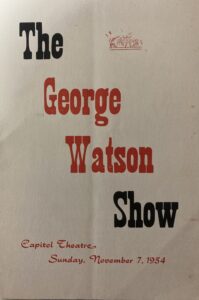
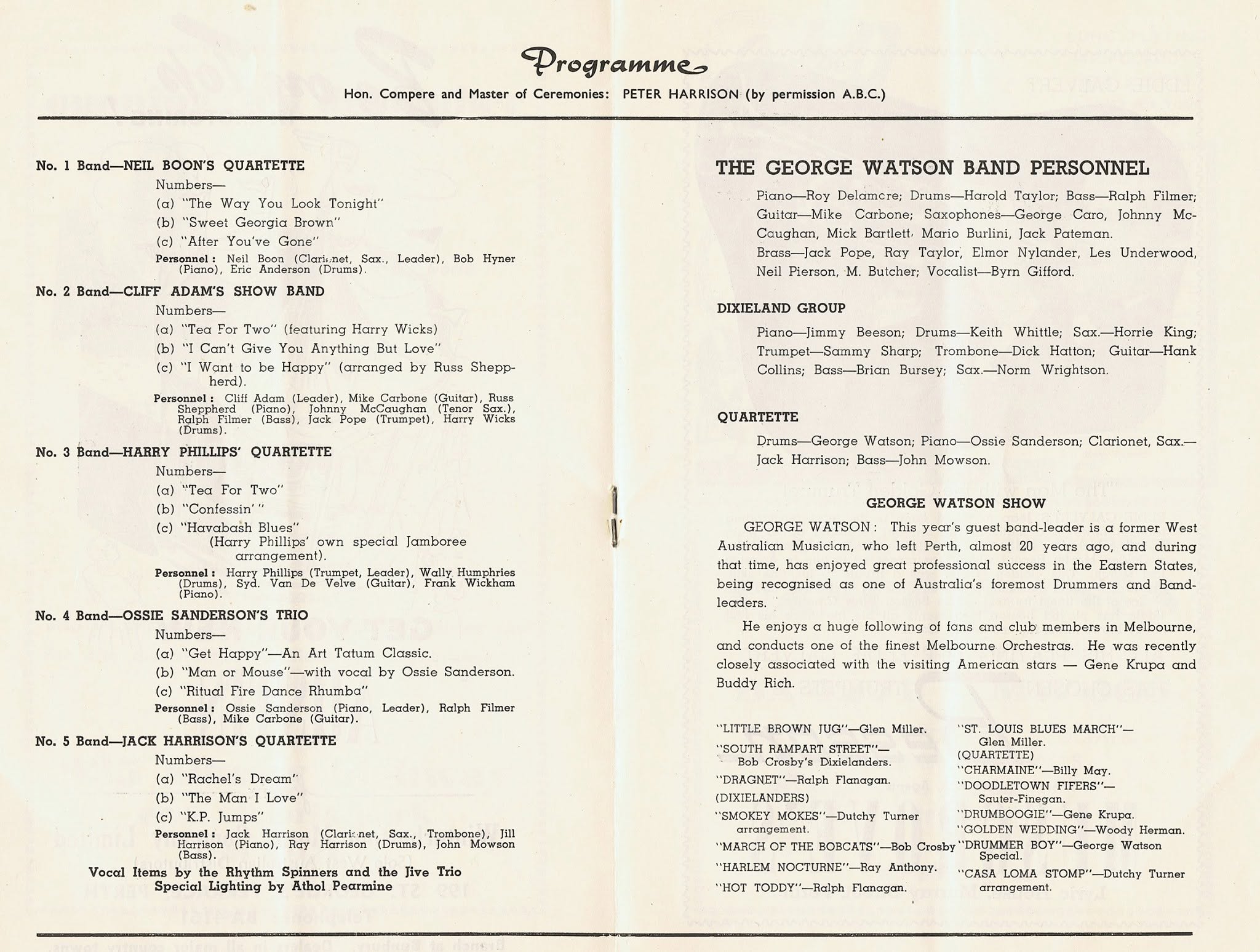
Sunday 7 November 1954 – Jazz Concert – George Watson Show
The Capitol Theatre was packed last night when six local bands and a combined band led by George Watson, a former West Australian, gave a jazz concert. Mr. Watson is regarded in Melbourne as one of Australia’s foremost drummers and bandleaders.
The young audience heard jazz classics played by Neil Boon’s Quartet; Cliff Adam’s Show Band; Harry Phillips’ Quartet; Ossie Sanderson’s Trio; Jack Harrison’s Quartet; and the Dixieland Group.
The West Australian Monday 8 November 1954 page 15
1956
BOON WILL BOOM WITH HIS BOOP-BOOP-A-DOO
One night last week I had the pleasure of working with a young musician who has just arrived here from Perth, and I have no hesitation in naming him as one of the most promising clarinettists in town today. He is 19 year old Neil Boon and his very easy style (which shows a distinct Goodman influence) and excellent tone, had the boys in the Joe Marchesani trio very enthusiastic indeed concerning his future prospects in the music game.
The boy’s playing was full of ideas and his technique is a tribute to the thorough teaching of Alan Rule in Perth. Rule was well known to Melbourne theatre audiences as a member of the Regent orchestra for years and built an excellent reputation here as a teacher, before returning to home in the West. He is a big husky fellow and a fine player himself. Another of his prize pupils who is frequently mentioned when swing musicians are discussing the country’s top clarinet men is Jack Harrison of Perth, whose sister Jill was recently appointed to the Melbourne Symphony Orchestra in the bassoon chair.
The Argus Melbourne Saturday March 31 1956
From Neil Boon’s memoires (after 1954):
Although Allan Rule was quite impressed when he heard about the success of my jazz quartet, he was rather concerned that I could be using too much vibrato. This would affect my suitability for orchestral work. I became very aware of the “non-vibrato” clarinet tone for the classics and worked hard to change this unwanted jazz influence.
In quick succession I had three sessions with the Symphony Orchestra when Jack Harrison was otherwise occupied. When I needed an A clarinet e.g. for Beethoven’s seventh, Allan lent me one of his, like he had done for the Mahler first (1966?). In fact, I was allowed to use this instrument for some time until I could buy my own A.
1971
Neil Boon joined the clarinet section of the West Australian Symphony Orchestra while Jack Harrison was away on a Churchill Fellowship.
https://thewest.com.au/entertainment/art/three-jazzy-decades-ng-ya-301838
1980
April 21 1980 – Octagon Performance
A performance of Sir William Walton’s “Façade Suite” will be given by the Music Society at the Octagon theatre tomorrow night. The brilliantly witty work with Neville Teede reading the nonsense verse of Edith Sitwell, will be accompanied by the Wigmore Ensemble conducted by Graham wood. Those taking part in the ensemble will be Jill Wright (flute), Jack Harrison (clarinet), Neil Boon (saxophone), Kevin Johnston (trumpet), Jill Cole and Sally Talbit (cellos) and Paul Sarcich (percussion). Members of the group will also play the Pastorales de Noel by Andre Jolivet the French composer and musical director of the Caomedie Francaise, the flute, violin and harp trio of Eugene Goosens and Igor Stravinsky’s “Epitaphium” for flute, clarinet and harp.
The Sunday Times April 20 1980