Studio portrait of Bill Harrison’s Orchestra — a cornerstone of Western Australia’s early dance-band era.
Bill Harrison’s Orchestra
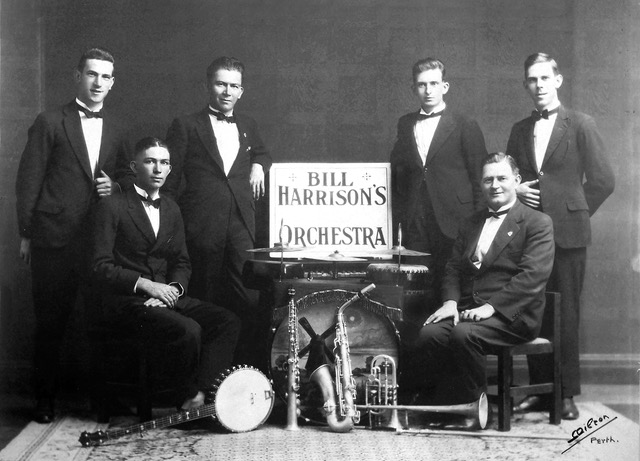
Studio portrait of Bill Harrison’s Orchestra — a cornerstone of Western Australia’s early dance-band era.
Person
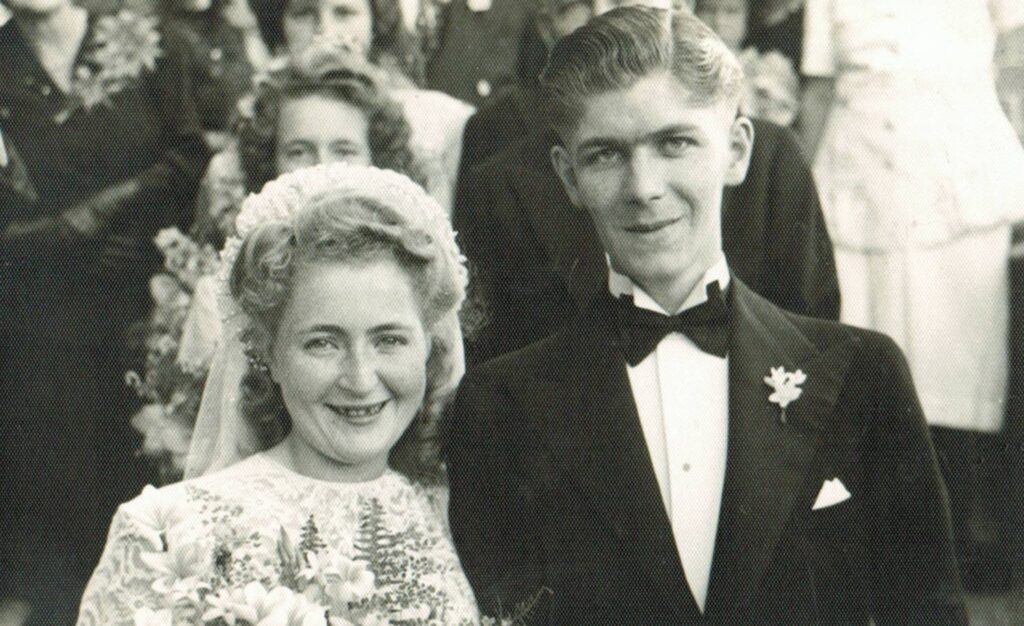
HARRISON, William Arthur was Jack Harrison‘s oldest brother – “Bill” Jnr.
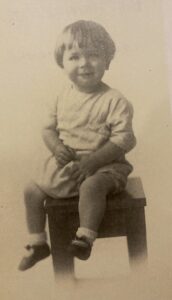
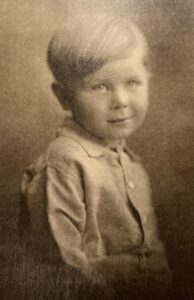
On 13th February 1926 in Subiaco, William Edward Harrison and Edna welcomed their first child, son William Arthur Harrison, who was the first grandchild of Phoebe and Arthur Harrison.
At the time, the Harrison family was living at 64 Bruce Street, Nedlands.
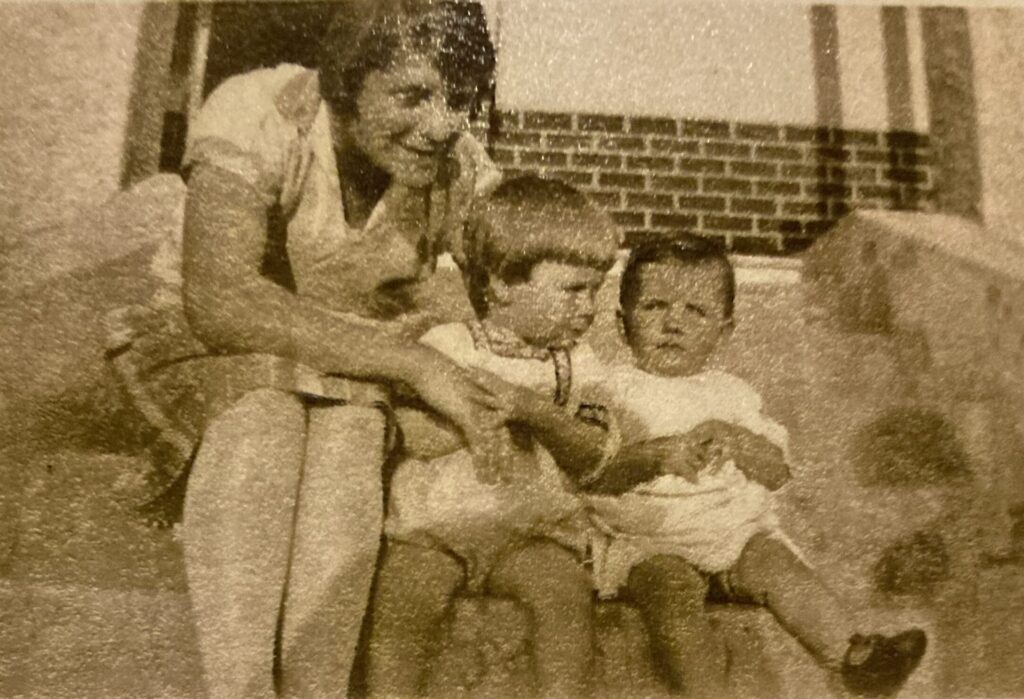
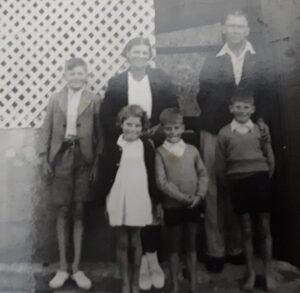
In 1929 his brother Ramon was born, followed in 1931 by his twin siblings Jack and Jill.
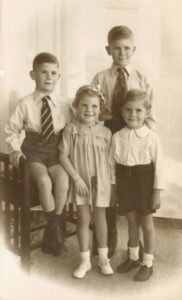
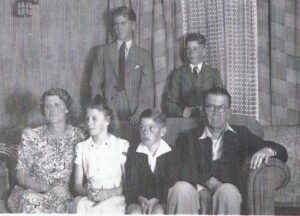
In 1932 Bill Jnr attended Nedlands State Primary School and then Scotch College in 1938.
Meantime, in 1935, the family moved to 24 Highway Nedlands.
From the age of 15 in 1941 Bill worked in the administration of steel companies.
 Australia entered World War II on September 3, 1939, immediately following Britain’s declaration of war on Germany. Prime Minister Robert Menzies announced the involvement, prompting a rapid volunteer mobilization for the 2nd Australian Imperial Force (AIF) to support British forces in Europe and the Middle East, while initiating home-front preparations.
Bill’s uncle Charles Harrison enlisted aged 33 in the Royal Australian Airforce in Harvey in August 1940.
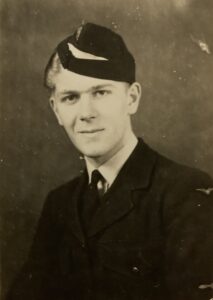
Bill enlisted in the RAAF (#441924) aged 18 in 1944 and was just about to get his wings when the war stopped.
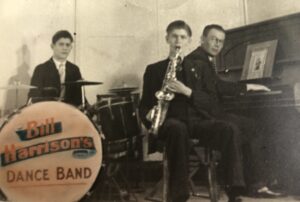
Bill played saxophone in the Harrison family jam sessions with his father and siblings.
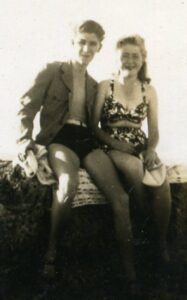
On 19th February 1945 the engagement was announced :
Mr and Mrs Frank Sansom, of 291 Churchill-avenue, Subiaco, have much pleasure in announcing the engagement of their youngest daughter, Mavis, to Bill, eldest son of Mr and Mrs W. E. Harrison, of 24 Highway. Nedlands.
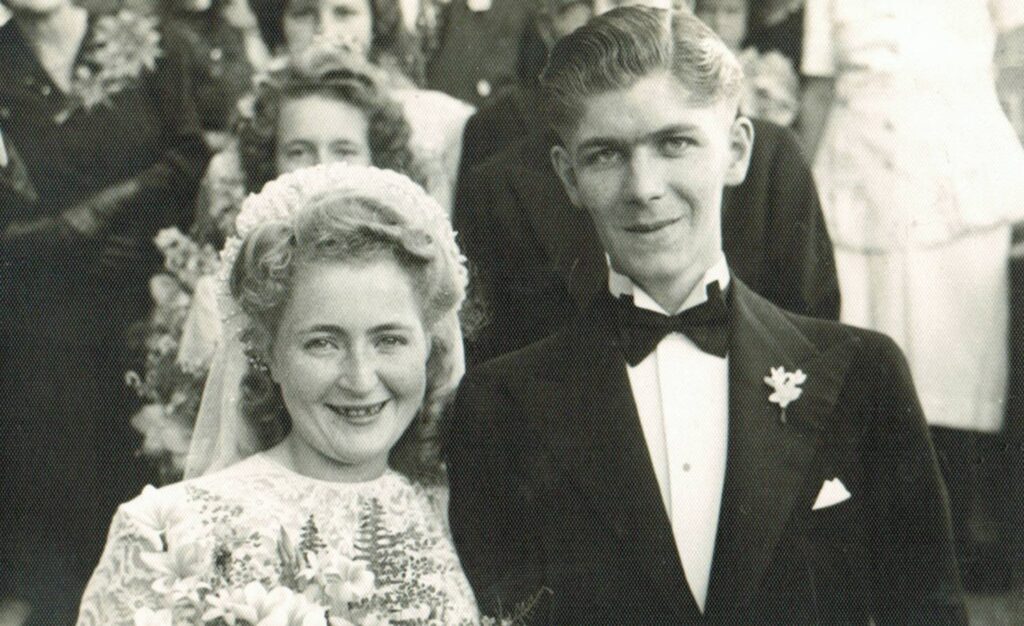
On the 15th February 1947 William Arthur Harrison married Mavis Mary Sansom and Jill Harrison was a bridesmaid. Being just 2 days after Bill Jnr reached the age of 21, the minister asked for Bill Snr’s blessing of the marriage – which he did.
The following year on 16th July 1948 Bill Jnr and Mavis provided Edna and Bill Snr with their first grandchild, Susan Mary.
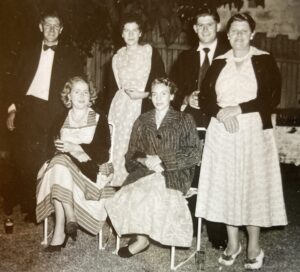
Their first home was in Cooper Street.
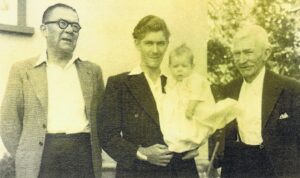
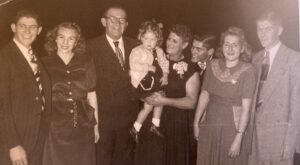
Bill was best man at the wedding of his brother Ramon to Norma Webber 16th December 1950, at 4.30 pm, St George’s Cathedral, Perth.
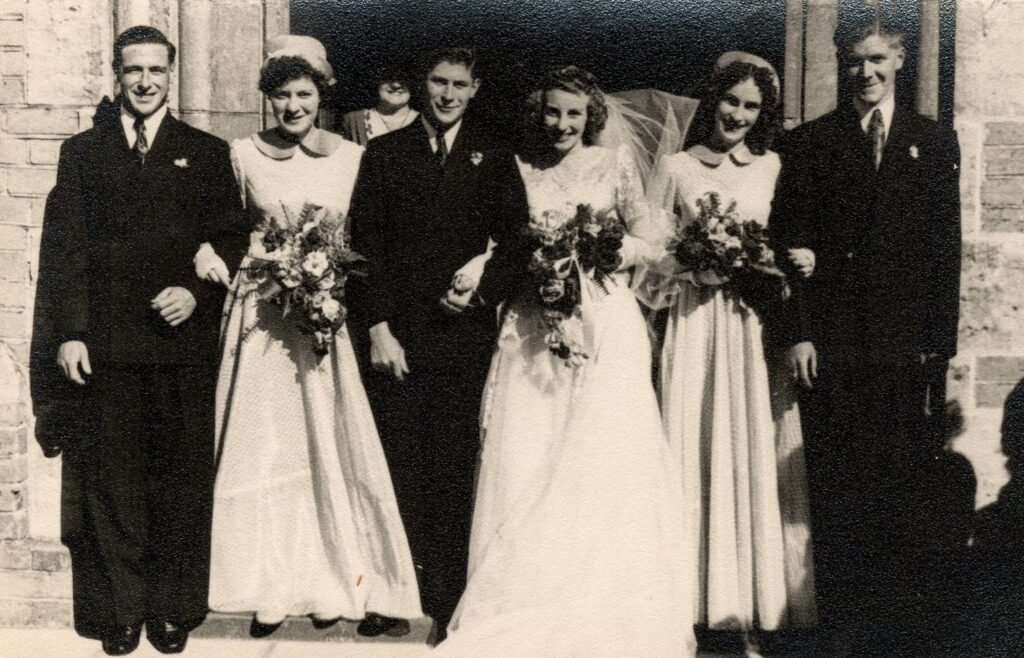
Around 1950, Bill purchased property at 176 Stirling highway on the corner of Rockton Road, Claremont, which consisted of a bank on the corner with vacant land behind on which he built two shops. Bill used one of these shops for his real estate office and offered the other to his brother Ramon to rent. Ray started his own business and had 3 registered business names: U Hire, Stall & Shelter Hire Service and Cottesloe Hire Service. These hires services provided equipment for fetes and fairs and party hire equipment such as coloured lights, trestles and chairs etc. Ray ceased this business on 15th October 1965 after five years.
Mavis and Bill had their second daughter Pauline May on 26th February 1951.
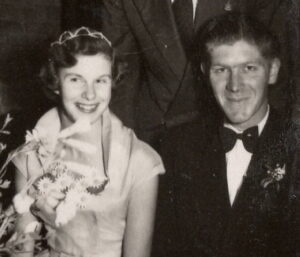
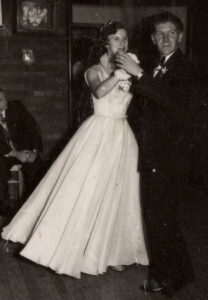
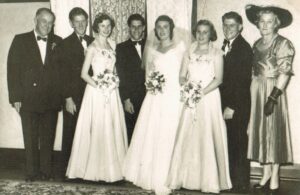
Bill’s youngest brother, Jack married Marcia Chayter on 14th December 1953 and Bill was a groomsman.
Bill and Mavis’s son Trevor William was born on 11th March 1954.
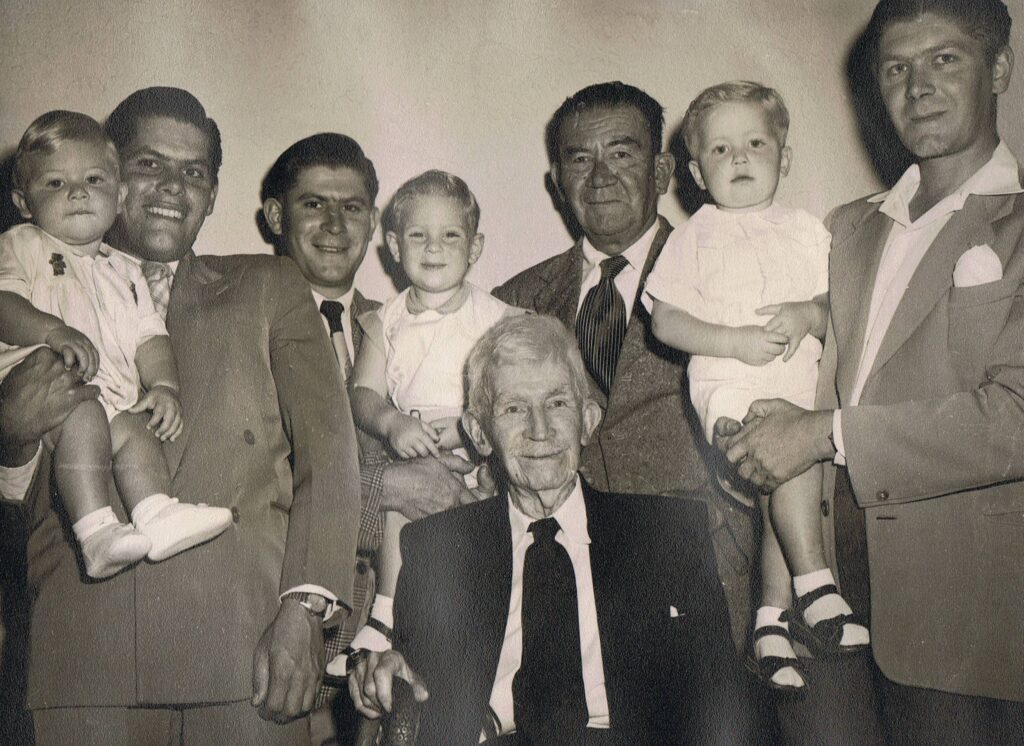
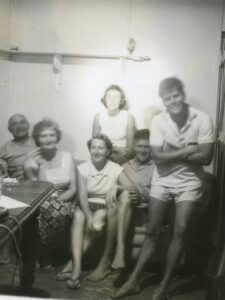
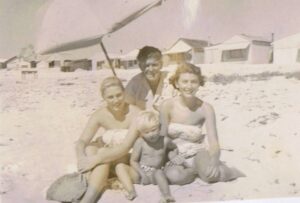
During the 1950’s Bill Jnr and Jack bought a shack at Whitfords beach together which was used for holidays. Julie Harrison remembers the long journey off the main road, (Wanneroo Road) through the sand dunes along the limestone tracks, it seemed to take forever to get to the coast.
Trevor Harrison believes it was approx 10 kms, turned left off Wanneroo Road, then left again into a gate (farmer’s gate) which was padlocked but the Harrison’s had keys. Trevor said that the tracks had old plasterboard sheets laid on them to stop the cars getting bogged, similar to the old switchback roads in City Beach. One thing that sticks Julie’s mind, was the old (antique now) furniture inside the shack, sideboard etc.
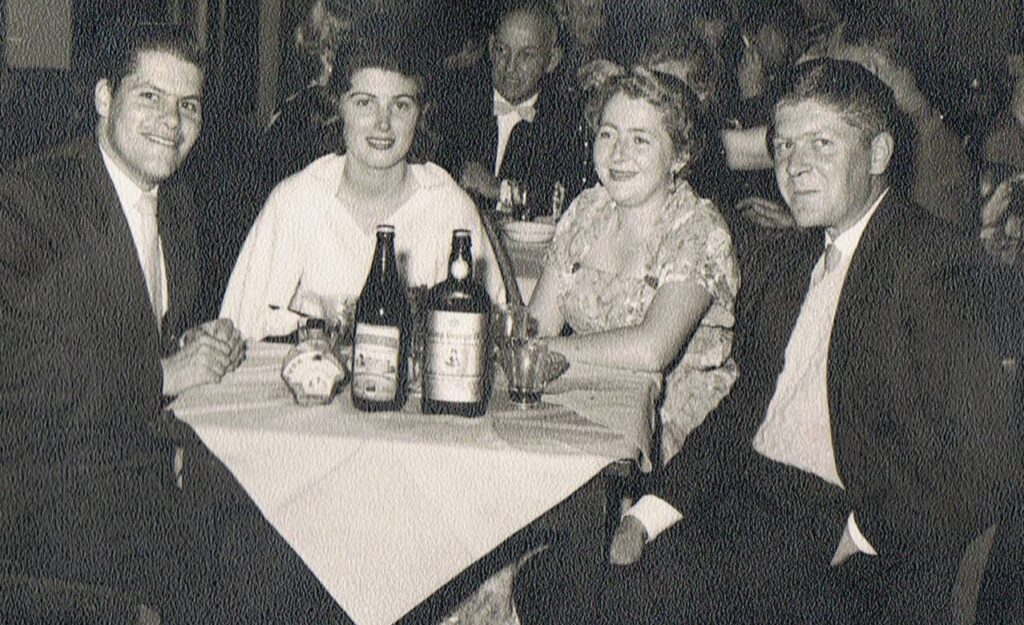
Around 1963, Bill purchased Coolbev Hire in Nicholson road, Subiaco and asked his brother Ramon to work for him, which Ray did for a couple of years. Ray’s job was to deliver the gear and products for hire and sale to functions, such as alcohol, party and catering supplies.
Bill was one of the first people (before Roy Weston) in Perth to franchise real estate, buying up houses and blocks of land and reselling them after development or subdivision.
Some of his investments included:
Rockton Road Claremont
A butchers shop opposite Guildford Chapel which was his real estate office
Land in Kalamunda, Rockingham and Mandurah in the late 1960s.
He bought streets of Mandurah off the map and pre sold them prior to them being titled.
He built a shopping centre with Dixon (Road named after him) and Patterson. It included Tom the Cheap Grocer with 6 boutique shops.
He bought the Boathouse Tavern and renovated it at the same time he owned the Parkerville Tavern.
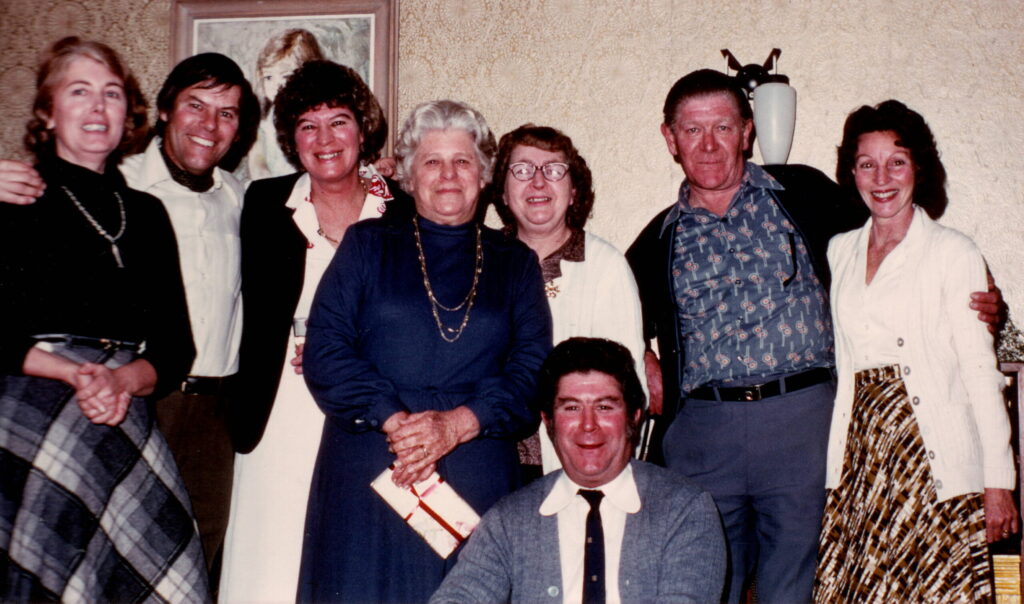
Bill was a life member of the Subiaco Football Club from 1970 and was involved on committees and with fundraising. With manager Basil Fuller, he was involved in booking the first overseas trip by any Australian football team to Singapore. Bill established business links whilst in Singapore. The football team also travelled to the Eastern states, all which required sponsorship as it was in the days when the players paid to play and weren’t even provided with parking.
In his retirement, he and Mavis moved to a property that had been a plant nursery on Gnangara Drive in Wanneroo.
Bill died 8th February 2000 aged 73.
HARRISON (William Arthur) “Bill”
13.2.1926 – 8.2.2000
Love husband of Mavis and father of Susan, Pauline and Trevor. Father-in-law of Kevin and Glenda, respected grandfather of Anthony, Andrew, Todd, Karen, Rebecca and Heath and loved great grandfather of Aaron, Jarrod and Hayley.
A chapter closes.
Rest in peace.
HARRISON (William Arthur)
In memory of my brother Bill who never appreciated his worth. Loved brother of Jack, brother-in-law of Marcia, uncle of Jay, Kim and Jody. In peace at last.
HARRISON (Bill)
Fond memories of happy times. Loving thoughts to Mavis and family. Brother Ray, Norma, Jeff, Julie, Jack and Elaine.
HARRISON (William Arthur)
Loved brother of Jill. Brother-in-law of John, uncle to Penny, Peter and Paul. Rest in Peace, Bill.
HARRISON (William)
In memory of Bill, brother-in-law of Dot and Dan, uncle of Neil. Passed away 8.2.2000.
HARRISON William (Bill)
A Life Member of the Club since 1970, Bill passed away after a long illness. Our sincere sympathy to his family. President, Directors and Players, Subiaco Football Club.
Person
15.1.898 – 2.5.1977
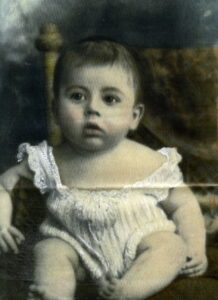 William Edward Harrison was the first child born in Subiaco to Arthur Dight Harrison and Phoebe Alice Parsons.
In 1903 the Harrison family are registered as living in 256 Perth Street (now known as Churchill Avenue) and Arthur’s occupation a carpenter. 256 Perth Street was a weatherboard cottage with sash windows and a picket fence. It had turned timber verandah posts and ornate wooden fretwork. We know that a little later they had a lemon tree, garden with pansies, chickens, a cat and a pet parrot. In 1903 electricity was available in Subiaco.
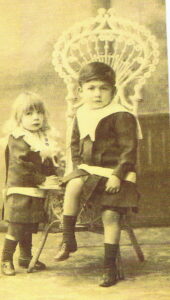
From 1904 aged 6, William Harrison probably attended Subiaco Primary School on Bagot Road which had been opened on 12 May 1897 with 390 children, reflecting the expansion of facilities in Subiaco during the 1890s gold boom. “Schooling…was widely viewed as little more than the introductory phase of an apprenticeship in the world of paid work. For girls, it was seen as a preparation for the unpaid tasks of socialising children and serving the men they would marry. Reading, writing and arithmetic – the fundamental skills deemed necessary to participate in society – were taught, and considerable time was spent reinforcing the key tenets of white Australia’s most precious faiths, learning scripture and repeatedly enouncing loyalty to the British Crown.” “This relative indifference to standards of formal education in the arts and sciences was probably in large part due to the absence of any real opportunity for the vast majority of Western Australia’s children, particularly children of the labouring classes, to undertake secondary or tertiary education.”
Spillman, Ken. Identity Prized: A History of Subiaco.University of Western Australia Press for the City of Subiaco, 1985. page 150-1
Arthur and Phoebe Harrison’s children learnt music, which is an indication of their financial ability to afford lessons, instruments and possibly a piano and also their consideration of music being a worthy subject during a time when education was merely a path to employment.
In July 1907, William wrote to the Daily Newspaper club The Sunshine League:
256 Perth-street, Subiaco.
Dear Uncle Tom, — I intended writing to you last week to ask you to put my name on the Sunshine Roll, but I had a very troubled week with toothache. On Saturday I went and got the tooth pulled out, so I am glad to say I have had a peaceful time since. My little brother Louis and I have a little garden between us; he is only seven, and has not written to you yet, but I wonder is it too late for us to be put on the garden roll? We will both look after our garden, and hope to have some nice flowers by-and-bye. Hoping to find you well, as this leaves us at present, —I remain, your loving nephew, Willie Harrison;- aged-, 9 1/3
Dear Willie,— You are both in plenty of time for taking part in the Sunshine scheme, and I have put your names on the roll. Isn’t toothache an awful pain? I remember when I was a little boy my father used to pull out my troublesome teeth with a small pair of pincers, and people in the next street could hear my yells. Decaying teeth should be either pulled out or stopped. I hope you will have, no further, trouble with-yours, Willie.— Uncle Tom.
The Daily News Saturday 6 July 1907 page 14
October 1907 – 256 Perth-road, Subiaco.
Dear Uncle Tom,— I am sending a few pansies for yourself out of my own Sunshine Patch for a button-hole. I think I will be able to take a bunch of flowers to, the Home of Peace. Our little Charlie is getting on so nicely so good-bye, Uncle Tom. — Your loving nephew, WILLIE HARRISON, aged 9 ¾
Dear Willie.— I was delighted with your lovely and thoughtful present. Your Sunshine Patch, must have come on splendidly, I can see you have been attentive to it. Again I thank you, Willie, and remain your loving Uncle Tom.
The Daily News Saturday 12 October 1907 page 14
In addition to Willie, the names of his sister Nellie and brother Lou Harrison from 256 Perth street, Subiaco first appear in the local newspapers on 19 October, 1907 in letter from the Matron at the Home of Peace in Hamersley Road, Subiaco after the children from the Sunshine League made a visit.
INTERESTING BATCH OF LETTERS BY NIECES AND NEPHEWS OF THE “SUNSHINE LEAGUE”
SECOND CLASS (Over 8 to 12 Years.)
256, Perth-street, Subiaco – Dear Uncle Tom, You hoped I did not smoke cigarettes. No. Mamma tells me about a young man who she knew in Geelong, who died through a growth in his throat caused by cigarette smoking, but I see a good many boys, very little older than myself, smoking cigarettes. I am sorry for all the, sick people at the Home of Peace, but still glad they have a good home and kind nurses. I will now say, good-night, dear Uncle Tom. Your loving nephew, WILLIE HARRISON, aged 10.
Dear Willie, I quite agree with you that cigarette smoking by boys is dangerous to their health. You are quite right when you say that the patients at the Home of Peace are well treated. The matron (Miss Anderson) and the nurses could not be kinder to them. Are you going to Monday’s concert at Kings Hall? Uncle Tom.
The Daily News Friday 1 May 1908 page 7
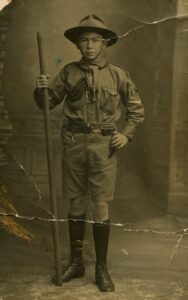
In 1908 at the age of ten William was playing the piano and studied music theory and harmony.
He was a boy scout, as was his brother Arthur “Lou”. The 1st Subiaco Scout Group was founded in 1908 and was initially known as Subiaco Troop 7. The troop was formed by a group of boys of similar ages and interests. The 1st Subiaco Scouts held their meetings in the Subiaco State School.
In 1909 Nellie and her brother Willie continued to write to Uncle Tom and raise money for the Perth Children’s Hospital including selling tickets to events and sending stamps.
PRIZE ESSAY, SUBJECT: ‘MY PETS’
256 Perth Street, Subiaco.
Dear Uncle Tom, I am going to write you an essay on ‘My Pets.’
I have three pets, a cat, a parrot, and a magpie. The cat I call ‘Spot’ because he has, a black spot on his back. He has a long tail and greyish-green eyes. He is a lazy old fellow, and sleeps on a chair by the fire all day. The maggie is black and white, but is not nearly so lazy as Spot. He is worming all day, and often catches big ones. He often chases the fowls, and when they go on the nest to lay he tries to pull them off. He roosts in the lemon tree. Joey is a pretty bird; he has a long, tail and & lot of colours. He has a yellow ring round this neck, and a green and blue breast. He can say ‘Pretty Joey,’ ‘Where are you working?’ ‘Have a- cup of tea,’ and if we are speaking, he says, ‘A?’ and if anyone comes into the yard he screams ‘Mamma!’. He is as good as a watch dog. I will now say good-night, uncle. I remain your loving nephew, WILLIE HARRISON, aged 11 ½
Daily News Saturday 14 August 1909 page 12
2010 PRIZE ESSAY (The Prize is a Book for Boys.)
256 Perth-street, Subiaco. Dear Uncle Tom, — I am writing you an essay on my holidays. During the first week Louis and I went to Crawley fishing, and on, Christmas Eve we went to the Queen’s Hall with two boy friends to see the pictures, and thought they were good. On Christmas Day we did not go out as Louis had a bad toothache, and on Boxing Day we did not go put either, but my father took Louis to get his tooth out. On Monday we made an: early start to Nedlands Park. We had a good day, but when we got home we were tired. On Wednesday we went to the Orphans’ Christmas picnic, and although I had a headache, I was pleased to see the orphans, enjoy themselves. On New Year’s Eve we all stayed up to see the New Year. in. Several times this week I went to Crawley. I went on Saturday, and caught eighteen whiting and a flathead. Louis and Nellie went to Stathams on Saturday for a week. When they come home I am going up to stay for some months. I hope you have had an enjoyable Christmas and will have a bright New Year. I remain your loving nephew, Willie HARRISON, aged 11.
The Daily News Saturday 15 January 1910 page 10
256 Perth-street, Subiaco. Dear Uncle Tom, — I am going to write you an essay on ‘How I spent my Holidays.’ The first week Willie and I went out fishing, and we caught a good many fish and crabs. I went to the little orphans’ picnic, and was glad to see them enjoy themselves. I went up to Statham’s Siding with Nellie, and came home last Friday. Now Nellie is ill with measles. Good-bye now, dear uncle.— I am, your loving little nephew, LOUIS HARRISON, aged 9.
Dear Louis,— I was sorry to hear of Nellie’s bad fortune in getting the measles. Tell her to avoid draughts and chills, and she will soon be all right again. Your handwriting is improving. If I were you I would write a page in an exercise-book every night, and you would soon be a very good penman.— Uncle Tom.
Daily News Saturday 22 January 1910 page 10
William was still involved with 7th Scout troop from Subiaco:
1910 – BOY SCOUTS On Saturday next, the 58th and 24th troops will attack the 4th and 7th troops, who will take up their position around the limekilns at Subiaco. The attackers will be under Scoutmasters Gill, Everett, and Phillips, and Deputy Scoutmasters Day, Asplin, and Ambler, and the defenders under Scoutmasters Harrison and Bennett, with their respective deputies.
The West Australian Friday 8 July 1910 page 7
1911 THE BOY SCOUTS – TROOP NOTES
Several metropolitan troops were in camp during the recent holidays.
Troop 7 (Subiaco) had a successful camp adjacent to the Old- Men’s Home. About 30 boys, accompanied: by S.M. Bennett and D.S.M. Standley, attended on Saturday evening. An impromptu ‘camp fire’ entertainment- was given before the residents of the home in the dining-hall. It so greatly pleased them that they are asking for an early repetition. The violin solos by P. L. Chiswell and recitations by Scout Priestly were, ‘excellently rendered.’, The little daughters of the Superintendent (Mr Rust) also assisted and were heartily received by the old men and the Scouts. Mr Rust was extremely kind to the boys. A splendid supper at his house concluded the entertainment on Saturday, and in case of wet weather during the night he allowed the boys to camp on the stage in the hall. On Sunday, he delighted them by asking for a detail of four boys to carry down to the camp a large can of soup and two enormous plum puddings, which were appreciated. The troop attended Church Service in the morning. The singing by the men was particularly good, and the sermon on ‘Zeal’ was one that should appeal to all true Scouts. The usual Scout exercises and swimming occupied the boys’ time. The winners of the recent map-drawing competition were P.L. Teede and Harrison.
Daily News Friday 27 October 1911 page 8
BOY SCOUTS. At a competition held at Mosman’s Bay on Saturday last under the direction of Sergt. Smith (Royal Humane Society) the following scouts of the 7th troop (Subiaco) passed their swimming test:-P. L. Chiswell, Harrison, and Downy.
The West Australian Tuesday 21 November 1911 page 4
In 1912 at the age of 14, William was studying Signwriting and Decorating at Perth Technical School.
1912 TECHNICAL SCHOOLS AND SCHOOL OF MINES – ANNUAL EXAMINATIONS. FIRST LIST OF RESULTS.
Appended are the results of the greater portion of the annual examinations in connection with the Technical Schools of Western Australia: Signwriting and Decorating. W. Harrison, (Perth Technical School).
West Australian (Perth, WA : 1879 – 1954), Monday 8 January 1912, page 3
TECHNICAL SCHOOLS. ANNUAL EXAMINATIONS.
Signwriting and Decorating: second class. Practice-only: W. Harrison.
West Australian (Perth, WA : 1879 – 1954), Tuesday 31 December 1912, page 4
In 1912 at the age of 14, William was an army cadet with the Subiaco 87B battalion and was a member of their brass band.
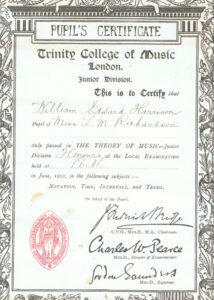
In June 1912 William Harrison attained a Trinity College of London Junior Division. Honours in Theory of Music. Subjects: Notation, Time, Intervals & Terms. Teacher: Miss L. M. Richardson.
TRINITY COLLEGE OF MUSIC LONDON. JUNE THEORY EXAMINATION.
The following results have been received of the June theory examination of the Trinity College of Music. London: Junior Division (Honours).
Thomas Gray, H. Henry, G. Henry, John Magee, H. E. Tracey, W. Willis (St. Joseph’s Convent, Fremantle), R. E. Smith, V. M. Austin, G. F. Bignell, M. J. Bourke, L. A. Coyne, A. Delaney, F. Henry, J. S. Hennessy, K. M. Kindelan. F. Sheridan (Sisters of Mercy, Victoria-square), V. M. Collopy. A. K. Doheny, J. L. Tarrant, L. M. K. Gawthorne, E. Harris, H. G Lapsley, N. Millard, E. C. Taylor (Sacred Heart Convent), Perth, J. Hambley, M. T. Mitchell, E. M. Pass (St. Brigid’s Convent, W.Perth), B. M. Connolly (Our Lady’s Convent School, Leederville), M. E. Jolley (Sisters of Mercy Midland Junction), K. O’Rielly, V. McGavin (St. Joachim’s Convent, Victoria Park), A. I. Little (Miss E. Randell L.T.C.L., organ) L. Ross (Miss E. Newman), W. E. Harrison (Miss L. M. Richardson), F. M. Newman, N. Newton (School of Music, Miss Taplin), E. M. Pumphrey (Miss A. Butler). N. W. Watson (Miss N. E. Watson), N. Hetherington (Miss Belle Young), N. B. Barnett, J. C. Barnett, E. N. Dunstan, D. A. Gordon, N. Turnock, E. F. Wilson (Ormiston College. Miss Wilson), G. A. Jones E. Starr (Miss Selby, A.T.C.L.), E. A. Brown. E. A. Hogben. A. E. Mainstone (Miss H. Errington, A.T.C.L.), J. O. Saunders (Mrs. Partridge), I. Fraser (Miss Cochrane), I. E. Christensen (School of Music, Mr. R. Jackson), I V. Tompson (Mrs. R. B. G. Dudley, L.A.B.), V. McNeilance Prowse (Miss R. C Meugens, A.T.C.L.), H. T. Boxall (Miss Davis), N. E. Turnbull, F. M. Burke (Miss A. Colgan, A.T.C.L.), 0. R. Luber (Miss F. Luber, L.T.C.L.), O. M. Ainslie, D. M. C. Andrews, V. E. G. Jose. R. M. Smith, C. M. Wilcox, N. L. Wilson (Girls’ High School, Miss Pornell).
The West Australian Monday 2 September 1912 page 8
William Harrison’s music teacher was Louisa Mary Richardson, the daughter of Professor of Music, John Sherwin Richardson, who resided at Coghlan Road Subiaco. Louisa was a foundation member of the Western Australian Music Teachers’ Association (WAMTA) was established in 1910 to standardise and vet local teaching qualifications.
Under the Commonwealth Defence Act (effective from 1911), male youths aged 14 to 18 were required to train as Senior Cadets. In 1912, at the age of 14, William Harrison was an army cadet with the 87B battalion under Captain Morgan.
March of Senior Cadets.
The metropolitan battalions of senior cadets belonging to the 22nd brigade will parade for the first time as a brigade to-night and march through the principal streets of the city. The brigade comprises the 86th, 87th, 88th and 89th battalions. and should there be a good muster, as is anticipated, over 2,000 young soldiers will take part in the march. The brigade is timed to leave the Drill Hall in Francis-street, at half-past 8 o’clock, and will be accompanied by the bands of the 86th and 88th Infantry.
The West Australian Thursday 24 October 1912 page 6
CADET ‘ COMPETITIONS. AN INTERESTING DISPLAY. THE SUCCESS OF AREA 87B.
It was a happy inspiration on the part of the officers of the 22nd brigade of senior cadets to hold military sports and athletic competitions for the young soldiers, and all concerned in the carrying out of the first annual gathering on the W.A. Cricket Association’s Ground on Saturday are to be congratulated upon the very successful result of their labours. The attendance of the general public was disappointing, but the cadets were present in large force, and those participating in the events were remarkably keen. His Excellency the Governor (Sir Gerald Strickland), attended by Major Wilkinson, A.D.C., arrived on the ground at half-past 2 o clock, and was received by a guard of honour from D Company 87th Battalion (Perth Modern School) and the Bunbury boys. The District Commandant (Colonel Irving) and his staff officers were present throughout the whole of the day, Colonel Irving acting as umpire-in-chief, and the other officers as umpires. A large number of militia officers attended and took great interest in the proceedings. The officers forming the committee of management worked indefatigably on the ground, and for some time previously in perfecting the arrangements. Particularly to the president (Lieutenant Jackson), the vice-president (Captain Annear), and the hon. Secretary (Lieutenant Williams), is a large share of the measure of success due. All of the events were carried out with military punctuality. It must have been very gratifying to all present to see such a fine body of the youth of Western Australia as was formed by the senior cadets of the 22nd Brigade. Sturdy, well set up, and clean, they provide an object-lesson of what can be done by a system of training such as that laid down by the military authorities. The officers, and more particularly the area officers, were justified in viewing the young soldiers with feelings of pride, and these feelings can also be participated in by those unconnected with the movement. The boys contested the various events as only keen healthy boys can, and both victor and vanquished took their honours and defeats like sportsmen, there were no complaints, and no recriminations. One accident occurred, Sergeant Heagney, of 86B, straining himself during the 100yds, race. He was removed in an ambulance to his home at Victoria Park, where he is progressing favourably towards recovery. Sergeant Heagney’s accident was the more regrettable as he was the commander of the section which competed for the best-turned-out section. A substitute had to be impressed at the last moment, and the section secured second place. In recognition of the section coming second in adverse circumstances, the residents of Victoria Park have decided to present silver medals to the members of the team. An interesting feature of the day’s programme was the presentation by Sir Gerald Strickland of the Countess of Dudley’s banners and the Adelaide Tailoring Company’s shield to D Company of the 87th Battalion for the best company in the State, and the medal given by the Australian Natives’ Association for being the best rifle shot in the senior cadets for the year 1911-12, to Cadet Tilley. The banners were received by Lieutenants Kirkpatrick and Brine, and His Excellency warmly congratulated the company upon the proud position it had won. The Imperial service medal was also handed to Mr. Varley, formerly an officer of the Imperial Prisons Department, by Sir Gerald Strickland.
It was unfortunate that the Bunbury boys, who had on the previous evening completed a trek from Bunbury, could not participate in the military events. Their uniforms bore traces of the week’s march and consequently they could not enter for the best-turned-out cadet, in which competition cleanliness of uniform and equipment was a determining factor, and as the boys forming the detachment were drawn from various portions of the area, they could not compete for the prizes offered for the best permanent section. However, they were very successful in the athletic events, winning all in which they took part. Lieutenant O’Donnell’s young soldiers sturdy and bronzed, naturally came in for a good share of attention on the part of the public, the universal opinion being that they form a body the command of whom any officer would be proud to have.
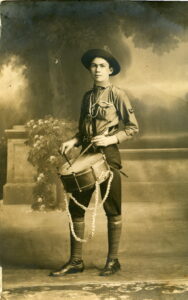
To 87B (Subiaco-Leederville) belong the proud privilege of being the most successful area as far as the military competitions are concerned. This honour carries with it the possession of a complete bugle band, consisting of a base drum, two side drums., and eight bugles, valued at £25, which was presented by Messrs. Dobbie and Co. Colonel Irving warmly congratulated the officer and boys of the winning area on the fine performance put up.
The West Australian Monday 9 December 1912 page 7
87B (Subiaco-Leederville) Senior Cadets bugle band equipment presented to them by Messrs. Dobbie and Co. following their victory in regional military training competitions. Because they were named the “most successful area,” they were awarded a premium musical setup consisting of a bass drum, two side drums, and eight bugles.
In June 1914 William Harrison, aged 16, was witness to a distressing scene at his neighbour’s residence:
A SUBIACO CASE.
Archibald Ogilvie, an elderly man, appeared in the City Court yesterday charged with having, at Subiaco on April 19, attempted to kill himself. William Edward Harrison, residing at 256 Perth-street, Subiaco, next to accused’s premises said that on the evening of April 19 accused’s son called him. He found Ogilvie lying on his verandah with two gashes in his throat. Wesley Ogilvie, accused’s young son, said that he and his father were going that evening to Mr. Don. Chipper’s premises to view the body of Ogilvie’s wife, who had died two days previously. Accused went to the outhouse at the end of the yard, and witness waited for him. When he came out, he said he was not feeling well; he stumbled on to the verandah, and then fell down. Witness noticed a bloodstained handkerchief round his neck. Dr. Gill arrived a little later, and Ogilvie was removed to the hospital. There was a large quantity of blood on the floor of the outhouse. P. C. Machin deposed to having found a razor in the outhouse. Ogilvie, who said he had no recollection of the affair was committed for trial.
The West Australian Thursday 25 June 1914 page 8
ALLEGED ATTEMPTED SUICIDE – Archibald Ogilvie; Charged. Committed for Trial.
A pathetic little story was told the Perth Police Court on Wednesday when Archibald Ogilvie, an elderly man, was charged with having attempted to kill himself on April 29th last. Ogilvie still looks very weak and pale. The fact that he was detained in the hospital for two months is enough to indicate that he had a fairly close call. Sergeant Smythe conducted the police-case and Ogilvie was undefended. Being deaf, he was allowed to stand near the witness box so he could hear what was said concerning him. Dr. Gill led off by stating he was called to attend to Ogilvie about 7.10p.m. on the night of Saturday April
Nineteenth at his residence in Perth Street. He found the man had three gashes in his throat and some injuries on his wrist. Ogilvie, who had lost a very large quantity of blood was moved to the hospital right away. The to have appear to have been CAUSED BY A RAZOR which was produced, for the doctor’s inspection.
William Edward Harrison, a next door neighbour, said he was called to Ogilvie’s house at ab out 7 p.m. He found him lying on the verandah, in a semiconscious state, with wounds on his throat.
Wesley Ogilvie, the seventeen year old son of the accused, who is small for his age, was next called to give evidence. He found it a trying ordeal, and the whole circumstances were very sad. On Sunday evening April 19th, he said has father went to an outhouse. About seven o’clock the lad went to tell him they would miss their train for the city. His father replied he would be coming in a minute. The boy noticed something wet on the floor, but did not know until later that it was his father’s blood. He went first to the front gate and then went inside. While he was there his father came along and stumbled on to the verandah. The boy asked him what was the matter and Ogilvie said he did not feel too well. Wesley went to see what was the matter, and found his father lying on the floor. When he saw what had happened he called Harrison from next door. “Where were you going that night?” asked Sergeant Smythe “I think this will explain a good deal, your Worship,” added the Sergeant to the P.M. “We were going to ” Mr. Chipper’s, the undertaker’s,” replied the lad. What, for?—”To see my mother, who was lying there dead” he answered, crying softly.
“That is the explanation of Ogilvie’s conduct, I, think,” said the Sergeant to Mr. Roe, “‘the defendant had just been unfortunate enough TO LOSE HIS WIFE. Evidence was also given by a constable who said Ogilvie was unconscious when he saw him. He also handed in a blood-stained razor which he had found in the outhouse. Mr. Roe asked Ogilvie if he wanted to say anything. He replied that he had no recollection whatever of what had taken place. “Is that all you wish to say?” “That is all I can say.” Ogilvie was then committed for trial and was allowed out on bail upon him promising not to do anything further of a foolish nature.
Truth Saturday 27 June 1914 page 4
[Archibald Ogilvie died 21st August 1921. His wife Lena died 17th April 1914. Wesley Ogilvie, enlisted in the A.I.F on 29th April 1916. Wesley died in 1974]
WORLD WAR II
Western Australia, as part of the Commonwealth of Australia, was officially committed to World War I on August 4, 1914.
Arthur Dight Harrison was aged 43 and his oldest son William aged 16.When Britain declared war on Germany at 11 p.m. on 4 August 1914 (London time), all dominions of the British Empire, including Australia, were automatically at war. The official enlistment age for the Australian Imperial Force (AIF) was generally 18 to 45 years. While volunteers could join at 18 with parental consent, the standard minimum age was often 21, and some younger men falsified their age to fight. Initial 1914 requirements were stricter, but upper age limits were raised to 45 by 1915. A total of 32,231 individuals from Western Australia enlisted, representing 37.5% of males aged 18 to 44.
1914 SCOUT TROOP REPORT – No. 7 (Subiaco)
A few boys camped at Blackboy Hill from Saturday till Sunday last, when a most enjoyable and instructive time was spent. Sergt. Major Shepherd, of the Engineers (who worked by Sir Robert Baden-Powell in South Africa), took great interest in the boys, and was kind enough to give them a lecture on methods of defence, explaining to them the details regarding the entrenchments that have been constructed by the troops in camp, and the utility of -barbed-wire entanglements as a means of obstruction to an invading force. He also showed them how and where mines were laid, and explained the nature of the explosives. The boys proved to be excellent listeners, and the sergeant-major’s kindness was much appreciated. The artillery lines were also visited, and Lieut. Leschen very kindly explained and demonstrated, the mechanism of the 18-pounder guns. The Scouts took full advantage of the opportunity to ask questions, to all of which Lieut. Leschen gave explicit replies, so that the boys absorbed a large amount of useful information. On Thursday last Scouts Sharp and Priestly were passed by Mr. Instructor Haigh for the ambulance badge. Leaders Medlin, Standley, and Harrison were re-examined and well proved their title to the badge.
The Daily News Saturday 26 September 1914 page 8
In June 1915, aged 17, William attained Australia Trinity College of London: Honours in Intermediate Theory of Music. Subjects: Transposition, Terms, Intervals, Figured Bass, Harmony, Analysis & Modulation. Teacher: Mr W.H. Coupland.
William Henry Coupland (1860–1931), a highly influential figure in Western Australia’s early classical music scene who served as President of the West Australian Music Teachers’ Association (WAMTA) in 1913. He was a close colleague of A.J. Leckie and Louisa Mary Richardson’s father, Sherwin Richardson, both of whom rotated the early presidency duties of the association.
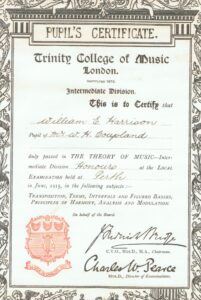
1915 TRINITY COLLEGE OF MUSIC LONDON. THEORY RESULTS.
Mr. W. H. Coupland, the local secretary of the Perth centre, has supplied the following list of passes and awards in connection with the theory examination held on June 19 last: Higher Local Division (Honours):–W. Pitchford (Sacred Heart Convent). Higher Local Division (Pass).-E. Hoare, L. Moylan, M. Kayser (Sisters of Mercy, Victoria Square). Senior Division (Honours). I. L. Hall (A. J. Leckie, Mus. Bac.), D. M. R. Canute (Miss G Du Rieu, A.M.L.C.M.), A. S. Groom (Miss Belle Young), E. Herrington, F. Henry, D. Carrington (Sisters of Mercy, Victoria Square), M. M. Brady, K. M. Cartright. I. Christensen, B. Kavanagh, H. E. Tracey (St. Joseph’s Convent Fremantle), T. Cohen (Sacred Heart College, Fremantle). Senior Division (Pass).-W. Fox (R. J.Baestian), E. E. Carter (Miss Davis), A. Cullen, K. M. Fanning, A. Grady, M. Grimes, A. Massam, N. O’Connell, D. T. Ratazzi, E. M. Stewart (St. Joseph’s Convent, Fremantle), M. P. Bennett I. M. Garland, R. P. M. Moore, M. Seymour (Sacred Heart Convent.). Advanced Intermediate Division (Honours).-C. E. Camper (Mrs. H. E. Camper), E. W. Willis (Mrs. Curthoys), B. Wyard, R. M. Ferrow (Miss G. Du Rieu, A.M.L.C.M.). Advanced Intermediate Division (Pass). B. Williams (R. J. Bastian), D. H. Munyard, C. E. Munyard (Miss G. Du Rien, A.M.L.C.M.), E. R. Dawson, B. Spiegl (Sacred Heart Convent), D. E. Gillett, P. Jordan (St. Brigid’s Convent), R. E. Bindley, A. E. Willoughby (Convent of Mercy, Midland Junction). Intermediate Division (Honours). W. E. Harrison (Mr. W. H. Coupland), C. Duncan (Miss P. Darlington, A.T.C.L.), E. M. Veal (Miss M. Errington, A.T.C.L), N. A. Huey O. R. Luber, E. J. Luber (Miss F. Luber, L.T.C.L.), J. M. Voigt (Miss Doris Robinson), M. P. Tostevin (Miss C. Seeker, L.T.C.L), Q. D. Stevens (Miss Belle Young), N. Barrett, P. Mugridge, C. Mitchell (Convent of Mercy, Victoria Square), A White, D. M. Sexton, T. McEncroe (Sisters of St. Joseph, Subiaco), W. Doherty (Sacred Heart Convent).
The West Australian Wednesday 29 September 1915 page 9
By 1916, the pressure on the men of Subiaco to enlist was immense, with twice as many West Australians in favour of conscription as were against it as reflected in the 1916 and 1917 referendums. Those who did not enlist were often harassed by the families of those who did with white feathers deposited in letter boxes to indicate cowardice. At recruitment drives, they would sing “We Don’t Want to Lose You, but We Think You Ought to Go” and there was an unwritten consensus that at least one member of a family should enlist. It is estimated that ten percent of Subiaco’s entire population enlisted and therefore absent from the district throughout the war years.
Ken Spillman Identity Prized; A History of Subiaco (1985) page 203
Many Senior Cadets or those turning 18 began enlisting. One of them was William Edward Harrison.
William was a proficient pianist and trumpeter and employed as a clerk with the government at his time of enlistment into the Australian Imperial Forces aged 18 on 17th July 1916. He was assigned to the 10th Light Horse 18/28th. Number 3237, a bugler and a trumpeter, listed himself as a civil servant and Presbyterian. His next of kin was father Arthur Dight Harrison, 256 Perth St, Subiaco. He was serving with 87B Senior cadets (joined 1912).
THE 26/10th LIGHT HORSE.
(By Trumpeter W. Harrison, of Subiaco.)
There’s Sergt. McWaters from W.A.,
A dinkum soldier I’ve heard them say:
He’s a good looking fellow when he’s awake,
But his ginger moustache, well, that takes the cake.
There’s Corporal Bob Fernie from gay Armadale.
He’s as sorry as hell for the day he set sail;
But he’s a decent fellow if there ever was one,
And when the guns go he’ll be well in the fun.
There’s Corporal Robinson, the man with the feet:
He once was a merchant in Wellington Street;
But Robbie’s got brains, this no man can dispute,
Although he’s a thin, lanky, long legged coot.
There’s old Jack O’Donough and little Bill Hankey,
And Ginger Bert Wallace, about twice as lanky;
There’s Gabriel Morrell and his cobber McQueen;
They’re all from the country and a little bit green.
There’s Harold McKnight and his cobber Val Browne,
They’re not country bumpkins; they came from the town.
They joined the Light Horse to join in the strife,
And they both pushed a pen in civilian life.
There’s silly Stan Smith and old Billy Whitton:
They’re in charge of the taps and they won’t be spit on.
They’re a bit out of place, for they both prefer beer,
And when the guns go they’ll be well in the air.
There’s fat Harry Gill, the troop’s hungry man;
He’s very well named, for he eats all he can.
He’s first to the table, and never late,
And when Gillie’s finished it’s no use to wait.
There’s farmer Dick Fulwood and young Bonnie Waters:
They’re both from the bush and at boxing they’re snorters.
Then can snare an opossum and ride down a ‘roo,
And everyone says they’re hot stuff on stew.
There’s old Tommy Silver and young Billy Higham:
They’re both decent fellows, and honest as I am;
That’s not saying much, but you know what I mean,
For at paying their debts they’re unnaturally keen.
There’s mess orderlies Wilson and big Charlie Collard:
They’re kings of the butter and bread made of pollard.
They’re last on parade and first into bed,
So you see they’re hard workers; I think nuff’s said.
There’s Clark, Melbourne, Parnell, Bott and young Gordon White:
They left W.A. to come out and fight;
To fight did I say, well, I made a mistake,
For they’re going to Egypt the fun to partake.
Well, that about all, I’ve no memory for names,
For all I can think of are Horton and James;
And they’re both good fellows, of that there’s no doubt,
For when a chap’s stony they always will shout.
Camp Chronical Midland Junction Thursday 24 May 1917 page 8
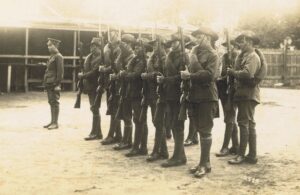
William wrote a diary whilst in the A.I.F. and it dates from 17.7.1916 until 4.7.1919.
Once stationed at Blackboy Hill, William immediately requested a transfer to be a bugler with Signal Squadron.
He wrote consistently to his parents and siblings from his enlistment in 1916:
Mother: PHOEBE ALICE PARSONS (b. 1871 aged 45)
Father: ARTHUR DIGHT HARRISON (b. 1871 aged 45)
Lew: ARTHUR LOUIS (b. 30.3.1900 aged 16)
Nell: NELLIE FRANCES (b. 25.9.1901 aged 15)
Charlie: CHARLES GEORGE (b. 20.8.1907 aged 9)
DIARY EXCERPT:
Thursday 17th August 1916 – BUGLER
Arose at home and journeyed to Claremont. We were duty company this day and I was pioneer. Went home in the evening. I was instructed to parade with the buglers this day and shifted my kit to the bugler’s tent.
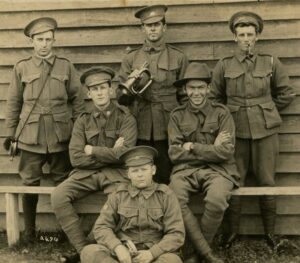
Friday 18th August 1916
Arose at home and went to Claremont. Paraded with buglers and done a bit of practice. Had evening off and went to the pictures with Ern Jenkins.
Saturday 19th August 1916
Arose at home and went to Claremont. Paraded with buglers. Went on duty at 2oc. Played calls as follows:
2pm Salute for Guard
5.30pm Cookhouse
6pm Retreat
6pm Officers’ Mess
7,8,9pm Defaulters
9.30pm First Post
10pm Last Post
10.15pm Lights Out 10.15.
Slept in camp this night. Wrote to F. Blott and L. Storey.
During World War I, Australian Imperial Force (AIF) buglers used standardized British Army bugle calls to regulate the daily routine of soldiers in camp, barracks, and behind the front lines. These loud, valve-less brass signals communicated time and duties before watches were common.
Morning Calls
Daytime Routine and Meals
Evening and Night Calls
Sunday 20th August 2016
Arose in camp at 7oc. Played Reveille 7oc Cookhouse 7.45 ½ hour warning 8.45 1/45 hour warning 9oc Markers 9.05 Advance 9.10 Cookhouse 12.45 Officers’ Mess 1oc Salute for Guard 2oc. It was wet this day. Had afternoon off. Spent evening with Les Dunne.
He remained at Blackboy Hill until he emarked:
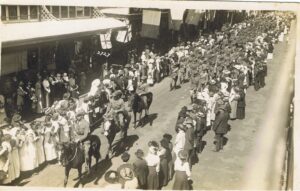
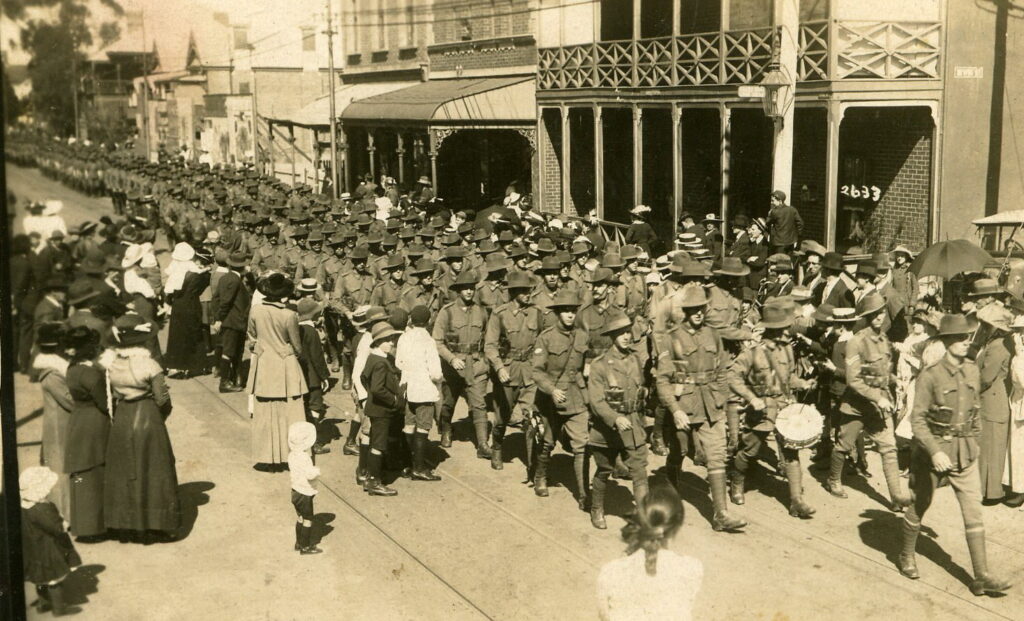
DIARY EXCERPT:
Monday 27th February 1917
Rose shortly after Reveille had breakfast and slipped home for the last time. In the afternoon we were told to be in readiness to go at any minute. We left Claremont at 6.30pm and journeyed to Fremantle where I met Mother and Nellie, Charlie, Belle, Vera, Lorna and Aunt Mattie. We embarked safely and the boat left about 1am the following morning. I slept on deck this night. (February 17, 1917, Australian Imperial Force reinforcements left Sydney aboard the RMS Morea, via Fremantle sailing to Bombay, India.)
Tuesday 28th February 1917 – on board RMS Morea
Woke on deck at 6oc stowed away my hammock completed my toilet and had breakfast. We were out of sight of land and saw shoal of flying fish. I spent most of my time on deck this day. Went to a concert in the evening and slept on deck.
Wednesday 29th February 1917– on board RMS Morea
Rose, washed and had breakfast. I felt a bit squeamish this day though I was not sick. Had boat drill at 10am and spent the afternoon in writing letters to home. Slept in my hammock below deck.
Thursday 1st March 1917– on board RMS Morea
Arose at about 6oc. Washed, shaved and had breakfast. I was ship’s trumpeter this day. My duties started at 8am and finished at the same time the next morning. I had a good look around the ship this day as my duties carried me to the First Saloon and Officers’ Mess. The Governor was down in our quarters this morning and chatted to some of the fellows. I spent considerable time on deck. A big wave washed through the porthole and swept away the tea things. Slept in my hammock.
During World War I, Australian Navy and troopship trumpeters (or buglers) played standardized military bugle calls to structure the daily routine of the crew and troops on board, marking times from wake-up to lights out.
Daily Routine Bugle Calls
Friday 2nd March 1917– on board RMS Morea
I arose at 5.45 played Reveille at 6oc. We had rain during the previous night and consequently the fellows who slept on deck had to retire below. We had boat drill at 10oc. It rained nearly all day so we had to stay below decks. The Governor came to our table and recited some patriotic poetry. The sea was very rough. At 7.30pm we had a church service at which I played the organ. I slept below in my hammock.
DIARY EXCERPT:
Thursday 19th April 1917 – Moascar – APPOINTED TRUMPETER AT DIVISION HEADQUARTERS
Arose at Reveille, dressed, had a wash and went on first parade. After breakfast we went to the range and I qualified in 400 yards stpp (14 out of 20) and the rapid shooting (3 out of 5). There were some bad dust storms this morning. After dinner we went through our field practise. On coming in from the range I had to report to Lieut. Ralston the adjutant (Lieutenant Edward Ralston served as an officer and troop leader connected to the Australian Light Horse). He offered me a job as Division at Headquarters trumpeter which I accepted. I was to report to him at 12oc the next day. Spent evening in Y.M.C.A. Sent postcards to Nell, Belle, Mother, Dad and stamps to Charlie and Lew. Retired at 8.30.
Friday 20th April 1917 – Moascar – DIVISION HEADQUARTERS TRUMPETER
Arose at Reveille and went on first parade. After breakfast we went to the range and went through another course of field practise. Got 5 hits out of 10. When this was over I paraded to the adjutant who put me on duty straight away. I practised in the afternoon, played smoko, mess, markers, advance, retreat, defaulters, first and last posts and lights out. I wrote to Nellie, had tea and went to see Lew. As I was on duty this night I had to stay in the isolation camp but Lewis came with me and had a yarn. I told the Corporal of the Guard to call me and retired. I had a soft bed to sleep on this night and slept well.
Friday 25th May 1917 – WELI SHEIK NURAN – SQUADRON TRUMPETER
Arose at 6oc and went on first parade. During the morning the Major informed me that I was to be the trumpeter of the Squadron and as we were not using trumpets I would help with the orderly room work. I was exempt from all parades. I ran two or three messages during the day and took two despatches to the Div. Headquarters. We had a splendid view of a taube that flew over our lines at tea time. A gun about three hundred yards away fired and done some good shooting. Wrote to Belle (23), Mother, Nell, Charlie, Lew, E. Jenkins and G. Ranford. Meals very good.
Saturday 26th May 1917 – WELI SHEIK NURAN
I got up at my leisure this morning and had nothing to do. We saw two taubes bombarded. Our camp is at Weli Sheik Nuran and is situated on a large plain which extends for miles. There are miles of Turkish trenches which have been evacuated. I took several despatches to Div. HQ. Studied Arabic most of the day. It was a bit hot. General Chauvel passed our camp with his bodyguard. (Chauvel was commander of the Australian and New Zealand Mounted Division and all Australian forces in Egypt. In the 1917 reorganisation of the forces in the Middle East, Chauvel was given command of the Desert Mounted Corps, becoming Australia’s highest ranked soldier.) We were issued with cigarettes and matches. Had my hair cut. There are rumours going that we will be shifting back to Belah. Retired early and the night was very cold.
Saturday 7th July 1917 – TEL EL FARA – ONE YEAR AFTER ENLISTMENT
Attended first parade and turned in till breakfast time. I had three trips to D.H.Q. with despatches. Our food was much of an improvement. Jacko was over. A whirly gig came along and lifted one of my blankets a hundred feet in the air. Wrote to Grandma, Nell (24), Mum (24). Received from Mum and Nell. Stunt coming off tomorrow and Reveille is to be at 4oc.
Sunday 8th July 1917 – TEL EL FARA
Arose at Reveille which was at 4oc on account of A,B,C & D troops going on a stunt. Headquarters (including myself) were left behind. Meals were good and consisted or rice and rabbit. A sceptic developed on my right foot and consequently I could not wear my boot. I borrowed a canvas boot from S.S.M. Had a bath and washed my clothes. This place abounds in water melons and we have our fill of them. Received letter from George Hawker.
Thursday 30th August 1917 – near KHAN UNIS
I attended first parade and as usual turned in till breakfast time. Started work at office a bit early – issued green envelopes. I done real well for tucker today – received an extra tin of fruit. Had a swim. N.Z. band played at D.H.Q. (New Zealand Mounted Rifles Brigade). I met Charlie Kensitt there and had a yarn to him. Plenty of our planes about. We can hear plenty of big guns going tonight. (heavy artillery of the British Egyptian Expeditionary Force bombarding the Ottoman defense lines at Gaza, about 25 kilometres away) Wrote to Mum (44), Nell (44) and Neva.
Friday 31st August 1917 – near KHAN UNIS
Routine same as usual. “Tin Dog” and fruit for dinner. Had a swim. I was not feeling myself today. Wrote to Belle (39) and Tim Graham. We were issued with tablets for purifying our drinking water. (helped prevent dysentery, cholera and typhoid.)
Saturday 1st September 1917 – near KHAN UNIS
Nothing much doing today. Put in leave to visit the 10th but was turned down. We have a new Corporal in H.Q. troop. Wrote a letter to Charlie Dickson. Had a swim.
Sunday 2nd September 1917 – KHAN UNIS
ANZAC MOUNTED DIVISION BAND CREATED – CONDUCTOR: John CROSBY-BROWNE
Lieutenant John Crosby-Browne of the 5th Light Horse had previously served as a military band conductor in the British Army. Recovering from malaria, he was approached by Lieutenant Colonel John Arnott, commanding officer of the 7th Light Horse Regiment, and asked to form a band to entertain and raise the morale of the troops.
Tuesday 4th September 1917 – near KHAN UNIS
Rifle inspection is now on first parade so I turned out with my rifle. Routine much the same as usual. There was a harness inspection which did not affect me. We were issued with bread today. Porridge, rice and stew were our respective diets today. Spent most of the time in reading and had a swim in the afternoon. J. Parker took a photo of my bivouac. Went to D.H.Q. where an A.I.F. band was playing.
Wednesday 5th September 1917 – near KHAN UNIS
I slept in this morning and nearly missed my breakfast. Had a swim and spent most of the day in reading. Bully beef for dinner. In the evening I went to a boxing tournament at the N.Z.B. (1st Signal Squadron (Anzac Mounted Division) logs record a major recreational event: a massive military boxing tournament New Zealand Brigade camp) It was very exciting and the Australian Band was playing there. Coming home we started to chase crabs and fish and consequently walked a mile past our camp.
Thursday 6th September 1917 – near KHAN UNIS
Slept in again this morning as I was very tired after last night’s walk. Jim Parker went to the 10th Reg. Les is alright. Bought 4 tins of jam and buried them under bivvy for safety. Had a swim. Saw several boats and aeroplanes. Spent most of the day in reading. Towards night we got a few drops of rain. Wrote to Nell (46), Mum (47) and Charlie B and played at D.H.Q. Saw bandmaster (Lieutenant John Crosby-Browne) about getting a transfer.
Friday 7th September 1917 – near KHAN UNIS
Arose and got leave to visit the 2nd Brigade. I walked about a mile along the beach and struck them at practise. I was given a cornet and after practise the bandmaster gave me a trial. I passed all right and he promised to have me transferred. I took the cornet home with me. Cleaned cornet and had a swim. In the evening I went out on the desert and had a practise. We had a few drops of rain tonight.
Thursday 13th September 1917 – near KHAN UNIS
William HARRISON joins ANZAC MOUNTED DIVISION BAND
Awoke and had breakfast which consisted of McConackie’s rations. (Maconochie rations during World War I were canned meat and vegetable stews manufactured by the Maconochie Brothers company) Had a swim today and after dinner had a practise on the cornet. The band played at D.H.Q. and I was with them. Lieut. Browne told me that my transfer was approved. Bill Bruce again stayed in my bivouac and he is staying here till he is sent for by the troop. Wrote to Lew Poad and Bert Parsons.
William Harrisons diary details the 32 members of the band performing over 140 performances around Egypt and Palestine.
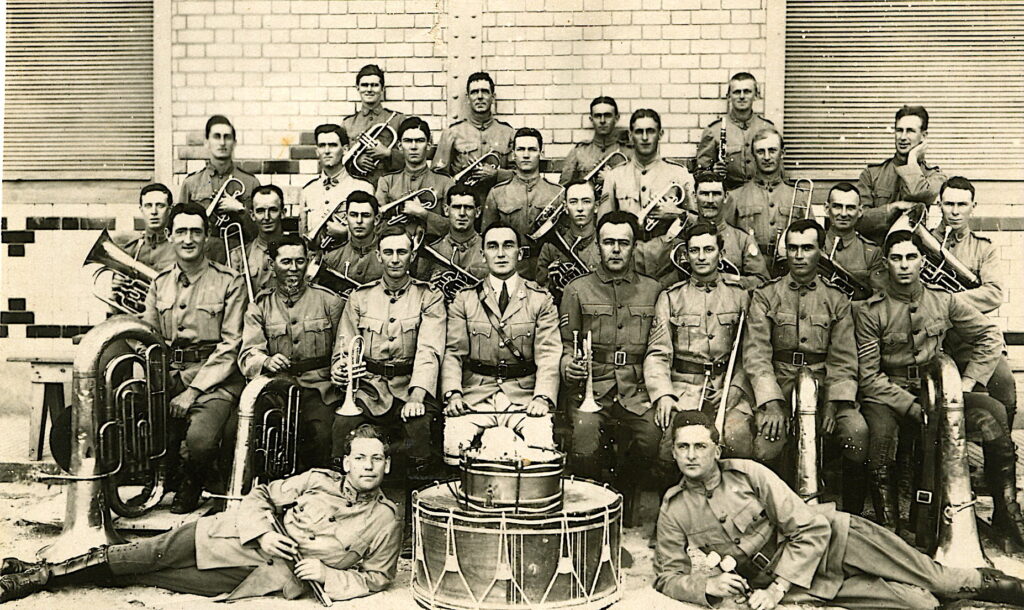
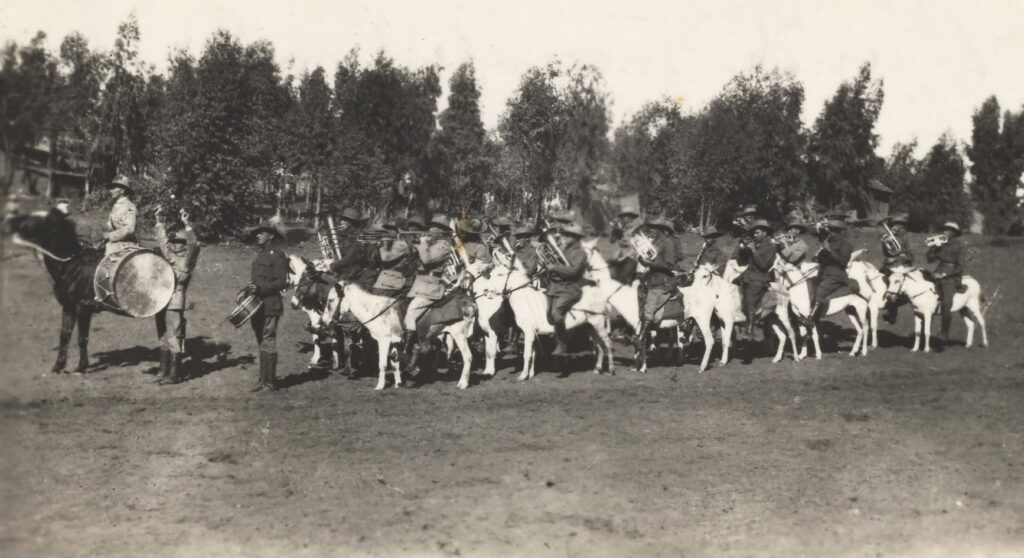
https://www.awm.gov.au/collection/C6851
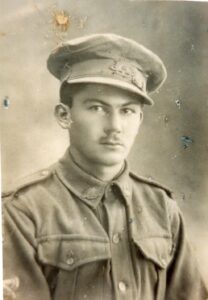
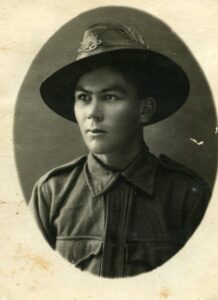
30th May 1919 – CAIRO
Reported A.I.F.H.Q. for medical examination. I was sent to hospital – 14th A.H. Abbassia [Cairo]. Slight riots about town. Met Wally Crain in hospital (Subiaco boy, Wallace Alfred CRAIN 1083, 10th A.L.H.)
9th June 1919
(Acting Sergeant and Bandmaster George Price died at 7.40pm in 4th Australian General Hospital in Randwick, Melbourne from “Cerebral tumour and cerebral hernia”.)
16th June 1919 – CAIRO HOSPITAL to KANTARA (PORT SAID)
I was boarded for Aussie but preferred to go back to Unit. Arrived on 17th June. Play tennis every day. Plenty of beer, fights, etc.
28th June 1919 – KANTARA (PORT SAID)
Embarked on “Madras” at Kantara. Left the same night.
4th July 1919 – COLOMBO
We are just passing the Island of Socotra. It was very hot through the Red Sea. We have struck a monsoon and everyone is seasick more or less. Arrived at Colombo. I had leave to bandy (a traditional, two-wheeled bullock cart or horse-drawn carriage used primarily for transit and transporting goods across Ceylon (now Sri Lanka). The term is derived from the Telugu word baṇḍi (meaning cart or carriage) and was widely used by British colonials, travelers, and visiting troops to describe the ubiquitous local vehicles) which means a train trip across the island. The scenery was magnificent and is recognised as some of the best in the world. We passed tea, coffee, cocoa plantations and fields of rice.
END OF DIARY
25th July 1919 – PERTH Disembarked 5th M.D. List 302
12th September 1919 Pay book finalised – 295 pounds 18/7
17th October 1919: Discharged 5th M.D.
MAINLY ABOUT PEOPLE
Trumpeter Will Harrison, son of Mr. and Mrs. A. Harrison, Perth Street, Subiaco, is returning from Egypt by the S.S. Madras.
The Daily News Thursday 17 July 1919 page 3
LATE SHIPPING – SPOKEN BY WIRELESS.
The Wireless Station at Applecross was to-day in communication with the following ships: — Ormonde, Madras, Hiniaroa, Swakopmund, War Soldier, War Armour, Gera, Commonwealth, Marathon, Janus, Malta, Miltiades.
The Daily News Thursday 24th July 1919 page 9
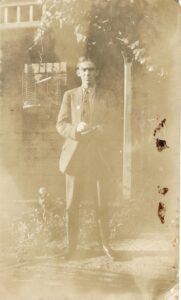
According to his Soldier’s Pay Book his final pay on 24th July 1919 was £295 18 and 7. William was officially discharged from the army on 17th October 1919 “being medically unfit (not due to misconduct)”. He had been in service for 3 years 103 days and had service abroad of 2 years 150 days.
After the war, William lived with his parents at 256 Perth Road Subiaco. When he returned, his siblings were 3 years older than when he had last seen them. Lou had gone from aged 16 to 19, Nellie from 15 to 18 and Charlie from 9 to 12.
In December 1919 William went to Dr Bennet with symptoms of malaria and chronic bronchitis. It obviously didn’t prevent him from practising the piano as he obtained his Teachers Diploma [Associate] in October 1921 in piano and theory and he returned to work as a clerk with the W.A. Government.
In May 1920, a group of returned servicemen formed the Band of 44th Battalion Association to later be known as the Returned Soldiers League (R.S.L.) Memorial Band. They performed in concerts with the Caledonian Pipe Band in which Walter and Bessie Kerr were members. William would marry Edna Kerr in 1925.
The attention of returned soldier bandsmen is directed to an advertisement calling a meeting to-night, at the Soldiers’ Institute, at 7.30. Band practice will commence under Bandmaster L. R. Green.
The West Australian Wednesday 26 May 1920 page 6
Initially established to perform for the Prince of Wales’ (notorious King Edward VIII who abdicated) visit to Perth in July 1920, 44th Battalion Association held a fundraising concert for the Mount Lawley-North Perth RSL sub-branch in the Lyceum Theatre, now known as the Astor Theatre on Thursday 19 June 1920. This band led a march past reviewed by the Prince of Wales at Government House and also performed at several events during his stay.
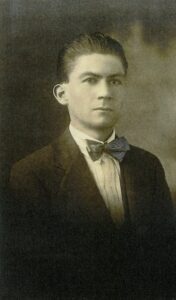
Friday 2nd July 1920 – The Forty-fourth’s Reunion.
The annual reunion of the 44th Battalion was held at St. George’s Hall, Perth, on Friday night, July 2, the date having been altered from June 6 (embarkation day) to July 2, in order to give members living-in country districts an opportunity to be present. The president of the Association (Capt. C. Longmore) presided, and on his left sat (the O.C., Lieut.-Colonel Mansbridge (“Old Billy”). The usual toasts were proposed, “The King” and “The Prince” by the chairman, the toast of “Kindred Associations” – being left ‘in the hands of Lieut.-Colonel Mansbridge; who emphasised the spirit of comradeship and fraternity which seemed to exist when members of battalions who meet in a social way and he trusted that
many more kindred bodies would arise from the ashes of the Great War and help to commemorate many stirring, episodes which had occurred overseas. “Fallen Soldiers” was honoured in silence, all glasses on the table’ being turned down. The toast of “Our Guests” was entrusted to Mr. Cropper Milligan, who eloquently eulogised the parties present, pointing out that the feeling of comradeship should exist among all fighting bodies.
At the conclusion of the “smoko” and after some Scotch members had introduced the Caledonian Pipe Band, the chairman announced that Senator Pearce had been approached by Mr. J. Cornell, M.L.C., on behalf of the Battalion Association with a request that the set of brass band instruments and uniforms which had been lent by the Defence Department, during the Prince’s visit should he retained by the association until directions came from the department in Melbourne for them to be returned. The chairman stated that the Senator had given a favourable reply and that at an early date everything would be fixed up and the band placed on a permanent basis. “God Save the King” terminated a most enjoyable reunion, many stories being told and retold, and many old fighting mates meeting once more.
The Australian Friday 9 July 1920 page 1
The Returned Sailors and Soldiers Imperial League of Australia (RSSILA) now R.S.L. W.A., was highly active in Perth, focused on welfare and advocacy for World War I veterans. Key activities included local sub-branch meetings and community events. From the early 1920’s Bill played piano in his own band “Harrison’s Orchestra” and frequently performed at Returned Soldier’s League Events.
Madame Bennett Wilkinson wishes to thank the W.A Concert Artists for admitting a party of wounded soldiers to witness the production of “Floradora,” also Mr. Durham Marcel for consenting to the Melrose artists giving an afternoon to the patients at the Base Hospital last week; Mrs. Kiely and Mr. Culley., of Cottesloe Beach; Messrs. Goerling, Anderson, Harrison, and Hodge deserve special thanks for their assistance with motors in driving them to and from Fremantle.
Sunday Times Sunday 1 August 1920 page 6
The Fremantle branch of the R.S.L. are running a children’s and adults’ fancy dress ball in the Fremantle Town Hall on Saturday next, August 28, starting at 8 p.m. Children will occupy the floor till 9.30p.m. and adults till 12p.m. Harrison’s jazz band has been engaged for the occasion; good prizes are offered for competition, and refreshments will be provided. Altogether an enjoyable evening is assured.
The Fremantle Times Friday 27 August 1920 page 1
R.S.L. Canteen.
The local branch of the R.S.L. was successful in securing the dry canteen and the manner in which it was carried out evoked the admiration; of all. Messrs. Brandon and Denslowe were purveyors of saveloys “and rolls, and they did a roaring business. They selected a “possy” near the wet canteen (no insinuations, Mr. Editor), and they were kept going all the afternoon. In another portion of the ground was the ice-cream stall conducted by Mr. E, Corbett, the secretary, and Mr. B., Baker, assisted occasionally by, President H. ‘Cooper. A large marquee had been erected, and here a bevy of willing workers dispensed refreshments. The ladies in
charge were -Mrs. C. (Sherville, Miss Miller, Miss Bailey, Mrs. Harrison, Mrs. Brandon, and Miss Baker. The male helpers were Messrs. Harrison, Pitton, Pitton, jun., T. Brown, and T. Taylor. The Y.M.C.A. kindly lent the furniture for the canteen, and Mr Crossley, of Perth, gave the coppers. The public patronised the tea tent liberally, but there was one oversight — the absence of fruit. It was also remarked that when the Governor entered the grounds to open the Show the band neglected to play the National Anthem, as is customary at such functions. However, mounting Tyler’s lorry, His Ex. declared the Show open. Although no patriotic flags were displayed, except at the hall in the’ soldiers’ canteen the Union Jack and the Australian flags were prominent. Our president, Mr. H Cooper, generally superintended all arrangements, and the band of the 44th Battalion rendered martial music and enlivened the general proceedings.
The Australian Friday 10 December 1920 page 5
George Strauss Mellor was a prominent Perth-based musician and WWI veteran who served as the long-time Bandmaster of the R.S.L. Band and foundation Secretary of the R.S.L. A skilled trumpeter, he was instrumental in early WA musical history was a local entrepreneur. Another notable R.S.L band member and student of George Mellor was trumpeter, Charles Court, who later became Premier of Western Australia.
An auspicious R.S.L. Band engagement included performing at the unveiling of the memorial for the 10th Light Horse Regiment in Kings Park by His Excellency the Governor, Sir Frances Newdegate on Sunday 13th March 1921 at 3.30pm. Sir Francis Newdegate laid the foundation stone for the memorial on 8 October 1920, using a trowel made from a Turkish bayonet taken at Beersheba. The monument is a granite obelisk located on Fraser Avenue, honouring the 299 men of the 10th Light Horse Regiment who lost their lives in World War I. Following the unveiling, a memorial service was conducted by the Chaplain-General, Archbishop Riley. The 10th Light Horse Regiment was the only light horse regiment recruited in Western Australia during the First World War. William Harrison was originally enlisted in the 26th Reinforcement of the 10th Light Horse in Claremont on 17th July 1916.
William continued his employment with the W.A. Government Lands and Titles Office.
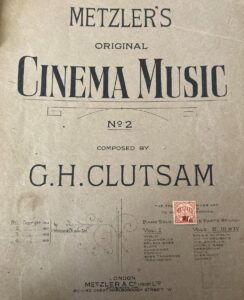
He was employed in the orchestra playing piano accompaniment for the silent movies at the open-air theatre at Cottesloe and the “Melrose” (later renamed the “Prince of Wales” Theatre in 1922).
“Under the baton of Lionel Hart, “WA’s finest combination of instrumentalists” brought musical accompaniment to the silent movies of Charlie Chaplin, Lillian Gish and Rudolf Valentino.”
“Stage, Screen & Stars” produced and printed by The West Australian
William recruited musicians for his own Band getting regular employment at nights whilst working during the day at the Titles Office:
May 1920 – Harrison’s (late A.I.F.) Band
makes merry music every Thursday evening at King’s Hall, Subiaco, at the R.S.L. assembly.
Call Friday 7 May 1920 page 10
Saturday 11th June 1921 – Dancing Subiaco Tonight. Grand Confetti and Streamer Carnival. Masonic Hall, corner Townshend-rd. and Perth St.Harrison’s full Jazz Band. Search lights. 1s., 1s. 6d. Robson and Wheeler.
The West Australian Saturday 11 June 1921 page 2
William Harrison obtained his Teachers Diploma [Associate] in October 1921 on piano and theory:
MUSIC – Trinity College, London – PRACTICAL EXAMINATIONS.
Dr. C. E. Ford was appointed to conduct the examinations by the Trinity College of Music, London, in Western Australia, portion of South Australia and Tasmania. The following is a list of passes at the Perth centre, as supplied by the local secretary, Mr. W. H. Coupland: Higher Examinations. Associate, A.T.C.L. (Pianoforte). The following candidates have fulfilled the requirements of practice and theory: W.E. Harrison, S. H. Blurton, C. R. Brown.
The West Australian Saturday 15 October 1921 page 12
William registered an “Indian” motorcycle in 1922 plate 1097 which his brother Charlie also used. [The Indian Scout is a motorcycle built by the Indian Motorcycle Company from 1920 to 1949].
MOTOR TRANSFERS. No. 1097. Indian motor cycle from J. G. Booty to W. E. Harrison, 256Perth-street, Subiaco.
Sunday Times Sunday 14 May 1922 page 11
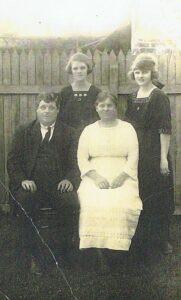
In June 1922, 24 year old William Harrison met 15 year old Edna Kerr and her older sister Bessie, as Musical Director and accompanist for the Rainbow Pierrots in which they performed together until they were married.
Saturday 3rd June 2022 – Theatiedom
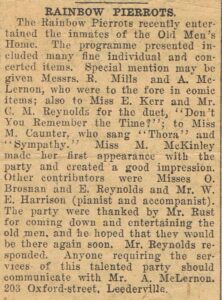
This evening the ‘Rainbow Pierrots’ are giving a concert to the inmates of the Parkerville Home. They are under the direction of Mr. Clovis, M. Reynolds and Mr W.E. Harrison, A.T.C.L.
Mirror Saturday 3 June 1922 page 4
Saturday 3 June 1922 – Concert at Parkerville
The Rainbow Pierrots on Saturday last gave a well appreciated programme in the Parkerville Hall to a packed audience. All the artists were well received and many encores were demanded. The programme embraced solos, part songs, ragtime, comic, dancing, monologues, etc. The contributors were:-Misses O. Brosnan, W. F. Hartwell, M. Batey, E. Reynolds. B. and E. Kerr; Messrs. W. E. Harrison, A.T.C.L. (musical director), A. Bowden. W. Cryer, A. McLennon, C. M Reynolds (managing director). The Pierrots were the guests of the residents during the week end.
The West Australian Wednesday 7 June 1922 page 8
In July 1922 William Harrison visited the Eastern states. Brother Lou Harrison was living at 55 Osborne St, South Yarra in Melbourne, working as a carpenter. His Uncle Walter Charles Parsons was a lather living at 4 Caroline St, South Yarra at the time and William had corresponded with his daughter Edna Parsons during WWI.
Subiaco Skits – Murmurs from the Model Suburb
Will Harrison, of Perth-Street, is over East enjoying a well-earned recreation. Will will (no pun) be back in a month to ogle the girls and tickle the ivories.
Mirror Saturday 29 July 1922 page 3
Phoebe’s brother Walter Parsons was Vice President of the Ascot Vale Catholic Young Men’s Society which coordinated social activities, a cricket and a football team.
1920 – ASCOT VALE.—The weekly meeting of the Ascot Vale C.Y.M.S. was held on Monday evening, May 3rd. Bro. W. Parson’s, vice-president, presided over a fair gathering of members…Mr, T Whelan reported defeat of football team by North Fitzroy by four points. Reports re ‘Boys’ Football Association and recent social were received. Members of football team were urged to attend training. Rev. Fr. Bakker kindly consented to give members a lecture on “Spiritualism” on Monday night, May 5th. He asked members to support the queen carnival; also school committee In reference to the local school fund. More cooperation was asked for from these members, and it was decided that football matters be discussed at general meetings under the heading of general business, both committees to meet Sunday mornings to discuss same. Mr. W. Parsons, as an executive officer, spoke, re matters connected with society in general, and urged members to take active interest in coming sports, collecting, and to attend annual smoke night.
Lou Harrison was also playing football and apparently he played with the Fitzroy Football Club.
William’s relatives in Melbourne 1922:
I wonder if William visited the Albert Street Conservatorium of Music during his visit and noted that at this time Dame Nellie Melba was teaching.
SUBIACO SKITS: Will Harrison back from the East and settled down to hard graft. What’s that, Will? Hard! But aren’t you in the Government?
Mirror Saturday 11 November 1922 page 3
After returning to Perth in 1922, William started buying land. By 1932 he had bought and sold some 25 properties, including lots in Cottesloe.
He continued performing with Edna Kerr in the Rainbow Pierrots and William Harrison’s Orchestra also played at dance carnivals at the Perth Town Hall and at regular dances in the King’s Hall, Rokeby Road, Subiaco.
DANCING – Tomorrow evening the, first weekly ‘dance de luxe’ will be, held in the Bon Marche dining-rooms, Hay Street. The hall will be specially illuminated and decorated, and. music will be rendered by the Altona Orchestra, including banjoline under the leadership of Mr. W.E. Harrison. The dancing will commence at 8.30, and supper will be provided.
The West Australian Thursday 10 May 1923 page 8
WHAT THE SUB-BRANCHES ARE DOING – WEST PERTH. This branch held a very successful concert and dance in the Soldiers’ Institute on the 17th August, when about 120 of both sexes attended. The committee desire to express their sincere thanks to the ladies and gentlemen for their kind assistance. The following contributed items: Misses Russell, L.A.B., Driver and Davis, and Messrs. Solomon, Fisher and Davies. Mr. Smart’s Band played three items, which were much enjoyed, and Miss Smart played the various accompaniments in her usual capable style. The music for the dance was supplied by Mr. Harrison’s Jazz Band, and left nothing to be desired.
Listening Post Friday 21 September 1923 page 6
Another digger organisation enjoying a richly deserved success is Harrison’s Returned Soldier Orchestra. With a combination of expert players, they have done much to raise the standard of dance music in this city. It is a well-known fact that good music is not always good dance music, and vice-versa, but to use the words of a well-known critic, “they are as just as enjoyable to listen to as to dance to”. Anyhow, good luck to Harrison and his merry men.
Sunday Times Sunday 24 February 1924 page 5
FRIDAY NIGHT. MARCH 14 1924
In the Literary Institute at 8 P.M. – COASTAL SCOTTISH PIPE BAND RE-OPENING SOCIAL. OLD TIME DANCES – LATEST DANCES – NATIONAL SCOTCH DANCING and SINGING. Come along to the Opening and Presentation to Mr. J. McLeod. Come all ye Auld Folk and bring the New Folk wi ye. Harrison’s Orchestra. TICKETS, Is. 6d.; no tax, Refreshments. INNES. President, CLARKE. Secretary.
The West Australian Saturday 8 March 1924 page 2
William started performing at White City in the Diggers’ Fairs.
YES! WE’VE DONE IT! DONE WHAT? HAD THE GREATEST OPENING OF ANY FAIR IN PERTH
THE DIGGERS’ FAIR. Last Night Exceeded Anything Ever Done in the same line in Perth. The huge area was uncomfortably crowded. Everything went with a swing, not the slightest hitch occurred. TO-NIGHT Things will even be better. And there will be WHIPPET RACING, BOXING, And AMUSEMENTS GALORE AT THE DIGGERS’ FAIR. The Dancing Floor, with Harrison’s Orchestra, is going all the time. Get on to the floor and your feet will tingle so that you cannot stop jazzing. TO-NIGHT’S PROGRAMME. 8 p.m. Dance Floor Opens. 8.15 p.m. Whippet Racing. 8.30 p.m. Cass Mahomet’s Concert Party. 9 pm Punch and Judy Show, with new and Original Settings. 9.15pm Boxing. Join the Crowd and Come Along. G.S. MELLOR, Sec. and Organiser.
The West Australian Tuesday 11 March 1924 page 2
THE DIGGERS’ FAIR – CARNIVAL SQUARE. Excellent and artistic displays have been made by enterprising firms with their goods. This is really the best method of introducing goods to the public, particularly if they be a new form of manufacture. The dance floor deserves special mention, owing to its excellent condition; and here may be seen youth and beauty, and occasionally sober middle-age gyrating to the strains of the excellent orchestra, under the able conductorship of Mr. W. Harrison. In spite of all prognostications to the contrary, “King Jazz” still reigns supreme; but jazz music as played by Harrison’s orchestra is enough to convert the most bitter opponent to this form of terpsichorean art.
Listening Post Friday 14 March 1924 page 12
SOCIAL
Government House Ballroom presented a very gay and animated scene on Wednesday evening of last week, the occasion being the A.T.N.A. annual ball, this year in aid of a club building fund which the association desires to acquire. His Excellency the Governor and the Hon. Lady Newdegate, with Major Kerr Pearse, and Mr. F. E. Chase in attendance, arrived about nine o’clock, to the strains of the National Anthem. …Harrison’s orchestra, which is an entirely returned soldiers band, provided excellent and inspiring music.
Western Mail Thursday 22 May 1924 page 35
On Sunday 10 August 1924 the engagement was announced in the Sunday Times of:
Edna May, younger daughter of Mr. and Mrs. W. Kerr of Leake Street, Bayswater, to William Edward, eldest son of Mr. and Mrs. A. D. Harrison, of Merriwa Street, Nedlands.
DIGGERS’ FAIR – At White City
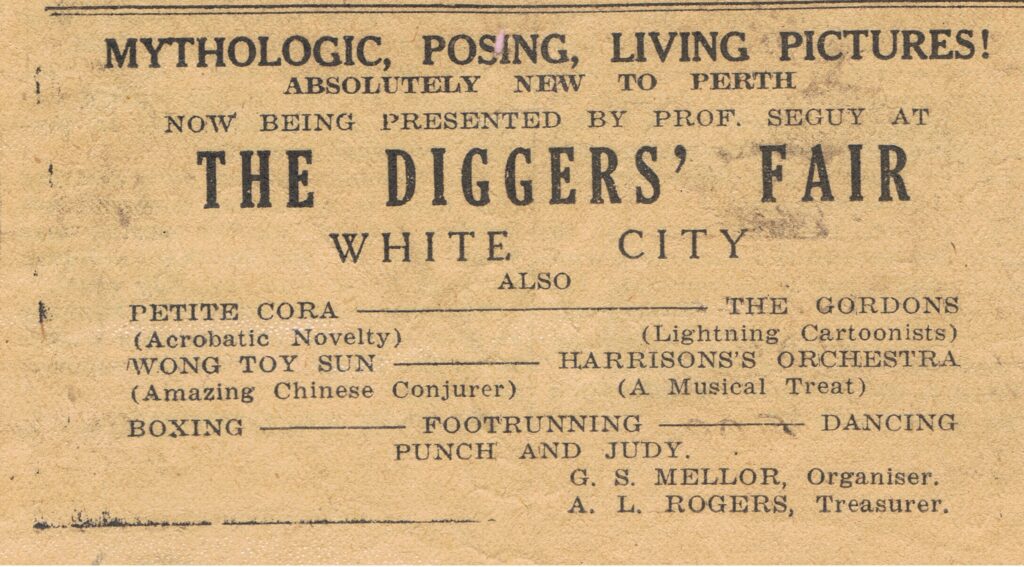
For those who have been looking forward to the re-opening of White City the news that the Diggers’ Fair will re-commence there on Wednesday night next will come as a pleasant surprise. For some weeks past the committee organising the Fair has been making every possible effort to give the public a high-class entertainment, and that these efforts have been successful will be shown by the number of really high standard amusements to be presented during the whole season. An outstanding attraction will be the well known magician, “Wong Toy Sun,” assisted by his talented company. Throughout his season at the Diggers’ Fair he will present many changes of programme. Another feature of the Fair is the whippet racing, under the auspices of the local club. Both amateur and professional foot runners will be well catered for, and a boxing tournament is also being arranged. The dance floor will be open, and music will be supplied by Harrison’s Returned Soldier Orchestra.
Sunday Times Sunday 5 October 1924 page 8
At an R.S.L. Band concert on 29th December 1924 William Harrison’s composition, a military style march named “Subiaco”, was first performed.
. . R.S.L. BAND . .
Under the Conductorship of Mr. George Mellor will render the following programme of music:
Programme
Monday 29th December 1924
GOD SAVE THE KING
AT THE LITERARY INSTITUTE – R.S.L. BAND POPULAR DANCE – A GRAND CARNIVAL
Commences tonight, being the first of their weekly dances. HARRISON’S RETURNED SOLDIER’S ORCHESTRA THE R.S.L. BAND will render a few popular airs under the baton of Mr George Mellor, prior to the dance. C.E. O’KEEFE organiser
DIGGERS’ FAIR – Tonight’s special programme
At the Diggers’ Fair, White City, tonight a special programme will be presented. At the top of the bill is the Bathing Beauties competition, an item which has proven itself to be the most popular event staged at the fair. A number of dainty girls take part in this, and the bathing costumes worn by them are modelled on the latest American beach crazes. Petite Cora, a wonderful juvenile acrobat, will present her novelty act, which is something altogether different from the usual turn of this nature. The amazing Chinese conjuror, Wong Toy Sun, will also submit for approval a new series of illusions. In the boxing stadium H. O’Brien (8.6) will meet J. Jefferies (8.4) and Kid Jones (8.5) will be matched against Pat Healy (8.6). There will also be a preliminary bout. Dancing, Harrison’s Returned Soldier Orchestra, Love’s Punch and Judy, and a host of other diversions will complete the bill. Another new attraction soon to be presented is the mythological posing living pictures. This is something absolutely new to Perth, and should prove to be exceptionally popular.
Daily News Thursday 6 November 1924 page 7
In February 1925 William Harrison’s orchestra played at the 44th Battalion Moonlight River Trip on the boat the S.S. Perth:
RIVER EXCURSIONS
A moonlight river trip conducted by the 44th Battalion will be made by the S.S. Perth tonight, leaving Barrack Street jetty at 8 o’clock. The route to be taken is from Perth to Point Walter, Rocky Bay, Claremont and Point Walter. Dancing will be held on board, Harrison’s Return Soldier Orchestra having been engaged. Tickets will be obtainable at the boat.
The West Australian Thursday 12 February 1925 page 8
R.S.L. WEEKLY DANCES
Say, Friends, No need to ask “what’s doing tonight”. There’s only one place worthy of notice, and which speaks for itself and that’s the LITERARY INSTITUTE Hay Street Perth near Pier Street TONIGHT You can dance better to HARRISON’S FAMOUS ORCHESTRA It’s something to write home about. Admission: Ladies 1s, 6d Gents 2s. We Pay Tax. C.E. O’KEEFE organiser
The West Australian Monday 16 March 1925 page 2
R.S.L. Dance – The R.S.L. Band dance will be held in the Literary Institute tonight. Harrison’s Returned Soldier’s Orchestra will provide the music for dancing.
The West Australian Friday 20 March 1925 page 10
ZOOLOGICAL GARDENS – SUNDAY NEXT at 3.30 P.M. – R.S.L. MEMORIAL BAND
Will Render the Following Programme:
March— “71st Infantry” Code
Overture — “Poet and Peasant” Suppe
Euphonium Solo — “Simple Tom” Thore
Selection— “The Mikado” (Sullivan)
Intermezzo — “Les Cloches de St. Malo” Raymond
Popular— “All Alone” Berlin
Selection—”Le Verve Joyeuse” Lehar
March — “Subiaco” Harrison
GOD SAVE THE KING
Now on view— Royal Siamese Cats – Elephant — Camel — Goats — Donkey— and Ponies. Gates open at 10 a.m. to 5.30 p.m. KODAK FILMS Admission 6d. Children half price.
The Daily News Thursday 11 June 1925 page 1
In August 1925 William Harrison conducted the R.S.L Orchestra in a Repertory Club season with part proceeds going to “Call of the Blind Appeal” and the “Kindergarten Appeal”. The season started at His Majesty’s Theatre and then performed at Fremantle Town Hall for three nights. It offered preferential tickets for members of The Western Australian Society of Concert Artists which an influential musical organization in Perth, operating from 1917 until approximately 1930. It played a key role in the local entertainment scene during the 1920s, including the establishment of a “Green Room Club” for performers.
‘A PAIR OF SILK STOCKINGS’
The Repertory Club will present the play “A Pair of Silk Stockings” in His Majesty’s Theatre for a season commencing on Saturday August 15 1925. The plot of the comedy, which is full of piquant situations, has been written by C. Harcourt around the fortunes of a vivacious young married lady who nearly loses her husband. The box plans will be opened at Nicholson’s on August 10. Members of the Repertory Club and the W.A. Society of Concert Artists may obtain preferential booking for the first two nights, today and throughout next week.
The West Australian Saturday 1 August 1925 page 14
R.S.L SOLDIERS AND SAILERS
When better music is required, the R.S.L Orchestra can supply it. The popularity of the digger musicians is increasing. The repertory Club’s last production, “A Pair of Silk Stockings” was accompanied by harmony under the baton of W. Harrison.
Sunday Times Sunday 30 August 1925 page 7
DIGGERS’ FAIR: Last night’s attendance at the Diggers’ Fair (White City) was again very good. The chief attraction was the performance of the Flying Wartons, aerial acrobats, who succeeded in thrilling the spectators with springboard flying and balancing. The clever child contortionist, Kitty Careena, has also become very popular, since her appearance. Harrison’s orchestra, the dance floor, footrunning, boxing and whippet racing are among the many other attractions presented nightly.
The West Australian Thursday 19 November 1925 page 12
DIGGERS’ FAIR – The Flying Wartons five continental aerial acrobats have been engaged to appear at the Diggers’ Fair, at White City. on Saturday next. Kitty Careena, child contortionist will also appear nightly. Harrison’s orchestra will provide the music for the dance floor, and there will also be boxing amateur and professional, footrunning, whippet racing, and other diversions.
The West Australian Saturday 7 November 1925 page 16
DIGGERS’ FAIR COMMENCES TONIGHT
Tonight at White City the Diggers’ Fair commences its season with the Flying Wartons as star attraction. The Wartons are aerial acrobats and their act is positively unlike anything before seen in the West. Brought out to Australia by Wirths’ Circus the Flying Wartons, who are a continental act, are now on their way to America, and Perth is their last appearance in Australia. Balancing, tumbling, springboard flying and seemingly impossible stunts at dizzy heights will be some of their offerings. Another big attraction is Kitty Careena, a wonderful child contortionist, who is also a newcomer to Perth. She has a really novel act which has earned her a big reputation in the Eastern States. Lovers of the fistie art will be well catered for each night, the stadium being under the direction of Harry Stone. Tonight’s bouts include Sam Stivey v. Len Dixon and Ron Johnson v. Big Ben and several preliminaries. Footrunning and whippet racing are also on the bill and then there is the dance floor and Harrison’s Orchestra. Tonight a progressive count of the elections will be posted on the grounds.
Daily News Saturday 14 November 1925
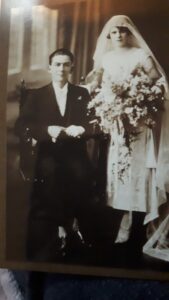 And they were married on the 25th July 1925.At the age of 27 on the 25th July 1925 at St Mary’s Church of England West Perth William Edward Harrison was married to the eighteen year old EDNA MAY KERR (born 12.8.1906 in Midland Junction, Western Australia). They lived at 64 Bruce Street Nedlands until their own house at 24 Highway (later Kingsway) Nedlands was completed.
William was still having bouts of malaria and was dogged by chronic bronchitis and was seen by Dr C. Anderson at this time. He spent some time at Fremantle Base Hospital and Hollywood Repatriation Hospital due to these ongoing health issues.
William registered a car – a Morris Cowley – from 1926 – 28, plate 13846.
The third annual military ball of the 44th Battalion will be held in the Princess Hall, Claremont, to-morrow (Monday) night. The hall has been decorated for the occasion in a striking and novel manner. Special provision has been made for patrons to remain to until the conclusion of the ball. A charabane and a tram will leave the hall at 1.15a.m. Music will he provided by the 44th Battalion Orchestra, under Mr George Mellor. A capable committee has charge of the supper. The committee wish to emphasise that there will be no late trains, as erroneously stated on the invitations issued.
Sunday Times Sunday 30 August 1925 page 7
On 13th February 1926 in Subiaco Edna gave birth to her first child, son William Arthur who was the first grand child for William’s parents Arthur and Phoebe.
1926 was a busy and joyful year for Phoebe and Arthur with two weddings and two grandchildren born.
January 16th 1926, William’s sister Nellie married Edward Francis McDavitt with Charlie Harrison as a groomsman.
On February 13th 1926 William’s brother Arthur “Lou” was married to Vera Fryer and Charlie Harrison was best man.
In 1926 Bill was the Musical Director of the Amusu Theatre at 443 Albany Highway in Victoria Park for two months.
William Harrison was invited to perform with his orchestra in the “Dover Road” season with “The Repertory Club” in August 1926.
‘THE DOVER ROAD’ Repertory Club Production. The Repertory Club will reenter the theatrical field next week with a three-night season of ‘The Dover Road” By A.A. Milne, the play will be staged at the Assembly Hall, Pier-street, on Thursday, Friday and Saturday and members claim that it will easily uphold the club’s reputation for first class entertainment.
The Daily News Friday 13 August 1926 page 10
1926 16th BATTALION A.I.F. RE-UNION.
Perhaps the most enthusiastic re-union held of late years was that of the 16th Battalion, held in the Soldiers’ Institute, on Friday, 29th October. About 300 members of the old unit, with such a wealth of tradition, attended, and the doings of great deeds by great men were re-told by the speakers. Percy Black, “Fat” McCarthy, Harry Murray, Colonels Pope, Margolin, and Tilney, Jack Axford, Martin O’Mara, and many other names of men who served with such distinction were mentioned. The speakers included Allan Muir (president), Padre Harper, General Hobbs, Colonels Collett, Margolin and Sweetapple, Major G. Shaw, Charlie Latham, M.L.A., and Dave Benson. An attractive dinner was served by lady friends, and the artists included Garnet Philp, Ivan Campbell, George Mellor, Ted Scott, W. E. Harrison and the R.S.L. Band. The function reflects great credit on secretary “Fat” McCarthy, V.C., and his splendid committee of workers.
Listening Post Friday 19 November 1926 page 7
SOLDIERS AND SAILORS
The smoke social of the West Perth sub-branch of the R.S.L. was a bumper affair. During the evening Padre Riley made reference to the number of diggers still outside the ranks of the R.S.L. The West Perth sub-branch has an average membership of 600, most of whom have been members since the inception of the sub-branch, and the combined Public Services of the State and Commonwealth Governments would be in a very poor position to-day had it not been for that great organisation-the R.S.L. The sub – branch desires to thank Mr. William Harrison for the excellent music provided by his orchestra at their smoke social and also to extend its appreciation to those artists who provided the vocal items, namely R. Buchanan, H. P. Clarke, H. Gibson, D. Lyall and H. Miller.
Sunday times Sunday 5 September 1926 page 7
1927 DIGGER’S FAIR – On Monday night the Diggers’ Fair will open at White City. The chief attraction of the carnival will be Barton Bros. Circus. Maurice Ribe and Jean Birch ballroom dancers, late of the Parisienne Tango Club, Melbourne will demonstrate the BIack Shuffle. Other attractions will include the dance floor with Harrison’s Orchestra officiating, boxing, tug of-war. Madame Cora (Physic Clairvoyant); ‘Hockey Vane and Cleopatra (snake charmers) and Punch and Judy.
The West Australian Wednesday 16 February 1927 page 11
DIGGERS’ FAIR – To-night Barton Bros.’ Circus will conclude the first week of a very successful season at Diggers’ Fair, White City. This afternoon a special matinee will be given and the full programme will be presented. Good crowds are attending Diggers’ Fair, where the most outstanding items are Maurice Rebe and Jean Birch, specialty dancers; Rockey Vane and Cleopatra, snake charmers; Madame Cora, Harrison’s orchestra, and the dance floor.
The West Australian Saturday 26 February 1927 page 15
Diggers’ Fair – The authorities of the Diggers’ Fair have certainly provided plenty to amuse the throng who nightly patronise Carnival Square. The work of Maurice Rebe and Jean Birch, ballroom speciality dancers, is especially interesting and instructive to dance enthusiasts. One of their features is “The Black Shuffle” which is bidding fair to knock the Charleston silly. As well, there is Rocky Vane and Cleopatra (snake charmers), Madame Cora (clairvoyant), Bill Harrison’s Orchestra and the dance floor, Punch and Judy, boxing and dozens of other diverting things.
Truth Saturday 26 February 1927 page 7
Barton’s Circus – Tonight Barton’s Circus commences the second week of its season at Diggers’ Fair, White City. The past six nights have necessitated the constant use of the “full house” sign, and there is every indication of these conditions continuing. The programme is of twenty-one acts, headed by the Five Flying Eugenes, sensational aerial acrobats; the Tybells, Dentine, Ethel Ashton, Frank Carl, Arcross Bros., Tarzan Baboons and Barney the “educated mule”, a show in himself. Foremost among the many other attractions of Diggers’ Fair is Rockey Vane and Cleopatra, snake charmers; Madame Cora, physic clairvoyant; Bill Harrison’s Orchestra and dance floor, boxing etc.
Daily News Monday 28 February 1927 page 8
Diggers’ Fair
Rocky Vane and his partner Cleopatra still go on fiddling about with serpents of various degrees of deadliness and spitefulness in the snake pit at Digger’s Fair. Then there is La Petite Bonnie, a contortionist, who does her best to emulate the snakes and is remarkably successful. Madame Cora, the dance floor and Harrison’s Orchestra, and boxing, are also things worthy of attention, among others.
Truth Saturday 12 March 1927 page 7
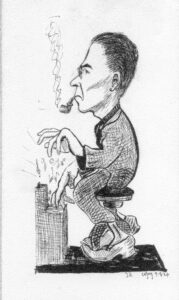
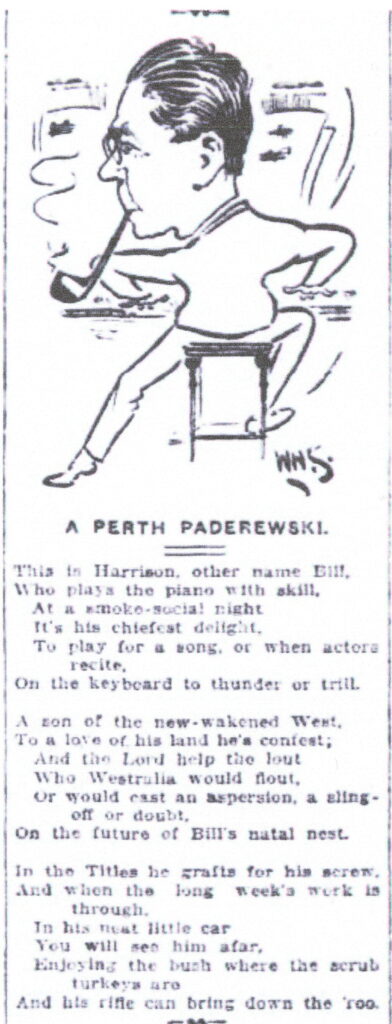
A PERTH PADEREWSKI
This is Harrison, other name Bill,
Who plays the piano with skill.
At a smoke-social night
It’s his chiefest delight,
To play for a song, or when actors recite.
On the keyboard to thunder or trill.
A son of the new-wakened West,
To a love of his land he’s confest;
And the Lord help the lout
Who Westralia would flout,
Or would cast an aspersion, a sling-off or doubt,
On the future of Bill’s natal nest.
In the Titles he grafts for his screw,
And when the long week’s work is through,
In his neat little car
You will see him afar.
Enjoying the bush where the scrub turkeys are
And his rifle can bring down the ‘roo.
Sunday Times 10 April 1927 page 14
Eugene Knoop (caricaturist)
In 1927, William Harrison’s orchestra performed at season with “The Repertory Club” in their season of “Lord Richard in the Pantry”:
REPERTORY CLUB – ‘Lord Richard in the Pantry’
In the Assembly Hall, in Pier-street, last evening, the Perth Repertory Club opened a four-night season of ‘Lord Richard in the Pantry’ before a large and most appreciative audience. The comedy, which is of the lightest possible type, and abounds in farcical situations is by Douglas Blow and Gilbert Hoare. The dialogue is sparkling with witty phrases throughout, and these are delivered with a delightful appearance of spontaneity which ‘get across’ from the beginning. The role of Lord Richard, which might, so easily have been overdone, and is not in any sense an easy one, was admirably sustained by Mr. H.W.D. Banger. Discovered in a vapor-bath on the removal of the screen in the first act; seen later as a reluctant lover, and later again as the embarrassed aristocrat carrying out (very badly) the duties, of a butler, Mr. Banger is constantly confronted with difficult situations, which he meets in a most natural way, .and without any amateurish stiffness. Mrs. J. N. Thomson, as Cook confirms the impression already received of her capabilities as an actress. Especially when, after executing an errand for ‘Mr. Bloggins,’ she returns, having tried to drown her sorrows in liquid refreshment is her work excellent. The carefully preserved balance, when picking up a dropped parcel, must have taken considerable study. Miss D. Mark plays lead as Mrs. Sylvia Gayford. Her work is eminently good and shows considerable development since her previous appearance. The part one that calls for restraint as well as for spontaneity, and Miss Mark, whether helping her incompetent butler to polish the silver or discussing her love affair with her friend, conveys an impression of naturalness that is most attractive. The part of Lady Violet Elliot, which does not give very much scope, is filled artistically by Miss Edna Russell; Miss Evelyn Loveioy, the ‘dilettante in souls,’ is admirably portrayed by Miss J. Mortlock. The part of Bryan, the pert and pretty parlormaid, is taken with verve by Miss Tess Smalpage, whose work is distinctly good, as is also that of ‘Rose’ (Miss M. Hodgson), the housemaid; and ‘Gladys’ (Miss Pattie Rees), who carries out with remarkable success the part of the kitchenmaid. Mr. K. J. Douglas scores another success with his portrayal of the imperturbable ‘Mr Carter’ and provides some of the. wittiest points of the piece; Mr. R. E. Banks, as ”Captain Bannister,” is seen at his best, especially when visiting his friend in the basement and helping to dispose of the silver. Mr. A. J. Bishop, as the secretary to the impecunious Lord Richard, has only a small part, but plays it well and Mr. A. E. Montefiore, as Detective-Inspector Brown, who had helped Lord Richard find his keyhole many times in former days, is admirable. Laughter and applause were frequent, and the short season should be a very successful one. At the final drop of the curtain the artists received numerous expressions of appreciation in the form of flowers, chocolates, mascots, etc. Mrs. J. N. Thomson, who produces the piece, is to be congratulated on her work; Mr. J. F. Ottaway as stage manager, with Mr. K. Farrington as assistant stage manager; left nothing to chance, and there were none of the little hitches that so frequent or mar the first nights of amateur performances.
The music, which was delightful, was provided by Mr W.E. Harrison’s orchestra under the direction of Mr. W.E. Harrison. It included “Quaker Girl” music and some of the best-known airs from “Wildflower”, also an item embracing some of the ‘Lucia di Lammermoor’ melodies.
The Daily News Saturday 17 September 1927 page 5
SOCIAL NOTES – The 11th Battalion held its annual ball on Friday evening in the Y.A.L. Hall. It was largely attended and an enjoyable time was spent by all present. The colours of the King and the 11th Battalion decorated the hall and these colours were also used in the decorative scheme in the supper room where wattles hovea, roses and Geraldton wax plant were arranged on the long tables…Mr William Harrison’s Orchestra provided the music. Amongst those present were General Sir Talbot and Lady Hobbs…
The West Australian Tuesday 12 July 1927 page 6
DIGGERS’ FAIR. Huge and delighted crowds are the order at Diggers’ Fair now being held at White City. The atmosphere is one of healthy enjoyment in the cool evening air amidst countless attractions. The stampede nightly provides the best and most daring horsemen with opportunities to display their prowess on equine outlaws, and Mr. McKean’s ring manner as ringmaster is an entertainment in itself. There is not a dull moment from start to finish, and the horses are handled in expert manner by the assistants. Once this is over there is a rush for the best vantage points to witness the ‘Flying Eugenes,’ whose marvellous and dazzling entertainment with the aid of trapezes is worth going a long way to see. The boxing contests to date have provided clean, willing, and hard-fought contests. The promoters are choosing nothing but the best men obtainable to keep abreast of the other excellent entertainments in all parts of the ground which include dancing, snake-pit, the whirligig, knock-down, housie, and many other games. The ground is brilliantly picturesque with its thousands of coloured lights, and the R.S.L. Band and Harrison’s talented orchestra complete a range of entertainment unequalled at any previous period in the history of White City.
The Daily News Wednesday 29 February 1928 page 10
Diggers’ Fair – Thrilling Stampedes White City is nightly packed with merry making people who can be heard paying tribute to the excellence of the arrangements, and the happy atmosphere which prevails at this popular centre. Thousands of coloured lights illuminate this amusement park, and dancing is in full swing to the tunes of Bill Harrison’s famous orchestra. The R.S.L. Band also render also render selections nightly and combine with other entertainers to make Diggers’ Fair night the ideal one. The stampede ranks as one of the best staged shows seen in this State for many a day and is an all-round neat turnout. Thought is now turned towards the rough riding championship of W.A. to be commenced next week.
Mirror Saturday 3 March 1928 page 7
WHITE CITY – The Diggers’ Fair – The present carnival being held at White City under the name of Diggers Fair has so far been a great success on account of the excellent fare provided. There are amusements for old and young alike ranging from dancing to bucking “bullocks, and trapeze acts of daring. The rough riding contests for the championship of WA are in full swing and boxing has been of high standard. New attractions are constantly being added, and there is always good music to be heard from the R.S.L. band and Bill Harrisons Jazz Band. The cause’ to which, the profits are to be donated is too well known to need repetition and while patrons enjoy an evening of healthy amusement it is gratifying for them to know that they are assisting a good cause in aid of the men who answered the call of war.
Sunday times Sunday 11 March 1928 page 8
Diggers’ Fair – The present carnival being held at White City under the name of Diggers’ Fair has so far been successful, one of the main reasons being that good value for money is provided. In this ideal entertainment square are felt none of the discomfits usually attaching to indoor-entertainments on summer nights, and the excellent fare provided, plus the fresh evening air provides a tonic as. well as an entertainment. There are amusements for old and young alike ranging from dancing to bucking bullocks and trapeze acts of daring. The rough-riding contests for the championship of W.A. are in full swing, and there is a challenge ride on between “Snowy” Watts and D. Keen on the outlaw mare Kate Kelly. Three silver cups are on offer and three gold medals, and ladies are catered for in the stampede arena. The boxing has been of very high standard. New attractions are continually being added, and there is always good music to be heard from the R.S.L. Band and Harrison’s Orchestra.
Truth Sunday 11 March 1928 page 12
WHITE CITY DIGGERS’ FAIR. The present Carnival being held at White City under the name of Diggers’ Fair has so far been a great success, one of the main reasons being that full value for money is provided in this ideal entertainment square are felt none of the discomforts usually attaching to indoor entertainments on summer nights, and the excellent, fare provided plus the fresh evening air provides a tonic as well as an entertainment. There are amusements for old and young alike ranging from dancing to bucking bullocks, and trapeze acts of daring. The roughriding contests for the championship of W.A. are in full swing. Three silver cups are on offer, and three gold medals, and ladies are catered for in the stampede arena. The boxing has been of very high standard, and two gold medals are being awarded for the most improved lad, and the most scientific display, during the carnival. New attractions are constantly being added, and there is always good music to be heard from the R.S.L. Band and Harrison’s Orchestra. The cause to which profits are to be donated is too well known to need description, and while patrons enjoy an evening of healthy amusement it is gratifying for them to know that they are assisting a good cause in aid of the men who answered the call of war.
Weekly Judge Friday 16 March 28 page 192
DIGGERS’ FAIR – Tonight at the Diggers’ Fair at White City, the Carlrenos, magicians and illusionists will conclude a successful week. Harrison’s Orchestra will provide music for the dance floor, entrance to which is free except on Friday and Saturday nights. The stadium will be re-opened tonight at 9.15 o’clock, when wrestling and boxing bouts will be put on, and Stan Gorringe will give a weight-lifting exhibition. Next week Eugene Knoop, the ambidextrous calligraphist, will caricature local celebrities.
The Daily News Saturday 16 March 1928 page 4
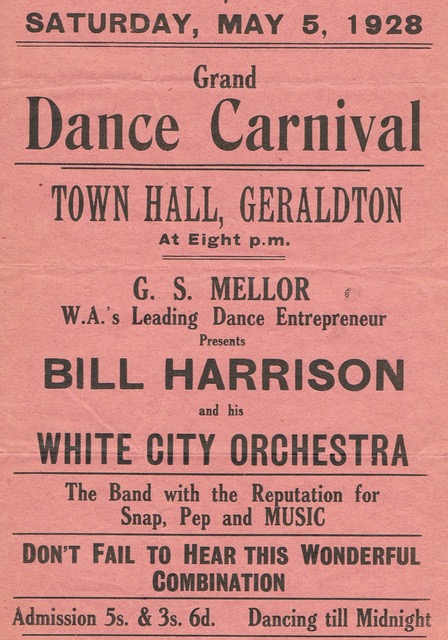
In May 1928 Bill’s “White City Orchestra” comprising of six instruments (Barney Barnard – drums, Bob Schenberg – violin, Billy Williams – trombone, George Mellor – trumpet, Vic Nicholls – saxophone, William Harrison – piano) played for a Grand Dance Carnival in the Town Hall at Geraldton. The poster advertising this event states “this band is noted for its snap, pep and good music, and has a state wide reputation, so that lovers of dancing should not fail to hear this wonderful combination.”
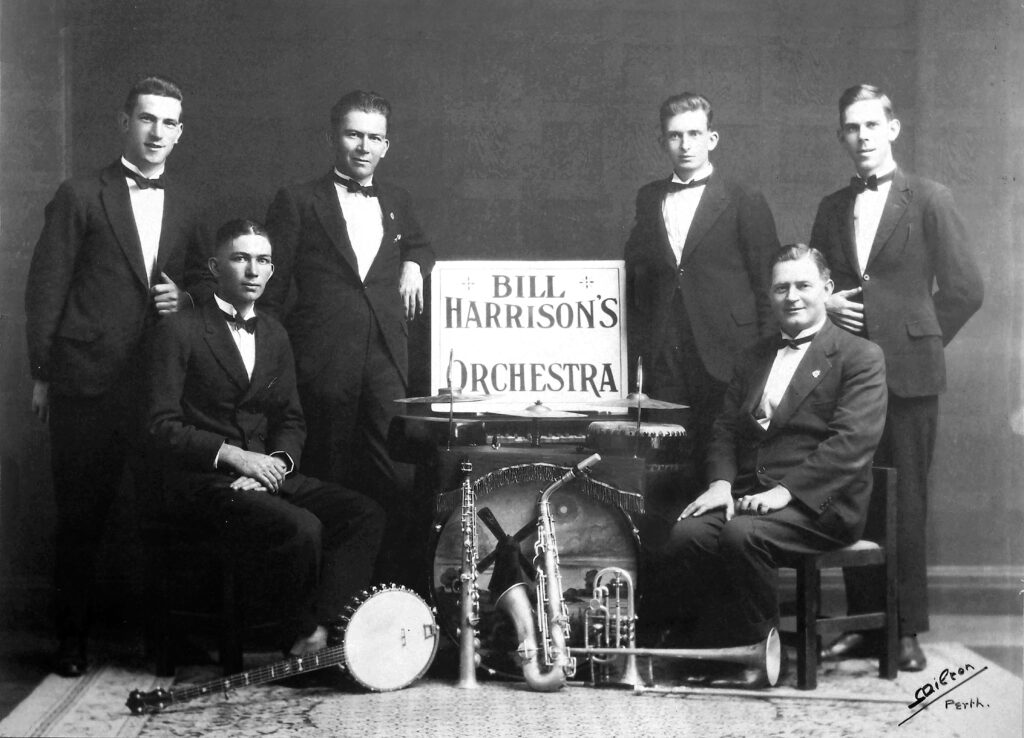 A CHAMPION MUSICIAN TO VISIT GERALDTON WITH WHITE CITY ORCHESTRA
Mr, Geo. Mellor, who will shortly be here as cornetist and manager with Bill Harrison’s Orchestra, is a man who has had many and varied experiences through life. Born in Newton, N.S.W., of a musical family, he commenced performing at the age of eight. In those days band contests were very popular and little George was a yearly contestant at Sydney and Ballarat. He has won no less than thirty two medals, apart from prizes for cornet playing. Since coming to Perth he has been conductor of the Perth City Band and of later years the R.S.L. Band. During the war he was well known to Diggers as bandmaster of the popular 16th Batt. band. Since the war he has spent some years touring the world with the Australian Commonwealth Band, and has just, returned from America with that combination. George is recognised as the leading cornetist in the West.
The Geraldton Express Monday 23 April 1928 page 3
CITY ORCHESTRA LUNCH-HOUR PROGRAMME TOMORROW
Harrison’s White City Orchestra of six instrumentalists will conduct their dance carnival in the Town Hall tomorrow night, when a splendid entertainment can be expected. The party, which is on its way back from the annual Murgoo event, will also play about Noon tomorrow Nicholson’s in Marine Terrace, which firm will be featuring and providing the music.
The Geraldton Express Friday 4 May 1928 page 2
From June 1928, William Harrison’s orchestra played at the old time dances in the King’s Hall, Subiaco every Friday night.
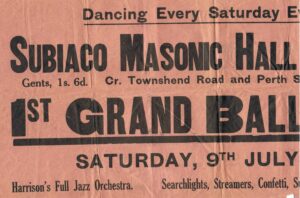
In 1929 the Diggers Fair Committee appointed his orchestra of four players to play at their Carnival at White City during March and April. He also directed the “Altona Orchestra” at the Bon Marche dining rooms, Hay Street, for a supper dance.
Presentation to Sir Thomas Coombe
At the annual smoke social of the West Perth Sub-Branch on the 19th, Sir Thomas Coombe was presented with the League’s Certificate and Badge of Merit. In addition to the guest of the evening there were present Colonel H. B. Collet (State President). Colonel Roberts (Deputy P.M.G.), Mr. T. A. L. Davey, M.L.A Captain Hugo Throssell, V.C., and representatives of other sub-branches. The presentation was made by Colonel Collett in his capacity of State President. Colonel Collett said that the recommendation which emanated from the West Perth Sub-Branch was endorsed by the State Executive, and the last Federal Conference, held in Sydney, unanimously authorised the award. Sir Thomas Coombe’s services included making available scholarships for soldiers’ children, providing entertainment for similar children, encouraging the Fallen Soldiers’ Children Scholarship Trust by his interest in the annual movie ball, assisting during the war the Friendly Union of Soldiers’ Wives, and doing many other private acts of charity. “To use language with which you are familiar,” said the Colonel, as he smilingly handed over the certificate, “this is a story of one reel, a human document which will in the future remind you of the gratitude of this League to you,” Sir Thomas Coombe responded appropriately and paid a glowing tribute to the valuable assistance he had received in his various charitable efforts from his right-hand man, Mr. Hamilton Brown. In proposing the State Executive, Mr. H. P. Clarke ably outlined the objects of the League. Among the other toasts honoured were the West-Perth Sub-Branch, the visitors, and the Press. Mr. C. P. Smith gave a series of his inimitable war stories, some of which we print in another column. Colonel Roberts, who is no mean raconteur, weighed in with a few good ones also. In responding for the visitors, Mr. T. A. L. Davey stressed the importance of returned men taking part in the public and political life of the State. An apology was received from Mr. J. Heath, of King’s Park. In his letter, Mr. Heath gave a summary of the position with regard to the Honour Avenue. Many improvements have been carried out, and the Master Painters have now completed the work of repainting the name plates. Musical items were rendered by Messrs. Clarke, G. Philp, R. H. Viner, and H. G. Neate. Mr. Harrison presided at the piano, and the arrangements for the evening’s entertainment were ably carried out by Mr. P. L. Ross. Mr. Hubert Parker, President of the Sub-Branch, was in the chair.
Listening Post Friday 25 January 1929 page 6
DIGGER’S FAIR OPENING TONIGHT Conducted by the Perth sub-branch of the R.S.L. the annual Digger’s Fair for ex-soldiers “up against it” will open this evening at White City. Among the many attractions are the Carlrenos, magicians whose slight of hand tricks and illusions have been eulogised by the Eastern states and New Zealand press. Harrison’s Orchestra has been engaged for the dance floor, and there will be waxworks and Punch and Judy shows, and numerous games of skill. The usual admission fee (6d) has not been increased.
Daily News Monday 11 March 1929 page 8
In March 1929, The Prince of Wales Theatre advertised the screening of its first Talking Picture movie, bringing the end of an era and employment for many musicians.
THE FIRST REAL TALKIE AT THE PRINCE OF WALES’ THEATRE.
After years of silent pictures, which America, the seat of the Movie Industry, has brought to perfection, audiences all over the world are to be given an opportunity of attesting the wonderful discovery of “Cine-sound.” in other words the “Talking Picture,” to be co-ordinated in Australia with the Western Electric System. Just as the gramophone, some 15 years ago, gave promise of making rapid strides, so does “Cinesound”. Western Electric System intend to revolutionise the moving picture world. The silent picture will still be with us, with “Cinesound” Western Electric System as an added attraction. There will be the sound picture—the synchronised sound picture—the talking sequence, and last, but not least, orchestration by film. The full, rich volume of human voices will emanate from the film, and what is more wonderful still, no matter how far back in the theatre a patron is seated, that voice from the screen, with its full power, will be heard as clearly as if the seat was in the front of the house. “The Jazz Singer” will be the first Cinesound to be presented by Union Theatres—at: the Prince of Wales Theatre, “‘The Jazz Singer” is the very film that revolutionised the movie industry from silence into speech. It features Al. Jolson, the highest paid minstrel singer in the world, who it is said was born with a sob in his vocal chorus, that just get into the “hearts of the people and thrills them as only a sympathetic voice can. Cinesound will be exclusive to the Prince of Wales Theatre in Perth, and during the next few weeks Western Electric experts will be engaged in preparing for the initial presentation of the sensational entertainment, “The Jazz Singer.” There are many other items to accompany the long feature and each of these will have its own interest.
Westralian Worker Friday 15 March 1929 page 7
DIGGERS’ FAIR At the Diggers’ Fair tonight Eugene Knoop (caricaturist) will make his, first appearance. Harrison’s orchestra will provide music for the dance floor, admission to which is free except on Friday and Saturday nights. Eroni (wire walker) and the Rolling Rollos have been booked for a short season. The proceeds of the fair will augment the amelioration fund for distressed ex-soldiers and their dependants.
The Daily News Monday 18 March 1929 page 2
British United Services Association The B.U.S.A. scored a brilliant success on March 4th, with their first annual ladies’ night. Members and friends to the number of about 200 romped and frolicked the time away, “lights out” coming all too soon. Mrs. Hopperton and her popular hubby, Harold, were in good form. Mrs. Tom Tandy had a surprise birthday cake presented—a real surprise. Master Roy Facey excelled himself on his xylophone. Bill Smudge, the funny man; Bill Harrison, at the piano; and others, too, all lent a hand to make the evening a success. Mrs. Cattermole helped with the programme, too, and later helped herself by winning the two big boxes of chocolates. The crowd have asked for another night. The Executive are considering the possibility on the evening of the annual meeting—probably June 10th. BUT—be on parade Anzac Day!
Listening Post Friday 22 March 1929 page 8
DIGGERS’ FAIR. The last three nights are announced of the Diggers’ Fair, White City. The principal attractions to-night will be a wrestling display by Billy Meeske at the stadium, roller skating on the dance floor by the Rollos and buckjumping at the rodeo. Harrison’s orchestra will provide the music for dancers.
The West Australian Thursday 4 April 1929 page 16
On 16th July 1929, Bill and Edna had their second son, Ramon Kerr Harrison.
HARRISON. — On July 16, at Kiama Private Hospital, Nicholson-road, Subiaco,
to Mr. and Mrs. W. Harrison, of Hollywood — a son.
Whilst working in the Electoral and Titles Office (the Treasury buildings and Titles Office buildings bounded by Barrack St, St Georges Terrace and Cathedral Avenue) William Harrison bought blocks of land in Inglewood and Subiaco (40 acres) for about 10 shillings a block/acre. His brother Lou and father Arthur built houses on these blocks to sell. This house at 112 Derby Road, Subiaco (now Shenton Park) later became the home of Vera and brother Lou Harrison.
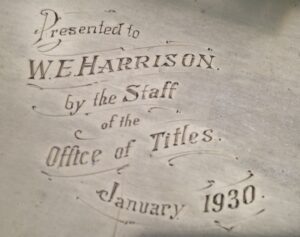
In 1930 William Harrison was presented with a silver plate by the Staff of the Titles Office, perhaps denoting 10 years service. One of his tasks at the Titles Office was utilising his beautiful pen and ink calligraphy on the actual titles.
Sailors and Soldiers Section A particularly successful dance was conducted by the Nedlands sub-branch of the R.S.L. on Thursday last when patrons so outnumbered the estimate that the smaller hall of the Broadway Theatre had to be vacated for the bigger floor space below. Expecting 100 and making provision for this number, the Women’s Auxiliary had the pleasing experience to almost the second century. Bill Harrison’s Orchestra provided excellent music up till midnight, and Mrs Goodman fed the multitude.
Sunday Times Sunday 25 May 1930, page 3
On Parade. Nedlands R.S.L held a dance in the lesser hall at the Broadway Theatre recently and the attendance rather staggered those running the show. The women’s auxiliary were told to expect about one hundred, and catered accordingly, but when double that number turned up, hurried arrangements had to be improvised, and the larger hall at the theatre utilised. Bill Harrison’s Orchestra provided the music and Mrs Goodman’s provisions left no room for complaint.
Western Mail Thursday 5 June 1930 page 2
RETURNED SOLDIER FIXTURES. The monthly dances organised by the Nedlands sub-branch R.S.L Women’s Auxiliary was held in the Nedlands Picture Hall and was an unqualified success in spite of the very inclement weather, some 70 couples taking to the dance floor – which was very gratifying to the newly elected president (Mrs George Randell), the hon. Secretary (Mrs A. Terelinck) and their band of willing workers. Musical items were rendered by Mr and Mrs Darwell while Bill Harrison’s Orchestra again catered for the dancers. The next dance has been arranged for Thursday 24 July.
Sunday Times Sunday 6 July 1930 page 12
British United Services’ Association The B.U.S.A. holds its annual ladies’ night, social and dance, at R.S.L. Headquarters, Perth, on Monday, March 31st. An enjoyable programme has been arranged—songs, dancing competitions, and fun for all. With ” Bill ” Harrison at the piano, the music, like the catering, will be exceptionally good. Any member who has not received an invitation by post, is requested to send his address to the secretary, 229 Charles St., North Perth. The price of admission is two shillings (ladies with male escort free). Anyone from the Old Country is invited to drop in and renew old friendships. The Executive of the British United Services’ Association requests that all Imperial ex-service men in the metropolitan area will parade at the sign of the Union Jack outside R.S.L. Headquarters, on Anzac Day for the march and combined service on the Esplanade. The muster each succeeding year has considerably increased since the Imperials have been organised, and it is hoped that this year they will show a larger parade state than any other unit. For exact time watch the Press.
Listening Post Friday 21 March 1930 page 16
PREFERENCE POLICY – RETURNED SOLDIERS’ PROTEST – Mass Meeting to be Held To-day
Today, at 3 p.m in the Prince of Wales Theatre, a mass meeting of returned soldiers is being held to protest against what is considered the general disregard of the preference policy by the Government. Invitations to accept positions on the platform have been accepted by many prominent citizens, who served with distinction during the war years. The theatre will be opened at 2 p.m., and from that hour until the commencement of the meeting, a purely “digger” orchestra, under the leadership of Mr. W. Harrison, will entertain with selections and community songs. There will be eight speakers to put forward the resolutions to be submitted, and they will be drawn from various parts of the State. The convenors (Perth sub-branch of the R.S.L.), has received many letters and telegrams of support from sub-branches throughout the country, also from many kindred organisations. The British United Services Association has asked to be allowed representation on the platform, and their request has been agreed to. The meeting will be strictly confined to ex-service men only, and all entrants must produce something to satisfy the doorkeepers of their bona fides.
Sunday Times Sunday 28 June 1931 page 6
On 12th August 1931, Edna and Bill had twins: Jill Lois and Jack Louis.
It was also the birthday of their 25 year old mother, Edna who didn’t know she was having twins – apparently her husband was so surprised he forgot to wish her a happy birthday! Edna must have had good babysitters for sons Bill Jnr (6) and Ramon (2) as William managed a gig a couple of days after the birth of the twins Jack and Jill on 12th August 1931:
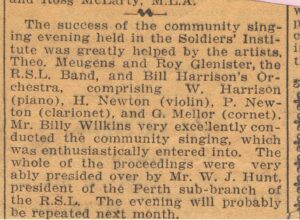
Sailors and Soldiers Section The success of the community singing evening held in the Soldiers’ Institute was greatly helped by the artists. Theo Meugens and Roy Glenister, the R.S.L. Band and Bill Harrison’s Orchestra comprising W. Harrison (piano), H. Newton (violin), P. Newton (clarionet) and G. Mellor (cornet). Mr Billy Wilkins very excellently conducted the community singing which was enthusiastically entered into. The whole of the proceedings were ably presided over by Mr. W. J. Hunt, president of the Perth sub-branch of the R.S.L. The evening will probably be repeated next month.
Sunday Times Sunday 16 August 1931 page 9
On Parade The Perth sub-branch deserved all the congratulations they got in the success of their recent community singing night. Not only did those present thoroughly enjoy themselves, but thousands were able, by means of wireless, to picture themselves back in the old possies where such songs were sung so long ago. Geroge Mellor and Bill Hunt, secretary and president, soloists Theo. Mengens and Roy Glenister, the R.S.L Band, and Bill Harrison’s Orchestra, all deserve a hearty pat on the back.
Western Mail Thursday 3 September 1931 page 2
ON PARADE Perth sub-branch of the R.S.L. will be staging another community singing night at the Soldiers’ Institute on Tuesday, September 29. All the old songs of other days will be sung and Harold Hopperton will assist with vocal items and monologues. George Mellor on the cornet and Bill Harrison at the piano should help the proceedings along: There is no charge for admission and diggers are invited to bring their friends.
Western Mail Thursday 17 September 1931 page 2
LATE SOCIAL NOTES Members of the 51st Battalion held their annual reunion in the Soldiers’ Institute on Friday evening last, when a good number of this famous battalion, including their V.C. (Cliff Sadlier), enjoyed a splendid night’s entertainment. President Roy Brown (who has held office for 10 years) controlled proceedings and his committee assisted by Bill Harrison (piano), and artists West, Jennings and Healy made the night one to be remembered.
ANNUAL SMOKE SOCIAL Senator Collett Honoured
Thoughts of monetary reform and other subjects which had been debated seriously during the past three days were thrust aside by delegates and others who attended the annual smoke social of the Returned Soldiers’ League, at the Soldiers’ Institute last night. A number of toasts were enthusiastically honoured ; songs were sung and musical items tendered. The State president (Senator H, B. Collett) was in the chair for the ninth year, and during the evening feeling reference was made to his impending resignation. On behalf of delegates to the conference, Lieutenant Colonel T. C. Fairley presented the president -with a gold wristlet watch, suitably inscribed. Senator Collett’s successor will be elected to-day. The first toasts honoured, were to the King and to ‘Fallen Comrades.’ In proposing the toast to ‘The Government and Parliament of Western Australia.’ Lieutenant-Colonel Fairley said that the Government could be sure that the conference was doing its best for the country and ex soldiers should have equal faith in the Government. The Minister for Agriculture (Mr. Millington), responding, congratulated the league on the excellence of its organisation. Stating that countries best equipped to defend themselves were best able to ensure peace within their shores, Archdeacon C. L. Riley stressed the need in Australia for an adequate defence, when proposing the toast ‘ to ‘The Armed Forces of the Crown.’ In a humorous speech, the District Commandant (Brigadier A. M. Martyn) responded. He, too, stressed the point that armed forces existed to prevent, not to provoke, war. He paid tribute, to the league, and to the rifle club movement, as valuable means of inspiring loyalty in citizens. Other toasts honoured were:— ‘The R.S.L..’ ‘The Primary Industries of W.A.,’ ‘Our Guests,’ proposed by Mr A.Yeates and responded to by, the Leader of the Opposition (Mr. Latham), the Lord Mayor of Perth (Mr. J. T. Franklin, MLC.),’ and Sir Charles Nathan. MLC. ‘The Press,’ ‘The ‘Staff, ‘ and ‘The Chairman.’ Messrs. H. G. Neate and W. Savage rendered vocal items. Messrs. Ted Scott and W. Talbot delivered monologues, and Mr. W. Harrison was at the piano.
The West Australian Thursday 5 October 1933 page 15
In 1934, the twin’s Godmother, using her “adopted” name Dorothy Irene Harrison, married George Ray who was also an orphan at Parkerville: A pretty wedding was solemnised at Christ Church, Claremont, recently between Miss Dorothy Irene Harrison and Mr George Ray. The ceremony was performed by Rev. John Bell. The bride, who was given away by her old friend the Sister Kate, late of Parkerville, walked to the chancel steps with Mr. W. Kerr of Bayswater. Mr C. Harrison was best man… At the conclusion of the ceremony Mr and Mrs W. Harrison of Nedlands entertained friends of the bride and the bridegroom at a very pleasant wedding party. Mrs Harrison wore a becoming dress of hyacinth blue marocain, touched with silver. Among the guests were sister Kate and Sisters Hayman and Bennett of Tresillian Hospital where the bride spent many happy years.
Western Mail Thursday 18 October 1934 page 31
William was by now working at the Electoral Office:
ROLL-PURGING WARNING TO CANVASSERS.
One Ordered to Pay Costs. ‘If people actuated by public spirit, or other motives, object to names being on the electoral roll, and fail to sustain valid objections, in future they will be liable for the costs,’ said Mr. H. D. Moseley. P.M., at the Perth Courthouse yesterday, after 28 objections to names on the Claremont and Nedlands rolls had been found to be without grounds. ‘In this case.’ he added, ‘the objectors were certainly not desirous of helping the Electoral Department. There was something under lying it.’ Altogether 238 electors were called upon to show cause why their names should not be removed from the two rolls. The Magistrate ordered the forfeiture of 2/3 deposit by the objector in each case where the elector had been found to be correctly enrolled, and in the case of one elector, who was represented in court, he awarded £1/1/ costs to be paid in addition. W. E. Harrison, Electoral Registrar for the Claremont district, said that objections had been lodged to 151 names on the Claremont roll. The department had investigated the cases and found that 17 of the names were correctly enrolled. Most of the objections, including all those to the names correctly enrolled, had been signed by L. M. Fitzsimmons, who objected on the grounds that the electors no longer lived at the addresses shown against their names.
The West Australian Thursday 14 February 1935 page 19
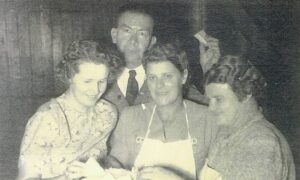
William purchased a property at 24 Highway Nedlands that had a shack on it. The shack was dismantled and rebuilt by brother Lou on one of his blocks of land in Kalamunda. He then applied for a building licence for a new ho9use to be built. Wife Edna and her sister Bessie started their own catering company and the house was built to accommodate it.
REAL ESTATE – 1935 Other new work authorised in the metropolitan area includes: – eight room brick residence, Highway Nedlands (1100 pounds) W.E. Harrison.
Sunday Times Sunday 3 March 1935 page 16
A NEDLANDS RESIDENCE.
Inspection Today and Tomorrow of the Spanish-Californian type of design and consisting of a hall, lounge, dining room, two bedrooms, kitchen, pantry, bathroom, laundry, workshop and garage on the ground floor, and study, two bedrooms and sleep-out on the second floor, a gentleman’s residence, built by Messrs. A. Harrison and Son at 24 Highway, Nedlands, will be open for inspection from 2 o’clock until 6 o’clock today and tomorrow. Features of the interior are texture walls and plate rails, and wrought iron balustrading. The conveniences include gas heater, gas stove and gas copper and sewerage. From the sleepout a fine view of the river is obtained.
The West Australian Saturday 24 August 1935 page 4
In 1936 Jack and Jill started their musical studies at the age of five under the instruction of their father. Jack was given a harminca by his older brother Bill and showed immediate signs of musical talent.
On 10th April 1937, William’s youngest brother Charlie Harrison was married to Emerald “Emmie” Koefod and William Harrison provided the music:
Picturesque Wedding at St. Mary’s Church – Miss E. M. Koefod and Mr. C. G. Harrison An attractive wedding was solemnised at it. Mary’s Church, Colin-street, West Perth, when Emerald Marion Koefod, youngest daughter of Mrs. E. Longbottom, of Aberdeen-street. Perth, was married to Charles George Harrison, of Kitchener Street, West Subiaco. The Rev. Stillwed performed the ceremony. The bride, who was given away by her foster-brother, was a charming figure in a frock of white Chantilly lace over white satin, and featuring a graceful frilled train. Her attendants were Miss Pearl Koefod (sister) and Miss Nellie Longbottom. They were dressed alike, wearing blue Chantilly lace over blue satin, and carrying bouquets of pink roses. The trainbearer, little Judith Harrison wore a dainty pink satin frock and carried a bouquet of pink and white roses. The bridegroom was attended by Mr. Joe Koefod, brother of the bride, as best man and Mr. Ray Fullerton was groomsman. The wedding breakfast was held at Keough’s Hall, the tables being artistically decorated, pride of place at the bride’s table being given to the handsome wedding cake. During the repast the customary toasts were honoured and telegrams read. Many of these came from relatives in the Eastern States. Dancing and games were enjoyed, and excellent music was supplied by Mr. William Harrison’s orchestra. Later in the evening the bride and bridegroom left by car for a tour through the South-West, returning through the Great Southern districts. The bride’s twilling frock was a smart maroon ensemble of wool crepe-de-chine, with matching accessories. The bride and groom were the recipients of numerous beautiful presents.
Sunday Times Sunday 6 June 1937 page 3
ELECTORAL ACT BREACHES Six Cases in Police Court. “There are hundreds of other similar cases under consideration which will be brought before the court unless claim cards are received promptly,” said Mr. W. E. Harrison, of the State Electoral Department, during the hearing of six charges, laid by the department, in the Perth Police Court yesterday. Mr. T. Y.A. Lang, P.M., was on the bench. The charge in each case was of having omitted, within 21 days after a change of address from that shown on the electoral roll, to make and sign a new claim and forward it to the electoral registrar for the district. None of the defendants appeared in court but in some cases letters from them were handed to the Magistrate. Referring to the first case, in which Eva Kathleen Harris was charged, Mr. Harrison said that in August he objected to her enrolment as at an address in Bruce-street, Nedlands, and she informed him that she had moved to Stirling-highway. On September 7 he sent two cards to her, with a memorandum asking her to fill them in and return them. They were not received and on September 21 a form was sent to her, as the first step in the proceedings. About seven days later a card was received from her. Defendant was fined 2/6, with 3/costs.
The West Australian Friday 21 October 1938 page 16
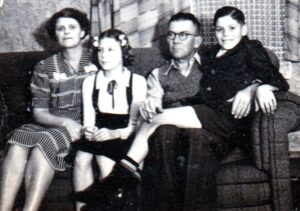
In January 1939 William Harrison entered Jack into the first competition he won was when he was aged 7 at a Scottish Community Concert at the Perth Town Hall. This link with the Scottish community was no doubt through Edna Harrison’s father, William Walter Kerr ,and her sister Bessie who were members of The Caledonian Society:
Scottish Concert. Under the patronage and in the presence of His Excellency the Lieutenant-Governor (Sir James Mitchell) and Lady Mitchell, the West Australian Scottish Union will conduct a Scottish concert in the Perth Town Hall tonight. There will be community singing of Scottish songs and Scottish amateur trials. Doors will be open at 7 o’clock.
The West Australian Monday January 2 1939 page 4
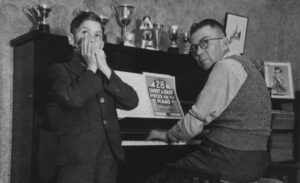
William accompanied his son Jack in the many concerts and broadcasts in which he performed:
Digger’s Night On August 4th (next Friday) 25 years after the war began, a digger’s night will be held at the Fremantle Town Hall community concert broadcast by 6PM-AM. On that night the amateur trials will be presented by returned men only. Next Monday night will also be digger’s night at the ANZAC House community concert broadcast by the same stations. At one of these concerts ex-service men in the amateur trials will compete for a cup provided by an anonymous donor. Songs of 20 years ago will make the “rafters” sing on both occasions. Votes of listeners and the opinions of independent judges will decide which two of the seven competitors in the search-for-talent and two of the competitors in the ace-announcer quest qualify for the final. Voets must reach station 6PR or W.J. Lucas Ltd, Hay Street Perth, by Wednesday. Cancassed votes render a candidate liable to disqualification. Results will be announced in The Daily News on Thursday. Other items on a thoroughly enjoyable programme were given by Miss Joan Stanton and Mr John Anstey, by Jack Harrison, eight-year-old mouth-organist, and by Niddy Roberts and his Laughmakers. Community singing again proved highly popular. The winner of the search is to be given a first-class return trip to Sydney with guaranteed engagements at Eastern states broadcasting stations. The ace-announcer selected will be given a trip to Sydney and a full-time job on arrival there. These substantial prizes are being offered by the sponsors of the contest, W.J. Lucas Ltd, M.J. Bateman Ltd, Milligan Street, Perth and Messrs. Randell and Long, Fremantle.
The Broadcaster July 29- August 5 1939 page 75
PEOPLE YOU LISTEN TO
One day a 12 year old boy named Bill was standing thoughtfully outside a shop window in town. Suddenly he put his hand in his pocket, pulled out three pence and, walking into the shop, exchanged the coins for a mouth organ. Then he went home and handed the mouth organ to his six year old brother, Jack Harrison, as a Christmas present. By the time his father came home from work Jack could play the chorus of “When I Grow too Old to Dream”. That was 18 months ago. From the 3d instrument Jack has gone on to a two-and-sixpenny one; then the priced jumped to 6/6 and then 25/, until today you will see him playing with 3 pounds worth of wood and metal. Last Thursday night Jack was programmed to appear at the 6PR community concert. But this seven year old boy was not going on as a competitor – he was programmed as a guest artist.
The Broadcaster August 5-12 1939 page 13
Australia entered World War II on September 3, 1939, immediately following Britain’s declaration of war on Germany. Prime Minister Robert Menzies announced the involvement, prompting a rapid volunteer mobilization for the 2nd Australian Imperial Force (AIF) to support British forces in Europe and the Middle East, while initiating home-front preparations.
Being an ANZAC digger from World War I, William Harrison was very involved in the Returned Soldiers’ League and was always supportive of fundraising events that supported the war effort and entertained the troops as well as community concerts aimed at raising morale. Radio news and broadcasts were central to many lives, especially those who sent members of their family to the war and were desperate for news of their loved ones.
William Harrison knew all the right people in Western Australia’s music scene having managed his own band during the 1920s and obviously contacted them in order to promote his young son, entering him in competitions and exposing him to the public with concert and broadcast performances.
The first mention of the impact of WWII is evident when Jack performed at ANZAC House on November 29th 1939 as part of the annual “Festival of Toys” fund for orphans broadcast by 6AM-PM:
According to a note from “Peggy” of 6AM-PM, the annual “Festival of Toys” fund for orphans is proving a great success, over 50 pounds already having been collected, much of which has been sent in by listeners, who have been surprised to learn that in the 18 orphanages in and around Perth there are 1330 children. The “Festival of Toys” provides at least one toy for each of these children and two representatives from each orphanage are selected by the children themselves to receive the toys on behalf of the others. This function will take the form of a studio party on December 19 when the staff of 6AM-PM will entertain the children with cakes, ices and Christmas fare. Afterwards some 50 or 60 children will sing carols, the choir being augmented by the choir of boys of St Mary’s Church, South Perth, under the direction of Mrs Pannet. This will be broadcast during the children’s session at 5.30p.m.On November 29 a concert at ANZAC House under the direction of Bill Talbot realised 30 pounds for the festival, assisting artists being Gwen Reid, Betty Day, Carmel Burroughs, Les Adams, Reg Smirke, Hugh Hay, Jack Harrison, Alan Roydhouse, Frank Peterson and Letty Hoskins (pianist.). The sum raised at this function included 9 pounds sent over from the naval and military men in camp at Rottnest and also from the residents. A Christmas concert organised by Bill Talbot will be held at Wooroloo Sanitorium on December 17.
The Broadcaster Dec 9 – 16 1939 page 31
In October 1940, Jack won first prize (75 pounds) in “Search for Talent” on the mouth organ accompanied by his father on piano, competing against largely adults and professional players. The prize was presented to him by Bryn Samuel, Manager of W.A. Broadcasters Ltd at the Grand Theatre. Broadcaster magazine wrote “the scene prior to the presentation of prizes for the 6ML Search for Talent at the Grand Theatre last Friday. Announcer Ned Taylor, second prize winner Eunice Nadin, Jack Harrison (first). Edith Carr (third) and station manager Bryn Samuel. The first prize was 75 pounds, the second 15 pounds and the third 10 pounds”. The Broadcaster October 26 – Nov 2 1940
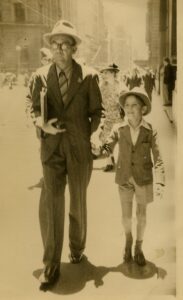
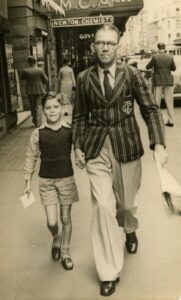 As a result of this win Jack travelled with his father to Sydney, where Jack had lessons with famous harmonica soloist Horrie Dargie, and then travelled to Melbourne. His father had set up professional engagements for him with Sydney radio 2LO, picture theatre bookings and secured a contract to appear with Dick Freeman’s Orchestra at the Trocadero.
Jack was offered a season on the Tivoli circuit. The Colgate-Palmolive “The Youth Show” premiered in Sydney on July 17 1940 and was produced by Russell Scott on 2BH with George Patterson Pty Ltd Agency handling the artists. Jack Harrison was a guest artist on several occasions whilst in the Sydney in 1941 and it was broadcast nationally by 2GB to 5DN-RM, 3AW, 6PR-TZ and 4BH. “All the players were presented with kits containing complete ranges of all Colgate-Palmolive products.”
Commercial-Broadcasting-Vol-9-No-03-1940-08-01.
PEOPLE YOU LISTEN TO
The small head of Jack Harrison, nine year old mouth organ exponent, was crowned with success within a week of his arrival in Sydney. Jack, by the time this is read, will have been in the harbour city for two weeks of a seven weeks’ tour, made possible when he won the first prize of 75 pounds from adult and professional competitors in the 6ML “Search For Talent” three months ago.
In Sydney, his father tells me in a letter, he’s having an hour’s tuition a day from Horrie Dargie, outstanding mouth organist. Within a week of his arrival the Tivoli Theatre circuit had offered him a Commonwealth-wide tour, but it was rejected by his father, who thought it would be too strenuous.
But fame did not stop the Tivoli offer. The nationals and locals in Sydney have both pounced upon him for microphone “appearances”. He is booked to appear in the Australia-wide “Amateur Hour” (6IX-WB, Thursdays in this State of W.A.) while he is making four broadcasts weekly for a sponsor on 2SM and has contracted to make four recordings with orchestra for another commercial station. When he is not engaged as described above or resting, he can be seen with Dick Freeman’s band at the Sydney Trocadero. On the return trip he’ll be broadcasting in Melbourne…And all in the first week.
The Broadcaster January 4-11 1941
Talking Shop- By “Finn” – Westralian Wonder
From farther and farther afield come the stars of 3Aws “Youth Show” and the latest on the list is an amazing young man from Nedlands, Western Australia. He is nine year old Jack Harrison who surprised everyone by winning the first prize in the big 150 pound “Search for Talent”. He competed against allcomers and won by popular vote, although listeners had no knowledge of his age or identity. Jack started playing the mouth organ …he will feature in the broadcast from 3AW.[1] And 4BH[2]
Jack’s father tells me (per the P.M.G.) that he has met at least 14 W.A. people in Melbourne and Sydney who are tops in the eastern entertainment world. He cut out newspaper references to some of the W.A. people which have appeared during the few weeks he has been in the East and forwarded them to me. One about “Duffy” Newton (who used to act in 6WF plays) made about ten inches of type, had a double column heading and carried a photo. Other cuttings contained photographs of David Samuel (deputy-leader of Bert Howell’s Band and leader of last year’s “Youth Sow” band), Chester Bond (who is at present featured in a big radio serial), Bob Gibson and George Watson (a principal of the Drum Club).
The Broadcaster February 1 – 8 1941
Jack was offered a weekly recording session and broadcast which was recorded at the 6AM Studio in the old ABC Broadcast House on a Sunday. William Harrison, his father, managed and accompanied him for his performances and kept a diary planning the repertoire for each show.
William Harrison cut this article out of the paper in November 1941:
Want Pixies’ Pay Cut – MELBOURNE, Thursday.
Whether the pixies, fairies, sprites, elves and gnomes who appear in Christmas pantomimes are overpaid at £1/12/6 a week was argued in the Arbitration Court yesterday. Theatre executives say that this is too much. No pixies were present in Court to put their side of the case. In an affidavit concerning wage claims, managing director Frank Tait of Australian and New Zealand Theatres Ltd. said that parents gladly sought the opportunity of having their children in productions. ‘EXCESSIVE’ Present award rates for juvenile performers were considered excessive under pantomime conditions and their effect was to limit the number of children employed, he said. It was felt that employers and parents alike would welcome the wider opportunities which reduced rates would provide. General Manager Wallace Parnell of the Tivoli Circuit said that under the present award rates it was necessary for even a child of nine to be paid £1/12/6, even though the child had to appear on the stage only for a maximum of 22 minutes six times a week. Under those conditions, it was obvious that employers could not employ as many children as they would normally. It made no difference to the show whether there were 20 or 50 children in it. Children regard pantomimes as part of their Christmas holiday enjoyment. The hearing was adjourned.
The Daily News Thursday 27 November 1941 page 12
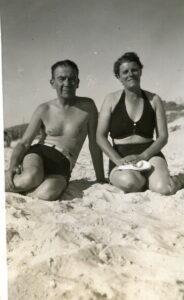
1944 was Jack’s last year at Nedlands State School. His father encouraged he and Jill to take up second instruments. Jll was given a bassoon. Jack wanted to pay french horn, but his father talked him out of it, pointing out that it was too limiting and that if he played clarinet he could play both jazz and classical. Jack began studying the clarinet with Percy Newton.
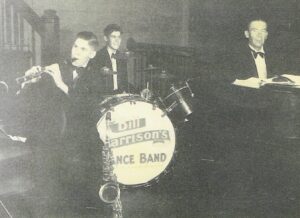
1945 Sunday nights became “jam session” night at the Harrison’s Nedlands home, with all four children (Bill Jnr on saxophone) joining in.
On the 18th March 1946, William Edward Harrison, Jack’s father, officially retired from his position as Clerk, Electoral Office, Crown Law Department at the age of 48.
LEGISLATIVE COUNCIL. BIENNIAL ELECTIONS. CENTRAL PROVINCE.
METROPOLITAN-SUBURBAN PROVINCE.
I have this day received a Write for the election of One Member for the above Province. Nomination Day: Wednesday. 10th April 1946. at 12 noon. Polling Day: Saturday. 4th May 1946. Chief Polling Place: State School. Bagot-road. Subiaco. W.E. HARRISON.
The West Australian Saturday 30 March 1946 page 15
William advertised his own dance band regularly in The West Australian:
1946 – Available-Bill Harrison’s Dance Band for Weddings, etc. ring WM2755
The West Australian Monday 1 April 1946 page 14
OLD-TIME and Modern Dance, Tonight and every Friday night, Victoria Park Town Hall Bill Harrison’s dance band. Val Stevens, M.C. Conducted by Ex-Servicemen’s Cricket Club.
The West Australian Friday 5 April 1946 page 15
Bill Harrison’s Dance Band specialises in weddings, parties, etc. Hall and catering arranged if desired. Phone WM2755.
The West Australian Wednesday 16 October 1946 page 23, 29 Nov1946 page 22
MANJIMUP – AROUND THE TOWN
Visitor to Tuesday’s R.S.L. social “do” afterwards described it as a “slashing” supper. Mr. J. F. Smith was at the piano, and among other artist’s contributing to a most pleasant evening were: Messrs McKinnon (saxophone) L. Archer (accordeon) and W. Harrison, who said something about the “Inside In” or “Outside In”—well why, worry—it was well given R.S.L. has a habit of producing variety when put to the test and even yodelling cowboy was produced.
Manjimup Mail and Jardee-Pemberton – Northcliffe Press Friday 7 March 1947 page 11
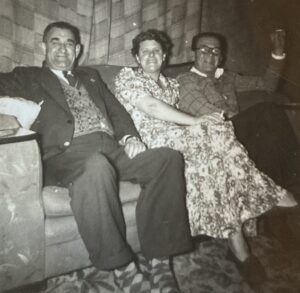
Pen Points on Perth – By Harry Black
A young man who is quickly coming into prominence in the local dance-band world is up-and-coming-altoist Jack Harrison. I had seen this name featured in many current dance-hall adverts., so snooped around to find who this “stranger” was fronting his own small outfit in quite a few nice little jobs, and was agreeably surprised to find former harmonica-wizard Jackie Harrison (now 15 years of age) tootling away on sax and clarrie with as much ease and confidence as many a veteran.
“SOMETHING OF A SENSATION”
He seemed to be reading almost anything around the place as well as finding his way around many of the old “fakies” with plenty of improvising. This may sound a tall yarn for one so young, but readers should remember that Jack Harrison was featured here in W.A. as somewhat of a sensation with his brilliant harmonica work and, after capturing all the local radio spots that he could, he went east to Sydney (when only 9 years of age) and there, after topping the poll in an Australian Amateur hour programme, fulfilled many radio dates with prominent Sydney radioites – Jack Davey’s Shows, the Youth Show and others. Thence to Melbourne to do a round of their Tivoli circuit and came happily back to Groper-land (NOT the least bit swell headed!!). Since his return Jack has been studying music very seriously, besides keeping many radio engagements, throughout each year – and now the fruits of his studies seem to be bearing well – judging by his easy switch to reed instruments in his own band.
IT RUNS IN THE FAMILY
Music is an integral part of the Harrison family, as veteran pianist Bill Harrison is Jack’s proud poppa, a sister plays piano in Jack’s outfit while a brother wields the drumsticks. Jack is being ably coached in his sax work by Ken Murdoch, while h is also studying “legit” clarinet with A.B.C. woodwind-ist Alan rule. Apart from these few activities, plus his harmonica appearances, plus his home rehearsals, plus his rehearsals with the A.B.C. Amateur Symphony Group, plus his private practise – Jack still finds time to be a modest 15 year old Aussie. All his many friends in local musical circles predict quite a musical future for young Jack – so we wish him the best of luck!!
Music Maker July 21 1947
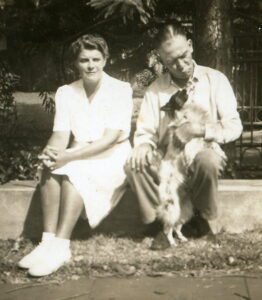
William was supervising the four hours practice a day by Ray, Jack and Jill, going from room to room to help them. He managed all their venue bookings, advertising and liaised with regards to their rehearsals at the ABC for broadcasts and performances.
In 1948 William and Edna had their first grandchild, Susan.
On 17th January 1950, William Snr (aged 52), Jack and Jill (aged 18) set sail from Fremantle aboard the Strathaird to Adelaide where Jill had won a scholarship to study bassoon and piano at the Adelaide Conservatorium. William and Jack then continued on to Melbourne and Sydney. William had written and liaised with venues and artists to ensure Jack got as much exposure and experience during the trip. During his stay in Sydney Jack performed with Frank Coughlan’s band in a series of swing concerts at the Trocadero and received an offer to stay with the band as a permanent member. Jack also received lessons from Clive Amadio. They returned to Perth on 2nd March 1950.
JACK HARRISON RETURNS TO PERTH
Jack Harrison is back in Perth after having spent two months in Adelaide, Melbourne and Sydney. It is Jack’s opinion that the standard of dance bands in the Eastern States, particularly Sydney, is very high. During his stay in Sydney, the young music maker played solo with Frank Coughlan’s band in a series of swing concerts at the Trocadero and received an offer to remain with the band as a permanent member. Coughlan’s band plays mostly specially arranged numbers from the pen of the ex-Perth pianist Jimmy Riley. Other band leaders whom Jack met in Sydney were Dennis Collinson who has a 15 piece dance band as well as his Radio Orchestra, Les White at Princess, Paul Lombard at the Celebrity Club and Wally Norman at the Roosevelt. In Melbourne, he met George Watson, Splinter Reeves, Abe Romain and Horry Dargi; and in Adelaide, Colin Bergenson who was playing at the Palais Royal. Jack feels that the highlight of his tour was his association with Clive Amadio. This artist, in his friendly way, gave Jack lessons and invited him to the radio studio during the presentation of the well-known Amadio broadcasts. Watching these, and also rehearsals gave the young player experience he could not have gained elsewhere, he says. Jack says that Amadio spends the whole week perfecting his Sunday session. Nothing is too much trouble. A staff of arrangers, stopwatch timing, a tape measure as an aid to balance and even a musician and technician with a musical score in the panel room. A photo described “to Jack, my rival from the West, Clive Amadio” now hangs in the music room of the Harrison household. Questioned regarding his plans for the future. Jack said that there appeared to be a shortage of young clarinettists in some of the Eastern States and there was a possibility of his being offered a position with one of the ABC Symphony Orchestras. He was practising hard.
Broadcaster Jack Harrison scrap book
1950 – PERTH TWINS TO STUDY HERE
Two young Perth musicians, 19 year-old twins Jack and Jill Harrison, are in Adelaide to further their musical careers.
Yesterday, Jack began his duties as second clarinettist with the S.A. Symphony Orchestra under conductor Henry Krips. Jill has been in Adelaide since March studying piano and bassoon at the Elder Conservatorium under an A.B.C. Scholarship.
Music is a family affair with the Harrisons. In Perth, Jack had his own dance band trio with Jill at the piano, older brother Ray on the drums and himself playing the saxophone and clarinet. Mr Harrison senior, who plays the piano, has his own dance band and Bill, the eldest son, plays the same instruments as Jack. Jack and Jill have ideas of forming their own band in Adelaide – “something on the lines of a Benny Goodman quartet or quintet,” they say. “But don’t get the idea that I’m keener on swing than the classics, because I’m not” Jack said today. “Otherwise I wouldn’t have tried for the job with the Symphony Orchestra.” Jack worked under Henry Krips before when Krips conducted the A.B.C. Symphony Orchestra in Perth before coming to Adelaide.
He and his sister said today the winning of a Perth dance band contest in 1948 really gave them the incentive to go on. A few months ago Jack was a finalist in the concerto competition in Perth.
Jill expects to spend all next year at the conservatorium, and hopes eventually to join the State orchestra which is being formed in Perth. Apart from his job, Jack’s main interest is in cars. He and his sister are busy searching for a flat, and hope to find one with a garage.
The News Adelaide Wednesday November 8 1950
On 20th July 1951 Jack’s ensemble auditioned at 2.30pm in A.B.C. Studio 1 by Ewart Chapple, Manager for Western Australia. “Jack Harrison and His Music” broadcast regularly for nine years on A.B.C. Radio 6WN up until 1960. The A.B.C. provided a 1 ¼ hour rehearsal followed immediately by a 1 ¼ hour pre-recording during the week (often Wednesday afternoons) and live broadcasts occurred Sunday evenings, usually 6 – 6.30pm. Jack was required to provide 27 minutes of music which were introduced by an A.B.C. presenter (often Peter Harrison – no relative) making a total of half an hour. Twenty seven minutes of new music was about 10 musical numbers that had to be new, arranged for the specific ensemble, parts copied by hand, practised and rehearsed before they got to the ABC. In 1959 Jack received a total of £42 for the above. Jack’s father William did many of the arrangements, made program suggestions, collated the music and augmented on percussion. In essence he was their manager and agent.
The first broadcast of “Jack Harrison and His Music” was on September 1951 on 6WN.
Engagement Party To celebrate
the engagement of their daughter, Miss Jill Harrison, to Mr John Mowson, Mr. and Mrs. Bill Harrison gave an outdoor party at their home in Nedlands last night. Miss Harrison wore a pretty, flared frock of pale-blue waffle pique. Among the guests were Mrs. A. Mowson, who arrived from Melbourne recently Mr. and Mrs. John Mathews, Mr. and Mrs. T. Bennett, Mr. and Mrs. A. Ackland, Mr. and Mrs. Alan Cole, Misses Stephanie James, and Shirley Flesflader. Miss Harrison and her fiancé plan to be married early next year.
The West Australian Monday 8 December 1952 page 12
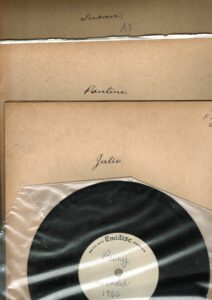 By the end of 1953, William and Edna’s nest was almost empty with all four children married. After their marriage, Jack and Marcia lived for six months with Jack’s parents until their Iwanoff house in City Beach was completed in June 1954. They rented the second storey of 24 Highway Nedlands for extra income (including tenant Shirley Moller who later married Bessie‘s son Ross George).
William was a composer and wrote “Subiaco March” and “Penny” both of which were performed by the W.A. Symphony Orchestra and broadcast by the A.B.C.
RADIO BROADCAST (1970) – 10.30 ORCHESTRA TIME
Tasmanian Orchestra – Conductor: Verdon Williams – “Penny” by Bill Harrison
He composed a work for every grand daughter: Susan, Pauline, Julie and Penny. Jody, his youngest born 1963, missed out as he was too old.
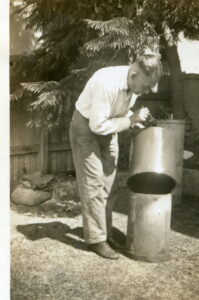 In his retirement, Bill Snr’s hobbies included the odd gig with his own band, making tom toms, gardening (especially growing red poppies and cinerarias) and tending his fishpond. He won an R.S.L award in 1955 for his garden. He managed his children’s careers, arranged music and performed percussion in the radio broadcasts of Jack Harrison and His Music. Edna and her sister Bessie continued with their catering business.
MEET THE FAMILY
By Mary Ferber
The Harrison’s of City Beach are a family who are what they are because their parents are what they are and their grandfather still is. They are music lovers and musicians. They practise partly because it is one of the things they do because they should, but also because they like to. There is no” do what I do, not do what I say” psychology in parental attitude from the parents. No lines of demarcation between popular music (what the young like) and classical (parents’ choice) any more than there is between a music lover and a musician. When four year-old Jody knocks out little tunes on the piano she is enjoying herself, but she is also being a serious creative musician and is treated seriously. And why not? These people do not learn music beginning with five finger exercises. They live it.
When Jody’s father Jack found a little mouth organ in his Christmas stocking when he was five he began his musical career. When in a few years he had one 10 silver cup,s $1000 in fees, topped the voting list in an amateur hour session and being on Eastern state tours playing his mouth organ, he backtracked according to conventional musical training ideas. He learned the piano from his father, worked hard at the clarinet and started consolidating a theoretical background. Now the States leading clarinet player in the ABC Symphony Orchestra, he has a solid knowledge of harmony, counterpoint and all that un-jazz. He still plays popular music as well as orchestral work and teaches.
His son Jay, 13, has inherited the clarinet his grandfather bought for his son Jack from a member of Johnny Turck’s US Army band during the war. He plays it in a modern group of youngsters who play Dixieland and call themselves “The Five Saints.” He also likes Mozart and playing hockey at Hale school and will sing in the school production of “Oliver”. Before the clarinet, Jay learnt the piano from his grandfather, Mr. William Harrison, as his seven-year-old brother Kimberley is doing now on Sunday night. The Harrison’s go to tea with the grandparents in Nedlands and the music lesson is sandwiched in. Bill Harrison. Senior was a part-time picture theatre pianist in the silent days with that wonderful repertoire of mood music which gave the old flicks another emotional dimension. He had to wait to resign from a government job to be a full-time musician, took a band up to the Murgoo races every year for 10 years, had a dance band and took his teaching diploma after the war. When his son had a group playing for radio, Bill Harrison did their arrangements for them. Now Jack Harrison does his own arrangements. Bill Harrison, now more than 70 and still playing and teaching on a restricted scale, belonged to that generation of parents who wanted their families to make music together. He drew his children into his own band- son Bill on saxophone. Ray on drums( he still does some playing) and twins Jack and Jill on clarinet and bassoon. At 16 the twins and Ray formed their own dance band. Playing for a Perth College dance, Jack met pretty Marcia Chayter and later married her. She is not a professional musician. She plays the piano usefully and enjoys singing in the chorus of the Gilbert and Sullivan Society as contentedly as Kimberley plays one hymn, arranged by his father, for his Sunday school.
John Mowson now Principal double bass player in the W.A. Symphony Orchestra came from Melbourne and married Jill Harrison the bassoon player nearly 3 years ago. John and Jill were invited to join the Sydney Symphony Orchestra on a tour which included the Commonwealth Arts Festival in England and in Asian countries. They left their two children with Jill’s parents. Two years later they were asked to join the Melbourne Symphony Orchestra for Expo 67 in Canada. There was then another little Mowson, so Penny, now eight, Peter showing musical promise at six and baby Paul were farmed out among the family. The family is scattered around Perth. Jack and Marcia Harrison have a delightful, modern, open-planned home at the end of the Dodonia Gardens City Beach with the coast down to Fremantle as picture in a picture window. The young have learnt to be quiet when music is going on in such a house, to listen with appreciation. But the whole family looks forward to having a music room so that making a noise when one wants to isn’t so important.
Daily News, Monday June 3 1968 page 10
William died 2nd May 1977 of pneumonia aged 79.
NOTED WA MUSICIAN DIES
One of the State’s oldest musicians, Mr Bill Harrison of Nedlands, died on Monday. He was aged 79. Mr Harrison was a prominent pianist and band leader between the 1930s and 1950s and two of his children are leading musicians in orchestras in Perth and Melbourne. The secretary of the Musicians’ Union, Mr Harry Bluck, said yesterday that Mr Harrison’s son Jack was the senior clarinettist in the W.A. Symphony Orchestra. His daughter Jill was a bassoonist with the Melbourne Elizabethan Theatre Trust Orchestra. Mr Bluck said that Mr Harrison senior had devoted a lot of time to encouraging and promoting young musicians.
The West Australian Wednesday May 4 1977
William and Edna had four children:
William Arthur (1926 – 2000)
Ramon Kerr (1929 – 2023)
Jill Lois (1931)
Jack Louis (1931 – 2013)