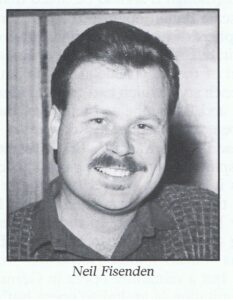
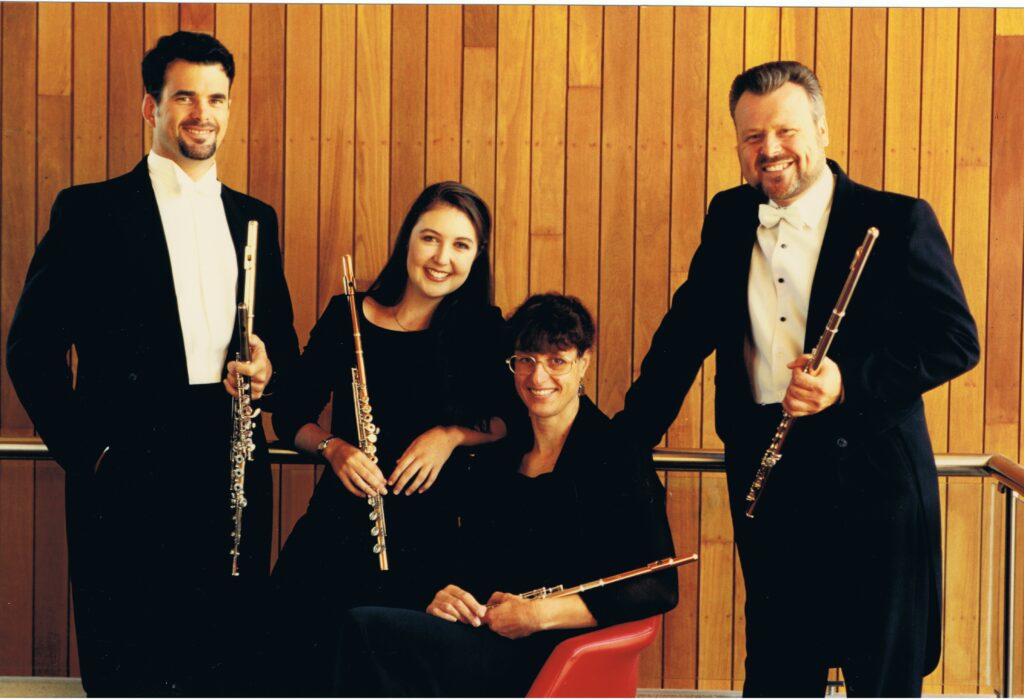
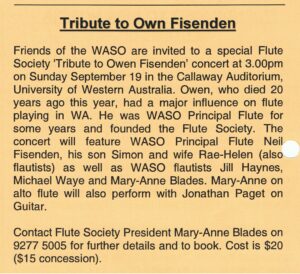
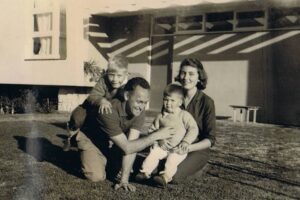
Neil Fisenden is the son of WASO flautist Owen Fisenden and Sylvia (nee Biddle).
He married flautist and singer Rae-Helen Warner and they have two musicians sons, Simon and Andrew.
Neil Fisenden was born in Perth and began flute studies with his father Owen at the age of nine.
In 1974 he joined the West Australian Symphony Orchestra as Second Flute and in 1978 was appointed Principal Piccolo.
He was a founding member of the Perth Woodwind Quintet performing often in concerts and recordings for the ABC. He also appeared regularly as soloist with the WASO.
Neil Fisenden – Churchill Fellowship
In 1979 he was appointed to the position of Principal Flute of the Adelaide Symphony Orchestra and in the same year awarded a Winston Churchill Memorial Trust Fellowship to study flute in London with Peter Lloyd, Principal Flute of the London Symphony Orchestra.
During his four year stay in Adelaide he frequently performed as a soloist with both the Adelaide Symphony and Adelaide Chamber Orchestras.
Neil returned to Perth in 1983 as Principal Flute of the West Australian Symphony and continued to appear regularly as a soloist, notably for the 1983 tour to Singapore and as a Master Series soloist in the 1993 season.
Neil lectured in flute at the University of Western Australia’s School of Music and The West Australian Academy of Performing Arts. He was chief flute examiner and woodwind specialist advisor to the Australian Music Examinations Board and was a member of the advisory selection panel for the Winston Churchill Memorial Trust. (1983-2013)
Neil is patron of the West Australian Flute Society and in 1991 was Director of the Eighth Australian Flute Convention.
1997 Neil Fisenden
In 2004 Neil was elected as a Director of the West Australian Symphony Orchestra.
Throughout his career Neil has been a very active teacher, believing strongly in the mandate to pass on a firm base of knowledge and experience to the next generation. This is the driving force which has led him, in collaboration with his wife Rae-Helen, to set up “Fisenden Music” dedicated to excellence in the areas of Tuition, Performance and Flute Sales and Service.
Neil was the founder and director of the Fisenden Flute Ensemble. (2006-2013)
Since moving to Melbourne in 2014, Neil has continued his musical career, releasing a CD entitled “The Iridescent Flute”, (showcasing exclusively Australian composers), joining the teaching staff at The Melbourne Conservatorium and joining the AMEB (Victoria), as a woodwind examiner and the position of Chair of Woodwind.
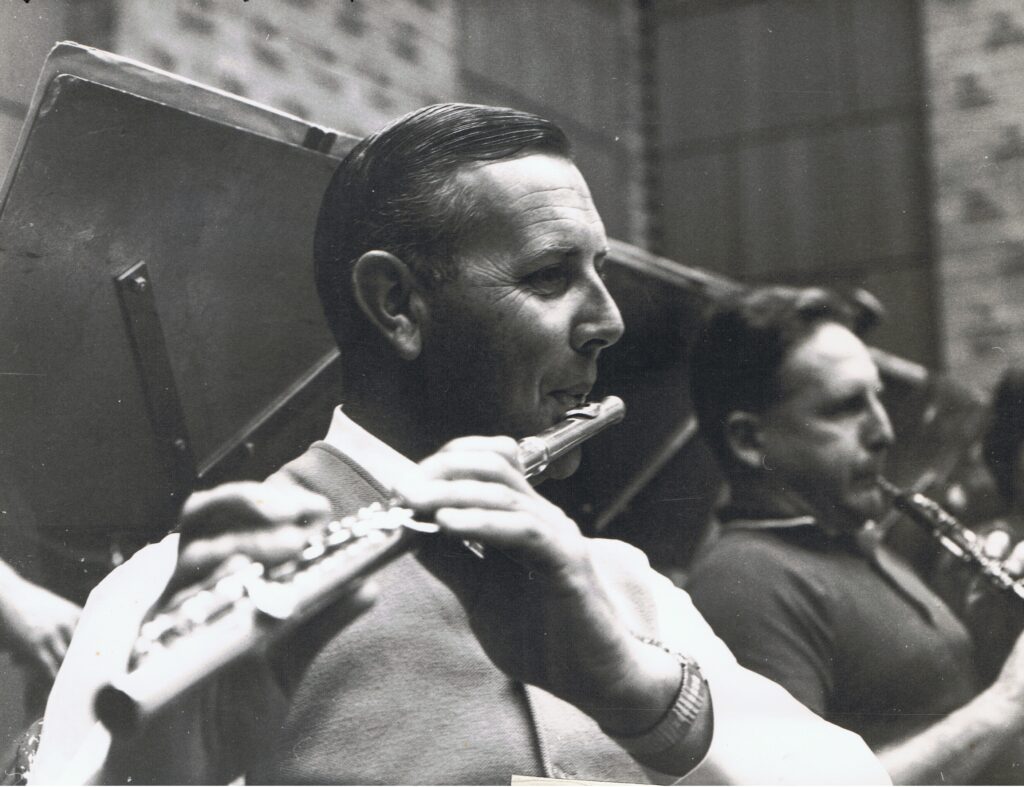
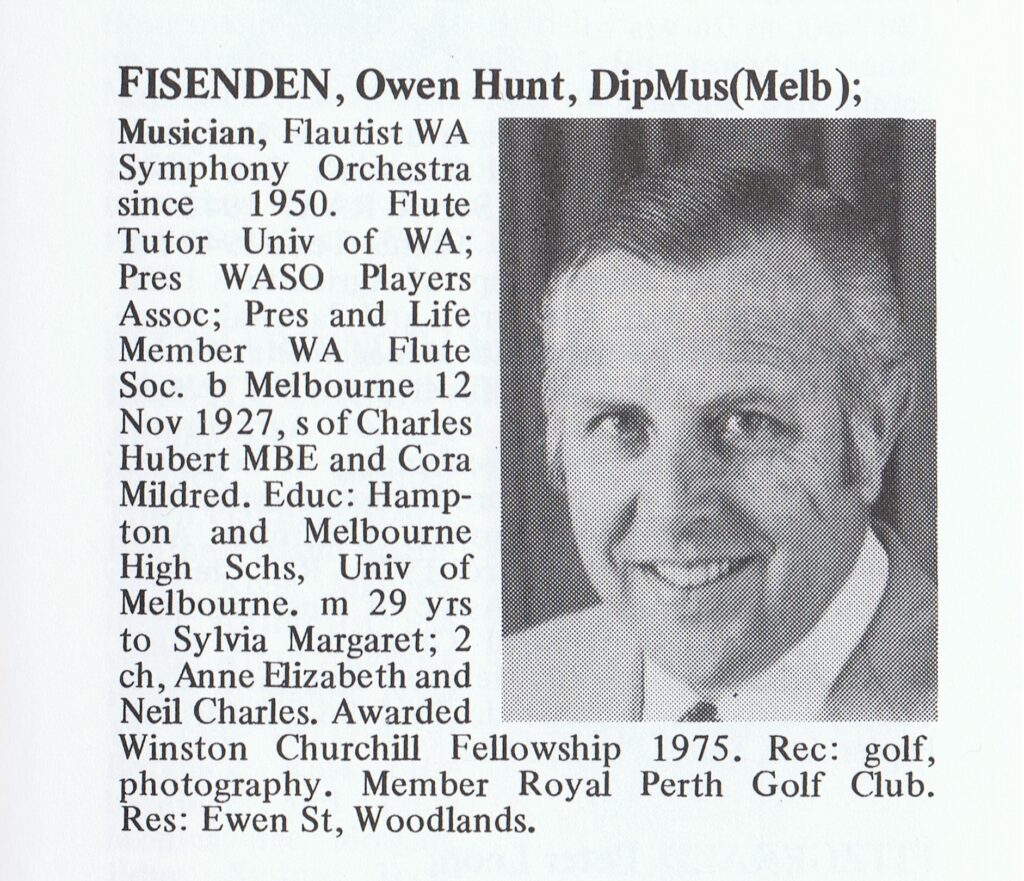
Born in 1927, Owen Fisenden was Principal Flute of the West Australian Symphony Orchestra from 1950 until 1977.
He married soprano Sylvia Biddle and they had two children, Anne and Neil.
A daily schedule of exercises for the flautist: Authored this well-known instructional music book for flute players, published in 1976.
Teaching: Mentored many prominent Australian musicians, including his son Neil Fisenden(who also became WASO Principal Flute) and Wendy Clarke (Associate Principal Flute of the Melbourne Symphony Orchestra).
Owen Fisenden Award: Honored posthumously through an annual Australian Music Examinations Board (AMEB) award in Western Australia given to top-achieving flute students.
Owen died of cancer aged 56 in 1984.
Owen Fisenden biography 1979
Sacks, Margaret. The Way 79 Who is Who. Crawley Publishers Pty Ltd, 1979. page 123
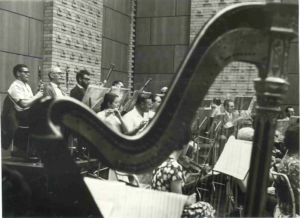
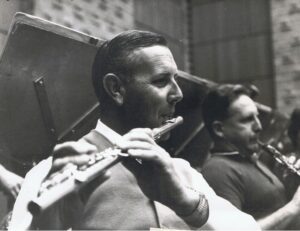
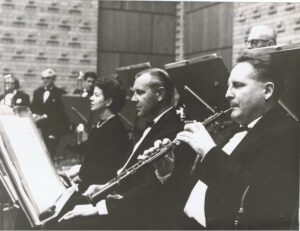
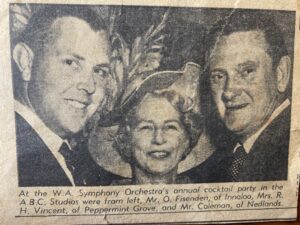
1967 Owen Fisenden, WASO Principal flute1967 Owen Fisenden WASO fluteOwen at ABC party
Local musicians will be interested to know that Miss Leoni (Dot) Salter and her orchestra of Western Australian professional musicians have made a sensational hit throughout their engagements in India. Leaving Perth late last year, they went to Colombo under engagement to the Hotel Mount Lavinia, and after a most successful season of several months they were then booked for the Grand Hotel, Calcutta, by appointment to His Excellency the Earl of Willingdon, Viceroy of India, where a further outstanding success was achieved. They were the highest-paid artists in any Calcutta hotel. Their performances attracted a great deal of interest, and local residents gained the impression that it was an All-American band, and great was their surprise to know that it consisted entirely of Australians.
Finishing their engagement at the Grand Hotel, they are now doing a return season at the Hotel Mount Lavinia. Accompanying Miss Salter are the Misses Edna and Leah Waterman, and Messrs. Niddy Roberts, Wally Hadley, Sam Sharp and George Caro.
Sunday Times (Perth, WA : 1902 – 1955), Sunday 8 September 1935, page 25
1947
Ice Skating Star – Mrs. Wally Hadley
TWEED-CLAD, with a gay painted Jacgmar scarf knotted casually around her neck, London style, Mrs. Wally Hadley, formerly Miss Joan Lovell, one of England’s ice skating stars called in last week. This tall, slight young woman with ashblonde hair, her West Australian banjoist husband and three young sons are among recent arrivals from England. Staying at Cannington with Mr. and Mrs. George Hadley, they had come up to spend the day with dance-band leader Sammy Sharpe and bis wife, old friends whom they had not seen for eight or nine years. Mrs. Hadley who began her ice skating career at 19, said she had given it up five years ago when her third child was born; looking after a family in wartime England was a full-time job on its own, she declared. With the Phil and Meagan Taylor Winter Sports Show for a number of years, Mrs. Hadley said she had skated in almost every town , in England, as well as touring Holland. But for family responsibilities, Australia would have met her years ago when the Phil and Meagan Taylor Company toured the Commonwealth.
The Hadleys will probably settle in Perth, when Mr. Hadley’s Australian tour is over, but with plans so indefinite, Mrs Hadley seemed content to wave off the future while concentrating on adjustments to a life “so completely different” to that which she had known. Change of environment had apparently been no setback to the three young Hadley hopefuls aged 12, 10 and five. The elder two are already settled down in Cannington school and hoping to take part in localshow day events, while the five year old, although he had completed a year’s schooling in England, was able to revel in an unexpected holiday, still being below school age here.
Western Mail (Perth, WA : 1885 – 1954), Thursday 9 October 1947, page 4
1950
All Together With A Tra-la-la
EVERY musicker of note turned up at the Jack and Dudie Pateman’s Nedlands home for the serious business of wetting baby Graeme William’s head. They packed the women off to Sylvia Caporn’s home and the ”boys’ had a right royal time. During the arvo Harry Bluck cheffed up spag. savories and what have you. Pete Sullivan (not the curly headed one) brought a can of Indian curry. A spokeshavian playlet ‘Cinderella’ was produced by Maestro Beeson, featured Alan Gough, Cliff Adam, Pete Harrison, Merv Rowston and ‘Lily of the Valley’ Roberts. It was a real classic. Kev Logan even stopped hibernating and made an attempt to hydrate himself. They nearly sold him a sax. Sam Sharp put on a happy time and the beer flowed like wine. Ray Le Cornu did a job with the kegs. Chick helped the food along. Wally Hadley, Maurice Maurice, Keith Whittle. ‘Mule Train,’ George Caro, ‘Cigarettes’ Cooke, Baden Flxter, Butch Kirkby, Bill Kirkham, Henry Cochran. were ell in it. At nine o’clock sharp they drank a special toast to George Franklin— wherever he might have been between here and Curfew rang at 2 a.m and everyone departed for their homes. They tell me the Patemans have since bought a block and 3 tents in case of repercussions from neighbours who may dislike jazz, Dixieland — and just plain noise.
Mirror (Perth, WA : 1921 – 1956), Saturday 20 May 1950, page 12
1952
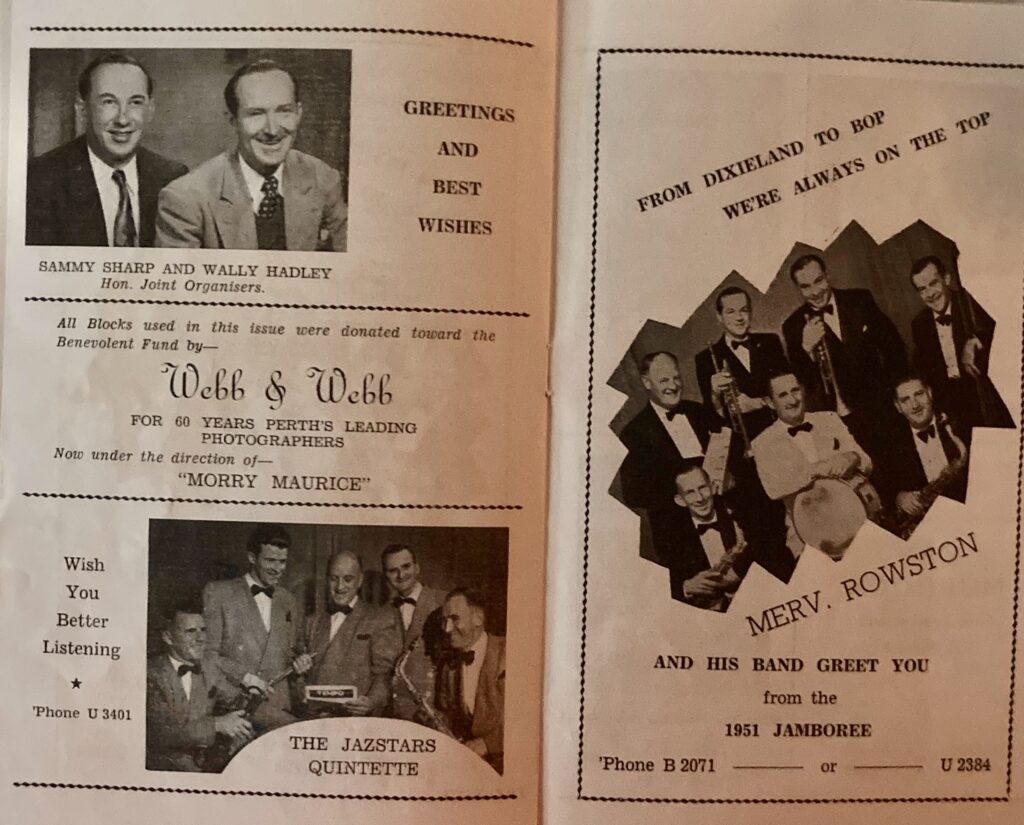
Wally Hadley, who organised this year’s Jazz Jamboree, has been a guitarist for 22 years. He left Perth in 1934 and after playing at famous hotels in India and Ceylon went on to England where he joined up with Freddy Morgan to form a banjo duo.
Freddy Morgan, incidentally, is now with Spike Jones. This act toured the US, the Continent — playing at one time with the Folies Bergere — and also did two tours of Australia with the Tivoli Circuit.
Famous names with whom Wally Hadley has worked Include Ted Ray, Ronald Frankau, Max Miller and Josephine Baker. Wally, a printer by trade, works at the Government Printing Office. He ranks as topliners In his particular field, American banjoist Harry Reser and French guitarist Django Reinhardt.
1953
IMPROMPTU JAM STOLE THE SHOW
An impromptu jam session nearly stole the show at Thursday night’s WA Amateur Dance Band Concert at the Capitol Theatre. Composite band of members who had competed earlier, really went to town and had patrons rocking in their seats. Jam band was led by internationally known Harry Phillips on the trumpet and Sid Vandervelde on guitar. Boys really turned it on and the crowd went wild. Even when Sammy Sharp came forward to announce the night’s awards the audience clamoured for another spread of jam. So, a grinning Sammy waved the boys to continue. Night was a feast of bounce, jive and bop with the amateur instrumentalists showing enough promise to indicate that many will soon be making pro names for themselves. Hundreds were present to hear 13 outfits, ranging in size from 4 to 11 pieces, vie with one another in a variety of Jazz renditions. Judges Ken Murdock, Ron Moyle, Merv Rowston, Harry Bluck and Bill Kirkham were not set an easy task. Finally, they awarded the shield to the West Coast Dixielanders, a 7 -piece outfit led by Phil Battey on trumpet, George Battey, clarinet, Dick Hatton, trombone. Conn Goldsmith, bass, Bob Anderson, piano. Alan Blight, drums, and Vince Goldsmith, guitar. These boys have been playing together less than a year and decided at the last minute to enter the contest They will hold the shield until next year’s contests.
The Dixielanders all prefer the type of music their name suggests is their special dish and are keen on the Jelly Roll Morton school. Second place went to Neil Manno’s Quintette with the Jive Five led by Wynne Hammer third. Other awards were: Best Instrumentalist; Ray Taylor, trumpet. Best Guitar: Jimmy Taylor. Best Drummer: Wynne Hammer. Best Pianist: Thelma McGrath. Best Vocalist: Bill Groessler. Most promising reed player was 17-y-o Neil Boon, a Dutch youth. Organisers, the W A Musicians’ Union, Sammy Sharpe and compere Wally Hadley are to be congratulated on a good show which all agreed was a great improvement on previous contests and augurs well for the future of dance music in this State. Saw quite a sprinkling of musicians who have given up regular playing in the audience at the Capitol, including Harry Ward and Laurie McGrath.
Mirror (Perth, WA : 1921 – 1956), Saturday 25 July 1953, page 11
NOTES ON THE DANCE BANDS
Thursday 27 August 1953
The Inkspots, not the famed coloured outfit, but a group of well-known business, sporting and musical folk who usually gather at popular Clive McMillan’s home, held a ladies’ night at the Continental, Claremont, on Thursday last. Guests included the following: Clive McMillan, Steve McHenry, Murray Church, Merv Rowston, Morry Maurice, Cliff Adam, Jim Beeson, Wally Hadley, Roy Delamere, Reg Benjamin, Jack and Jill Harrison, Johnny Mowson, Dr. Willington, Cyril Bird and Reg North. Mine host Harry Ward entertained on the banjo and joined the boys on trombone in several jam sessions.
Mirror Saturday 29 August 1953 page 13
An effort is being made to have a reunion of players of Ron Moyle’s old band. – These include: Ron Moyle (pianist and leader), Cliff Adam (guitar, vocals and tapdancing), Niddy Roberts (drums), Wally Hadley (banjo), Tommy Bennett (bass), Ken Pimmell and Viv Nylander (trumpets), Charles Thompson (trombone), Alan Gough, George Caro, Bob Gibson (saxes).
Mirror (Perth, WA : 1921 – 1956), Saturday 24 October 1953, page 12
Wally Hadley and Sammy Sharp were interviewed by Andrew Bisset for the History of jazz in Australia collection [sound recording]
By 1942, aged 14, Burrows had begun playing clarinet and quit school. He began appearing at Sydney jazz clubs, and appeared on The Youth Show, a Macquarie Radio show. In 1944 he was invited to play and record with George Trevare’s Australians. He became well known in Sydney jazz circles and was performing in dance halls, nightclubs and radio bands. He was a member of Jim Gussey‘s ABC Dance Band for five years.
1953
Jazz man defer to pipes
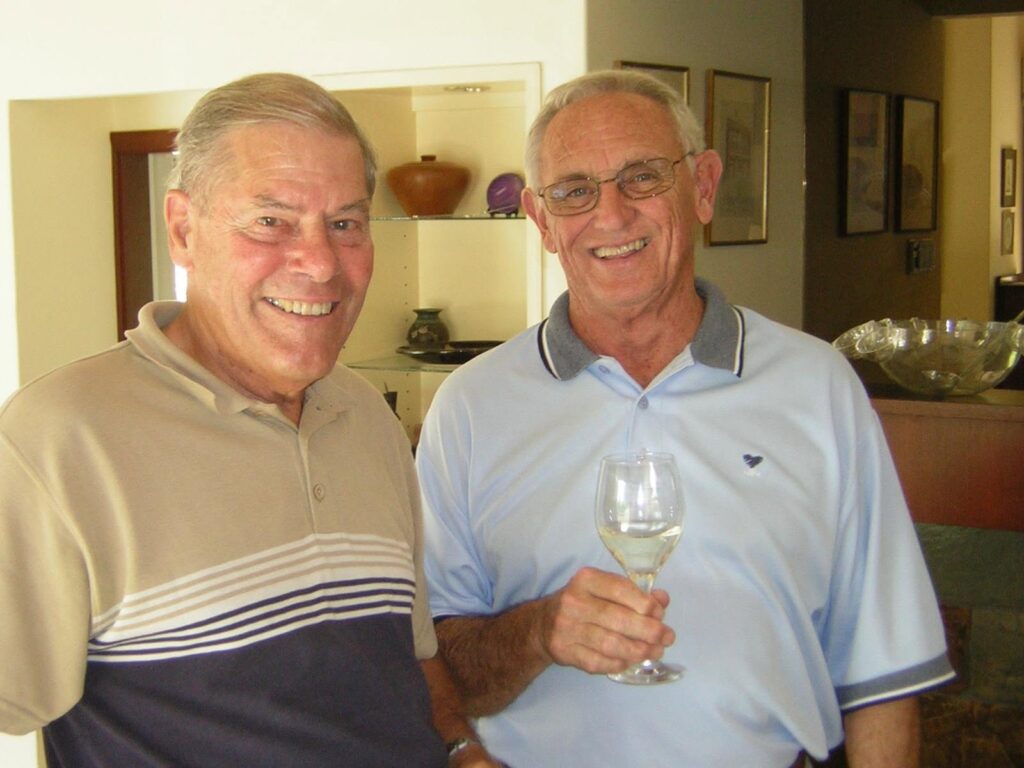
Australian jazz legend Don Burrows celebrated his 74th birthday at Scotch College to the sounds of pipes and drums. He took time out from classic swing to listen to the school band with his WA mat, musician Jack Harrison and Kevin Hunt, one of Australia’s most highly regarded jazz pianists. On Saturday, Don held a jazz workshop for Scotch music students. Don and Jack have been friends for 49 years after a spontaneous meeting in Sydney.
On his honeymoon, Jack called Don, whom he had not met, to ask where he was playing. Don had heard Jack playing his clarinet on the Young Australia Show and told him to stand outside his hotel in King’s Cross with his clarinets and he would pick him up. They have been friends ever since. Jack said “Burrows is still the same Mr Nice Guy I met all those years ago, his enthusiasm for his profession has never waned.” Jack, who was a student at Scotch in the 1940s said he and Don still shared a passion for music, and for passing it on to young musicians. He said he and Don had sat like two grumpy old men playing jazz to the accompaniment of a computer program called Band in a Box. [1]
[1] Claremont Nedlands Post August 31 2002 Vol. 28 No. 35
During the 1960s and 1970s Burrows had many engagements in Australia and the United States, including six years performing at the Wentworth Hotel in Sydney in quartets with Ed Gaston, George Golla, and various drummers. It was this association which made his name the “most familiar in Australian jazz”. In 1972, he was invited to perform at the Montreux Jazz Festival and later the Newport Jazz Festival.
The year 1973 was a watershed for Burrows as he received the first gold record for an Australian jazz musician for his record Just the Beginning,[8] instigated the first jazz studies program in the southern hemisphere, at the New South Wales Conservatorium of Music (under the direction of Rex Hobcroft) and was appointed a Member of the Order of the British Empire (MBE). In 1979 he was appointed Chair of Jazz Studies at the conservatorium.
Burrows performed to mostly classical music audiences through tours with Musica Viva and the Australian Broadcasting Corporation concert series. He led the nationally televised show The Don Burrows Collection for six years. He had an extensive recording career with his groups and performed on albums by others.
In 1981 Burrows played woodwind on a Play School album, Hey Diddle Diddle: it was his only involvement with the show.
In 2005 Burrows toured with a small band that included the Australian jazz pianist Kevin Hunt. He used his photographic images with his music in a show called Stop, Look and Listen.
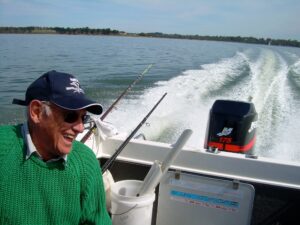
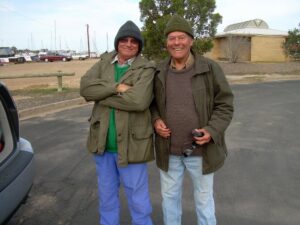
Jack Harrison and Don Burrows jammingDon Burrows fishing trip on his boatDon Burrows and Jack Harrison on a fishing holiday
Don loved fishing, a passion he shared with Jack Harrison.
Burrows had arthritis from age 38. In a 2008 interview with the Australian Broadcasting Corporation’s Andrew Ford, celebrating his 80th birthday, he said that “arthritis is not the greatest for playing a musical instrument. But playing a musical instrument is very, very good for arthritis”. In later years he had Alzheimer’s disease and lived in a nursing home in northern Sydney. He died on 12 March 2020, aged 91.
https://en.wikipedia.org/wiki/Don_Burrows
Allan Meyer, Don Burrows, Jack Harrison
IS THERE AN AUSTRALIAN who hasn’t heard of Don Burrows? Legendary musician Don Burrows (AO, MBE) has been at the forefront of the jazz world for most of his 60 years in the business. He’s a household name in Australia, renowned for his musicianship and his enthusiastic support for the jazz arts. He’s also highly respected internationally, where he’s toured numerous times to great acclaim annually since 1960.
This superb multi-instrumentalist plays flute, clarinet and all the saxophones, from alto to baritone. He’s a composer and arrange of great note, and one of the world’s finest interpreters of the jazz tradition. A Don Burrows concert is a journey from classic swing and the gentle sway of Brazilian bossa nova to exciting modern jazz.
Did you know that this Living National Treasure (named in 1988 and 1998) was the first Australian jazz artist to win a gold record, the first to play Europe’s famed Montreaux and the USA’s Newport festivals, the first to play in China, the first awarded a Creative Arts Fellowship, the first inducted into the ARIA Hall of Fame, the first Director of a Jazz Studies course. He has also found time to host his own television show, The Burrows Collection, for six years on ABC TV, has released close to forty albums, and regularly tours here and abroad, including South and North America, Europe, the Middle East and Asia. And just look at this who’s who of great recording and concert partners – Oscar Peterson, Dizzy Gillespie, Nat King Cole, Mel Torme, Stephane Grappelli, Tony Bennett, James Morrison, George Golla, Cleo Laine, Frank Sinatra, Kate Ceberano, the Sydney Symphony Orchestra and hundreds more.
Now in his 74th year, Don Burrows has not even begun to think about slowing down. He continues to tour Australia and the world regularly. In the last few years Don Burrows appearances have included China, Brazil, Argentina, Mexico, Venezuela, Cuba, New Zealand and all the major jazz festivals of Australia. His passion for jazz has seen him embark on several countrywide educational tours in recent years, taking his music and experience to schools in isolated corners of Australia, from Broome to Tasmania.
His 1995 Creative Arts Fellowship, under the auspices of which he tours schools, follows two earlier honours – an Order of Australia and an MBE – in recognition of his generous and unstinting work in promoting jazz. Each year the University of Sydney awards Honorary Degrees to people who have achieved great distinction in their field. On the 25th of May 2000, Don Burrows was awarded the degree of “Doctor of Music” [Honoris causa].
On the second of April 2001, Don Burrows was awarded for the second time the degree of “Doctor of Music” [Honoris causa] from the Edith Cowan University in Perth, Western Australia.
In October 2001, Don Burrows returned to Mexico and South America to perform with musicians from Brazil, Venezuela and Argentina. Recently he headlined the first International Jazz Festival in Nepal.
Don is now in his 60th year as a professional musician.
Throughout a long, varied and successful career Don Burrows has played just about every kind of venue, in front of just about every kind of audience, from nightclubs and festival stages to television studios and outback classrooms. His musicianship and his ability to communicate his passion for the music have become legendary. He remains one of Australia’s pre-eminent artists, veritably a Living National Treasure.
Up-and-coming exponent of the tenor sax is 18-y-o Peter Clinch, who is heard a lot— and appreciated — in city dance combinations.
Biography
18 – year – old tenor exponent Peter Clinch, of Wembley commenced taking sax lessons at the age of 13 with noted Perth reed man, George Caro. His studies on this instrument commenced along the normal classical lines and later he moved about in amateur orchestral circles until early in 1947, when he joined a group of young musicians who were training under Ken Murdoch, the back-bone of, and stepping stone to, the majority of the city’s prospective dance band men.
During Peter’s stay with Ken’s group, he filled a casual role and played with a number of small outfits around the city until he received his first break, playing 2nd. tenor with Jackie Sue’s Seven Piece outfit at the Fremantle Town Hall in the 1947 season. He remained with this combination for one season, playing at the port and a number of city spots, before moving his stand across to the Chris Gosper combination, which was featured at Anzac House.
During the middle of 1948, Peter sat in with the Sammy Sharp outfit as 4th tenor and later accepted 2nd tenor when well known Johnny McCaughan vacated the position to go South in October, ’48. Since then he has remained with the Sharp outfit and has been heard in the Jazz Jamboree with this outfit, the Battle of the Bands with Jackie Sue and was prominent in Thursday’s Round-up over 6WF, once again with Sammy’s boys. He is a full-time dance musician , and is assured of a rosy path ahead.
Mirror (Perth, WA : 1921 – 1956), Saturday 25 June 1949, page 15
1950
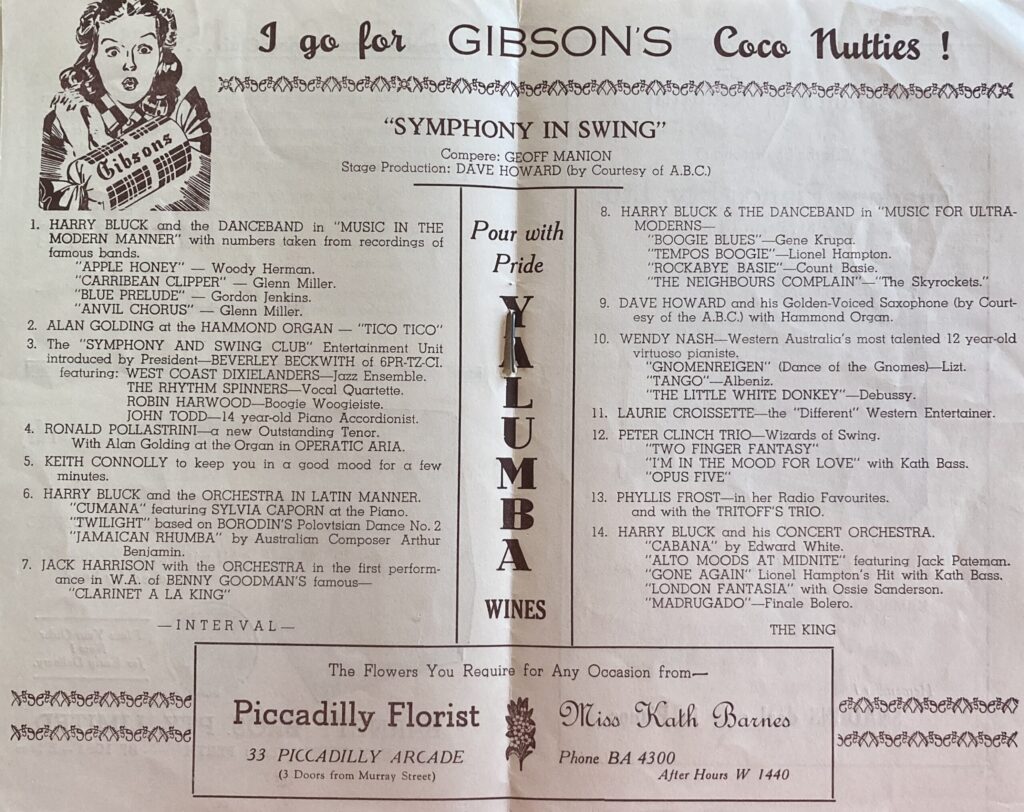
Thursday, Oct. 5th – Capitol Theatre at 8pm – 1950’s GREATEST MUSICAL SHOW
Bruce Carroll presents – Symphony In Swing
With Harry Bluck’s Concert Orchestra and Dance Band, Over 50 Leading Musicians and Radio Artists, Wendy Nash — 12-year-old Virtuoso Pianiste, Jack Harrison — Clarinet Star of the West, Ossie Sanderson — 16-year old ‘London Fantasia’ Soloist, Phyllis Frost — International Broadcasting Vocaliste, Ronald Pollastrini — W.A.’s Outstanding Lyric Tenor, Tritoff’s Trio — First appearance of Radio Vocal Trio, Kath Bass — Star Rhythm Vocaliste, Alan Golding — Leading Exponent of Hammond Electric Organ, Peter Clinch trio — Wizards of Swing, Dave Howard — and His Golden Voiced Saxophone (By Courtesy A. B.C.), Keith Connolly — Sophisticated Humorist, Laurie Croissette — Tho ‘Different’ Western Entertainer ,Symphony and Swing Club’s Entertainment Unit with West Coast Dixielanders — State’s smartest Jazz Ensemble, John Todd — 14-year-old Star Piano Accordionist, Rhythm Spinners — State’s leading Male Modern Vocal Group, Robyn Harwood — Boogie Woogie Specialiste, Beverly Beckwith — Co-Compere of S. and S. Club Group. Compere: Geoff Manion. Stage Production: Dave Howard By Courtesy A. B.C. PRICES : 3/- 4/- 5/- (plus tax). Box Plan at Nicholsons Limited. The Daily News Monday 25 September 1950 page 12
1950 Symphony in Swing programJAZZ JAMBOREE TOMORROW The annual Jazz Jamboree will be held at the Capitol Theatre at 8.45 p.m. tomorrow. Almost 100 professional musicians will take part and play all types of modern music. The entire proceeds of the concert will go to the musicians’ benevolent fund. Sixteen dance-band leaders, all wellknown musicians, will take part, and the show comperes will be Geoff Manion and Peter Harrison.
West Australian (Perth, WA : 1879 – 1954), Saturday 28 October 1950, page 7
THE BIGGEST DANCE BAND SHOW of the YEAR — ALL YOUR FAVORITES
JAZZ JAMBOREE of 1950 – CAPITOL THEATRE – SUNDAY, OCTOBER 29th
NINE OF THE STATE’S LEADING DANCE BANDS
Bill Kirkham’s Embassy Band
Ken Murdoch’s Ensemble
Ron Jenkins Band
Peter Clinch Boptette
Merv Rowston’s Band
Colin Hicks and His Musk
Wayne Hendrick’s Modernaires
Norm Wrightson’s Band
Harry Bluck’s Music in the Modern Manner
ALL YOUR SWING, JAZZ AND BEBOP PAVORITES
500 Unreserved Seats on Sale at Doer
GFOFF MANION and PETER HARRISON. Comperes
JAZZ MUSIC: Nine dance bands combined to present the “Jazz Jamboree of 1950” in the Capitol Theatre on Sunday night to raise money for the W.A. Musician’s Benevolent Fund. Every seat was filled and the audience had an op portunity of comparing different styles. Warm applause greeted special efforts by the bands or their vocalists. The programme was produced by Harry Bluck and the comperes were Geoff Manion and Peter Harrison.
West Australian (Perth, WA : 1879 – 1954), Tuesday 31 October 1950, page 9
1951
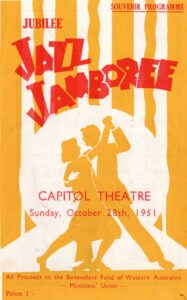
1951 Jazz Jamboree program cover
SUNDAY 28th OCTOBER 1951 – CAPITOL THEATRE – JAZZ JAMBOREE
Featuring 12 of Perth’s Leading Dance Bands
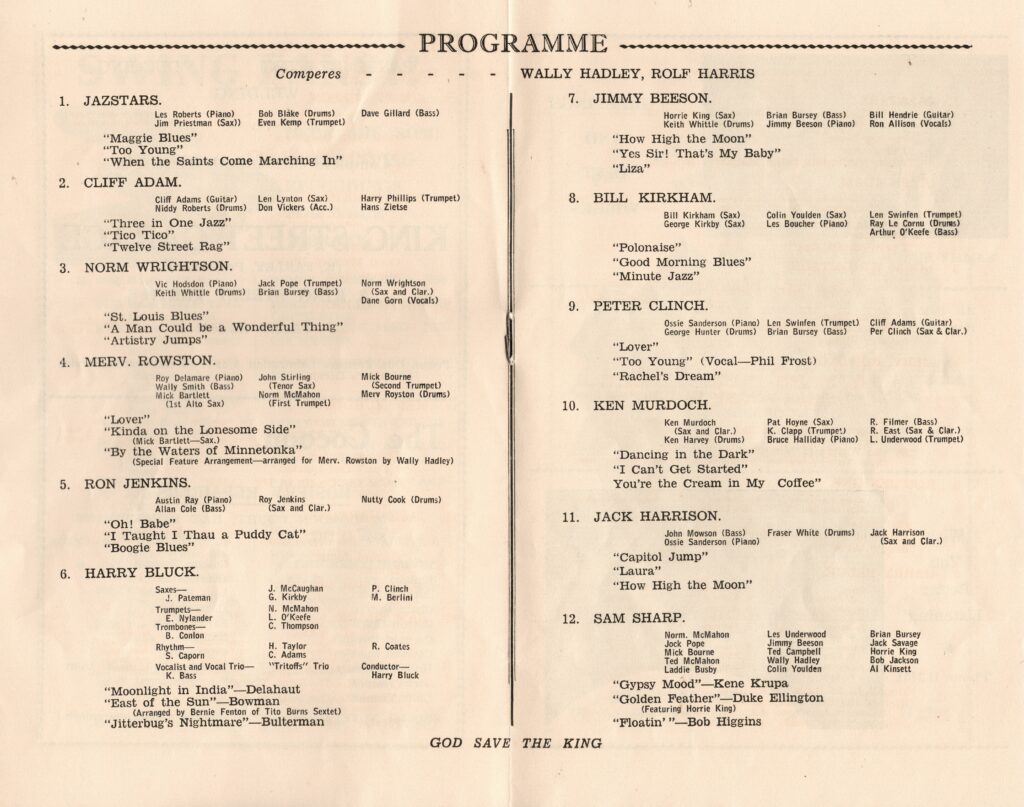
Jazzstars, Cliff Adams, Norm Wrightson, Merv Rowston, Ron Jenkins, Harry Bluck, Jimmy Beeson, Bill Kirkham, Peter Clinch, Ken Murdoch, Jack Harrison, Sammy Sharp.
Booking Opens at Nicholsons. Friday 19th October 1951.
A Hot Spot In The Old Town Last Night
Evidence of the increasing popularity of jazz with young and old Perth people was last night s Jazz Jamboree at the Capitol Theatre. Between. 500 and 600 fans were turned away. The theatre, which seats 2249 people, was filled by 7.55 p.m. — 10min. after 400 unreserved seats were offered at the theatre. And bodgies and widgies were far outnumbered by the “over-40” brigade. It was a record house for a jazz jamboree. The audience heard 12 of Perth and Fremantle’s best bands perform. All musicians gave their services free and the Musicians’ Benevolent Fund got the benefit— £501 was paid for tickets. Programme sales yielded more than £50 and, officials estimate that 600 more programmes would have sold “like hot music”.
Daily News (Perth, WA : 1882 – 1955), Monday 29 October 1951, page 3
1951 Jazz Jamboree – programme
1952
1953
Peter joined the RAAF Central Band as Principal Solo Clarinet and Senior NCO in 1953.
He married Joy Iolanthe in Victoria in 1953 and they had a daughter Robyn and son David together.
1967
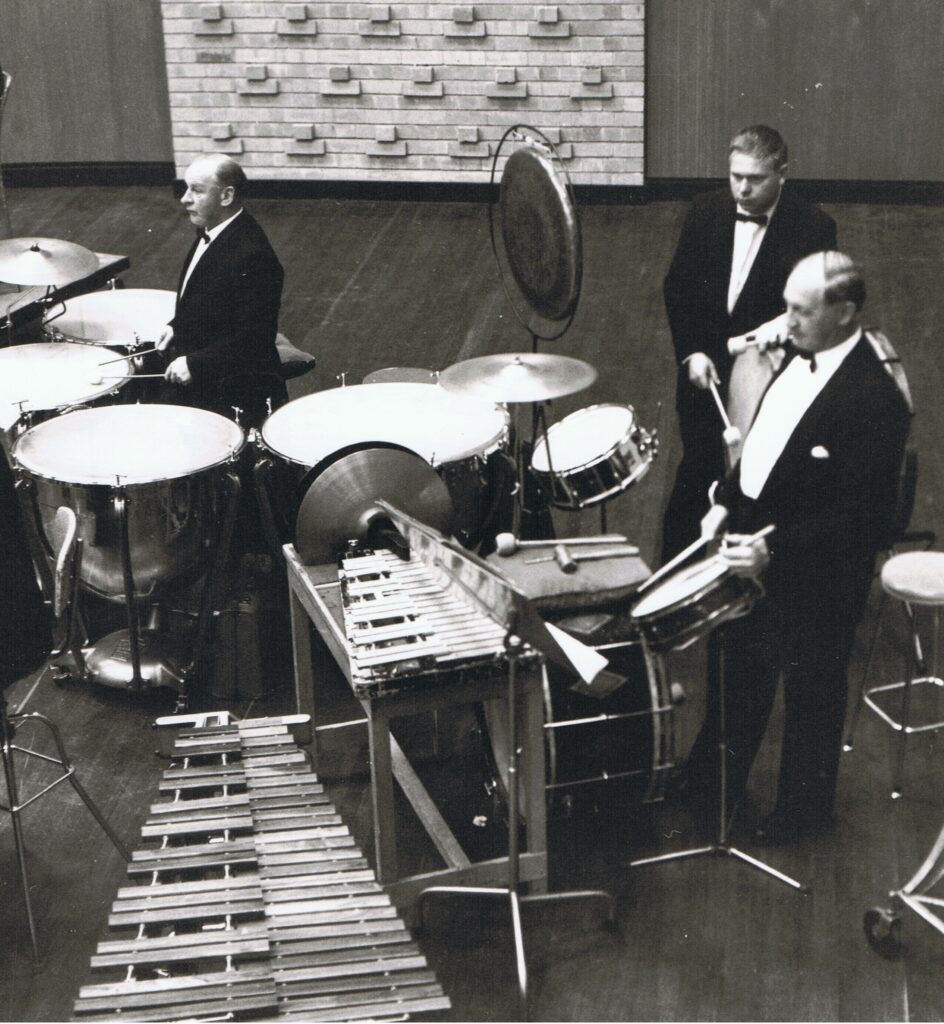
1967 WASO: Peter Clinch augmenting on percussion
1971
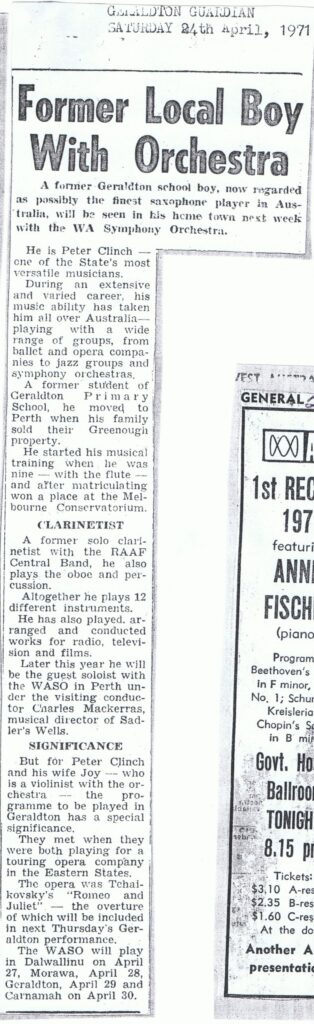
1971 Peter Clinch article
Peter played in WASO, filling in for Jack Harrison who went overseas for 5 months on a Churchill Fellowship.
1995
Peter Clinch died in Melbourne on 6th June 1995 aged 64.
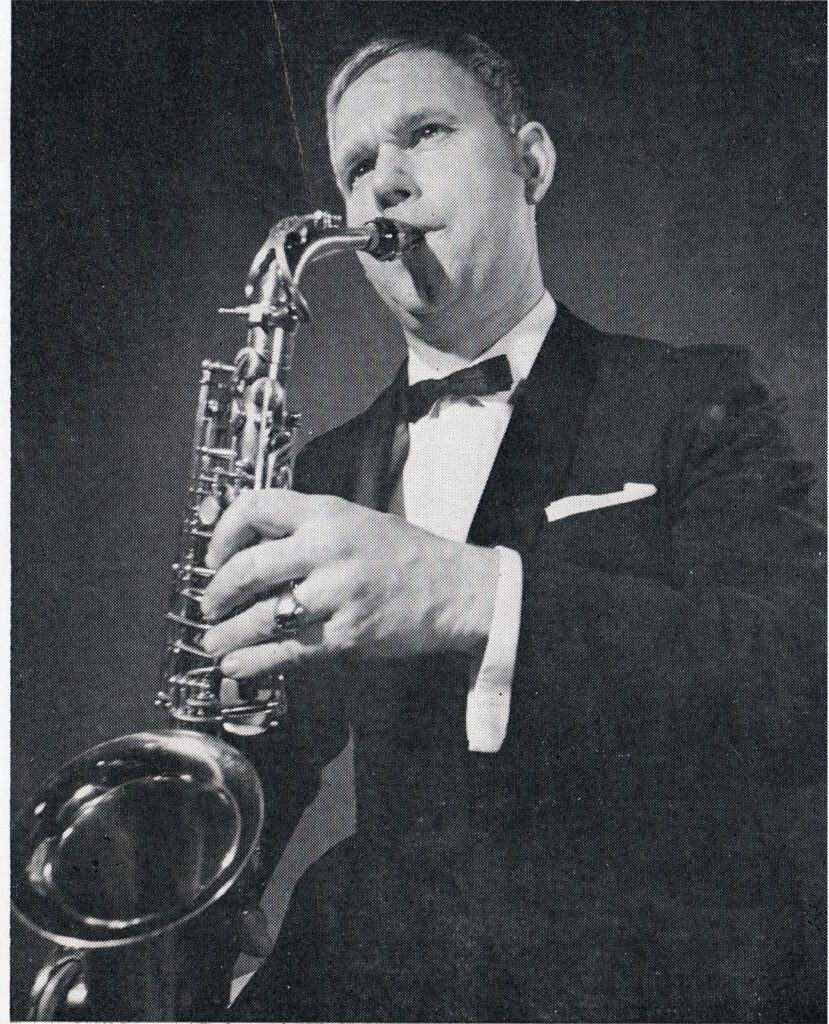
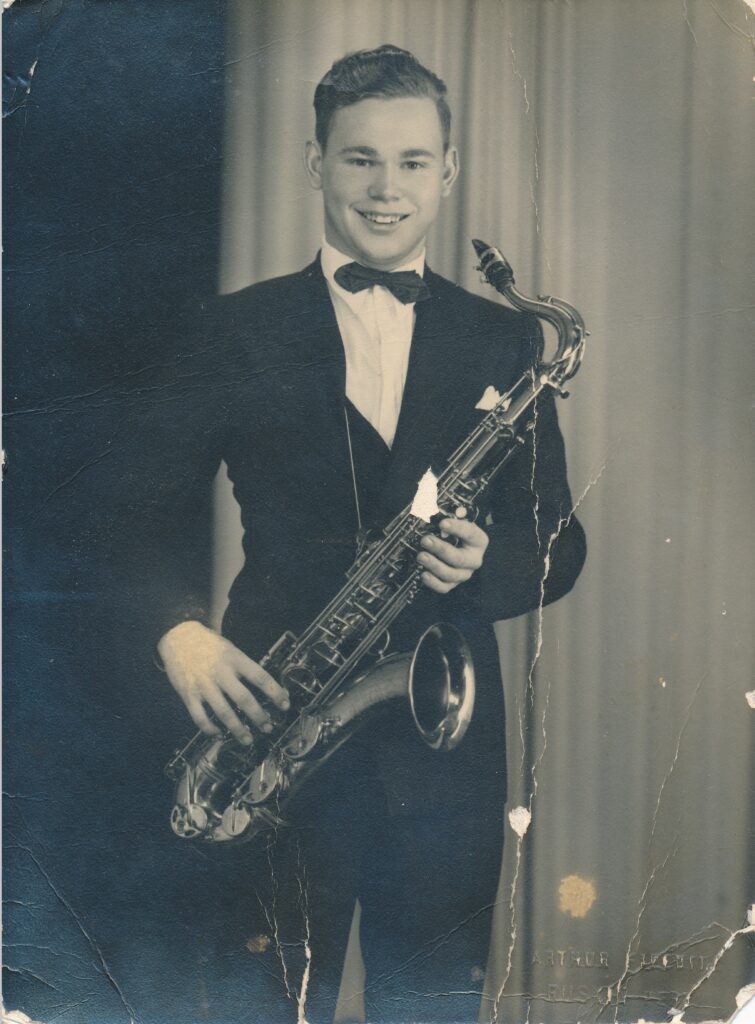
Peter Clinch was an Australian saxophonist, clarinettist, composer and educator.
Dr. Peter Clinch was born in Geraldton, Western Australia in 1930.
He began his early career augmenting in the clarinet section of the Perth Symphony Orchestra in 1947 , the West Australian Symphony Orchestra and then joined the RAAF Central Band as Principal Solo Clarinet and Senior NCO in 1953. Subsequent to this he played clarinet and saxophone with every ABC Symphony Orchestra in Australia either as a member of the orchestra or as a soloist. Peter was the Head of the Music Department at the Melbourne College of Advanced Education and later the Reader, then Associate Dean (Music Education) at the Faculty of Music, University of Melbourne.
As well as producing a number of recordings, Peter toured extensively in Europe, Asia and the USA as a soloist, recitalist, a chamber music performer, and a conductor as well as giving lectures and masterclasses. The Peter Clinch Saxophone Quartet was the most exciting ensemble of the Australian music scene, certainly its most pertinent in contemporary significance. He won several awards for composition. He was widely respected as a conductor and his jazz performance. He was the founder and President of the Clarinet and Saxophone Society of Victoria, Vice President of the Comité International de Saxophone and has a citation in several “Who’s Who” guides including “Who’s Who in the Commonwealth” and “Who’s Who in the World”. He was the Head of the Department and Reader and Associate Dean of Music Education at the Melbourne CAE (University of Melbourne).
Peter’s international conference contributions included papers for several of the World Saxophone Congresses, the Australian National Clarinet Seminar in Sydney, several of the International Clarinet Congresses and the Australian National Saxophone Seminar in Melbourne (which he organised). He also presented papers at conferences in Western Australia, Sydney, London, Canberra and Yugoslavia. He died in 1995.
Peter’s published works included a Clarinet Tutor for Allan’s Music, the Tausch Concerto for Clarinet and Orchestra and several other clarinet and jazz studies tutors. His journal articles included articles for the international publication Studies in Music, music and book reviews for the Journal of Music Education, the Journal of Australian Music and Musicians, the National Association of Teachers of Singing, the International Journal of Music Education and The Clarinet.
Original compositions include Instruments of the Orchestra, Introduction and Fugue for 4 Percussion, Music for a Grand Tour, Variations for Clarinet and Electric Tape, Introspections for Saxophone and Tape, Saxophony for Voice, Flute, Clarinet and Percussion, Inventions for 7 Players, Clarion Call for Small Ensemble, Music for Clarinet and Small Ensemble, and Quartet for Clarinet, Viola, Piano and Percussion. Many of these works were performed overseas in London, West Berlin, Salzburg, Munich, Hamburg and Brussels.
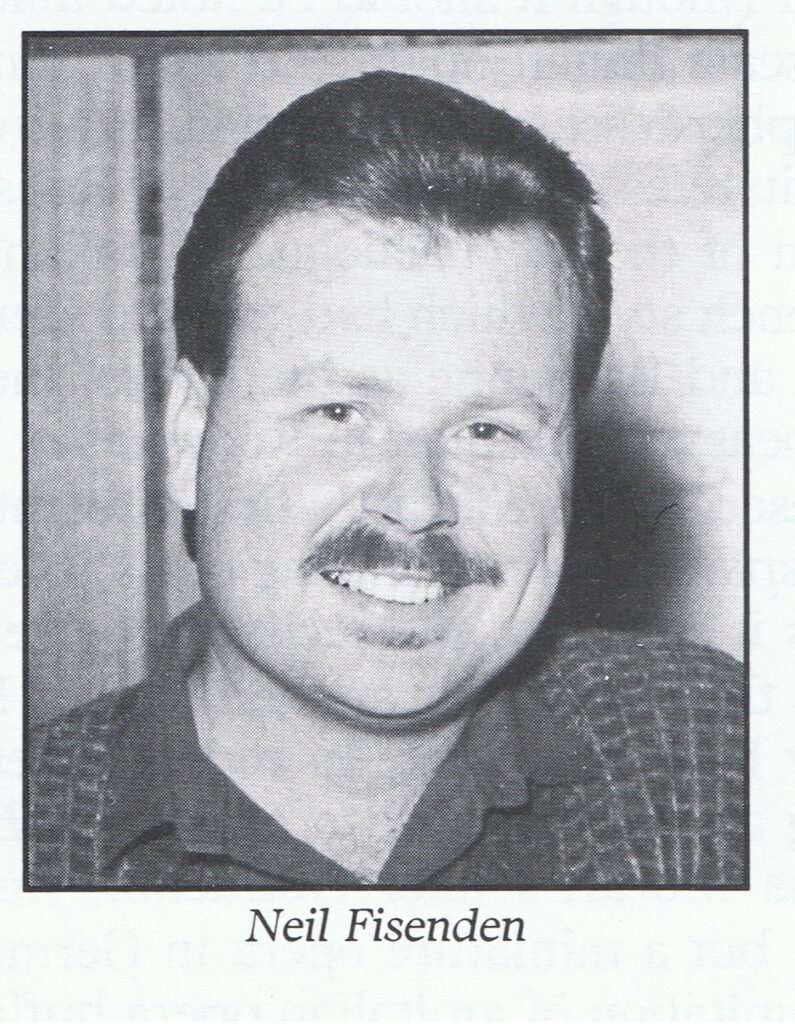
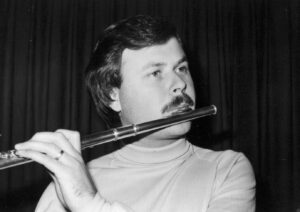 In 1974 he joined the West Australian Symphony Orchestra as Second Flute and in 1978 was appointed Principal Piccolo.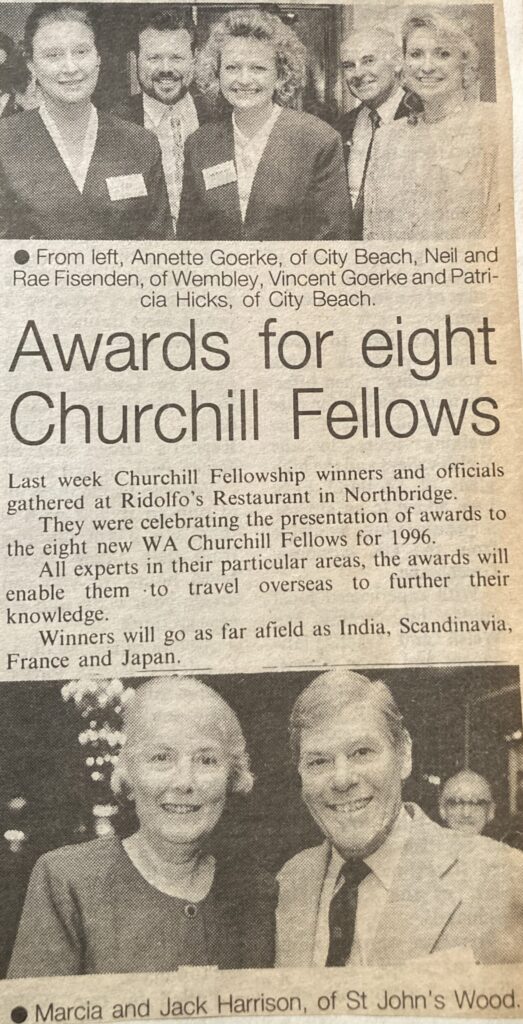
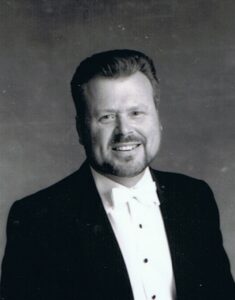 Neil returned to Perth in 1983 as Principal Flute of the West Australian Symphony and continued to appear regularly as a soloist, notably for the 1983 tour to Singapore and as a Master Series soloist in the 1993 season.