WOOD, Graham
Born in 1930, Wood participated in the Australian Youth Orchestra’s (AYO) original National Music Camps from 1949 to 1954. He later served as National Music Camp Director in 1979 and 1980 and was a tutor at many other National Music Camps. He was conferred as an AYO Life Member in 2006 in recognition of his dedication to music education.
In the 1950s Wood performed with London’s Royal Opera House orchestra, followed by three years at the London Philharmonic Orchestra. He then settled in Perth, WA, where he joined the West Australian Symphony Orchestra during its early development.
He toured with the Southern Serenaders.
He founded the Oriel String Quartet.
He was a member the Wigmore Ensemble of Musica Antiqua.
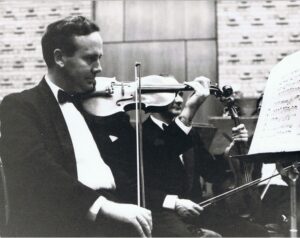
Graham’s reminiscences of his first days in WASO:
Within a week of our arrival I was ensconced in the first violin section of the WA Symphony Orchestra. The ABC had just moved into a brand new building in Adelaide Terrace and the orchestra’s studio [the Basil Kirke Studio] was claimed to be the latest state of the art broadcasting studio in the country. It certainly suited the small 50-piece band, which I discovered on my first day. By 2005, the ABC had moved out and the building was to be demolished!
The quality of the playing in 1960 left much to be desired. The ABC employed the WASO and we were all superannuated public servants, so it was difficult to sack a player who was not up to scratch! I sat on the outside of the second desk, behind the leader, Vaughan Hanly and Barbara Tyler. My desk partner was Margaret Poole-Johnson. I could fill volumes with details of some of the extraordinary characters who inhabited the ranks of the orchestra at this time. Space however limits me to mentioning just a few.
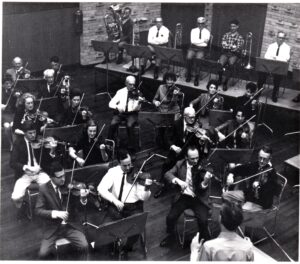
The resident conductor was John Farnsworth Hall. I had experienced some rotten conductors already, but Farnsworth really took the cake! An irascible charlatan of a fellow, he would fly into a rage at imagined slights or blame players when some mishap occurred, usually of his own doing. Fortunately he was also lazy and we could depend on days finishing early and calls being cancelled or cut short! This was a blessing in that we had time for our own individual pursuits, such as teaching and chamber music playing. Vaughan Hanly was a highly competent violinist with much experience and a high reputation as a teacher.
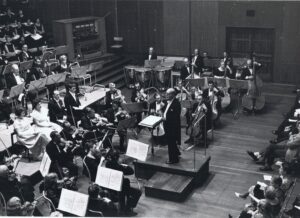
Barbara Tyler was also competent, but rather neurotic, with a tendency to talk non-stop, to such an extent that she would froth at the mouth! Most of the others violinists were either ageing or young and inexperienced. John Dean led the viola section. I had met him at the University Conservatorium in Melbourne when we were both violin students there. He took to the viola when the principal position became vacant in Perth. We have been lifelong friends.
The front desk of the cello section was a hoot! Two mad Hungarians sat together there. Principal was Louis Moyser, a middle aged expatriate in the process of decay. He had the remains of a fine technique, but alcohol had infiltrated it. His desk partner was another alcoholic, Zoltan Barna, a plump clown of a fellow who had a large collection of musical tricks, amusing at first. The two of them caused our conductor a lot of strife. He called them “Buda” and “Pest”, which was about the only thing I admired him for.
Graham spent 24 years as the WASO’s associate concertmaster. The orchestra said of his passing:
’Graham will be remembered for his extraordinary artistry, beautiful tone, and wonderful sense of humour. Beyond the stage, Graham helped to shape WA’s music community through his dedication to teaching and mentoring, inspiring generations of violinists, including members of our Orchestra today.’
In 1974, Wood co-founded the Western Australian Youth Orchestra, for which he was most recently vice patron. The orchestra wrote on the social media: ’His enduring legacy has profoundly influenced the orchestral and artistic communities of Western Australia across multiple generations.’
Vale Graham Wood OAM
Graham Wood participated in the Australian Youth Orchestra’s (AYO) original National Music Camps from 1949 to 1954. He later served as National Music Camp Director in 1979 and 1980 and was a tutor at many other National Music Camps. He was conferred as an AYO Life Member in 2006 in recognition of his dedication to music education. The CEO of the AYO said of Wood: ‘His impact on music and music education will continue to inspire and benefit future generations.’
He reminisces:
I was involved in the annual National Music Camps. My further drives east were usually to attend a Music Camp, now as a violin tutor. At this time the Camps were still held at Geelong Grammar School or St. Peters College in Adelaide. The founders of the organisation were still going strong. Ruth Alexander, John Bishop and Percy Jones, with Ron Maslyn Williams had established a tradition, which lasted for many years. The organization grew, evolving in the 21st century into the highly renowned Youth Music Australia. In the sixties students still slept in dormitories, assembled all together in the school refectory and sang grace at meals. There were strict lights out times and tight codes of behaviour. But everyone had [and still do have] a wonderful time. The staff received a tiny stipend, which only partly paid one’s drink bill, but we didn’t mind. These days they are paid professional rates for their time. One of the principal pleasures for us staff members was meeting with other musicians from all over the country, hearing the latest gossip and playing chamber music together. I continued my involvement with Music Camps for many years and in many differing roles – as conductor, Camp Director, member of the Board etc. My enthusiasm for the Music Camp movement stemmed from my own experience as a student, an experience which I’ve seen mirrored in hundreds of later Campers, an excitement and stimulation about music making which led me to the decision that being a musician was exactly what I wanted to do with the rest of my life.
His pivotal role as an educator also included his work as an examiner for the Australian Music Examinations Board, where he continued to work until 2022. He also adjudicated many of WA’s string competitions for young players.
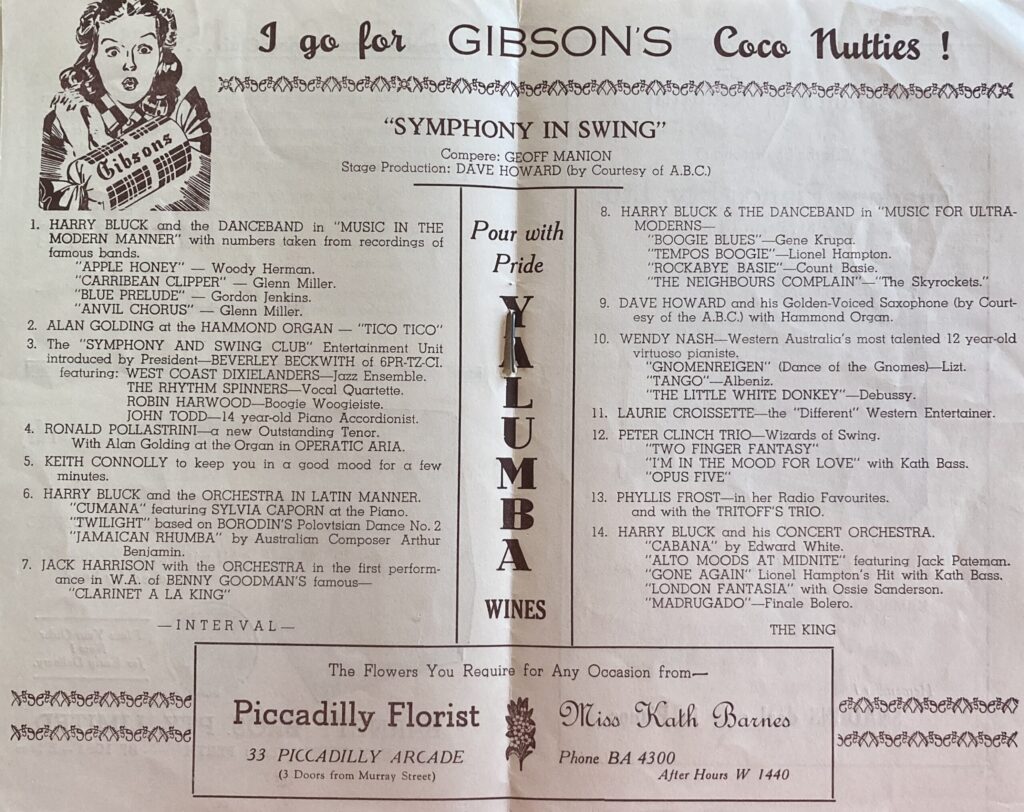
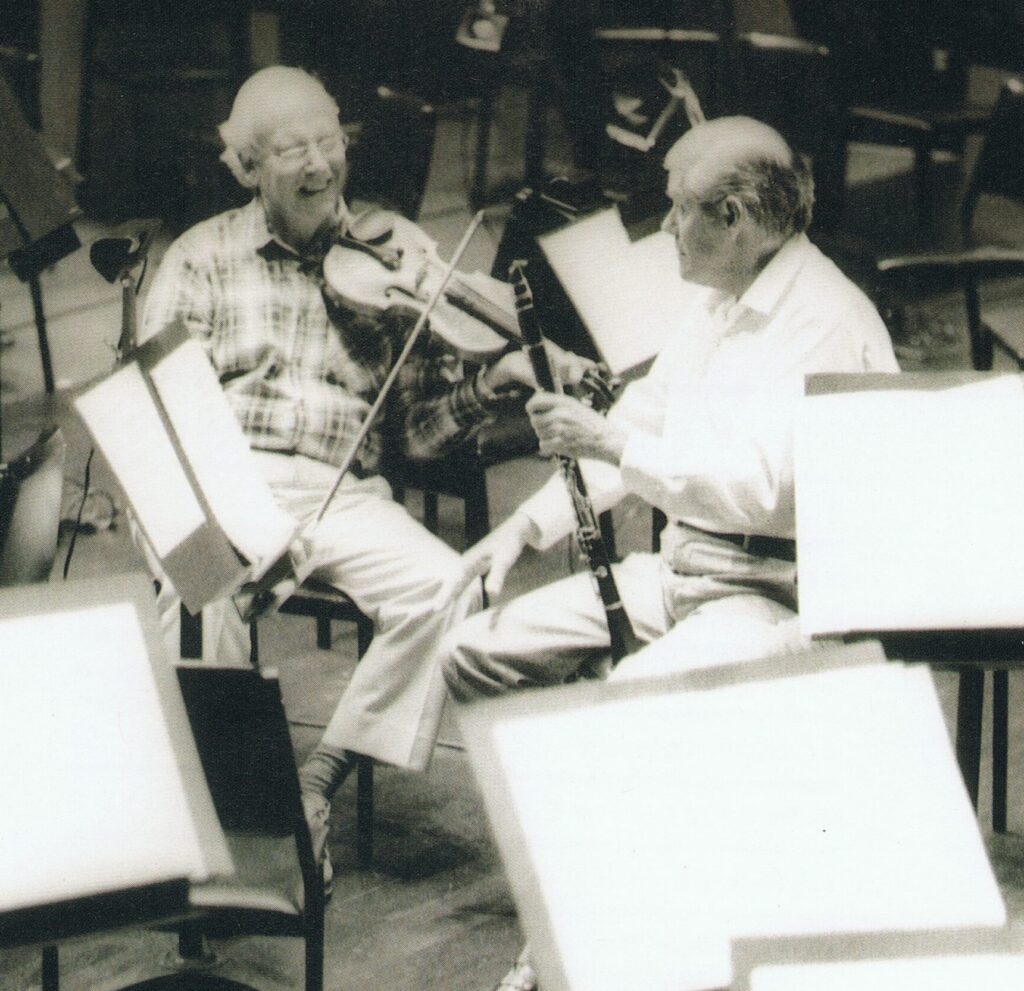
Graham composed a clarinet quintet which was premiered by Jack Harrison.
QUINTET FOR CLARINET AND STRINGS
1966 MUSIC LOVER’S DIARY
The Oriel String Quartet, of which Ashley Arbuckle is a member, will combine with clarinettist Jack Harrison to give a recital for the Kylie Music Club in the Skinner Galleries at 8.15pm on May 8. The programme will include Graham Wood’s Quintet for Clarinet and Strings. Proceeds will go to the W.A. Music Bursary Trust Fund.
The Chamber Music Society and the Kylie Music Club will hold a combined recital in the Skinner Galleries at 8.15 tomorrow. The Oriel String Quartet, of which Ashley Arbuckle is a new member, will be joined by clarinettist Jack Harrison in a concert. The proceeds will go to the W.A. Music Bursary Trust Fund. The programme will include Graham Wood’s Quintet for Clarinet and Strings. Mr Wood and Mr Arbuckle are beginning to make their marks as composers. Both are new bachelors of music. The Chamber Music Society welcomes guests at it s musical evenings and aims to have 150 to 200 members this year. The Kylie Club is also seeking new members.
May 8th 1966 -RECITAL WILL AID FUND – By Sally Trethowan
The Kylie Music Club and the Chamber Music Society combined their monthly meetings last night in a special program in the Skinner Galleries to aid the W A. Music Bursary Trust Fund. The Oriel String Quartet played works by Haydn and Brahms and with clarinettist Jack Harrison performed a quintet for clarinet and strings by the Oriel’s leader Graham Wood. Mr. Wood has much to say in his music and he communicates it in an idiom easily comprehended by even the conservative in the audience. His quintet is tightly constructed and the music, even in the scherzo’s taut rhythms, is romantic and appeals strongly to the listener’s emotions. The clarinet role is conceived as a solo song threading the string texture. Jack Harrison last night gave this part an eloquent reading especially in the wistful soliloquy that opens and concludes the work.
| 8.5.1966 | Graham Wood Quintet for Clarinet and Strings WORLD PREMIERE | Jack Harrison (clarinet) Oriel String Quartet | Skinner Galleries Kylie Music Club Western Australia |
https://www.australianmusiccentre.com.au/artist/wood-graham
Graham continued tutoring, composing, and studying music well into his eighties.
On 24 September 2005, Australian violinist and educator Graham Wood OAM died at age 95. Throughout his career, he was a highly influential and dedicated member of the Australian musical community, not only as a violinist but also as a passionate educator who shaped the development of string playing and teaching in Western Australia (WA).
https://theviolinchannel.com/australian-violinist-graham-wood-has-passed-away/
Vale Graham Wood, violinist and educator
He and his wife Patricia had three children: Adrian, Martin (dec) and Imogen.