Search names, events, places, organisations, and sources across the archive.
Person
CARMICHAEL, Michael
Born in Melbourne in 1930, John Carmichael studied piano with Raymond Lambert and composition with Dorian Le Gallienne at the University Conservatorium before continuing his piano studies at the Conservatoire National in Paris with Marcel Ciampi. Contact with Arthur Benjamin while he was still in Australia led to a period of study with him in London, studies in composition continued later with Anthony Milner.
John Carmichael was a pioneer in the field of music therapy; he developed music teaching and music appreciation projects at Stoke Mandeville Hospital (where the Paraplegic Olympics was born) and Nethern Mental Hospital in Surrey. Then followed a period as Musical Director of the Spanish dance company Eduardo Y Navarra, with extensive international touring including an Australian visit during which ABC Television recorded their dance program Fuego en la Sangre (Fire in the Blood). The contact with flamenco, expressed both in dance and by the flamenco singers and guitarists, led John Carmichael to encapsulate the experience in his Concierto Folklórico, released on ABC Classics with the composer as piano soloist.
In 1980 James Galway premiered John Carmichael’s Phoenix – Concerto for Flute & Orchestra at the Sydney Opera House; he gave the American premiere at the Hollywood Bowl a few months later and included the work in his Flute Masterpieces series released by RCA to celebrate Galway’s 60th birthday. His Trumpet Concerto, recently released on CD with John Wallace and the BBC Scottish Symphony Orchestra, was originally written for Australian trumpeter Kevin Johnston and also released on ABC Classics, together with his Country Fair for clarinet and orchestra.
Writing for the piano has always stimulated ideas for compositions, including works for four hands, and has led to collaborations with Australian pianists such as Victor Sangiorgio and Antony Gray, who gave the premier of Carmichael’s Piano Quartet Sea Changes in London in 2000 with Australian string players Belinda MacFarlane, Morgan Goff and Matthew Lee; the work was later released on the ABC Classics CD Sea Changes.
John Carmichael’s work for wind octet On the Green was premiered at St. Martin-in-the-Fields in 2007. Celebrating the green spaces of West London where the composer has lived for the least 40 years, it highlights the events which take place in these areas open to all to enjoy – open air music, fun fairs, children’s games and care-free summer’s days.
Concentration on melodic and thematic development within well-wrought musical structures has always been a feature of Carmichael’s music, something remarked on by both listeners and reviewers. In 2007 on the release of the ABC Classics CD Solo Flights, a complete recording by Antony Gray of Carmichael’s music for solo piano, it was selected as CD of the Week on the ABC network and was reviewed in the Classic FM Magazine in the UK as “77 minutes of enchanting music”, while Rob Barnett in Classical Music on the Web, reviewing the CD Sea Changes, remarks that Carmichael is “completely serious in his pursuit of discovery in melody – blissfully accessible and often sheerly beautiful”.
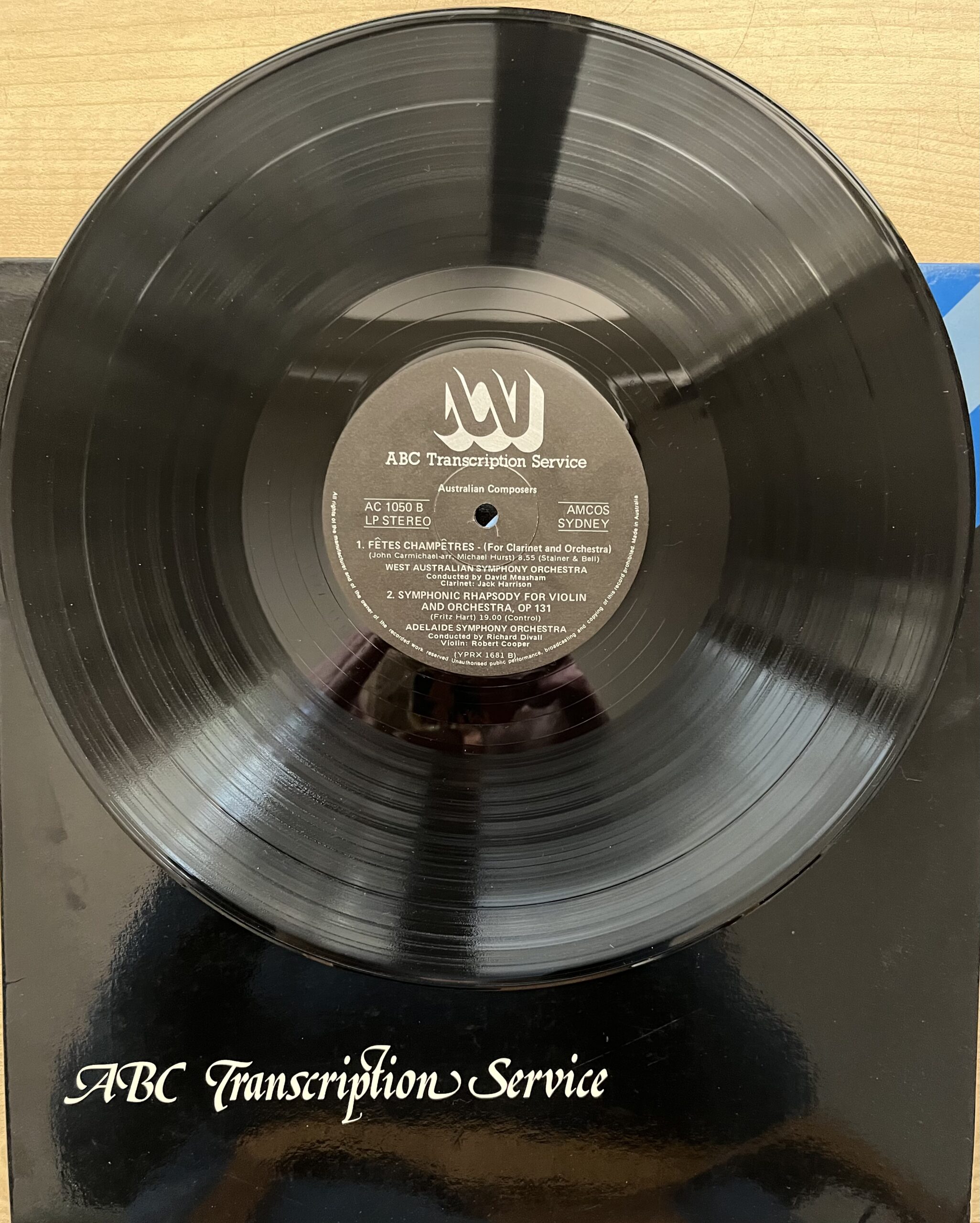
John Carmichael wrote A Country Fair (also known as [Fêtes champêtres]) in 1960 as a work for clarinet and piano, later orchestrating it in 1972.
Original Composition: 1960 (for clarinet and piano)
Orchestral Version: 1972 (for clarinet and orchestra)
Movements: Passepied, Berceuse, and Rigaudon
30.1.1972
John Carmichael“A Country Fair” Orchestrated by Michael Hurst (in 1972) AUSTRALIAN PREMIERE The piece was originally written for clarinet and piano in 1963 under the title Fêtes champêtres
Eric Coates was born on August 27th, 1886, at Hucknall. His father was a well-loved and respected doctor in this small mining town in the centre of the Nottinghamshire coalfields between Nottingham and Mansfield. Coates showed an interest in music at an early age, studying first the violin and then the viola with George Ellenberger, a pupil of Joachim, and harmony with Dr Ralph Horner in Nottingham.
At the age of twenty he arrived in London determined to make a career in music despite some family misgivings. He won a scholarship to the Royal Academy of Music where he studied viola with Lionel Tertis and composition with Frederick Corder. This was in the days of Sir Alexander Mackenzie when the Academy was in Tenterden Street. At the outset Mackenzie recognised Coates’ talents. ‘Mark my words, young man,’ he said to Coates, ‘ye’ll start as a viola player but ye’ll end up as a composer!’
From 1912-1919 Eric Coates was principal viola of the Queen’s Hall Orchestra under Sir Henry Wood. He also played under the batons of Elgar, German, Delius, Holst, Walford Davies, Bantock, Richard Strauss, Debussy, Ethel Smyth (who addressed him delightfully as ‘the man who writes tunes’), Mengelberg Nikisch and Beecham. He also played in theatre orchestras including the one at the Savoy Theatre for the Gilbert & Sullivan Operas. Although a very modest man, he enjoyed telling the story about members of the orchestra having a competition to see who would be the first to play an entire score from memory —and how he won. Coates played in string quartets too. He took Lionel Tertis’ place in the Hambourg String Quartet for a tour of South Africa.
Eventually, in 1919, when neuritis in his left hand made playing the viola more and more difficult, Eric Coates turned exclusively to composition. By this time, his music was acquiring a steady following with such established successes as Stonecracker John (1909) and Miniature Suite with its entrancing Scene du bal, first performed at a Prom Concert in 1911.
Eric Coates’ work is in the tradition of polished melodic light music started by Sir Arthur Sullivan and continued by Edward German. Indeed, in his early years, Coates was much influenced by German. During the 1920s, however, Eric Coates developed a distinctive style which embraced his own use of the newly-introduced American syncopated idiom. He was the first European composer to treat this new style seriously and successfully integrate it into symphonic writing. When he adopted syncopation, the music critics of the heavier press ignored him but it never concerned him. ‘After writing the London Suite,’ he once said, ‘I moved from the music page to the news page and it was one of the moves I have never regretted.’
For over twenty seven years Eric Coates’ march Knightsbridge, from his London Suite introduced BBC Radio’s In Town Tonight. For forty years By the Sleepy Lagoon announced Desert Island Discs. And these were not the only long running programmes that used Coates’ music. His march Calling All Workers was the clarion call for the thousands of Music While You Work programmes broadcast during the hard days of the war. Halcyon Days (Elizabeth Tudor) from The Three Elizabeths Suite opened and closed BBC Television’s immensely popular serialisation of Galsworthy’s The Forsyte Saga. These were just a few of the programmes that were enhanced by Eric’s music which seems to give them a special cachet and perhaps a touch of magic because they all seemed to be successful. After Knightsbridge was first broadcast in 1933, twenty thousand letters arrived at Broadcasting House within the following two weeks asking for the name of the composer and the signature tune of In Town Tonight.
Whereas many British composers sought inspiration in the countryside it was usually the reverse for Coates. He was most happy working amongst the sounds and excitement of London. Inspiration sometimes came to him in the most unusual places. A certain pillar box in Harley Street, for instance, is said to have inspired one of his marches. Eric Coates received many letters suggesting ideas for suites. Most of these were unsuitable but one from a Rev Arthur L Hall of Barnes did inspire The Three Elizabeths dedicated to the then Queen Consort (to become the Queen Mother) and first performed in 1944.
The years from 1926 to 1939 were the most prolific in Coates’ career and marked his rise to international fame. From this period comes: The Three Bears, Cinderella, The Enchanted Garden, London Suite, London Again Suite, From Meadow to Mayfair, the Saxo-Rhapsody, The ThreeMen, Four Ways and The Jester at the Wedding.
What is not quite so well known today is that Coates composed a large number of songs. Speaking of these, Mrs Stanford Robinson, who sang many of them under her professional name, Lorely Dyer, said: ‘I always enjoyed singing Eric’s songs. They had a lovely vocal line and gave one every chance to colour one’s voice. My favourites were Fairy Tales of Ireland, Bird Songs at Eventide, I Heard You Singing and, most of all, Green Hills of Somerset.
Eric Coates enjoyed conducting his own music and had very decided views on the subject. He liked his music to be taken at brisk and lively tempi — he frowned on those conductors who made it sound slow and stodgy — there was nothing like that about him. Stanford Robinson, who must have conducted more performances and made more recordings of Eric’s music than any other conductor, said, ‘He was a very good conductor. He was always neat and immaculate and, of course, having been an orchestral player himself, he did not bully the orchestra but he was always in control.’
One’s overall impression, reading his autobiography, Suite in Four Movements, published in 1953, is that Eric Coates was an essentially happy person, full of joie de vivre. His son, Austin Coates, confirmed that this was so and said: ‘Yes, that’s absolutely true although at home we noticed how calm and extremely well ordered he was. For instance, he couldn’t settle down to write music until he was properly dressed in the morning complete with tie and Harris Tweed coat — and, perhaps, a Turkish cigarette. He was very formal at home and incredibly tidy. If I left a book lying around anywhere there would be quite a lot of remonstrances to follow. But he was very easy to live with.’
Recently, Sir Charles Groves wrote of him, ‘Eric Coates was a gentle and quietly-spoken man but his music crackled with vitality. He could write tunes and could clothe them in the most attractive instrumental colours; not for nothing had he been Henry Wood’s Principal Viola in the Queen’s Hall Orchestra. ‘He did not, as far as I know, aspire to writing symphonies or oratorios. He knew what he could do and he did it superbly well. ‘Someone once said that the marches of Souza would make a man with a wooden leg step out; a man would have to have a wooden heart not to respond to the music of Eric Coates.’
When Eric Coates died on December 21st 1957, it was rightly commented that perhaps no other composer had ever provided music to suit the public taste so unerringly for so many years. Indeed from his early song successes in Edwardian days to those of his last orchestral works (including The Dam Busters’ March), Eric Coates was recognised as the ‘uncrowned king of light music’.
Reproduction Rights
This biography can be reproduced free of charge in concert programmes with the following credit: Reprinted by kind permission of Warner/ChappellSAXO-RHAPSODYTheSaxo-RhapsodyEric Coates is a classical concert piece written in 1936 for solo E-flat alto saxophone and orchestra. The Saxo-Rhapsody stands as one of the notable early concert works written to showcase the expressive and technical capabilities of the saxophone within a light orchestral framework. It features lyrical melodies paired with lively, rhythmic sections. Early landmark recordings featured pioneering saxophonist Sigurd Raschèr alongside Coates conducting.
Key Details
Composer: Eric Coates (1886–1957)
Year of Composition: 1936
Instrumentation: Solo E-flat alto saxophone with symphony orchestra (also arranged for saxophone and piano)
Duration: Approximately 11 minutes
Publisher: Faber Music
1956
Eric Coates Saxophone Rhapsody (1936)
PERTH PREMIERE?
Free concert
Orchestral Shell Supreme Court Gardens Perth, Western Australia Broadcast on 6WN from 8.30pm to 10pm
A free concert in the Supreme Court Gardens (using the new orchestral shell) will be given tomorrow evening by the A.B.C. starting at 8.30. John Farnsworth Hall will conduct the W.A. Symphony Orchestra and the soloists will be Jack Harrison (in Eric Coate’s Saxophone Rhapsody) and Ivan Nylander (in Koenig’s Post-Horn Galop). Orchestral numbers will be from Offenbach, Delibes, Sibelius, Bizet, Arthur Benjamin, Johann Strauss, etc.Tonight’s free concert comes over 6WN from 8.30pm to 10pm. The W.A. Symphony Orchestra provides the music from the Orchestral Shell. John Farnsworth Hall is the conductor. Saxophonist Jack Harrison and post-horn player Ivan Nylander will give solo items. Harrison will play Saxophone Rhapsody and Nylander The Post-Horn Galop.WASO COUNTRY TOURMoora Town Hall Monday 5th August 1957Northampton King’s Hall Tuesday 6th AugustMullewa Town Hall Thursday 8th AugustConductor – John Farnsworth HallSoloists: Vaughan Hanly (violin) Jack Harrison (saxophone)ERIC COATES: Saxo-Rhapsody
https://en.wikipedia.org/wiki/Eric_Coates
Born in Sydney in 1913, Dulcie Holland trained at the NSW State Conservatorium of Music, where she studied piano with Frank Hutchens, cello with Gladstone Bell, and composition with Alfred Hill. She graduated with her Teacher’s Diploma in 1933. After leaving the Conservatorium she studied for a time with Roy Agnew.
Travelling to London, Holland studied at the Royal College of Music with John Ireland, and at the end of her first year was awarded the Blumenthal Scholarship (which provided for three years of study at the RCM) and the Cobbett Prize for Chamber Composition. With the outbreak of World War II the next year, however, she returned to Australia to work as a freelance composer. On a return visit in 1950 she studied with the serialist composer Matyas Seiber.
During the 1940s in Sydney, she combined family life with producing a considerable output of original music. It was in 1944 that she composed one of the greatest treasures of Australian music, the Trio for violin, cello and piano.
In the 1950s her musical output turned in a new direction, when she was associated with the Department of the Interior as composer of music for some forty films documenting life in Australia, produced at the time of the large post-war intake of migrants.
In 1973 the first of Holland’s many books on the technique of writing music appeared. To her, it was a matter of logic that a teacher should help others in explaining the art of two-part writing, melody writing and so on, and Dulcie’s books on musicianship and related matters remain a unique educational contribution and their fame has spread far and wide.
Included among the many prizes Dulcie won for her compositions are ABC/APRA Awards in 1933, 1944, 1951, and 1955; ANZAC Festival Awards in 1954, 1955, and 1956, the General Motors Theatre Award in 1963 and the Henry Lawson Award in 1965. In 1977 she received the AO, and in 1993 was honoured with an Honorary D.Litt. from Macquarie University in recognition of her achievements.
Dulcie Holland died in Sydney on 21 May 2000 at the age of 87.
https://www.australianmusiccentre.com.au/artist/holland-dulcieCOMPOSER IS PROVOCATIVE – February 21, 1956 – By “Fidelio”A West Australian composer, James Penberthy, offered us last night what in some ways the most adventurous Australian composition so far heard in the Art Gallery programmes. This includes, notably, his medium of expression; a wind quintet consisting of flute, oboe, clarinet, horn and two bassoons. For this unusual combination Mr Penberthy had produce a work in short, linked movements, based on the music and life of Australian aborigines. He obtained interesting effects in the way of atmosphere and drastic colourings, but his score sounded very fragmentary. It seemed often to be hovering uncertainly between outright imitative realism and the freer imaginative flight which, we felt, should not convincingly emerge. Another unusual inclusion was a set of three nicely fanciful songs for soprano and flute (no piano) by John Gordon, the words being taken from Chinese. The rest was chiefly light music, generally pretty in a conventional style. There were two pieces for flute and piano by A.C. Black (a West Australian), clarinet and piano pieces by Dulcie Holland and Moneta Eagles, songs by Horace Keats and Elizabeth Mills. The performers were Sylvia Biddle (soprano), Owen Fisenden (flute), Jack Harrison (clarinet), Neil Pierson (horn), Ron Richmond (oboe), George Dreyfus and Claude Welling (bassoons) and Phyllis Allen (accompanist).
Work Details
Year: 1950
Instrumentation: Clarinet, piano.
Duration: 5 min.
Difficulty: Medium — AMEB Grade 6-7.
Written for: Clive AmadioFirst performance: by Clive Amadio, Olga Krasnik — 1950. for ABC radio
https://www.australianmusiccentre.com.au/workversion/holland-dulcie-ballad/4433
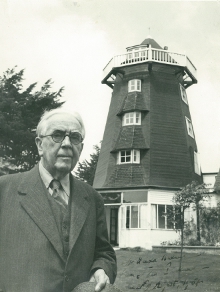
Born near Manchester, studied and taught at the Royal College of Music, lived in Chelsea, London for over 50 years and died in a converted windmill in Sussex. Ireland’s foremost inspirations were the ancient landscapes of the Channel Islands, Dorset and Sussex and the writings of pagan mystic Arthur Machen; the composer recounting that he himself had experienced a ‘vision’ on the South Downs.
John Ireland was born in Bowdon, near Manchester, England on 13th August 1879. His parents were literary people and knew many writers of the day, including Emerson. Ireland entered the newly-established Royal College of Music in London at the age of fourteen, lost both his parents shortly after, and had to make his own way as an orphaned teenager, studying piano, organ and composition. The last was under Sir Charles Stanford, who taught many of the English composers who emerged at the end of the 19th century: Ralph Vaughan Williams, Gustav Holst, Frank Bridge (born in the same year as Ireland), Eugene Goossens, Arthur Bliss, Herbert Howells, George Butterworth, and many others.
Ireland destroyed almost all his student works and juvenilia (the beautiful Sextet for clarinet, horn and string quartet being one of the few works which he permitted to be published, and then only towards the end of his life) and emerged as a celebrated composer towards the end of World War I when his Violin Sonata No.2 in A minor brought him overnight fame. From then until his death in 1962 he led an outwardly uneventful life combining composition, composition teaching at the Royal College (where his pupils included Benjamin Britten and E. J. Moeran), and his position as organist and choirmaster at St. Luke’s Church, Chelsea, in London.
Ireland’s music belongs to the school of ‘English Impressionism’. Having been brought up on the German classics, notably Beethoven and Brahms, he was strongly influenced in his twenties and thirties by the music of Debussy, Ravel, and the early works of Stravinsky and Bartók. While many of his contemporaries, such as Vaughan Williams and Holst, developed a language strongly characterised by English folk song, Ireland evolved a more complex harmonic style closer to the French and Russian models. Like Fauré, he preferred the intimate forms of chamber music, song, and piano music to the larger orchestral and choral canvases, He wrote neither symphony (unlike his friend Arnold Bax who wrote seven) nor opera and only one cantata, These Things Shall Be, but his Piano Concerto is arguably the best to have been written by an Englishman, and is a work of intense emotion and nostalgic feeling.
Ireland was strongly influenced by English poetry. His settings of A. E. Housman, Thomas Hardy, Christina Rossetti, John Masefield and Rupert Brooke are among the best known of his works. He was also highly susceptible to the spirit of place. He lived for many years in London’s Chelsea (Chelsea Reach is a depiction in the form of a barcarole of that great sweep of the Thames as it passes along the Embankment to the west of the Houses of Parliament). He was also devoted to the Channel Islands of Guernsey and Jersey. Their location between England and France must have seemed appropriate to his musical orientation, but more importantly he found there traces of prehistoric pagan ritual to which he had originally been drawn through the writings of the Welsh writer Arthur Machen.
But perhaps his greatest love was for the English county of Sussex, a landscape of rolling downs and (in Ireland’s day) isolated villages, including Amberley whose ‘Wild Brooks’ – streams coursing through fields – gave him the inspiration for one of the most brilliant of his piano pieces. Ireland eventually retired to Sussex in 1953 when he bought a converted windmill, Rock Mill, underneath the Downs. He died there on 12th June 1962.
Ireland’s music is intensely personal in style and has always attracted a devoted following among discerning music lovers. As well as his Piano Concerto, previously mentioned, works that continue to be frequently performed and recorded are: A Downland Suite and Concertino Pastorale for strings, The Overlanders, A London Overture, Mai-Dun, and TheForgotten Rite for orchestra, sonatas for cello and piano, violin and piano, and clarinet and piano, The Holy Boy, Sea Fever and his beautiful motet Greater Love (to name but a few). His hymn tune My Song is Love Unknown is sung in churches throughout the English speaking world.
Fantasy-Sonata is a piece in E-flat major for clarinet and piano composed by John Ireland in 1943. The work is Ireland’s only extant piece for solo clarinet and one of his last major compositions before his retirement. It is dedicated to Frederick Thurston and was premiered by Thurston and Ireland in January 1944. The two also broadcast the piece live on the BBC in 1948. The piece is about 15 minutes long.
Fantasy-Sonata was written between January and June 1943, while Ireland was temporarily living in Essex. It was inspired by the Roman comic poem “Satyricon” and by Ireland’s experience in being evacuated from Jersey during the Second World War. Fiona Richards has suggested that the work also contains “allusions to Ireland’s attraction to younger men”.
The through-composed piece is written in a very loose sonata form with frequent shifts in tempo, mood, and tonal centre, but has no clear resolution, as would be expected in a typical sonata. It has a lush and highly virtuosic piano part; Scott Goddard argued that “in all English music of the last half-century there has been no purer pianoforte writing than this”. The clarinet part covers the instrument’s entire range, incorporating both legato and rhythmic passages.
A reviewer from the News Chronicle, cited by Colin Lawson, noted that he “had never imagined that clarinet and piano could be combined so satisfactorily; nor that (by a mixture of tact and daring) they could form such an exciting ensemble”.
Gordon Jacob was the musician’s musician par excellence. He was noted for his complete professionalism as a composer and arranger of music both light and serious. Jacob was born in London on 5 July 1895 and died on 8 June 1984, shortly before his 89th birthday. After his initial schooling at Dulwich College, he became a student at the Royal College of Music in London, where his tutors included Sir Charles Villiers Stanford, Sir Hubert Parry and Herbert Howells. He taught briefly at Birkbeck and Morley Colleges, also in London, before returning to the Royal College as a lecturer in 1926; he was to remain there until his retirement in 1966. His students there included Malcolm Arnold, Imogen Holst (composer daughter of Gustav), Elizabeth Maconchy and Bernard Stevens.
Gordon Jacob is remembered for his achievement in a number of fields. His textbooks Orchestral Technique (1931), The Composer and his Art (1955) and The Elements of Orchestration (1962) are still widely read and respected. He arranged a number of works by other composers, producing orchestral versions of Vaughan Williams’ English Folk Song Suite and Holst’s First and Second Suites and Moorside Suite, all originally for wind or brass band, and orchestrating items from the Fitzwilliam Virginal Book as the William Byrd Suite (1922, rev. 1939); Mam’zelle Angot is a ballet suite arranged from Lecocq’s opera of 1872.
Jacob also wrote a number of original works for symphonic band, including An Original Suite (1928), Music for a Festival (1951), Flag of Stars (1956), the Concerto for Band (1970), Double Concerto (1976) and Celebration Overture (1984).
His original orchestral works include two symphonies (1929 and 1944), three sinfoniettas (1942, 1951, 1953), a Divertimento for small orchestra (1938), the Galop joyeux (1937) and a generous quantity of concertante pieces: for viola, piano (two concertos), oboe (two concertos), bassoon, cor anglais, horn, violin (two concertos), flute (two concertos), cello, trombone and harmonica.
Gordon Jacob is published by Boosey & Hawkes.
This biography can be reproduced free of charge in concert programmes with the following credit: Reprinted by kind permission of Boosey & Hawkeshttps://www.boosey.com/composer/Gordon%20Percival%20Septimus+Jacob?ttype=BIOGRAPHYhttps://www.gordonjacob.net/index.htmlRHAPSODY FOR ALTO SAXOPHONE AND STRINGSwas composed onOctober 27, 1948and was originally written as a Rhapsody for English Horn (Cor Anglais) and Strings for the oboist Terence MacDonagh. Jacob simultaneously created the alternative arrangement for the E-flat alto saxophone, which has since become a staple in classical saxophone repertoire.In March 1963 Jack Harrison performed the Australian premieres ofGordon Jacob’s Rhapsody for Alto Saxophone and Strings
andRalph Vaughan Williams’s Romance for Harmonica and Orchestra
ABC FREE CONCERTWithW.A. Symphony OrchestraConducted by John Farnsworth HallSoloist: Jack Harrison (saxophonist and harmonica player)Programme includes:Rhapsody for Alto Saxophone and Strings (Gordon Jacob)Romance for Harmonica and Orchestra (Vaughan Williams)Tomorrow Night at 8pmSupreme Court Gardens
Mar 1963
Gordon Jacob Rhapsody for Alto Saxophone and Strings (1948) AUSTRALIAN PREMIERE
Vaughan WilliamsRomance for Harmonica and Orchestra (1951) AUSTRALIAN PREMIERE
MUSIC – By Peter Hellstrom – Festival Of Perth 1966The Master of Queens Musick, Sir Arthur Bliss, has told the Festival Of Perth committee that the planning of the musical programs in the coming festival is a magnificent gesture to British music and should be more widely known. That it has become well known already in Britain is showing by letters from many leading authorities there they include congratulations from the executive of the Composers Guild of Great Britain. Though some prominent English music festivals like Cheltenham Aldeburgh and the longest established Three Choirs Festival feature their country music, no British festival has in recent times included such an extensive and exciting range of British music in one series. Works of nearly 70 composers are included. The Perth programs have been wisely spaced over the six week festival period and though many of the concerts will start at the customary 8 pm some will be at 6 pm to enable patrons to attend another festival attraction the same evening.Works by Vaughan Williams, Gordon Jacob, Howard Ferguson, Lennox Berkeley and Michael Tippett will be new to W.A. The London Symphony Orchestra conducted by Colin Davis will introduce Bliss’s “Discourse for Orchestra” to Australia in one of its Perth concerts. In the other, Tippitt’s Symphony No. 2 and Stravinsksy’s Symphony in Three movements will be played here for the first time. Leading W.A. musicians appearing as soloists in the festival will include soprano Molly McGurk who will sing Benjamin Britten’s song cycle Les Illuminations with the W.A. Symphony Orchestra. She will also sing the solo soprano part in the University Choral Society’s performance of Vaughan Williams A Sea Symphony. Stephen Dorman will be the accompanist for tenor David Galliver’s three British song recitals. He will also partner violinist Vaughan Hanly in a Sonata recital and will play the solo part in constant Lambert’s Concerto for Orchestra and Nine Instruments. Jack Harrison will be the soloist in David Tunley’s Clarinet Concerto and will be joined by the Oriel Quartet in Bliss Clarinet Quintet. Graham Wood will introduce James Penberthy’s Romance for Violin and Orchestra and Alice Carrard will be the pianist with the A.B.C. Wind Players in Rawsthorne’s recent quintet. Madame Carrard will be joined by Mr Dornan, Stephanie James and Michael Cole to perform Malcolm Williamson’s new Concerto for Wind Quintet and two pianos. The new university organist, Mr John Hind, will be soloist in a program which will feature the W.A. Bach Society. The Oriel Quartet will also be the soloists with the W.A. Symphony Orchestra in Elgar’s Introduction and Allegro for strings and will give a separate recital of works by Howells, Frank Bridge, John Exton (the newly appointed senior lecturer in music at the university) Gerald Finzi, Elizabeth Lutyens and Edmund Rubbra. The West Australian September 1965FOURTEENTH ANNUAL FESTIVAL OF PERTH – THE ABC PRESENTS(in association with Festival of Perth Committee) Opening Concerts ofMUSIC OF BRITAIN SERIESA 15-concert feast of music from the great heritage of British compositions and including many new works.Tuesday Feb 8 1966A.B.C. Festival OrchestraConductor: Vaughan HanlySoloist: Jack Harrison (clarinet)Programme:Symphony No. 4 (Boyce)Little Symphony (Jacob)Concerto for Clarinet and Strings – first performance (Tunley)Serenade (Ferguson)B Flat Divertimento (Berkeley)WINTHROP HALLReserve Prices 11/-, 8/6, Unreserved from 5/ at hall after 7pmhttps://www.gordonjacob.net/
Trevor Alan Jones was born in Sydney in 1932. He studied at the NSW State Conservatorium of Music (1949-1955), and at the University of Sydney (1954-1955), completing a BA and an MA, both with first class honours. Upon graduation he received the University of Sydney’s University Medal.
In 1955 he went as a Saltonstall Fellow to Harvard University, USA, to study musicology and composition, before continuing his studies in musicology at King’s College, Cambridge, in 1956. In 1957 he attended the Royal College of Music, London, where he studied composition, conducting and the harpsichord continuo. He also studied conducting privately with Sir Eugene Goossens.
Jones was the recipient of numerous awards, including the Busby and Sydney Moss Scholarships (University of Sydney), a Fulbright Travel Award (USA) and, several times, the Frank Albert Prize (University of Sydney).
Formerly a professional bassoonist, harpsichordist and recorder player in Sydney and Perth, Trevor Jones held a number of teaching posts in Australian tertiary institutions. In 1954 he took up a position as teaching fellow while a research student in the Department of Music at the University of Sydney, becoming a temporary lecturer there in 1958 and 1959, after his return from the USA and Europe. He was Senior Lecturer in Music at the University of Western Australia from 1960 to 1965, and in 1965 became the Foundation Professor of Music and Chairman of the Department of Music at Monash University in Melbourne, a position which he retained until his retirement in 1988.
Jones’s compositions include works for choir, for example his Four Goliard Songs and Elegy; instrumental chamber works, songs and incidental music for documentary films. His Fugue in Jazz Rhythms won first prize in the Recorder Society of NSW’s 1963 Composers’ Competition.
His major area of research and publication was ethnomusicology, with a particular emphasis on Australian Aboriginal music. Jones contributed the article on the didjeridu in the New Grove Dictionary of Music and Musicians. He was also interested in music education, and carried out research into English wind music of the Jacobean period.
Trevor Jones served on several committees, such as the UNESCO National Advisory Committee for Music, the Australian Institute of Aboriginal Studies’ Ethnomusicology Committee (1964-1976), and the ABC Music Advisory Committee (1966-1969).
https://www.australianmusiccentre.com.au/artist/jones-trevorTrevor Jones arrived at UWA as a Senior Lecturer in the late 1950s alongside Tunley. A bassoonist, ethnomusicologist, and composer, Jones was deeply invested in Renaissance, Baroque, and Indigenous Australian music before leaving to become the Foundation Professor of Music at Monash University.
1961 – MUSIC by Peter HellstromAs a contribution to the W.A. Music Council’s bursary scheme, the University Music Society will hold a public concert in Winthrop Hall at 8 o’clock on Monday night. The programme will be presented by the University Orchestral Society, clarinettist Jack Harrison and the University’s A Cappella Choir. They will perform works by composers of the 16th Century to the present, including compositions by Perth musicians Jennifer Fowler, David Tunley and Trevor Jones. The West Australian Saturday (cut off) 1961FESTIVAL CONCERT TONIGHTWorld Premiere of David Farquhar’s prize winningConcertino for Piano and OrchestraFirst Performance in Australia – Chamber Concerto No. 3 for Bassoon, Strings and Percussion by Elisabeth Lutyens.David Tunley’s Introduction and Scherzo for Clarinet and StringsPlus works by Dvorak, Grieg, Delius, Elgar, Walton and others.UNIVERSITY ORCHESTRA conducted by Trevor Jones.Soloists: Michael Cole, Jack Harrison, Brian Pope.Assisting Artists: John Mowson, John Dean, Verdon Williams.WINTHROP HALL8pm Sat 5th August 1961Unreserved seats at door 10/ Students 7/6CANTATA ZOOLOGICA
A classical musical composition created in 1963 by the Australian composer, ethnomusicologist, and academic Trevor Alan Jones (1932–2012).
Instrumentation: The piece is written for a mixed choir (SATB) and a wind quintet consisting of a flute, oboe, clarinet, bassoon, and horn.
Commission: It was commissioned by the Choir of the Sydney University Musical Society.
Text & Movements: The composition sets animal-themed literary texts to music. For example, the fourth movement, titled “Tiger,” is a musical setting of William Blake’s famous 1794 poem, “The Tyger”.
1966HARSH-TONED MUSIC ENTERTAINSBy Sally TrethowanThe last of the festival “Music of Britain” chamber concerts given in the Basil Kirke memorial studio last night offered some of the most complex and insistently dissonant music of the whole series. Yet each of the three works was so excellently performed that some measure of the composers musical thought in each case intense and highly individual must surely have impressed the general music lover no matter how unsympathetic he might have been to the harsh contemporary harmonic language. The first work “Quintet for wind and piano” by Alan Rawsthorne, was perhaps the most earnest in intention, and also the most abstruse and uncompromising. Much of it was concerned with working out, in terms of spasmodic tempi, unremitting dissonance and often exciting and original blends of wind colour, two moods, one apparently serene but masking disquieting emotional currents; the other desperately merry. This difficult music was persuasively presented by Alice Carrard (piano), Peter Randall (oboe), Jack Harrison (clarinet), Brian Pope (bassoon) and Neil Pearson (French horn). After this, Trevor Jones’s happy blend of whimsy lyricism and drama in his “Cantata Zoologica” was immensely entertaining. It was given a premiere late last year by the W.A. Bach Society choir and quintet and it was performed last night by the same artists except that the conductor on this occasion was Laughton Harris and the narrator was Neville Teede. Mr Harris’s cogent grasp, poetically and musically of the work was incisively conveyed through the unerring accuracy of his beat to which the choir and instrumentalists responded with brilliant execution. Mr Harris also conducted the final concerto for wind Quintet and two pianos (eight hands) by Malcolm Williamson. The wind players were joined by flautist Owen Fisenden and pianist Madame Carrard by fellow soloist Allyne Tilsed, Stephen Dornan and Michael Cole. This work exhibited complex interplay of tone colour. The finale, where the piano parts exploded in figuration of a Bartokian ferocity and aliveness was, I think, unrivalled in the festival music for sheer excitement of performance. The West Australian Wednesday March 9 1966 page 17
Festival of Perth: “Music of Britain” series Basil Kirke Studio A.B.C. Adelaide Terrace, Perth, Western Australia
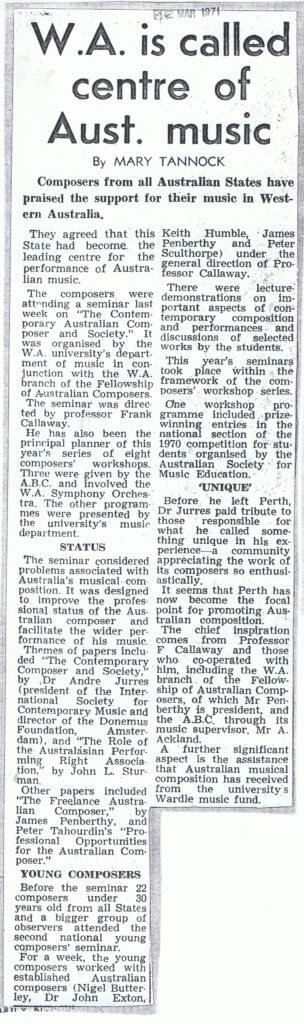
Workshop at its most attractive – By MARY TANNOCK – Thursday February 18 1971Last night’s Australian composers workshop program at the Basil Kirke Studio was distinguished by the presence of Dr Andre Jurres, president of the International Society of Contemporary Music and the Australian composer Peter Sculthorpe. They were members of the panel chaired by Professor Frank Callaway. It was also the most attractive of the workshop series in the festival so far. Works by Margaret Sutherland, Colin Brumby, John Exton, Peter Sculthorpe and Trevor Jones were performed by Molly McGurk (soprano), Jack Harrison (clarinet), Stephen Dornan (piano) and the Oriel Quartet. Peter Sculthorpe’s “The stars turn” opened with wistful echoes from Gregorian Chant and a sea shanty and dissipated quickly into the character of the song. With limpid tones Miss McGurk sensitively delineated the shifting patterns of a lyrical line. Again, with Colin Brumby’s “Three Italian Songs for High Voice and String Quartet”, she infused chiselled and graceful declamation into the string line, throwing into relief its undulating fluidity. Trevor Jones’s “Essay for String Quartet” was alive with dense pulsating rhythms and sometimes fugal growth. Its textural complexity was skilfully highlighted by the Oriel Quartet. In Margaret Sutherland’s “Sonata for Clarinet and Piano” traditional texture and techniques were cleverly reconciled to the clarinet line and the accompanist Stephen Dornan’s deft chordal Textures in the piano provided neat and subtle undertones.The West Australian February 19 1971Composers’ Workshop an Evening of Contrasts – By ALAN BONDS – Thursday February 18 1971The workshop program presented in the Basil Kirke Studio last night was an evening of contrasts. The programme began with a polished rendition by Jack Harrison and Stephen Dornan of a “polished” Sonata for Clarinet and Piano by Dr. Margaret Sutherland. The work’s appeal was immediate, its form was basically straightforward and concealed few intricacies for cerebral digestion. The cycle of three songs by Colin Brumby further enhanced this composer’s reputation for skilful handling of texts. The work was witty and sensitive, but I feel that the texture of the accompanying string quartet was frequently too thick and overpowered the refined singing of Molly McGurk. For those interested, last Thursday’s performance of John Exton’s String Quartet (1969) was their fourth opportunity to hear the work in as many months and the work could easily stand a fourth hearing. It is completely absorbing, combining the all-embracing logic of serialism with a wonderful sense of contrast and colour. The performance by the Oriel Quartet was both accurate and persuasive, skilfully handling textures, which demand fine precision and control. “The Stars Turn” (1970) by Peter Sculthorpe was I feel more notable for the performance than the music which was performed. The piece itself was expressive and moving in the skull for tradition of Irkanda and the Quartets but I couldn’t help it feel that I had heard it all before. Molly McGurk did a splendid job moulding and phrasing as she might to Schubert or Brahms. The Oriel Quartet concluded the performance with a performance of Trevor Jones’s “Essay for string Quartet”. It would be fair to say that much of the work is reminiscent of Bartok’s quartet writing. The Essay was easily sectionalised thematically with frequent excursions through poly modality to atonalism. The Sunday Times February 21 1971
Albert James Penberthy was born in Melbourne in 1917 and received his early music training from his father. After attending the universities of Western Australia and Melbourne he became a schoolmaster where he taught music and formed orchestras. Following active war time service with the RAN, he obtained first class honours in composition at the University of Melbourne. He later studied composition with Nadia Boulanger in France and conducting with Sir John Barbirolli in England.
For many years he worked in Western Australia where he founded the West Australian Opera Company and was co-founder of the West Australian Ballet Company. He was a prolific composer and his major works number over 100. Although he wrote in many different genres, his intense interest in the theatre resulted in 22 ballets and 11 operas, and it is in this body of work, which displays his strong dramatic and lyrical gifts, that his importance in Australian music lies.
In 1975 Penberthy moved to live on the North Coast of NSW, where he founded the School of Arts at Southern Cross University.
He was awarded the degree of Doctor of Music from Melbourne University in 1975 and the Order of Australia in 1986. James Penberthy died on 29 March 1999
Art Gallery Program Art Gallery of Western Australia (inside the Jubilee Building on Beaufort Street,)
The review written by “Fidelio” describes the premiere of a groundbreaking wind quintet by West Australian composer James Penberthy.
Venue: The Art Gallery of Western Australia (then commonly called the National Art Gallery of Western Australia). The text directly mentions this was the most adventurous Australian piece “so far heard in the Art Gallery programmes.”
Date: February 21, 1956
This performance was part of a chamber music series integrated into the 4th Annual Festival of Perth. The concert specifically showcased modern Australian wind and vocal music, breaking away from conventional light classical styles. The ensemble listed at the bottom features notable musicians of the era, including a young George Dreyfus on bassoon before he became one of Australia’s premier composers.
In 1956, the Art Gallery of Western Australia (AGWA) was located inside the Jubilee Building on Beaufort Street, within the same complex where WA Museum Boola Bardip stands today.
COMPOSER IS PROVOCATIVE – February 21, 1956 – By “Fidelio”
A West Australian composer, James Penberthy, offered us last night what in some ways the most adventurous Australian composition so far heard in the Art Gallery programmes. This includes, notably, his medium of expression; a wind quintet consisting of flute, oboe, clarinet, horn and two bassoons. For this unusual combination Mr Penbethy had produce a work in short, linked movements, based on the music and life of Australian aborigines. He obtained interesting effects in the way of atmosphere and drastic colourings, but his score sounded very fragmentary. It seemed often to be hovering uncertainly between outright imitative realism and the freer imaginative flight which, we felt, should not convincingly emerge. Another unusual inclusion was a set of three nicely fanciful songs for soprano and flute (no piano) by John Gordon, the words being taken from Chinese. The rest was chiefly light music, generally pretty in a conventional style. There were two pieces for flute and piano by A.C. Black (a West Australian), clarinet and piano pieces by Dulcie Holland and Moneta Eagles, songs by Horace Keats and Elizabeth Mills. The performers were Sylvia Biddle (soprano), Owen Fisenden (flute), Jack Harrison (clarinet), Neil Pierson (horn), Ron Richmond (oboe), George Dreyfus and Claude Welling (bassoons) and Phyllis Allen (accompanist).
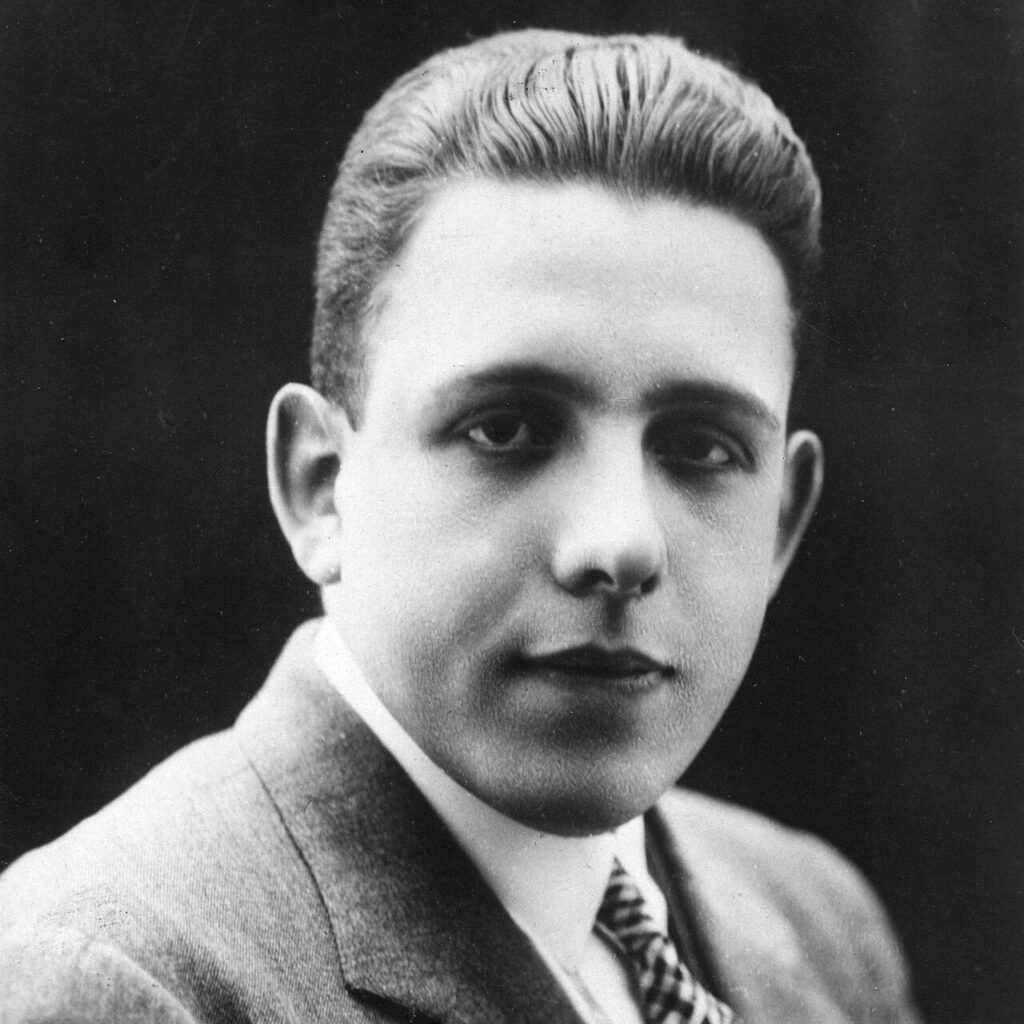
Born in Paris, France, in 1899, Francis Poulenc was a composer noted for music that is witty, crystal clear, and tuneful.
His mother, a talented amateur pianist, was his first piano teacher. Poulenc’s involvement with music was as an amateur for some years. At age 18, Poulenc had his first major success as a composer with Rapsodie Nègre for baritone and chamber ensemble. He had had no composition lessons tothis point and, despite some study later, he remained largely self-taught.
While in the French National Service in 1918, Poulenc composed a number of miniature pieces. Among them was a short work for piano, Trois Mouvements Perpétuels, played for the first time in public in 1919, which became popular throughout Europe.
In the 1920s, he was part of a group of five other young French composers nicknamed “Les Six.” They followed the artistic leanings of Satie and Cocteau, rebelling against the Germanic tradition in music.
Poulenc wrote in almost every medium. His piano works included short pieces as well as concertos for one and two pianos and orchestra. Among his choral works are Un Soir de Neige and a Stabat Mater. His theater works include several ballets: a one-character, one-act tragedy, La Voix Humaine as well as the religious opera, Les Dialogues des Carmelites.
https://www.kennedy-center.org/education/resources-for-educators/classroom-resources/media-and-interactives/artists/poulenc-francisCLARINET SONATA
The clarinettist Benny Goodman, who commissioned the piece, was intended to premiere it with the composer accompanying. Poulenc died suddenly of a heart attack on 30 January 1963 before it was published, and an editor was employed to ascertain the identity of some notes, as well as provide missing dynamics and articulations. The premiere was given at New York City’s Carnegie Hall by Benny Goodman and Leonard Bernstein on 10 April 1963.
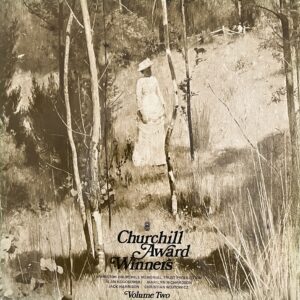
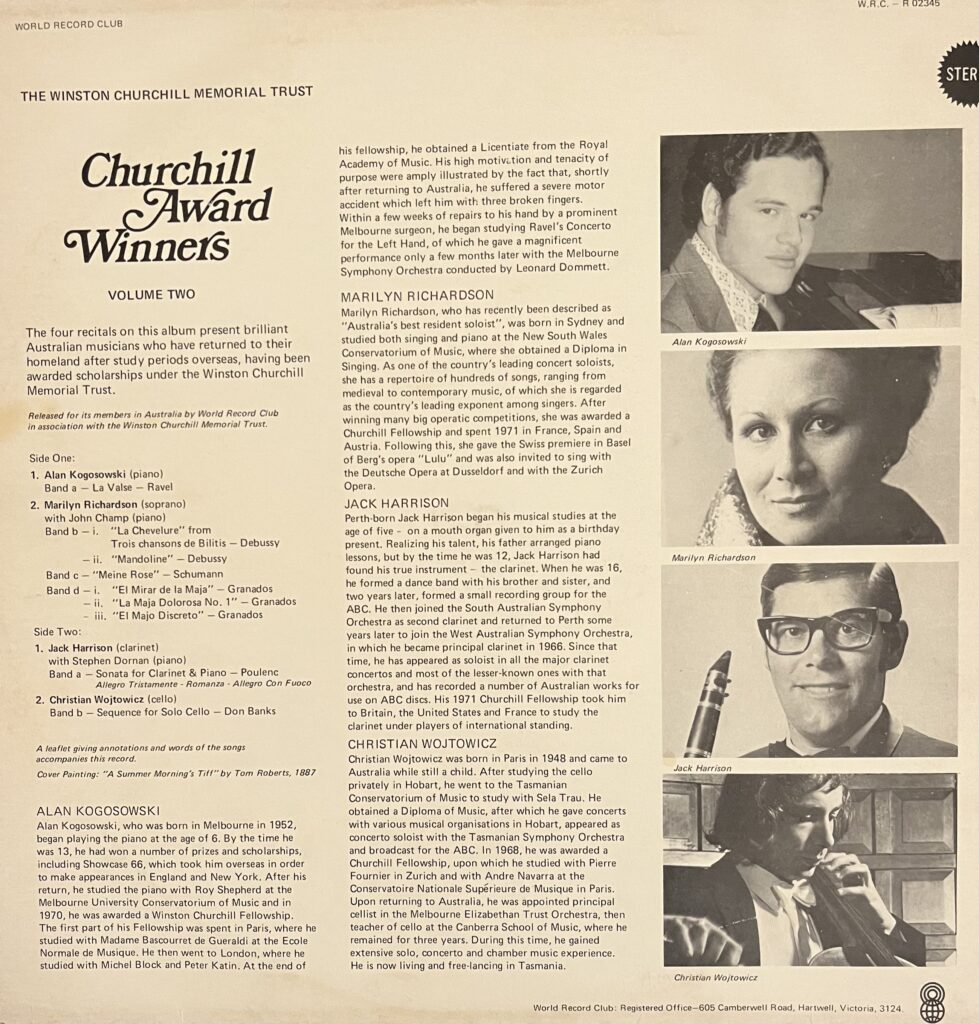
The first Australian recording of Poulenc’s Clarinet Sonata was made by Jack Harrison and Stephen Dornan (piano) in 1973. It was recorded at the A.B.C. for the 2nd L.P. of Churchill Fellowship artists for The Winston Churchill Memorial Trust.
1973
Poulenc Clarinet Sonata (1963) FIRST AUSTRALIANRECORDING
Jack Harrison (clarinet) Stephen Dornan (piano)
Recorded at the A.B.C. for the 2nd L.P. of Churchill Fellowship artists for The Winston Churchill Memorial Trust.
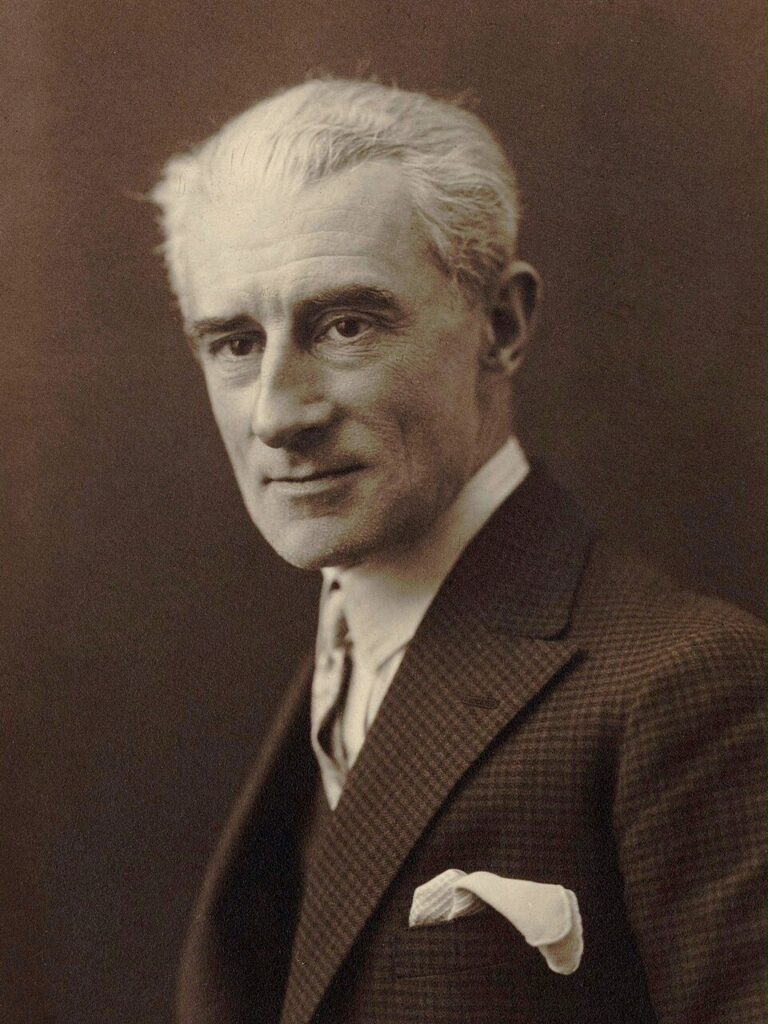
Born in Ciboure, France, in 1875, Maurice Ravel was an outstanding figure in modern French music.
His family moved to Paris when he was three months old. He began his musical studies at the age of seven. He entered the Paris Conservatory where he studied composition under Gabriel Faure¢ in 1899, when he also won recognition for his Pavane for a Dead Princess.
Around 1902, he joined an avant-garde group of artists, writers, and musicians who discussed ideas and collaborated on projects. Impressionistic compositions from this period include the piano suite Gaspard of the Night (1908), Spanish Rhapsody for orchestra (1908), and the ballet Daphnis et Chloé (1912).
After serving in World War I, his works included the choreographic poem, La Valse (1920); the opera The Child and the Enchantments (1925); and Boléro (1928), originally intended as a ballet.
In 1921, he was awarded the Légion d’Honneur. Despite the award’s public announcement Ravel declined accepting it. In 1928, Ravel took a four-month tour of the United States where his concerts and piano recitals received an enthusiastic reception. During this trip he met George Gershwin, whose work he much admired.
One of Ravel’s last major works was the Piano Concerto in D, for the left hand (1931), written for the Viennese pianist Paul Wittgenstein (1887-1961), who had lost his right arm in the World War. Stricken with a neurological disorder in 1932, Ravel died in Paris in 1937.
In the first years of the 20th Century, Debussy and Ravel were championed as the latest important voices in French Art Music, each playing important roles within an intoxicating style generally labeled Impressionism. In a reflection more of fans and critics than the actual relationship between the two composers or their musical styles, Parisians would even take sides in a feisty rivalry of Debussy vs. Ravel. This passionate dichotomy lent itself to another contest of the period: a competition between two rival manufacturers of the concert harp, each with a different solution for equipping with instrument with the complete array of chromatic tones. In 1903, the Pleyel company commissioned Debussy to write an ensemble work featuring their new fangled chromatic harp resulting in Danse sacrée et Danse profane of 1904 for harp and string quartet. In 1905, the Érard company followed suite by offering Ravel the commission to feature their pedal harp and, quickly thereafter, in a rush that he described as “a week of continuous work and three sleepless nights”, Ravel completed his Introduction and Allegro for harp, flute, clarinet and string quartet.
As it requires an unconventional ensemble compared with the string quartet, piano trio or even a full orchestra, Ravel’s truly fantastic Introduction and Allegro is a relatively rare bird on the concert stage. Comprising a single movement with two sections—a short introduction presenting a few crucial motifs forming the thematic substance of the ensuing allegro—it can be regarded in some ways as little harp concerto. The harp takes the lead in stating the main theme of the Allegro, pursues a concertante rivalry with the ensemble and eventually indulges in solo cadenza celebrating Érard’s harp in its full glory. But with its independence of parts, brilliant color and its myriad of ingenious textures often juxtaposing strings against winds, Ravel’s piece makes for well-balanced chamber music.
A familiar and beloved Impressionistic style features both poetic languor and sparkling animation so richly wrought from an economy of musical motifs. At the heart is the solo cadenza for harp: a nearly still reflecting pool of the entire work very gently grazed with the ripples of a soft breeze and sparse, mesmerizing harmonics like a meditative Asian zither of a rarefied, exotic aesthetic.
Many have noted that Ravel ultimately omitted this work from his catalog and made no mention of it in his autobiography. Yet it was the first of a small number of works he recorded in 1923.
The Perth Premiere of Ravel’s “Introduction and Allegro for harp, flute, clarinet and string quartet” was performed by the Oriel String Quartet, Owen Fisenden (flute), Jack Harrison (clarinet) and harpist, Alan Ratcliffe on Sunday 6th October 1968 in a free concert put on by the A.B.C. in the Basic Kirke Studio.
Free A.B.C. Concert – Sunday October 5th 1968
In tomorrow afternoon’s free concert in the A.B.C.s Basil Kirke Studio beginning at 3 o’clock, the performers will be the Oriel String Quartet, clarinettist Jack Harrison, flautist Owen Fisenden and harpist Alan Ratcliffe. The program will be quartets by Dalayrac and Debussy and “Introduction and Allegro” for harp, flute, string quartet and clarinet by Ravel.The West Australian Saturday October 5 1968
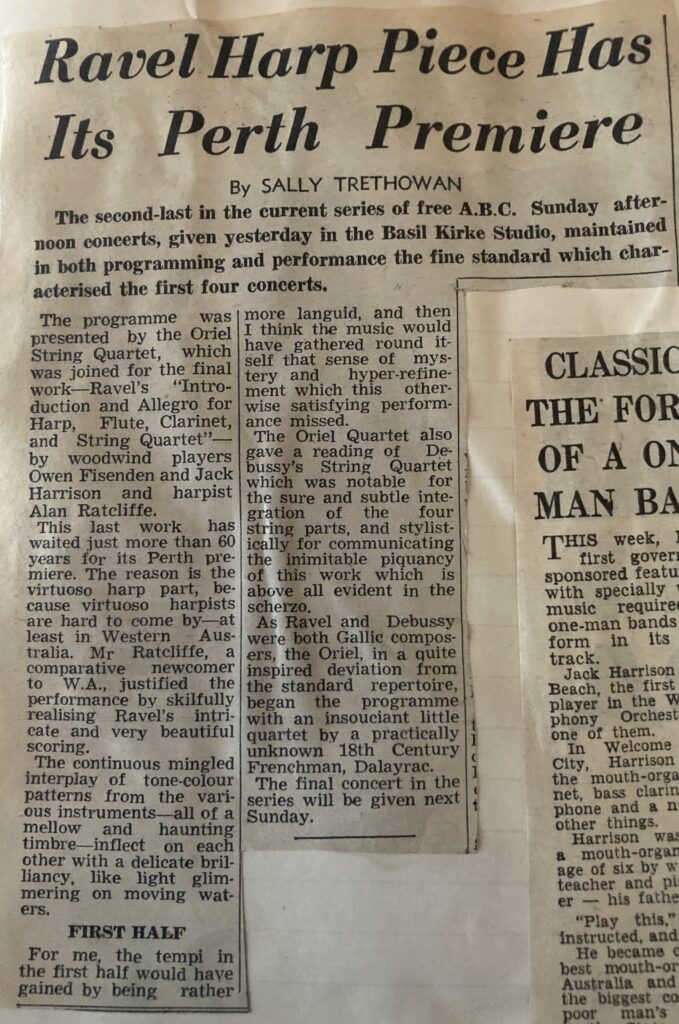
Ravel Harp Piece Has Its Perth Premiere – By Sally Trethowan
Sunday 6th October 1968
The second last in the current series of free ABC Sunday afternoon concerts given yesterday in the Basil Kirke Studio maintained in both programming and performance the fine standard which characterised the first four concerts. The program was presented by the Oriel String Quartet which was joined for the final work – Ravel’s “Introduction and Allegro for harp, flute, clarinet and string quartet” by woodwind players Owen Fisenden and Jack Harrison and harpist, Alan Ratcliffe. This last work has waited just more than 60 years for its Perth Premiere. The reason is the virtuoso harp part, because virtuoso harpists are hard to come by, at least in Western Australia. Mr Ratcliffe a comparative newcomer to W.A., justified the performance by skilfully realising Ravel’s intricate and very beautiful scoring. The continuous mingled interplay of tone coloured patterns from the various instruments – all of a mellow and haunting timbre – inflect on each other with a delicate brilliancy like light glimmering on moving waters. For me, the tempi in the first half would have gained by being rather more languid, and then I think the music would have gathered around itself that sense of mystery and hyper refinement which this otherwise satisfying performance missed. The Oriel Quartet also gave a reading of Debussy’s String Quartet which was notable for the sure and subtle integration of the four string parts, and stylistically for communicating the inimitable piquancy of the work which is above all evident in the Scherzo. As Ravel and Debussy were both Gallic composers, the Oriel, in a quite inspired deviation from the standard repertoire, began the program with insouciant little quartet by practically unknown 18th century Frenchman Dalayrac.
The final concert in the series will be given next Sunday. The West Australian Monday October 7 1968
6.10.1968
RavelIntroduction and Allegro (1905)PERTH PREMIERE
Jack Harrison (clarinet), Oriel String Quartet Owen Fisenden (flute) Alan Ratcliffe (harp)
Free Concert, Basil Kirke Studio A.B.C. Adelaide Terrace, Perth, Western Australia
Ravel Introduction and Allegro for Harp, string quartet, flute and clarinet
With Michael Jefferies – harp; David Leviston – flute; Jack Harrison – clarinet
Chamber Group off to a Good Start – By Derek Moore Morgan – 23rd April 1979
The recently formed Wigmore Ensemble made its first public appearance last night with a delightfully varied program at the Octagon Theatre. A flexible group with no fixed numbers, it has the practical advantage of being able to present music of widely different genres some of which inevitably gets left on the shelf because it doesn’t quite fit a specific mould such as the string quartet or Trio. This was a University of W.A. music Society recital. The performers were Graham Wood and Ashley Arbuckle (violins), John Dean (viola), Jill Cole (cello), Neil Fisenden (flute), Jack Harrison (clarinet) and Anthony Maydwell (harp). The final item, Ravel’s atmospheric and beautifully crafted “Introduction and Allegro” brought all the players together to produce a nice degree of sonority and delicacy capturing much of the subtlety of the masterpiece. Starting with the Mozart Quartet for Flute and Strings in D major a mellifluous example of the composer’s earliest style, the players gave us a bright indication of the bubbling and effervescent Gatty of the Rondo finale. The British composer Frank Bridge, himself a viola player, wrote a whole body of telling string music. His little known Trio (Rhapsody) from 1928 proved to be a forward looking piece for the difficult unless usual combination of two violins and viola, with mysterious opening and closing sections surrounding an energetic central portion. The Italian composer Malpiero’s “Sonata a cinque” (1936) is an appealing piece of writing which hangs on the air like a haunting elergy. Anthony Maydwell’s expressive harp playing came to the fore here. The Quartet for clarinet and strings by Rawsthorne is another piece of chamber music which is deftly written and manipulates varying moods. Jack Harrison’s neatly inflected clarinet tone was well handled.
Alan Rawsthorne was born on 2 May 1905 in Haslingden, Lancashire. He spent a period of training as a dentist, and not until his early twenties did he take up music seriously. He then entered the Royal Manchester College of Music, studying piano, composition, and cello. In 1930 he went abroad and continued his studies, including piano under Egon Petri. On his return to England he taught from 1932 to 1934 at Dartington Hall, there writing music for the School of Dance-Mime. He settled in London in 1935 and three years later gained international recognition through a performance of his Theme and Variations for two violins at the London Festival of the International Society for Contemporary Music. The same Society, just at the outbreak of war, produced his Symphonic Studies at the Warsaw Festival, a work which subsequently won a firm place in the orchestral repertoire.
After the war – during which Rawsthorne served in the Army – he devoted the bulk of his time to composition, and although he was not a prolific composer, his output was substantial. Notable among his post-war compositions are the two violin concertos; the Cello Concerto, commissioned by the Royal Philharmonic Society; the Second Piano Concerto – probably the most popular of his major works – three symphonies; the second and third string quartets; the sonatas for violin & piano, and cello & piano; the Quintet for Piano and Wind; the Quintet for Piano and Strings; and the Ballade for piano written for John Ogden. He also composed a good deal of incidental music for stage and film as well as a ballet for Covent Garden, Madame Chrysanthème.
Rawsthorne was awarded the CBE in 1961, and was made an Honorary Doctor of Music by Liverpool, Essex, and Belfast Universities. He died in Cambridge on 24 July 1971, but his elegant and beautifully crafted music continues to be enjoyed by both performers and listeners. There is an active Rawsthorne Society which disseminates information about the composer, and encourages recordings.
In 2007 the Rawsthorne Trust commissioned Edward Harper to re-orchestrate Rawsthorne’s setting of Coleridge’s Kubla Khan. The score and parts of the choral work, originally commissioned by the BBC, were destroyed when Rawsthorne’s flat was bombed in 1940. The première of the newly reconstructed work took place in Manchester’s Bridgewater Hall in March 2008.
QUINTET FOR PIANO, OBOE, CLARINET, HORN, AND BASSOON (1963)
The first performance of Alan Rawsthorne’s Quintet for Wind and Piano took place in the spring of 1963.
The piece was commissioned by the BBC specifically for its prestigious Thursday Invitation Concerts series. While specific individual ensemble configurations varied for the live broadcast broadcast, the primary musicians associated with the debut and subsequent definitive early recordings of the piece included prominent British instrumentalists of the era:
Sidney Sutcliffe (Oboe)
Bernard Walton (Clarinet)
Alan Civil (Horn)
Roger Birnstingl (Bassoon)
David Parkhouse (Piano
1966 – HARSH-TONED MUSIC ENTERTAINS – By Sally Trethowan
The last of the festival “Music of Britain” chamber concerts given in the Basil Kirk memorial studio last night offered some of the most complex and insistently dissonant music of the whole series. Yet each of the three works was so excellently performed that some measure of the composers musical thought in each case intense and highly individual must surely have impressed the general music lover no matter how unsympathetic he might have been to the harsh contemporary harmonic language. The first work “Quintet for wind and piano” by Alan Rawsthorne, was perhaps the most earnest in intention, and also the most abstruse and uncompromising. Much of it was concerned with working out, in terms of spasmodic tempi, unremitting dissonance and often exciting and original blends of wind colour, two moods, one apparently serene but masking disquieting emotional currents; the other desperately merry. This difficult music was persuasively presented by Alice Carrard (piano), Peter Randall (oboe), Jack Harrison (clarinet), Brian Pope (bassoon) and Neil Pierson (French horn). After this, Trevor Jones’s happy blend of whimsy lyricism and drama in his “Cantata Zoologica” was immensely entertaining. It was given a premiere late last year by the W.A. Bach Society choir and quintet and it was performed last night by the same artists except that the conductor on this occasion was Laughton Harris and the narrator was Neville Teede. Mr Harris’s cogent grasp, poetically and musically of the work was incisively conveyed through the unerring accuracy of his beat to which the choir and instrumentalists responded with brilliant execution. Mr Harris also conducted the final concerto for wind Quintet and two pianos (eight hands) by Malcolm Williamson. The wind players were joined by flautist Owen Fisenden and pianist Madame Carrard by fellow soloist Allyne Tilsed,Stephen Dornan and Michael Cole. This work exhibited complex interplay of tone colour. The finale, where the piano parts exploded in figuration of a Bartokian ferocity and aliveness was, I think, unrivalled in the festival music for sheer excitement of performance. The West Australian Wednesday March 9 1966 page 17
8.3.1966
Alan Rawsthorne
Quintet for Piano, Oboe, Clarinet, Horn, and Bassoon (1963)AUSTRALIAN PREMIERE
The Quartet for Clarinet and Strings (composed in 1948) by Alan Rawsthorne was written for and dedicated to the celebrated British clarinettist Frederick Thurston.
The piece received its first performance in London in November 1948 by the following musicians:
Frederick Thurston (Clarinet)
Harry Blech (Violin)
Keith Cummings (Viola)
Douglas Cameron (Cello)
Chamber Group off to a Good Start – By Derek Moore Morgan – 23rd April 1979
The recently formed Wigmore Ensemble made its first public appearance last night with a delightfully varied program at the Octagon Theatre. A flexible group with no fixed numbers, it has the practical advantage of being able to present music of widely different genres some of which inevitably gets left on the shelf because it doesn’t quite fit a specific mould such as the string quartet or Trio. This was a University of W.A. music Society recital. The performers were Graham Wood and Ashley Arbuckle (violins), John Dean (viola), Jill Cole (cello), Neil Fisenden (flute), Jack Harrison (clarinet) and Anthony Maydwell (harp). The final item, Ravel’s atmospheric and beautifully crafted “Introduction and Allegro” brought all the players together to produce a nice degree of sonority and delicacy capturing much of the subtlety of the masterpiece. Starting with the Mozart Quartet for Flute and Strings in D major a mellifluous example of the composer’s earliest style, the players gave us a bright indication of the bubbling and effervescent Gatty of the Rondo finale. The British composer Frank Bridge, himself a viola player, wrote a whole body of telling string music. His little known Trio (Rhapsody) from 1928 proved to be a forward looking piece for the difficult unless usual combination of two violins and viola, with mysterious opening and closing sections surrounding an energetic central portion. The Italian composer Malpiero’s “Sonata a cinque” (1936) is an appealing piece of writing which hangs on the air like a haunting elergy. Anthony Maydwell’s expressive harp playing came to the fore here. The Quartet for clarinet and strings by Rawsthorne is another piece of chamber music which is deftly written and manipulates varying moods. Jack Harrison’s neatly inflected clarinet tone was well handled.