Search names, events, places, organisations, and sources across the archive.
Person
WALTON, William
29.3.1902 – 8.3.1983
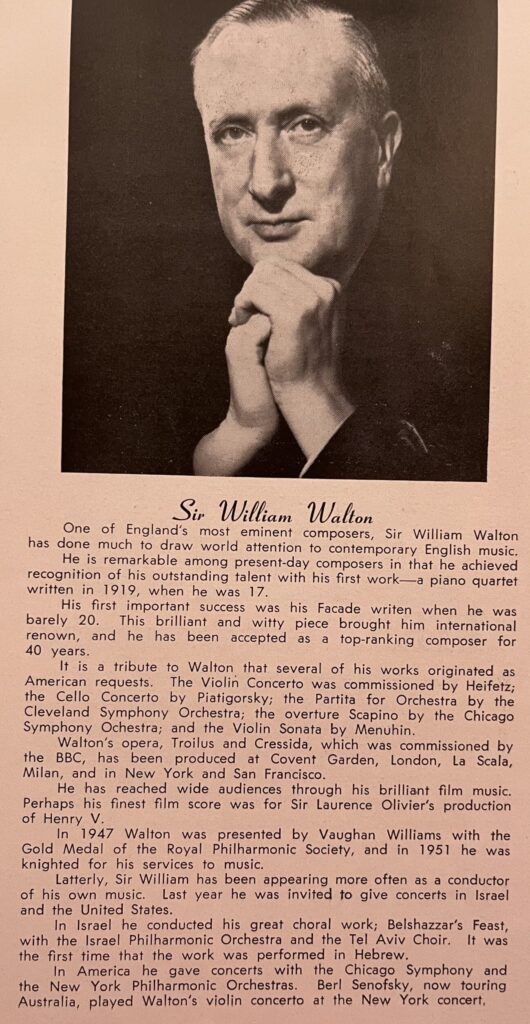
Sir William Turner Walton OM was an English composer. During a sixty-year career, he wrote music in several classical genres and styles, from film scores to opera. His best-known works include Faccedil An Entertainment, the cantata Belshazzar’s Feast and his First Symphony. Born in Lancashire, the son of a musician, Walton was a chorister and then an undergraduate at Christ Church, Oxford. On leaving the university, he was taken up by the literary Sitwell siblings, who provided him with a home and a cultural education.
His earliest work of note was a collaboration with Edith Sitwell, Façade, which at first brought him notoriety as a modernist, but later became a popular ballet score.
Other early works that made his name were a Viola Concerto and Belshazzar’s Feast. In middle age, Walton left Britain and set up home with his young wife on the Italian island of Ischia. By this time, he had ceased to be regarded as a modernist, and some of his compositions of the 1950s were criticised as old-fashioned. His only full-length opera, Troilus and Cressida, was among the works to be so labelled and has made little impact in opera houses.
In his last years, his works came back into critical fashion; his later compositions, dismissed by critics at the time of their premieres, were revalued and regarded alongside his earlier works. Walton, who was largely self-taught as a composer, was a slow worker, painstakingly perfectionist, and his complete body of work across his long career is not large.
https://www.kennedy-center.org/artists/w/wa-wn/sir-william-walton
From February until May 1964 composer Sir William Walton visited Australia and New Zealand conducting his own works. He visited his sister Nora Donnelly in New Zealand. The entire 1964 tour of Australia—including his travel, accommodations, and performances in Perth—was primarily financed and organized by the Australian Broadcasting Commission (ABC), in cooperation with the Adelaide Festival of Arts. The initial financial “anchor” that justified bringing Walton halfway across the world was the 1964 Adelaide Festival. The festival committee pooled its budget with the ABC to co-sponsor Walton as their headline international composer. He was brought out specifically to oversee the Australian premiere of his opera Troilus and Cressida and conduct his symphonic works.
Walton’s 1964 Australian itinerary mostly highlights his scheduled performances of the Hindemith Variations with various state orchestras. However, behind the scenes, the tour suffered from a notorious logistical headache: the physical sheet music and orchestral parts for the Hindemith Variations were either missing, incomplete, or faulty. Because they couldn’t play the planned program, Walton and his promoters had to frantically substitute pieces. He frequently turned to his famous suite Façade because it was a crowd-pleaser and something he could pull together quickly with local players.
The original, definitive version—featuring the instrumental ensemble accompanied by a live narrator reciting the poetry through a megaphone—did not receive a major, documented Australian premiere until Sir William Walton’s first-ever tour of the country in 1964. The tour’s primary, officially scheduled staging of the full Façade entertainment took place at the Adelaide Festival of Arts in March 1964, where Walton personally conducted the Festival Chamber Group. It was because of the wild success of this specific presentation that Walton was able to quickly pull the piece out of his back pocket and recreate it on the fly.
FAÇADE
May 1964
William Walton FaçadePERTH PREMIEREPerformed in front of Walton
Jack Harrison James Beattie (speaker) Verdon Williams (conductor)
Festival of Perth Basil Kirke Studio A.B.C. Adelaide Terrace, Perth, Western Australia
Walton’s “Façade” for speaker and chamber ensemble with which Walton first made an impact on the English musical scene. It consists of a recitation of Edith Sitwell poems against the background of chamber ensemble music. The speaker will be James Beatty and the ABC chamber ensemble will be conducted by Verdon Williams. The other work in the programme, Bliss Clarinet Quintet, will be performed by the Oriole String Quartet with Jack Harrison. The West Australian Saturday February 26 1966WORDS, MUSIC BLEND SUBTLY IN “FAÇADE”By Sally TrethowanNearly 2 years ago, actor James Beatty conductor Verdon Williams and a small chamber ensemble gave a scintillating performance of the original version of “Façade”. The same actor and conductor were responsible for a no less diverting and accomplished reading of the work in the Basil Kirk Memorial studio on Saturday night as part of the Festival Of Perth “Music of Britain” series. William Walton deft and witty accompaniment to the spoken verses by Edith Sitwell no longer shock audiences as they did in the 20s. What seemed iconoclastic musical language then, derived as it was mainly from jazz and the music-hall, seems passe now. But though time has weathered the original satiric bite, the work still magnificently fulfils the sub- title “An Entertainment”. A successful performance of “Façade” depends predominantly on fractional timing and coordination between the individual musicians, and between the speaker and instrumentalists. On this count Saturday’s reading could scarcely have been better.Beattie’s performance of the verbal prestidigitations in the “Tarantella” and part of the “’Tango Paso Doble” was admirable as was his rhythmic delivery of the apparently nonsensical compilation of associative images into a rich mosaic of orchestrated word sounds.The other work on the program, Arthur Bliss’s Clarinet Quintet, is extremely demanding on all players, though in no sense is it a showpiece. The Oriel String Quartet and clarinettist Jack Harrison, who also performed this work in the composers presence when he visited W.A. about 18 months ago, gave a craftsman like an intelligent reading, inclusive in the brusque helter-skelter scherzo and finale, and reflective, even faintly nostalgic, in the intensely lyrical first and third movements. Bliss’s harmonic acidulation in these movements, however, precludes any thought of the molasses type sentimentality often associated particularly in 19th century music with lyricism.The West Australian Monday February 28 1966Walton’s “Façade” for speaker and chamber ensemble with which Walton first made an impact on the English musical scene. It consists of a recitation of Edith Sitwell poems against the background of chamber ensemble music. The speaker will be James Beatty and the ABC chamber ensemble will be conducted by Verdon Williams. The other work in the programme, Bliss Clarinet Quintet, will be performed by the Oriole String Quartet with Jack Harrison. The West Australian Saturday February 26 1966FESTIVAL FAILS IN ITS HUNT FOR A MUSICAL DRAW CARDBY KENNETH HINCE IN PERTHPut on at cocktail time “Façade” was prefaced by the Clarinet Quintet of Arthur Bliss, music of thick Brahmsian texture. This has no necessary reason for existence being simply a work that someone felt like writing down. All the instruments are used with a sense of duty, all the movements are filled with scrupulously professional writing, but it’s total meaning might be boiled down into a bar or two of Elgar or Britten. Only a historian could have really enjoyed its performance; only an archivist could have been satisfied to hear it played instead of reading it over in a library. It was performed on Saturday by Jack Harrison and the Oriol String Quartet – Harrison with unfailingly accurate but monotonous uninflected attack, the Quartet balanced, well matched and reasonably polished. “Façade” came off rather worse. Music of superb elan which has worn much better than most people realise, it had a fairly good reading from James Beatty. The décor in the Basil Kirk studio was quite adequate with a gauze curtain allowing just enough of the reciter and the chamber Orchestra to come through to the audience. But the instrumental work was just not accurate enough for the music. For a mid 60s audience, the point of this music lies half in the way it bites its thumb at Victorian morality, half in the bitterly precise realisation of the score. On Saturday under Verdon Williams, things were too this and that too hither and thither. For people who had not heard “Façade” before this was a tolerable enough experience but to a man who wanted to feel the true historical grip of this music, the performance was too slack and inefficient for a casual reading let alone for a performance of festival tone. The Australian Monday February 28 1966Walton’s “Façade Suite” will be given by the Music Society at the Octagon theatre tomorrow night. The brilliantly witty work with Neville Teede reading the nonsense verse of Edith Sitwell, will be accompanied by the Wigmore Ensemble conducted by Graham wood. Those taking part in the ensemble will be Jill Wright (flute), Jack Harrison (clarinet), Neil Boon (saxophone), Kevin Jonston (trumpet), Jill Cole and Sally Talbit (cellos) and Paul Sarcich (percussion). Members of the group will also play the Pastorales de Noel by Andre Jolivet the French composer and musical director of the Caomedie Francaise, the flute, violin and harp trio of Eugene Goosens and Igor Stravinsky’s “Epitaphium” for flute, clarinet and harp.The Sunday Times April 20 1980
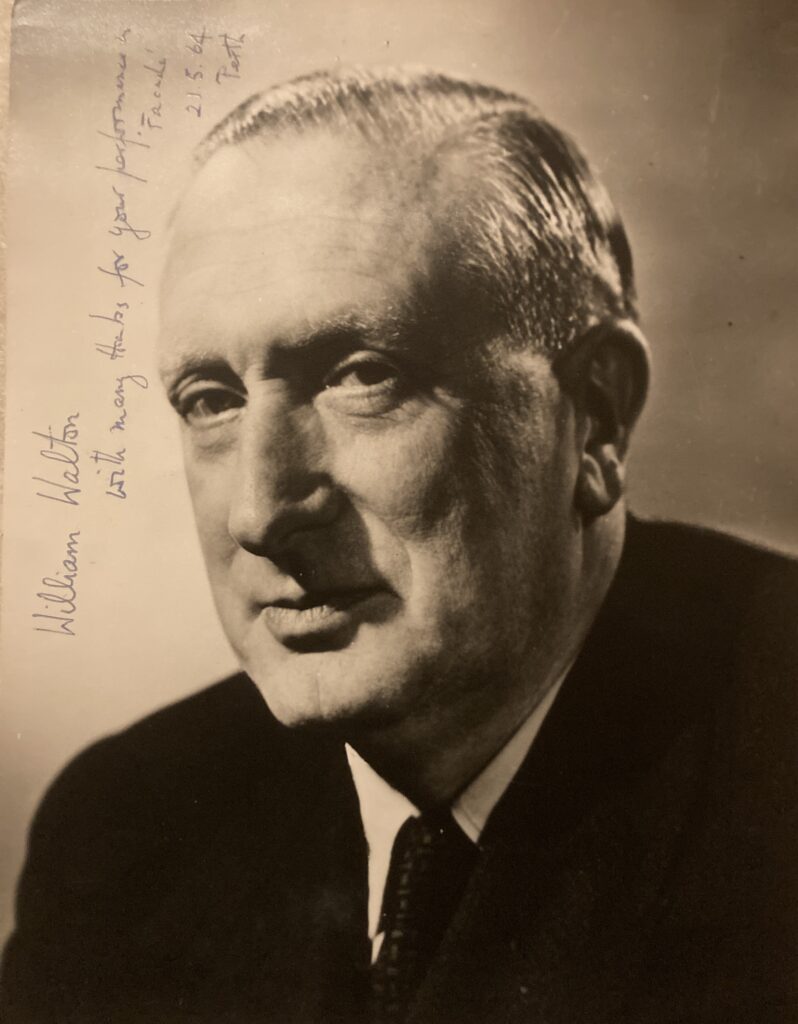
Walton signed a photo for Jack Harrison that reads
“with many thanks for your performance in “Façade” 21.5.64 Perth”.
The Irish pianist, musicologist, and composer, Howard Ferguson, was heard at the age of 13 performing in a music competition by the pianist Harold Samuel, who persuaded Ferguson’s understanding parents to let him come to London to study with him. Two years later Ferguson entered the Royal College of Music, studying composition first with the legendary pedagogue R.O. Morris and then with Ralph Vaughan Williams, and conducting with Malcolm Sargent; he also continued to study privately with Harold Samuel. It was through Morris that he met another composition student, Gerald Finzi, and they remained close friends, discussing each other’s music in depth; their correspondence is currently being edited for publication.
Howard Ferguson was always a distinguished chamber musician and he first came to widespread attention through the publication of his First Violin Sonata (1931) and his Octet (1933), generally regarded as his most masterly work. The Octet was initially drafted as a quintet for clarinet and strings, but the canny Morris, observing that there was no companion piece to share the scoring of the Schubert Octet, suggested that Ferguson recast it accordingly.
Through Harold Samuel, Ferguson had met Myra Hess, and at the outbreak of World War II he was enlisted by her to help run the series of concerts at the National Gallery which did so much to maintain wartime morale in London. The importance of the concerts was officially recognised when Ferguson was released from service with the RAF Central Band to continue his work with the Lunchtime Concerts. With the War over, Ferguson took up his concertising career again, maintaining two long-lived duos with musicians he had met through those National Gallery concerts, the violinist Yfrah Neaman and the pianist Denis Matthews. From 1948 until 1963 he also taught at the Royal Academy of Music, where Susan Bradshaw, Richard Rodney Bennett and Cornelius Cardew were among his students.
In the meantime he was still composing, including a Second Violin Sonata in 1946, a Piano Concerto in 1950-1951 and a song-cycle, Discovery, that was later recorded by Kathleen Ferrier. Howard Ferguson closed his career in composition with two large-scale choral works, both written for the Three Choirs Festival: Amore langeo for tenor, chorus and orchestra (1955-1956) and The Dream of the Rood for soprano or tenor, chorus and orchestra (1958-1959).
Howard Ferguson was unusual among composers in that he voluntarily called a halt to his composing career when barely past his 50th birthday; his musical energies thereafter were deployed in a number of parallel enthusiasms, not least musicology. His activities as a musicologist now filled the gap left by composition, and he produced a number of authoritative editions of early keyboard music; his musicological efforts were crowned in 1978-1979 with a complete edition of the Schubert piano sonatas. Howard Ferguson is published by Boosey & Hawkes. https://www.bach-cantatas.com/Lib/Ferguson-Howard.htmhttps://www.boosey.com/composer/Howard+Ferguson
MUSIC – By Peter Hellstrom – Festival of Perth 1966The Master of Queens Musick, Sir Arthur Bliss, has told the Festival Of Perth committee that the planning of the musical programs in the coming festival is a magnificent gesture to British music and should be more widely known. That it has become well known already in Britain is showing by letters from many leading authorities there they include congratulations from the executive of the Composers Guild of Great Britain. Though some prominent English music festivals like Cheltenham Aldeburgh and the longest established Three Choirs Festival feature their country music, no British festival has in recent times included such an extensive and exciting range of British music in one series. Works of nearly 70 composers are included. The Perth programs have been wisely spaced over the six week festival period and though many of the concerts will start at the customary 8 pm some will be at 6 pm to enable patrons to attend another festival attraction the same evening.Works by Vaughan Williams Gordon Jacob, Howard Ferguson, Lennox Berkeley and Michael Tippett will be new to W.A. The London Symphony Orchestra conducted by Colin Davis will introduce Bliss’s “Discourse for Orchestra” to Australia in one of its Perth concerts. In the other, Tippitt’s Symphony No. 2 and Stravinsksy’s Symphony in Three movements will be played here for the first time. Leading W.A. musicians appearing as soloists in the festival will include soprano Molly McGurk who will sing Benjamin Britain’s song cycle Les Illuminations with the W.A. Symphony Orchestra. She will also sing the solo soprano part in the University Choral Society’s performance of Vaughan Williams A Sea Symphony. Stephen Dorman will be the accompanist for tenor David Galliver’s three British song recitals. He will also partner violinist Vaughan Hanley in a Sonata recital and will play the solo part in constant Lambert’s Concerto for Orchestra and Nine Instruments. Jack Harrison will be the soloist in David Tunley’s Clarinet Concerto and will be joined by the Oriole Quartet in Bliss Clarinet Quintet. Graham Wood will introduce James Penberthy’s Romance for Violin and Orchestra and Alice Carrard will be the pianist with the A.B.C. Wind Players in Rawsthorne’s recent quintet. Madame Carrard will be joined by Mr Dornan, Stephanie James and Michael Cole to perform Malcolm Williamson’s new Concerto for Wind Quintet and two pianos. The new university organist, Mr John Hind, will be soloist in a program which will feature the W.A. Bach Society. The Oriel Quartet will also be the soloists with the W.A. Symphony Orchestra in Elgar’s Introduction and Allegro for strings and will give a separate recital of works by Howells, Frank Bridge, John Exton (the newly appointed senior lecturer in music at the university) Gerald Finzi, Elizabeth Lutyens and Edmund Rubbra. The West Australian September 1965FOURTEENTH ANNUAL FESTIVAL OF PERTH 1966THE ABC PRESENTS (in association with Festival of Perth Committee) Opening Concerts ofMUSIC OF BRITAIN SERIESA 15-concert feast of music from the great heritage of British compositions and including many new works.Tuesday Feb 8 1966A.B.C. Festival OrchestraConductor: Vaughan HanlySoloist: Jack Harrison (clarinet)Programme:Symphony No. 4 (Boyce)Little Symphony (Jacob)Concerto for Clarinet and Strings – first performance (Tunley)Serenade (Ferguson)B Flat Divertimento (Berkeley)WINTHROP HALLReserve Prices 11/-, 8/6, Unreserved from 5/ at hall after 7pm
27.7.1968
Howard Ferguson Octet Op. 4for clarinet, bassoon, horn, string quartet and double-bass (1933)
AUSTRALIAN PREMIERE
ABC Broadcast
Basil Kirke Studio A.B.C.
Adelaide Terrace, Perth, Western Australia
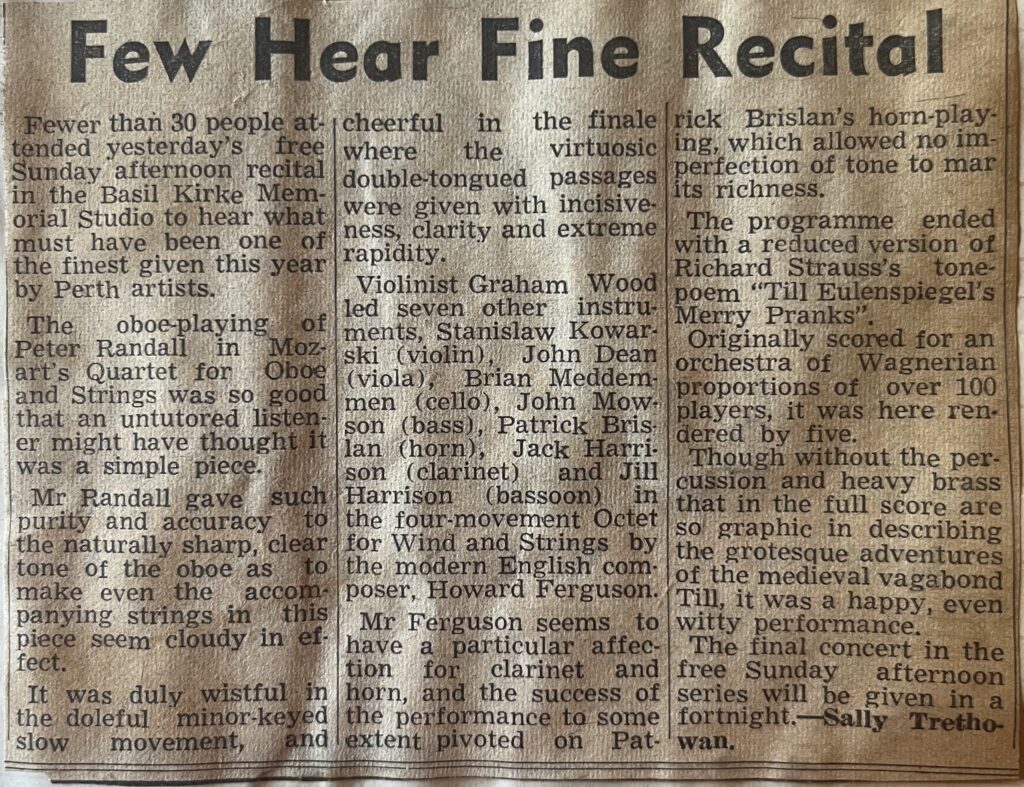
FergusonFEW HEAR FINE RECITALBy Sally TrethowanSunday February 29 1968Fewer than 30 people attended yesterday’s free Sunday afternoon recital in the Basil Kirke Memorial Studio to hear what must have been one of the finest given this year by Perth artists. The oboe playing of Peter Randall in Mozart’s Quartet for oboe and strings was so good that an unchartered listener might’ve thought it was a simple piece. Mr. Randall gave such purity and accuracy to the naturally sharp clear tone of the oboe as to make even the accompanying strings in this piece seem cloudy in effect. It was duly wistful in the doleful minor keyed slow movement and cheerful in the finale where the virtuosic double-tongued passages were given within incisiveness, clarity and extreme rapidity. Violinist Graham Wood led seven other instrumentalists Stanislaw Kowarski (violin) John Dean (Viola) Brian Meddemmen (cello) John Mowson (bass) Patrick Brislan (Horn) Jack Harrison (clarinet) and Jill Harrison(bassoon) in the four movement Octet for Wind and Strings by the modern English composer Howard Ferguson. Mr. Ferguson seems to have a particular affection for clarinet and horn, and the success of the performance to some extent pivoted on Patrick Brislan’s horn playing which allowed no imperfection of tone to mar its richness. The program ended with a reduced version of Richard Strauss’s tone poem “Till Eulenspiegel’s Merry Pranks”. Originally scored for an orchestra of Wagnerian proportions of over 100 players, it was here rendered by five. Though without the percussion and heavy brass that in the full score are so graphic in describing the grotesque adventures of the mediaeval vagabond Till, it was a happy even witty performance. The final concert in the free Sunday afternoon series will be given in a fortnight.
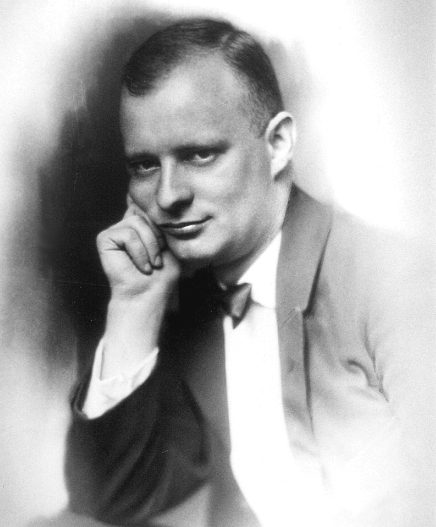
German composer Paul Hindemith was born in Hanau, Germany on November 16, 1895. A major innovator of musical modernism, he was a composer, conductor, violist, educator, and a scholar. In his early teens he studied the violin at the Hoch Conservatory in Frankfurt and composition with Arnold Mendelssohn and Bernhard Sekles.
Hindemith acted as concertmaster for the Frankfurt Opera House Orchestra from 1915-23, interrupted only by time spent in army service. ; Initially establishing his reputation through his chamber music and expressionistic operas, Hindemith subsequently turned to neo-classicism in his Kammermusiken (1922-27). This series of seven chamber concerti pay homage to Bach’s Brandenburgs, while employing distinctly modern elements, notably jazz.
Besides chamber works, Hindemith composed in other genres including lieder, and music for amateurs as well as school children. ; Hindemith produced masterpieces including: the opera Mathis der Maler (1934-1935) in which he dramatized the dilemma of the artist in society and reflected the need for greater responsibility to art; the ballet Nobilissima Visione (1938) based on the life of St. Francis; and, the choral work Six Chansons (1939) to French poems by Rilke.
He also wrote several sonatas for every major instrument, which became part of the standard repertory. ; The Nazis forced Hindemith to leave Germany where his works were considered “culturally Bolshevist.” In 1938 he began his exile in Switzerland followed two years later by an exile in the United States, where he joined the Yale University faculty (1940-53).
The 1940s were witness to what is generally considered the apogee of Hindemith’s output and critical standing with such masterpieces as: Symphony in E Flat (1940); The Four Temperaments (1940); Sonata for Two Pianos (1942); Ludis Tonalis (1942), an homage to Bachâ’s Well -Tempered Clavier; Symphonic Metamorphosis on Themes of Carl Maria von Weber (1943); and, Sinfonia Serena (1945). In 1953 Hindemith left the United States for Switzerland. There he composed the opera Die Harmonie der Welt, where his search for an all-encompassing harmony was realized.
In 1963 Hindemith became ill in Frankfurt and died there in December.
https://www.kennedy-center.org/artists/h/ha-hn/paul-hindemithQUARTET FOR CLARINET, VIOLIN, CELLO AND PIANO
Paul Hindemith’s quartet for clarinet, violin, cello, and piano is a major work of imposing scale. Also celebrated during his lifetime for his virtuosic viola-playing, as a composer Paul Hindemith was a “revolutionary of the 20th-century musical world” (Emmanuel Loubet). Unusual among his contemporaries for his fascination with contrapuntal technique (with models like Bach and Handel), the passionate music theorist nonetheless described in his treatise the need for an expanded tonality that surpassed major-minor harmonic structures to find a new foundation in a hierarchic order of intervals. Composed in 1938 as he was emigrating from Germany under the growing storm of Nazism, Hindemith’s quartet performed here perfectly mirrors his dual ambitions of combining Baroque-inspired contrapuntalism with neoclassicism and other more modern compositional techniques.
https://www.medici.tv/en/concerts/chamber-music-society-hindemith-quartet-clarinet-violin-cello-and-pianoWIGMORE ENSEMBLE – 8.15pm Tuesday May 22 1979 – Perth Concert HallPaul Hindemith Quartet for Clarinet, Violin, Cello and Piano (1938)Graham Wood (violin) Jill Cole (cello)Jack Harrison (clarinet) David Bollard (Piano)Players respond to Challenge – By Derek Moore MorganThe main aim of the recently formed Wigmore Ensemble is to achieve flexibility of repertoire by altering the number and content of the group after the fashion of Britain’s famous Melos Ensemble. Last night’s Perth Concert Hall appearance for Musica Viva by W.A. artists Graham Wood, Jill Cole, Jack Harrison and David Bollard produced just the sort of piece which can so easily suffer neglect – the quartet for violin, cello, clarinet and piano of 1938 by Hindemith. This is a work which exploits a fine range of ideas and moods suffering not at all from the dryness which can affect this composer at times. The players had a well integrated and developed work under their fingers and they responded to its challenge. David Bollard’s handling of the prominent toccata-like piano climax had the right driving energy. The Wigmore ensemble can be very pleased with this their Concert Hall debut. The West Australian Wednesday May 23 1979
22.5.1979
Paul Hindemith
Quartet for Clarinet, Violin, Cello and Piano (1938)
Jack Harrison (clarinet) The Wigmore Ensemble Graham Wood (violin) Jill Cole (cello) David bollard (piano)
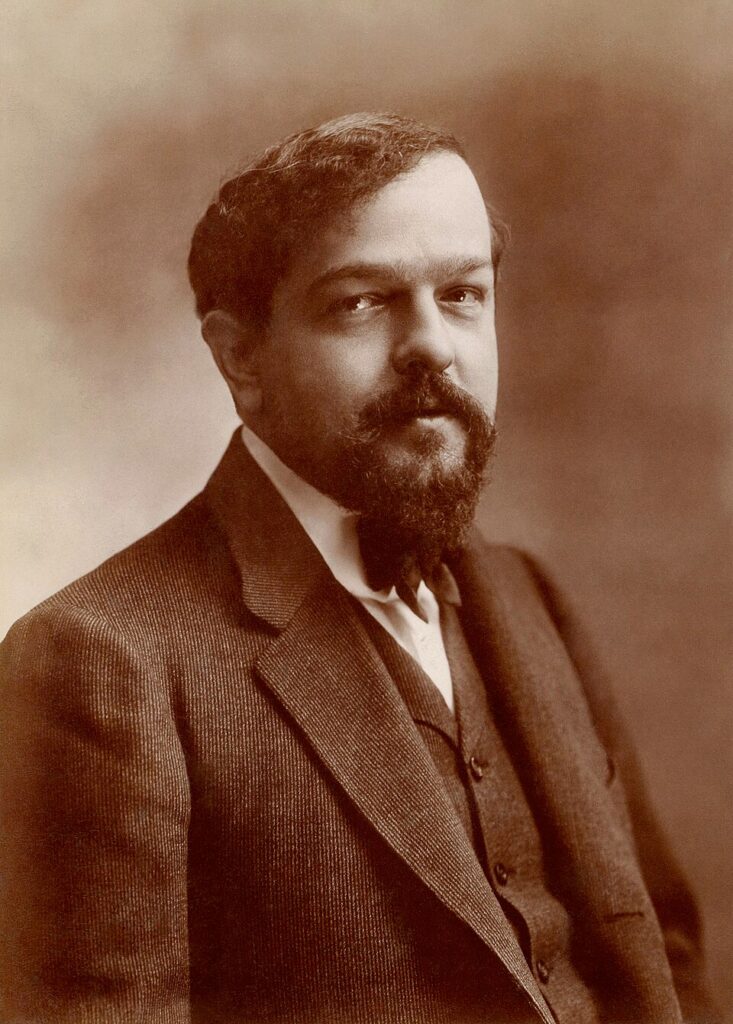
Born in Saint-Germain-en-Laye, France in 1862, Claude Debussy was the creator and leading exponent of French musical impressionism. At age ten, he entered the Paris Conservatory, where he studied piano with Antoine Francois Marmontel and composition with Ernest Guiraod. Over the next ten years, he continued his studies at the Conservatory and became acquainted with a wide range of music as he traveled to Italy, Austria, and Russia.
In 1894, his cantata, The Prodigal Son, won the coveted Grand Prix de Rome. From 1887 on, Debussy confined his activity to composition, rarely appearing in public as a performer. He enjoyed the company of the leading impressionist poets and painters who gathered at the home of the poet Stephane Mallarme. Their influence is felt in Debussy’s first important orchestral work, Prelude to the Afternoon of a Faun (1894). This work established the style of impressionist music and initiated Debussy’s most productive period, which lasted nearly 20 years.
During that time, he composed his one completed opera, Pelleas and Melisande (1892-1902); the orchestral suites Nocturnes (1893-99), The Sea (1903), and Images (1906-09); most of his piano music, including the books of Preludes (1910-13); the ballet, Games (1912); and one of his best known piano compositions, Claire de Lune, from Suite Bergamasque (1890-1905).
Around 1910, Debussy developed cancer, which sapped his strength during his last years. Many projects were started, such as an opera based on Edgar Allan Poe’s The Fall of the House of Usher, but few were completed. He died in Paris in 1918.
Composed between December 1909 and January 1910, it was dedicated to the French clarinet professor Prosper Mimart.
In 1909, Gabriel Fauré, Director of the Conservatoire de Paris, named Debussy to its board of directors (le Conseil Supérieur). One of Debussy’s first duties was to supply two works for the next year’s clarinet examinations. The Rhapsodie was first performed as part of the examinations on July 14, 1910. The original composition was for clarinet and piano; Debussy published his own orchestration of the accompaniment in 1911, after the official premiere with Mimart.
PERTH – YOUTH AND MUSIC – Issued by the A.B.C. Youth Concerts’ Committee
A well-attended committee meeting, at which further details of recorded programmes for youth Clubs were arranged, was held on July 12. The A.B.C. agreed to make studio space available at Broadcast House, for Youth Concerts’ Committee members to present programmes of recorded music (and supper) to other members and friends. The first gathering of this kind was on July 23. It was extremely successful and the Committee is keen to make these a regular feature of Youth concerts activity.
The third Youth Subscription concert on August 9 1956 will be conducted by John Farnsworth Hall with Jack Harrison, soloist, playing a Rhapsody for Clarinet and Orchestra by in the first half of the concert, and a Rhapsody for Saxophone and orchestra by the same composer in the second half. Youth and Music issued by the A.B.C. Concerts’ Committee No. 3 August 1956
MUSIC AND THEATRE BY “FIDELIO” – DEBUSSY RHAPSODIES
For the A.B.C.’s next Youth Concert on Thursday August 9, Mr John Farnsworth Hall will be in charge, and Jack Harrison will set up what is maybe a record for these concerts (or indeed any in the annals of the W.A. Symphony Orchestra) by appearing as soloist not merely on two occasions in the programme but playing each time a different instrument. With the clarinet he will be heard in a Rhapsody by Debussy, and with the saxophone in – again – a Rhapsody by Debussy. There is no “funny business” about this: Debussy really did write a rhapsody for the clarinet and also a rhapsody for the saxophone. The latter was commissioned by an American lady, left unfinished by Debussy and completed by Roger-Ducasse.
WN is broadcasting the ABC Youth Concert from the Capitol Theatre on Thursday and Friday evenings. Jack Harrison, a brilliant young Perth musician in both classical and modern spheres, will be the soloist with the W.A. Symphony Orchestra. J. Farnsworth Hall is the conductor. The opening half of the concert is broadcast on Thursday starting at 8pm. Jack Harrison joins the orchestra in Debussy’s Rhapsody for Clarinet and Orchestra. On Friday at 9.15pm, when the second half of the concert is broadcast, Harrison is featured on saxophone.
THE WEST AUSTRALIAN (newspaper) August 1956
SAXOPHONE SHINES IN A HOTCH-POTCH
By “Fidelio”
“The saxophone is classified as a woodwind instrument” the Professor of Music at Harvard University tells us in a treatise published this year “despite the fact that it is entire made of brass.” There, of course, is one proof more that musicians are an irrational folk. (For an alternative explanation read the next few sentences of Professor Piston’s book.). Professor Piston also tells us that while in serious music the saxophone gives voice with “a pure, steady tone,” in popular dance music nowadays it is “Tremulous, oversweet, sentimental and it is almost invariably played out of tune.”
We are certain that Mr Jack Harrison did not play it “almost invariably played out of tune” last night; but then, Mr Harrison was not in a dance hall but at the Capitol and devoting his skill not to jive but to Debussy’s Rhapsody for Saxophone and Orchestra. He also played for us, and very effectively, another Debussy “Rhapsody” for clarinet, which gave him greater opportunities than the saxophone piece. Neither is particularly good Debussy.
For this A.B.C. Youth Concert Mr Farnsworth Hall compiled a programme which achieved great variety at the cost of being rather a hotch-potch. Among the purely orchestral works three commanded special attention – “An Outback Overture” by the Australian composer John Anthill; the wonderful pages from Berlioz’s “The Trojans” unusually labelled “Royal Hunt and Storm”; and Schumann’s rarely heard overture to “Manfred”, a welcome tribute in this centenary year, for all its sombreness. We had some beautiful playing in the Berlioz, though the horns were not quite up to the mark. The West Australian August 1956
1956
Debussy Premiere Clarinet Rhapsody Debussy Saxophone Rhapsody AUSTRALIAN PREMIERE being performed in same programme (maybe even in the world?)
Jack Harrison (clarinet) Jack Harrison (saxophone) John Farnsworth Hall (conductor) West Australian Symphony Orchestra
Capitol Theatre Perth, Western Australia
16.2.1971
DebussyRhapsodie No. 1
Jack Harrison (clarinet) Arthur Fiedler (conductor)
Festival of Perth Winthrop Hall University of Western Australia
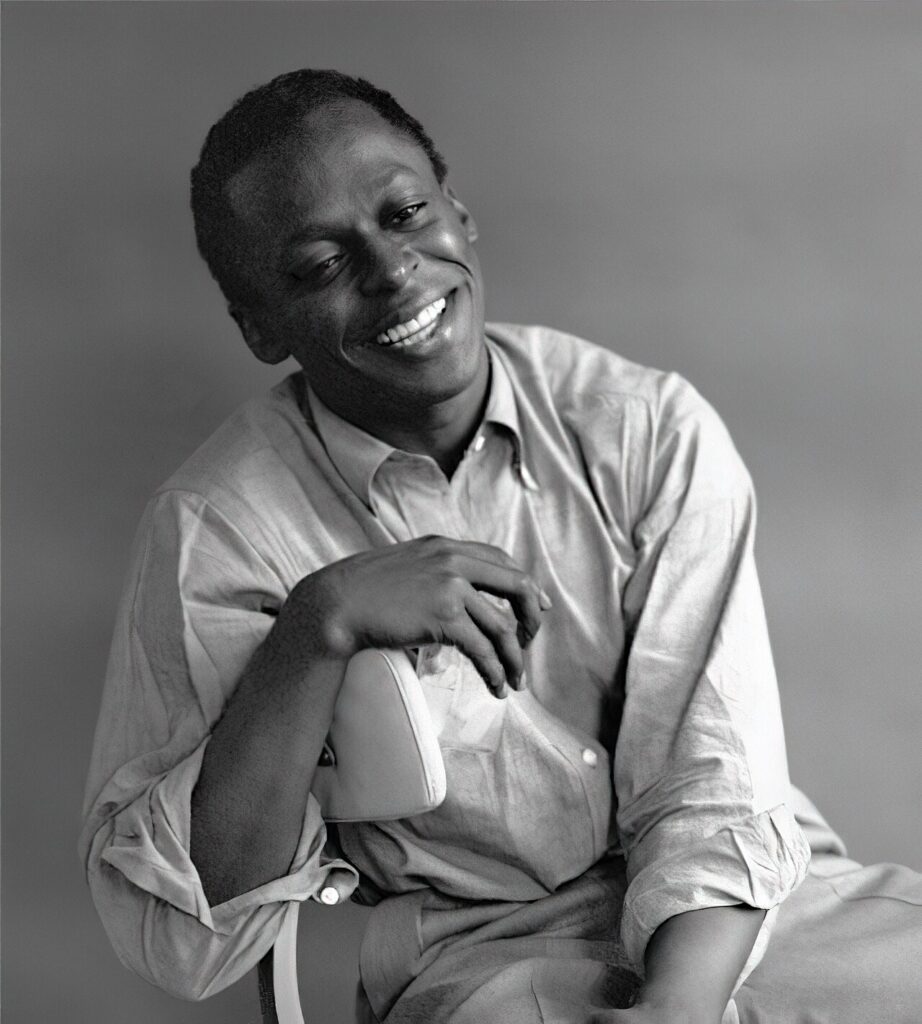
Miles Davis was arguably the most influential jazz musician in the post-World War II period, being at the forefront of changes in the genre for more than 40 years.
Born into a middle-class family, Davis started on the trumpet at age 13. His first professional music job came when he joined the Eddie Randall band in St. Louis in 1941. In the fall of 1944 Davis took a scholarship to attend the Juilliard School, a convenient passport to New York. It didn’t take him long to immerse himself in the New York scene and he began working 52nd Street gigs alongside Charlie Parker in 1945. Soon, Davis found work with Coleman Hawkins and the big bands of Billy Eckstine and Benny Carter.
During the late 1940s, a number of musical contemporaries began to meet and jam regularly at the small apartment of arranger-pianist Gil Evans. Among them were saxophonists Gerry Mulligan and Lee Konitz, and pianist John Lewis. Out of this group of musicians, Davis formed the nonet to record his first major musical statement, Birth of the Cool. In addition to the standard piano, bass, and drums rhythm section, Davis’ nonet horn section used French horn and tuba along with trombone and alto and baritone saxophones, lending the band a unique harmonic sound.
In 1955, Davis assembled his first important band with John Coltrane, Red Garland, Paul Chambers, and Philly Joe Jones, adding Cannonball Adderley in 1958. By this time Davis, influenced by George Russell‘s theories, had begun playing in modes rather than standard chord changes, which led to his most famous album (and the all-time biggest-selling jazz album), Kind of Blue, in 1959. Davis also continued an important musical partnership with Gil Evans, recording four releases in five years: Miles Ahead, Porgy and Bess, Sketches of Spain, and Quiet Nights.
In 1964, Davis assembled a new band of younger musicians, which became known as his second great quintet. This included Herbie Hancock, Tony Williams, Ron Carter, and Wayne Shorter. By this time, the Miles Davis Quintet was recording mostly originals, with all the band members contributing memorable tunes. Davis’ horn playing also changed, increasing the spacing of notes to create more suspense in the music.
In 1968, Davis again changed direction, leading the way for electric jazz with the release of In a Silent Way. By the 1969 release of Bitches Brew, as he deepened the electronic elements and rock rhythms of his music, the transformation was complete. By the mid- 1970s, following the debilitating effects of a 1972 auto accident, Davis went into semi-retirement. He returned to the scene in 1980 and resumed touring in 1981, attracting newer fans. From then to 1991, Davis remained vital and popular, receiving the Grammy Lifetime Achievement Award in 1990.
Selected DiscographyBirth of the Cool, Capitol, 1949-50
Kind of Blue, Columbia, 1959
The Complete Live at the Plugged Nickel, Columbia, 1965
Bitches Brew, Columbia, 1969
Amandla, Warner Brothers, 1989
https://www.arts.gov/honors/jazz/miles-davis
https://www.milesdavis.com/
“So What”
is the first track on the 1959 album Kind of Blue by American trumpeter Miles Davis.
It is one of the best-known examples of modal jazz, set in the Dorian mode and consisting of 16 bars of D Dorian, followed by eight bars of E♭ Dorian and another eight of D Dorian. This AABA structure puts it in the thirty-two-bar format of American popular song.
The piano-and-bass introduction for the piece was written by Gil Evans for Bill Evans (no relation) and Paul Chambers on Kind of Blue. An orchestrated version by Gil Evans of this introduction is later to be found on a television broadcast given by Miles’s first quintet (minus Cannonball Adderley, who was ill that day) and the Gil Evans Orchestra; the orchestra gave the introduction, after which the quintet played the rest of “So What”. The use of the double bass to play the central theme makes the piece unusual. This arrangement was later performed and recorded as part of the album Miles Davis at Carnegie Hall.
PELICANThursday April 23rd 1964Jazz by Nessia SolomonsJazz versatility in jazzNo classical music this week! Instead the fresh sound of modern jazz filled Winthrop Hall as the sounds of Jack Harrison (alto sax and clarinet) Billy Clowes (piano) David Ellis (bass) and Bill Tattersall (drums) presented a program on the changing styles of jazz. The Jack Harrison Quartet features the well-known Billy Clowes Trio while Jack Harrison is also a member of the W.A. Symphony Orchestra in which he plays clarinet. Although they play other styles of music, they enjoy playing jazz with a vibrant sound that is synonymous with modern jazz today. The opening number “9.20 special” a tune written for Count Basie, was of fast tempo and made the expectant audience sit up and listen. Unfortunately, the acoustics in Winthrop Hall caused the drumming to sound a little dominant at all times, however the smooth playing of both piano and saxophone tied this over to no disadvantage. Pianist Billy Clowes composed the next number played – a 12 bar blues – a style which has been popular at all times through the evolution of jazz to the present day. As always, when a composer plays his own tune, the result is an extra special sound with an atmosphere perfectly suited to its style. Perhaps it was just the Paul Desmondish sound of the alto sax or maybe some ultramodern chord forms, yet this and a few other numbers were reminiscent of Dave Brubeck’s style. The changing styles and jazz were illustrated through five numbers, the two most popular being a swinging version of “Alexander’s Ragtime Band” and an excellent takeoff Miles Davis in “So What”. Although the group was versatile as it had to be for that program, they seem to play with much greater ease the more modern numbers, especially “Work Song”. This number was played in great style – it possessed an interesting, varied beat as the drummer and the bass player really gave forth the jazz message in their solos. The musicians pleased an obviously critical audience with their versatility, as with showing by the applause for several numbers and on the whole, the jazz concert did lift, however slightly, the cultural curtain to edge a little way through the sound barrier that divides the two cults of music in the Western world today. PELICAN Undergraduate Newspaper UWA, Vol 35 No. 5 Thursday April 23rd 1964
1.12.1964
Miles Davis’s “So What”PERTH PREMIERE
Jack Harrison (clarinet and alto-saxophone), Billy Clowes (piano)David Ellis (bass) and Bill Tattersall (drums)
ABC TV live to air broadcast Adelaide Terrace, Perth, Western Australia
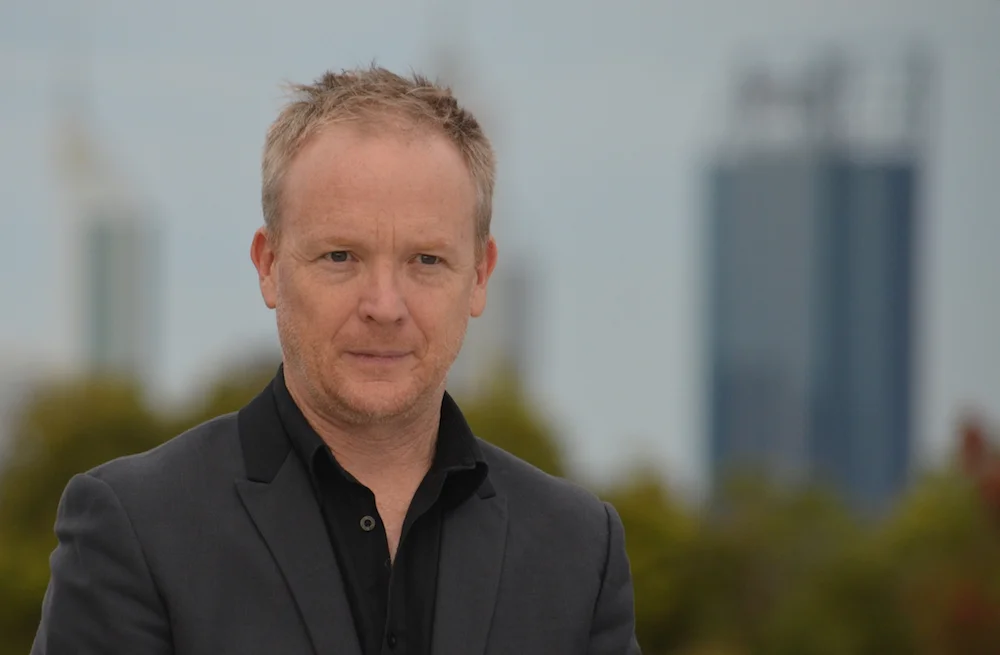
James Ledger is an ARIA award-winning composer with a breadth of work spanning solo, chamber, electronic and orchestral music.
His first orchestral work, Indian Pacific, from 1996 is still regularly performed around Australia and has had twelve performances so far in 2022. He has held residencies with the West Australian, Adelaide and Christchurch (NZ) Symphony Orchestras, the Australian National Academy of Music (Melbourne) and the Australian Festival of Chamber Music (Townsville). He has received commissions from Australia’s leading ensembles including the Melbourne, Sydney and Tasmanian symphony orchestras, the Australian Chamber Orchestra and Australian String Quartet.
Ledger has collaborated with Australian musician Paul Kelly on two song-cycles: Conversations with Ghosts (2012) and Thirteen Ways to Look at Birds (2019). Both of these albums won ARIA awards. He has won APRA Art Music Awards
for Viola Concerto (2019), Golden Years (violin concerto) (2011) and Chronicles (2009).
He is Chair of Composition at the Conservatorium of Music at the University of Western Australia.
https://www.australianmusiccentre.com.au/artist/ledger-james
For more information please visit jamesledger.comRashomon confessions for clarinet quintet by James Ledger
First performance 13 December 2009, Utzon Room, Sydney Opera House WASO Chamber Players (Allan Meyer – clarinet) . Commissioned by Sydney Opera House with funds provided by Regina Ridge Trust.
https://catalogue.nla.gov.au/catalog/4938391
Andrew Schultz was born in Adelaide, Australia, in 1960 and grew up in regional New South Wales and Victoria before his family moved to Brisbane where he completed his secondary schooling at St Peter’s College. His teachers and mentors included George Crumb, David Lumsdaine and Luciano Berio and he studied at the Universities of Queensland, Pennsylvania and King’s College London. His music covers a broad range and has been performed, recorded and broadcast by leading groups and musicians internationally.
Schultz has been the recipient of various awards and honours in Australia and overseas, including five Australia Council Fellowships, Fulbright Award, Commonwealth Scholarship, Maggs Award and the APRA Music Award. Recent successes include the Harvard Chair of Australian Studies, the Schueler Award, the Paul Lowin Prize and the premiere of his Symphony No. 3 – Century (2013) in front of an audience of 150,000 – a special commission to celebrate the centenary of Australia’s capital, Canberra. The latter was described as a “resounding success, drawing a standing ovation, wolf whistles and prolonged applause” [City News], and “Century is excellent. It is epic. It is powerful and beautiful” [Canberra Times]. His Symphony No. 4 was premiered in Perth in 2025 to similar acclaim: “suffused with joy and wonder” [West Australian] and “in the awe of nature and the divine” [Quadrant].
Schultz has written a series of large-scale dramatic works, several of which incorporate parts for Australian indigenous singers. His three operas (Black River, Going Into Shadows and The Children’s Bach) have been presented live and on film internationally. Black River (1988) was awarded the Australian National Composer Opera Award and, in its film version, the Grand-Prix, Opera Screen at Opera-Bastille, Paris. Critics noted the vitality and energy in the staged and filmed work. “There are moments in Black River,…which for a comfortable white audience are among the most shattering one could come across in the opera theatre” [Sydney Morning Herald]. “There is a skilful interweaving of dramatic statements and reflective interludes and the urgent, percussive rhythms propel the drama to an undecided conclusion. As in life, the story continues” [Vogue Australia]. “A landmark in culture” [SMH].
The three act Going Into Shadows (2000), commissioned by the Guildhall School of Music and Drama, was premiered in London and Australia in 2001 and was again to a libretto by his sister, Julianne Schultz. Critics noted it as “a powerful modern drama that is both sharp, thought-provoking and relevant…as fine a piece of modern composition as you could wish to hear” [Courier Mail]. “The London premiere was fascinating. The many effects and colours in the piece are used brilliantly to highlight the psychological motivation and the cultural background of the characters” [Opera Now]. “Pedal tones anchor each scene and setting, and the ravishing orchestration is suffused more with modal fear than minimalist sumptuousness” [The Australian]. “For as long as I live I will not forget the second performance of Going into Shadows…life is not always just froth and bubble and great art, which I believe this opera is, reflects and drives home some tough human truths” [Opera-Opera].
The Children’s Bach (2007), based on the novel by Helen Garner (libretto, Glenn Perry), was commissioned with Australia Council support and had its premiere season in 2008 with Chamber Made Opera in Melbourne; the opera has been described as “utterly original” [The Age], it “throws up ideas and debate long after a performance has ended” [Limelight], and it “will long linger in the memory” [Michael Halliwell, The Conversation].
Schultz’s orchestral music includes a series of works commissioned by the Sydney Symphony Orchestra: The Devils’ Music (premiered with Jakov Kreizberg in 1989), Diver’s Lament (Edo de Waart, 1995), little tree (Lyn Williams, 2003), and Sound Lur and Serpent (David Robertson, seven city China tour, 2014). Sound Lur and Serpent has been described as “an arresting piece drawing on elemental sonorities to potent affect” [SMH] and an “evocative, imposing miniature with resounding power and penetrating clarity” [The Australian].
Journey to Horseshoe Bend is a cantata premiered in 2003 by the Sydney Symphony (directed by David Porcelijn) and released as a CD by ABC Classics. The libretto by Gordon Kalton Williams was drawn from the book of the same name by anthropologist TGH Strehlow. “The hour-long work sprawls as vast and languidly as the continent of its setting. Whispered voices and snatches of Aranda chants and Bach chorales recreate the miasma of delirious thoughts in the head of the dying pastor. When both cultures sing their version of Bach’s Wachet auf! – in the Aranda hymnal, it is simply known as No. 309, Kaarrerrai worlanparinya … – a great cultural divide, a cultural chasm centuries long seems to have been breached. The capacity audiences in the two Opera House performances greeted the new work with sustained ovations” [Gramophone]. “This cantata contains some of the most touching music I have heard in an Australian work” [SMH]. “Schultz’s stunning evocation of the harsh outback is one of the many strong points in this rich and diverse work” [NZ Listener].
Another large-scale work is a version of the Song of Songs. Scored for 18 voices the work was commissioned by ABC Radio and The Song Company for their twentieth birthday and had its first performance directed by Roland Peelman at the Sydney Opera House in 2004. A “setting of a modern recrafting by the Melbourne poet Barry Hill of the original biblical text, succeeds in creating something new in the world of choral sound” and “a soaring, richly woven and effusive sound fabric” [SMH]. Other works for The Song Company include Ekstasis (1990) and Wild flower (2006). Ekstasis “was originality indeed, with a multitude of anguished, increasingly urgent and complex sounds emerging from a silence that itself added a dimension, finally sinking into calm… ecstasy in a sensual, sexual sense, musically transcribed” [SMH]. By contrast is the comedic Le Moliére Imaginaire (2015) – a new version of a scene from Moliére: “urbane, virtuosic, cultured, witty and naughty in equal measure” [Carl Vine, Musica Viva Australia Blog] and “a wicked stagey swipe at all medicos” [Adelaide Advertiser]. The work was commissioned by Musica Viva Australia for the eight voice British ensemble, I Fagiolini, with a text by Timothy Knapman and premiered throughout Australia in 2015.
Chamber works have also been acclaimed. Barren Grounds (1988): “as a whole seems to me music of exceptionally high originality and abundant invention” [Peter Platt, Sounds Australian]. Stick Dance II (1989): its “movement through time is light and airy, almost weightless, like a glittering dance?” [American Record Guide]. Dead Songs (1991): “is a work of art of a high order, adroitly shaped to…lead to an ending of universal resonance. Its first performance…affirmed the creative poise of a composer who feels sufficient confidence in his own judgment to write not a single note more than is absolutely necessary…[A] vital, spellbinding experience” [Roger Covell, SMH]; and, “music of substance and expression. His Dead Songs is a long, complex, and very satisfying setting of adaptations of epitaphs seen at seaside cemeteries in New South Wales…it is tightly composed and expressively executed” [American Record Guide]. Tonic Continent (2000): “conjured up images of vastness…rumbling piano delineating the space between echoing strings” [New Zealand Herald]. Stille Sprache (2009), written for Felicitas Fuchs to texts by Rilke, “opened up mightily impressive vistas. At times quite breathtaking in its scope, it was sometimes difficult to accept that such an expansive musical canvas was peopled by just three performers” [The Straits Times].
Piano music, both miniatures and expanded forms have featured in Schultz’s output including the large-scale Sea-Change (1987) and Nocturnes and Variations (2014). The latter was described as follows: “This captivating piece added to the growing sense that a distinct musical language is coming out of Australia which is as unique and starkly beautiful as the land itself” [The Straits Times]. Barcarole (1992) is a miniature: “Wrought, and very effective…and truly melancholy, not an ascription one can often make to any recent music, let alone a miniature” [Chris Dench, Sounds Australian]. “His characteristically opulent style permeated Barcarole and Sleepers Wake (2003) – amidst rich textures and languorous lyricism, while the slightly quirky Four Inventions (2008)…revelled in decoration and felicitous irony” [Adelaide Advertiser]. Stephen Emmerson and Bernard Lanskey commissioned and have often performed his expansive piano duet 12 Variations (1997): “atmospheric, expressive, and personal…commanding, sensitive, hypnotic, and remarkable for its range of textural sonority” [Music Forum]. Dark Well (2021) is a large and theatrical work for two pianos exploring rich piano sonorities and expressive catharsis and has been described as “magically dark… with waves of tension and relaxation” [Opera+]. His recent Piano Concerto (2023) was premiered by Rosemary Tuck with the New London Orchestra at Cadogan Hall, London in 2025.
Schultz’s orchestral commissions, Once upon a time… (2006), Endling (2007) and Peace (2013), and Ghosts of Reason – Symphony No. 2 (2008) had their respective premieres in Brisbane with The Queensland Orchestra in Hobart with the Tasmanian Symphony Orchestra and with the Adelaide Symphony. Endling has been described as a “beautiful, deeply thoughtful reflection” [Adelaide Advertiser], “a work of communicative power and concentration” [Music Forum] and “in its serenity and inner calm, this music has something both heartbreaking and deeply moving” [Codaex, Germany]. The second symphony’s premiere in Denmark and Germany also earned critical praise, “Andrew Schultz’s music touches the soul and speaks to the mind” [Klasisk Pt, Denmark]. By contrast, the “truly cataclysmic” August Offensive (2012) [Limelight] has been heard in Australia and Turkey, both as a concert piece in its own right and as a movement of the Gallipoli Symphony featuring leading composers from Australia, New Zealand and Turkey. Several choral-orchestral projects commissioned by the Australian War Memorial have followed including Golden Dominion (2021), The Line (2022) and De Profundis (2025) with performances directed by Christopher Latham. In recent years the composer has also worked closely with the West Australian Symphony Orchestra on three new commissions: Maali – Concerto for Four Winds (2016), Bassoon Concerto (2022) and Symphony No. 4 (2024).
ABC Classics have recorded the TSO/Richard Mills performing Endling and Once upon a time… in addition to the Violin Concerto (1996) with Jennifer Pike as soloist. One critic wrote of the CD’s music that it is “honest, compassionate, dignified, accessible” [Music Forum] and another that this is “music for eternity” [Codaex, Germany]. ABC Classics released a further album of orchestral music, Century, in 2018 (with TSO/Hamish McKeich) and Maali in 2020 (with WASO/Simone Young). Other recent CD releases include choral music with The Song Company, Kühn Choir of Prague and Brisbane Chamber Choir, volumes of chamber music and vocal chamber music (Halcyon) on Tall Poppies, CDs of chamber music (Southern Cross Soloists), piano music (Antony Gray) and The Children’s Bach (CIMF/Peelman) on Wirripang. Numerous recordings are available for streaming and on YouTube.
Schultz is Emeritus Professor of Music at UNSW Sydney and was the Gough Whitlam and Malcolm Fraser Professor of Australian Studies at Harvard University in 2022-23. He has also held posts and residencies including as Head of Composition and Music Studies at the Guildhall School of Music (London), Professor of Composition and Dean of Creative Arts at the University of Wollongong (Australia), Director of the Symphony Australia TSO Composers’ School, a visiting lecturer at the Norwegian Academy of Music (Oslo), UDK Berlin, Palace University Czechia, Malmö Academy of Music and Osaka School of Music (Japan), Artist in Residence – Banff Centre for the Arts (Canada), Artist in Residence – Cité Internationale des Arts, Paris, and Visiting Fellow – Institute for Advanced Musical Studies, University of London. He has also served as Chair of the Arts NSW Music Committee, Chair of the Australian Music Centre Board and Editor of the Biographical Directory of Australian Composers. The National Library of Australia holds Schultz’s collected papers and memorabilia in their manuscript collection.
Maali (2016)
“Also on the program is Maali, a concerto for oboe, clarinet, horn and bassoon specially commissioned, from Australian composer Andrew Schultz. Young has been in constant communication with the composer regarding factors such as balance and the Perth Concert Hall’s superb acoustics. “We talk about historically informed,” Young says. “Here, we can be directly informed by a living composer.” [William Yeoman, “Twenty Years Young,” West Australian, 26 July 2017]
“Young is an exciting conductor who…favours a robust approach to interpretation….this account of Schultz’s attractive, finely-crafted Maali was a case in point. Here the talents of the WASO stalwarts Peter Facer (oboe), Allan Meyer (clarinet), Adam Mikulicz (bassoon), and David Evans (horn) were allowed to blaze forth individually, collectively and as part of the often expansive orchestral texture.
This was as much to do with Schultz’s ear for melody and timbre as with Young’s acute sense of ensemble and sound-blanace.” [William Yeoman, “Young at heart of melody,” West Australian, 7 August 2017]
“This concert also features a brilliantly thought-out commission from the orchestra, a concerto for four soloists drawn from the orchestra’s ranks, composed by Andrew Schultz. Listen to Young discuss her memories here: “The players themselves have had an input into the writing”, Young explains. “So it’s really something that the orchestra feels they, and rightly so, have real ownership of.” [Duncan Yardley, “Simone Young’s 20 Years with WASO,” ABC Classic FM, 12 August 2017]
“Maali was commissioned by the West Australian Symphony Orchestra (WASO) and its name is the Noongar word for the large black swans synonymous with the Swan River and Perth region. It is an orchestral work in the sinfonia concertante style, which in this case features a small group of woodwind soloists whose interplay with the orchestra is highlighted. There are three parts, each inspired by the maali and their behaviour, and without getting too literal, the woodwind soloists could certainly be aligned with them (timbres also not unlike the sound made by the maali) and the orchestra with their river home.
The darting, sinewy oboe and clarinet lines in “Lively, Fast and Playful” turn languid and rippling in the second “Slow, Dreamlike” movement, all the while interspersed with watery splashes of orchestral colour. In the final movement, the maali are “Fast, Joyous”, to which I would add regal and triumphant as the work builds to an intense, full-bodied climax. The magnificent acoustics of Perth’s modernist Concert Hall are on show in this live recording with internationally renowned Australian conductor Simone Young, whose precise, nuanced direction produces typically high calibre results, as the thunderous audience response to this performance testifies.” [Lisa MacKinney, “Not your usual swansong: Andrew Schultz celebrates the maali, Perth’s black swans,” Limelight, 7 April 2021]
Richard Mills is deservedly one of Australia’s most sought after composers and music directors. In recent years he has pursued a diverse career as a composer and a conductor, which has seen him working with a large number of the nation’s music organisations.
Mills’s works are regularly performed throughout the world. Compositions range from major orchestral and choral works to ballet music. Commissions for the Sydney Symphony include Tenebrae,Emblems, and Totemic Journeys. Requiem Diptych was commissioned and premiered by the Chicago Chamber Musicians Brass in 2001. His symphonic/choral work for the Melbourne Symphony Orchestra, The Little Mermaid, was premiered in August 2005.
Victorian State Opera commissioned Mills to write an opera of Ray Lawler’s Summer of the Seventeenth Doll, which premiered in Melbourne in 1996, and received a Sydney season in 1999. His second opera, Batavia, was commissioned by Opera Australia and was premiered at the Melbourne Festival in 2001 to great acclaim, consequently receiving a number of Green Room and Helpmann Awards. He has been commissioned to write a new opera for the 2007 Perth International Festival with subsequent performances in Melbourne and Brisbane.
The performance of Wagner’s Tristan und Isolde in Brisbane in 2005 with the Australian Youth Orchestra under his baton won a Helpmann Award in 2006, and he will conduct it again in staged performances in Perth later in 2006.
His CD recording Richard MillsOrchestral Works with the Queensland Symphony Orchestra has become a best seller on the ABC Classics label. His three volume CD of the film music of Franz Waxman with the same orchestra was awarded a Deutsche Schallplattern Kritiks Preis in 1992, and he has conducted recordings with the West Australian and Tasmanian Symphony Orchestras.
Mills continues a high level of involvement in the community through such commissions for the 1982 Commonwealth Games, the 2000 Olympic Games, the 2006 Commonwealth Games, and the Australian Bicentenary re-orchestration of Charles Williams’ Majestic Fanfare (the ABC news theme).
In 2005 he was honoured with the Ian Potter Foundation Award for Established Composers. He was the 2008 Musica Viva Australia’s featured composer.
Mills is currently the artistic director of Victorian Opera and in the past has been the Artistic Director of the West Australian Opera, Artistic Consultant with Orchestra Victoria, Director of the Australian Music Project for the Tasmanian Symphony Orchestra, and Senior Fellow, University of Melbourne.
Biography provided by the composer — current to May 2022
https://www.australianmusiccentre.com.au/artist/mills-richardDouble Concerto for Clarinet and Violinhttps://www.wisemusicclassical.com/work/62878/Double-Concerto–Richard-Mills
“Carl Vine AO is one of the most prolific and consistently inspired composers of our time, with an output that includes eight symphonies, thirteen concertos and six string quartets” (Chicago Classical Review, August 2022). His compositions are performed frequently around the world and recordings of his music on more than 70 albums are available on the major streaming platforms. He has an extensive range of chamber music alongside various work for film, television, dance and theatre.
Although primarily a composer of modern art music, he has undertaken such diverse tasks as arranging the Australian National Anthem and writing music for the Olympic Games (Closing Ceremony, Atlanta 1996). From 2000 until 2019 Carl was the Artistic Director of Musica Viva Australia, the world’s largest entrepreneur of chamber music. Within that role he was also Artistic Director of the Huntington Estate Music Festival from 2006, and of the Musica Viva Festival (Sydney) from 2008. Carl has been Senior Lecturer in Composition at the Sydney Conservatorium of Music since 2014.
Fractured 3 vertebrae falling out of a tree during gymnastics. Unable to play the trumpet, so started learning piano.
1967
Student at Guildford Grammar School (Secondary), Perth. Started learning the pipe organ under Choral Director Kathleen Wood. Pianist and Organist for School Church Services, Assemblies and assorted performances.
1970
First Prize in the Australian Society for Music Education Composers’ Competition (under-18 section) for ‘Unwritten Divertimento’: his first complete electronic work.
1971
Completed his first commissioned score, ‘2 Short Circuits’ (electronic tape work), for the West Australian Ballet Company, choreographed by Eleanor Martin. Graduated Dux of Guildford Grammar School with 2 Government University Exhibitions.
1972
Enrolled in Bachelor of Science degree course majoring in Physics at the University of Western Australia. Winner, Open Instrumental Solo division (Piano) of the Perth Music Festival. A.Mus.A. (Associate in Music, Australia) with distinction for Piano from the Australian Music Examinations Board. Harpist (on the piano) with the Queensland Youth Orchestra conducted by John Curro, for James Christiansen’s production of ‘Tosca’ at the Innisfail Festival, North Queensland.
1973
Trainee Sound Recording Engineer at the Tape Transcription Unit, BBC, Shepherds Bush, London (2 months). Created the music soundtrack for experimental films ‘IS’ and ‘Facade’ directed by Barrie Oldfield (WA). Winner of the Australian Broadcasting Commission’s Instrumental and Vocal Competition (Western Australian division – Piano).
1973-5
Pianist (casual orchestral, and occasionally solo) with the West Australian Symphony Orchestra.
1974
Transferred to Bachelor of Music degree course (Composition Major) at the University of Western Australia. A member of the West Australian Debating Team competing at the National Championships in Adelaide.
1975
Participated in the inaugural ‘Young Composers’ Training Scheme’ organised by the Australia Council. Moved to Sydney to commence his professional career.
1975-8
Accompanist and rehearsal pianist for the Sydney Dance Company (then the ‘Dance Company of New South Wales’). Created the soundtrack for experimental film ‘Envir’ directed by Barrie Oldfield. Performed at a vast range of musical, electronic and ‘alternative’ events in and around Sydney. He was also Musical Director of ‘Sounds Nice’ vocal duo on the Sydney ‘club’ circuit with various TV appearances. Until 1980, freelance performer with such groups as the Australia Ensemble, A-Z Music, the Seymour Group, Mused Performance Ensemble, the Ashes of Sydney and others.
1976
Regular performer at the Sydney Opera House ‘Environmental Music Series’. Assisted by the Australia Council to attend the Gulbenkian International Choreographic Summer School in Guildford, England.
1977
First fully professional commission for Dance : ‘Tip‘ (for Sydney Dance Company). The score was called ‘961 Ways to Nirvana‘, for amplified string quartet, orchestra and electronics. (work subsequently withdrawn)
1978
Resident composer with the Sydney Dance Company. Composed the music for the first all-Australian full-length Ballet – ‘Poppy‘. Guest performer at ‘Music Rostrum ’78’ (featuring Luciano Berio). Guest conductor for the Seymour Group.
1979
Conductor, pianist and resident composer at the London Contemporary Dance Theatre. Founded the contemporary music performance ensemble ‘Flederman’ with trombonist Simone de Haan in Sydney. Remained as pianist, composer, conductor and director of the ensemble until 1989.
1980
Participant in the first ‘Australian Composers’ Summer School’ with the ABC Sinfonietta
1980-2
Lecturer in Electronic Music Composition at the Queensland Conservatorium of Music. The Flederman ensemble averaged 30 concerts each year on the Australian eastern seaboard.
1983
Received the ‘Adams’ award for outstanding contribution to Music for Dance in Australia. Flederman made its first international tour to the USA. Moved to Toowoomba (South-East Queensland) for R & R.
1984
Musical Director of the Australia/New Zealand Choreographic School (Melbourne) directed by Glen Tetley.
1985
Resident Composer at the New South Wales State Conservatorium. From 1985 to 1987, occasional conducting appearances with the Australian Chamber Orchestra.
1987
Resident Composer with the Australian Chamber Orchestra. Guest conductor with the Sydney Philharmonia Society. Flederman receives the Sydney Myer Performing Arts ‘Group’ Award.
1988
Flederman international tour to Holland, Finland and the UK, including a concert on the opening night of the BBC Proms. Carl’s Symphony No. 2 is performed by the Sydney Symphony Orchestra conducted by Stuart Challender across the continental United States, while the West Australian Ballet Company premieres his ‘Legend‘ choreographed as the dance work ‘The Night of the Full Moon‘ by Jacqui Carroll.
1989
Guest Artist at EVOS Music (Perth), W.A.University and W.A.Academy for the Performing Arts. Awarded the Sounds Australian National Music Critics’ Award for the Best Instrumental or Ensemble Work of 1988 (‘Miniature IV’). Flederman closes down after their Federal funding is withdrawn.
1990
Symphony No. 3 premiered by the Sydney Symphony Orchestra under Stuart Challender at the 1990 Adelaide Festival of the Arts.
1991
The Queensland Ballet Company premieres ‘The Tempest‘ choreographed by Jacqui Carroll.
1992-5
Deputy Chairman of the Australia Council.
1993
ABC Classics Records releases the premiere recording of Carl Vine’s first Three Symphonies performed by the Sydney Symphony Orchestra conducted by the late Stuart Challender.
1994
Carl’s first and second Symphonies choreographed by Glen Tetley for the Canadian National Ballet Company.
2000-
2019
From 2000 until 2019 Carl was the Artistic Director of Musica Viva Australia, the largest entrepreneur of chamber music in the world.
2006-
2019
As part of his duties as Artistic Director of Musica Viva Australia, Carl was also Artistic Director of the Huntington Estate Music Festival, one of Australia’s most prestigious and successful annual chamber music festivals.
Freelance composer living in Sydney.In line with Carl’s lifelong fascination with progamming and automation, he has released a free set of Lua Scripts to enhance the native abilities of Finale music software.
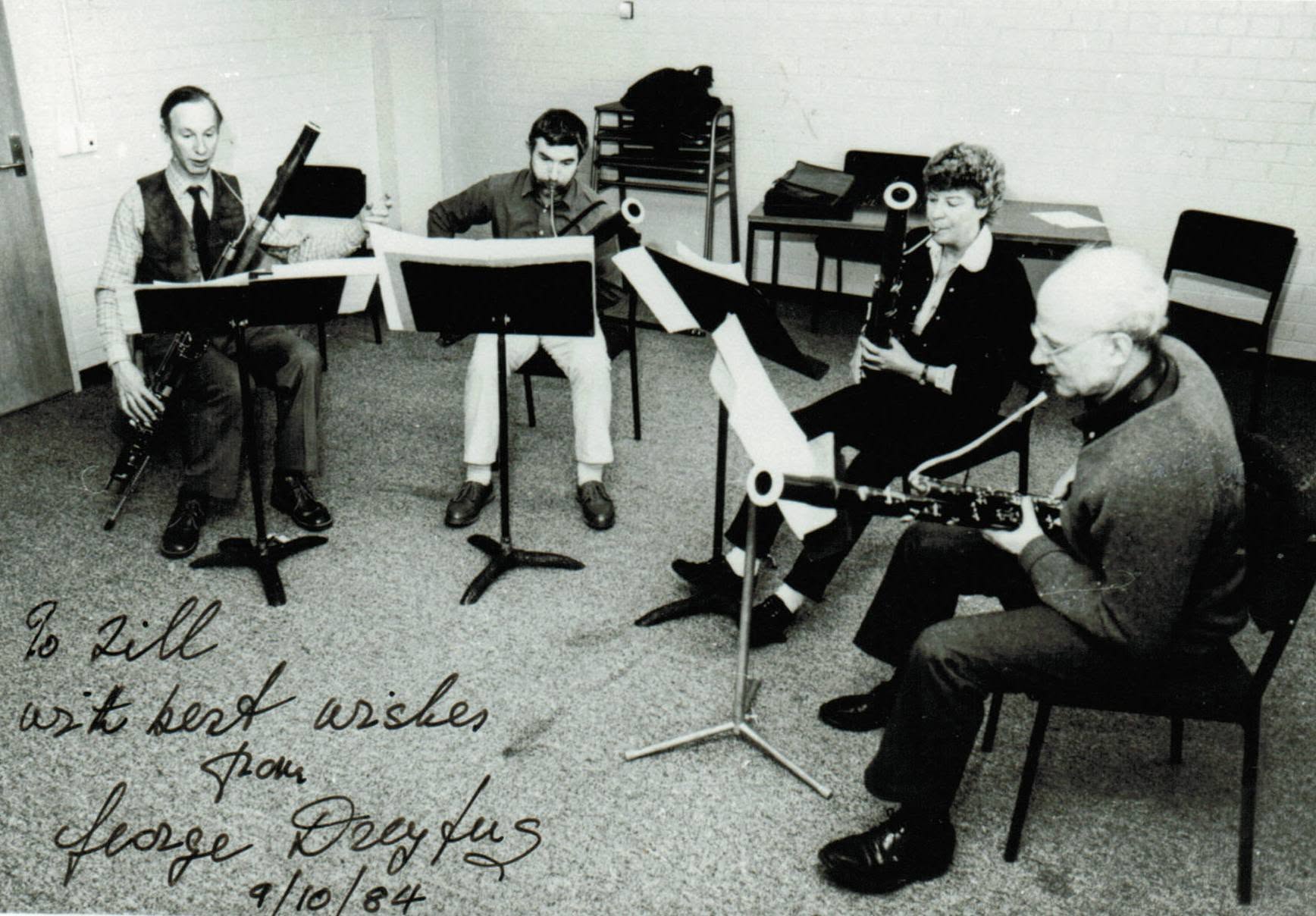
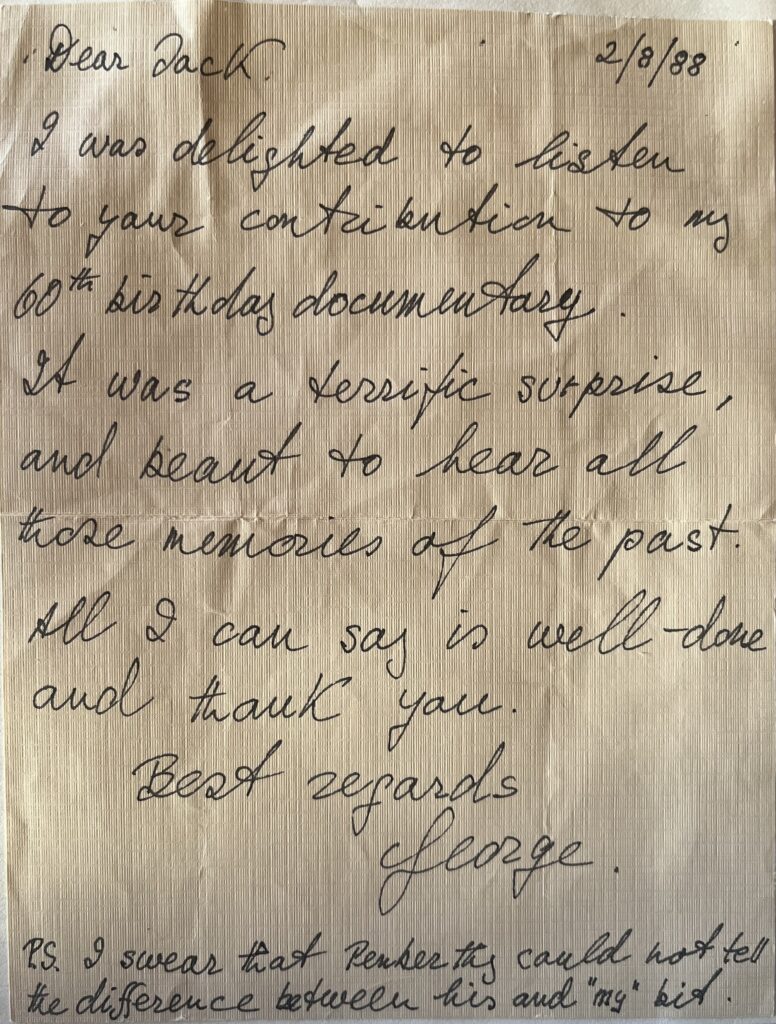
George Dreyfus (born 22 July 1928, Wuppertal, Germany) is one of Australia’s most distinctive composers. Fleeing Nazi persecution, his Jewish family emigrated to Melbourne in 1939.
Trained as a bassoonist, he played in the J.C. Williamson opera seasons and joined the ABC’s Melbourne Symphony Orchestra in 1953, later studying in Vienna.
Largely self-taught as a composer, he became a leading figure in Australian new music, writing symphonies, operas and chamber works alongside celebrated film and television scores, most famously the theme for the 1970s series Rush.
His German-premiered operas include Rathenau (1993) and Die Marx Sisters (1996).
Honoured as a Member of the Order of Australia (1992) and with the Bundesverdienstkreuz (2002), Dreyfus marked his 90th birthday in 2018.
Bassoonist George Dreyfus was a member of the WASO in 1956. Later moving to Melvourne,he became a well known composer, particularlyfor his popular theme music to the television series “Rush”. George added life to the orchestra and colout to the schools concerts. He would attach a rubber glove to the top of his bassoon and blow a low note, whereby the glove would inflate and George would wave to the delighted school children.
A West Australian composer, James Penberthy, offered us last night what in some ways the most adventurous Australian composition so far heard in the Art Gallery programmes. This includes, notably, his medium of expression; a wind quintet consisting of flute, oboe, clarinet, horn and two bassoons. For this unusual combination Mr Penberthy had produce a work in short, linked movements, based on the music and life of Australian aborigines. He obtained interesting effects in the way of atmosphere and drastic colourings, but his score sounded very fragmentary. It seemed often to be hovering uncertainly between outright imitative realism and the freer imaginative flight which, we felt, should not convincingly emerge. Another unusual inclusion was a set of three nicely fanciful songs for soprano and flute (no piano) by John Gordon, the words being taken from Chinese. The rest was chiefly light music, generally pretty in a conventional style. There were two pieces for flute and piano by A.C. Black (a West Australian), clarinet and piano pieces by Dulcie Holland and Moneta Eagles, songs by Horace Keats and Elizabeth Mills. The performers were Sylvia Biddle (soprano), Owen Fisenden (flute), Jack Harrison (clarinet), Neil Pierson (horn), Ron Richmond (oboe), George Dreyfus and Claude Welling (bassoons) and Phyllis Allen (accompanist).
1968
MUSIC – FESTIVAL OF PERTH 1968
By Peter Hellstrom
An aspect of the Festival of Perth already creating interest throughout Australia is a workshop series of four Australian composers to be presented by the A.B.C. in conjunction with the festival committee. The workshops will consist of programs of works mainly for Orchestra. Several will be first performances they will be given in the Basil Kirke Studio at 6 pm on February 15, 22 and 29 and March 7. Each program will have a different conductor. The conductors will be Henry Kripps, Patrick Thomas, John Hopkins and Thomas Mayer. A further special feature of each program will be the presence of at least one interstate composer who will come to Perth for the occasion. The composers are Nigel Butterley, Larry Sitsky, Felix Werder and Richard Meale. Other interstate composers whose works will be performed are Colin Brumby, George Dreyfus, Helen Gifford, Peter Sculthorpe and David Ahern. The four W.A. composers contributing to the programs are James Penberthy, Dr John Exton, David Tunley and Jennifer Fowler. As a contrast to the formality of the normal concert presentation, the workshops will include discussion between conductors, composers and members of the audiences. In several of the concerts, provision has been made for some works to be played twice to give listeners a further opportunity of coming to grips with the new music. The chairman of the Festival Of Perth music committee, Professor Frank Callaway, said yesterday that W.A. compositions would include Mr Tunley’s Concerto for Clarinet and Strings (with soloist Jack Harrison), Dr Exton’s Movements for Orchestra, a recently completed string Quartet by Jennifer Fowler to be played by the Oriel Quartet and James Penberthy’s Cantata for Chorus and Orchestra “The Swan of Bibbulman”. This will be performed by the Lyrics Singers and the W.A. Symphony Orchestra. The work is set to a poem by Mary Durack. The West Australian Saturday December 23 1967
1979
The Australian Broadcasting Commission presents a
FREE AUSTRALIAN COMPOSERS’ WORKSHOP
(from the printed program)
Concerto for clarinet and strings DAVID TUNLEY
Soloist Jack Harrison
The Concerto for Clarinet and Strings combines elements of rich romanticism with the more pungent harmonies and buoyant rhythms of the 20th century “neo-classic” idiom. It was written for Jack Harrison, whose particular style of playing moulded much of the works character, particularly in the cadenza of the opening movement which is accompanied by a solo double base whose throbbing rhythms and deep sounds is reminiscent of the didgeridoo. The slow second movement catches an intensity of expression eminently suited to the solo instrument giving way to a lilting dance in the finale.
Concerto for Bassoon and Orchestra JAMES PENBERTHY – Soloist Jill Mowson
The Bassoon Concerto was written in November 1954 for the West Australian Symphony Orchestra’s John Cran. He never played it and the first performance was given by George Dreyfus with his own Melbourne Orchestra 15 years later. There were only two movements consisting of fast and slow sections showing the agility of the instrument in merry if not clownish mood, and in contrast and eloquence in a more reflective manner. A new second movement, very serious in nature, was written this year specially for the present Jill Mowson performance. The old second movement now becomes the third.