Person

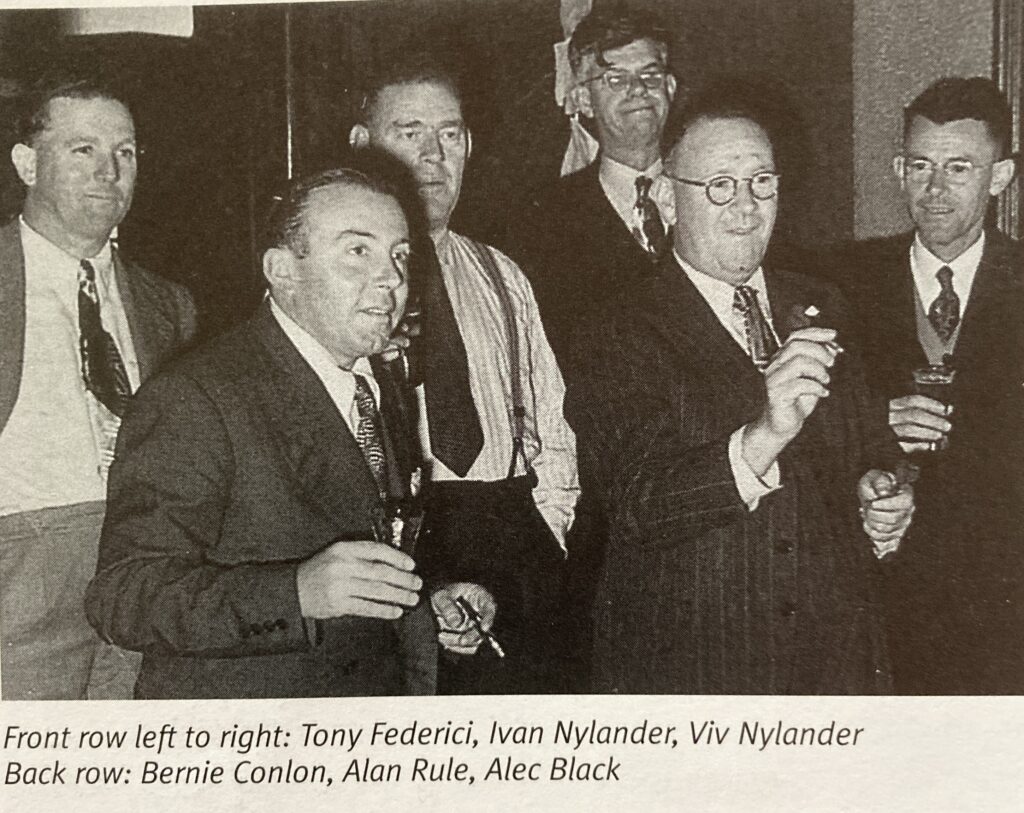
BLACK, Alec

Alexander “Alec” Carl Black was born in January 1912 in Northam and had a brother Edward and sister Hilda who were both prominent pianists in Perth’s music scene.

Alec married Rona Wedgwood in 1941 and they had four sons, Geoffrey (who was a violinist int the WASO), Russell, Douglas and Neville.

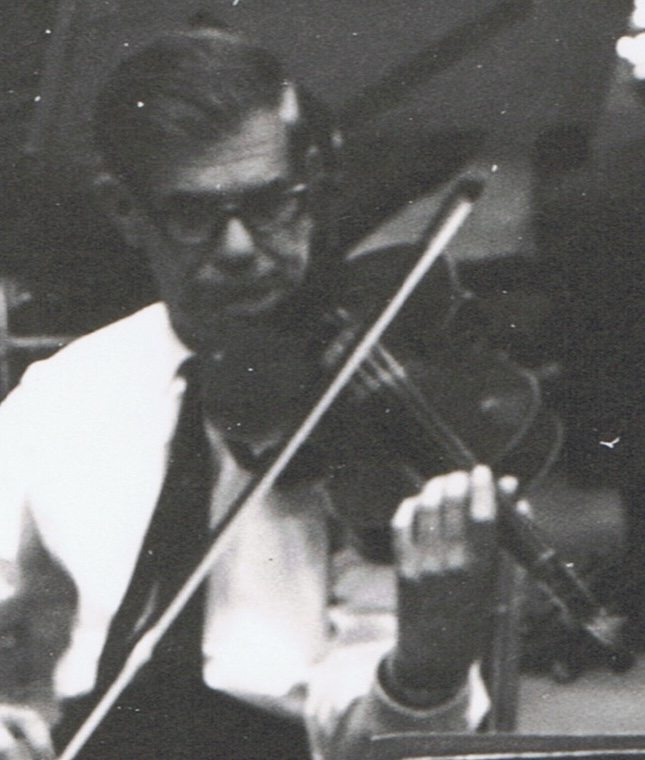
Alec played viola in the very early days of the Perth Symphony Orchestra, later WASO.  He was also an accomplished pianist and doubled on celeste when necessary. He was also a professional music copiest.


1933

KYLIE MUSIC CLUB – October’s Varied Programme

The first part of the programme at the October meeting of the Kylie Music Club on Saturday afternoon was devoted to Brahms, but works by Dvorak, Liszt, Leschetisky and some Hungarian folk songs gave variety after the interval. The most important work performed was the fine piano quintet in F minor (Opus. 34), The four movements snow Brahms in his strongest and most challenging moods, rather than in his gentler moments, and even the beautiful slow movement is remarkable more for strength than for delicacy. The players were Mr. Lio Chase and Miss Margaret Sharp (first and second violin), Mr. Alec Black (viola), Mr. Val Robertson (‘cello) and Mr. Edward Black (piano), the last named giving a brilliant performance throughout, and the ensemble work being admirably maintained. The concluding number was a Dvorak Sonatina in G major, played by Mr. Leo Chase, with Mr. Edward Black at the piano, and was also very interesting.

Daily News (Perth, WA : 1882 – 1955), Monday 23 October 1933, page 8


1934

Music Club at Home.

The president (Mrs. Cecil Mason) and members of the L.A.B. Music Club entertained at an at home at the Karrakatta Club Hall on Saturday night. It was the club’s first social function this season, and proved most enjoyable. The president received the guests wearing a frock of parchment satin with iridescent sequin trim ming, and a scarlet pleated satin shoulder cape. She was assisted in entertaining by the newly-appointed secretary, Miss Marjory Southwood, and some of the members. Madame Madalah Masson and Miss Mona Nugent, who are at present in Perth from the Eastern States, were among the guests of the evening. Madame Masson wore a charming frock of Wedgwood blue georgette, and Miss Nugent chose white silk marocain patterned in a rich red floral design. Mrs. Mason, in a brief speech, extended a cordial welcome to the guests and also to Dr. Crisp, the newly-elected vice president, and expressed pleasure at the number of friends from kindred organisations present. In the course of her remarks she gave a short resume of the club’s activities during the past year, among them being the entertainment of distinguished visitors from the musical world overseas and examiners from London. The hall was arranged with a gay floral decorative scheme, including dahlias, roses, tecomas, carnations, grasses and palms, which produced a galaxy of colour. The programme of music presented was keenly appreciated. Among those contributing items were: — Miss Margaret Sharp. Mr. David Powell, and Miss Hilda Black (a trio by Bach), Miss Edna Curtis (song), Miss June Epstein (piano), Mrs. Dorothy Arnold, and Miss Ivy Stevenson (vocal duet), Messrs. Edward Black, Lio Chase, Alec Black, and Sid Morley (string quartet, Brahms), Miss Marcia Hodges (songs), Miss Gwen Greaves (piano), and the L.A.B. Music Club Choir, who, under the conductorship of Miss Gladys Cunliffe, sang several part songs. In a short interlude in the programme a scene from a Period play (arranged by Mrs. Le Tessier), presented by Misses Sylvia George, Gertrude Cowell, Marjorie Knight, Phyllis Caporn. Anita Fitzgerald, and Mr. Arthur Hardman added to the pleasure of the evening. Supper, handed round in pleasant informal fashion by members of the L.A.B. Club, and en oyed to a babel of cheery conversation, brought the evening’s entertainment to a close. The guests included: — Madame Madalah Masson and Miss Mona Nugent, Mr. and Mrs. Alfred Sandover, Mr. and Mrs Basil Kirke, Rabbi and Mrs. Freedman, Mr. and Mrs. C. P. Smith, Mr. and Mrs. A. J. Leckie, Dr. and Mrs. Boyd. Dr. and Mrs. Ralph Crisp, Mr. and Mrs. A. Knapp. Mr. and Mrs. G. Reid, Mr. and Mrs. W. E. Southwood, Mr and Mrs. Frank Robertson, Mr. E. J. and Miss G. Watkin. Mr. and Mrs. Fordham, Mr. and Mrs. A. Raphael, Mr. and Mrs. F. M. Binney, Mr. and Mrs. E. Dodd, Mr. and Mrs Frank Davies. Mr. and Mrs. Cecil Treadgold, Mr. and Mrs. Leslie Austin, Mr. and Mrs. K. Raphael. Mr. and Mrs. 6. J. Paterson. Mr. and Mrs. Ottaway; Mesdames W. H. Vincent, Dudley Ward, Howard Birt, Dean, Westcott, Le Tessier, J. H. Main, Clear, A. Arnold. Gilles and Miss Kitty Gilles. Cooper, James Withnell, J. Price, Ick, Pellam Webb; Misses E. Hamilton, Zoe Lenegan, J. L. Young, Molly Ick, Gertrude Wal ton, Kitty Gillies, Gertrude Hutton, Ida Geddes. Flora Bunning, Robson, Anderson, Willets, Meta Pickering, A. Thomas, Skinner, Cranfield. Low den. O’Halloran, Sylvia George, Gertrude Cowell, Marjorie Knight, Phyllis Caporn, Alnwick, L. Howell, Ida Roberts, B. Mitchell, F. Hodd. D. Main, T. Rees, E. Egan, M. Humphry, N. Jack son, M. Cunningham, B. Bockelberg G. Carey. G. Donovan, A. Urquhart. G. Greaves, W. Hamilton, E. and F. Purselove, N. Cullen, J. Rossiter, M. Southwood, V. Kenniwell, Joy Fordham K. Sherlock. M. Hudleston. B. Gravenall, M Millar E. Johns, J. Kennedy. M. Narrett, E. Carmichael, M. Devine. E. Arnold, K. Wilson. P Tweedie, Ida Roberts, I. Parker, G. Cunliffe, E. Curtis, H. Black, P Brennan, J. Tullidge, L. Culligan, Ethel Ewins; Messrs. Cecil Mason, Lio Chase, Arthur Hardman, Edward Black, G Clifton T C. Miller. K. Devenish, Bill and Eric Southwood, Alec Black, and S. Morley.

West Australian (Perth, WA : 1879 – 1954), Monday 12 March 1934, page 8


SUNDAY AFTERNOON CONCERT – Anzac House Fund to Benefit.

The third of a series of ‘Pleasant Sunday afternoon’ concerts arranged by Mr. W. L. Menkens, was held at the North Perth Town Hall yesterday. The Ven. Archdeacon C.L. Riley gave an address on some phases of the Returned Soldiers’ League. He was supported by the State Secretary of the league (Mr. D. M. Benson).  The collection was in aid of the Anzac House building fund. Among those present were Senator H. B. Collett and Mr. William Watson, M.H.R. Mr. R. E. Clothier, M.L.A., was in the chair. An enjoyable programme of community singing (conducted by Mr. E. R. Berry), and musical and elocutionary items were given. Mrs. Florence Dain’s speaking choir presented a number of items, including ‘The Welcome’ (Nettie Palmer), ‘The Slip-rails and the Spur’ (Henry Lawson), ‘Frogs in Chorus’ (A. B. Patterson), ‘Sea Fever’ (John Masefield). ‘Car-goes’ (John Masefield) and ‘An Unfinished Picture’ (Norman Gale). A vocal duet, ‘Break, Diviner Light’ (Allitsen), was sung by Air. and Mrs. Jack Trethowan. Solos were given by Mrs. Jack Trethowan, Misses Mary Batey and Rhoda Ash, and Messrs. C. B. Sims, E. J. Brickhill and Jack Trethowan. A violin solo was played by Mr. Alec Black and an instrumental duet (piano and violin), ‘Sonata’ (Mozart), was given by Miss Hilda Black and Mr. Alec Black. Miss Elsie McCallum recited ‘Roses in Rain’ (W. Greaves). A pianoforte solo, ‘Etude’ (Chopin) was played by Miss Thelma E. Berry, who also acted as accompanist. The next ‘pleasant Sunday afternoon’ of the series will be held at the North Perth Town Hall on June 3, at 3 o’clock.

West Australian (Perth, WA : 1879 – 1954), Monday 21 May 1934, page 4


1935

The Kylie Music Club.

A Delightful musical programme was arranged by Mr. David Powell for the monthly meeting of the Kylie Music Club, which took place at the Karrakatta Club hall on Saturday afternoon. The president, Mrs. W. H. Vincent, received the guests at the entrance to the hall wearing a becoming frock of navy blue marocain patterned in white. There was a good attendance and members much enjoyed the programme presented. The following artists contributed items: Nora Coalstad, piano solos by Bach Busoni, Debussy and Ravel; (Mr.) E. N. Moran songs by Bach, Godard, and Coleridge Taylor; Horace Dean, violin solos by Bach and Veracini (accompanied by N. E. Moran); Marcia Hodges, songs by Bach and Brahms; and Flora Bunning and Nora Coalstad, compositions by Bach-Phillip on two pianos. Among those present were:

Mr. and Mrs. T. Meugens, Mr. and Mrs. E. Black, Mrs. N. Balaton and Misses Mary and Dorothy Balston; Mesdames H.C F. Keall, Noel Cuthbert, N. Cowan, Russell-Smith, Raphael, A. Sherwood, Despciessis, C. L. Clifton, Walton. Robert Bunning, R. P. Vincent, E. H. B. Lefroy, K. Hodge, Vine, G. B. Brown, Percy White, Muir, Abbott, R. Crisp; Misses G. Rennie, C. Shenton, H. Coalstad, Hilda Black, Gladys Cunliffe, Gertrude Hutton, Ida Geddes, Joy Fordham, Meta Pickering, Lucy Howell, Gladys Pendred, Veronica Kenniwell, Madge King, Flora Bunning, G. Bunning, Lefroy, V. Lake, Marcia Hodges; Messrs. Rietze, Horace Dean, David Powell, Alec Black and N. E. Meran.

Western Mail (Perth, WA : 1885 – 1954), Thursday 21 February 1935, page 30


1936

In 1936 auditions, overseen by Ernest J. Roberts, were held in order to establish a nucleus of  Perth musicians to augment the 6.W.F. Studio Orchestra for public concerts given by the Perth Symphony Orchestra.
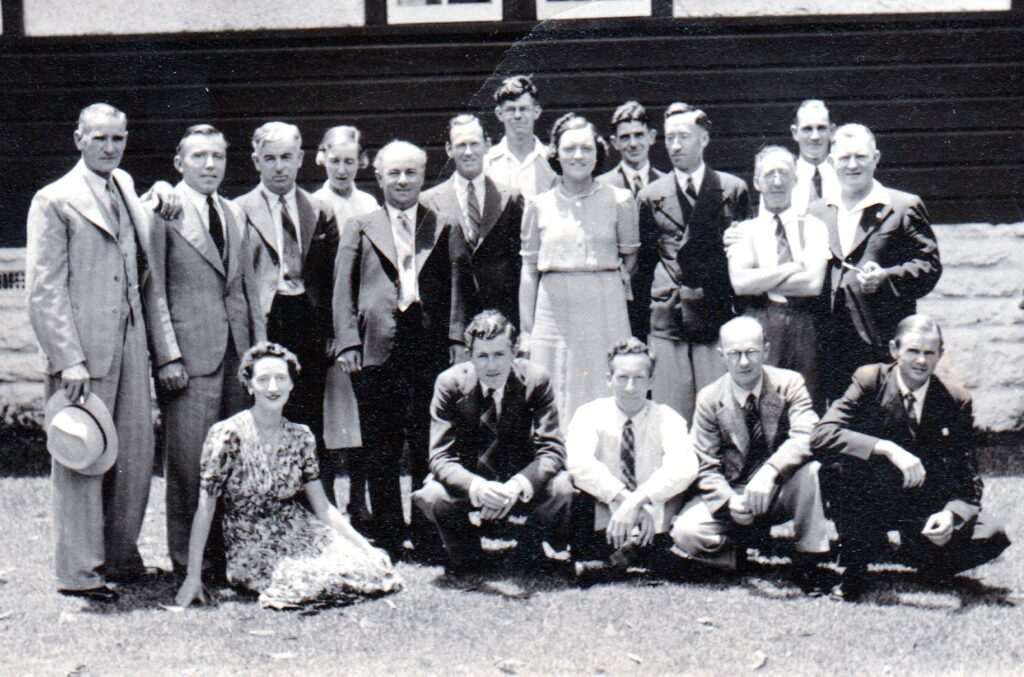
1930s Perth Studio Orchestra in front of old ABC building.

BACK L-R: Fred Flint, Tony Federici, Harry Singleton, Rima Swain, Lazar Sverdloff, Ivan Nylander, Alec Black, Vera Rees, Percy Newton, William Glassford, George Davies, Bob Trew, George Mellor.

FRONT: ?, Vaughan Hanly, Dave Kember, Harold Thornton, ?.


Music Teachers Gather In Force

THE W.A. Music Teachers Association held its monthly meeting in the Assembly Hall last Saturday night. Despite the cold and wet weather, a large gathering of members and friends was present. They were received by Mr. R. J. Bastian President) and Miss J. L.nYoung (honorary secretary). The hall was prettily decorated with wattle and palms, and on the small supper tables were vases of yellow and white daisies and gold and orange marigolds. Varied Music A delightful programme of choral  and instrumental music was presented by members of the association, those taking part being: Mr Frank Robertson’s Ladies’ Choir, in part songs, by Sweeting, Harrison, Pery Buck, Walter Davies and Dr. Rigby; Madame Layton Gaubert, two Brahms’ songs with viola accompaniment by Mr. David Powell; Miss Olga Willson, pianoforte solo, ‘The Lark’ (Glinka); Messrs. A. Black, A. Gamba and S. T. Morley, string trio, ‘Serenade’ (Dohnanyi); Mrs. W. McRostie, two monologues, accompanied by Mr. H. Black; Messrs. A. Gamba’and E. S. Craft, viola and piano duet, ‘Sonate’ (Gorke Bowen): Miss Evelyn Shotter and Mr. David Powell, violin and viola, Mozart Sonata. At the conclusion of the programme a hearty vote of thanks’to the performers was moved by Mr. Dean and seconded by Mr. A. R. Wood. An enjoyable supper concluded the evening. Among The Assembly Those present included Mr. R.J. Bastian (president), Mr. and Mrs. A. J. Leckie, Mr. and Mrs. Cecil Mason, Mr. and Mrs. E. S. Craft, Mr. and Mrs. A. R. Wood, Mr. and Mrs. H. Dean, Professor P. H. and Mrs. Fraenkel. Mr. and Mrs. N. E. Moran, Mr. and Mrs. R. H. Hamilton, Mr. and Mrs. F. Tate, Mr. and Mrs. R. Robinson, Mr. and Mrs. R. Mooney, Mr. J. Clifton, Mesdames Layton Gaubert, Howard Birt, E. M. McRostie, M. Nicholas, M. Ferres, J. Sheppard. L. Richardson, P. Boesser, E. J. McMonagle and B. N. Hinewood; Misses Trixie Shephard, Meta Pickering, Joy Fordham, Barbara Leckie, G. Thornbury, E. J. Purcell, D. S. Gray, M. Frape, A. P. Ringer, L. Howell, Adela Harris, Evelyn Robson, Jean Hamilton, M. Grigg, Ella Peterson, Joy Saunders, P. Willows, M. and D. Boesser, D. Warrick, L.. L.. Shenton, N. . Henfrey, Ena Corser, W. Seddon, A. MacAndrew, J. Hord, R. Birkhead. Phyllis Daly, Edna Warren; Messrs. J. Clifton, Frank L. Robertson, S. T. Morley. David Powell, A. R. Wood. Alec Black, C. Warren, C. Gamba and Keith Devenish.

Daily News (Perth, WA : 1882 – 1955), Wednesday 8 July 1936, page 8


1939

Royal Schools Music Club. LARGE bowls of poinsettias, tinted banksia, chrysanthemums and roses made an attractive decorative scheme at the Karrakatta Club Hall when the Royal Schools’ Music Club entertained many guests and members on Saturday evening. The president (Mrs. Cecil Mason) received at the entrance to the hall, and chose for the occasion a frock of jade green chiffon with touches of silver. She was assisted by the secretary (Miss Gwenyth Greaves), who wore a frock of eau de nil georgette with corsage spray in violet tonings, and the assistant secretary (Miss Marjorie Wyndham), who chose a frock of delphinium blue taffeta patterned in gold and silver. Mrs. Mason extended a cordial welcome to the guests, and in doing so referred to the fact that Miss Wyndham had been notified that as a result of the recent examinations she had been successful in gaining the diploma of Fellowship of the Trinity College of Music, London, and took the opportunity of extending to Miss Wyndham and her teacher, Miss Ida Roberts (who is also a member), the club’s congratulations on this achievement. The programme of entertainment arranged by Miss Wyndham opened with an interesting paper on “Sir James Barrie,” by Miss Dorothy Mark. This was followed by one of Sir James Barrie’s plays, “Seven Women,” which was presented by the following cast:~Misses Joyce Mortlock and Dorothy Mark, and Messrs. Harold Harvey and Frank O’Grady. A musical programme was also enjoyed, to which the following artists contributed:-Miss Jean Robinson (piano solo), Miss Hilda Black and Mr. Alec Black (sonata for violin and piano), Miss Dorothy Arnold (vocal soli, accompanied by Miss Margaret Cunningham), Miss Joyce Glasson (piano sol), Misses Elvie Arnold and Elvie Rodstedd (vocal duets accompanied by Miss Yvonne Rees), and Misses Mina Chapman and Jean Robinson (sonata for violin and piano). Supper served by the committee brought the evening to a close.

West Australian (Perth, WA : 1879 – 1954), Tuesday 16 May 1939, page 3


1941

Mr. and Mrs. W. H. Black entertained on Wednesday evening at their home in West Leederville, in honour of Miss Rona Wedgwood’s approaching marriage to Mr. Alec Black. The party took the form of a miscellaneous tea, and many attractive gifts were received. Competitions and games helped to pass the evening.

Among the guests were Mr. and Mrs. Tregoweth, Mr. and Mrs. Maschmedt, Mrs. Noel Pros-er; Misses Beryl Wedgwood, Lexie Wigmore, Kathleen Slapp, May Haigh, Gwen Gamble, Ottilie and Amanda Strempel, Tess McCaul, Edith Doel, Bid Bounsell, Amy Tunstall, Eileen Tregoweth, Freda Stevens, Messrs. John Townsend and Roy Collinson.

Sunday Times (Perth, WA : 1902 – 1955), Sunday 18 May 1941, page 18

Evening of Music.

MEMBERS of the W.A. Music Teachers’ Association and many friends met last Saturday night at the Burt Memorial Hall and listened to a programme of music by local composers. The programme was arranged by Mr. Edward Black. The president, Mr. F. L. Robertson, with Mrs. Robertson, and the hon. secretary, Miss J. L. Young, received the guests. Mr. Edward Black gave an introductory paper on “The Guild of Australian Composers.” This was followed by songs by Mrs. Carroll, Paul Buddee, Edward Black, and Otto Kaye, sung by Miss Lorna McKean; four sketches for violin and cello, composed by Lazar Sverdloff were played by Madame Zlata Kalmikoff and the composer; song by Miss Lorna Ford. sung by Miss Boesser; songs by Roy Wood, sung by Mr. Frank Robertson: piano solos by Alec and Edward Black played by Edward Black; and songs by Miss Florence Hcdd. sung by Miss Gertrude Hutton. At the conclusion of the music supper was served on tables gay with yellow and orange tinted flowers.

West Australian (Perth, WA : 1879 – 1954), Wednesday 2 July 1941, page 8

Music Club Entertains. Members of the Royal Schools Music Club entertained last Saturday evening at the Karrakatta Club hall. The president (Mrs. Cecil Mason), who received the guests, wore a black satin figured skirt with white satin bodice and coral accessories. The programme was arranged by Miss Marjorie Wyndham and assisting artists included Mr. and Mrs. Alec Black (violin and piano), Myrel Frape (songs accompanied by Marjorie Wyndham), Joyce Glasson (piano) and Lottie Dean (songs, accompanied by Mr. Dean). Misses Joyce Marshall and Mina Chapman were the winners of a competition arranged by Marjorie Wyndham.

West Australian (Perth, WA : 1879 – 1954), Thursday 14 August 1941, page 3


1950
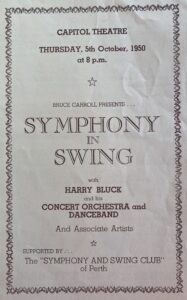
1950 Symphony in Swing program cover

Thursday, Oct. 5th – Capitol Theatre at 8pm  – 1950’s GREATEST MUSICAL SHOW

Bruce Carroll presents – Symphony In Swing

With Harry Bluck’s Concert Orchestra and Dance Band, Over 50 Leading Musicians and Radio Artists, Wendy Nash — 12-year-old Virtuoso Pianiste, Jack Harrison — Clarinet Star of the West, Ossie Sanderson — 16-year old ‘London Fantasia’ Soloist, Phyllis Frost — International Broadcasting Vocaliste, Ronald Pollastrini — W.A.’s Outstanding Lyric Tenor, Tritoff’s Trio — First appearance of Radio Vocal Trio, Kath Bass — Star Rhythm Vocaliste, Alan Golding — Leading Exponent of Hammond Electric Organ, Peter Clinch trio — Wizards of Swing, Dave Howard — and His Golden Voiced Saxophone (By Courtesy A. B.C.), Keith Connolly — Sophisticated Humorist, Laurie Croissette — Tho ‘Different’ Western Entertainer ,Symphony and Swing Club’s Entertainment Unit with West Coast Dixielanders — State’s smartest Jazz Ensemble, John Todd — 14-year-old Star Piano Accordionist, Rhythm Spinners — State’s leading Male Modern Vocal Group, Robyn Harwood — Boogie Woogie Specialiste, Beverly Beckwith — Co-Compere of S. and S. Club Group. Compere: Geoff Manion. Stage Production: Dave Howard By Courtesy A. B.C.   PRICES : 3/- 4/- 5/- (plus tax).   Box Plan at Nicholsons Limited.   The Daily News Monday 25 September 1950 page 12
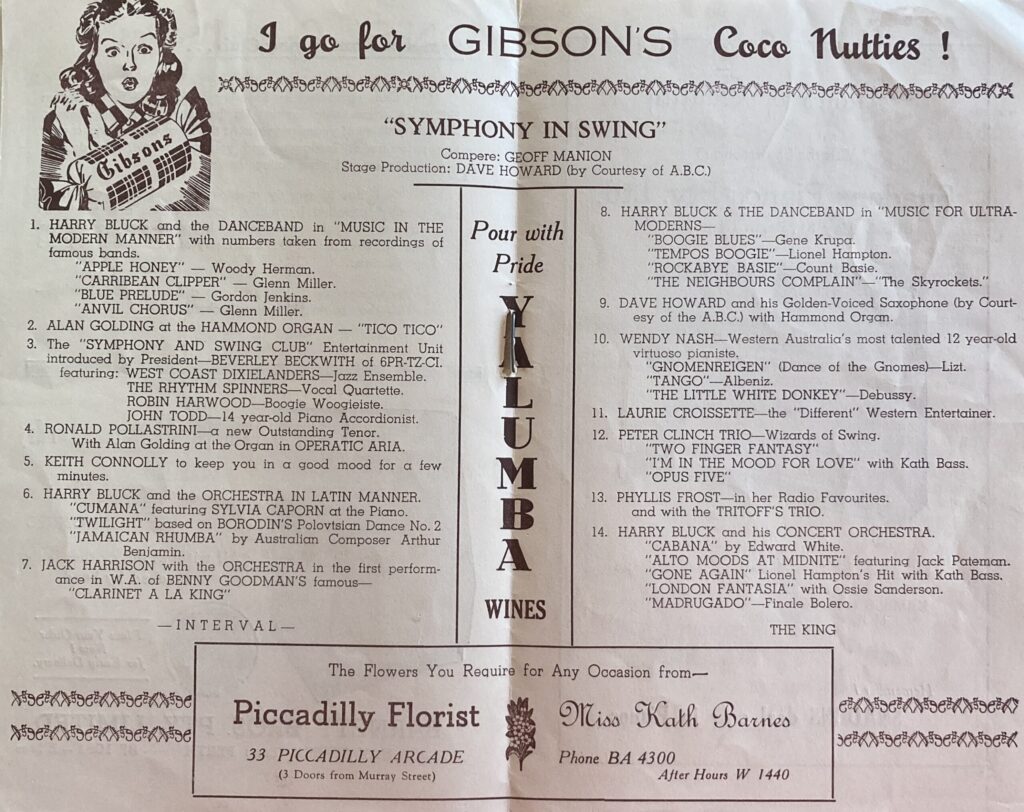
1950 Symphony in Swing program

October 5 1950 Symphony In Swing

On October 5, a concert entitled “Symphony in Swing” will be presented in the Capitol Theatre. Produced by Harry Bluck, whose concert orchestra and dance band will give a number of items, the programme will include varied numbers by local artists, many of whom are under 20 years of age. The 12-year-old pianist, Wendy Nash, will give a classical group, Jack Harrison, the young clarinettist will give the first West Australian performance of a number entitled “Clarinet a la King,” and the 16-year-old pianist Ossie Sanderson, will present “London Fantasia.” Other artists will be Ronald Pollastrini, tenor, and a new vocal group, the Tritoffs, who will be making their first public appearance. They will be associated with Phyllis Frost, the blind vocalist. There will be many other singers and instrumentalists.  Western Mail Thursday 28 September 1950 page 23
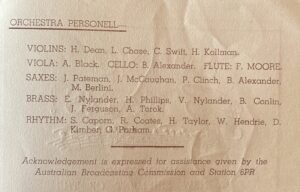
1950 Symphony in Swing orchestra list

Harrison, Marcia, West Australian Symphony Orchestra Celebrating 75 Years, (WASO Holdings Pty Ltd, 2003). P.22


1956

COMPOSER IS PROVOCATIVE

February 21, 1956

By “Fidelio”

A West Australian composer, James Penberthy, offered us last night what in some ways the most adventurous Australian composition so far heard in the Art Gallery programmes.  This includes, notably, his medium of expression; a wind quintet consisting of flute, oboe, clarinet, horn and two bassoons.  For this unusual combination Mr Penberthy had produce a work in short, linked movements, based on the music and life of Australian aborigines.  He obtained interesting effects in the way of atmosphere and drastic colourings, but his score sounded very fragmentary.  It seemed often to be hovering uncertainly between outright imitative realism and the freer imaginative flight which, we felt, should not convincingly emerge.  Another unusual inclusion was a set of three nicely fanciful songs for soprano and flute (no piano) by John Gordon, the words being taken from Chinese.  The rest was chiefly light music, generally pretty in a conventional style.  There were two pieces for flute and piano by A.C. Black (a West Australian), clarinet and piano pieces by Dulcie Holland and Moneta Eagles, songs by Horace Keats and Elizabeth Mills.  The performers were Sylvia Biddle (soprano), Owen Fisenden (flute), Jack Harrison (clarinet), Neil Pierson (horn), Ron Richmond (oboe), George Dreyfus and Claude Welling (bassoons) and Phyllis Allen (accompanist). 


1967
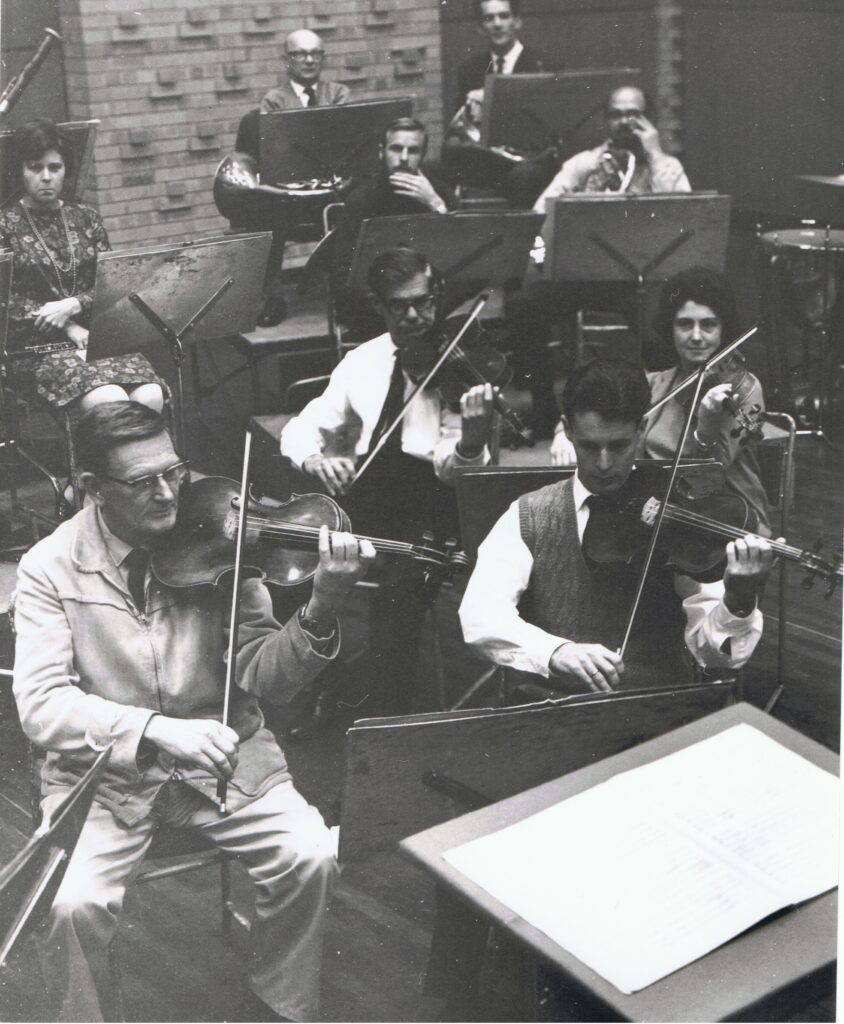
1967 WASO viola section

Alec played in the viola section of WASO for over 40 years up until at least 1976.

Alec died in December 2000 aged 88.
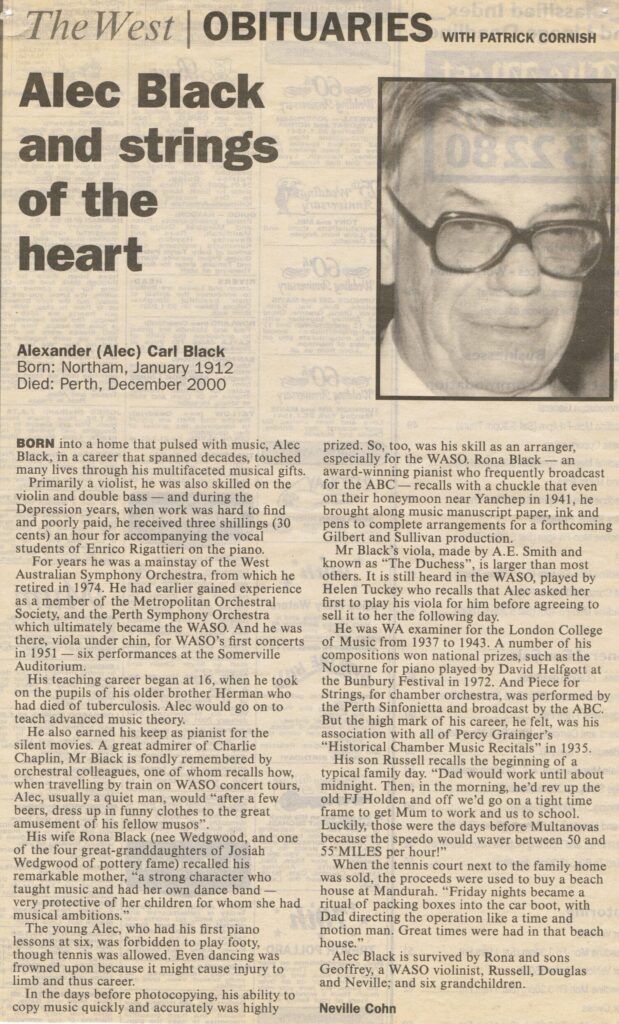
Alec Black obituary: The West Australian by Neville Cohn

Instruments

Years

Person

SMALLEY, Roger

1943 – 2015

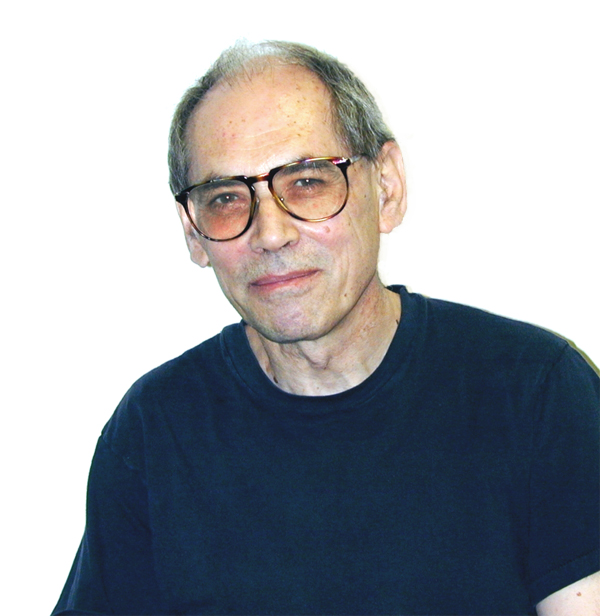
A prominent and versatile figure in contemporary music, Roger Smalley AM was born near Manchester, England in 1943. He studied piano with Antony Hopkins and composition with Peter Racine Fricker and John White at the Royal College of Music, London. He also took private composition lessons with Alexander Goehr and furthered his studies with Karlheinz Stockhausen on the Cologne Course for New Music.

Roger Smalley’s compositions have been performed and broadcast world-wide. He has been commissioned by many prestigious organisations and groups, including the BBC, ABC, West German Radio, Festival of Perth, London Sinfonietta, Australian Chamber Orchestra, Fires of London, Flederman, Nova Ensemble, Seymour Group and Australia Ensemble. His works feature on more than 20 commercially released CDs.

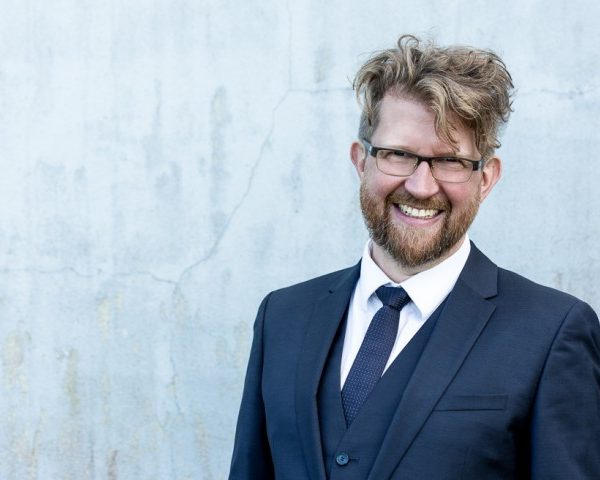
Roger Smalley

As a young composer, he was awarded the Royal Philharmonic Society Prize for his orchestral work Gloria Tibi Trinitas. His Piano Concerto, a BBC commission for European Music Year (1985), was the recommended work in the annual UNESCO Rostrum of Composers in 1987. This was the first time the Australian Broadcasting Corporation’s entry made it to the top of the list. In 2007, Smalley’s orchestral piece Birthday Tango (recently retitled Footwork) received the Australian Classical Music Award in the category ‘Best composition by an Australian composer’.

As a pianist, Roger Smalley was widely recognised for his performances of contemporary music. Early in his career, he was a prize-winner in the Gaudeamus competition for interpreters of contemporary music (1966), and received the Harriet Cohen award for contemporary music performance in 1968. In 1969, together with Tim Souster, he formed Intermodulation, an ensemble specialising in works involving improvisation and live electronics, which performed throughout England and Europe until 1976.

As a performer, Roger Smalley mastered a wide variety of solo and chamber music – he also appeared as a conductor. In 1989, he became the first Artistic Director and conductor of the West Australian Symphony Orchestra’s 20th Century Ensemble, continuing until 2000. His recordings as pianist and conductor have been released, among others, on the ABC Classics and Tall Poppies labels.

Smalley’s academic career was closely tied to his activities as a composer and performer. In 1968, he was appointed the first Artist-in-Residence at King’s College, Cambridge, where he subsequently held a three-year research fellowship. He came to Australia initially for a three-month composer residency at the University of Western Australia in 1974. He returned two years later to become a research fellow and subsequently Associate Professor of Music. In 1996, he was appointed a professiorial Research Fellow at the UWA. He was Emeritus Professor and Honorary Senior Research Fellow at The University of Western Australia and Honorary Research Associate at the Sydney Conservatorium of Music.

In 1991 he was the recipient of a Creative Development Award from the West Australian Department for the Arts, and was elected a Fellow of the Australian Academy of the Humanities. In 1994 he was awarded the Australia Council’s prestigious Don Banks Fellowship ‘in recognition of his distinguished contribution to Australian music’. He received the Australian Government Centenary Medal in 2001 and was proclaimed a Western Australian Living Treasure in 2004. In 2011, Smalley was appointed a Member of the Order of Australia (AM).

In 2015, Roger Smalley moved from Perth to Sydney where he lived until his death on 18 August 2015.

https://www.rogersmalley.com/


1977

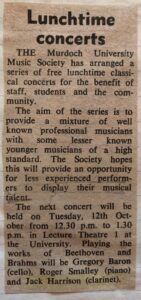
1977 Lunchtime Concert: Baron, Smalley, Jack Harrison

Lunchtime Concerts

Tuesday October 12th 1977

The Murdoch University Music Society has arranged a series of free lunchtime classical concerts for the benefit of the staff, students and the community.  The aim of the series is to provide a mixture of well known professional musicians with some lesser known younger musicians of a high standard.  The Society hopes this will provide an opportunity for less experienced performers to display their musical talent.  The next concert will be held on Tuesday 12th October from 12.30pm to 1.30pm in Lecture Theatre 1 at the University.  Playing the works of Beethoven and Brahms will be Gregory Baron (cello), Roger Smalley (piano) and Jack Harrison (clarinet).   


1981

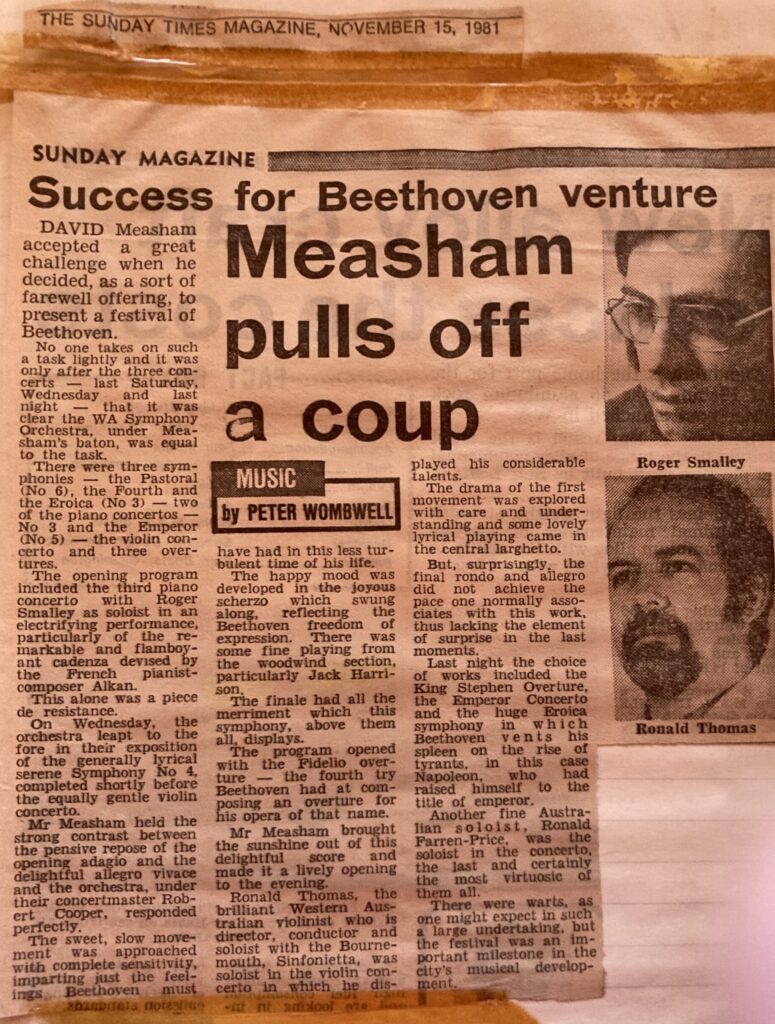
Measham pulls of Coup: Roger Smalley, Ronald Thomas


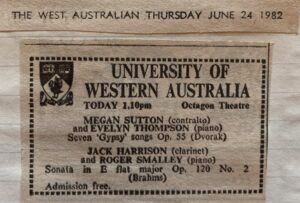
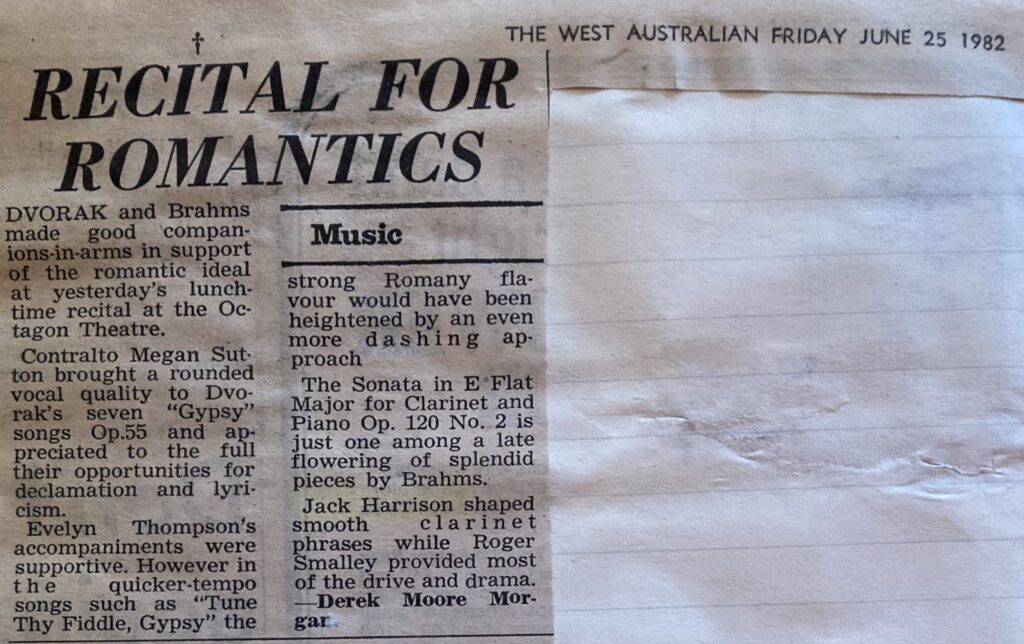
University of Western Australia

1.10pm Thursday June 24th 1982

Megan Sutton (contralto)

Roger Smalley (piano)

Jack Harrison (clarinet)

Sonata in E flat major Op. 120 No. 2 (Brahms)


1983


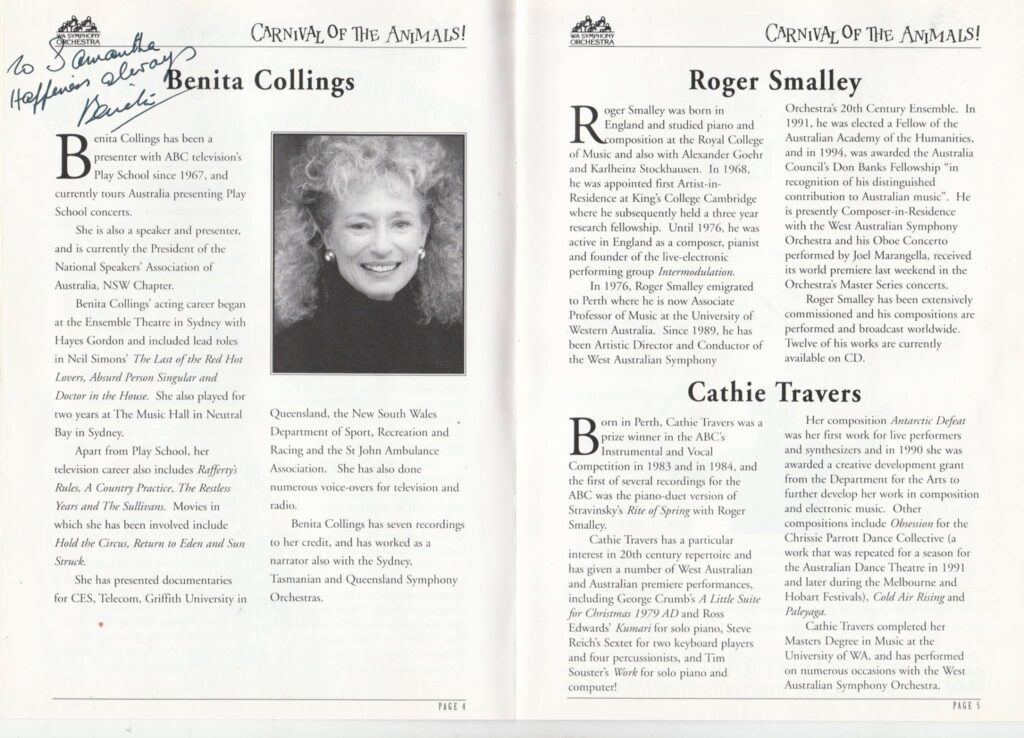
WASO Carnival of the Animals Concert – Presented by Benita Collings, Soloists Smalley, Travers


https://www.australianmusiccentre.com.au/artist/smalley-roger


https://en.wikipedia.org/wiki/Roger_Smalley


OBITUARIES

Roger Smalley obituary

Composer and pianist who went from Britain to Australia, where he was active in musical life for four decades

Meirion Bowen

Wed 2 Sep 2015 01.55 AEST

The British-born composer Roger Smalley, who has died aged 72, was not only one of the most distinctive composers of the post-second world war generation; he was also active as a pianist, teacher and concert organiser. Following a composer residency at the University of Western Australia in Perth, he took up a permanent post there, and went on to be a significant force in Australian musical life for four decades.

Roger Smalley left Britain for Australia, and became a significant force in musical life there for four decades. Photograph: www.rogersmalley.com

His first published works – the Variations for Strings (1964), Piano Pieces I-V (1965) and String Sextet (1965) – pointed to his interest in new and experimental music. But they also showed an incipient interest in Renaissance music that came to the fore in a series of works based on keyboard pieces by the 16th-century organist and composer William Blitheman. Two works called Gloria Tibi Trinitas (one for orchestra, 1965, the other, which won a Royal Philharmonic Society prize, for soloists, chorus and orchestra, 1966) were followed by his Missa Brevis (1967) and two works called Missa Parodia (one for piano, the other for piano and ensemble, both 1967).

Smalley nonetheless retained an individual voice, and was critical of what he considered to be the over-prescriptive approach of Pierre Boulez. In 1965-66 he studied with Karlheinz Stockhausen in Cologne. The music that Smalley wrote for Intermodulation – the live-electronics ensemble he co-founded with Tim Souster, Peter Britton and Robin Thompson – reflects a degree of influence by Stockhausen, but is less mystical in character.

Accord (1975), for two pianos, first performed by the composer with Stephen Savage, was the work he regarded as his “real” Op 1. It is both brilliantly structured and powerfully communicative. A recording by the pianists Daniel Herscovitch and Erzsébet Marosszéky was released earlier this year on the Continuum label.

Like a number of other works, Accord was inspired by the view from a high point of Perth and its environs. Australia made a great impact on him during his visit there in 1974, and he returned to make it his home for the rest of his life, moving to Sydney in 2007. Works created in his adopted country included Didgeridoo (1974), for four-track tape, and, for orchestra, Diptych (Homage to Brian Blanchflower, 1991), based on some of the Perth-based dedicatee’s artworks, and Close to the Edge (1995), inspired by the miniatures of another Western Australian artist, Lesley Duxbury.

The Scherzo from Roger Smalley’s Piano Trio

However, Smalley never simply nurtured a confined territory of his own: he remained open to ideas in music of all periods, as in a series of works based wholly or partly on the mazurkas of Chopin, notably his Variations on a Theme of Chopin (1989), Piano Trio (1991) and Poles Apart, for a mixed quintet of wind and strings (1992). All three can be found on a recording on the NMC label, Poles Apart and Other Chamber Works (2004).

Of his larger-scale works, his Symphony was premiered at the BBC Proms in 1982, and he was the soloist in his Concerto for Piano and Orchestra when it was commissioned by the BBC for European Music Year 1985; the two were coupled on a CD for Vox Australis (1987). The Cello Concerto was first performed in Perth in 1997 by Raphael Wallfisch, to whom it was dedicated, and is included in a recording titled Kaleidoscopes, on ABC Classics (2003).

An excerpt from Roger Smalley’s Pulses, 1969, revised 1986

A native of Swinton, near Manchester, Roger was the son of Lionel Smalley, a secondary school headteacher, and his wife, Dorothy, the school secretary. Roger took to playing the piano as if performing at the Royal Albert Hall, so his father made a key for the existing piano lock to restrict his access to the instrument in the hope that the boy would do some homework. From Leigh grammar school, he won a scholarship to the Royal College of Music, London, to study the piano with Anthony Hopkins and composition with Peter Racine Fricker, John White – a CD of whose piano sonatas he recorded for NMC (1997) – and, privately, with Alexander Goehr.

I first met Smalley when he was at the RCM, and, impressed by his brilliance as a pianist, later invited him to give a recital at Kingston Polytechnic, south London, where I was music director. We were both on the committee of the Macnaghten Concerts, promoting contemporary music, and had great fun trying to bring up to date what was by then a rather conservative organisation, on one occasion attracting a large audience to the Queen Elizabeth Hall in London for a programme featuring both Intermodulation and rag music by Scott Joplin.

Roger Smalley playing Piano Sonata No 95 by his former teacher John White

In 1989, Smalley became the first artistic director and conductor of the West Australian Symphony Orchestra’s 20th Century Ensemble, which he continued to conduct until 2000. He received the Australian government centenary medal in 2001, was proclaimed a Western Australian Living Treasure in 2004, and, in 2011, was appointed a Member of the Order of Australia.

In 1967 he married Sarah Roe. The marriage ended in divorce, but they remained good friends. He is survived by his partner, Patricia Benjamin, the children from his marriage, Rachel and Davey, and three granddaughters.

Roger Smalley, composer and pianist, born 26 July 1943; died 18 August 2015

https://www.theguardian.com/music/2015/sep/01/roger-smalley


by Rosalind Appleby

Roger Smalley Remembered 1943-2015

Date: September 1, 2015

Author: Rosalind Appleby

The music world has marked the passing of British/Australian composer Roger Smalley this month. Smalley died from Parkinson’s on 18th August 2015. He was well known in Western Australia because he was lecturer of composition at the University of Western Australia for three and a half decades and among other things founded the WASO 20th Century Ensemble. In 2004 he was proclaimed a State Living Treasure.

Vincent Plush in The Australian credited Smalley with putting Perth, the most isolated capital in the world, on the musical map.

WASO artistic planning manager Evan Kennea who studied composition under Roger Smalley agreed.

“Through his association with WASO, his brilliant music, his significant academic career, his exceptional performances and recordings as pianist and his inspirational support of young and emerging talent, Roger Smalley was a galvanising influence on the music world of Perth,” Kennea said.

Smalley’s funeral was on 26th August in Sydney, his home since 2007. Several eulogies were shared including one by WA French horn player Darryl Poulsen which has been reprinted below with permission. There was a request made that any floral tributes at the funeral be replaced instead with donations to the Australian Music Centre – a fitting tribute for a man whose life was all about music.

Roger Smalley Eulogy by Darryl Poulsen

Darryl Poulsen read this eulogy at Roger Smalley’s funeral celebration in Sydney on 26 August 2015.

My name is Darryl Poulsen. I am fortunate to have been a friend and colleague of Roger Smalley’s for more than three decades. I was his academic colleague at the University of Western Australia, and have performed with Roger many times over those years.

There are many people who have been a large part of Roger’s life, and I would like to acknowledge some of them here. Roger’s family: Rachael and Davey, daughter and son; their mother and Roger’s former wife Sarah; and Peter, his brother. They have all, from afar in the United Kingdom, been a very special part in Roger’s life. I had the good fortune of meeting a number of his UK family, either over there whilst on tour with Roger, or at special occasions here in Australia. I was struck on those occasions by the obvious love and affection between them, undiminished by the many thousands of kilometres separating them.

Roger lived for many years in Western Australia, and no doubt there are many colleagues and friends there, many of whom are not able to be here today.

Finally I would like to acknowledge Roger’s partner Pattie Benjamin and her children James, Sarah and Tim. They have all been a significant part of Roger’s life here in Australia. Pattie has provided unfailing support to Roger over many years. Support which has endured both the good times as well as the challenging times, such as his several recent bouts of ill-health. This enabled Roger to focus on his music, providing him with both a secure domestic base, as well as a keen interest and support, in all aspects of his musical career.

To all of Roger’s family and friends, I extend my deepest sympathies.

To talk about Roger the person, one has to talk about Roger the musician, for they really were one and the same. Composer, pianist, chamber musician, conductor, educator, and music critic: Roger was all of these, and his contributions to each were distinguished.

Extensive details of Roger’s background and achievements are readily available elsewhere, so I shall not use this occasion to recount them here. Suffice it to say, the list of musicians with whom he studied; prizes won, both as composer and performer; prestigious commissions; and significant honours and awards speaks for itself.

A self-effacing person by nature, the honours and awards are all the more appropriate recognition of the profound importance of Roger’s contribution to the arts.

Prior to coming to Australia, Roger was enjoying much artistic success in the UK and Europe. Fate of another kind, however, visited him, in the early 1970s. Professor Frank Callaway, then Head of Music at the University of Western Australia, contacted Roger during a visit to the UK seeking a meeting with him. Sir Frank, as he later became, was indefatigable when it came to enticing distinguished, talented international musicians to visit his Music Department in the most isolated capital city in the world, Perth.

The rest of that story is now history. Roger accepted Frank Callaway’s invitation for a three-month composer in residence position at UWA, arriving there in 1974. Three years later, he returned to Perth to take up an ongoing academic appointment at UWA. Naturally, his work as composer and performer was closely linked to his academic work. Roger spent three and a half decades at UWA, during which time he became a Professorial Fellow.

One can only begin to imagine the initial cultural readjustment Roger must have had to make when arriving in Perth from London. It seems however that, ultimately, this geographical and cultural displacement provided Roger a unique opportunity to seek new musical inspiration.

One such example was the stimulus he derived from his interest in visual arts, especially paintings and installations. His collaboration with artist Brian Blanchflower inspired the piece: Diptych: Homage to Brian Blanchflower, which, I am advised, Roger considered one of his finest. A similar collaboration with the printmaker Lesley Duxbury, also resulted in his piano quartet, both named and structured, after her artwork Crepuscule.

In Roger’s own words, he described the influence of visual art in an interview with William Yeoman:
‘….. up until the time I moved over here [Perth], I had never written anything at all with a visual stimulus. All of these pieces have been written here. So I think that being in a country where landscape and vastness and distance are all part and parcel of existence, obviously awoke a side of me which hadn’t been obvious before.’

Looking back now, one must acknowledge that Australian music is indeed the richer for the foresight of Frank Callaway all those years ago.

I would now like to offer some brief reflections on Roger. Two colleagues, Alan Bonds and Cathie Travers, recently shared their thoughts and recollections of Roger with me. Alan Bonds, violinist/violist, reminisced with me about Roger, when he first arrived in Perth, and when Alan himself was an undergraduate student in a number of Roger’s classes. The following are a few random recollections:

Although Roger’s interest, and indeed reputation, was firmly based in electronic music, we were all amazed that he would be interested in playing in regular chamber music sessions. Sight-reading substantial works, piano quartets and quintets, of Schubert, Schumann, Brahms etc., we were astonished that Roger would not only sight-read anything, but also play flawlessly. His intuitive grasp of music made for an enthralling experience for his musical partners.
 
Although coming with the extreme intellectual tendencies of the Cologne and Darmstadt Schools, he still enjoyed playing the beauty in the music of Schubert and Brahms. He was just a great musician who importantly, knew where he came from.
 
Studying and playing the music of the Second Viennese School with Roger was a formative influence. In particular, performing Schoenberg’s Pierrot Lunaire with Jane Manning and Roger was unforgettable, the performance was transformative.
 
Interestingly, like Stockhausen, Roger also discovered that humans make better music than machines. He wrote very challenging music. Roger was a modernist through and through, and he held his faith to the end.
 
His teaching was as rigorous as it was spontaneous and inspirational. He had a unique ability to see into the very heart of the music, and communicate it.
 
Cathie Travers offered the following insight into Roger’s influence at UWA:

Roger was not an especially good ‘piano’ teacher in the sense of helping to develop an advanced instrumental technique. But he was a great teacher about music. His sight-reading skills were fabulous. At the piano, Roger automatically started collecting and collating information on the elements of the score and the way the musical structure hung together [or failed to do so, as the case may be]… his hands responded to the flood of musical information pouring out of his brain, and his fast physical responses meant his read-throughs of complex scores were astoundingly accurate. He tended to drive a car in a similar manner: information in, and quick response reactions out; it could be a bit harrowing in the passenger seat of the car though.
 
I think it’s fair to say that his fascination with musical structure informed his every moment of existence as a musician, whether he was performing, educating, arranging or composing.
 
My own first recollection of Roger goes back to 1981. Returning to Australia from studying and working in Europe, I first met Roger when enrolling as a postgraduate student at UWA. I was extremely fortunate to have had Roger working with me performing in a number of recitals and chamber music concerts, as part of my postgraduate program.

No sooner had we commenced our musical projects, Roger decided to expand the horn literature by writing a new work for me. This was Echo IV. Written for horn and tape delay, it was the last in a series of works for solo instrument and tape delay. This was the pre-digital era, when electronics were still largely analogue.

Performing the work set considerable challenges. In particular, mastering the logistics of a tape delay system, comprising two reel-to-reel recorders stretched some distance across the auditorium, syncing the resultant time delay with an independent click-track, was fraught with unanticipated irregularities. So much so, that on the day of the premiere of Echo IV, it was decided to prerecord the two echos, which would then be played back with the live horn, and click track.

This too, however, proved challenging in performance. Synchronisation of the click-track and the recorded tracks parted company, leaving me with the invidious choice of deciding to play with either one or the other, rather than all together, as the composer intended!

Technological limitations of the day were never an impediment to Roger’s creativity. I remember Roger very distinctly saying that future advances in technology would one day make the playing of this piece, as well as other similar works, easier to realise. He was right of course. Some years later, with the benefit of the arrival of digital delay devices, we were able to perform Echo IV again, this time without click track, and more in the manner that the composer had conceived it.

Eventually, I joined Roger as an academic colleague at the University of Western Australia. During this extended period, more new works were commissioned and premiered.

A notable occasion with Roger was a tour we undertook of the United Kingdom, and Western Australia. Aptly called ‘Crossing Continents’, it was an innovative composition and performance exchange between British and Australian musicians. The concerts featured new works by British composers Dorothy Ker, George Nicholson and Adrian Moore, together with music by Roger, and James Ledger from the University of Western Australia.

Of particular note was the recognition Roger received in the UK. Interested musicians and public simply appeared from everywhere, seeking out Roger Smalley, even as we performed and gave workshops in some of the smaller places like in Surrey, for example. The reverence for Roger and his music was palpable.

Despite his long illness, I do not recall Roger ever complaining. Even in recent times, the world of music still occupied his being. The radio in his room at Lulworth, permanently tuned to ABC Classic FM, broadcast without interruption. I am sure that the presence of this music went some way to transport him from the terrible illness which had overtaken his body.

During a recent visit, I was able to talk with Roger about a composer whose music I had just heard performed in Vienna. The composer was the French Canadian, Claude Vivier. Interestingly, Roger’s body moved in recognition of the name as it was spoken. In a few precious but muted words, Roger was able to share with me his enthusiasm for Vivier’s music, and also relate the common ground they both had with Stockhausen. It was like a brief moment of musical conversation with the old Rog., I knew so well.

Two years ago, I had the good fortune of attending Roger’s 70th birthday celebration. At that event, I was asked to offer a few words about him. I chose to conclude my comments with a quote, which I would like to share once more. The musical idea expressed in the quote, in my opinion, deeply reflects the very essence of the Roger we know so well. The quote, from the journal, The Listener of 12 August 1971, is Roger in his own words, describing the compositional process of his work entitled Beat Music which premiered at the 1971 Proms concert with the ensemble Intermodulation:

‘I am continually trying to get away from the feeling that I am composing the music, and closer to the sensation that the music is composing itself. This sensation, which I experienced more strongly than ever before while writing Beat Music, is extremely difficult to verbalise, but I could describe it as the feeling that if you descend deeper and deeper into the materials of music until you reach the smallest and most insignificant-sounding object (say a C natural so low that it is no more than a click every second), you will merely have to disturb it slightly with the point of your pencil – push it around on the manuscript paper a little – and it will release the most phenomenal amount of energy.’

Farewell Roger.


We are sorry to report the death of RCM alumnus, Roger Smalley, on 18 August 2015.  He was a hugely prominent and distinctive figure in contemporary music, both as a composer and a pianist.

Born in Swinton, near Manchester, in 1943, Roger Smalley started learning the piano at a young age.  His father, a head teacher, would reportedly lock the piano in order that he should do some homework.  He won a scholarship to study at the Royal College of Music in 1961, where he studied the piano with Antony Hopkins and composition with Peter Racine Fricker and John White.

Following an appointment as Artist in Residence at King’s College, Cambridge, in 1968 he then took a short composer residency at the University of Western Australia, later emigrating to Australia in the mid-1970s.  He subsequently continued to enjoy a career as an academic at the same University, later moving to Sydney in 2007.  In this time, he became a significant figure in Australian musical life, and his adopted country featured prominently in some of his works, notably Accord for two pianos (1975), inspired by the view from Perth and Didgeridoo (1974) for four track tape.

In 1989 he became the first artistic director and conductor of the West Australian Symphony Orchestra’s 20th Century Ensemble.  He received the Australian government centenary medal in 2004 and was appointed a Member of the Order of Australia in 2011.

He was awarded the RPS prize for his orchestral work Gloria Tibi Trinitas.  He received numerous prestigious commissions, made many recordings and his works were performed and broadcast worldwide. His own performance of his Piano Concerto was the recommended work in the UNESCO Composers’ Rostrum in 1987 – the first time the Australian Broadcasting Corporation’s entry made it to the top of the list.

https://www.rcm.ac.uk/about/news/all/rogersmalley.aspx


Roger Smalley Remembered 1943-2015

Instruments

Person

GRANDAGE, Iain

Iain Grandage composed Blackwood.


Iain Grandage composes, conducts and performs. He has received the prestigious Sidney Myer Performing Arts Award, and the Ian Potter Emerging Composer Fellowship, and been composer-in-residence with the Western Australian Symphony Orchestra, and musician-in-residence at the UWA School of Music, where he is currently an Honorary Research Fellow.

Iain’s concert works have been performed by the Australian Chamber Orchestra, the Brodsky Quartet, the Australian String Quartet, Australian Brass Quintet, Jean-Yves Thibaudet, Sara Macliver, Craig Ogden and choirs and orchestras around Australia. Recent highlights include the Victorian Opera production, in 2014, of his opera The Riders, based on the Tim Winton novel with libretto by Alison Croggon. The Riders was described by Michael Shmith (The Age ), as ‘…an opera of rare dramatic power, utmost musicality and first-rate performances’ and by Peter Burch (The Australian) ‘.. a bewitching jewel of contemporary music theatre’. Peter Rose of the Australian Book Review wrote, ‘The real star of the night was Grandage’s radiant new score’.

For the ANZAC Centenary, Iain conducted the Adelaide Symphony Orchestra in the critically and publically acclaimed world premiere performance of his oratorio Towards First Light, written with Kate Mulvany. ‘Grandage shows us intimacy, vulnerability, inspiration, comfort and desolation in this exceptional piece’, wrote Gordon Forrester (Limelight), while Graeme Strahle (The Australian) wrote: ‘this was a memorable world premiere of a major new Australian work. Grandage conducted a polished Adelaide Symphony Orchestra with tremendous flair and energy.’

His compositions for the theatre include Helpmann Award-winning scores for Cloudstreet, The Secret River, When Time Stops and (in collaboration with Kate Miller-Heidke) The Rabbits, and the and Green Room Award-winning scores for The Riders, Lawn, In the Next Room, Babes in the Wood, The Odyssey and The Blue Room for theatre companies including Belvoir, Black Swan, Malthouse, MTC and STC.

As music director, he has won Helpmann Awards for his work with Meow Meow on the Malthouse/Sydney Festival production Little Match Girl, and with the cast on Sydney Theatre Company’s The Secret River. He won Green Room Awards for his work with ANAM and Meow on Wunderschon, and with Meow and Malthouse on Vamp. He has conducted orchestras for Gurrumul and Tim Minchin and led a revival of Shane Warne The Musical for the 2013 Adelaide Cabaret Festival.

Most recently, he was music director and arranger for Opera Australia’s critically lauded new opera The Rabbits by Kate Miller-Heidke and Lally Katz. Iain has worked as musical supervisor and arranger for the Black Arm Band on their award-winning performances Hidden Republic, dirtsong and Seven Songs­; and collaborated with Steve Pigram, Mark Atkins and Richard Tognetti on the ACO’s multimedia presentation The Reef. He was music director and arranger for Eddie Perfect’s Songs from the Middle with the Brodsky Quartet and ANAM, broadcast on ABC in 2011.

Future work includes commissions from the Melbourne Symphony Orchestra, Katie Noonan with the Brodsky String Quartet, and collaborations with Kate Miller-Heidke and Tim Minchin.

Iain Grandage — current to August 2015

Studied with

Roger Smalley (1989 – 1992)


Teacher/Influence on

Duncan Gardiner (2004)

Lachlan Skipworth (2004)


Instruments

Years

Person

WOOD, Graham

Graham Wood OAM

Born in 1930, Graham Wood participated in the Australian Youth Orchestra’s (AYO) original National Music Camps from 1949 to 1954.

In the 1950s Wood performed with London’s Royal Opera House orchestra, followed by three years at the London Philharmonic Orchestra.

Graham then settled in Perth, WA, where he joined the West Australian Symphony Orchestra during its early development.


1962

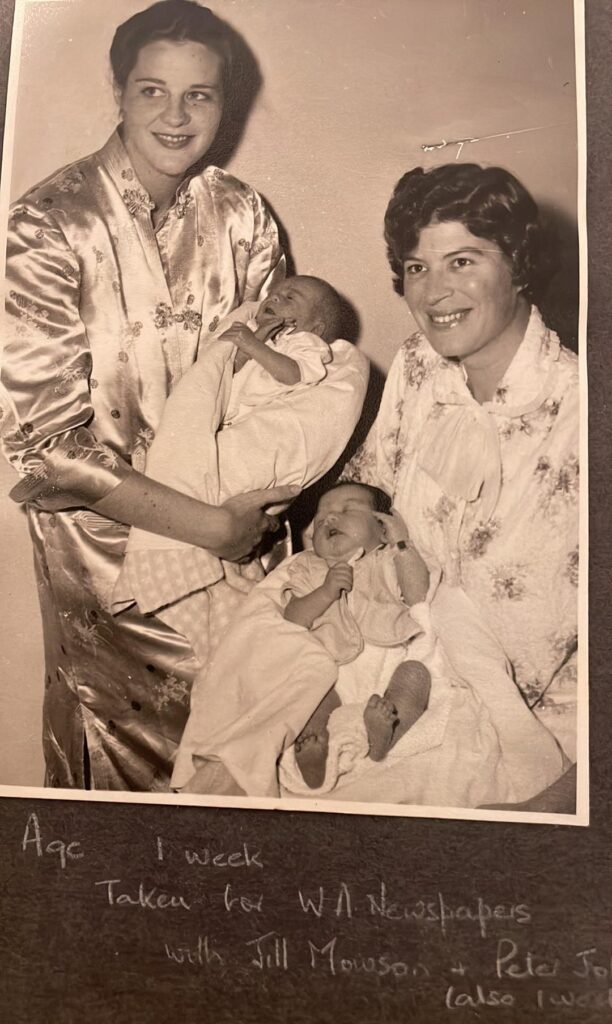
Tricia and Adrian Wood; Jill and Peter Mowson – born the same day – 2nd May 1962 

Peter Mowson, son of Jill and John Mowson, was born in the same hospital on the same day as Adrian Wood, son of violinist WASO colleague Graham Wood and his wife, Tricia.  

Different People, Same Path

Mrs. Graham Wood of Stubbs Terrace Daglish, and her friend Mrs. John Mowson of Marine Parade Cottesloe have a lot in common besides their babies Adrian Michael and Peter John.  The women met after they had each married members of the W.A. Symphony Orchestra. Mr Wood is a violinist and Mr. Mowson plays the bassoon (!) Each played with the Melbourne Symphony Orchestra six years ago.  Mrs Wood and Mrs Mowson found out at about the same time that they were going to have babies and they went to the same doctor. They did the same prenatal exercise exercises and were confined in adjoining rooms in St John of God Hospital Subiaco at the same time. Their babies were born early on the same morning and both, as their names suggest are boys. Adrian is the sixth grandchild of Mrs Wood’s mother, Mrs Mary Hodgkin of Princess Street, Mosman Park, who gained her Master of Arts degree on the same day the baby was born.

The West Australian June 14 1962


MUSICIANS TO TOUR IN NORTH

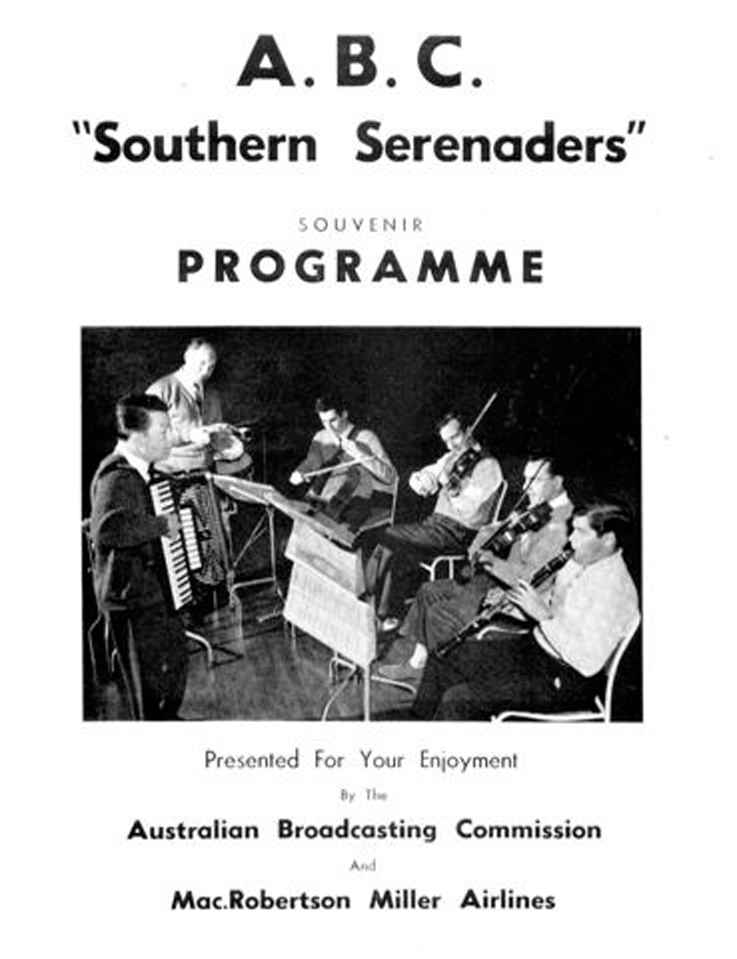
The A.B.C. and MacRobertson Miller Airlines Ltd. Will send seven musicians through the North-West for a series of concerts between August 28 and September 8.  The A.B.C. artists will fly 4000 miles in 12 days to give concerts in Carnarvon, Port Hedland, Broome, Derby, Wyndham, Kununurra and Darwin.  The group is to be led by Verdon Williams, will include Shirley Fresfader, Peter Piccini (accordion), Jack Harrison (clarinet and harmonica), Graham Wood (violin), Laslo Vidak (violin and viola) and Brian Meddeman (cello and violin).  A small TV film unit will tour with the group.  The film they make will be shown in the Eastern States as a part of an A.B.C. project to focus attention on the North.  

The West Australian August 8 1962

The “Southern Serenaders”

From August 28 – September 8th 1962 the A.B.C. sent a small group of musicians, led by Verdon Williams, on a tour of the north west of the state.  Apart from Verdon, the ensemble which we called “The Southern Serenaders” included Graham Wood on violin, Laslo Vidak on violin and viola, Brian Meddemmen on cello, Jack Harrison on clarinet and harmonica, Peter Piccini on accordion and soprano Shirley Flesfader. 


Graham Wood wrote: “ We travelled by DC3 aircraft, giving concerts in Carnarvon, Port Hedland, Derby, Broome, Darwin, Wyndham and Kununurra.  Verdon had arranged all the music, which was of a pretty light nature and we all had a solo spot.  We were paid £8 per concert and received a living allowance of £3/3/0 a day.  We had a happy time, enjoying each other’s company.  Peter Piccini was a natural comic and poor Shirley was the butt of many a practical joke, which she took in good part.  One thing I remember vividly was the night when a huge stick insect landed on my violin while I was playing “The Flight of the Bumblebee”!

Most of the towns were still remote and largely undeveloped at that time, so people really appreciated our efforts.  The aborigines were shy about coming to our concerts, so in Derby a few of us were taken out to a camp late at night after our performance.  In a moonlit clearing we played to the people, some of whom produced a couple of digeridoos and played them for us.  A magical moment ensued, as Jack Harrison quietly joined in with some gentle improvisations on his clarinet.  We were entranced as were all the people there, dogs included.  A genuine fusion of cultures.”


RECORD AUDIENCE CHEERS 1962 CULTURAL TOUR

The A.B.C. “Southern Serenaders” played to an estimated audience of 6000 people during their 4000 mile tour of seven North West ports including Darwin and Kununurra.

Darwin gave the orchestra its largest reception.  About 4000 people crowded the Darwin oval sitting on available chairs provided, on rugs on the ground and in hundreds of motor cars parked around the perimeter of the ground.  Darwin’s town Clerk (Bill Sullivan), who estimated the size of the audience, remarked that in all his experience it was the largest crowd he had seen in Darwin at such a presentation.  Everywhere they went the “Southern Serenaders” earned cheering ovations and goodwill for M.M.A. and the A.B.C.

Departing from Derby around 4am, Jack Harrison (clarinet) and Peter Piccini (accordion) decided to hold an impromptu jam session in the air terminal.  When M.M.A.’s chartered F.27 arrived, they moved out onto the tarmac, serenading the sleepy-eyed passengers that emerged from the aircraft in the small hours.  The previous night, six members of the orchestra, augmented by four aborigine musicians, improvised what was probably the most unique combination of sounds heard in the North in a long time.  The only bachelor in the orchestra, cellist Brian Meddemmen, was the only member of the group game enough to bring home an aboriginal wife beater.  Violinist Laszlo Vidak fell victim to “fiddler’s peril” when the top string on his violin broke during a solo.  He finished the item without a break and few people realised what had happened until Verdon Williams mentioned it to the audience.

On arrival at Wyndham, Peter Piccini discovered that the precision mechanism on one key on his £500 accordion had broken.  A technician from Wyndham Aeradio was located who did a superb welding job at short notice and a scant hour before the concert there.  Mr Piccini was still replacing bits and pieces of springs, levers and keys with the able assistance of Graham Wood and Jack Harrison.

In their off-duty moments, most members of the group took the opportunity to see the surrounding countryside of the towns they visited.  Mr. E.K. Sholl, A.B.C. Manager, Fred Combs, A.B.C.2 cameraman and cellist Brian Meddermmen earned top honours for vim, vigour and vitality by climbing the Bastion at Wyndham and Kelly’s Knob at Kununurra.  Shirley Flesfader was the only member of the touring group to return to Perth with genuine Nor’-West influenza.  Well on the road to recovery as Jetstream went to press, Miss Flesfader enjoyed the joke on herself remarking “Trust the soprano to be the only one in the company to catch the ‘flu’”.  To Verdon Williams, the North-West was a paradise.  He collected seeds and minute cuttings of different varieties of Western Australian plants, shrubs and flowers.  Some are already established in the large garden of his south Perth home.

PRAISE FROM A.B.C.

At every port-of-call, the Manager for Western Australia of the Australian Broadcasting Commission, Mr. E.K. Sholl, told audiences at the “Southern Serenaders” concerts how greatly he admired the work being done by M.M.A. to bring culture programmes into the North.  He went on to assure audiences that by next March the A.B.C.’s two short wave stations, VLX and VLW, would increase their signals from 10 to 50 kilowatts and from 2 to 10 kilowatts respectively.  “You will then be able to receive Perth short wave broadcasts with approximately the same clarity as you now receive Melbourne’s transmission through Radio Australia”, Mr Sholl said.  This, he anticipated, would enhance the listening pleasure of almost everyone in the North from Carnarvon to Wyndham.  Jetstream Official Publication of Mac.Robertson Miller Airlines Ltd. Vol 1. No. 20 September 1962

The Southern Serenaders

1964

1964. WASO tutors include: Patrick Brislan, Don Johnson, John Gould and Ashley Arbuckle (all standing on the left and rear). Seated in the second row: Owen Fisenden, Graham Wood, Jack Harrison, John Mowson, Brian Meddemmen, John Dean, Stan Kowarski, Vaughan Hanly, Peter Randall, Brian Pope and also Prof. Frank Callaway.

1967

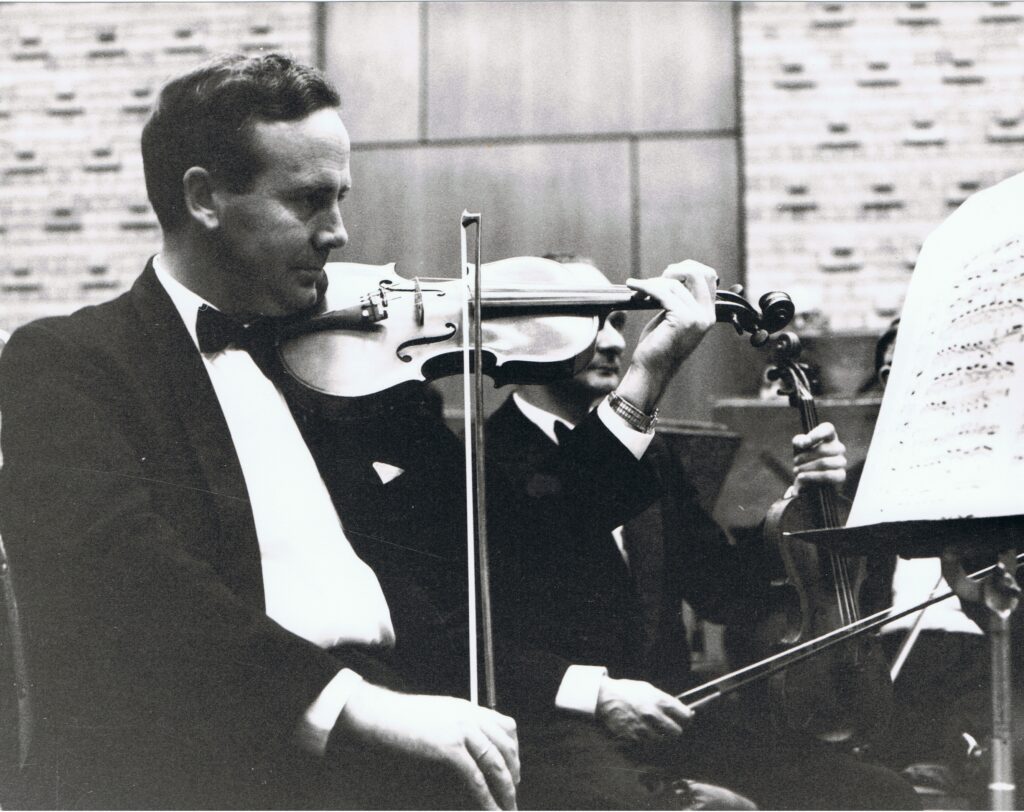
1967 Graham Wood in WASO

Graham’s reminiscences of his first days in WASO:

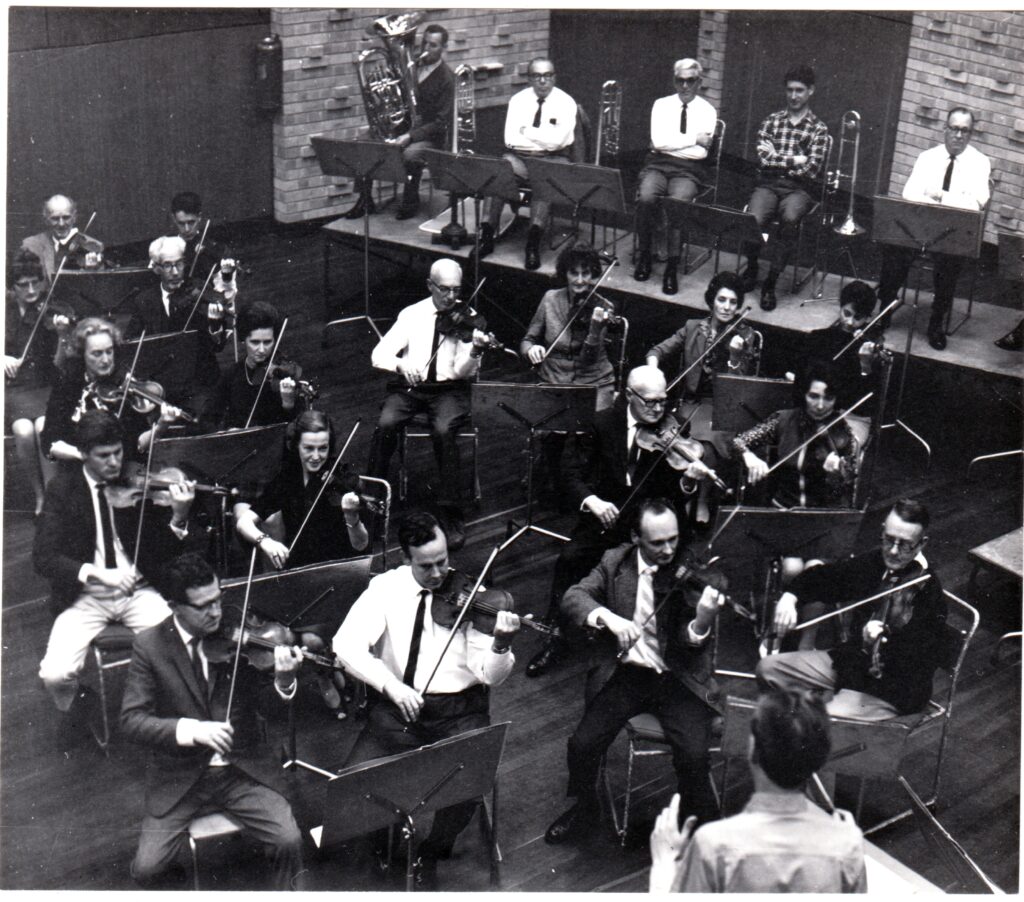
Within a week of our arrival I was ensconced in the first violin section of the WA Symphony Orchestra. The ABC had just moved into a brand new building in Adelaide Terrace and the orchestra’s studio [the Basil Kirke Studio] was claimed to be the latest state of the art broadcasting studio in the country. It certainly suited the small 50-piece band, which I discovered on my first day.  By 2005, the ABC had moved out and the building was to be demolished!

The quality of the playing in 1960 left much to be desired. The ABC employed the WASO and we were all superannuated public servants, so it was difficult to sack a player who was not up to scratch! I sat on the outside of the second desk, behind the leader, Vaughan Hanly and Barbara Tyler. My desk partner was Margaret Poole-Johnson. I could fill volumes with details of some of the extraordinary characters who inhabited the ranks of the orchestra at this time. Space however limits me to mentioning just a few.

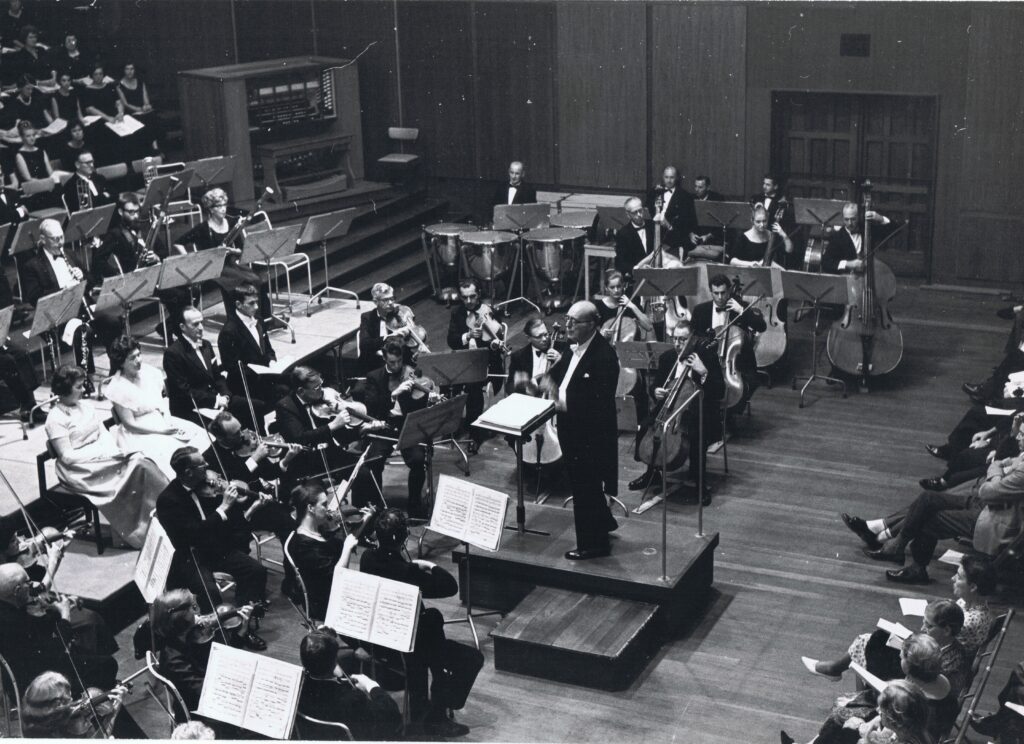
1967 WASO in Basil Kirke Studio

The resident conductor was John Farnsworth Hall. I had experienced some rotten conductors already, but Farnsworth really took the cake! An irascible charlatan of a fellow, he would fly into a rage at imagined slights or blame players when some mishap occurred, usually of his own doing. Fortunately he was also lazy and we could depend on days finishing early and calls being cancelled or cut short! This was a blessing in that we had time for our own individual pursuits, such as teaching and chamber music playing. Vaughan Hanly was a highly competent violinist with much experience and a high reputation as a teacher.

1965 John Farnsworth Hall conducting WASO in Winthrop Hall

Barbara Tyler was also competent, but rather neurotic, with a tendency to talk non-stop, to such an extent that she would froth at the mouth! Most of the others violinists were either ageing or young and inexperienced. John Dean led the viola section. I had met him at the University Conservatorium in Melbourne when we were both violin students there. He took to the viola when the principal position became vacant in Perth. We have been lifelong friends.

The front desk of the cello section was a hoot! Two mad Hungarians sat together there. Principal was Louis Mojzer, a middle aged expatriate in the process of decay. He had the remains of a fine technique, but alcohol had infiltrated it. His desk partner was another alcoholic, Zoltan Barna, a plump clown of a fellow who had a large collection of musical tricks, amusing at first. The two of them caused our conductor a lot of strife. He called them “Buda” and “Pest”, which was about the only thing I admired him for.

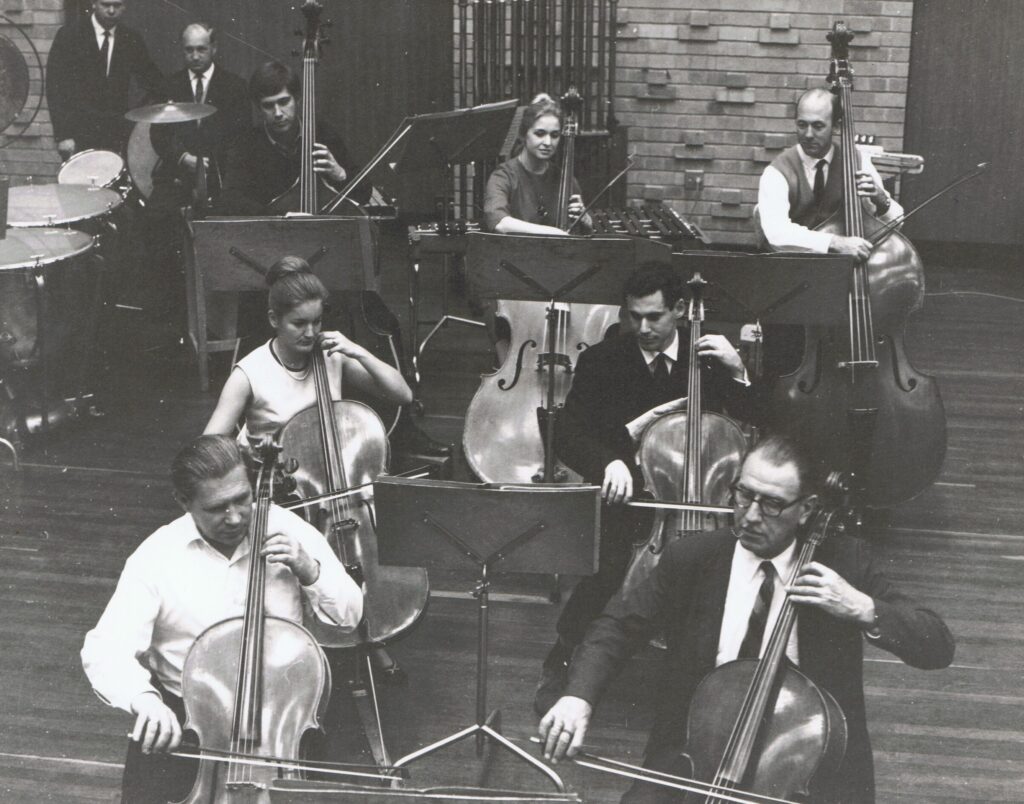
1967 WASO cellos and basses: Front row left to right: Zoltan Barna (Pest), Louis Mojzer (Buda). 2nd row Jill Heady, Brian Meddemmen. 3rd row: David Ellis, Aino Neumann, John Mowson. Back row: Peter Clinch, Verdon Williams.

1968

The Australian premiere performance of Till Eulenspiegels lustige Streiche, Op. 28 by Richard Strauss arranged for five instruments by Austrian composer Franz Hasenöhrl in 1954 was performed by Graham Wood (Violin) Jack Harrison (Clarinet) Jill Harrison  (Bassoon) Patrick Brislan (Horn) John Mowson (Double Bass) on Sunday February 29 1968 in the A.B.C. Basil Kirke Studio as part of the Festival of Perth.


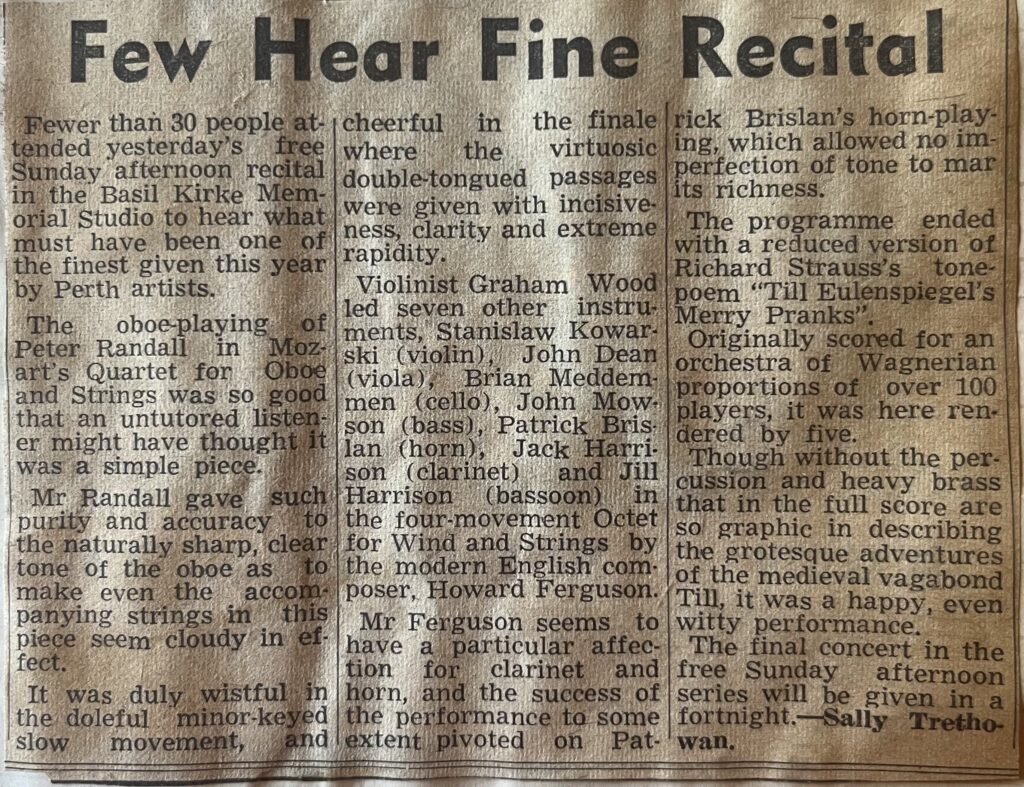
FEW HEAR FINE RECITAL – By Sally Trethowan – Sunday February 29 1968

Fewer than 30 people attended yesterday’s free Sunday afternoon recital in the Basil Kirke Memorial Studio to hear what must have been one of the finest given this year by Perth artists.  The oboe playing of Peter Randall in Mozart’s Quartet for oboe and strings was so good that an unchartered listener might’ve thought it was a simple piece. Mr. Randall gave such purity and accuracy to the naturally sharp clear tone of the oboe as to make even the accompanying strings in this piece seem cloudy in effect. It was duly wistful in the doleful minor keyed slow movement and cheerful in the finale where the virtuosic double-tongued passages were given within incisiveness, clarity and extreme rapidity. Violinist Graham Wood led seven other instrumentalists Stanislaw Kowarski (violin) John Dean (Viola) Brian Meddemmen (cello) John Mowson (bass) Patrick Brislan (Horn) Jack Harrison (clarinet) and Jill Harrison (bassoon) in the four movement Octet for Wind and Strings by the modern English composer Howard Ferguson. Mr. Ferguson seems to have a particular affection for clarinet and horn, and the success of the performance to some extent pivoted on Patrick Brislan’s horn playing which allowed no imperfection of tone to mar its richness. The program ended with a reduced version of Richard Strauss’s tone poem “Till Eulenspiegel’s Merry Pranks”.  Originally scored for an orchestra of Wagnerian proportions of over 100 players, it was here rendered by five. Though without the percussion and heavy brass that in the full score are so graphic in describing the grotesque adventures of the mediaeval vagabond Till, it was a happy even witty performance. The final concert in the free Sunday afternoon series will be given in a fortnight.


The West Australian premiere of “Soldier’s Tale” was performed on Sunday September 29th 1968 in a free concert put on by the A.B.C. in the Basic Kirke Studio.  Directed by Verdon Williams, the performers were Graham Wood (violin), John Mowson (bass), Jack Harrison (clarinet), Jill Harrison (bassoon), Donald Johnson (trumpet), Alan Mewitt (trombone) and Brian Sadique (percussion).

Free A.B.C. Concert Sunday September 29th 1968

The free concert in the A.B.C.s Basil Kirke Studio tomorrow beginning at 3 o’clock is one of a series of six in which distinguished artists are performing a wide variety of works. The program will be Bartok’s outstanding and complicated “Sonata for two pianos and percussion” played by Wendy Nash and Stephen Dornan and percussionists John Reece and Brian Sadique directed by Verdon Williams and Stravinsky’s “Soldiers Tale” concert suite conducted by Verdon Williams. The performers will be Graham Wood (violin), John Mowson (bass), Jack Harrison (clarinet), Jill Harrison (bassoon), Donald Johnson (trumpet), Alan Mewitt (trombone) and Brian Sadique (percussion).

The West Australian Saturday September 28 1968


1972

Graham Wood was appointed Lecturer in Violin and Viola at the University of Western Australia Music Department in 1972 and was on the staff until he took early retirement in 1988 to pursue his performing and teaching career. He was active as the conductor of the University Orchestra and then the University Training Orchestra which developed into the Western Australian Youth Orchestra in 1981.


1975

The first Master of Music degree in performance was awarded to the clarinet player Peter Clinch in 1974 and the next two such degrees were obtained by Graham Wood in 1975 and David Bollard in 1978.

Meyer, John, Touches of Sweet Harmony: Music in The University of Western Australia 1953 – 1998, (The University of Western Australia, 1999).


1977

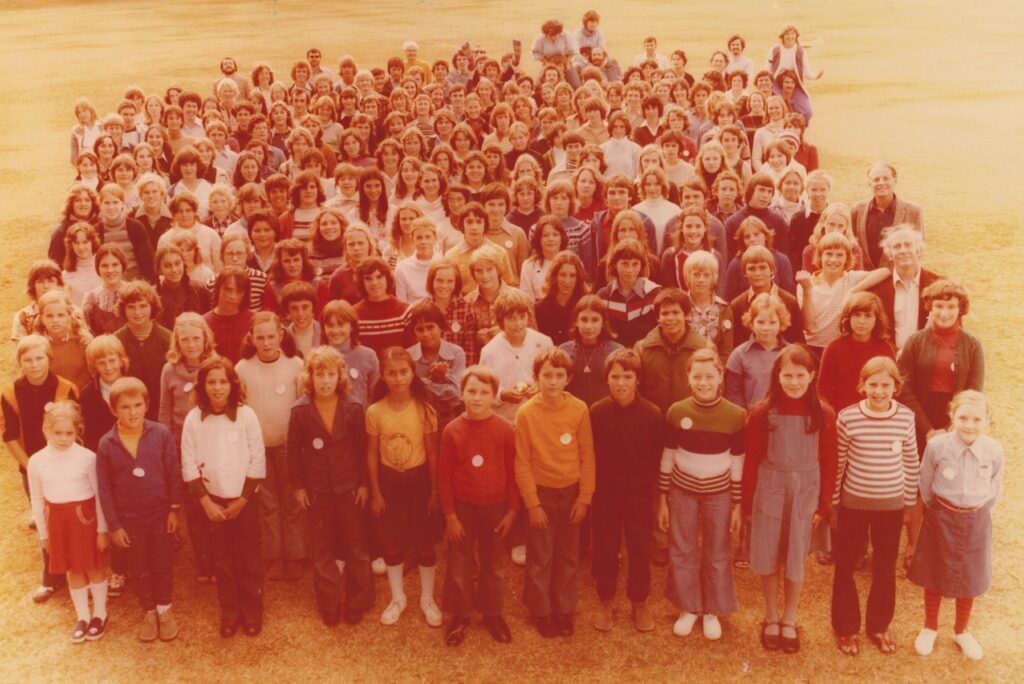
1977 NMCA Perth May Camp at MLC – Graham Wood third row, far right
May Camp at M.L.C.: Sonia Tunley, Catherine Hewgill, Graham and son Adrian

1979

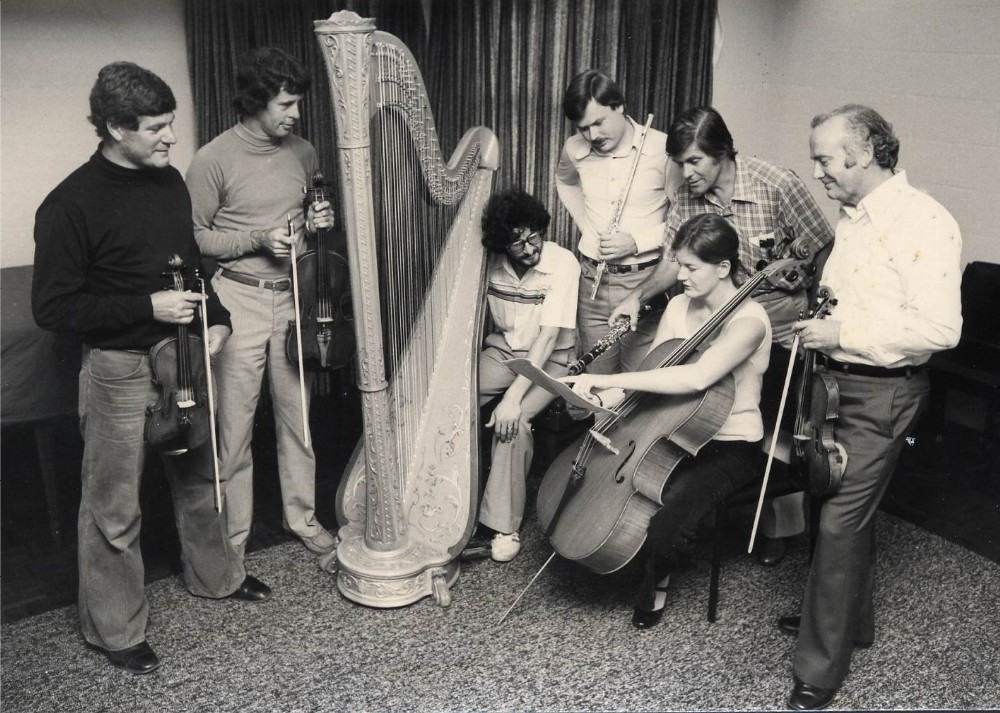
Graham Wood led the Wigmore Ensemble a flexible chamber group comprising members of staff as well as other leading local and visiting instrumentalists.

Wigmore Ensemble: Ashley Arbuckle, John Dean, Anthony Maydwell, Neil Fisenden, Jack Harrison, Jill Cole (nee Heady), Graham Wood.

Chamber Group off to a Good Start – By Derek Moore Morgan – 23rd April 1979 The recently formed Wigmore Ensemble made its first public appearance last night with a delightfully varied program at the Octagon Theatre. A flexible group with no fixed numbers, it has the practical advantage of being able to present music of widely different genres some of which inevitably gets left on the shelf because it doesn’t quite fit a specific mould such as the string quartet or Trio.  This was a University of W.A. music Society recital. The performers were Graham Wood and Ashley Arbuckle (violins), John Dean (viola), Jill Cole (cello), Neil Fisenden (flute), Jack Harrison (clarinet) and Anthony Maydwell (harp). The final item, Ravel’s atmospheric and beautifully crafted “Introduction and Allegro” brought all the players together to produce a nice degree of sonority and delicacy capturing much of the subtlety of the masterpiece.  Starting with the Mozart Quartet for Flute and Strings in D major a mellifluous example of the composer’s earliest style, the players gave us a bright indication of the bubbling and effervescent Gatty of the Rondo finale.  The British composer Frank Bridge, himself a viola player, wrote a whole body of telling string music.  His little known Trio (Rhapsody) from 1928 proved to be a forward looking piece for the difficult unless usual combination of two violins and viola, with mysterious opening and closing sections surrounding an energetic central portion. The Italian composer Malpiero’s “Sonata a cinque” (1936) is an appealing piece of writing which hangs on the air like a haunting elergy. Anthony Maydwell’s expressive harp playing came to the fore here.  The Quartet for clarinet and strings by Rawsthorne is another piece of chamber music which is deftly written and manipulates varying moods. Jack Harrison’s neatly inflected clarinet tone was well handled.


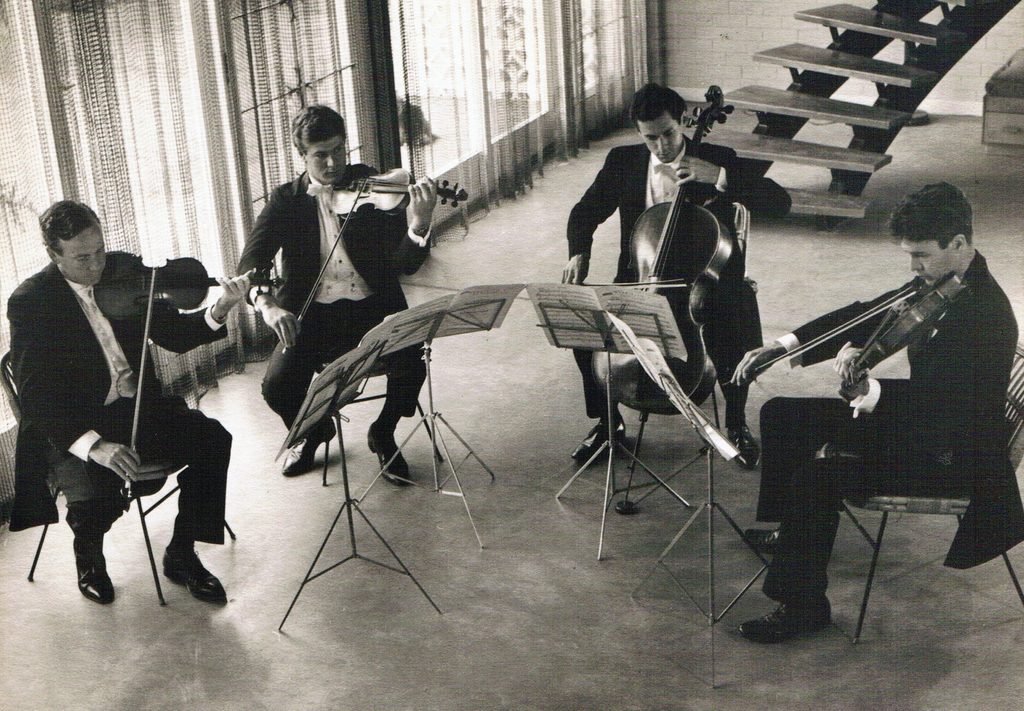
Graham Wood was the leader of the Oriel String Quartet and the University of Western Australian String Trio.

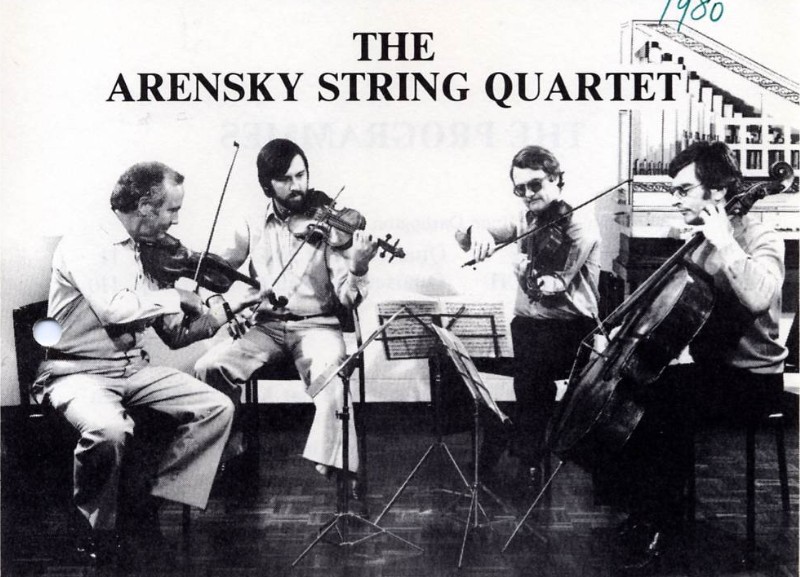
Also the Arensky String Quartet which changed its name to the Western Australian String Quartet in 1982.  

Graham Wood, Alan Bonds, Berian Evans and Gregory Baron.
Musica Antiqua in period costume; Lyn Tilsed on harpsichord


 Graham served as National Music Camp Director in 1979 and 1980 and was a tutor at many other National Music Camps. He was conferred as an AYO Life Member in 2006 in recognition of his dedication to music education.


Graham spent 24 years as the WASO’s associate concertmaster. The orchestra said of his passing: 

’Graham will be remembered for his extraordinary artistry, beautiful tone, and wonderful sense of humour. Beyond the stage, Graham helped to shape WA’s music community through his dedication to teaching and mentoring, inspiring generations of violinists, including members of our Orchestra today.’


In 1974, Wood co-founded the Western Australian Youth Orchestra, for which he was most recently vice patron. The orchestra wrote on the social media: ’His enduring legacy has profoundly influenced the orchestral and artistic communities of Western Australia across multiple generations.’

Vale Graham Wood OAM


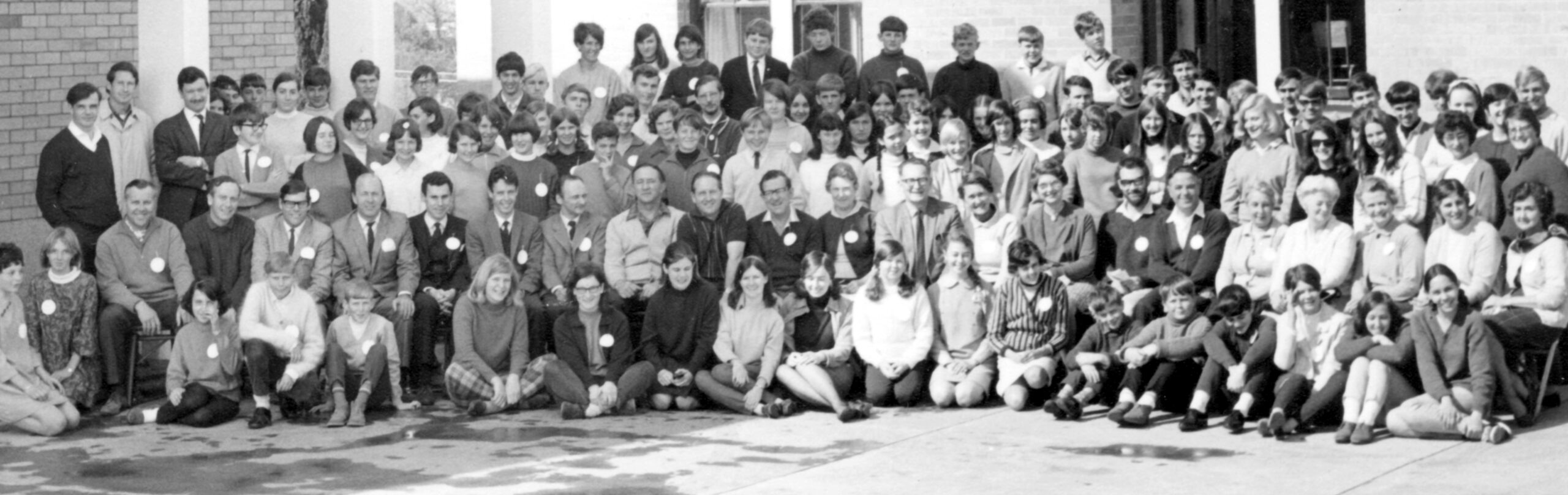
Graham Wood participated in the Australian Youth Orchestra’s (AYO) original National Music Camps from 1949 to 1954. He later served as National Music Camp Director in 1979 and 1980 and was a tutor at many other National Music Camps.  He was conferred as an AYO Life Member in 2006 in recognition of his dedication to music education.

The CEO of the AYO said of Wood: ‘His impact on music and music education will continue to inspire and benefit future generations.’ He reminisces:

I was involved  in the annual National Music Camps. My further drives east were usually to attend a Music Camp, now as a violin tutor. At this time the Camps were still held at Geelong Grammar School or St. Peters College in Adelaide. The founders of the organisation were still going strong. Ruth Alexander, John Bishop and Percy Jones, with Ron Maslyn Williams had established a tradition, which lasted for many years. The organization grew, evolving in the 21st century into the highly renowned Youth Music Australia. In the sixties students still slept in dormitories, assembled all together in the school refectory and sang grace at meals. There were strict lights out times and tight codes of behaviour. But everyone had [and still do have] a wonderful time. The staff received a tiny stipend, which only partly paid one’s drink bill, but we didn’t mind. These days they are paid professional rates for their time. One of the principal pleasures for us staff members was meeting with other musicians from all over the country, hearing the latest gossip and playing chamber music together. I continued my involvement with Music Camps for many years and in many differing roles – as conductor, Camp Director, member of the Board etc. My enthusiasm for the Music Camp movement stemmed from my own experience as a student, an experience which I’ve seen mirrored in hundreds of later Campers, an excitement and stimulation about music making which led me to the decision that being a musician was exactly what I wanted to do with the rest of my life.


His pivotal role as an educator also included his work as an examiner for the Australian Music Examinations Board, where he continued to work until 2022. He also adjudicated many of WA’s string competitions for young players. 


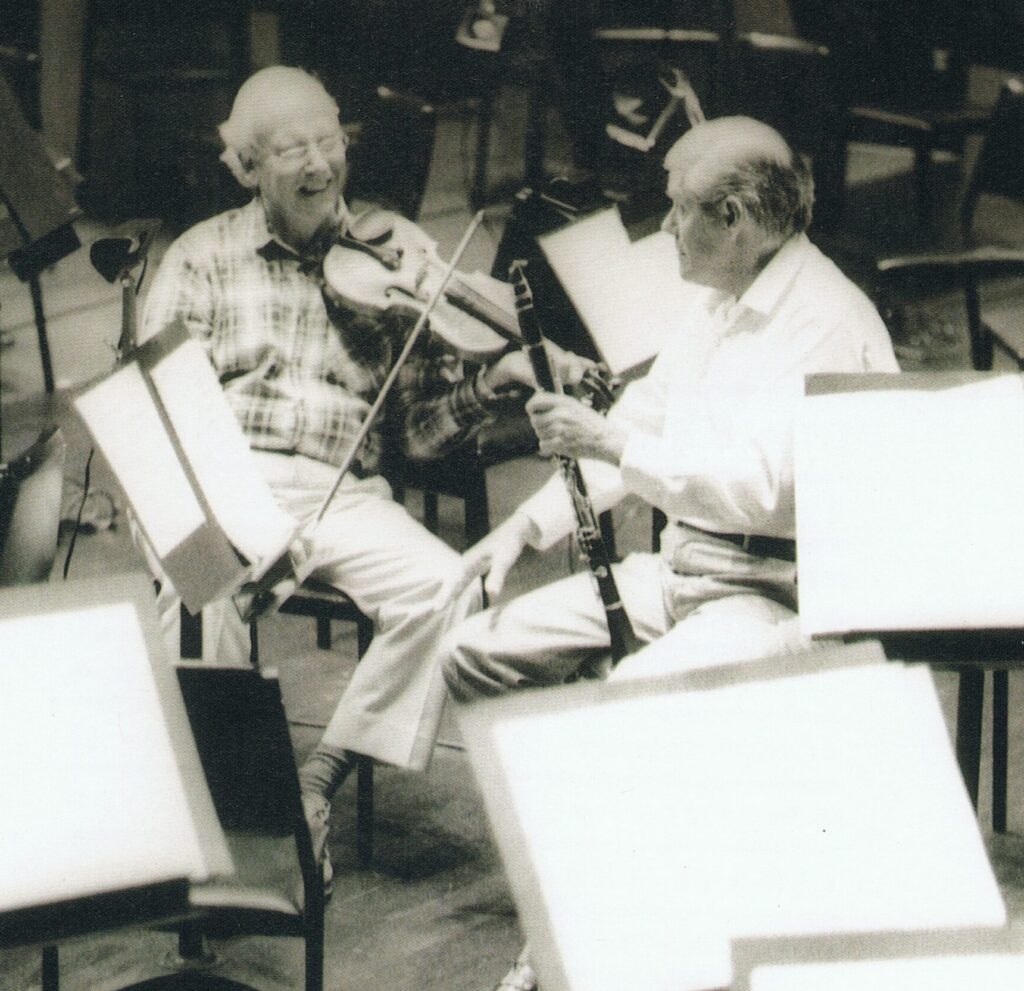
Graham composed a clarinet quintet which was premiered by Jack Harrison.

QUINTET FOR CLARINET AND STRINGS – 1966 MUSIC LOVER’S DIARY

The Oriel String Quartet, of which Ashley Arbuckle is a member, will combine with clarinettist Jack Harrison to give a recital for the Kylie Music Club in the Skinner Galleries at 8.15pm on May 8.  The programme will include Graham Wood’s Quintet for Clarinet and Strings.  Proceeds will go to the W.A. Music Bursary Trust Fund.

The Chamber Music Society and the Kylie Music Club will hold a combined recital in the Skinner Galleries at 8.15 tomorrow.  The Oriel String Quartet, of which Ashley Arbuckle is a new member, will be joined by clarinettist Jack Harrison in a concert.  The proceeds will go to the W.A. Music Bursary Trust Fund.  The programme will include Graham Wood’s Quintet for Clarinet and Strings.  Mr Wood and Mr Arbuckle are beginning to make their marks as composers.  Both are new Bachelors of Music.  The Chamber Music Society welcomes guests at it s musical evenings and aims to have 150 to 200 members this year.  The Kylie Club is also seeking new members.


May 8th 1966 – RECITAL WILL AID FUND – By Sally Trethowan

The Kylie Music Club and the Chamber Music Society combined their monthly meetings last night in a special program in the Skinner Galleries to aid the W A. Music Bursary Trust Fund. The Oriel String Quartet played works by Haydn and Brahms and with clarinettist Jack Harrison performed a quintet for clarinet and strings by the Oriel’s leader Graham Wood.  Mr. Wood has much to say in his music and he communicates it in an idiom easily comprehended by even the conservative in the audience. His quintet is tightly constructed and the music, even in the scherzo’s taut rhythms, is romantic and appeals strongly to the listener’s emotions. The clarinet role is conceived as a solo song threading the string texture. Jack Harrison last night gave this part an eloquent reading especially in the wistful soliloquy that opens and concludes the work.  

8.5.1966

Graham Wood

Quintet for Clarinet and Strings WORLD PREMIERE

Jack Harrison (clarinet)  

Oriel String Quartet

Skinner Galleries
Kylie Music Club
Western Australia

https://www.australianmusiccentre.com.au/artist/wood-graham

Graham continued tutoring, composing, and studying music well into his eighties.


On 24 September 2005, Australian violinist and educator Graham Wood OAM died at age 95. Throughout his career, he was a highly influential and dedicated member of the Australian musical community, not only as a violinist but also as a passionate educator who shaped the development of string playing and teaching in Western Australia (WA).

https://www.thestrad.com/news/influential-australian-violinist-and-educator-graham-wood-dies/20290.article

https://theviolinchannel.com/australian-violinist-graham-wood-has-passed-away/

Vale Graham Wood, violinist and educator

He and his wife Patricia had three children: Adrian, Martin (dec) and Imogen.


Instruments

Years