Search names, events, places, organisations, and sources across the archive.
Person
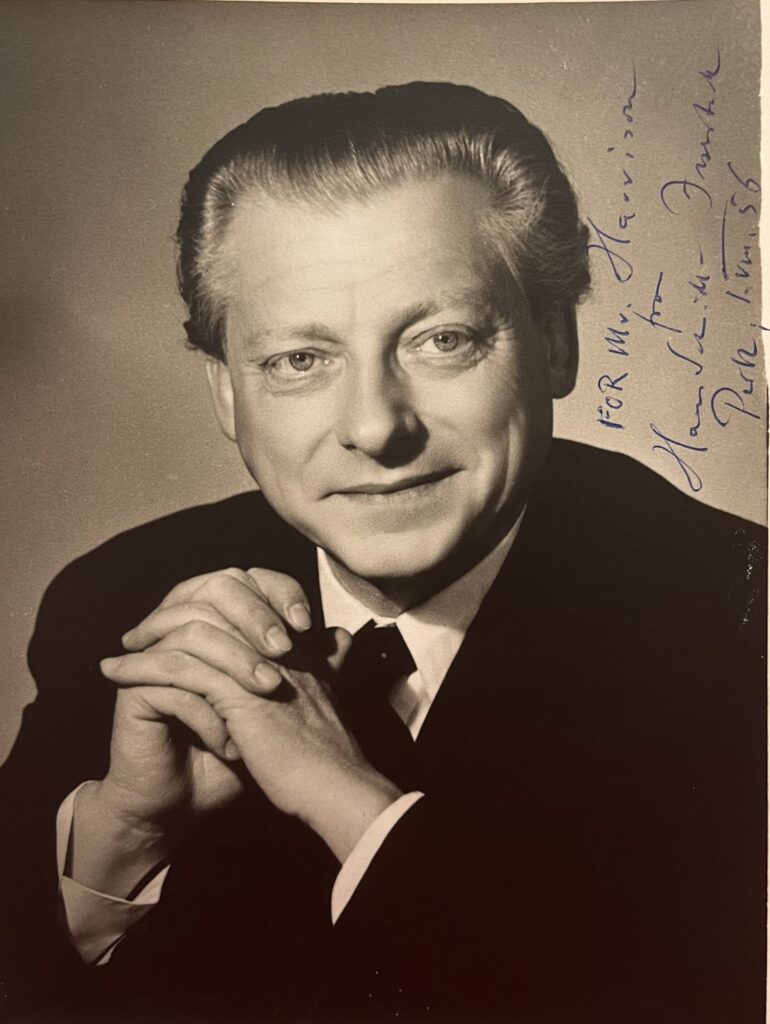
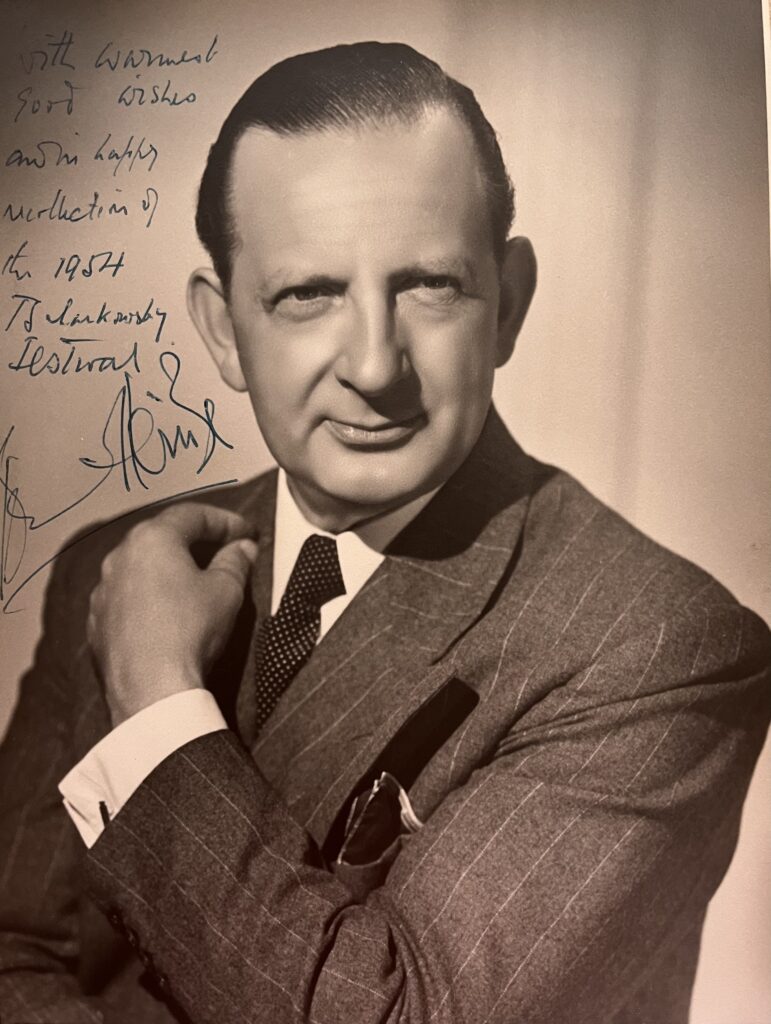
SCHMIDT-ISSERSTEDT, Hans
Hans Schmidt-Isserstedt (5 May 1900 – 28 May 1973) was a German conductor and composer. After studying at several music academies, he worked in German opera houses between 1923 and 1945, first as a répétiteur and then in increasingly senior conducting posts, ending as Generalmusikdirektor of the Deutsche Oper Berlin.
After the Second World War, Schmidt-Isserstedt was invited by the occupying British forces to form the Northwest German Radio Symphony Orchestra, of which he was musical director and chief conductor from 1945 to 1971. He was a frequent guest conductor for leading symphony orchestras around the world, and returned to opera from time to time, including appearances at Glyndebourne and Covent Garden as well as the Hamburg State Opera.
Schmidt-Isserstedt was known for his transparent orchestral textures, strict rhythmic precision, and rejection of superfluous gestures and mannerisms on the rostrum. His extensive recorded legacy features the Austro-German classics with which he was widely associated, but also includes works by Czech, English, French, Italian and Russian composers.
Joseph Mozart Post (1906-1972), musician, was born on 10 April 1906 at Erskineville, Sydney, eldest child of native-born parents John Anthony Joseph Post, law clerk, and his wife Annie Theresa, née Schadel. He grew up in a home rich in the traditions of amateur music-making. His mother was a talented chorister, and his father an enthusiastic conductor much involved with church choirs and suburban musical societies. Joe was regarded as a child prodigy. From about the age of 8 he provided the piano accompaniment at his parents’ musical gatherings. He attended the Christian Brothers’ parish school at Waverley, won a scholarship, and was among the first students at the New South Wales State Conservatorium of Music, opened under Henri Verbrugghen in March 1916. Post studied piano and oboe, acquiring enough proficiency on the latter instrument by the age of 15 to play with the New South Wales State Orchestra until it was disbanded in 1922. He then toured with theatre orchestras, visiting New Zealand in 1924 with one of J. C. Williamson Ltd’s musical-comedy companies.
By 1926 Post was teaching oboe and cor anglais at the conservatorium; later, he also offered tuition in piano. He graduated in 1927 with diplomas in performance and teaching (pianoforte). Despite such auspicious beginnings, he did not see his vocation as a teacher nor as an orchestral musician, but chose to build a career as a conductor. The elder Post gave his son extensive informal training in the conductor’s art. Joseph always regarded his father as his most important mentor and severest critic.
After valuable experience conducting the conservatorium’s chamber orchestra and the choir at St Brigid’s Catholic Church, Coogee, Post seized an opportunity in 1932 to organize a 350-voice choir for the Imperial Opera Company (a touring Italian troupe) to perform in the Williamson Imperial Grand Opera Season. When the regular conductor became indisposed, Post conducted a performance of Aida at only a few hours notice, which led to regular conducting appearances with the company.
The establishment of the Australian Broadcasting Commission in 1932 introduced a powerful new force to the Australian music scene. Post astutely recognized the potential of radio and accepted an offer from the A.B.C. to form a wireless chorus in Sydney. He severed his connexion with the conservatorium, did some conducting with Sir Benjamin Fuller‘s Royal Grand Opera Company and visited Europe in 1935. Returning to Australia, he moved to Melbourne. From 1936 to 1947 he worked for the A.B.C. as a conductor of the Victorian Symphony Orchestra and the city’s A.B.C. wireless chorus.
Post was commissioned lieutenant and mobilized in the Australian Army Service Corps, Militia, on 24 August 1940. Transferred to the Australian Imperial Force in July 1942, he was promoted temporary major in the following month and made commandant of the transshipment centre at Terowie, South Australia, an important staging point on the overland supply route to Darwin. He relinquished command in February 1945 and was placed on the Reserve of Officers in March. At St Patrick’s Cathedral, Melbourne, on 12 May 1943 he had married Nancye Lille Tucker, a 28-year-old stenographer.
After World War II Post continued as one of the A.B.C.’s chief conductors. From 1947 to 1957 he was associate-conductor with the Sydney Symphony Orchestra, a term that virtually coincided with (Sir) Eugene Goossens‘s period in charge. Post made many guest appearances with A.B.C. orchestras across Australia. In 1950 he went to Britain on exchange with Charles Groves, conductor of the British Broadcasting Corporation’s Northern Orchestra. At his début at the Royal Albert Hall, Post became the first Australian to conduct at a Promenade Concert; he included a piece by the Australian composer Clive Douglas. He also conducted the Hallé and other British orchestras. At his final concert with the Northern Orchestra, crowds filled the hall and flowed outside.
Despite such successes, Post’s career with the A.B.C. was marred by disappointment. In 1945 he had submitted a proposal to the A.B.C. to establish the Victorian Symphony Orchestra on a full-time basis, but he was twice overlooked for the position of principal conductor. He made no secret of his chagrin when he was not appointed director of music in 1957. Throughout his long tenure with the A.B.C., he never relinquished his involvement with his first love, opera. He was musical director (1947-54) of Gertrude Johnson‘s National Theatre Movement and principal conductor (from 1949) for its opera. In addition, Post also conducted seasons with the New South Wales National Opera in Sydney, and joint seasons of the combined opera companies in 1952. Granted leave from the A.B.C., he was appointed musical director of the Australian Elizabethan Theatre Trust in 1955. He conducted the trust’s first opera production, The Marriage of Figaro, in 1956, but resigned next year to return to the A.B.C. as assistant-director of music.
Heavier administrative responsibilities did not significantly curtail the number of Post’s performances. In 1963 he established the Sydney Little Symphony Orchestra and conducted its début series of four concerts. He also continued his long association with school concerts. The advent of television broadcasting created new audiences for him. He made television appearances with the S.S.O. and conducted numerous operas on television. In 1962 he travelled to Europe and the United States of America to investigate methods of presenting music on television.
At a time when most Australian classical musicians depended on success abroad, Post built a public career in Australia. He and Sir Bernard Heinze represented the first generation of native-born conductors to rise to prominence under the A.B.C. Post conducted when an Australian was required to support visiting celebrity musicians. The role suited his talents admirably. He was proud of his efforts to promote ‘Australian’ composers, releasing recordings of Raymond Hanson‘s Concerto for Trumpet and Orchestra (1948) and Robert Hughes’s Xanadu (1954). Nor was he averse to the performance of ‘new music’, though his tastes could hardly be regarded as avant garde.
In 1966 Post was appointed O.B.E. That year he succeeded Heinze as director of the New South Wales State Conservatorium. He was its first diplomate to fill the position. Although reluctant to take the job, he put considerable effort into the conservatorium’s opera school, but limited his wider involvement to consolidating initiatives begun by Heinze.
Post was a small, spry man with an alert demeanour and an acerbic tongue. He had many interests beyond the music world, being fond of sport (especially golf and lawn bowls), gardening (particularly cultivating camellias) and cooking. A passionate ‘do-it-yourself’ home handyman (who whittled his own batons from English birch), he had an intensely practical approach to life. Post preferred to talk about anything but music, and always insisted that his favourite composer was the one ‘whose work I am playing at the moment’. Like many musicians, he had a strong sense of effort insufficiently rewarded. While he and his brothers John Verdi and Noel Schumann were propelled into careers as professional musicians, Joseph actively discouraged his only child Nola from any sort of musical training. Privately, he spoke of a vanquished desire to practise architecture.
Increasingly dogged by ill health, Post resigned from the conservatorium in late 1971 and moved to the Gold Coast, Queensland. He died of myocardial disease on 27 December 1972 at Broadbeach and was cremated; his wife and their daughter survived him. Although the family had Jewish connexions, Post had been raised in the Catholic faith and died devout in his atheism. He made an unrivalled contribution to the development of opera-conducting in Australia and was, in Roger Covell’s words, the ‘first Australian-born musician to excel in this genre’. As an orchestral conductor, he was judged a ‘good all-round man’: he was well-regarded for his enthusiasm, clarity and economy of gesture, but he was not associated with inspiring or challenging musicianship. None the less, his ability to take over conducting assignments at very short notice became legendary and was greeted with ‘rave’ reviews. Such was the case in 1955 when he substituted for Goossens at a day’s notice to conduct Max Rostal in Bartók’s Violin Concerto, a score with which Post was unfamiliar.
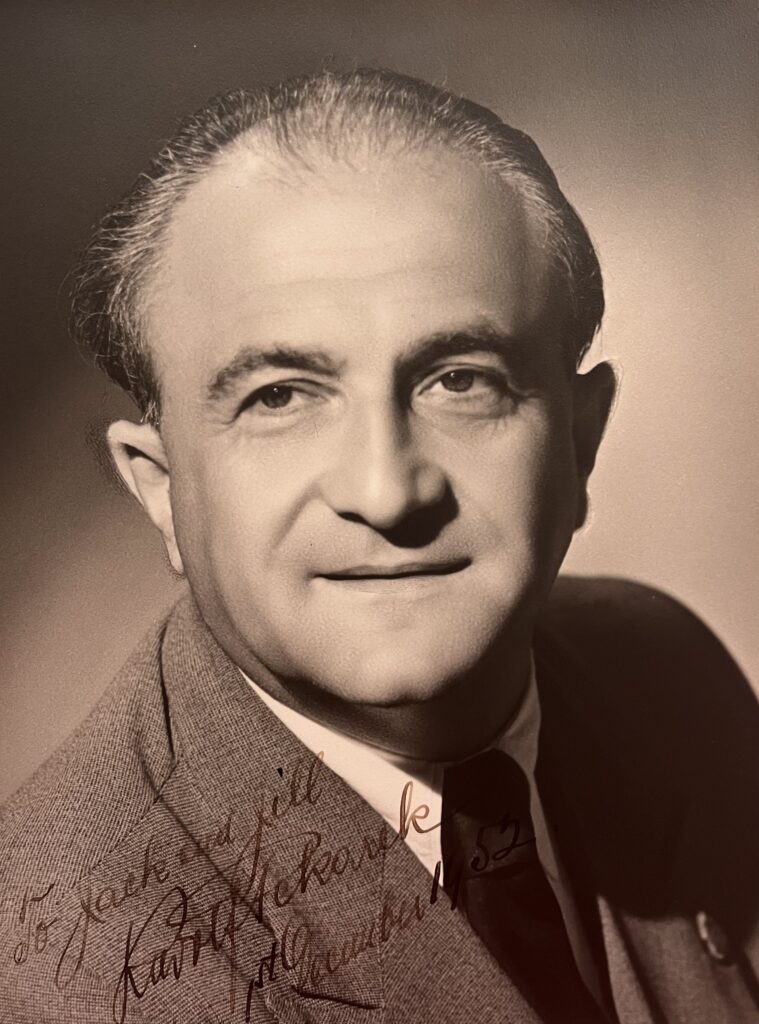
Rudolf Pekarek (1900 – 1974) was a conductor born in Czechoslovakia in 1900.
In 1934, he founded the Film, Opera, Koncert (FOK) Symphony Orchestra in Prague, which became the Prague Symphony Orchestra in 1952. Pekarek was its chief conductor until 1941.
That year he and his wife Terry (nee Gutmann) were deported to the concentration camp in Lodz (Litzmannstadt). In 1944 they were taken to Auschwitz, and were among the few survivors liberated from the camp in January 1945.
Pekarek joined the Czecho-Slovak army advancing west under the command of the Soviet army. He was the chief conductor of the Army Arts Ensemble from 1945 to 1947.
After returning to Prague and being reunited with his wife Pekarek was again conductor of the FOK Symphony Orchestra from 1947 to 1948.
The Pekareks migrated to Australia in December 1948. Pekarek was the resident conductor of the West Australian Symphony Orchestra from 1949.
In 1954 he became the chief conductor of the Queensland Symphony Orchestra. He retired from this position in 1967 but continued working as an occasional guest conductor with orchestras around Australia.
Sir Bernard Thomas Heinze, musician and conductor, was born on 1 July 1894 at Shepparton, Victoria, fourth child of Victorian-born parents Benjamin Heinze, jeweller, and his wife Minnie Frederica, née Greenwell. Both parents were amateur musicians who encouraged their children to follow their example. Educated at St Patrick’s College, Ballarat, Bernard became a pupil of Walter Gude, the founder of the local Lyric Orchestra. At 16 he won an Australian Music Examinations Board scholarship to the Melbourne University Conservatorium (MA, 1948). He was awarded the (Sir William) Clarke scholarship at the end of his first year, enabling him to study at the Royal College of Music, London, where his teachers included the violinist Achille Rivarda, the pianist Herbert Sharpe, and the composers Frank Bridge and Sir Charles Stanford.
World War I interrupted Heinze’s studies. Commissioned on 23 September 1915 in the Royal Garrison Artillery, he served on the Western Front and as an aide-de-camp to Major General Sir Herbert Guthrie Smith, the director of artillery. After being demobilised in 1920 he wrote music criticism for the London Saturday Review while completing his term as Clarke scholar. In 1920 the Gowland Harrison scholarship took him to the Schola Cantorum, Paris: he studied history and composition under its founder, Vincent d’Indy, violin with Nestor Lejeune, and solfège with G. De Lioncourt. Having a particular interest in orchestral techniques, he attended rehearsals of the Concert Coloune under Gabriel Pierné. In 1922 he toured southern Europe as a member of the Lejeune String Quartet, but left it after only a few months to study violin with Willy Hess in Berlin.
In 1923 Heinze returned to Australia, in part to adjudicate the South Street eisteddfod, Ballarat. The following year he joined the Melbourne University Conservatorium as teacher of violin. He rapidly gained prominence and supporters as conductor of the Melbourne University Symphony Orchestra and founder of the Melbourne String Quartet. In 1925 he succeeded William Laver as Ormond professor of music: `his energy is boundless’, Table Talk noted, `his ambition, the same’.
Heinze was committed to increasing the public performance of music, and to securing the professionalism of players. In 1925 he inaugurated free concerts for schools at which he lectured and conducted; he also introduced subscription series and, after a short visit to Europe in 1928, launched celebrity concerts, featuring many outstanding overseas performers. Already the conductor of the Royal Melbourne Philharmonic Society (1927-53), after a period of competition with Fritz Hart’s Melbourne Symphony Orchestra, in 1933 he amalgamated the USO with the effectively bankrupt MSO (Victorian Symphony Orchestra after 1949), remaining with it until 1956.
As a conductor, Heinze revealed his strength in the interpretation of the Romantics, from Beethoven to Tchaikovsky and Elgar; Richard Strauss, Mahler and Sibelius were also high on his preferred list. New music featured regularly in his programs: in 1929 he gave the first Melbourne performances of works by Percy Grainger, Rimsky-Korsakov and Borodin, and in 1933 the first Australian performance of Bruckner’s symphony in C minor. In 1931 he was made a fellow of the Royal College of Music. At Newman College chapel, University of Melbourne, on 6 July 1932, he married Valerie Antonia, daughter of Sir David Hennessy.
Heinze’s influence was greatly enhanced by his appointment in 1929 as part-time director-general of music to the Australian Broadcasting Co., and consolidated by his role from 1934 as part-time music adviser to its successor, the Australian Broadcasting Commission. In these positions he supervised performance of music for broadcast, co-ordinated educational concerts, and championed the ABC’s policy, adopted in 1936, of establishing professional symphony orchestras in each State. In 1938 he toured Europe and the United States of America to investigate the role of radio in promoting music, also conducting in Paris, Berlin, Budapest and Helsinki, and serving as a juror for the Concours Ysaÿe in Brussels (for which he was appointed to the Ordre de la Couronne).
Amid the stringencies of war, in 1941-45 the university agreed to release Heinze to act as chief resident conductor for the ABC’s celebrity concert seasons. In part through wartime necessity, he included Australian artists as soloists. Music could easily have stagnated in such a climate, but instead it flourished. While staging popular festivals featuring Beethoven’s and Russian music (in Melbourne and Sydney respectively, in 1944) and challenging audiences with a radical series of symphonies by Honegger, Heinze also featured works by Australian composers of `great promise’, Roy Agnew, (H. J.) Brewster Jones, Clive Douglas, Miriam Hyde and Robert Hughes among them.
Resuming his duties as Ormond professor early in 1945, Heinze remained a pervasive force at the ABC. In 1947, after a tour as guest conductor for the Canadian Broadcasting Commission (which was to lead to an honorary doctorate of laws from the University of British Columbia, 1947), he introduced to Australia the youth concert series that would shape the musical taste of a generation. He welcomed steady increases in subscriptions to orchestral series, devising innovative programs offering works by Shostakovich, Britten and Bartōk. Critics were sometimes uneasy with the dominance of his personality and occasional lapses in direction, but none the less welcomed the freshness he brought to both the podium and the audience. Some concerts, Kenneth Hince later recalled, were `careless’ but `none was dull’. If Heinze’s frequent absences from the university provoked questions, the conservatorium still benefited from his prestige and energy. During what he called his `golden years’ as director, it produced composers of the calibre of Donald Banks, James Penberthy and Peter Sculthorpe. Heinze was knighted in 1949; later that year he received an honorary doctorate of music from the University of Western Australia.
Tall, urbane, impeccably groomed and a noted raconteur with a carefully cultivated, mellifluous voice, Sir Bernard had, at least in public, a contagious enthusiasm and cheerfulness. In 1956 he resigned from the conservatorium and succeeded (1957-67) Sir Eugene Goossens as director of the New South Wales State Conservatorium of Music. With legendary restlessness he continued to travel extensively, promoting music. In a daring initiative given the political climate of the times, he undertook a conducting tour of the Soviet Union and Eastern Europe in 1958. Across Australia audiences continued to adore him; his players, however, generally considered him dictatorial, anti-female, and someone to be feared. His extensive influence ensured that a word in the right quarter could make or break a career.
Heinze had always drawn much power from his control of strategic committees, through chairmanship or sheer gamesmanship. Beyond the ABC, these included service as a representative of education in music on the Victorian Council of Public Education (1936-57), as a close associate of the AMEB, as vice-patron of the Arts Council of Australia, Victorian division, and as an active member and international representative (Belgium, 1953) of the Australian National Advisory Committee for the United Nations Educational, Scientific and Cultural Organization. In Sydney, and with expanding public support for the arts, new opportunities arose. He served as vice-patron (1955-65) of the Arts Council of Australia, New South Wales division; on the executive committee (1957-66) and later as a trustee of the Sydney Opera House; and as foundation chairman of the advisory board of Commonwealth Assistance to Australian Composers (1967), and the music advisory committee of the Australian Council for the Arts (1968).
Without doubt the dominant musical figure of twentieth-century Australia, Heinze raised and maintained national musical standards, providing an unparalleled example of leadership to the profession. He thought of music in nineteenth-century `high art’ terms, seeing it as a moral good to which the community should aspire while using contemporary means to ensure that outcome. He also gained recognition for music teaching as an accredited profession in schools. As Felix Werder noted, Heinze `was not simply another curator-conductor, he was godfather to the Australian composer’. The fiftieth anniversary of his first public appearance as conductor was celebrated at the Melbourne Town Hall in 1974. He was named Australian of the Year in 1975, appointed AC in 1976 and in 1979 became the first Australian to receive UNESCO’s International Music Council award.
Fit and active well into his eighties, Sir Bernard Heinze remained a keen gardener and collector. He died at Bellevue Hill, Sydney, on 10 June 1982, survived by his wife and their three sons. Following a requiem Mass at St Peter’s Catholic Church, Toorak, at which Fauré’s Requiem was sung, he was buried in Brighton cemetery, Melbourne. He left behind an immense legacy, securing for serious music a permanent place in Australia, not as a remote European inheritance but as the ancestral house in which Australians could live and grow. In 1957 a portrait by Paul Fitzgerald was presented to the university conservatorium, and in 1975 the ABC televised a biographical feature, `The Bernard Heinze Story’. An annual award in his name, established in 1985, is given in recognition of an outstanding contribution to music in Australia.
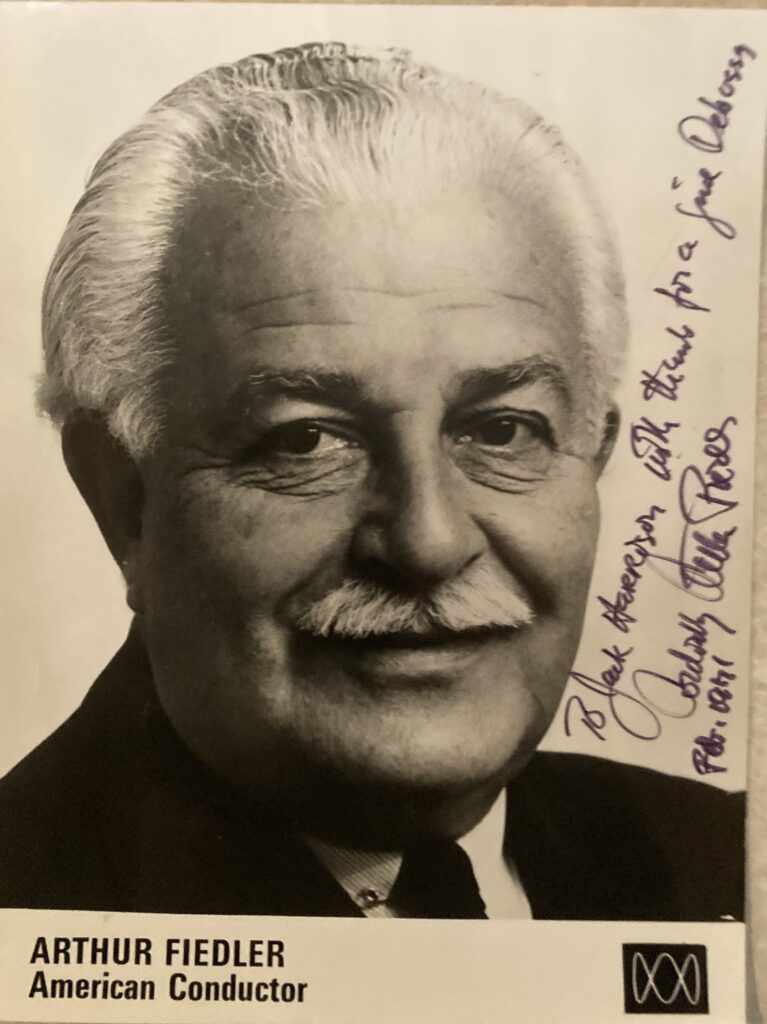
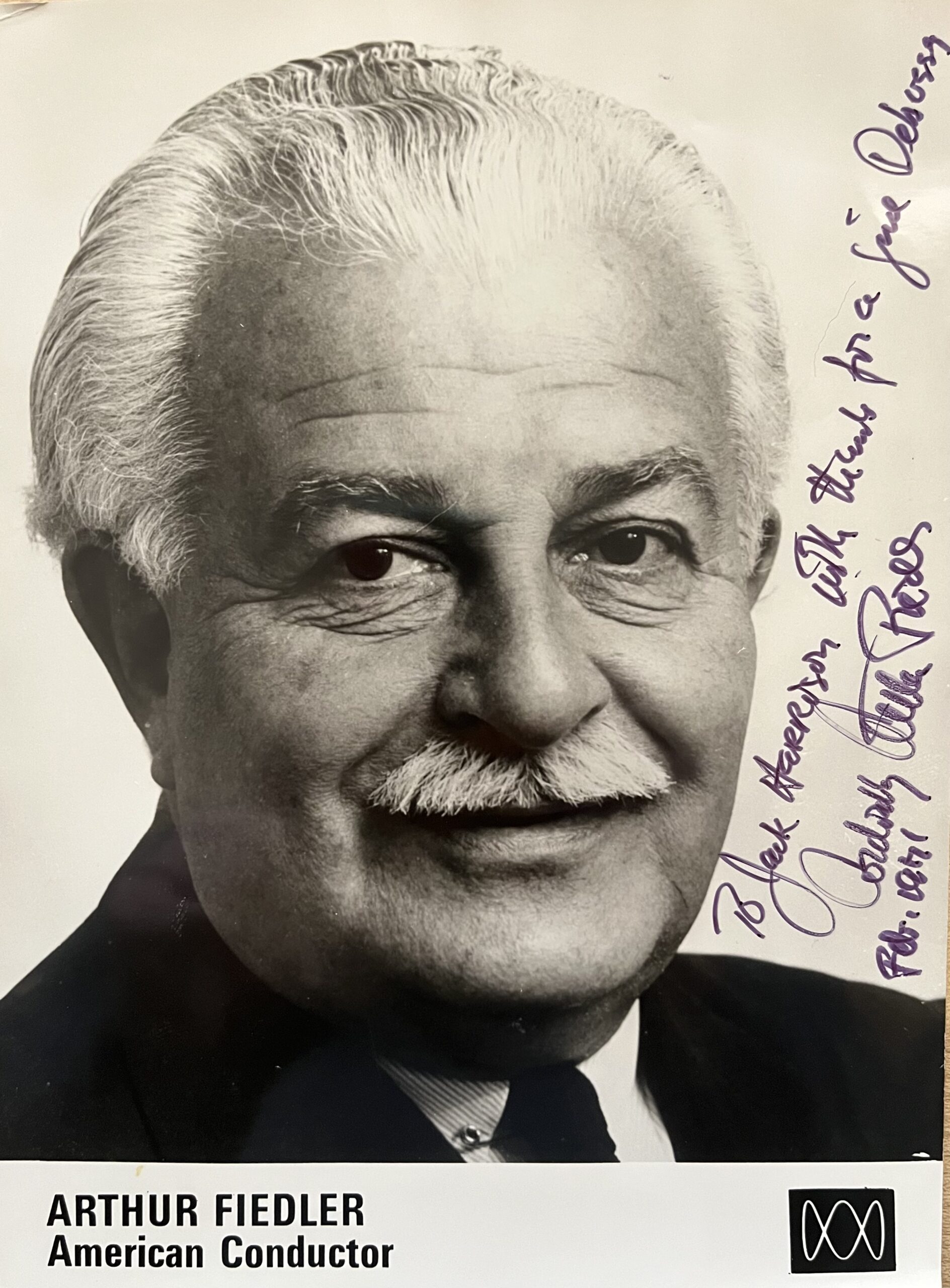
Arthur Fiedler (born December 17, 1894, Boston, Massachusetts, U.S.—died July 10, 1979, Brookline, Massachusetts) was an American conductor who was maestro of the Boston Pops Orchestra for 50 seasons and the best-selling classical conductor of all time; his recordings with the Pops sold some 50,000,000 discs. (The Boston Pops Orchestra is the Boston Symphony minus its principal players.) Fiedler, whose principal aim was “to give audiences a good time,” led the Pops in performances of popular tunes, show music, and classics.
From 1911 to 1915 Fiedler studied violin, piano, and conducting at the Royal Academy of Music in Berlin before joining the Boston Symphony as a member of the second violin section. He played in the viola section from 1918 to 1930. He also was proficient on the celesta, piano, and organ. Fiedler organized the Arthur Fiedler Sinfonietta (1924), a chamber symphony, when he was refused the conductorship of the Pops. In 1929 he organized the Esplanade concerts, in which symphonic music was played outdoors in Boston for the first time. In 1930 he became conductor of the Pops, a post he held until his death in 1979.
Fiedler, Arthur Arthur Fiedler conducting the Yomiuri Nippon Symphony Orchestra, 1967.
As conductor of the Boston Pops, Fiedler developed a varied and light-hearted repertoire that struck a responsive chord with the public. He excelled at adapting popular dance music and other songs to performance by a symphonic orchestra. Fiedler was viewed by many critics as a highly able technician and a superb showman rather than as a first-rate interpreter of classical music, however.
FESTIVAL OF PERTH – ARTHUR FIEDLER – TUESDAY FEBRUARY 16 1971
Arthur Fiedler the internationally famous conductor of the Boston Pops concerts will conduct the West Australian Symphony Orchestra for two concerts during the Festival. The concerts should be known as Fiedler concerts, will be held at Winthrop Hall on Saturday, February 13 and Tuesday, February 16. Mr Fiedler’s connection with the Boston Symphony Orchestra goes back to 1915 when he joined it as a violinist. In 1930 he was appointed the 18th conductor of the Boston Pops concerts a feature of Boston musical life since 1885. Record sales which have helped to make the Boston Pops Orchestra famous now total more than 47 million. Mr Fiedler will be appearing by arrangement with the Australian Broadcasting Commission. Soloists at the Fiedler concerts will be David Bollard and clarinet and harmonica player Jack Harrison who is a Churchill fellowship winner for 1971.
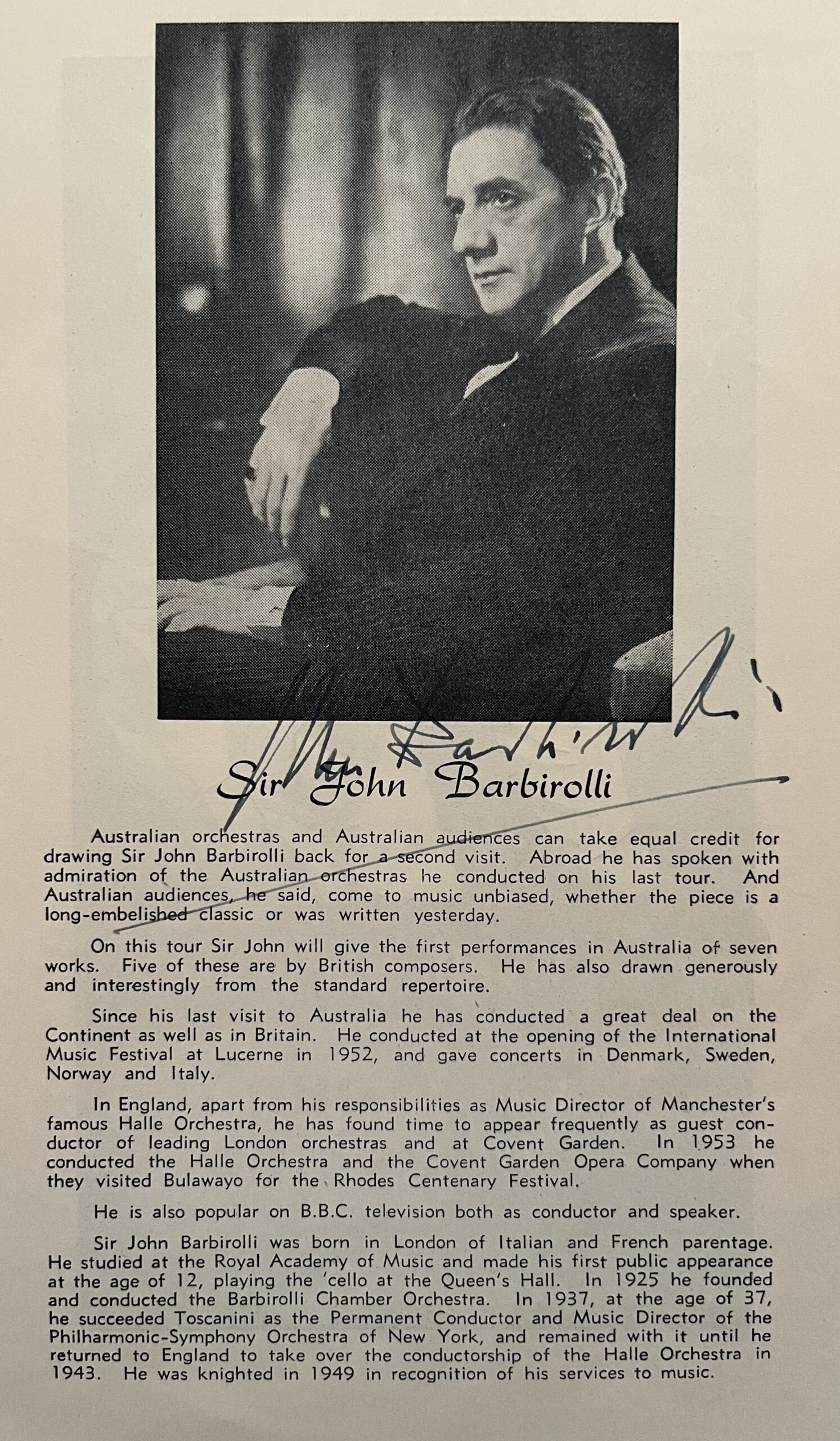
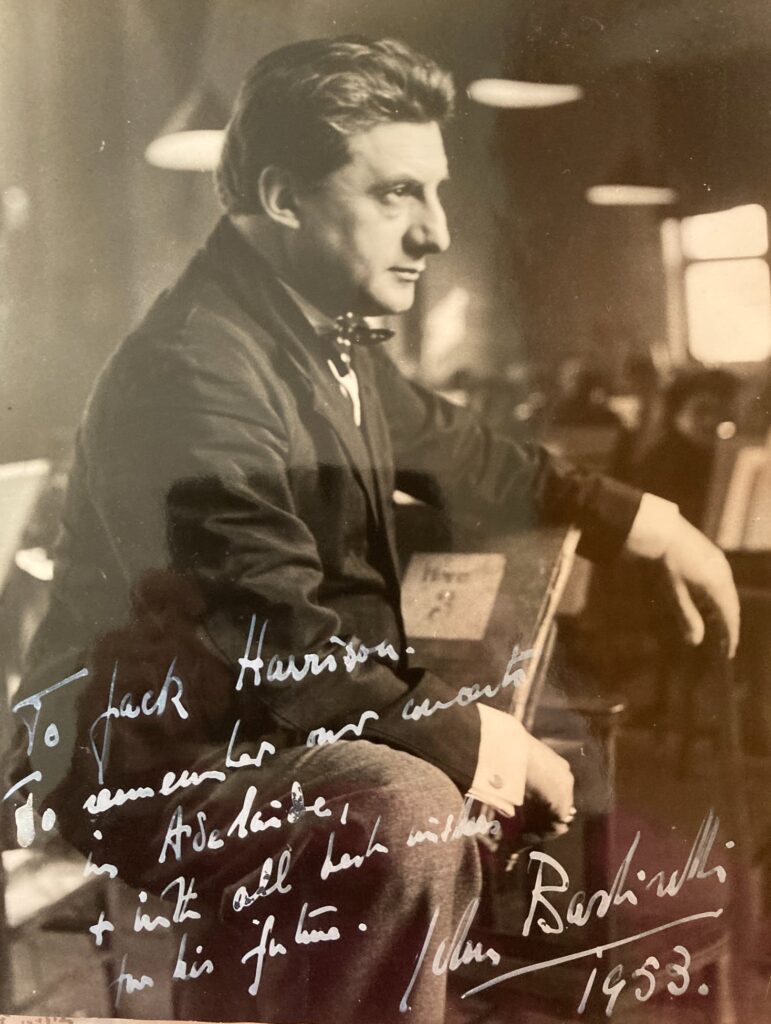
Sir John Barbirolli (born Dec. 2, 1899, London, Eng.—died July 29, 1970, London) was an English conductor and cellist.
Barbirolli was the son of an émigré Italian violinist and his French wife. He began playing the violin when he was 4 (later switching to the cello) and, at the age of 10, became a scholar at the Trinity College of Music. He attended the Royal Academy of Music from 1912 to 1916 and established himself as an orchestral and solo cellist. During his mid-20s he devoted himself to chamber work. He then turned to opera as a full-time conductor, taking seasons at Covent Garden and Sadler’s Wells and making appearances at the British National Opera. He also conducted with the London Symphony Orchestra and the Scottish Orchestra. Invited for the 1936–37 season of the New York Philharmonic, he won the permanent post of music director in succession to Arturo Toscanini and held it through that organization’s memorable centenary season, 1941–42.
His subsequent appointments included conductorships (1943–70) with the Hallé Orchestra in Manchester, Eng., where he gained international recognition as a conductor. A decade of deteriorating health did not prevent him from continuing guest conducting, recording, and worldwide touring with major orchestras. He was principal conductor for the Houston Symphony Orchestra (1961–67) and was a favourite guest conductor with the Berlin Philharmonic Orchestra (1961–70). He was knighted in 1949.
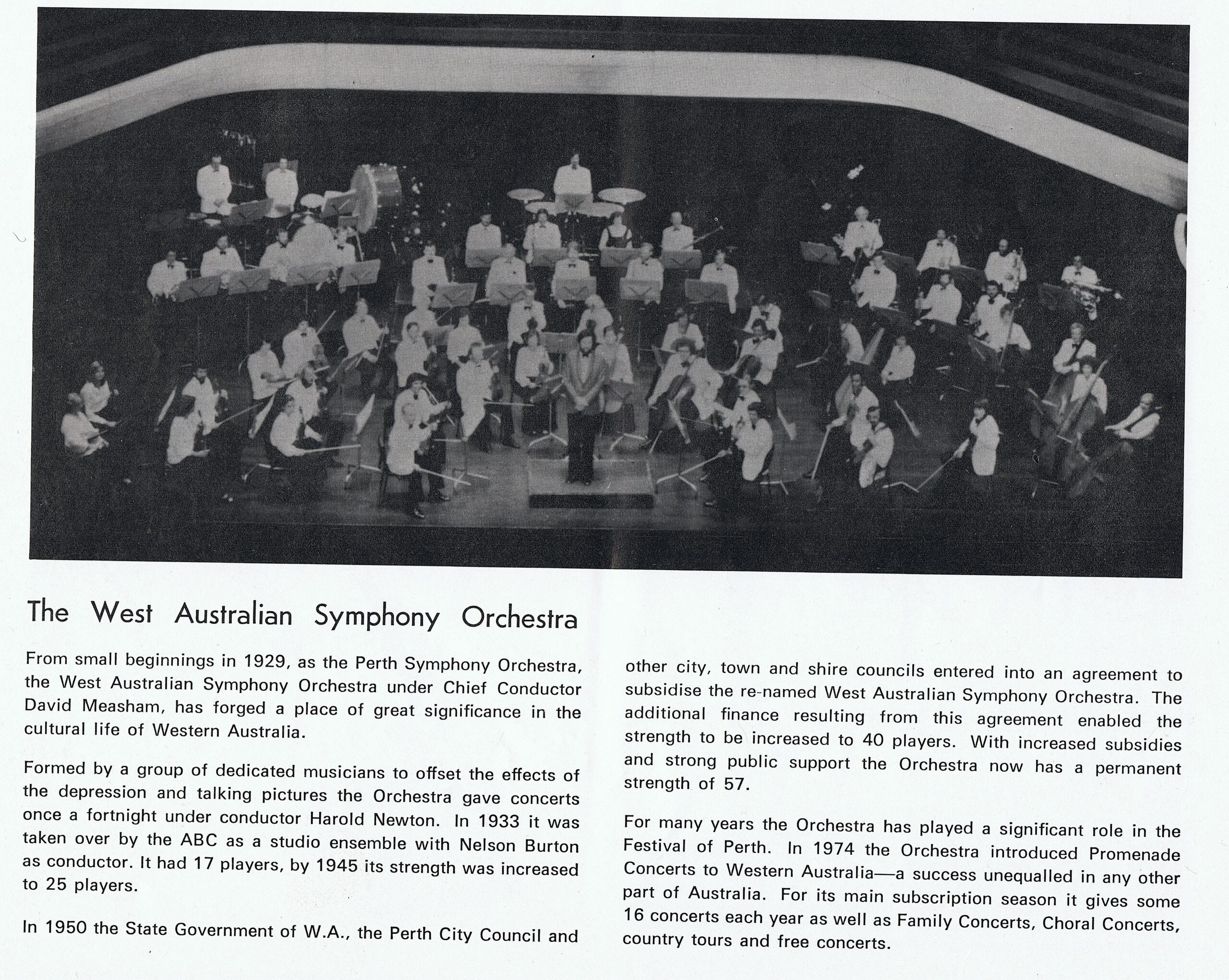
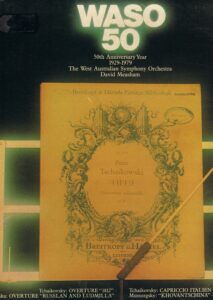
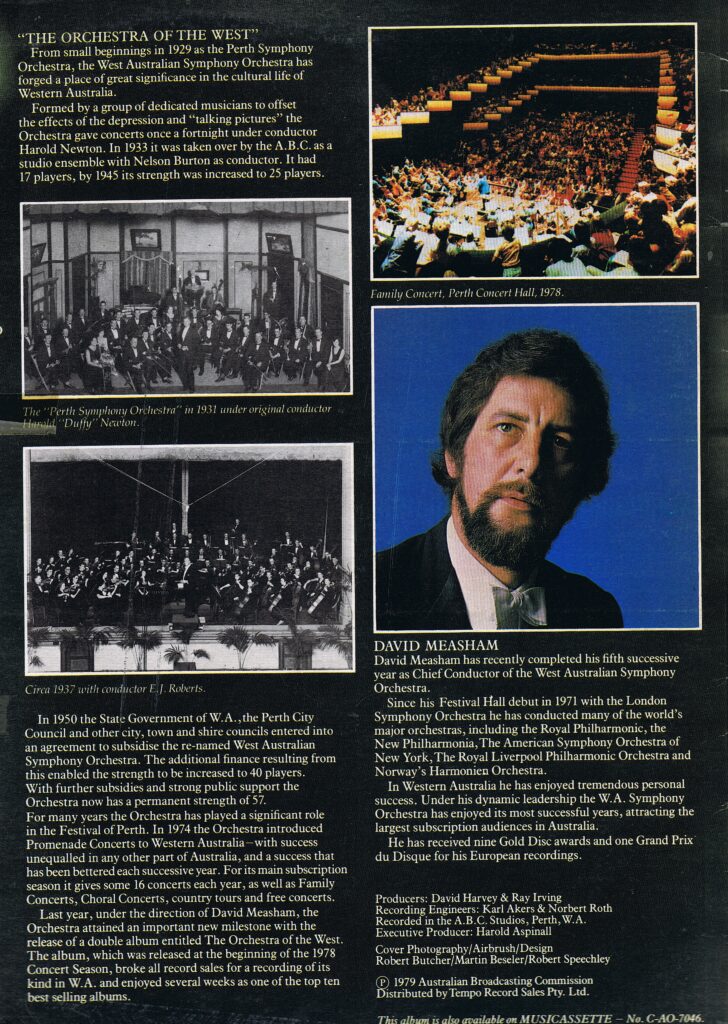
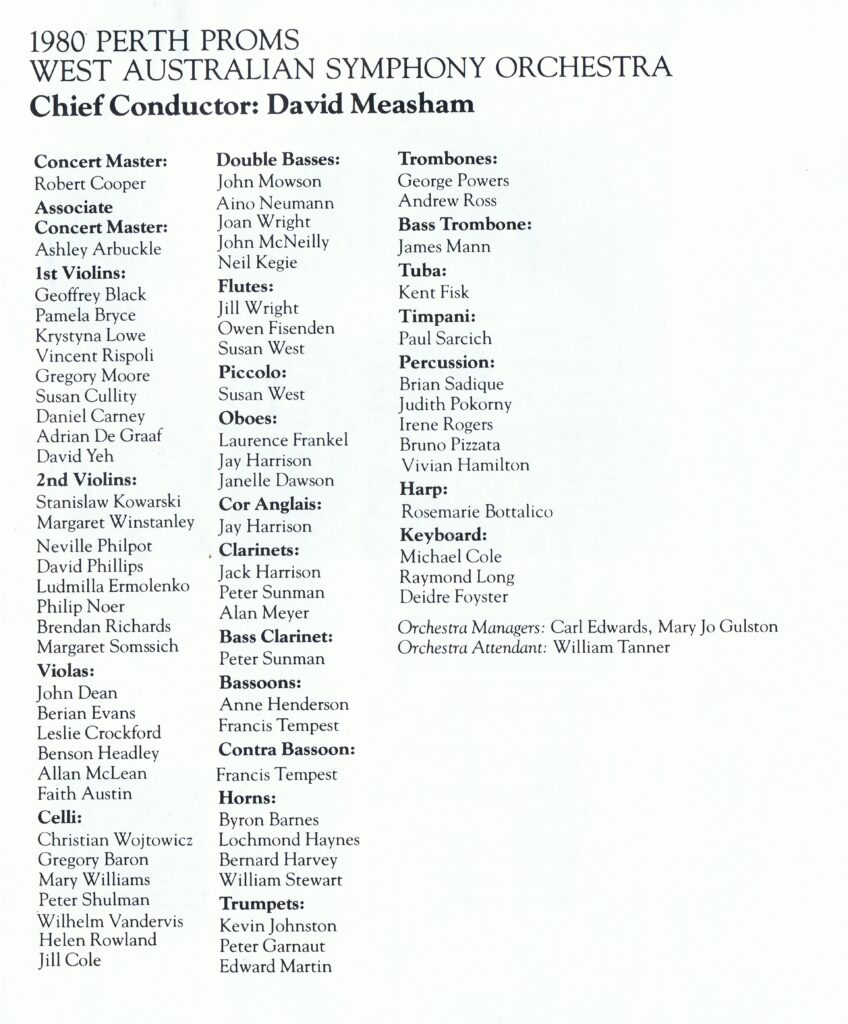
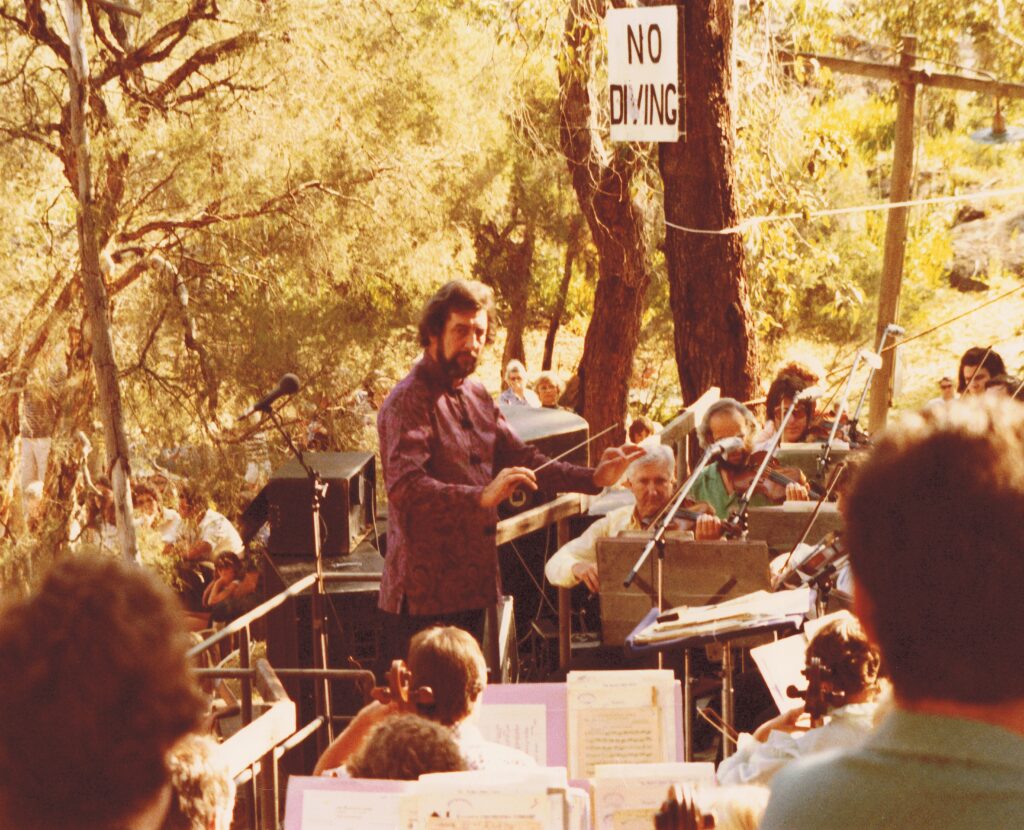
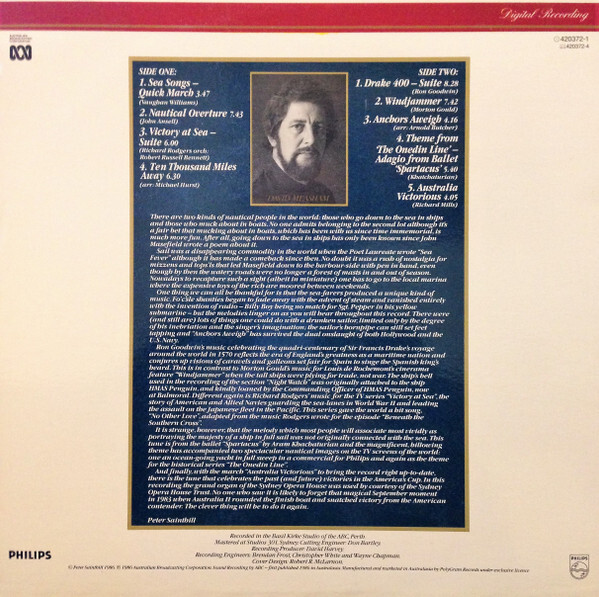
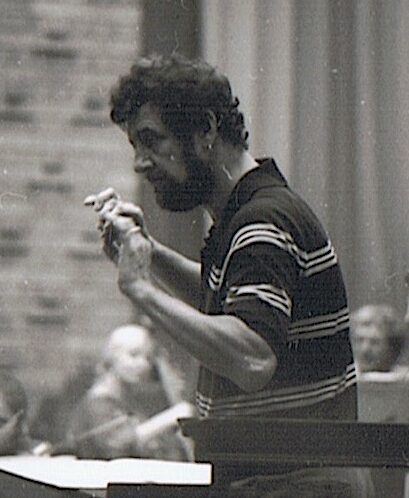
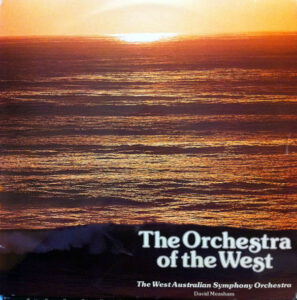
David Measham was principal conductor of the West Australian Symphony Orchestra from 1974-81, and its principal guest conductor 1981-86.
1975
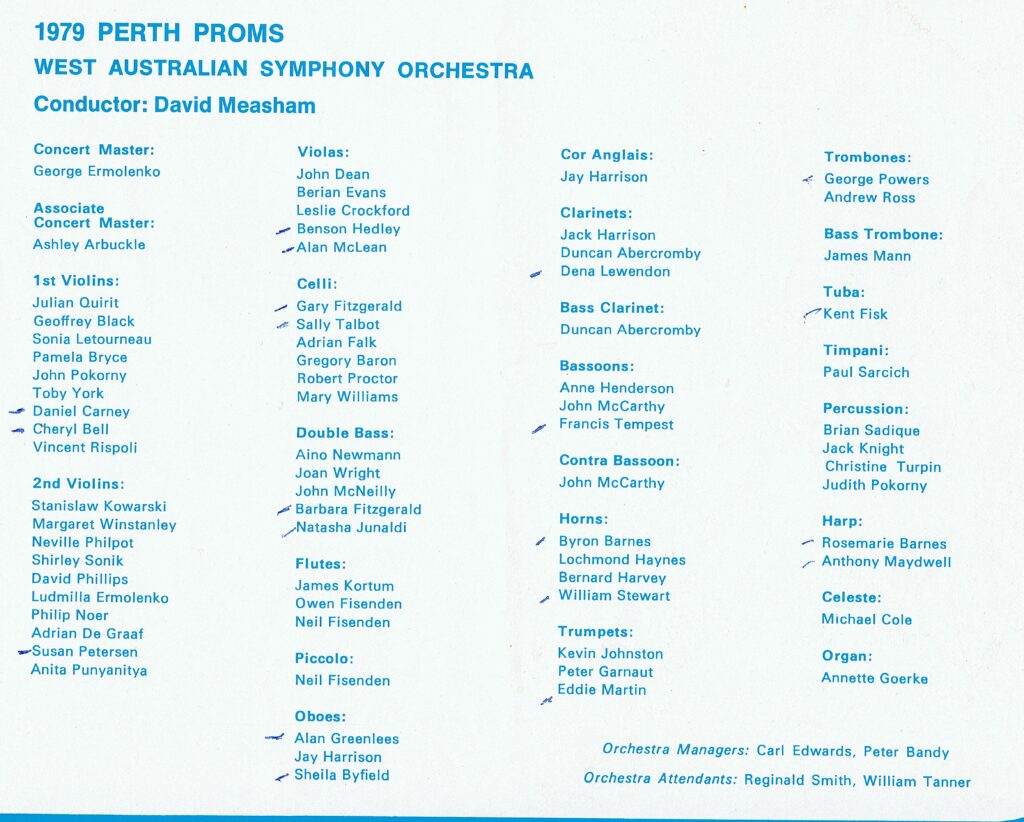
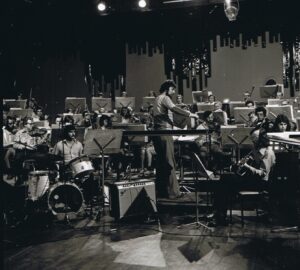
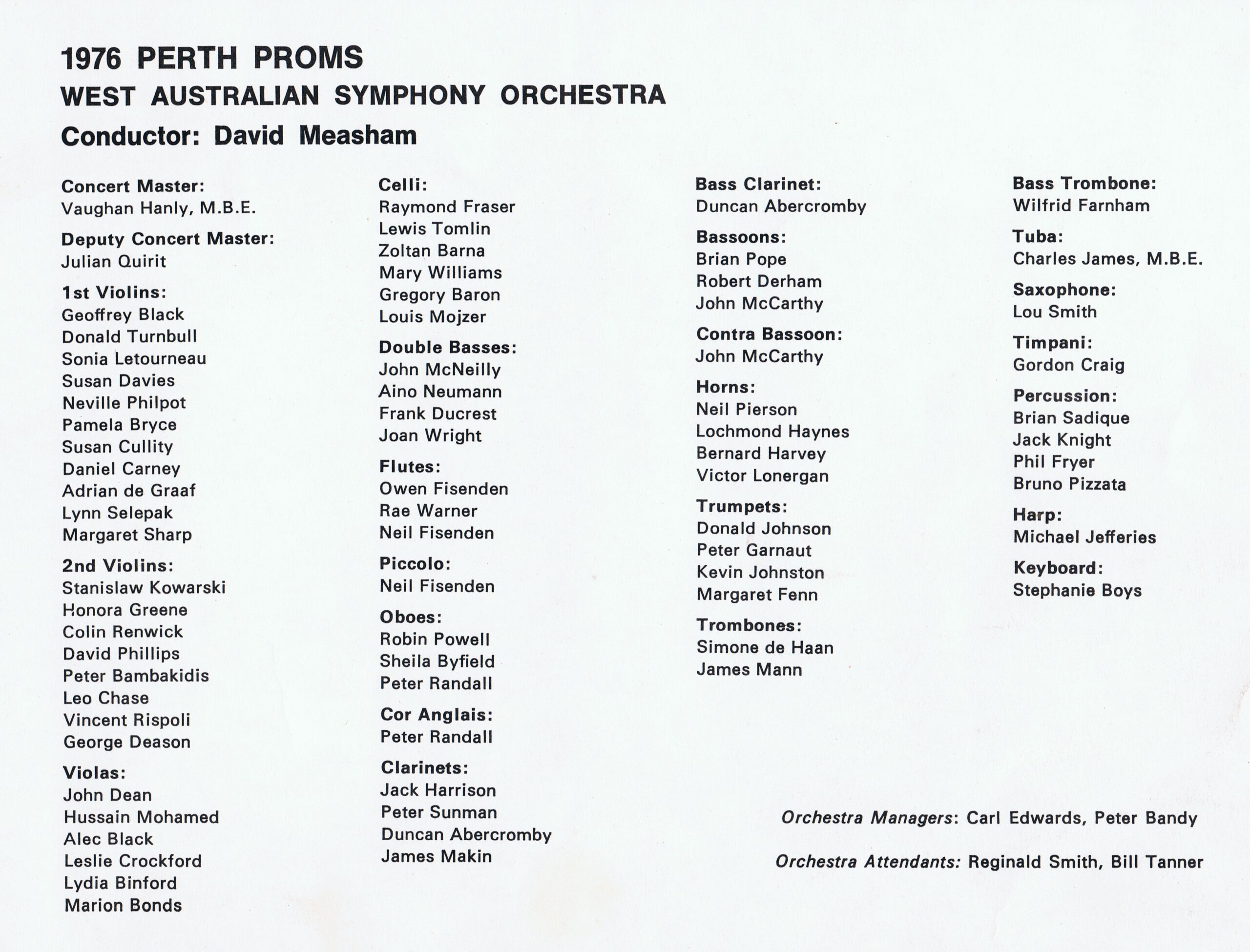
In 1975, he began an indoor season of three Promenade Concerts as part of the Perth International Arts Festival modelled on the London Proms.
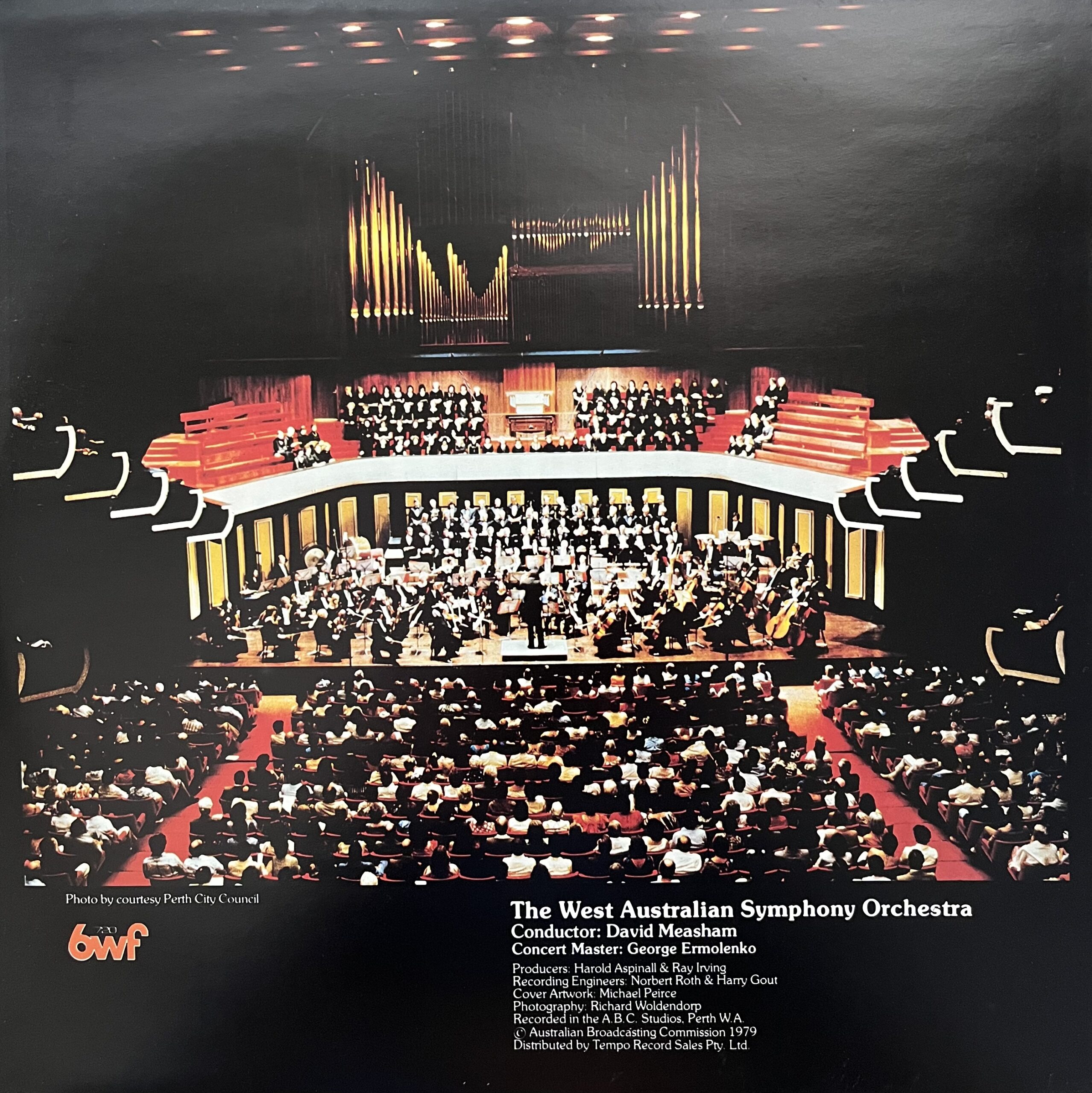
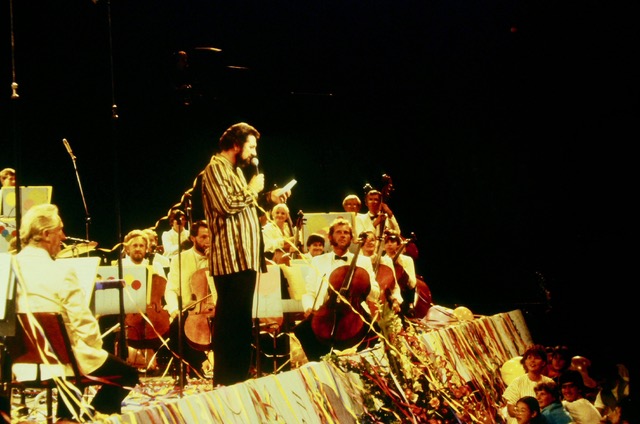
The untimely death of Tibor Paul in 1973 gave rise to the appointment of David Measham, whose prom concerts given in the Perth Entertainment Centre attracted huge audiences (19,000 patrons over three nights in 1980).
The extension of repertoire into more popular styles caused a period of instability within the Orchestra, but later became accepted as an essential part of its work.
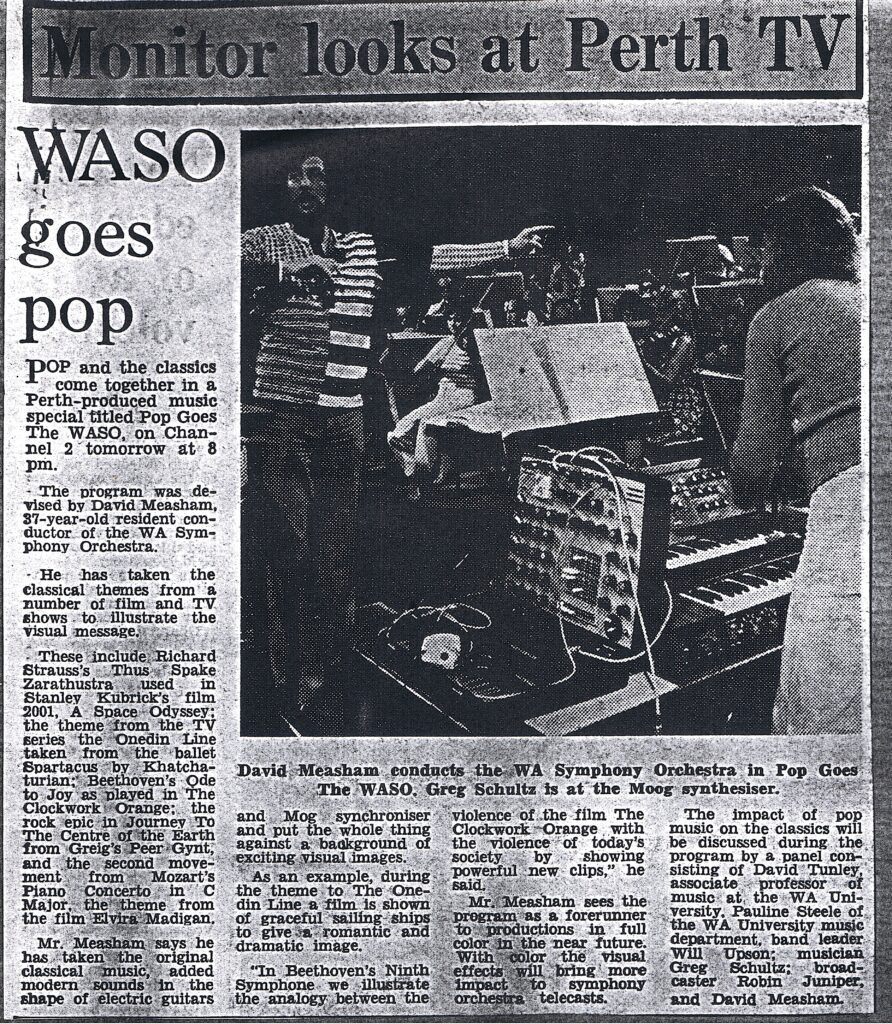
1975 Measham “Pop Goes the Weasel” with guitarist Ray WalkerVaughan Hanly and David Measham with WASO1975 Measham “Pop Goes the Weasel” in the Basil Kirke Studio
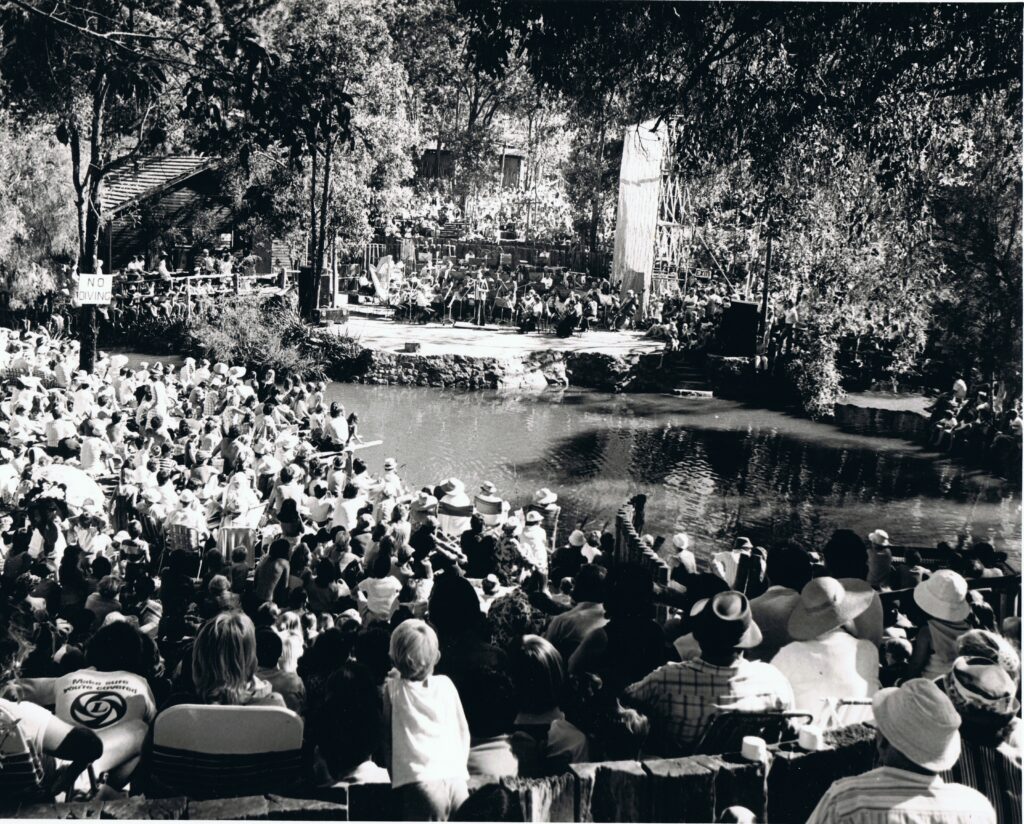
1982 WASO with David Measham1982 WASO at Parkerville Amphitheatre
1983
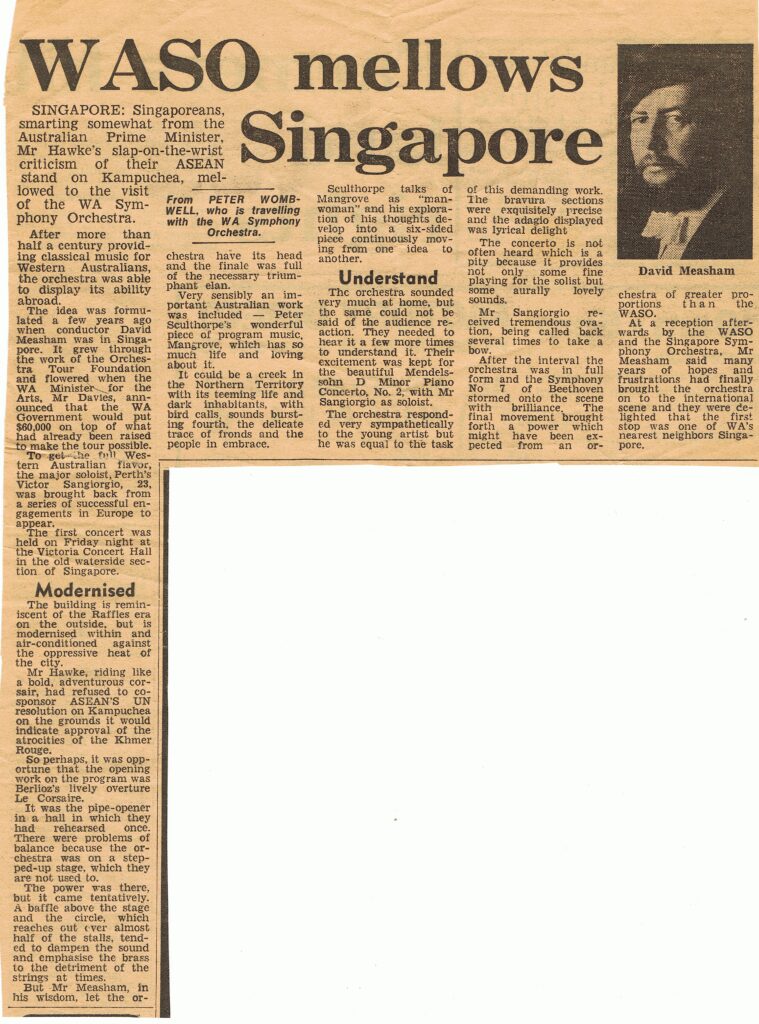
1983 WASO Singapore Tour
1984
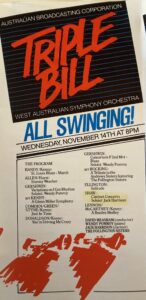
1984 Proms Measham
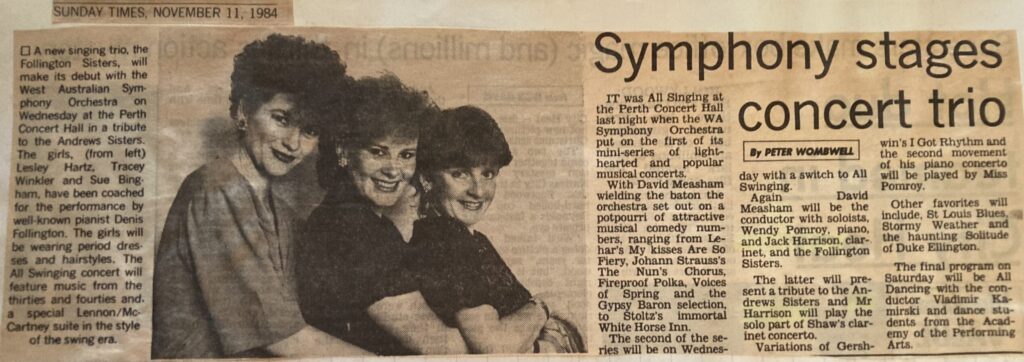
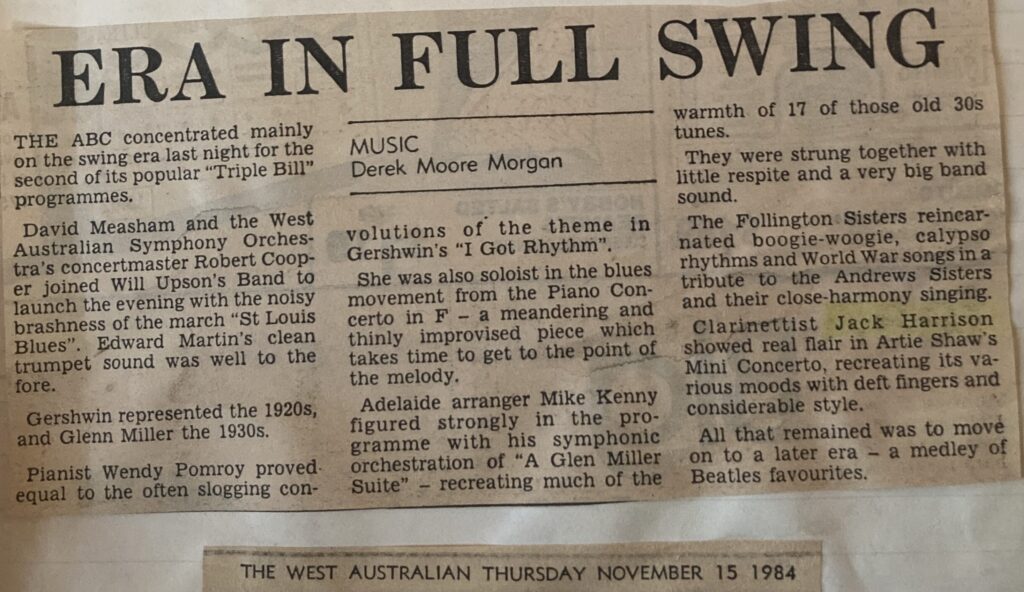
1984 WASO MeashamMeasham and the Follington Sisters article1984 WASO Measham
1986
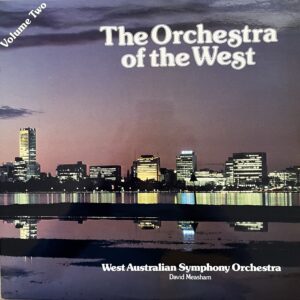
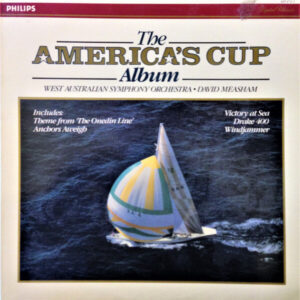
WASO The America’s Cup Album conducted by David Measham
1993
1993 Jody Harrison, Ian McNamara and David Measham: WASO Macca Australiana concert
He presented a radio series for ABC Classic FM called “Both Sides Of The Podium”, where orchestra players discussed their experiences working with various conductors.
At one rehearsal, Measham took over when the conductor, Leonard Bernstein, said he wanted to hear what the orchestra sounded like from the back of the hall and called for a volunteer conductor. He then had further assistance in conducting from Bernstein. Subsequently, in his conducting career, Measham was music director of Phoenix Opera, and chief conductor of the Stetson University Summer Institute in Florida. In 1971, Measham made his Royal Festival Hall conducting debut with the LSO, when he took over from Hans Schmidt-Isserstedt at the last minute on one 2-hour rehearsal.[2]
In 1971, Measham emigrated to Western Australia and was based in Perth. He was principal conductor of the West Australian Symphony Orchestra 1974-81, and its principal guest conductor 1981-86. There he gave many first performances, and took the orchestra on its first overseas tour, to Singapore, and to the Sydney Festival, before an audience of 120,000. In 1975, he began an indoor season of three Promenade Concerts as part of the Perth International Arts Festival, modelled on The Proms. He presented a radio series for ABC Classic FM called “Both Sides Of The Podium”, where orchestra players discussed their experiences working with various conductors. His other interests in Perth included yachting, and he was a member of the Claremont Yacht Club and then Mounts Bay Sailing Club where he raced his own keel-boat.
Measham died of cancer of the pancreas, in Perth. His early marriage to the soprano Susan Shoemaker ended in divorce. His two children from his marriage, Aaron and Guenevere, survive him.
George Reid was an early Australian music director and conductor. He played a fundamental role in the region’s orchestral history before the Australian Broadcasting Commission (ABC) introduced its “Celebrity” orchestral structure in 1936, a lineage that ultimately evolved into the modern-day West Australian Symphony Orchestra (WASO). Additionally, he was known for directing other local groups during that era, such as the Perth City Band.
Last Saturday evening the city was full of entertainment. Among the various shows not the least interesting was that given in the Town Hall by some of the members of the Y.A.L. The show was conducted in a very capable manner, and interest was added by the fact that the proceeds were to go towards the institution of a Y.A.L. stall at the Ugly Men’s Wonderwork appeal. Mr. George J. Reid batonned the Y.A.L. orchestra band, and provided some very spirited music. A couple of good solos were rendered by J. McCusker and St. Elmo Vaughan. Bert Fisher gave a good violin rendering of the intermezzo from “Cavalleria Rusticana, ” and W. Berry supplied some Highland dance selections. There was a little sketch by T. Marie, Chester Bond and George Zeplin that was well carried out. Martin Stott gave a monologue and some Dickens recitations, while Chester Bond made a hit as an ‘ ‘ Sun-Raysed ” schoolboy. The company finished off the entertainment with two scenes from “A Midsummer Night ‘s Dream. ‘
W.A. Family Sphere (Perth, WA : 1919 – 1920), Friday 16 January 1920, page 5
1924
FREMANTLE ORCHESTRAL SOCIETY.
At the Fremantle Town Hall on Thursday night in the presence of a large audience, the Fremantle Orchestral Society gave their a concert. The orchestra, which consisted of about thirty performers, rendered a number of selections, both popular and classical, which were much appreciated, and Miss E. Ross and Mr. Rhys Francis, in vocal offerings, contributed in no small measure to the success of the entertainment.
West Australian (Perth, WA : 1879 – 1954), Saturday 20 September 1924, page 10
1925
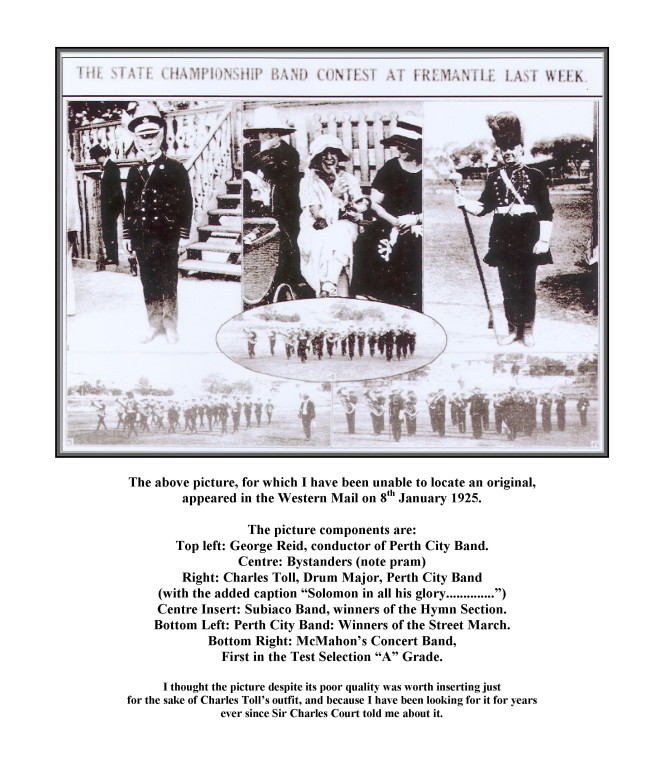
Top left: George Reid, conductor of Perth City Band. Right: Charles Toll, Drum Major, Perth City Band. Centre insert: Subiaco Band, winners of the Hymn Section. Bottom left: Perth City Band, winners of the Street March. Bottom right: McMahon’s. Courtesy State Library of W.A. BA2811/10
The Perth City Band, under Conductor George Reid, will render an enjoyable programme to-morrow (Sunday) afternoon in the Government Gardens, commencing at 3.45 o’clock.
Mirror (Perth, WA : 1921 – 1956), Saturday 2 May 1925, page 2
From comments he made subsequent to the contest it is apparent that Mr. G. Mellor, adjudicator of the Y.A.L. Band contest which was held last night, was well satisfied with the performances he had heard. He said that the standard of the playing was much improved on that of last year and he was much impressed with the band presentation. While some of the individual soloists were not quite up to the standard of last year, the younger players were a great improvement on previous years. Also in attendance at the contests were Mr. George Reid, first musical director, and Mr. Val Smith, second musical director. They too- expressed appreciation of the contest, and in course of a few remarks, observed that it brought back some happy memories of the day when they held positions with the band. The finals for the champion of the league solo for all finalists will be held on July 23, when the championship of the league will also be decided. The winner will be entitled to hold the cup presented by the officers of the league. The contest last night was conducted by Mr. Ron Rees, musical director of the Y.A.L. RESULTS. The results were: — Trumpeters’ Solo (‘Fanfare’): Norman Williams (35 points), 1. Drummers’ Solo (own choice) : Douglas King (40), 1. ‘B’ Grade Cornet Solo (‘Sweet Spirit Hear My Prayer’): Billy Weston (35), 1. ‘A’ Grade Cornet Solo (Raff’s ‘Cavatin’) : Norman Law (30). 1. Champion Solo: (”’Neath .Austral Skies’): Charles Thompson (40). Tenor Horn Solo (‘Goodbye, Sweetheart’): Clarie Gray (3G), 1. Baritone Euphonium Solo (‘Melody in T’): Roy Facey (36), 1. Trombone Solo (‘Kathleen Mavourneen’) : Robert Lockwood (33). 1. Bass Solo (‘Flower That Bloometh’) : Em Negus (33). 1. ‘B’ Grade Duet (‘Ever of Thee’): George Franklin and Billy Mangini (33). ‘A’ Grade Duet – ‘Robin Adair’) : Norman Law and Fred Brunsgard (33).
Daily News (Perth, WA : 1882 – 1955), Saturday 4 July 1931, page 3
1932
In 1932, timpanist George Reid, who also conducted the City of Perth regimental Band, took over as the resident conductor of the Perth Symphony Orchestra when from Harold T. “Duffy” Newton left for England. Reid held the position of resident for one year after which he was succeeded by Nelson Burton (1933-1935). He was invited back as guest conductor of P.S.O on many occasions. The orchestra gave 10 outside broadcasts during 1932, conducted in the main by Reid. “It seems that the committee of the Perth Symphony Orchestra was unwilling to reinstate Harold Newton, retaining the less flamboyant but more reliable George Reid as the conductor.” Harrison, Marcia, West Australian Symphony Orchestra Celebrating 75 Years, (WASO Holdings Pty Ltd, 2003). P.8
The Perth (professional) Symphony Orchestra is to commence its series of concerts for the season at His Majesty’s Theatre on Sunday evening, May 8. Mr. H. T. Newton, foundation conductor of the orchestra, is at present on leave, and Mr. G. J. Reid is acting as honorary conductor. A large and influential committee has been appointed and it is hoped to place the organisation on a sound and permanent basis so that the public will have the opportunity of hearing the orchestra in fortnightly concerts.
West Australian (Perth, WA : 1879 – 1954), Saturday 23 April 1932, page 5
A charity concert, organised by the Government Electricity Supply Department in aid of the Railway, Tramway and Electricity Supply Ray, was held in His Majesty’s Theatre on Tuesday last. There was a good attendance and all items were enthusiastically received. The well balanced programme opened with an overture by the Perth Symphony Orchestra under the baton of Mr. George Reid, followed by vocal numbers by Irene Stancliffe. Will Savage, Gertrude Hutton, David Lyle, the Bel Canto Choristers and the Select Four, a cornet solo by Charles Court, violin solos by Horace Dean, ballets by the pupils of Miss Estelle Anderson, and humorous monologues by W. E. Talbot. The concluding item was an amusing one-act play (produced by Miss Pat Hanna), and capably enacted by Miss Muriel Bird and Messrs. H. Bagot and J. Stillwell. Mrs. J. W. Stancliffe was the official accompanist, the hon. organiser. Mr. R. C. West and the hon. secretary. Mr. H. H. G. Clarke.
Sunday Times Sunday 9 October 1932 page 2
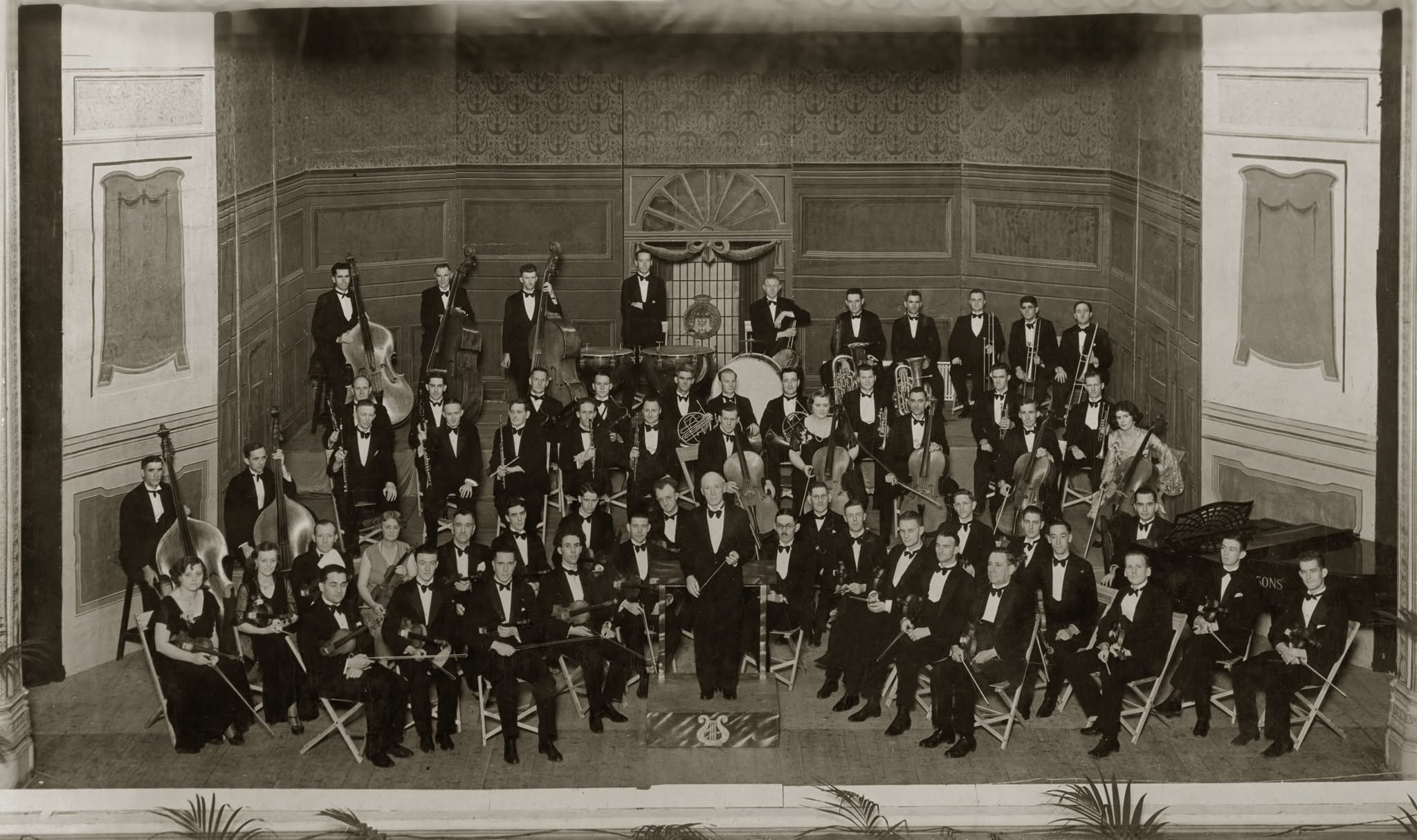
1933 Perth Symphony Orchestra conducted by George Reid in His Majesty’s Theatre
1933
The musical adjudicator for the forthcoming State championship band contests, which will open at Subiaco Oval on February 24 is Mr. George J. Reid. Mr. Reid has been closely identified with the musical life of Perth for the past 25 years. He held the position of conductor to the Perth City Band for several periods, was the musical director of the Young Australian League for a number of years, and led the band of that organisation on its first overseas tour. He is now the conductor of the Perth Symphony Orchestra
West Australian (Perth, WA : 1879 – 1954), Saturday 18 February 1933, page 5
1934
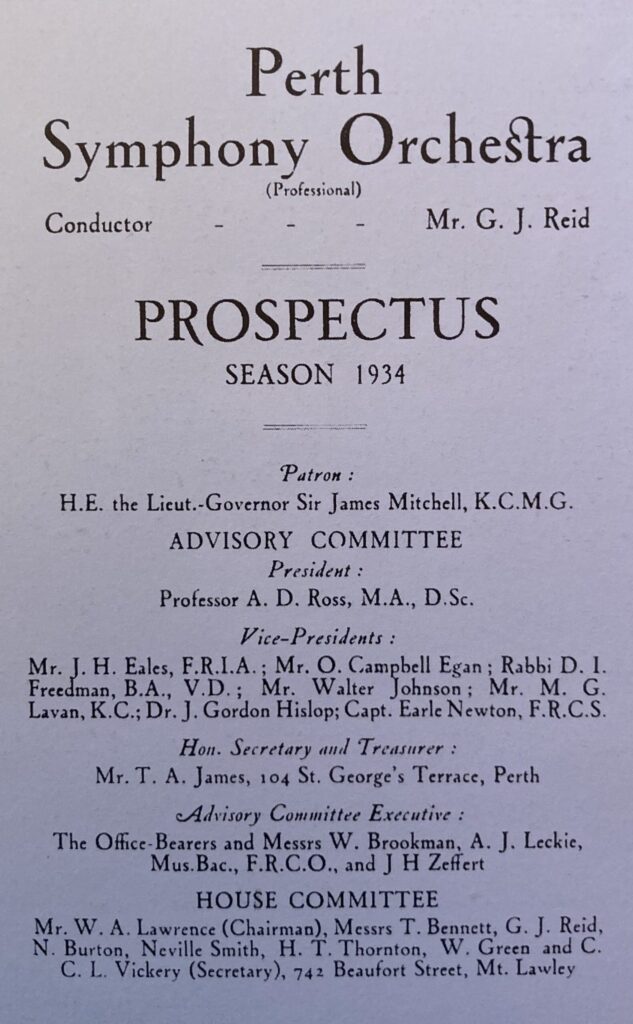
1934 Perth Symphony Orchestra Season – conducted by George Reid
PERTH SYMPHONY ORCHESTRA – Mr. Grainger as Guest Conductor.
The appearance of Mr. Percy Grainger as conductor lent a special interest) to last nights concert by the Perth Symphony Orchestra at His Majesty’s Theatre which was enjoyed by an enthusiastic audience. Mr. Grainger had charge of the orchestra in his own setting of the old English ‘Shepherd’s Hey.’ He proved a Vigorous conductor, and obtained from the: players a dashing and spirited performance in which every member of the orchestra had a share, with special mention deserved by the players of the brighter percussion instruments. Under the regular conductor, Mr. George Reid, the orchestra opened the programme with a powerful performance of Beethoven’s great ‘Egmont’ overture. Its most satisfying work, however, was in Massenet’s ‘Scenes Pittoresque’ suite a feature of which was the excellent showing by the woodwinds. In particular was this noticeable in the third movement in which a wonderfully bell like effect was achieved. The fine legato playing of the strings at the close jot this movement provided a good contrast to the final ‘Fete Boheme,’ in which all the fun of the fair was presented with great gusto. The well-known ‘Faust’ ballet music, by Gounod demonstrated the orchestras wealth of violins, to the extent that a lessening of tone in the more light and graceful passages would have resulted in greater contrasts being obtained. To close the programme the orchestra gave a spirited performance of Glinka’s ‘Russlan and Ludmilla’ overture. Miss Mercia de Mamiel, the assisting vocalist, brought beauty of tone to Mendelssohn’s ‘Wings of Song’ and Logan’s ‘Pale Moon’. As an encore the Brahm’s Lullaby was added. Mr. Harold Reid, xylophonist, gave a brilliant performance of Suppes ‘Morning, Noon and Night.’ which aroused such enthusiasm that arrangements of ‘Liebestraume’ and ‘Believe me, if all those endearing charms’ had to be played before Mr. Reid was allowed to leave. The President of the orchestra (Professor A. D. Ross) announced that at its next Sunday night concert, on June 10, Mr. John Bishop, of Melbourne, would be guest conductor.
West Australian (Perth, WA : 1879 – 1954), Monday 28 May 1934, page 11
The next programme to be presented by the West Australian State Symphony Orchestra, at the Prince of Wales Theatre on Sunday evening September 9, will include the overture to ‘The Merry Wives of Windsor’ (Nicolai), a further extract from the ‘Scheherazade’ suite of Rimsky Korsakov— ‘The Young ‘Prince and Princess’; and one of German’s ‘Henry VIlI.’ dances. Supporting artists include Miss Tess Smallpage, soprano, and Miss Evelyn Landells, pianist. The Perth Professional Symphony Orchestra, under the conductorship of Mr. G. J. Reid, will give its next concert at His Majesty’s Theatre on Sunday week, September 16. In response to numerous requests, the first two movements of Tchaikowsky’s ‘Pathetique’ Symphony will be included in the programme. Other numbers will include ‘Son and Stranger’ overture (Mendelssohn), ‘From the Countryside’ suite (Eric Coates), ‘Entry of the Gods into Valhalla’ (Wagner), ‘Henry VIII. Dances’ (German), ‘Handel in the Strand’ (Percy Grainger), and ‘Imperial March’ (Elgar). The assisting vocalist will’ be Miss Lulu Potter, soprano, who will be heard in songs by Mozart and Puccini.
West Australian (Perth, WA : 1879 – 1954), Saturday 8 September 1934, page 23
The Perth Professional Symphony Orchestra’s concert tomorrow evening at His Majesty’s Theatre will be the concluding concert of the 1934 season. As the occasion is the anniversary of the Armistice, the first half of the programme will be devoted to remembrance music. Under the conductorship of Mr. G. J. Reid, the orchestra will play the march ‘Power and Glory’ (Sousa, arranged by M. H. J. Otto), ‘Marche Funebre’ (Chopin), ‘Land of Hope and Glory’ (Sir Edward Elgar) and ‘Last Post’ and ‘Reveille’ will be sounded on the trumpets. Mr. C. L. Jenkins (baritone) will sing ‘Red Poppies’ (a poem by ‘Dryblower,’ the music by W. S. Fotheringham) , and ‘Verborgenheit’ and ‘Fussreise’ (Hugo Wolf). The remainder of the programme will be devoted to request items, which will include the overture to ‘William Tell’ (Rossini), ‘Serenata’ (Toselli) and the ballet music to ‘Faust’ (Gounod). Finally, the orchestra will take their farewell for the season by playing the fourth movement of the Haydn ‘Farewell Symphony.’ In this number the various members of the orchestra complete their parts seriatim, and, one after the other, blowing out their candles, leave the stage. The conductor, left alone, extinguishes his candle, leaving the theatre in complete darkness. The concert will be given in the presence of His Excellency the Lieutenant Governor and Lady Mitchell, naval and military representatives and office bearers and members of the R.S.L.
West Australian (Perth, WA : 1879 – 1954), Saturday 10 November 1934, page 23
1935
In 1935, the Perth Symphony Orchestra, conducted mainly by George Reid, gave most of its performances in the newly completed Anzac House in St George’s Terrace, and one special Jubilee Concet in the Capitol Theatre.
Sir William Lathlain presided at the annual general meeting of the Metropolitan Symphony Orchestra, which was held during the week. The election of office-bearers resulted as follows — Patron, The Lieutenant-Governor, Sir James Mitchell; President, Sir William Lathlain; Vice-Presidents, Messrs- Cecil Dent, A. H. Dickson, R. H. Goodman, A. J. Leckie, Eugene Levinson, W. H. Vincent; hon. conductor, Mr. Edward Black; hon. deputy conductor, Mr. C. Court; hon. secretary, Miss Pixie Pretty; hon. asst. secretary, Miss E. G. Pretty; hon. treasurer, Mr. C. Court; hon. librarian, Mr. K. Jones; hon. auditor, Mr. M. H. J. Otto; hon. concert secretary, Mr. R. R. Jones; committee, Misses E. Crabtree and E. Shotter, and Messrs. D. Powell, R Perrin, W. A. Smith and K. Jones. The financial statement showed that losses had been incurred at the orchestra’s 69th, 70th and 71st concerts. The next concert is .to be held early in June when, In the absence of Mr. Black on a broadcasting engagement in the Eastern States, Mr. George Reid will conduct.
West Australian (Perth, WA : 1879 – 1954), Saturday 23 March 1935, page 23
The fourth concert of the Perth Symphony Orchestra’s winter series, with Mr. G. J. Reid as conductor, will be given tomorrow evening, June 30, at Anzac House. Mendelssohn’s youthful masterpiece, the overture to ‘A Midsummer Night’s Dream,’ and the overture to ‘The Magic Flute’ (Mozart) are the opening and concluding numbers respectively of an otherwise cosmopolitan programme, which includes two ‘Polovtsian Dances’ from the opera ‘Prince Igor’ (Borodin), some ‘Hiawatha’ music by Coleridge-Taylor, Mozkowski’s ‘Spanish Dances,’ and Kreisler’s ‘Caprice Viennois.’ Miss Gertrude Hutton (contralto) will contribute ‘Armez-Vous’ (Gluck) and songs by Travers and Ivor Novello.
West Australian (Perth, WA : 1879 – 1954), Saturday 29 June 1935, page 23
INSPIRED MUSIC –Symphony Orchestra’s Concert
On Sunday evening, August 25, the Perth Professional Symphony Orchestra, conducted by Mr. G J. Reid, will give the eighth of its winter concerts at Anzac House. A particularly fine programme include works by some immortal masters of orchestral composition as Wagner, Weber, Brahms, Grieg and Coleridge-Taylor. The ‘Oberon’ overture is to be followed by the four movements — ‘Morning,’ ‘Death of Ase,’ ‘Anitra’s Dance’ and ‘In the Hall of the ‘Mountain King’ — of Grieg’s suite ‘Peer Gynt,’ Op. 64: and by the celebrated arrangement by Weingartner of Weber’s ‘Invitation to the Waltz,’ ‘Three Hungarian Dances’ (Brahms) and ‘The Procession of the Grail’ (Wagner). That BEAUTIFUL MELODY ‘The Willow Song,’ will be heard in its context as the fourth movement of the suite ‘Othello’ by Coleridge-Taylor, which includes also a ‘Dance,’ ‘Children’s Intermezzo,’ ‘Funeral March’ and ‘Military March.’ The programme will conclude with the overture from ‘Zampa’ (Herold). The assisting, artist, Signor Ugo Mina (tenor), will contribute songs by Verdi and others.
Mirror (Perth, WA : 1921 – 1956), Saturday 24 August 1935, page 23
1936
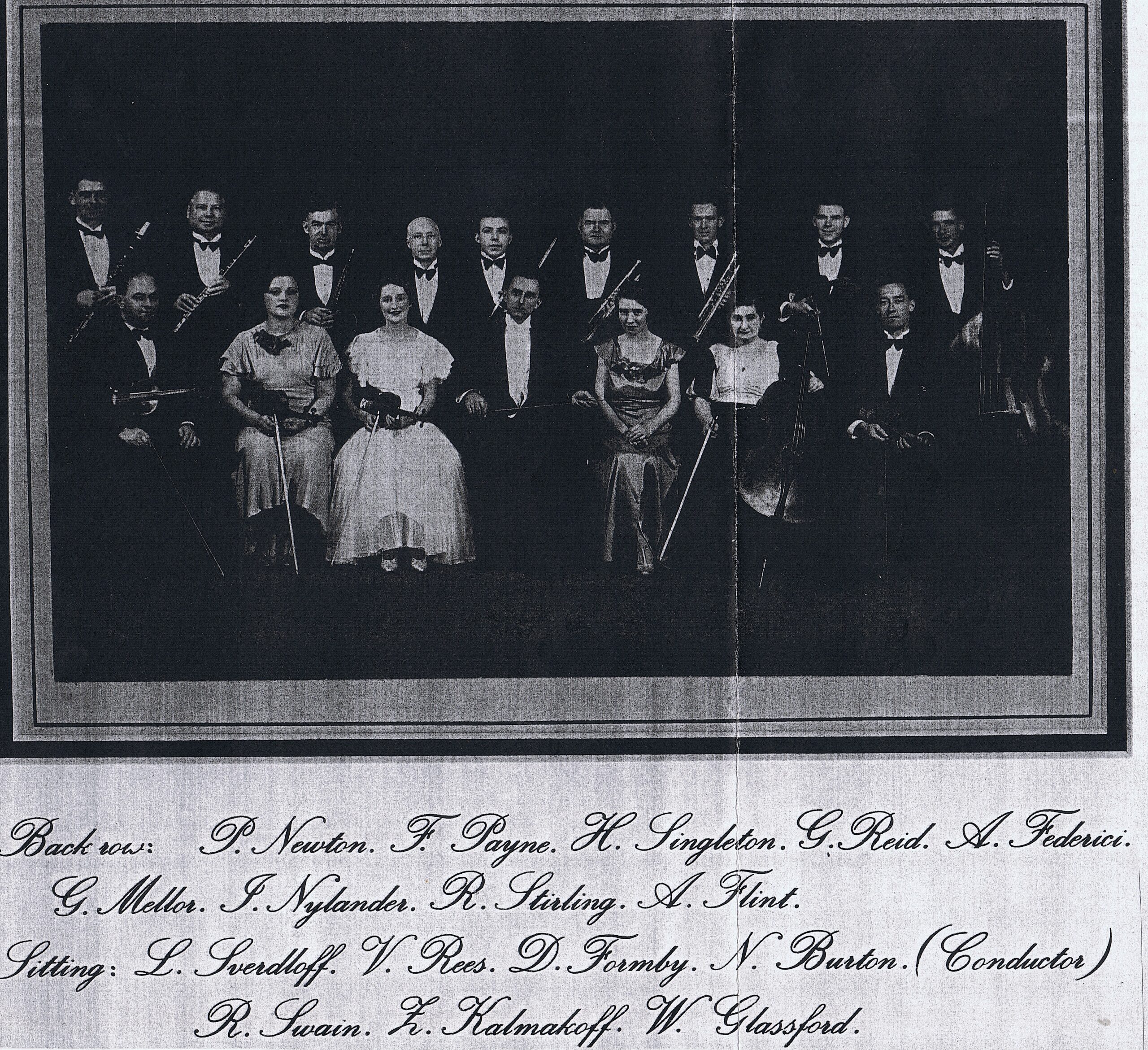
1936 Perth Concert Orchestra
1943
Description
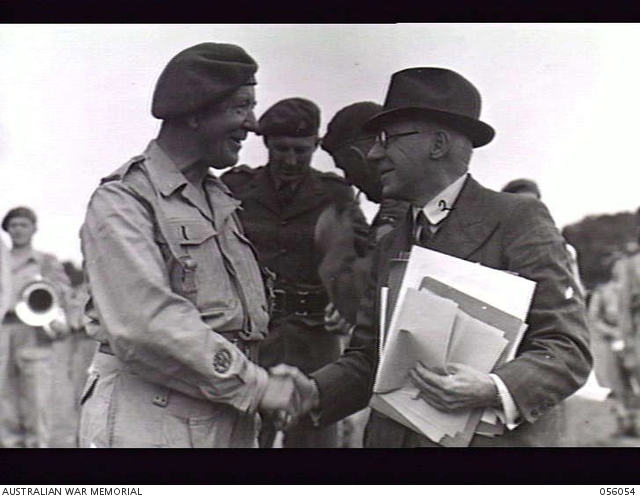
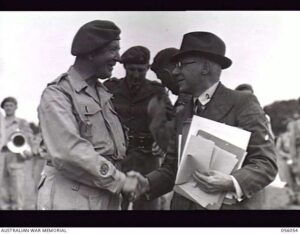
GERALDTON, WA. 1943-08-15. MR GEORGE J. REID (RIGHT), ADJUDICATOR OF THE TRIANGULAR BAND CONTEST BETWEEN THE BANDS OF THE 1ST AUSTRALIAN ARMOURED DIVISION, THE 35TH BATTALION AND THE 54TH BATTALION, CONGRATULATES WARRANT OFFICER 2 A. H. BAILE (CONDUCTOR) OF THE BAND OF THE 1ST AUSTRALIAN ARMOURED DIVISION, ON HIS BAND WINNING EVERY PRIZE IN THE CONTEST.
Biography Our Musician for the week is alto and tenor sax expert Jack Pateman, leading alto with the Harry Bluck Sextet. Known throughout the local dance band world as ‘Daddy’ Pateman because of his long association with the dance band profession, Jack commenced earning the sax shortly after World War I at the age of 18, and attended the same tutor as Ken Murdoch at about the same time, namely George Reid, one-time conductor, of the Perth Symphony Orchestra. His first dance band engagement came to him when he took the alto seat in his father’s orchestra (Alf Pateman’s Old Time Band) which played for Mrs. B. Richards’ old time dances at the Unity Theatre back in the 20’s. At a later stage he joined pianist Bill Naughton, now in the Eastern States, and Merv Rowston. This trio moved into the Kit Kat Cabaret Cottesloe and were there for some time. From this nightery, he moved on to the Piccadilly Ballroom where he joined Charlie Sheridan’s 10-piece combination as third alto and later toured with this outfit when it conducted a large scale tour through the wheat belt and sou-west. He was a prominent figure at the Wentworth Hotel, where he occupied alto chair with the Fred Nice trio for -years and during this time he saw 2 seasons at the ANA Boathouse with Jack Nice’s band. During the war, while in the 125 AGT, he played alto and tenor in a concert party quartet under Captain Fred Nice. After the war he took his own band into the Club Cabarita and was later joined by Harry Bluck, who later reformed the band and moved into the Pagoda, where they are now seeing their third season. Jack Pateman was a notable figure in the Jazz Jamborees and was also with the ABC show, Sunday Serenaders, under Sammy Sharp. He has always been a utility man and during his 20 odd years of experience has carried baritone, tenor and alto responsibilities. Jack, whose home is in Claremont is a full-time teacher of the alto- tenor and clarinet. —’QUAIL.’
Mirror (Perth, WA : 1921 – 1956), Saturday 18 June 1949, page 13
Australian conductor Ron Spigelman is an honors graduate of the Royal Academy of Music, London.
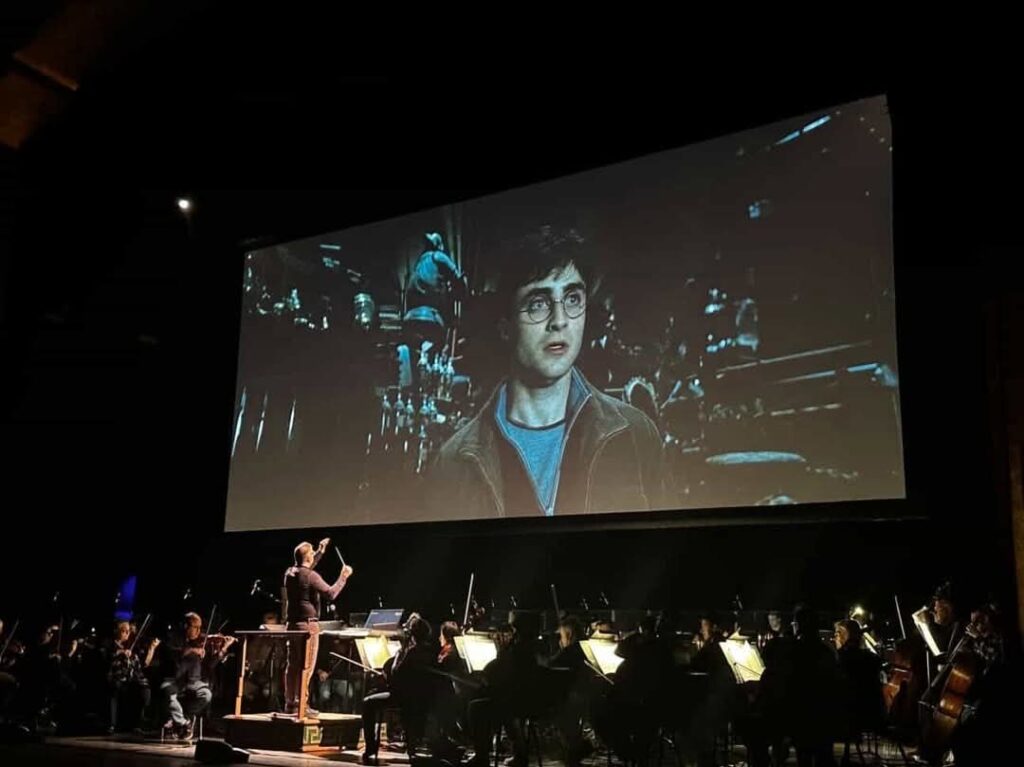
Ron Spigelman conducting a WASO “Zoo” concert
He began his career in Australia in 1992 as a conductor-in-training with the West Australian Symphony, the Queensland Symphony Orchestra in 1993 and then assistant conductor of the Adelaide Symphony Orchestra in 1994 – with who he recorded an album entitled Dream Children that was nominated for an ARIA award and still receives radio play on the ABC. His career moved to the United States in 1994 when he won the position of Associate Conductor of the Fort Worth Symphony (Texas) and then the Buffalo Philharmonic (New York), subsequently becoming Music Director of the Fort Worth Dallas Ballet, the San Angelo Symphony, Texas Chamber Orchestra, Springfield Symphony (Missouri), and the Lake Placid Sinfonietta (NY) where he is now conductor emeritus. He has also served as Principal Pops Conductor of the Fort Worth and Syracuse Symphonies and is now in his second season as Principal Pops Conductor of the Buffalo Philharmonic developing and conducting approximately 12 programs each season.
Guest conducting appearances have included the Atlanta, St. Louis, Baltimore, Utah, Oregon, Kansas City, Vancouver, Milwaukee, Grand Rapids, Colorado, Dallas and Nashville Symphonies, as well as the Florida Orchestra, Louisville Orchestra and the Minnesota Orchestra.
Ron Spigelman
He has conducted Symphonic, Ballet, Opera, Musical Theatre and Pops plus over 30 live-to-film productions including all eight of the Harry Potter films. Guest artists he has accompanied include Horacio Gutierrez, Rachel Barton Pine, Richard Stoltzman, Marvin Hamlisch, Peter Paul & Mary, James Taylor, Leslie Odom Jr., Vanessa Williams, Gladys Knight, Arturo Sandoval, and many others.
Career highlights include the world premiere of Pegasus by Lowell Liebermann with the Dallas Symphony, his Carnegie Hall debut with the Buffalo Philharmonic in 2004, and the world premiere recording of Sylvan by Michael Torke with the Lake Placid Sinfonietta for their centennial season in 2017.
Ron lives in Tulsa, Oklahoma with his wife Laura, and they have a combined 6 children. He is board president of Harmony Project Tulsa, bringing instrumental instruction to underserved youth in collaboration with the Tulsa Public Schools and he is a frequent conductor of the Tulsa Symphony Orchestra. In 2024 he graduated summa cum laude with a bachelor’s degree in Family and Human Development at Arizona State University receiving the dean’s medal for academic excellence and in May of 2026 completed his Master of Liberal Studies degree – also from ASU – graduating with academic distinction. His applied project was a graduate course for conductors in the vital communication, leadership and social skills needed to become a resonant leader and effective music director on and off the podium.

 David Measham was principal conductor of the
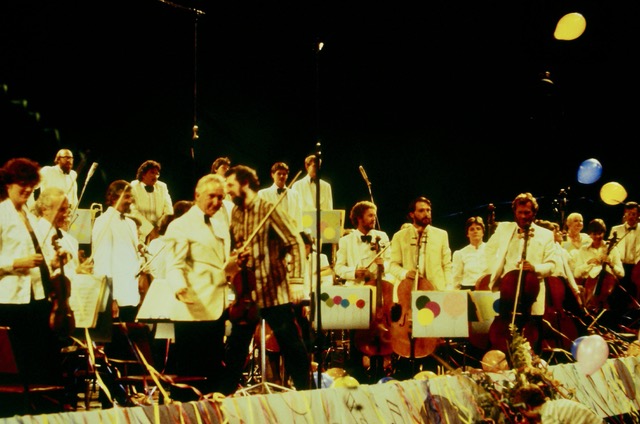
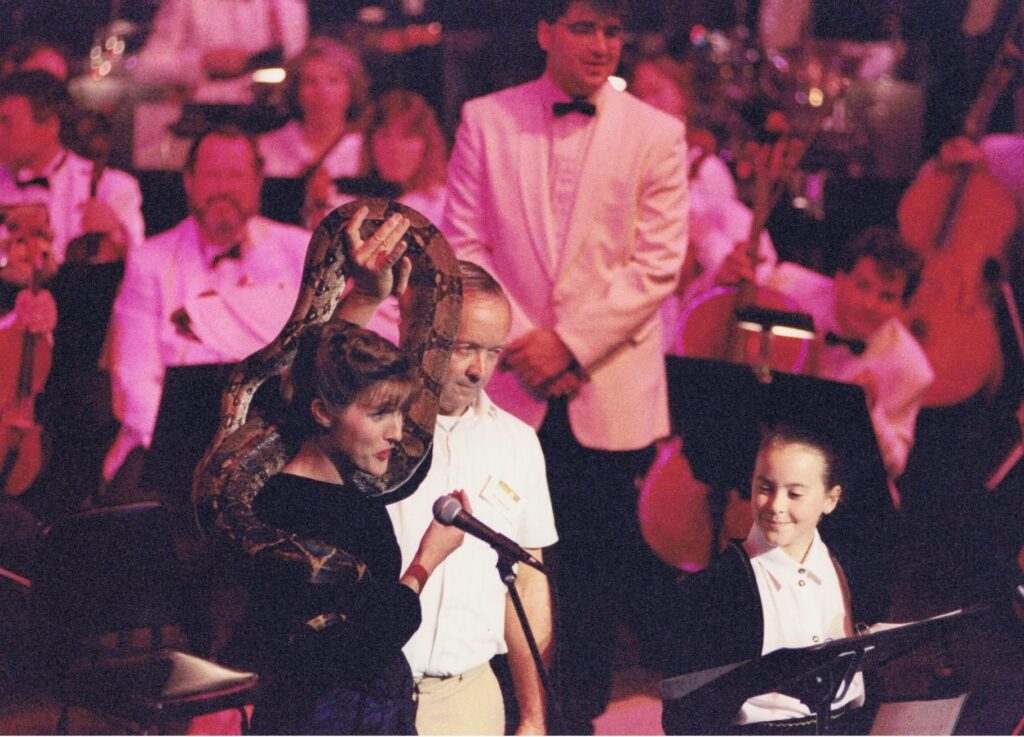
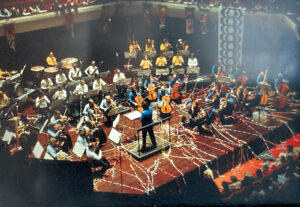 1975 WASO Family Concert with coloured skivvies
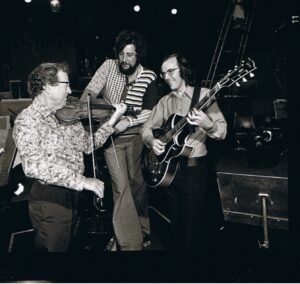
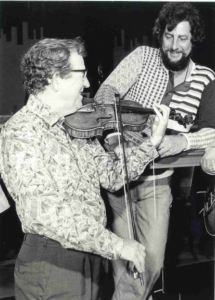
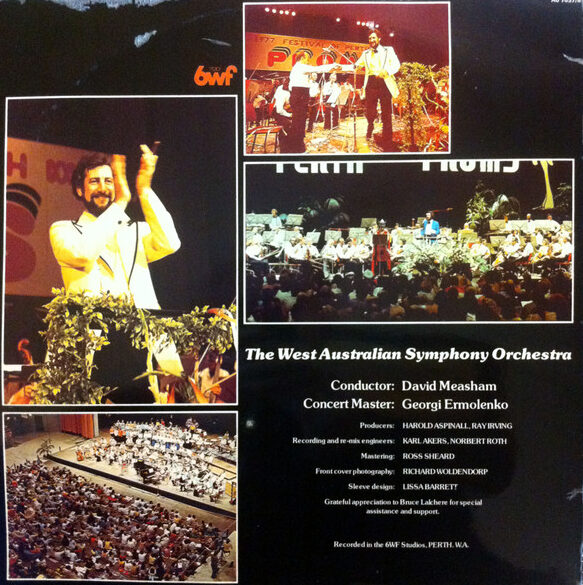
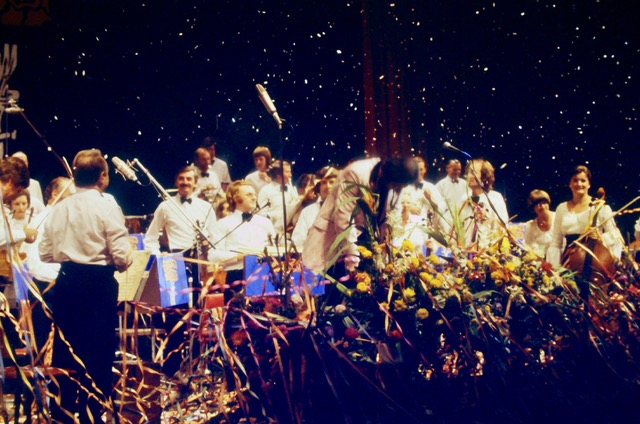 1978 Prom concert Perth Entertainment Centre