Search names, events, places, organisations, and sources across the archive.
Person
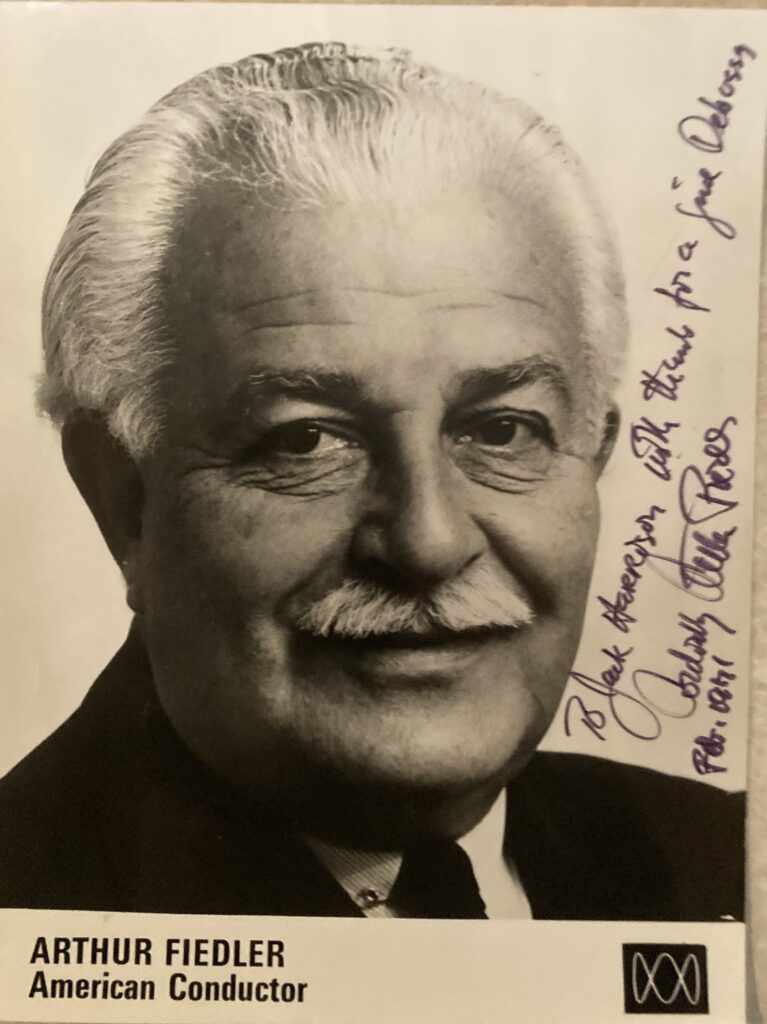
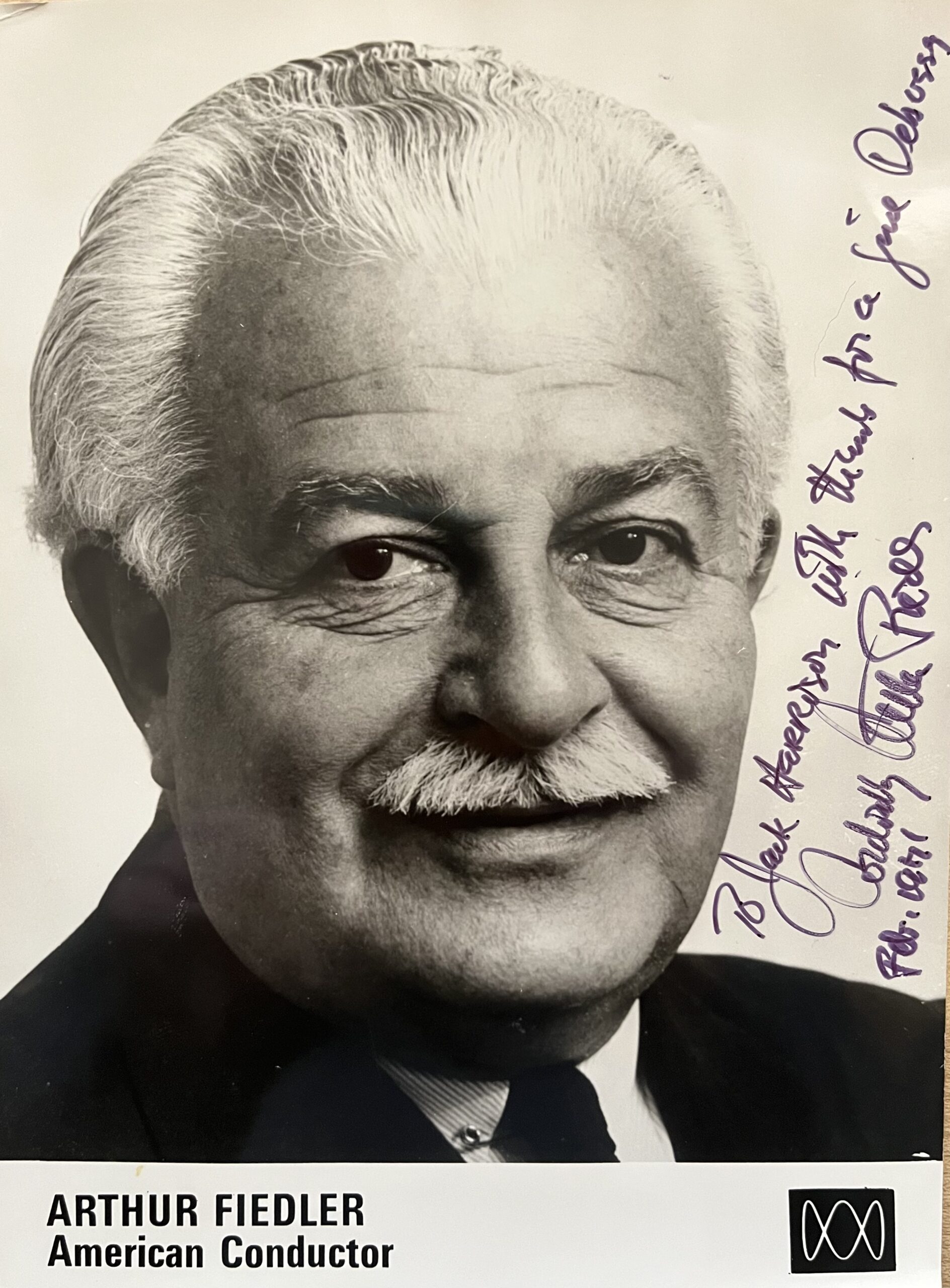
FIEDLER, Arthur
Arthur Fiedler (born December 17, 1894, Boston, Massachusetts, U.S.—died July 10, 1979, Brookline, Massachusetts) was an American conductor who was maestro of the Boston Pops Orchestra for 50 seasons and the best-selling classical conductor of all time; his recordings with the Pops sold some 50,000,000 discs. (The Boston Pops Orchestra is the Boston Symphony minus its principal players.) Fiedler, whose principal aim was “to give audiences a good time,” led the Pops in performances of popular tunes, show music, and classics.
From 1911 to 1915 Fiedler studied violin, piano, and conducting at the Royal Academy of Music in Berlin before joining the Boston Symphony as a member of the second violin section. He played in the viola section from 1918 to 1930. He also was proficient on the celesta, piano, and organ. Fiedler organized the Arthur Fiedler Sinfonietta (1924), a chamber symphony, when he was refused the conductorship of the Pops. In 1929 he organized the Esplanade concerts, in which symphonic music was played outdoors in Boston for the first time. In 1930 he became conductor of the Pops, a post he held until his death in 1979.
Fiedler, Arthur Arthur Fiedler conducting the Yomiuri Nippon Symphony Orchestra, 1967.
As conductor of the Boston Pops, Fiedler developed a varied and light-hearted repertoire that struck a responsive chord with the public. He excelled at adapting popular dance music and other songs to performance by a symphonic orchestra. Fiedler was viewed by many critics as a highly able technician and a superb showman rather than as a first-rate interpreter of classical music, however.
FESTIVAL OF PERTH – ARTHUR FIEDLER – TUESDAY FEBRUARY 16 1971
Arthur Fiedler the internationally famous conductor of the Boston Pops concerts will conduct the West Australian Symphony Orchestra for two concerts during the Festival. The concerts should be known as Fiedler concerts, will be held at Winthrop Hall on Saturday, February 13 and Tuesday, February 16. Mr Fiedler’s connection with the Boston Symphony Orchestra goes back to 1915 when he joined it as a violinist. In 1930 he was appointed the 18th conductor of the Boston Pops concerts a feature of Boston musical life since 1885. Record sales which have helped to make the Boston Pops Orchestra famous now total more than 47 million. Mr Fiedler will be appearing by arrangement with the Australian Broadcasting Commission. Soloists at the Fiedler concerts will be David Bollard and clarinet and harmonica player Jack Harrison who is a Churchill fellowship winner for 1971.
John Meyer graduated from UWA with a BA Honours in music, then proceeded to MA and PhD. He studied piano with Alice Carrard and organ with Stan Craft, obtaining an LMusA performance diploma for piano.
He has contributed articles and book reviews to research journals as well as writing on various aspects of music in WA, including the history of music at UWA and entries for the Historical Enyclopedia of Western Australia. He was invited to launch Jean Farrant’s history of RSMC at the Club’s 80th anniversary celebration in 2006.
John has been a UWA staff member in Music and the University Library, also holding research positions at Sheffield University and ANU. He has contributed concert reviews to The West Australian and arts journals.
John was President of the Richard Wagner Society of WA from 2012 to 2016. He is an active member of the Uniting Church (including as organist and choir director), as well as club historian of the University of WA Cricket Club.
West Australian Joan studied music, specialising in Dalcroze Eurhythmics, mime, dance, speech, drama, gaining BA, Dip Ed, (UWA): B Ed, M Ed (ECU) and PhD (Monash), LRAM (London), Diplôme Supérieure (I J-D, Geneva) and has tutored for Kindergarten College, WAIT, Curtin University, UWA, ECU, WAAPA and Notre Dame.
She has performed and directed for numerous theatre, opera, dance and music organisations and pursued volunteer commitments, interstate and internationally, connected with theatre, festivals, community arts, children’s playgrounds, Girl Guides, local history, and many recreation projects for seniors.
She has served on numerous Boards including WA Arts Council, Australia Council, Festival of Perth, Playhouse Theatre, Dance and the Child International and ASSITEJ (Theatre for youth and children International).
A former President, but now Patreon of Dalcroze Australia, she has presented workshops and examinations in Southeast Asia, Taiwan, Japan, New Zealand, Fiji Europe and UK.
In the mid-50s, Joan was a UW Guild Councillor, President of the University Dramatic Society and codirector of the Uni Revue Company.
In the 1980s she was the elected Warden of UWA Convocation (the Alumni Graduates) and awarded travelling grants; the Inaugural Australia Council Ros Bower Community Arts Fellowship and WA Government Women’s Fellowship (later renamed the Edith Cowan Fellowship).
Joan is a Fellow of ACHPER, founding and Hon. Life member of ASME, AUSDANCE, GRADS and Dalcroze Australia. Awarded the Medal of the Order of Australia, the Medal of the Centenary of Federation, the UWA Chancellor’s Medal, she received AUSDANCE National Award for Services to Dance Education; the WA Government 50-year Volunteer Service medal, and a Lifetime Achievement Award from the International Dalcroze Studies Conference.
Joan and bassoonist Brian, her husband of 70 years, had 3 sons and 5 grandchildren.
Now widowed, Joan is the proud great grandma of two!
The Adult Education Board (AEB) country tours were a pioneering regional outreach initiative managed by the University of Western Australia (UWA). Operating at their peak from the 1930s through the 1960s, these tours brought high-quality lectures, theatrical productions, classical music concerts, and films to remote outback towns and agricultural communities across Western Australia. They served as a vital cultural lifleline for rural communities that were otherwise isolated from metropolitan cultural hubs.
In the 1930s, the UWA Adult Education Board established the “Box Scheme”. This program sent boxes of books and accompanying educational notes written by UWA academics via the state’s railway network to rural study groups. This structural network laid the foundation for physical travelling tours.
Following World War II, under the leadership of directors like Hew Roberts, the AEB significantly expanded its geographical reach. It introduced the “Music for Everyone” spring tours, which sent renowned classical musicians and vocalists to regional halls.
1950
Jack Harrison went on Adult Education Tours in the Country to: Moora, Carnamah, Geraldton, Morowa, Goomalling and Wongan Hills representing this year’s State finalists in the A.B.C. vocal and concerto competition.
ABC Winner On Tour
Miss Elise Longwill, of Claremont, winner of the vocal section of the Australia wide concerto and vocal competition, who returned from Sydney on Friday, left Perth today on a tour of the wheat belt. On tour with her are clarinettist Jack Harrison and pianist Flora Bunning and Adult Education Assistant Director J. Birman. Their first recital will be given tonight at Moora, after which they will go to Carnamah, Geraldton, Morawa, Goomalling and Wongan Hills. The tour, which will end on Saturday night, will be the first of three tours by these artists under the auspices of the Adult Education Board.
The Daily News Monday 10 July 1950 page 2
MOORA
EVERYMAN’S MUSIC RECITAL
Those citizens of Moora Who are Interested In the cultural advancement of the district, owe a debt of gratitude to the Adult Education Board of W.A. for giving them the opportunity to hear artists of such excellence as Flora Bunning. Elise Longwill and Jack Harrison. A representative group of people were present and they made up in enthusiasm for the many empty seats. The highlight musically speaking, of the evening, was undoubtedly Miss Flora Bunnings brilliant interpretation of the Etude in C Minor (Chopin). Probably the majority of her listeners would find it difficult to analyse accurately the course of their excessive enjoyment and appreciation. Miss Bunning’s beautiful legato playing, of the famous D flat Major Nocturne (Chopin) was greatly marred (in the opinion of the writer) by the untunefulness of the pianoforte. The untunefulness was not so apparent in either Debussy Arabesque or the modern Spanish where the clearness and neatness of the rapid passages masked the deficiencies of the instrument. Forest Murmurs (Liszt) and Unfinished Waltz, completed the player’s solo list. Miss Bunning showed herself as an admirable ensemble player in association with Miss Elise Longwill and Mr. Jack Harrison. The concerted numbers were very happily conceived, particularly pleasing being the Shepherd on the Rock by Schubert. Miss Longwill delighted us with her group of Early English Songs in the first part of the programme. The group of modern songs in the second part were also well received.
Mr. Jack Harrison (Clarinettist) in the opinion of the writer had by far the hardest task. He gave a very pleasing performance, despite the difficulty of playing with a piano of uncertain tunefulness. The Weber Concertino Opus 26 was very successfully played; also the Nocturne in E flat major (Chopin). The Debussy, however, was his star performance. A lovely bit of musicianship all round, composer, player and accompanist. Altogether, the concert, was one to be remembered in the “mind’s-ear” for many a day, worthy of a much larger audience and a much better piano —Ruth Krieg. The North Midland Times (Moora) Thursday 20th July 1950 page 4
Tuesday 11th July 1950(Jack in Carnamah)
Recital at Carnamah – Talented Visiting Artists – ENTHUSIASTIC HOUSE
Three gifted artists in Miss Elise Longwill (soprano), Miss Flora Bunning (pianist) and Mr. Jack Harrison (clarinettist) presented a programme —rich in sparkling gems—under the auspices of the Adult Education Board to an appreciative audience last Tuesday night at Carnamah. Fresh from her triumph in Sydney, where she won the final in the vocal section of the Australian Broadcasting Commission’s concerto and vocal competition for 1950, Miss Longwill left the impression that she has a successful career in front of her. She has talent, youth and an unspoiled personality. Her voice is strikingly melodious, with an enunciation so perfect that not a word was lost to anyone. She soared to the top notes with the ease of a lark and like that eminent personality of the concert platform (Peter Dawson) on his last tour in Western Australia showed with songs which were in English that there is a charm in them too often overlooked in the past by those who made foreign compositions a fetish. Only twenty-three years of age, Miss Longwill has already achieved distinction in her profession. Although born in Liverpool, she came to Australia when but four years old and is entitled to regard herself as “a dinkum Aussie.” Jack Harrison first saw the light of day eighteen years ago in Nedlands. He demonstrated that he is a clarinettist of unusual promise. When voice, clarinet and piano were combined he showed an admirable appreciation of all that was required of him, with delicacy, restraint and brilliance wherever needed. The maturity in the art of Miss Flora Bunning was quickly apparent with a confident and understanding approach to her numbers, she soon had the audience captivated, her nimble fingers as they flew over the keyboard plucking the notes forth with a dexterity which had the hallmark of fine musicianship. The left hand work was especially admirable and, whether in the subdued passages or in the sprightly, she was unfailingly effective It was an evening with many enjoyable features and the visitors must have found it a pleasure, too, to discover such. manifest appreciation of their ability. Enthusiasm is contagious and it was clearly in evidence both amongst the audience and artists on Tuesday night. The Irwin Index (Mingenew) Saturday 15 July 1950 page 1
Wednesday 12th July 1950 (Jack in Geraldton)
Geraldton Top of Form- Fine Town Hall Recital – Talented Visiting Artists – ENTHUSIASTIC HOUSE
With the co-operation of the Geraldton Music-Lovers’ Club, the Adult Education Board was responsible in the Geraldton Town Hall last night for the presentation of a recital which will live long in memory. Three gifted artists in Miss Elise Longwill (soprano), Miss Flora Bunning (pianist) and Mr. Jack Harrison (clarinettist) presented a programme rich in sparkling gems. Although the house was on the thin side, its enthusiasm was in inverse proportions to its numerical strength, its warm-hearted appreciation bringing the visitors back for encores. Fresh from her triumph in Sydney, where she won the final in the vocal section of the Australian Broadcasting Commission’s concerto and vocal competition for 1950, Miss Longwill left the impression that she has a successful career in front, of her. She has talent, youth, and an unspoiled personality. Her voice is strikingly melodious, with an enunciation so perfect that not a word was lost in the back rows of the Town Hall last night. She soared to the top notes with the ease of a lark, and like that eminent personality of the concert platform (Peter Dawson) on his last tour in Western Australia showed with songs which were all in English that there is a charm in them too often overlooked in the past by those who made foreign compositions a fetish. Her first four numbers were by seventeenth century composers, with words by William Shakespeare in three of them ; in the second half — again with admirable deportment and facile accomplishment — she submitted three songs by contemporary composers. The initial bracket comprised ‘It was a Lover and his Lass’ (Morley), ‘When Daisies Pied’ (Arne), ‘It Attempt From Love’s Sickness’ (Purcell) and ‘Where the Bee Sucks (Arne) and the latter group ‘Sing, Break Into Song’ (Mallinson), ‘Cloths of Heaven’ (Dunhill) and ‘Five Eyes’ (Gibbs), while an ever popular number in ‘The Road to the Isles’ was sung as an encore. Only twenty-three years of age, Miss Longwill has already achieved distinction in her profession. Although born in Liverpool, she came to Australia when but four years old and is entitled to regard herself as ‘a dinkum Aussie,’
Jack Harrison first saw the light of ‘day eighteen years ago in Nedlands. He began his contributions to the programme with a Weber selection (Concertino, Op. 26) last night and soon demonstrated that he is a clarinettist of unusual promise. When voice, clarinet and piano were combined at the close of the opening half in ‘The Shepherd on the Rock’ (Schubert), he showed an admirable appreciation of all that was required of him, with delicacy, restraint and brilliance wherever needed. Beginning the second half of the delightful programme, he submitted the Nocturne in E Flat Major (Chopin), ‘Fantaisie Miniature’ (Paquot) and ‘The Little Nigger’ (Debussy) with ‘On Wings of Song’ (Mendelssohn) as an encore. Miss Bunning, Miss Longwill and Mr. Harrison at the close offered ‘Bird Songs at Eventide’ (Coates) and ‘The Pipes of Pan’ (Lehar), the last named proving one of the outstanding successes of the evening. (The final verse was again given to a delighted house as an encore). The maturity in the art of Miss Flora Bunning was quickly apparent. With a confident and understanding approach to her numbers, she soon had the audience captivated, her nimble fingers as they flew over the keyboard plucking the notes forth with a dexterity which had the hallmark of fine musicianship. The left hand work was especially admirable and, whether in the subdued passages or in the sprightly, she was unfailingly effective. She opened with Chopin’s Study in A Flat Major before going on to two further Chopin numbers in the Nocturne in D Flat Major and the Etude in C Minor Revolutionary Study, giving Liszt’s ‘Forgotten Waltz’ as an encore. In the second half Miss Bunning was again in high favor with ‘Arabesque’ (Debussy) and ‘Concert Allegro’ (Granados). The last named was particularly impressive and in response to sustained applause the artist played ‘Clair de Lune’ (Debussy). It was aa evening with many enjoyable features and the visitors must have found it a pleasure, too, to discover such manifest appreciation of their ability. Enthusiasm is contagious and it was clearly in evidence both amongst the audience and artists last night. Geraldton Guardian Thursday 13 July 1950 page 5
Thursday 13th July 1950 Jack in Morawa
Thursday, 13th July, 1950, At 8.15 p.m. MORAWA TOWN HALL
MAKE SURE OF YOUR SEAT – For a Magnificent Concert – Three Brilliant Artists: ELISE LONGWILL, Soprano (1950 Winner of A.B.C. Concerto and Vocal Competition), JACK HARRISON, Clarinettist (Finalist 1950 A.B.C. Competition), FLORA RUNNING, Pianist. Box Plan at Smith’s Pharmacy, Res 4/- ; At Doors 2/6. (No Tax), Children 1 6 to all parts of Hall. Direction :—ADULT EDUCATION BOARD. Greenough Sun Thursday 6 July 1950 page 5
Friday 14th July 1950 Jack inGoomalling
Celebrity Artists For Goomalling
A number of activities is planned this year by the Adult Education Board for country centres. The Acting Director of Adult Education (Mr. John Birman) announced in Perth that his Board is going to present to country centres a series of concerts and recitals and ballet performances in the next few months, which will bring the standard of amenities in country areas up to that prevailing in Perth. This expansion of policy in bringing good music and excellent entertainment to country people was made possible partly by the generous Contribution of the State Government, which voted a certain amount of money for this purpose. Mr. Keith George, of the Linley Wilson School of Dancing and Ballet, has just completed a preliminary tour of northern towns, during which he investigated the state of the stages and the existing facilities for the purpose of presenting the ballet group which will be touring the area late in August and early in September. Of immediate interest to the people of Goomalling is the forthcoming visit of three brilliant Perth artists, two of whom have recently successfully competed in the annual vocal and concerto competition conducted by the ABC. The party, consisting of Miss Elise Longwill, soprano (the winner of this year’s competition), Jack Harrison, clarinettist (a finalist), and Miss Flora Bunning, the well-known Perth pianist, will give a concert at Goomalling on Friday, July 14. Box plan. is open at Garnet Royal’s, and it is hoped that this and other activities will meet with the full support of the public. Local arrangements are made by a committee acting on behalf of the Adult Education Board, and all inquiries should be sent to Miss B. Hymus. Goomalling Gazette Thursday 13 July 1950 page 2
Saturday 15th July Jack in Wongan Hills – end of tour
Wongan Hills Hall at 8.15pm – MAKE SURE OF YOUR SEAT – For a Magnificent Concert – Three Brilliant Artists: ELISE LONGWILL, Soprano (1950 Winner of A.B.C. Concerto and Vocal Competition), JACK HARRISON, Clarinetist (Finalist 1950 A.B.C. Competition), FLORA RUNNING, Pianist. Box Plan at Pelham’s Newsagency. Res. 4/ at door 2/6 (no tax). Children 1/6 to all parts of hall. Wongan-Ballidu Budget Thursday 6 July page 2
From Monday 23rd October 1950 Jack Harrison toured to country centres under the auspices of the Adult Education Board and was accompanied on piano by and Stephanie James and vocalist Pamela Flower.
COUNTRY MUSIC TOUR
Three well-known local artists will leave on Monday on a tour of country towns under the auspices of the Adult Education Board. They are Miss Stephanie James, pianist, Miss Pamela Flower, soprano, and Mr. Jack Harrison, clarinettist. The assistant-director of Adult Education (Mr. John Birman) said yesterday that towns to be visited would include Harvey, Balingup, Donnybrook, Busselton, Boyup Brook, Kojonup, Katanning and Pingelly. This would be the last of a series of concerts in country districts presented by the board during this year. Afternoon, performances for children would be given, in conformity with the board’s policy to arrange concerts for schoolchildren whenever possible, Mr. Birman said.
The West Australian Saturday 21 October 1950 page 8
Tuesday October 24 1950 – Harvey – Outstanding Trio Of Artists
An outstanding trio of artists will present a concert at Harvey on Tuesday, October 24, under the auspices of the Adult Education Board. They are Miss Stephanie James, pianist, brilliant young West Australian, who has just returned home from overseas studies; Miss Pamela Flower, soprano, who is this year’s winner of the West Australian section of the Mobil Quest competition and who performed last year as soloist with the Perth Symphony Orchestra; and last, but not least, a very outstanding young man, Jack Harrison, who is well known throughout the State for his ability as a clarinet player. Mr. Harrison was this year’s State finalist in the A.B.C. vocal and concerto competition. There will be a school matinee in the afternoon.
Harvey-Murray Times Friday 29 September 1950 page 2
WEDNESDAY 25 OCTOBER 1950 – BALINGUP
A letter from the Adult Education Board which was read at the fast meeting of the CWA at Balingup intimated that there “was an opportunity of providing Balingup with a concert on Wednesday, 25th October. Three excellent Western. Australian artists will be making the trip and will include Miss Pamela Flower, soprano, this year’s winner of the WA division of the mobile quest competition. Jack Harrison, clarinettist, the finalist of this year’s ABC Vocal and Concerto competition and Miss Stephanie James who has just returned home from extensive studies abroad. There will be one evening performance and one afternoon performance for the children.
Blackwood-Warren Sentinel Thursday 5 October 1950 page 6
Thursday October 26 1950 – DONNYBROOK
The Adult Education Board advised that their next visit to Donnybrook with a group of artists would be on Thursday, October 26. The visiting group would include Pamela Flower, soprano; Jack Harrison, clarionetist; with Stephanie James, pianist. The secretary reported that the hall had been booked and preliminary arrangements made.
South Western times Thursday 28 September 1950 page 2
DONNYBROOK EDUCATION BOARD RECITAL
Visit Of Talented West Australian Artists Under the direction of the Adult Education Board Donnybrook was given the opportunity last Thursday to hear three brilliant West Australian artists, Miss Stephanie James (pianist), Miss Pamela Flower (soprano) and Mr Jack Harrison (clarinettist). The programme presented was well chosen, this being evident by the warm reception it received from a fairly large audience. Most gratifying to the local committee was the enthusiastic comments made by those who were fortunate to be present. This augurs well for the future. Mr. Jack Harrison opened the programme with Weber’s Concertino Op. 26 His control of tone and well rounded phrasing at once gave evidence of his ability. Worthy of note was the tonal work in the sustained passages of the slow movements. Later he was heard in “Hymn to the Sun” (Rimsky-Korsakov) Arabesque, an adaptation from Debussy’s No. 2 Prelude and Anita’s Dance from the Peer Gynt Suite by Grieg. Concluding both halves of the programme the voice, clarinet j and piano were heard together in “The Thrush” (Harrhy), “Bird Songs at Eventide” (Coates), “By the Waters of Minnetonka” (Lieurance), “Pipes of Pan” (Monckton). This could have been improved if the clarinet obligato was arranged and not merely the subtraction of certain passages from the piano accompaniment. Mention must be made of Miss James as the accompanist. At all times she was able to catch the mood and tempo of the soloists which is no mean feat. Her ability is remarkable. At the conclusion of the concert members of the local committee of the Adult Education Board entertained the artists at supper. Both Mr. Newton, the Adult Education Board representative and Miss Stephanie James, the leader of the artists thanked the committee. Among the audience were noticed the chairman of the Preston Road Board, Mr. J. K. Kirkpatrick and Mrs. Kirkpatrick, Mr. and Mrs. Newman (Lowden), Mr. and Mrs. R. Skinner, Mr. and Mrs. Guy Brockman, Mr. and Mrs. Cyril Skinner (Lowden), Mr. R. Trevena and Miss Trevena, Mr. A. O. W. Knight, Mr. L. Miller, Mr. T. V. Finch, Mr. and Mrs. L. Mortlock, Mr. and Mrs. G. V. Mitchell, Mrs. A. C. Fenn.
The Preston Mail and District Advocate Thursday 2 November 1950 page 3
THURSDAY October 26 1950 – CONSUMMATE ARTISTRY – Young Westralians Please – DONNYBROOK
A greatly improved patronage was afforded the Adult Education Board’s recital on Thursday evening last when the programme was presented by three brilliant young West Australian artists. The interest now being displayed in what the A.E.B. designates Everyman’s Music is most heartening to the committee which has undertaken the local arrangements. In this respect a word of thanks is due to Mr. Frank Arbuthnott who prepared an ideal stage setting, with the requisite lighting, and to Mr. L. J. Mortlock who made a new Mignon piano, from his showroom, available for the occasion. The visiting party paid glowing tributes to the way they had been received in Donnybrook and of the arrangements
made for the concert presentation. The local Adult Education Committee entertained Misses James and Flower and Messrs. Harrison and Newton (manager) at supper at the conclusion of the entertainment. During the afternoon a short matinee performance was given to about two hundred and fifty children drawn from the Donnybrook schools and the young folk evinced keen appreciation in the fare presented, especially when the mouth organ was produced by Jack Harrison. A pleasing feature of the afternoon was the way the children joined in singing the National Anthem.
The evening opened with Jack Harrison performing the clarinet solo part of Concertino Op. 26 (Weber), Stephanie James explaining that the Concertino was originally written to be played with orchestra. The clarinet was heard to good advantage in slow sustained passages and fingering left little to be desired. The first half of the programme concluded with concerted numbers for voice, clarinet and piano. This was particularly pleasing work, the numbers being “The Thrush” (Edith Harrhy) and “Bird Songs at Eventide” (Eric Coates) , the voice and clarinet harmonising to good effect. Jack Harrison again opened after the interval, choosing “Hymn To The Sun” (Rimsky- Korsakov), “Arabesque” (Debussy) and “Anita’s Dance” (Grieg). Here again the tone was beautiful and brought the audience to its toes. The programme concluded with another concerted group by the voice, clarinet and piano. These numbers “By The Waters Of Minnetonka” (Thurlow Lieurance) and “Pipes Of Pan” (Monckton) lent themselves admirably to the co-ordination of voice and clarinet. For the whole programme sympathetic accompaniments were given by Stephanie James. Thanks To Adult Education Board At the conclusion of the programme Mr. A. C. Frost, provisional chairman of the Donnybrook Adult Education Board Committee, on behalf of the audience, thanked the A.E.B. and the artists for the excellent programme given. Speaking on behalf of the committee he thanked the audience for their splendid response and voiced thanks to Mr. Len Mortlock for the loan of the new piano for the concert. He also expressed the hope that it would be possible to bring other artists and bigger ventures to Donnybrook. One of the requisites for more ambitious programmes was a concert grand piano and the Proton Road Board had now set in motion a proposition to purchase such an instrument for the hall. Previous generations, he said, were long sighted enough to provide a big hall and a stage of requisite size and now support from the Donnybrook people could make the completion of the whole project possible. Replying, Mr. Newton said that it was most heartening to the artists to receive such a warm reception and to have such a satisfactory setting prepared for which to give the concert. He went on to congratulate the Donnybrook civic fathers on their foresight and wisdom in securing a beautiful instrument for their hall. He promised that the A.E.B. would do everything possible to send programmes that will measure to the standard that is being set, mentioning the new State Symphony Orchestra. Finally, Mr. Newton thanked the committee for the setting they had provided on the stage for this concert\ as it was very rarely that the stage is well set and he felt sure that Mr. Arnott’s attention to these details had brought out the very best from the artists. He concluded by saying that the children’s audience at that afternoon’s matinee had been a credit to the parents of Donnybrook.
South Western Times (Bunbury) Thursday 2 November 1950 page 2
FRIDAY 27 October 1950 – BUSSELTON EVERYMAN’S MUSIC RECITAL – POPULAR VISITING ARTISTS
The programme presented in the Regal Theatre last Friday night by the artists, Stephanie James (pianiste), Pamela Flower (soprano) and Jack Harrison (clarinettist) proved to be one of the most popular and enjoyable Busselton has yet heard. The youth and charm of the performers appealed instantly to the audience, while the sincerity and quality of their work revealed them as musicians of high calibre. In turn, the warmth and appreciation of the audience inspired the artists, so that in such a pleasant, atmosphere, it was not surprising that the hours tied all too quickly. The programme opened with Weber’s Concertino, played by Jack Harrison, very ably accompanied by Stephanie James, who described. the piece beforehand as a small concerto. Jack Harrison’s artistry and tone were displayed again later in Rimsky Korsakov’s “Hymn to the Sun,” Debussy’s “Arabesque” and Grieg’s “‘Anitra’s Dance.” The three artists combined most effectively in two groups, one at the end of the first half of the programme and the other at the conclusion. So enjoyable was this combination, with the blending of the clarinet, voice and piano, that, the audience demanded an encore. On Friday afternoon, the children of the State School and Busselton Convent attended a short concert given by the visiting artists. Judging from the warmth of the applause the children enjoyed themselves thoroughly.
The South Western News (Busselton) Thursday 2 November 1950 page 5
Saturday October 28 1950 – Celebrity Concert At Boyup Brook
On October 28, under the auspices of the Boyup Brook Chamber of Commerce, the Adult Education Board included Boyup Brook in its itinerary and gave two hours of delightful instrumental and vocal recital. Those who were unable to attend are to be sympathised with for missing a musical treat which will long be remembered by those fortunate enough to be there. At conclusion the recital, two dainty posies of roses were handed to the lady artists by Mr. R. U Graham, the President of the Chamber of Commerce, after which Mr. B. Ryan, on behalf of the Chamber and residents of the district thanked the Director, Mr. B. Newton, the artists and the Adult Education Board for the recital. He expressed the appreciation of the real music loving section of the community and hoped the Education Board would always include Boyup Brook in its future itineraries. In responding, Mr. Newton said the Board would always include Boyup Brook in its itineraries. He emphasised how pleased he, and the artists were with the reception they had received, and made special comment on the decorations of the stage with flowers from local gardens, which he and the artists regarded as a special token of artistic appreciation. After the recital, he and the artists, accompanied by Members of the Chamber of Commerce and a few friends were entertained at “Blackwood” the home of Mr. and Mrs. R. L. Graham, to a delightful supper, at conclusion of which Mr. Newton thanked the host and hostess for their hospitality. At conclusion of supper, Mr. Harrison was persuaded to bring out his mouth organ, on which instrument he is one of Australia’s most outstanding artists, he gave two excellently rendered numbers which showed his ability with that instrument as well as with the clarinet. Noticeable features of the Director and the Artists were their sociability. They enjoyed themselves just as much as those present enjoyed their company. It was a happy conclusion to a pleasant evening and musical feast. On Sunday they, were taken on a tour round the district by Members of the Chamber of Commerce and by invitation were the guests to afternoon tea at the home of Mr. and Mrs. Frank Ritson. They were accompanied by Mr. and Mrs. R. L. Graham as host and hostess and Mr. and Mrs. A.T, Smith-Ryan. On the Monday they gave a morning concert to scholars from the Boyup Brook, Chowerup and Greenbushes schools in the Boyup Brook Town Hall. Over three hundred scholars were there.
The president of the Chamber of Commerce (Mr. R. L. Graham) and Mrs. Graham invited members of the Chamber of Commerce and their wives to a supper party at their home on Saturday evening last in honour of concert artists Miss Stephanie James, Miss Pamela Flower and Mr. Jack Harrison and Mr. Newton, of the Adult Education Board. An enjoyable supper was served, after which Mr. Jack Harrison favoured the guests with several mouth organ solos, accompanied by Miss James at the piano. On behalf of the artists, Mr. Newton thanked Mr. and Mrs. Graham for their informality and help in making the party such a success. Among those present were: The secretary (Mr. W. Bainbridge) and Mrs. Bainbridge, Mr. and Mrs. E. L. Cummins, Mr. and Mrs. F. Proctor, Mr. and Mrs. A. Smith-Ryan, Mr. and Mrs. V. Randell, Mr. B. 0. Ryan, Miss J. Graham and Mr. E. Godfrey, Mr. P. Scammel and Mr. and Mrs. W. Drown. On Sunday Mr. and Mrs. R. L. Graham and Mr. and Mrs. A. Smith-Ryan took Miss James, Miss Flower and Mr. Harrison touring around the district and later, by invitation, they visited the farm of Mr. and Mrs. F. Ritson and had afternoon tea.
The Blackwood Times (Greensbushes) Friday 3 November 1950 page 8
Monday 30 October 1950 at 8.15pm – KOJONUP MEMORIAL HALL
TUESDAY, 31st OCTOBER, 1950 at 8.15 p.m. in the – KATANNING TOWN HALL
MAKE SURE AND BOOK YOUR SEATS FOR THE CONCERT Featuring three Brilliant young West Australian Artists. STEPHANIE JAMES (Pianist) (First Public appearance after return from abroad), PAMELA FLOWER (Soprano) ,(West Australian Finalist Mobil Quest Competition), JACK HARRISON (Clarinettist) (West Australian Finalist A.B.C. Concerto Competition).
Box plan at Blythe’s Newsagency; Box plan at Barkley & Gilbert’s. Prices: 4/- (No Tax); Children, 1/6 anywhere Direction : Adult Education Board.
The Great southern Herald (Katanning) Friday 20 October 1950 page 4
CONCERT ARTISTS AT KATANNING – PROGRAMME TO BE PRESENTED ON TUESDAY OCTOBER 31
The Adult Education Board has advised that three concert artists will be presenting a programme at the Katanning Town Hall on Tuesday, October 3. The artists are all well-known in musical circles and their visit to Katanning will be welcomed. The third artist is also a West Australian, who has advanced very well in the musical world. He is Jackie Harrison who, since a very small lad, has been broadcasting over all stations. Mr. Harrison plays several instruments but is visiting Katanning as a clarinettist on this occasion. He is now only 20, but is the proud leader of his own dance band in Perth. He is perhaps better known among the younger people for his success in the jazz band contests in Perth each year. His twin sister plays the piano and his family in general are very musical.
The Great southern Herald (Katanning) Friday 6 October 1950 page 2
KATANNING ADULT EDUCATION CONCERT – DELIGHTFUL PROGRAMME PRESENTED AT KATANNING
Sponsored by the Adult Education Board, three concert artists presented a delightful programme of great appeal at the Katanning Town Hall on Tuesday. Miss Stephanie James, who is well known in Katanning and who recently returned from further studying abroad, is regarded as one of the most promising pianists in Western Australia. Complementary with the other artists, Miss James showed her skill as a component artist and, as a soloist, played with great sensitivity and understanding Miss Pamela Flower’s chief quality was the delicate and restrained manner in which she handled the work she had chosen. Her stage presence was remarkable for one so young. Jack Harrison has had a meteoric rise to fame as a clarinet virtuoso and gave an unusual selection which was greatly appreciated. The choice of programme was ideally suited for the audience to which it was presented and evidence of its appeal was obvious through out. PIANO NEEDED IN KATANNING At the conclusion of the “presentation, Mr. B. Newton of the Adult Education Board, expressed the appreciation of the artists for the reception they had received at Katanning. He thanked particularly Miss Rae Ricket, and those who had assisted her, for making the local arrangements for the concert and for stage decorations. In thanking Miss Russell, headmistress of “Kobeelya,” for the loan of a piano, Mr. Newton considered it possible that presentations of Adult Education concerts at Katanning might increase in the future, in which case a good piano would he required at the Town Hall. He stated that a small local authority, not very far from Katanning, had recently purchased for its town hall a £900 instrument.
The Great Southern Herald (Katanning) Friday 3 November 1950 page 2
PINGELLY WEDNESDAY NOV 1 and NOV 2 1950
Miss Pamela Flower (soprano), this year’s W.A. finalist in the Mobil Quest competition; Jack Harrison, Clarinettist (finalist in the A.B.C. vocal and concerto competition), Miss Stephanie James, pianist (just returned from studies aboard), are to visit Pingelly under the auspices of the Adult Education Board). The Pingelly Committee finalised arrangements early this week for the visit of these outstanding artists, who are to combine in a Music-Song Recital in the Pingelly Town Hall on Wednesday evening, November 1, and a special programme for district school children, on Thursday morning, November 2. Residents of Pingelly, Brookton and surrounding districts will learn with pleasure of this visit by such well-known and highly rated artists and -at the same time will accord a measure of appreciation to those resi- dents responsible for the arrangements. The box plan will open shortly at the Pingelly Newsagency and further details will be given later.
Pingelly Brookton Leader Thursday 5 October 1950 page 2
Pingelly Adult Education Board – Visit of Outstanding Artists. – Wednesday 1st NOVEMBER
It must have been a disappointment to those residents responsible for the visit to this centre on Wednesday evening of last week three such brilliant artists as Miss Stephanie James (pianist), Miss Pamela) Flower (soprano), and Mr. Jack Harrison (clarionetist), that the Everyman’s Music Recital in which these three artists took part should have been accorded such relatively poor patronage. The Adult Education Board, under the auspices of which the recital was made possible, is commended for its efforts in bringing top ranking artists to rural centres and when a town of the size of Pingelly is privileged to participate in these tours, it is regrettable that the audience is not as large as it should be. Those who attended Wednesday evening’s concert were indeed fortunate, for the performance of the artists was really excellent and thoroughly enjoyed by all present. Mr. Jack Harrison fully retained, if not enhanced, his reputation with delightful renditions on his clarionet.
Pingelly – Brookton Leader Thursday 9 November 1950 page 2
ADULT EDUCATION CONCERT ENJOYED – Wednesday 1st NOVEMBER
Although the attendance at the Everyman’s Music Recital on Wednesday night last, was perhaps, a little disappointing, those who went along thoroughly enjoyed the program submitted by the three Adult Education Board artistes. Fortunately, there were sufficient patrons present to warrant a return at a later date of a similar program, which according to the manager, Mr. E. Newton, would be available in the near future. Many people attended, thinking that all the, music played would be of a classical level well above the heads of the ordinary layman. They were, however, very-agreeably surprised, to find that the majority of the program was well known and those songs which were not so well known were so well presented that they were usually as well enjoyed. Mr. Jack Harrison, who commenced the program with Concertino On. 26 by Weber literally thrilled his listeners with his uncanny technique and control of his clarinet. The rich mellow tone which he so effortlessly produced from this tube of wood and metal won him instant favour. Trios comprising piano, voice and clarinet obligato were exceptionally well presented and proved very popular.
Blackwood – Warren Sentinel Thursday 2 November 1950 page 6
The tour ended after schools’ performances the morning of Thursday 2nd November in Pingelly, a two hour drive from Perth.
Person
BLACK, Alec
Alexander “Alec” Carl Black was born in January 1912 in Northam and had a brother Edward and sister Hilda who were both prominent pianists in Perth’s music scene.
Alec married Rona Wedgwood in 1941 and they had four sons, Geoffrey (who was a violinist int the WASO), Russell, Douglas and Neville.
Alec played viola in the very early days of the Perth Symphony Orchestra, later WASO. He was also an accomplished pianist and doubled on celeste when necessary. He was also a professional music copiest.
1933
KYLIE MUSIC CLUB – October’s Varied Programme
The first part of the programme at the October meeting of the Kylie Music Club on Saturday afternoon was devoted to Brahms, but works by Dvorak, Liszt, Leschetisky and some Hungarian folk songs gave variety after the interval. The most important work performed was the fine piano quintet in F minor (Opus. 34), The four movements snow Brahms in his strongest and most challenging moods, rather than in his gentler moments, and even the beautiful slow movement is remarkable more for strength than for delicacy. The players were Mr. Lio Chase and Miss Margaret Sharp (first and second violin), Mr. Alec Black (viola), Mr. Val Robertson (‘cello) and Mr. Edward Black (piano), the last named giving a brilliant performance throughout, and the ensemble work being admirably maintained. The concluding number was a Dvorak Sonatina in G major, played by Mr. Leo Chase, with Mr. Edward Black at the piano, and was also very interesting.
Daily News (Perth, WA : 1882 – 1955), Monday 23 October 1933, page 8
1934
Music Club at Home.
The president (Mrs. Cecil Mason) and members of the L.A.B. Music Club entertained at an at home at the Karrakatta Club Hall on Saturday night. It was the club’s first social function this season, and proved most enjoyable. The president received the guests wearing a frock of parchment satin with iridescent sequin trim ming, and a scarlet pleated satin shoulder cape. She was assisted in entertaining by the newly-appointed secretary, Miss Marjory Southwood, and some of the members. Madame Madalah Masson and Miss Mona Nugent, who are at present in Perth from the Eastern States, were among the guests of the evening. Madame Masson wore a charming frock of Wedgwood blue georgette, and Miss Nugent chose white silk marocain patterned in a rich red floral design. Mrs. Mason, in a brief speech, extended a cordial welcome to the guests and also to Dr. Crisp, the newly-elected vice president, and expressed pleasure at the number of friends from kindred organisations present. In the course of her remarks she gave a short resume of the club’s activities during the past year, among them being the entertainment of distinguished visitors from the musical world overseas and examiners from London. The hall was arranged with a gay floral decorative scheme, including dahlias, roses, tecomas, carnations, grasses and palms, which produced a galaxy of colour. The programme of music presented was keenly appreciated. Among those contributing items were: — Miss Margaret Sharp. Mr. David Powell, and Miss Hilda Black (a trio by Bach), Miss Edna Curtis (song), Miss June Epstein (piano), Mrs. Dorothy Arnold, and Miss Ivy Stevenson (vocal duet), Messrs. Edward Black, Lio Chase, Alec Black, and Sid Morley (string quartet, Brahms), Miss Marcia Hodges (songs), Miss Gwen Greaves (piano), and the L.A.B. Music Club Choir, who, under the conductorship of Miss Gladys Cunliffe, sang several part songs. In a short interlude in the programme a scene from a Period play (arranged by Mrs. Le Tessier), presented by Misses Sylvia George, Gertrude Cowell, Marjorie Knight, Phyllis Caporn. Anita Fitzgerald, and Mr. Arthur Hardman added to the pleasure of the evening. Supper, handed round in pleasant informal fashion by members of the L.A.B. Club, and en oyed to a babel of cheery conversation, brought the evening’s entertainment to a close. The guests included: — Madame Madalah Masson and Miss Mona Nugent, Mr. and Mrs. Alfred Sandover, Mr. and Mrs Basil Kirke, Rabbi and Mrs. Freedman, Mr. and Mrs. C. P. Smith, Mr. and Mrs. A. J. Leckie, Dr. and Mrs. Boyd. Dr. and Mrs. Ralph Crisp, Mr. and Mrs. A. Knapp. Mr. and Mrs. G. Reid, Mr. and Mrs. W. E. Southwood, Mr and Mrs. Frank Robertson, Mr. E. J. and Miss G. Watkin. Mr. and Mrs. Fordham, Mr. and Mrs. A. Raphael, Mr. and Mrs. F. M. Binney, Mr. and Mrs. E. Dodd, Mr. and Mrs Frank Davies. Mr. and Mrs. Cecil Treadgold, Mr. and Mrs. Leslie Austin, Mr. and Mrs. K. Raphael. Mr. and Mrs. 6. J. Paterson. Mr. and Mrs. Ottaway; Mesdames W. H. Vincent, Dudley Ward, Howard Birt, Dean, Westcott, Le Tessier, J. H. Main, Clear, A. Arnold. Gilles and Miss Kitty Gilles. Cooper, James Withnell, J. Price, Ick, Pellam Webb; Misses E. Hamilton, Zoe Lenegan, J. L. Young, Molly Ick, Gertrude Wal ton, Kitty Gillies, Gertrude Hutton, Ida Geddes. Flora Bunning, Robson, Anderson, Willets, Meta Pickering, A. Thomas, Skinner, Cranfield. Low den. O’Halloran, Sylvia George, Gertrude Cowell, Marjorie Knight, Phyllis Caporn, Alnwick, L. Howell, Ida Roberts, B. Mitchell, F. Hodd. D. Main, T. Rees, E. Egan, M. Humphry, N. Jack son, M. Cunningham, B. Bockelberg G. Carey. G. Donovan, A. Urquhart. G. Greaves, W. Hamilton, E. and F. Purselove, N. Cullen, J. Rossiter, M. Southwood, V. Kenniwell, Joy Fordham K. Sherlock. M. Hudleston. B. Gravenall, M Millar E. Johns, J. Kennedy. M. Narrett, E. Carmichael, M. Devine. E. Arnold, K. Wilson. P Tweedie, Ida Roberts, I. Parker, G. Cunliffe, E. Curtis, H. Black, P Brennan, J. Tullidge, L. Culligan, Ethel Ewins; Messrs. Cecil Mason, Lio Chase, Arthur Hardman, Edward Black, G Clifton T C. Miller. K. Devenish, Bill and Eric Southwood, Alec Black, and S. Morley.
West Australian (Perth, WA : 1879 – 1954), Monday 12 March 1934, page 8
SUNDAY AFTERNOON CONCERT – Anzac House Fund to Benefit.
The third of a series of ‘Pleasant Sunday afternoon’ concerts arranged by Mr. W. L. Menkens, was held at the North Perth Town Hall yesterday. The Ven. Archdeacon C.L. Riley gave an address on some phases of the Returned Soldiers’ League. He was supported by the State Secretary of the league (Mr. D. M. Benson). The collection was in aid of the Anzac House building fund. Among those present were Senator H. B. Collett and Mr. William Watson, M.H.R. Mr. R. E. Clothier, M.L.A., was in the chair. An enjoyable programme of community singing (conducted by Mr. E. R. Berry), and musical and elocutionary items were given. Mrs. Florence Dain’s speaking choir presented a number of items, including ‘The Welcome’ (Nettie Palmer), ‘The Slip-rails and the Spur’ (Henry Lawson), ‘Frogs in Chorus’ (A. B. Patterson), ‘Sea Fever’ (John Masefield). ‘Car-goes’ (John Masefield) and ‘An Unfinished Picture’ (Norman Gale). A vocal duet, ‘Break, Diviner Light’ (Allitsen), was sung by Air. and Mrs. Jack Trethowan. Solos were given by Mrs. Jack Trethowan, Misses Mary Batey and Rhoda Ash, and Messrs. C. B. Sims, E. J. Brickhill and Jack Trethowan. A violin solo was played by Mr. Alec Black and an instrumental duet (piano and violin), ‘Sonata’ (Mozart), was given by Miss Hilda Black and Mr. Alec Black. Miss Elsie McCallum recited ‘Roses in Rain’ (W. Greaves). A pianoforte solo, ‘Etude’ (Chopin) was played by Miss Thelma E. Berry, who also acted as accompanist. The next ‘pleasant Sunday afternoon’ of the series will be held at the North Perth Town Hall on June 3, at 3 o’clock.
West Australian (Perth, WA : 1879 – 1954), Monday 21 May 1934, page 4
1935
The Kylie Music Club.
A Delightful musical programme was arranged by Mr. David Powell for the monthly meeting of the Kylie Music Club, which took place at the Karrakatta Club hall on Saturday afternoon. The president, Mrs. W. H. Vincent, received the guests at the entrance to the hall wearing a becoming frock of navy blue marocain patterned in white. There was a good attendance and members much enjoyed the programme presented. The following artists contributed items: Nora Coalstad, piano solos by Bach Busoni, Debussy and Ravel; (Mr.) E. N. Moran songs by Bach, Godard, and Coleridge Taylor; Horace Dean, violin solos by Bach and Veracini (accompanied by N. E. Moran); Marcia Hodges, songs by Bach and Brahms; and Flora Bunning and Nora Coalstad, compositions by Bach-Phillip on two pianos. Among those present were:
Mr. and Mrs. T. Meugens, Mr. and Mrs. E. Black, Mrs. N. Balaton and Misses Mary and Dorothy Balston; Mesdames H.C F. Keall, Noel Cuthbert, N. Cowan, Russell-Smith, Raphael, A. Sherwood, Despciessis, C. L. Clifton, Walton. Robert Bunning, R. P. Vincent, E. H. B. Lefroy, K. Hodge, Vine, G. B. Brown, Percy White, Muir, Abbott, R. Crisp; Misses G. Rennie, C. Shenton, H. Coalstad, Hilda Black, Gladys Cunliffe, Gertrude Hutton, Ida Geddes, Joy Fordham, Meta Pickering, Lucy Howell, Gladys Pendred, Veronica Kenniwell, Madge King, Flora Bunning, G. Bunning, Lefroy, V. Lake, Marcia Hodges; Messrs. Rietze, Horace Dean, David Powell, Alec Black and N. E. Meran.
Western Mail (Perth, WA : 1885 – 1954), Thursday 21 February 1935, page 30
1936
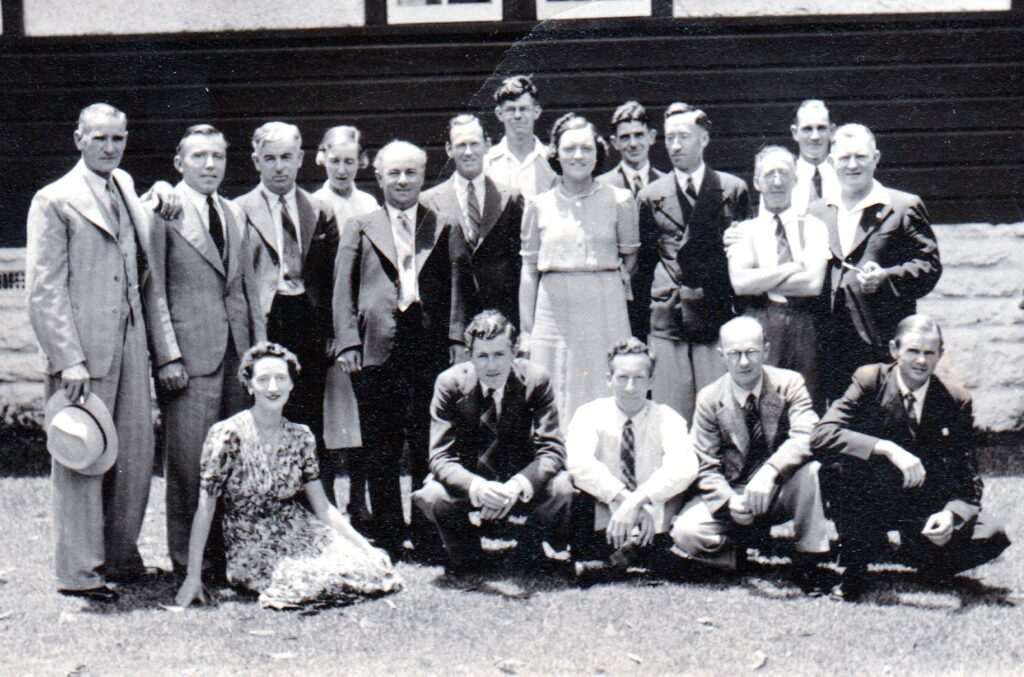
In 1936 auditions, overseen by Ernest J. Roberts, were held in order to establish a nucleus of Perth musicians to augment the 6.W.F. Studio Orchestra for public concerts given by the Perth Symphony Orchestra.
1930s Perth Studio Orchestra in front of old ABC building.
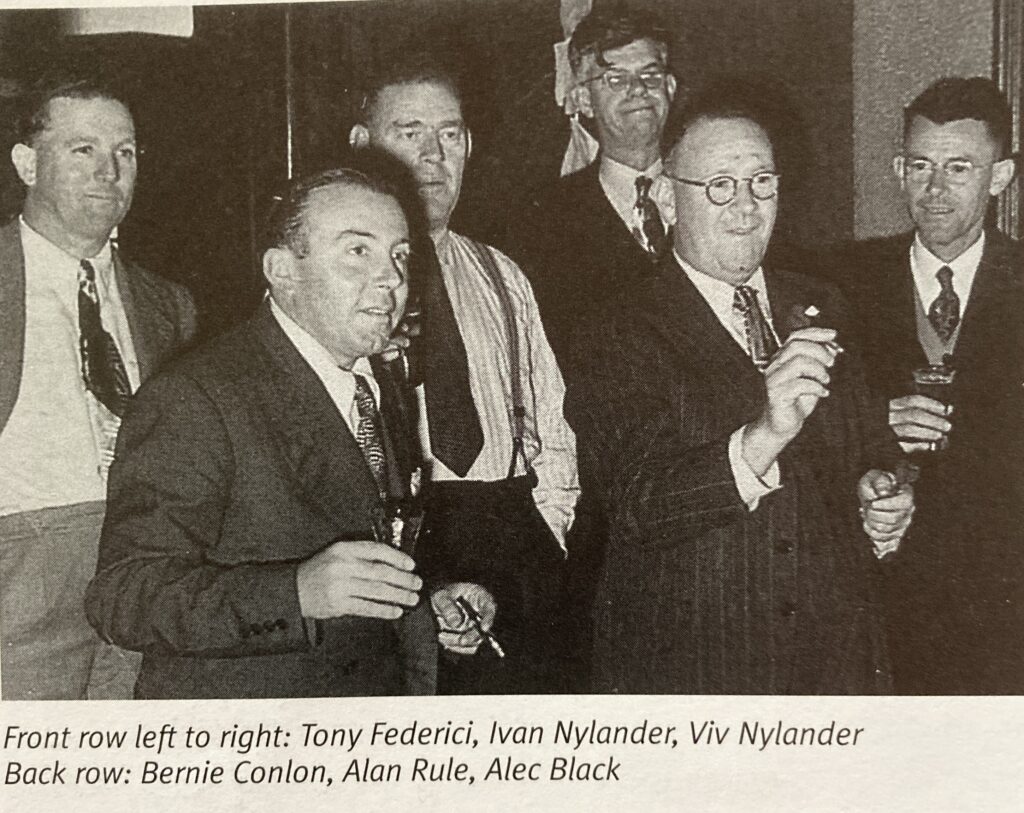
BACK L-R: Fred Flint, Tony Federici, Harry Singleton, Rima Swain, Lazar Sverdloff, Ivan Nylander, Alec Black, Vera Rees, Percy Newton, William Glassford, George Davies, Bob Trew, George Mellor.
FRONT: ?, Vaughan Hanly, Dave Kember, Harold Thornton, ?.
Music Teachers Gather In Force
THE W.A. Music Teachers Association held its monthly meeting in the Assembly Hall last Saturday night. Despite the cold and wet weather, a large gathering of members and friends was present. They were received by Mr. R. J. Bastian President) and Miss J. L.nYoung (honorary secretary). The hall was prettily decorated with wattle and palms, and on the small supper tables were vases of yellow and white daisies and gold and orange marigolds. Varied Music A delightful programme of choral and instrumental music was presented by members of the association, those taking part being: Mr Frank Robertson’s Ladies’ Choir, in part songs, by Sweeting, Harrison, Pery Buck, Walter Davies and Dr. Rigby; Madame Layton Gaubert, two Brahms’ songs with viola accompaniment by Mr. David Powell; Miss Olga Willson, pianoforte solo, ‘The Lark’ (Glinka); Messrs. A. Black, A. Gamba and S. T. Morley, string trio, ‘Serenade’ (Dohnanyi); Mrs. W. McRostie, two monologues, accompanied by Mr. H. Black; Messrs. A. Gamba’and E. S. Craft, viola and piano duet, ‘Sonate’ (Gorke Bowen): Miss Evelyn Shotter and Mr. David Powell, violin and viola, Mozart Sonata. At the conclusion of the programme a hearty vote of thanks’to the performers was moved by Mr. Dean and seconded by Mr. A. R. Wood. An enjoyable supper concluded the evening. Among The Assembly Those present included Mr. R.J. Bastian (president), Mr. and Mrs. A. J. Leckie, Mr. and Mrs. Cecil Mason, Mr. and Mrs. E. S. Craft, Mr. and Mrs. A. R. Wood, Mr. and Mrs. H. Dean, Professor P. H. and Mrs. Fraenkel. Mr. and Mrs. N. E. Moran, Mr. and Mrs. R. H. Hamilton, Mr. and Mrs. F. Tate, Mr. and Mrs. R. Robinson, Mr. and Mrs. R. Mooney, Mr. J. Clifton, Mesdames Layton Gaubert, Howard Birt, E. M. McRostie, M. Nicholas, M. Ferres, J. Sheppard. L. Richardson, P. Boesser, E. J. McMonagle and B. N. Hinewood; Misses Trixie Shephard, Meta Pickering, Joy Fordham, Barbara Leckie, G. Thornbury, E. J. Purcell, D. S. Gray, M. Frape, A. P. Ringer, L. Howell, Adela Harris, Evelyn Robson, Jean Hamilton, M. Grigg, Ella Peterson, Joy Saunders, P. Willows, M. and D. Boesser, D. Warrick, L.. L.. Shenton, N. . Henfrey, Ena Corser, W. Seddon, A. MacAndrew, J. Hord, R. Birkhead. Phyllis Daly, Edna Warren; Messrs. J. Clifton, Frank L. Robertson, S. T. Morley. David Powell, A. R. Wood. Alec Black, C. Warren, C. Gamba and Keith Devenish.
Daily News (Perth, WA : 1882 – 1955), Wednesday 8 July 1936, page 8
1939
Royal Schools Music Club. LARGE bowls of poinsettias, tinted banksia, chrysanthemums and roses made an attractive decorative scheme at the Karrakatta Club Hall when the Royal Schools’ Music Club entertained many guests and members on Saturday evening. The president (Mrs. Cecil Mason) received at the entrance to the hall, and chose for the occasion a frock of jade green chiffon with touches of silver. She was assisted by the secretary (Miss Gwenyth Greaves), who wore a frock of eau de nil georgette with corsage spray in violet tonings, and the assistant secretary (Miss Marjorie Wyndham), who chose a frock of delphinium blue taffeta patterned in gold and silver. Mrs. Mason extended a cordial welcome to the guests, and in doing so referred to the fact that Miss Wyndham had been notified that as a result of the recent examinations she had been successful in gaining the diploma of Fellowship of the Trinity College of Music, London, and took the opportunity of extending to Miss Wyndham and her teacher, Miss Ida Roberts (who is also a member), the club’s congratulations on this achievement. The programme of entertainment arranged by Miss Wyndham opened with an interesting paper on “Sir James Barrie,” by Miss Dorothy Mark. This was followed by one of Sir James Barrie’s plays, “Seven Women,” which was presented by the following cast:~Misses Joyce Mortlock and Dorothy Mark, and Messrs. Harold Harvey and Frank O’Grady. A musical programme was also enjoyed, to which the following artists contributed:-Miss Jean Robinson (piano solo), Miss Hilda Black and Mr. Alec Black (sonata for violin and piano), Miss Dorothy Arnold (vocal soli, accompanied by Miss Margaret Cunningham), Miss Joyce Glasson (piano sol), Misses Elvie Arnold and Elvie Rodstedd (vocal duets accompanied by Miss Yvonne Rees), and Misses Mina Chapman and Jean Robinson (sonata for violin and piano). Supper served by the committee brought the evening to a close.
West Australian (Perth, WA : 1879 – 1954), Tuesday 16 May 1939, page 3
1941
Mr. and Mrs. W. H. Black entertained on Wednesday evening at their home in West Leederville, in honour of Miss Rona Wedgwood’s approaching marriage to Mr. Alec Black. The party took the form of a miscellaneous tea, and many attractive gifts were received. Competitions and games helped to pass the evening.
Among the guests were Mr. and Mrs. Tregoweth, Mr. and Mrs. Maschmedt, Mrs. Noel Pros-er; Misses Beryl Wedgwood, Lexie Wigmore, Kathleen Slapp, May Haigh, Gwen Gamble, Ottilie and Amanda Strempel, Tess McCaul, Edith Doel, Bid Bounsell, Amy Tunstall, Eileen Tregoweth, Freda Stevens, Messrs. John Townsend and Roy Collinson.
Sunday Times (Perth, WA : 1902 – 1955), Sunday 18 May 1941, page 18
Evening of Music.
MEMBERS of the W.A. Music Teachers’ Association and many friends met last Saturday night at the Burt Memorial Hall and listened to a programme of music by local composers. The programme was arranged by Mr. Edward Black. The president, Mr. F. L. Robertson, with Mrs. Robertson, and the hon. secretary, Miss J. L. Young, received the guests. Mr. Edward Black gave an introductory paper on “The Guild of Australian Composers.” This was followed by songs by Mrs. Carroll, Paul Buddee, Edward Black, and Otto Kaye, sung by Miss Lorna McKean; four sketches for violin and cello, composed by Lazar Sverdloff were played by Madame Zlata Kalmikoff and the composer; song by Miss Lorna Ford. sung by Miss Boesser; songs by Roy Wood, sung by Mr. Frank Robertson: piano solos by Alec and Edward Black played by Edward Black; and songs by Miss Florence Hcdd. sung by Miss Gertrude Hutton. At the conclusion of the music supper was served on tables gay with yellow and orange tinted flowers.
West Australian (Perth, WA : 1879 – 1954), Wednesday 2 July 1941, page 8
Music Club Entertains. Members of the Royal Schools Music Club entertained last Saturday evening at the Karrakatta Club hall. The president (Mrs. Cecil Mason), who received the guests, wore a black satin figured skirt with white satin bodice and coral accessories. The programme was arranged by Miss Marjorie Wyndham and assisting artists included Mr. and Mrs. Alec Black (violin and piano), Myrel Frape (songs accompanied by Marjorie Wyndham), Joyce Glasson (piano) and Lottie Dean (songs, accompanied by Mr. Dean). Misses Joyce Marshall and Mina Chapman were the winners of a competition arranged by Marjorie Wyndham.
West Australian (Perth, WA : 1879 – 1954), Thursday 14 August 1941, page 3
1950
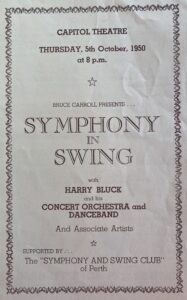
1950 Symphony in Swing program cover
Thursday, Oct. 5th – Capitol Theatre at 8pm – 1950’s GREATEST MUSICAL SHOW
Bruce Carroll presents – Symphony In Swing
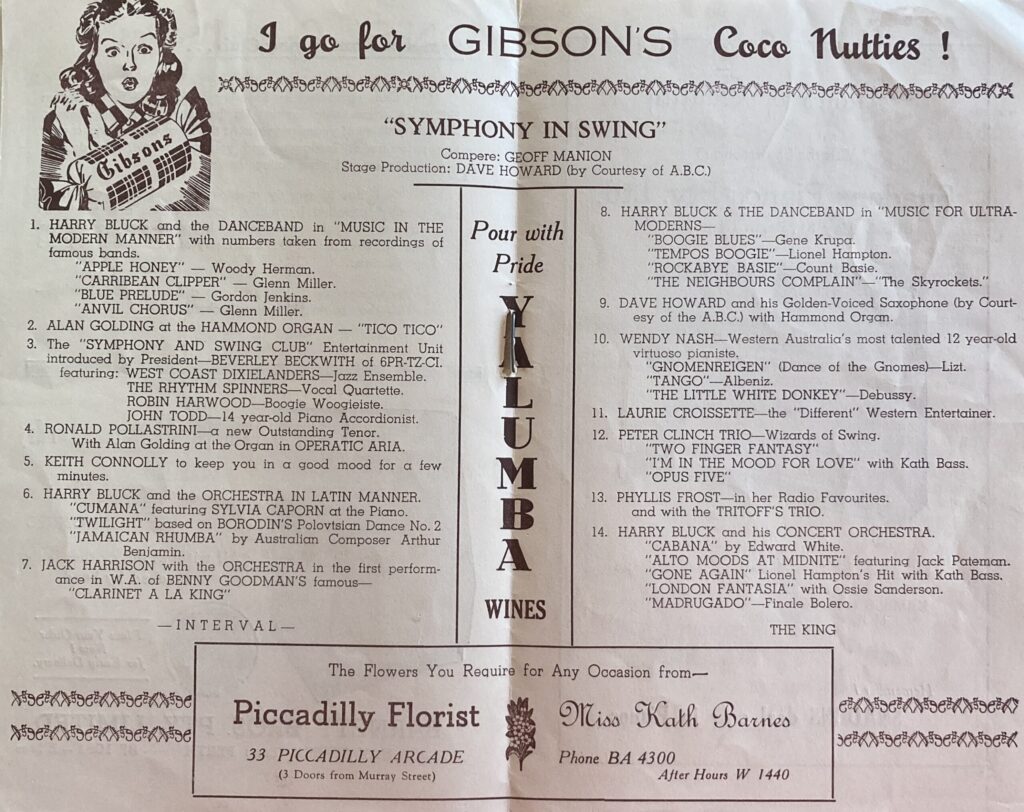
With Harry Bluck’s Concert Orchestra and Dance Band, Over 50 Leading Musicians and Radio Artists, Wendy Nash — 12-year-old Virtuoso Pianiste, Jack Harrison — Clarinet Star of the West, Ossie Sanderson — 16-year old ‘London Fantasia’ Soloist, Phyllis Frost — International Broadcasting Vocaliste, Ronald Pollastrini — W.A.’s Outstanding Lyric Tenor, Tritoff’s Trio — First appearance of Radio Vocal Trio, Kath Bass — Star Rhythm Vocaliste, Alan Golding — Leading Exponent of Hammond Electric Organ, Peter Clinch trio — Wizards of Swing, Dave Howard — and His Golden Voiced Saxophone (By Courtesy A. B.C.), Keith Connolly — Sophisticated Humorist, Laurie Croissette — Tho ‘Different’ Western Entertainer ,Symphony and Swing Club’s Entertainment Unit with West Coast Dixielanders — State’s smartest Jazz Ensemble, John Todd — 14-year-old Star Piano Accordionist, Rhythm Spinners — State’s leading Male Modern Vocal Group, Robyn Harwood — Boogie Woogie Specialiste, Beverly Beckwith — Co-Compere of S. and S. Club Group. Compere: Geoff Manion. Stage Production: Dave Howard By Courtesy A. B.C. PRICES : 3/- 4/- 5/- (plus tax). Box Plan at Nicholsons Limited. The Daily News Monday 25 September 1950 page 12
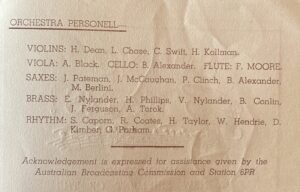
1950 Symphony in Swing program
October 5 1950 Symphony In Swing
On October 5, a concert entitled “Symphony in Swing” will be presented in the Capitol Theatre. Produced by Harry Bluck, whose concert orchestra and dance band will give a number of items, the programme will include varied numbers by local artists, many of whom are under 20 years of age. The 12-year-old pianist, Wendy Nash, will give a classical group, Jack Harrison, the young clarinettist will give the first West Australian performance of a number entitled “Clarinet a la King,” and the 16-year-old pianist Ossie Sanderson, will present “London Fantasia.” Other artists will be Ronald Pollastrini, tenor, and a new vocal group, the Tritoffs, who will be making their first public appearance. They will be associated with Phyllis Frost, the blind vocalist. There will be many other singers and instrumentalists. Western Mail Thursday 28 September 1950 page 23
A West Australian composer, James Penberthy, offered us last night what in some ways the most adventurous Australian composition so far heard in the Art Gallery programmes. This includes, notably, his medium of expression; a wind quintet consisting of flute, oboe, clarinet, horn and two bassoons. For this unusual combination Mr Penberthy had produce a work in short, linked movements, based on the music and life of Australian aborigines. He obtained interesting effects in the way of atmosphere and drastic colourings, but his score sounded very fragmentary. It seemed often to be hovering uncertainly between outright imitative realism and the freer imaginative flight which, we felt, should not convincingly emerge. Another unusual inclusion was a set of three nicely fanciful songs for soprano and flute (no piano) by John Gordon, the words being taken from Chinese. The rest was chiefly light music, generally pretty in a conventional style. There were two pieces for flute and piano by A.C. Black (a West Australian), clarinet and piano pieces by Dulcie Holland and Moneta Eagles, songs by Horace Keats and Elizabeth Mills. The performers were Sylvia Biddle (soprano), Owen Fisenden (flute), Jack Harrison (clarinet), Neil Pierson (horn), Ron Richmond (oboe), George Dreyfus and Claude Welling (bassoons) and Phyllis Allen (accompanist).
1967
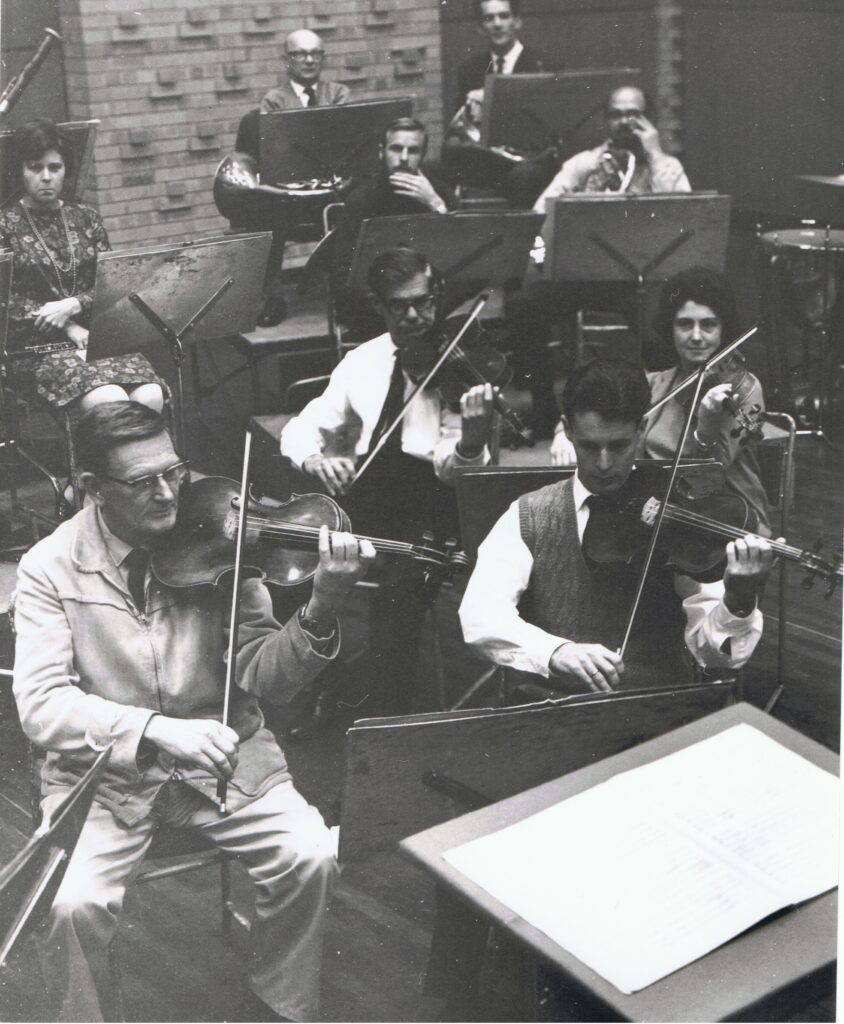
1967 WASO viola section
Alec played in the viola section of WASO for over 40 years up until at least 1976.
Alec died in December 2000 aged 88.
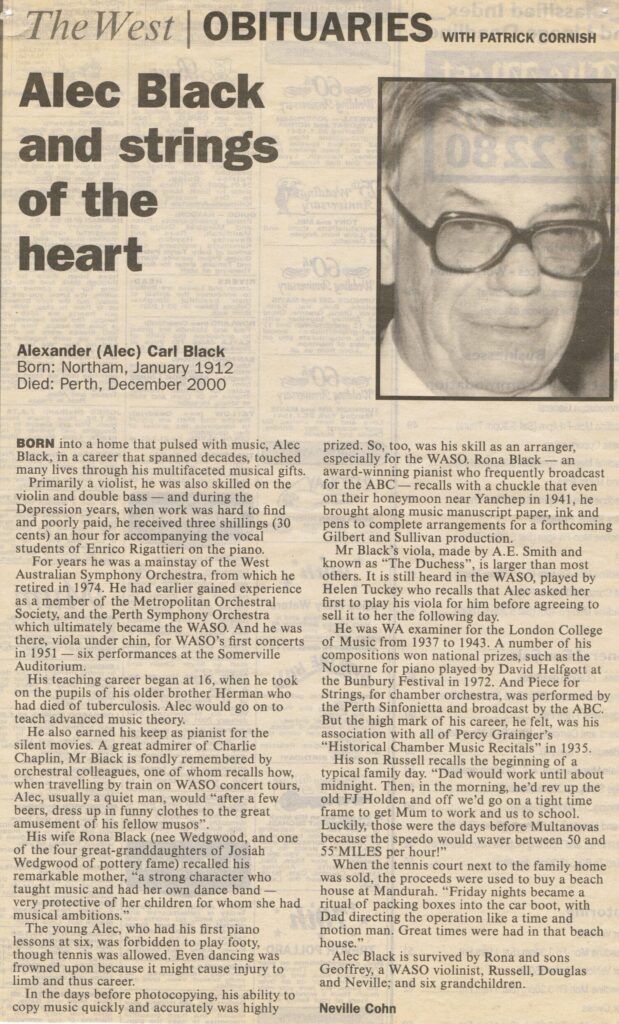
Alec Black obituary: The West Australian by Neville Cohn
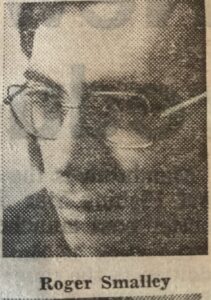
A prominent and versatile figure in contemporary music, Roger Smalley AM was born near Manchester, England in 1943. He studied piano with Antony Hopkins and composition with Peter Racine Fricker and John White at the Royal College of Music, London. He also took private composition lessons with Alexander Goehr and furthered his studies with Karlheinz Stockhausen on the Cologne Course for New Music.
Roger Smalley’s compositions have been performed and broadcast world-wide. He has been commissioned by many prestigious organisations and groups, including the BBC, ABC, West German Radio, Festival of Perth, London Sinfonietta, Australian Chamber Orchestra, Fires of London, Flederman, Nova Ensemble, Seymour Group and Australia Ensemble. His works feature on more than 20 commercially released CDs.
Roger Smalley
As a young composer, he was awarded the Royal Philharmonic Society Prize for his orchestral work Gloria Tibi Trinitas. His Piano Concerto, a BBC commission for European Music Year (1985), was the recommended work in the annual UNESCO Rostrum of Composers in 1987. This was the first time the Australian Broadcasting Corporation’s entry made it to the top of the list. In 2007, Smalley’s orchestral piece Birthday Tango (recently retitled Footwork) received the Australian Classical Music Award in the category ‘Best composition by an Australian composer’.
As a pianist, Roger Smalley was widely recognised for his performances of contemporary music. Early in his career, he was a prize-winner in the Gaudeamus competition for interpreters of contemporary music (1966), and received the Harriet Cohen award for contemporary music performance in 1968. In 1969, together with Tim Souster, he formed Intermodulation, an ensemble specialising in works involving improvisation and live electronics, which performed throughout England and Europe until 1976.
As a performer, Roger Smalley mastered a wide variety of solo and chamber music – he also appeared as a conductor. In 1989, he became the first Artistic Director and conductor of the West Australian Symphony Orchestra’s 20th Century Ensemble, continuing until 2000. His recordings as pianist and conductor have been released, among others, on the ABC Classics and Tall Poppies labels.
Smalley’s academic career was closely tied to his activities as a composer and performer. In 1968, he was appointed the first Artist-in-Residence at King’s College, Cambridge, where he subsequently held a three-year research fellowship. He came to Australia initially for a three-month composer residency at the University of Western Australia in 1974. He returned two years later to become a research fellow and subsequently Associate Professor of Music. In 1996, he was appointed a professiorial Research Fellow at the UWA. He was Emeritus Professor and Honorary Senior Research Fellow at The University of Western Australia and Honorary Research Associate at the Sydney Conservatorium of Music.
In 1991 he was the recipient of a Creative Development Award from the West Australian Department for the Arts, and was elected a Fellow of the Australian Academy of the Humanities. In 1994 he was awarded the Australia Council’s prestigious Don Banks Fellowship ‘in recognition of his distinguished contribution to Australian music’. He received the Australian Government Centenary Medal in 2001 and was proclaimed a Western Australian Living Treasure in 2004. In 2011, Smalley was appointed a Member of the Order of Australia (AM).
In 2015, Roger Smalley moved from Perth to Sydney where he lived until his death on 18 August 2015.
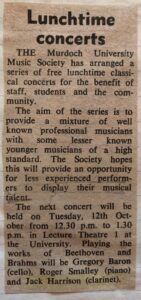
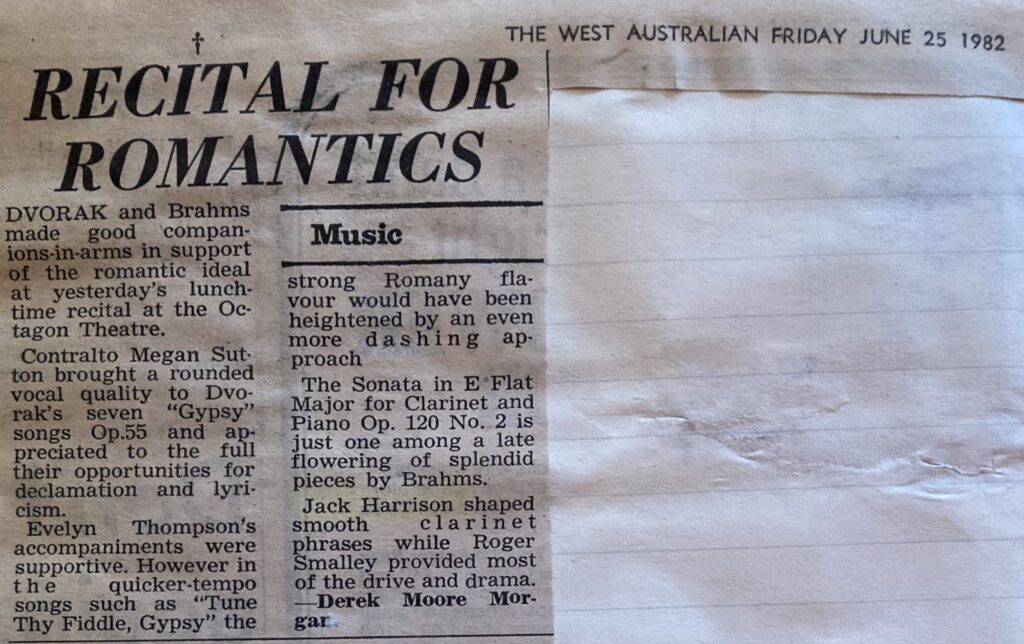
1977 Lunchtime Concert: Baron, Smalley, Jack Harrison
Lunchtime Concerts
Tuesday October 12th 1977
The Murdoch University Music Society has arranged a series of free lunchtime classical concerts for the benefit of the staff, students and the community. The aim of the series is to provide a mixture of well known professional musicians with some lesser known younger musicians of a high standard. The Society hopes this will provide an opportunity for less experienced performers to display their musical talent. The next concert will be held on Tuesday 12th October from 12.30pm to 1.30pm in Lecture Theatre 1 at the University. Playing the works of Beethoven and Brahms will be Gregory Baron (cello), Roger Smalley (piano) and Jack Harrison (clarinet).
1981
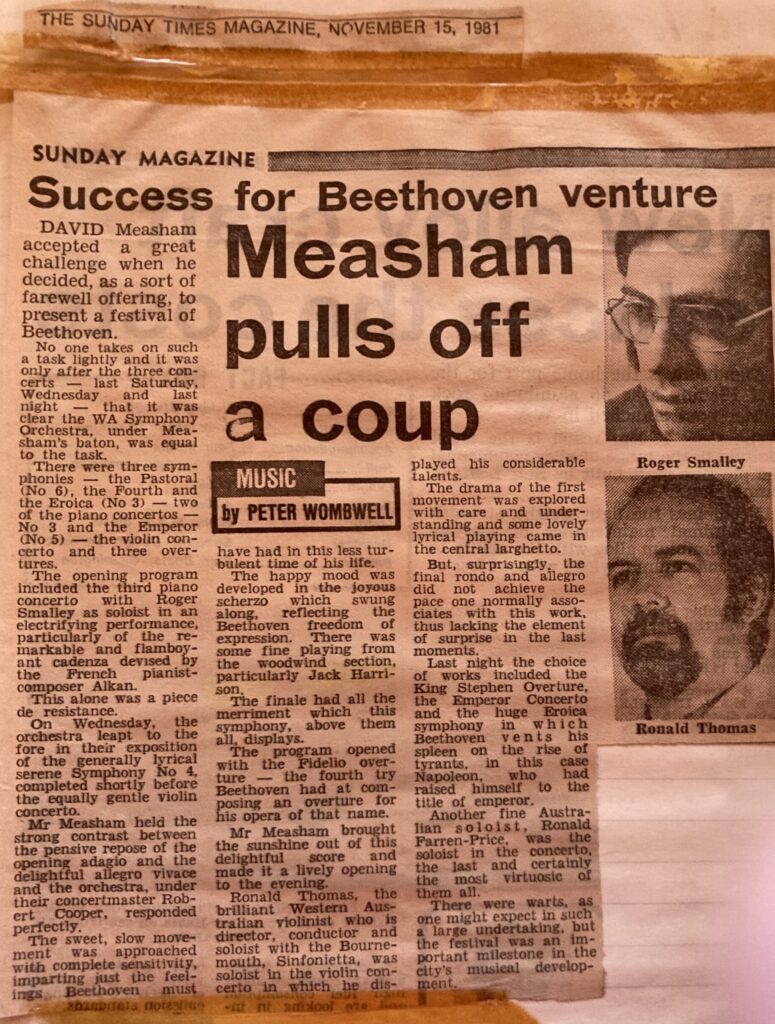
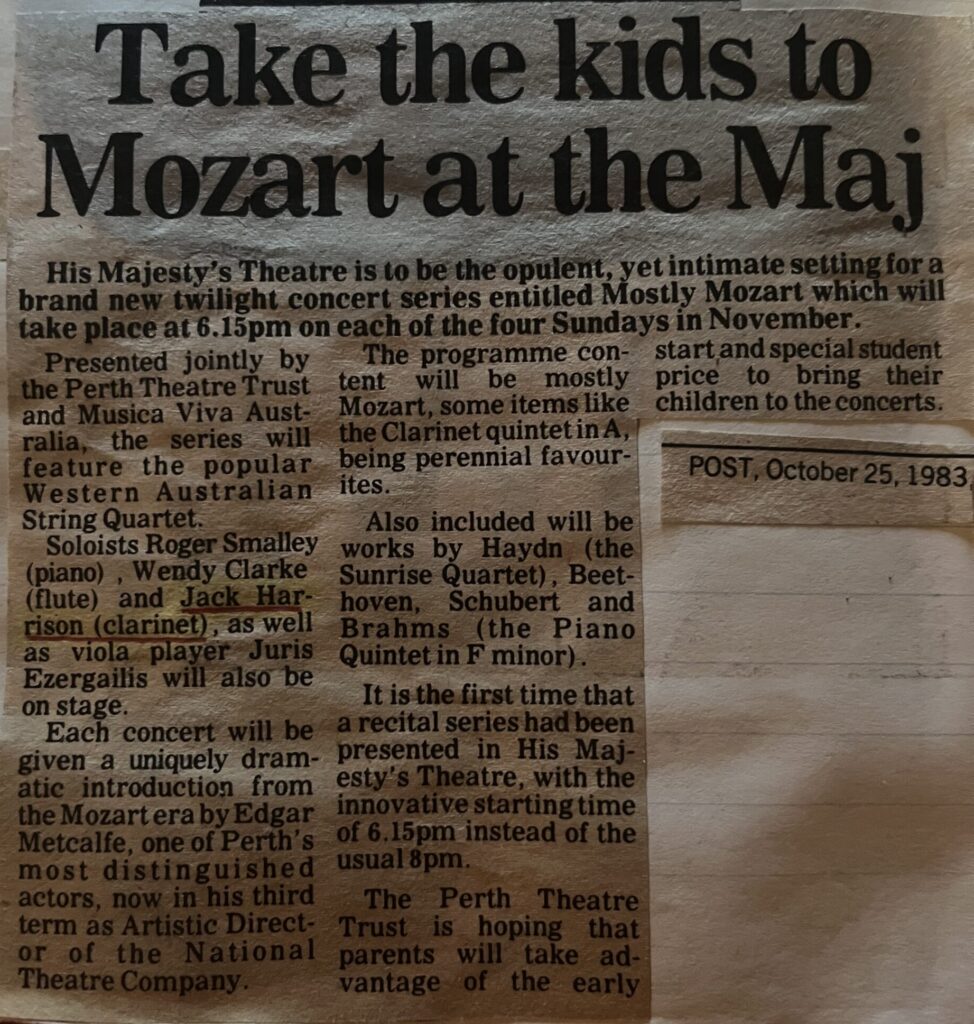
Measham pulls of Coup: Roger Smalley, Ronald Thomas
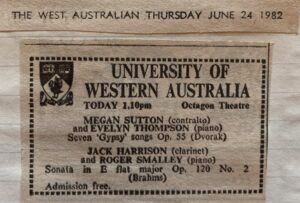
University of Western Australia
1.10pm Thursday June 24th 1982
Megan Sutton (contralto)
Roger Smalley (piano)
Jack Harrison (clarinet)
Sonata in E flat major Op. 120 No. 2 (Brahms)
1983
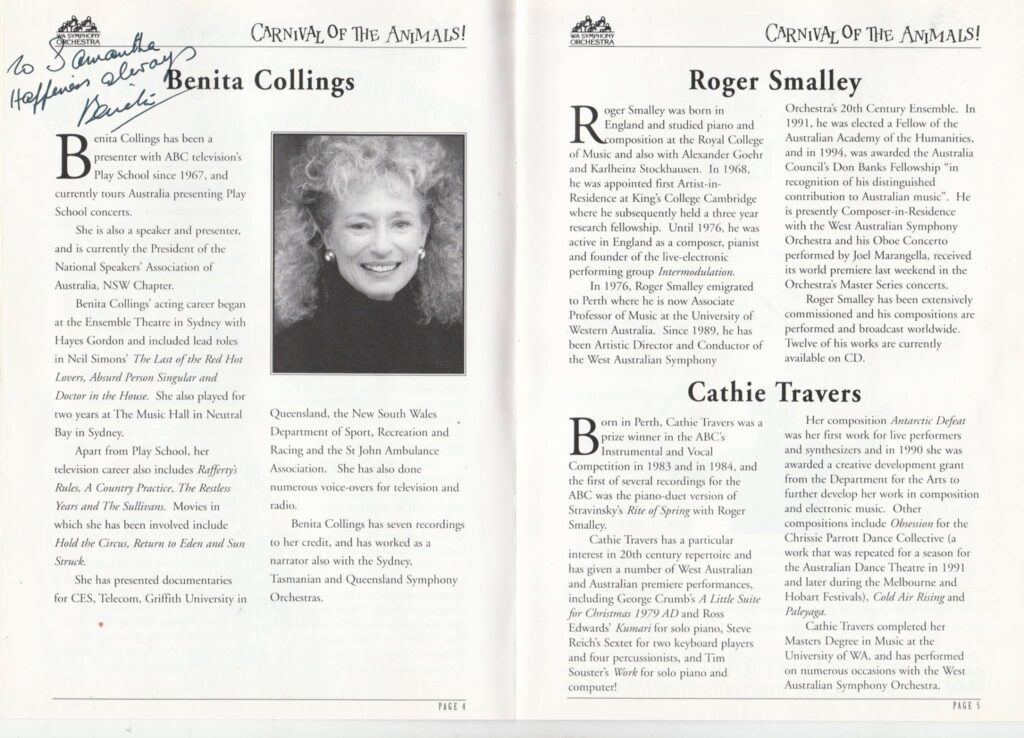
WASO Carnival of the Animals Concert – Presented by Benita Collings, Soloists Smalley, Travers
The British-born composer Roger Smalley, who has died aged 72, was not only one of the most distinctive composers of the post-second world war generation; he was also active as a pianist, teacher and concert organiser. Following a composer residency at the University of Western Australia in Perth, he took up a permanent post there, and went on to be a significant force in Australian musical life for four decades.
Roger Smalley left Britain for Australia, and became a significant force in musical life there for four decades. Photograph: www.rogersmalley.com
His first published works – the Variations for Strings (1964), Piano Pieces I-V (1965) and String Sextet (1965) – pointed to his interest in new and experimental music. But they also showed an incipient interest in Renaissance music that came to the fore in a series of works based on keyboard pieces by the 16th-century organist and composer William Blitheman. Two works called Gloria Tibi Trinitas (one for orchestra, 1965, the other, which won a Royal Philharmonic Society prize, for soloists, chorus and orchestra, 1966) were followed by his Missa Brevis (1967) and two works called Missa Parodia (one for piano, the other for piano and ensemble, both 1967).
Smalley nonetheless retained an individual voice, and was critical of what he considered to be the over-prescriptive approach of Pierre Boulez. In 1965-66 he studied with Karlheinz Stockhausen in Cologne. The music that Smalley wrote for Intermodulation – the live-electronics ensemble he co-founded with Tim Souster, Peter Britton and Robin Thompson – reflects a degree of influence by Stockhausen, but is less mystical in character.
Accord (1975), for two pianos, first performed by the composer with Stephen Savage, was the work he regarded as his “real” Op 1. It is both brilliantly structured and powerfully communicative. A recording by the pianists Daniel Herscovitch and Erzsébet Marosszéky was released earlier this year on the Continuum label.
Like a number of other works, Accord was inspired by the view from a high point of Perth and its environs. Australia made a great impact on him during his visit there in 1974, and he returned to make it his home for the rest of his life, moving to Sydney in 2007. Works created in his adopted country included Didgeridoo (1974), for four-track tape, and, for orchestra, Diptych (Homage to Brian Blanchflower, 1991), based on some of the Perth-based dedicatee’s artworks, and Close to the Edge (1995), inspired by the miniatures of another Western Australian artist, Lesley Duxbury.
The Scherzo from Roger Smalley’s Piano Trio
However, Smalley never simply nurtured a confined territory of his own: he remained open to ideas in music of all periods, as in a series of works based wholly or partly on the mazurkas of Chopin, notably his Variations on a Theme of Chopin (1989), Piano Trio (1991) and Poles Apart, for a mixed quintet of wind and strings (1992). All three can be found on a recording on the NMC label, Poles Apart and Other Chamber Works (2004).
Of his larger-scale works, his Symphony was premiered at the BBC Proms in 1982, and he was the soloist in his Concerto for Piano and Orchestra when it was commissioned by the BBC for European Music Year 1985; the two were coupled on a CD for Vox Australis (1987). The Cello Concerto was first performed in Perth in 1997 by Raphael Wallfisch, to whom it was dedicated, and is included in a recording titled Kaleidoscopes, on ABC Classics (2003).
An excerpt from Roger Smalley’s Pulses, 1969, revised 1986
A native of Swinton, near Manchester, Roger was the son of Lionel Smalley, a secondary school headteacher, and his wife, Dorothy, the school secretary. Roger took to playing the piano as if performing at the Royal Albert Hall, so his father made a key for the existing piano lock to restrict his access to the instrument in the hope that the boy would do some homework. From Leigh grammar school, he won a scholarship to the Royal College of Music, London, to study the piano with Anthony Hopkins and composition with Peter Racine Fricker, John White – a CD of whose piano sonatas he recorded for NMC (1997) – and, privately, with Alexander Goehr.
I first met Smalley when he was at the RCM, and, impressed by his brilliance as a pianist, later invited him to give a recital at Kingston Polytechnic, south London, where I was music director. We were both on the committee of the Macnaghten Concerts, promoting contemporary music, and had great fun trying to bring up to date what was by then a rather conservative organisation, on one occasion attracting a large audience to the Queen Elizabeth Hall in London for a programme featuring both Intermodulation and rag music by Scott Joplin.
Roger Smalley playing Piano Sonata No 95 by his former teacher John White
In 1989, Smalley became the first artistic director and conductor of the West Australian Symphony Orchestra’s 20th Century Ensemble, which he continued to conduct until 2000. He received the Australian government centenary medal in 2001, was proclaimed a Western Australian Living Treasure in 2004, and, in 2011, was appointed a Member of the Order of Australia.
In 1967 he married Sarah Roe. The marriage ended in divorce, but they remained good friends. He is survived by his partner, Patricia Benjamin, the children from his marriage, Rachel and Davey, and three granddaughters.
Roger Smalley, composer and pianist, born 26 July 1943; died 18 August 2015
The music world has marked the passing of British/Australian composer Roger Smalley this month. Smalley died from Parkinson’s on 18th August 2015. He was well known in Western Australia because he was lecturer of composition at the University of Western Australia for three and a half decades and among other things founded the WASO 20th Century Ensemble. In 2004 he was proclaimed a State Living Treasure.
Vincent Plush in The Australian credited Smalley with putting Perth, the most isolated capital in the world, on the musical map.
WASO artistic planning manager Evan Kennea who studied composition under Roger Smalley agreed.
“Through his association with WASO, his brilliant music, his significant academic career, his exceptional performances and recordings as pianist and his inspirational support of young and emerging talent, Roger Smalley was a galvanising influence on the music world of Perth,” Kennea said.
Smalley’s funeral was on 26th August in Sydney, his home since 2007. Several eulogies were shared including one by WA French horn player Darryl Poulsen which has been reprinted below with permission. There was a request made that any floral tributes at the funeral be replaced instead with donations to the Australian Music Centre – a fitting tribute for a man whose life was all about music.
Roger Smalley Eulogy by Darryl Poulsen
Darryl Poulsen read this eulogy at Roger Smalley’s funeral celebration in Sydney on 26 August 2015.
My name is Darryl Poulsen. I am fortunate to have been a friend and colleague of Roger Smalley’s for more than three decades. I was his academic colleague at the University of Western Australia, and have performed with Roger many times over those years.
There are many people who have been a large part of Roger’s life, and I would like to acknowledge some of them here. Roger’s family: Rachael and Davey, daughter and son; their mother and Roger’s former wife Sarah; and Peter, his brother. They have all, from afar in the United Kingdom, been a very special part in Roger’s life. I had the good fortune of meeting a number of his UK family, either over there whilst on tour with Roger, or at special occasions here in Australia. I was struck on those occasions by the obvious love and affection between them, undiminished by the many thousands of kilometres separating them.
Roger lived for many years in Western Australia, and no doubt there are many colleagues and friends there, many of whom are not able to be here today.
Finally I would like to acknowledge Roger’s partner Pattie Benjamin and her children James, Sarah and Tim. They have all been a significant part of Roger’s life here in Australia. Pattie has provided unfailing support to Roger over many years. Support which has endured both the good times as well as the challenging times, such as his several recent bouts of ill-health. This enabled Roger to focus on his music, providing him with both a secure domestic base, as well as a keen interest and support, in all aspects of his musical career.
To all of Roger’s family and friends, I extend my deepest sympathies.
To talk about Roger the person, one has to talk about Roger the musician, for they really were one and the same. Composer, pianist, chamber musician, conductor, educator, and music critic: Roger was all of these, and his contributions to each were distinguished.
Extensive details of Roger’s background and achievements are readily available elsewhere, so I shall not use this occasion to recount them here. Suffice it to say, the list of musicians with whom he studied; prizes won, both as composer and performer; prestigious commissions; and significant honours and awards speaks for itself.
A self-effacing person by nature, the honours and awards are all the more appropriate recognition of the profound importance of Roger’s contribution to the arts.
Prior to coming to Australia, Roger was enjoying much artistic success in the UK and Europe. Fate of another kind, however, visited him, in the early 1970s. Professor Frank Callaway, then Head of Music at the University of Western Australia, contacted Roger during a visit to the UK seeking a meeting with him. Sir Frank, as he later became, was indefatigable when it came to enticing distinguished, talented international musicians to visit his Music Department in the most isolated capital city in the world, Perth.
The rest of that story is now history. Roger accepted Frank Callaway’s invitation for a three-month composer in residence position at UWA, arriving there in 1974. Three years later, he returned to Perth to take up an ongoing academic appointment at UWA. Naturally, his work as composer and performer was closely linked to his academic work. Roger spent three and a half decades at UWA, during which time he became a Professorial Fellow.
One can only begin to imagine the initial cultural readjustment Roger must have had to make when arriving in Perth from London. It seems however that, ultimately, this geographical and cultural displacement provided Roger a unique opportunity to seek new musical inspiration.
One such example was the stimulus he derived from his interest in visual arts, especially paintings and installations. His collaboration with artist Brian Blanchflower inspired the piece: Diptych: Homage to Brian Blanchflower, which, I am advised, Roger considered one of his finest. A similar collaboration with the printmaker Lesley Duxbury, also resulted in his piano quartet, both named and structured, after her artwork Crepuscule.
In Roger’s own words, he described the influence of visual art in an interview with William Yeoman:
‘….. up until the time I moved over here [Perth], I had never written anything at all with a visual stimulus. All of these pieces have been written here. So I think that being in a country where landscape and vastness and distance are all part and parcel of existence, obviously awoke a side of me which hadn’t been obvious before.’
Looking back now, one must acknowledge that Australian music is indeed the richer for the foresight of Frank Callaway all those years ago.
I would now like to offer some brief reflections on Roger. Two colleagues, Alan Bonds and Cathie Travers, recently shared their thoughts and recollections of Roger with me. Alan Bonds, violinist/violist, reminisced with me about Roger, when he first arrived in Perth, and when Alan himself was an undergraduate student in a number of Roger’s classes. The following are a few random recollections:
Although Roger’s interest, and indeed reputation, was firmly based in electronic music, we were all amazed that he would be interested in playing in regular chamber music sessions. Sight-reading substantial works, piano quartets and quintets, of Schubert, Schumann, Brahms etc., we were astonished that Roger would not only sight-read anything, but also play flawlessly. His intuitive grasp of music made for an enthralling experience for his musical partners. Although coming with the extreme intellectual tendencies of the Cologne and Darmstadt Schools, he still enjoyed playing the beauty in the music of Schubert and Brahms. He was just a great musician who importantly, knew where he came from. Studying and playing the music of the Second Viennese School with Roger was a formative influence. In particular, performing Schoenberg’s Pierrot Lunaire with Jane Manning and Roger was unforgettable, the performance was transformative. Interestingly, like Stockhausen, Roger also discovered that humans make better music than machines. He wrote very challenging music. Roger was a modernist through and through, and he held his faith to the end. His teaching was as rigorous as it was spontaneous and inspirational. He had a unique ability to see into the very heart of the music, and communicate it.
Cathie Travers offered the following insight into Roger’s influence at UWA:
Roger was not an especially good ‘piano’ teacher in the sense of helping to develop an advanced instrumental technique. But he was a great teacher about music. His sight-reading skills were fabulous. At the piano, Roger automatically started collecting and collating information on the elements of the score and the way the musical structure hung together [or failed to do so, as the case may be]… his hands responded to the flood of musical information pouring out of his brain, and his fast physical responses meant his read-throughs of complex scores were astoundingly accurate. He tended to drive a car in a similar manner: information in, and quick response reactions out; it could be a bit harrowing in the passenger seat of the car though. I think it’s fair to say that his fascination with musical structure informed his every moment of existence as a musician, whether he was performing, educating, arranging or composing.
My own first recollection of Roger goes back to 1981. Returning to Australia from studying and working in Europe, I first met Roger when enrolling as a postgraduate student at UWA. I was extremely fortunate to have had Roger working with me performing in a number of recitals and chamber music concerts, as part of my postgraduate program.
No sooner had we commenced our musical projects, Roger decided to expand the horn literature by writing a new work for me. This was Echo IV. Written for horn and tape delay, it was the last in a series of works for solo instrument and tape delay. This was the pre-digital era, when electronics were still largely analogue.
Performing the work set considerable challenges. In particular, mastering the logistics of a tape delay system, comprising two reel-to-reel recorders stretched some distance across the auditorium, syncing the resultant time delay with an independent click-track, was fraught with unanticipated irregularities. So much so, that on the day of the premiere of Echo IV, it was decided to prerecord the two echos, which would then be played back with the live horn, and click track.
This too, however, proved challenging in performance. Synchronisation of the click-track and the recorded tracks parted company, leaving me with the invidious choice of deciding to play with either one or the other, rather than all together, as the composer intended!
Technological limitations of the day were never an impediment to Roger’s creativity. I remember Roger very distinctly saying that future advances in technology would one day make the playing of this piece, as well as other similar works, easier to realise. He was right of course. Some years later, with the benefit of the arrival of digital delay devices, we were able to perform Echo IV again, this time without click track, and more in the manner that the composer had conceived it.
Eventually, I joined Roger as an academic colleague at the University of Western Australia. During this extended period, more new works were commissioned and premiered.
A notable occasion with Roger was a tour we undertook of the United Kingdom, and Western Australia. Aptly called ‘Crossing Continents’, it was an innovative composition and performance exchange between British and Australian musicians. The concerts featured new works by British composers Dorothy Ker, George Nicholson and Adrian Moore, together with music by Roger, and James Ledger from the University of Western Australia.
Of particular note was the recognition Roger received in the UK. Interested musicians and public simply appeared from everywhere, seeking out Roger Smalley, even as we performed and gave workshops in some of the smaller places like in Surrey, for example. The reverence for Roger and his music was palpable.
Despite his long illness, I do not recall Roger ever complaining. Even in recent times, the world of music still occupied his being. The radio in his room at Lulworth, permanently tuned to ABC Classic FM, broadcast without interruption. I am sure that the presence of this music went some way to transport him from the terrible illness which had overtaken his body.
During a recent visit, I was able to talk with Roger about a composer whose music I had just heard performed in Vienna. The composer was the French Canadian, Claude Vivier. Interestingly, Roger’s body moved in recognition of the name as it was spoken. In a few precious but muted words, Roger was able to share with me his enthusiasm for Vivier’s music, and also relate the common ground they both had with Stockhausen. It was like a brief moment of musical conversation with the old Rog., I knew so well.
Two years ago, I had the good fortune of attending Roger’s 70th birthday celebration. At that event, I was asked to offer a few words about him. I chose to conclude my comments with a quote, which I would like to share once more. The musical idea expressed in the quote, in my opinion, deeply reflects the very essence of the Roger we know so well. The quote, from the journal, The Listener of 12 August 1971, is Roger in his own words, describing the compositional process of his work entitled Beat Music which premiered at the 1971 Proms concert with the ensemble Intermodulation:
‘I am continually trying to get away from the feeling that I am composing the music, and closer to the sensation that the music is composing itself. This sensation, which I experienced more strongly than ever before while writing Beat Music, is extremely difficult to verbalise, but I could describe it as the feeling that if you descend deeper and deeper into the materials of music until you reach the smallest and most insignificant-sounding object (say a C natural so low that it is no more than a click every second), you will merely have to disturb it slightly with the point of your pencil – push it around on the manuscript paper a little – and it will release the most phenomenal amount of energy.’
Farewell Roger.
We are sorry to report the death of RCM alumnus, Roger Smalley, on 18 August 2015. He was a hugely prominent and distinctive figure in contemporary music, both as a composer and a pianist.
Born in Swinton, near Manchester, in 1943, Roger Smalley started learning the piano at a young age. His father, a head teacher, would reportedly lock the piano in order that he should do some homework. He won a scholarship to study at the Royal College of Music in 1961, where he studied the piano with Antony Hopkins and composition with Peter Racine Fricker and John White.
Following an appointment as Artist in Residence at King’s College, Cambridge, in 1968 he then took a short composer residency at the University of Western Australia, later emigrating to Australia in the mid-1970s. He subsequently continued to enjoy a career as an academic at the same University, later moving to Sydney in 2007. In this time, he became a significant figure in Australian musical life, and his adopted country featured prominently in some of his works, notably Accord for two pianos (1975), inspired by the view from Perth and Didgeridoo (1974) for four track tape.
In 1989 he became the first artistic director and conductor of the West Australian Symphony Orchestra’s 20th Century Ensemble. He received the Australian government centenary medal in 2004 and was appointed a Member of the Order of Australia in 2011.
He was awarded the RPS prize for his orchestral work Gloria Tibi Trinitas. He received numerous prestigious commissions, made many recordings and his works were performed and broadcast worldwide. His own performance of his Piano Concerto was the recommended work in the UNESCO Composers’ Rostrum in 1987 – the first time the Australian Broadcasting Corporation’s entry made it to the top of the list.
TONIGHT 7th DECEMBER at Fremantle R.S.L. Hall, South Terrace. Dancing 8 p.m. till 1 a.m. Supper Provided.
Items by such well-known artists as Arthur Murray, ace crooner; Chris Gosper, king of the keyboard. LUCKY SPOT DANCES. DOT WINTON’S BAND. Photographers in attendance.
Daily News (Perth, WA : 1882 – 1955), Friday 7 December 1945, page 16
1947
FIRST JAZZ JAMBOREE – JIVE TONIGHT
Hot music’s deepest groove in years will lead to the Capitol tonight, when 8 leading bands will stage Perth’s first Jazz Jamboree. Outstanding combinations of Merv Rowsfcon, Chris Gosper, Sammy Sharp, John Stirling, Henry Cochrane, Ray Harley, Bill Kirkham and the Hounslow group will present a programme ranging from earliest jazz to modern swing.
Sunday Times (Perth, WA : 1902 – 1955), Sunday 12 October 1947, page 11
MUSIC SWIM
SURFERS at North Cottesloe will have music while they swim next Sunday. An eight-piece band — ‘Chris Gosper and his Music for Moderns’ — will give a jazz concert on the beach on Sunday afternoon. The concert, presented by the North Cottesloe Surf Life-Saving Club, will be the first live-artist musical show to be held on a beach in W.A. A stage is being built on the sand at North Cottesloe on Saturday and a public address system is being arranged so that people on all parts of the beach will be able to hear the music. If this venture is a success, Chris Gosper in conjunction with the North Cottesloe Surf Life Saving Club, will repeat it periodically and may even establish a permanent band for beachgoers.
Daily News (Perth, WA : 1882 – 1955), Thursday 27 November 1947, page 6
1948
Open Air Theatre Built
A big, floodlit open-air theatre has been built for tonight’s Radio Star Show at lower Supreme Court Gardens. The largest of its kind ever to be erected in Perth, the stage has been built among the trees, shrubs and flowers. Among those who will appear are Roy (‘Mo’) Rene, Hal Lashwood, Theo Walters and Jack Burgess. Gates will open at 7 p.m. — an hour before the concert is scheduled to start. Special squads of police will patrol the fences. Motor cycle police will escort the entertainers to the grounds when they arrive here by tonight’s A.N.A. Skymaster. The local artists include Wally Hadley, Ante Soljanic, Nell Shortland-Jones and Chris Gosper and his orchestra. Reserved seats are 6/6 each. Other seats are 3/ each. Money raised by tonight’s concert will aid the Australian Surf Life Saving Association and will boost the Miss Australia Surf Girl contest.
Daily News (Perth, WA : 1882 – 1955), Saturday 31 January 1948, page 18
PERTH RADIO STATIONS USING MORE BANDS AND LIVE ARTIST SESSIONS
Quick survey of local musicians currently airing programmes in Perth shows what a keen interest is being shown by local radio stations, both national and commercial, in presenting “flesh and blood” shows, especially by members of the dance band fraternity. Here are where a few of our leading “outfits” can be heard over the local ether. Sammy Sharp’s Band (featuring a 15 piece combination) and vocalist Peter Boyd are prominent each Thursday evening over station 6PR with a Band Presentation and “Talent Quest” show. Over the same network from Perth Town Hall, Chris Gosper and his “Music for Moderns” are relayed from their weekly midday sessions, which have proved a huge success, and shows signs of developing into something really big. From the same network come many other “live” shows including pianist Warrick Lever, Henry Cochrane and Jimmy Beeson. George Hay and his “Hawaiians”, Billy Barnes’ Hill Billys, Accordionist Harry Bluck, saxophonist Jack Pateman. On the Nationals the weekly show features the “Rhythmettes”, a novelty outfit led by Harry Bluck, while the Jackie Harrison Quintette and Emil also give occasional broadcasts, not forgetting of course, soloist Henry Cochrane. Quick roundup of the other stations tells us of a weekly Sunday Show by the “400 Swingtette” over 6KY, where Chris Gosper and Ralph St. Clair play solo piano sessions, while a prominent Hill Billy movement is also aired by this station.
TONIGHT Patricia Wainwright’s VARIETY SHOW
His Majesty’s Theatre, by Jeff Manion, Chris Gosper, Henry Cochrane and thirty other well known -artists including The Gable Williams Tumbling Rascals. It’s forWooroloo.
Sunday Times (Perth, WA : 1902 – 1955), Sunday 19 September 1948, page 6
1948 The Second Jazz Jamboree
Already the bands concerned in this year’s “Jazz Jamboree” are working on their numbers for this colossal programme which shows every promise of superseding last year’s magnificent turn out. The bands listed to appear so far are – Merv Rowston’s, Jack Harrison’s, Ron Jenkin’s, A Jazz Group, Bill Kirkham’s, Chris Gosper’s and Sammy Sharp’s bands. This year a box plan will be opened and so it is hoped to avoid the terrific crush and queuing that took place last year – the queue was four deep, entirely encircling a complete city block – and was there for a couple of hours in pouring rain. Also – at last – proceeds from this year’s Jamboree go to the Musician’s own Benevolent Fund. Music Maker October 1948
SUNDAY OCTOBER 31st – JAZZ JAMBOREE OF 1948 Capitol Theatre, Sunday Night October 31 – eight leading bands led by Merv Rowston, Sammy Sharp, Chris Gosper, Harry Bluck, Ron Jenkins, Bill Kirkham, Jack Harrison, Ken Murdoch. Box plan at Nicholsons. Adm 2/6 Proceeds to Charity. Harry Bluck, who heads the A.B.C. Rhythmettes, is the brains behind the business and all proceeds go to the Musicians’ Benevolent Fund. The Mirror Saturday October 23 1948 Vol 25. No. 1379
1949 – MELBOURNE
Followers of the Gosper combination will be with me in wishing Chris, who is now studying with the Melbourne Conservatorium, all the best. They tell me that while Keith Whittle (Embassy drummer) and Chris were marking time in Melbourne recently, it was jointly decided to take on a temporary occupation with the South Melbourne Aviation Engineering Supply Co. transferring nuts and bolts by wheelbarrow from one part of the factory to another. In 3 days, the musicians ran into no end of humorous strife. Climax Came when Chris was accidentally ‘crowned’ with a 5foot crow-bar. Chris has been sitting in with the Stork Club and is now with George Watson’s Academy of Music teaching modern pianoforte.
Mirror (Perth, WA : 1921 – 1956), Saturday 30 April 1949, page 14
PERTH PIANIST IN MELBOURNE
Appears Perth pianist Chris Gosper is now well established in Melbourne. He is studying at the Conservatoriom, is on the teaching staff of ex-Perth drummer George Watson. Chris has chosen the trombone as his second instrument of study. He is playing piano at the Colchester night dob. Chris wishes to be remembered to Perth friends.
Mirror (Perth, WA : 1921 – 1956), Saturday 17 September 1949, page 12
1950
Popular former Perth pianist and bandleader Chris Gosper, who took his son Karl, a spastic cripple, to Melbourne 12 months ago for treatment, would have had to return here but for the Red Cross. Mr. Gosper had tried for eight months to find accommodation reasonably close to the Spastic Centre at the Carlton Children’s Hospital. Discouraged, he decided to bring four -year-old Karl back to Perth for treatment. When the Victorian branch of the Red Cross heard of his predicament, it offered to help by caring for Karl at its Welfare House, East St. Kilda,
Daily News (Perth, WA : 1882 – 1955), Monday 1 May 1950, page 9
Iain Grandage composes, conducts and performs. He has received the prestigious Sidney Myer Performing Arts Award, and the Ian Potter Emerging Composer Fellowship, and been composer-in-residence with the Western Australian Symphony Orchestra, and musician-in-residence at the UWA School of Music, where he is currently an Honorary Research Fellow.
Iain’s concert works have been performed by the Australian Chamber Orchestra, the Brodsky Quartet, the Australian String Quartet, Australian Brass Quintet, Jean-Yves Thibaudet, Sara Macliver, Craig Ogden and choirs and orchestras around Australia. Recent highlights include the Victorian Opera production, in 2014, of his opera The Riders, based on the Tim Winton novel with libretto by Alison Croggon. The Riders was described by Michael Shmith (The Age ), as ‘…an opera of rare dramatic power, utmost musicality and first-rate performances’ and by Peter Burch (The Australian) ‘.. a bewitching jewel of contemporary music theatre’. Peter Rose of the Australian Book Review wrote, ‘The real star of the night was Grandage’s radiant new score’.
For the ANZAC Centenary, Iain conducted the Adelaide Symphony Orchestra in the critically and publically acclaimed world premiere performance of his oratorio Towards First Light, written with Kate Mulvany. ‘Grandage shows us intimacy, vulnerability, inspiration, comfort and desolation in this exceptional piece’, wrote Gordon Forrester (Limelight), while Graeme Strahle (The Australian) wrote: ‘this was a memorable world premiere of a major new Australian work. Grandage conducted a polished Adelaide Symphony Orchestra with tremendous flair and energy.’
His compositions for the theatre include Helpmann Award-winning scores for Cloudstreet,The Secret River, When Time Stops and (in collaboration with Kate Miller-Heidke) The Rabbits, and the and Green Room Award-winning scores for The Riders,Lawn, In the Next Room, Babes in the Wood, The Odyssey and The Blue Room for theatre companies including Belvoir, Black Swan, Malthouse, MTC and STC.
As music director, he has won Helpmann Awards for his work with Meow Meow on the Malthouse/Sydney Festival production Little Match Girl, and with the cast on Sydney Theatre Company’s The Secret River. He won Green Room Awards for his work with ANAM and Meow on Wunderschon, and with Meow and Malthouse on Vamp. He has conducted orchestras for Gurrumul and Tim Minchin and led a revival of Shane Warne The Musical for the 2013 Adelaide Cabaret Festival.
Most recently, he was music director and arranger for Opera Australia’s critically lauded new opera The Rabbits by Kate Miller-Heidke and Lally Katz. Iain has worked as musical supervisor and arranger for the Black Arm Band on their award-winning performances Hidden Republic, dirtsong and Seven Songs; and collaborated with Steve Pigram, Mark Atkins and Richard Tognetti on the ACO’s multimedia presentation The Reef. He was music director and arranger for Eddie Perfect’s Songs from the Middle with the Brodsky Quartet and ANAM, broadcast on ABC in 2011.
Future work includes commissions from the Melbourne Symphony Orchestra, Katie Noonan with the Brodsky String Quartet, and collaborations with Kate Miller-Heidke and Tim Minchin.
Alex is an Australian clarinettist based in the UK.
He is currently Sub-Principal Clarinet with the Welsh National Opera Orchestra, and has worked with the most of the major London orchestras.
He is a long-time member of Explore Ensemble, a boundary pushing new music group, working with some of the most exciting living composers, performers and improvisers in the UK and abroad.
Alex has also worked as a pianist and musical director with several large community choirs and was until recently Director of Music Programmes for Liberty Choir, a charity which creates and runs choirs in prisons, creating pathways to rehabilitation.
Alex studied with Allan Meyer and Paul Dean in Australia, before working with Nicholas Cox, Barnaby Robson and Linda Merrick at the Royal Northern College of Music.
After graduating he continued to take lessons and masterclasses with Andrew Marriner, Chi-Yu Mo, Francois Benda and Yehuda Gilad.
Sylvia Patricia Caporn was born in Claremont in 1915 to Sarah and Charles Caporn.
1936
Dance In Honor Of Young Couple
SOME 60 friends of Miss Phyllis Joyce and Mr. Robert Hagan gathered at the Carlton Club last Thursday evening to wish them happiness in their approaching marriage. Dancing was enjoyed, the music being supplied by Miss Sylvia Caporn and Mr. Ray Le Cornu. The guests of honour were presented with a handsome silver teapot.
Daily News (Perth, WA : 1882 – 1955), Monday 20 July 1936, page 6
1937
MRS. RAYMOND H. LE CORNU . . . who, until her marriage this afternoon, was Miss Sylvia Caporn, of Claremont.
Titian Haired Bride In White Satin
White satin was the choice of the titian-haired bride at the wedding of Miss Sylvia Patricia Caporn, daughter of Mr. and Mrs. C. H. Caporn, to Mr. Raymond H. Le Cornu, only son of Mr. and Mrs. P. Le Cornu, of Bayswater, which was solemnised in the Methodist Church, Claremont, this afternoon. The bride, who was given away by her father, wore a gown of white satin with a lily-leaf design at the neckline, wide shoulders, long tight sleeves coming to a point over the hands, and front and back panels. The back panel extended into a long train, edged with folded satin. Her tulle veil, which was worn over the face as she entered the church, was caught with a bunch of pearls, and reached to the edge of the train. She carried a small sheaf of white lilac. Old-World Gowns The bridesmaids, Misses Joy Caporn (the bride’s sister) and Myrtle Carlton, were frocked alike in old-world gowns of moon-glint stiffened net, with puffed sleeves and rosettes encircling the hems of the full skirts. Bonnet-shaped hats of net with trailing ribbons and un-usual bouquets of wheat and blue scabious completed their ensembles. The best man was Mr. Jack Cardigan, and the groomsman Mr. Ralph Walters. The Reception After the ceremony a reception was held in the Myola Club hall. Mrs. Caporn wore a gown of navy crepe and white georgette, and carried a bouquet of mixed roses. Mrs. Le Cornu was in pink, and also carried roses. Later Mr. and Mrs. Raymond Le Cornu left by car for their honey-moon, the bride travelling in a frock of rhythm blue crepe trimmed with stiff black net, and black straw hat and accessories.
Daily News (Perth, WA : 1882 – 1955), Saturday 20 February 1937, page 13
CONCERT AT PRISON
Mrs Page Lennon presented the Pleasant Hour concert party in a varied programme to the inmates of the Fremantle Prison last Sunday. Those helping on this occasion were Mr. Ray Le Cornu (orchestra), Misses Jenny Deering, Ethel Crisp. Alma Crane, Vera Fletcher, Sylvia Caporn, Valda Gray, Edna Lancaster, Jean Kurts and Nellie Kershaw, Messrs. Jack Maloney, Wally Wandless, Harry Dorrington, Kay Norgard, Norm. Dunne, Harry Pender, Kay Le Cornie, Ron Alexander, Reg. Harte, George Brown and Jess Frankish. Thanks are due to Messrs. Gus Shulman, Arnold Kershaw, Norm Reid, Roy Saunders, Arthur Hoskins, Jack Maloney, Ray Langley and Laurence Brewer for driving the artists to and from the prison. The accompanists were Misses Jenny Derring and Sylvia Caporn. Mr. Jess Frankish arranged the programme.
Daily News (Perth, WA : 1882 – 1955), Thursday 8 July 1937, page 10
1939
On Sunday May 7th 1939 Jack Harrison was guest artist in a “Radiola Rhythm” broadcast by Radio 6PR relayed to 6AM and 6WB.
Billy Barnes Memories
Picking up the thread of Bitty Barnes’s reminiscences… We were discussing the Radiola Rhythm Band around 1935-6. Then Alwyn Kurts conceived the idea of community concerts with variety, and the Town Ball shows were launched. These proved so popular that a larger hall had to be obtained, so a shift was made to the Capitol Theatre. Personnel comprised Alwyn Kurtz compere, Sylvia Caporn piano, the late ‘Skip’ Alexander clarinet and sax, Viv Nylander trumpet, Alf Shute bass, and Billy Barnes guitar vocals and comedy. Show then transferred to the Ambassadors, which became a very popular mid-day show and continued until war broke out and the outfit then carried on the good work entertaining at camp concerts. Mirror Saturday 6 June 1953 page 12
1945
P.O.W. WELCOMED. First of a Series of Dances. The first of the monthly series of the POW Relatives’ Association’s “welcome home” dances proved so popular last night that by 9 o’clock the doors of the Town Hall had to be closed. Crowds of ex-POW and their friends crowded the ball while many more looked on from the balcony. The GOC, Western Command (Major-General A. J. Boase) was present. The chairman of the association (Rev C. E. Taylor) welcomed the men and pointed out that the dances were intended for renewals of friendships and a chance for servicemen to get together. He said that the association intended to hold a dance on the last Tuesday of every month and hoped it would not be long before many of the POW in Japanese hands would be able to be present. Nell Shortland-Jones was in charge of the programme while the music was supplied by Sylvia Caporn.
West Australian (Perth, WA : 1879 – 1954), Wednesday 1 August 1945, page 7
1947
George Caro (saxophone), Peter Boyd (trumpet) and Sylvia Caporn (pianist)
THREE MEMBERS of a Perth band gave a noisy farewell to people who watch them leave for Collie for the first of a series of one-night performances which will take in nearly all principal country centres. Northam and Bunbury are next on the list. Left to right above are George Caro (saxophone), Peter Boyd (trumpet) and Sylvia Caporn (pianist).
Daily News (Perth, WA : 1882 – 1955), Tuesday 9 December 1947, page 12
1949
Rhythmettes
(photo) The Rhythmettes: A combination regularly featured in “Mirth and Music” from 6WF on Tuesday nights. Left to right: Harry Bluck (leader, piano accordionist and arranger), Jack Harrison (clarinet), Sylvia Caporn (pianist), Ralph Filmer (bass), George Hay (guitar) and Bill Hendrie (guitar).
The Broadcaster Saturday July 2 1949 Vol. 16. No. 796
1950
A.B.C. TO VISIT MANDURAH
For the first time since the inception of the A.B.C. programme “I’ll pay that One” the unit will make a public visit to a country district on Thursday October 26. On this date, competitors in the enjoyable quiz will be drawn from residents of Mandurah and surrounding areas at an evening at the Hotham Valley Hall, Mandurah, at 8 o’clock. Before recording “I’ll Pay that One”, the visiting ABC team will offer the audience a number of items interspersed with community singing led by jovial compere John Juan. Producer of the show is well-known saxophonist Dave Howard who, with pianist Sylvia Caporn, will play several popular numbers. After this interlude, recording begins of “I’ll Pay that One”. This is a bright session based on a simple quiz which contestants never have any trouble answering. It is the only West Aust, feature broadcast regularly to all Australian States, including New Guinea, and is a regular feature of programmes on Radio Australia. An A.B.C. spokesman said this week that members of the “I’ll Pay That One” team were looking forward to the Mandurah visit because it represented the first of the country contacts which they hoped to make more frequently in the future.
South Western Advertiser (Perth, WA), Thursday 12 October 1950, page 8
1951
Square Dancing Draws Record Attendance At Pinjarra Hall
The introduction of Square Dancing to country districts proved an outstanding success at Pinjarra when representatives of the ABC, Messrs. Dave Howard, Bob Scudder, Harry Bluck, George Caro and Sylvia Caporn entertained a capacity house on Monday night. From Harvey to Armadale, Mandurah to the Hills Districts, the record crowd came. So many attended that the entrance to the street and side windows crowded as they endeavoured to see the new craze which is
sweeping the country. As an introduction to country towns the success of the venture is assured. That a record crowd would be in attendance was obvious by the number who attended to receive tuition given between 6 and 8 p.m.
Popular Caller
Caller Bob Scudder carried the evening with a swing and kept the large crowd entertained with his variety and versions of old and popular songs. From toddlers to ancients who came along just for the heck of seeing the dance, from the gentleman in the dinner suit to the teenager with the gaily coloured swinging skirt it was entertainment plus. The echo of those enjoying themselves awakened residents who until the end of the evening would find sleep impossible.
Captivating
It is rarely that one dance can captivate an audience for a whole evening, normally one dance repeated throughout would become monotonous but the square dance with variety has set a precedent. Not since the Charleston swept the country has anything been seen like this. So much were the crowd enjoying themselves with laughter and song that two small children having a free for all near the entrance were passed unnoticed. As the crowd swelled into the hall endeavouring to enjoy the fun they pressed onto the stage among the musicians who didn’t seem to mind and were obviously enjoying themselves as much as anyone. When it became obvious that no more could be admitted Dave Howard forsook the ticket office for his main attraction, the saxophone, and joined the band.
South Western Advertiser (Perth, WA), Thursday 15 March 1951, page 1
1951 ABC STudio 7 Cliff Adams, Bill Hendry, Muriel Costigan, Dave Howard, Sylivia Caporn, Harry Bluck, Ralph Filmer
Symphony In Swing
On Thursday October 4, Harry Bluck will present is annual concert in the form of the Jubilee Symphony in Swing.
Kath Bass (pictured) will be one of the vocalists. The orchestra will consist of 30 dance and symphony players. Lionel Lewis will compere the show. Featured soloists will include: Clarinettist Jack Harrison, pianist Ossie Sanderson, soprano Phyl Davidson, accordionist John Todd, vocalist Anatol Pablo, comedian Laurie Croisette, saxophonist Dave Howard, vocalist Phyllis Frost, the popular radio vocal Tritoff’s Trio, pianist Sylvia Caporn, harmonica player Vic de Lano, Latin dancers Robert and Shelda, organist Allan Golding. Harry Bluck reports that his recent Eastern states trip enabled him to bring back many special orchestrations and arrangements which will be presented at the concert.
The Broadcaster October (from Jack Harrison scrap book)
1952
OFFICIAL OPENING OF NEW SERVICE STATION
Strangers coming into Merredin on Thursday last were a little bewildered as to what was going on. It was not a public holiday or gala day anywhere in the State as far as they knew, but something unusual was certainly going on in the Eastern Wheatbelt capital. Coming into town from the west, the eye met flags flying in Memorial Park, miniature flower beds with flowers of every variety blooming in profusion, which would be the envy of any gardener; fountains with statuettes emitting aqua purra for the goldfish, all this being surrounded by lawns giving a most picturesque effect.
From an improvised platform, the compere, Mr. Ian Millbank invited the company to partake of the good things provided, and then introduced some A.B.C. talent in Sylvia Caporn (pianist), Nea Sharpe (violinist), and Nell Shortland-Jones (soprano) who would entertain during the afternoon. Nell, who is so popular throughout Western Australia, set things moving from the right foot by her superb rendering of the soprano solo, “Because of You,” and as a demand encore “Be My Love.” Other renditions during the afternoon increased this artists popularity. Sylvia Caporn also pleased with piano solos, and Nea Sharpe’s artistic handling of the violin was captivating. A local artist to face the mike was our own Mrs. Chadwick, who as a prelude to her song, “Kimona,” described how when bathing at the coast without bathers, they lost their kimonas and found themselves in an awkward predicament. This brought forth rounds of applause and cries for more, which was willingly given. Then the roof almost lifted when Mr. Bill Kennedy, Dalgety’s rep., was announced as the next artist. Bill has a deep bass-baritone voice which he uses with telling effect in light and shade passages such as are necessary in his selection of the popular ballad, “Klondyke Kate.” The applause had hardly subsided when it broke out afresh at the appearance of Bill Sheridan, Bill’s rival, who was determined not to be outdone and to keep Elder’s flag flying by rendering “Will She Ever Come Back to Me”, a number that gave him plenty of scope to use his beautiful lyric-tenor voice to the best advantage and if there happened to be a wager on this competition we would give it as a photo finish.
Ladies’ auxiliary of the Musicians’ Association held two successful functions recently. First was the annual dinner at Earl’s Court and then the children’s Xmas tree al Cottesloe Civic Centre. Races and novelties were presented on the lawns and a spread was held in the Lesser Hall, which coincided with the arrival of Santa, who distributed toys from the tree. Congratulations to popular sec. Sylvia Caporn and her energetic committee.
Mirror (Perth, WA : 1921 – 1956), Saturday 19 December 1953, page 13
1954
Dance Band Notes
Well known Perth dance and radio band leader Harry Bluck is now convalescent after parting with his appendix at Westminster last week. Harry won’t be back on deck until February, so Sylvia Caporn will fill in on piano, and saxophonist Jack Pateman, who has been associated with HB. tor 8 years, will deputise with the baton. The jive contest will commence at the open air at Cottesloe Palais tonight. Sammy Sharp’s band will dish out their usual groovy rhythms.
Mirror (Perth, WA : 1921 – 1956), Saturday 9 January 1954, page 10
Moora Football Association Presentation Ball
The Central Midlands Football Association are holding their 1st Annual Presentation Ball on Wednesday. October 13 1954 at the Moora Town Hall. It is hoped that a large crowd will be in attendance to enjoy the evening which is guaranteed, to be entertainment at its best. Sylvia Caporn on of W.A.’s leading musicians has been engaged to provide music, the catering arrangements for supper are in the hands of Mrs. C. S. Brown—locals will need no further recommendation that this side of the evening will highly successful. During the evening a short ceremony will take place at 10.30 p.m. when the Kestel Gold Medal for Fairest and Best for the season the leading goalkickers trophy etc., will be presented.
Midlands Advocate (Perth, WA), Thursday 30 September 1954, page 3